
“Move Forward, Major Garrett!” – The Concealed Stiletto Club Attributed to Major G. W. Garrett
By Ori Ben-Chorin · Originally published November-December 2026 · pp. 54–63
On November 30, 1864, in one of the most catastrophic frontal assaults of the entire U.S. Civil War, some 20,000 Confederate soldiers crossed nearly two miles of open Tennessee ground into the fire of a well-fortified Union line at Franklin.
Held in support near a stone wall, roughly 200 yards from the Federal earthworks, a young Mississippi major waited with his regiment until the order came from General John Adams: “Move forward, Major Garrett!” Garrett pressed forward, and where so many fell, he survived.
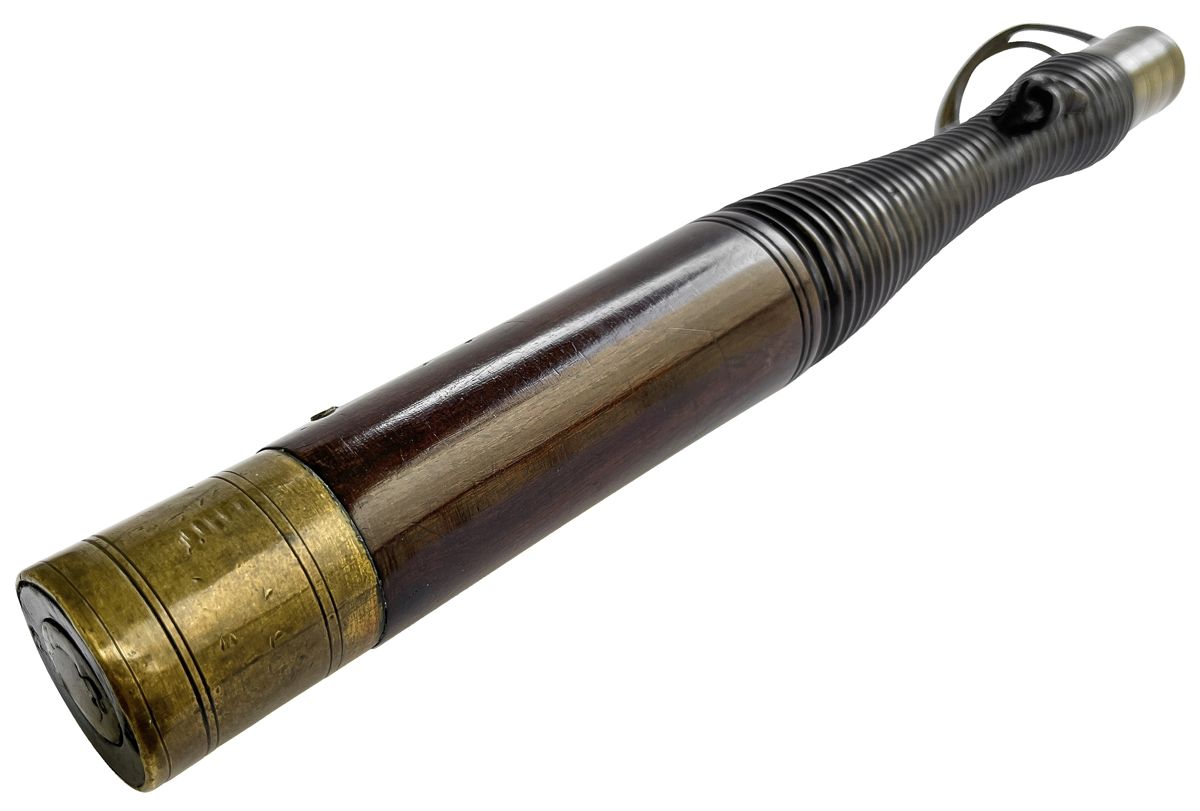
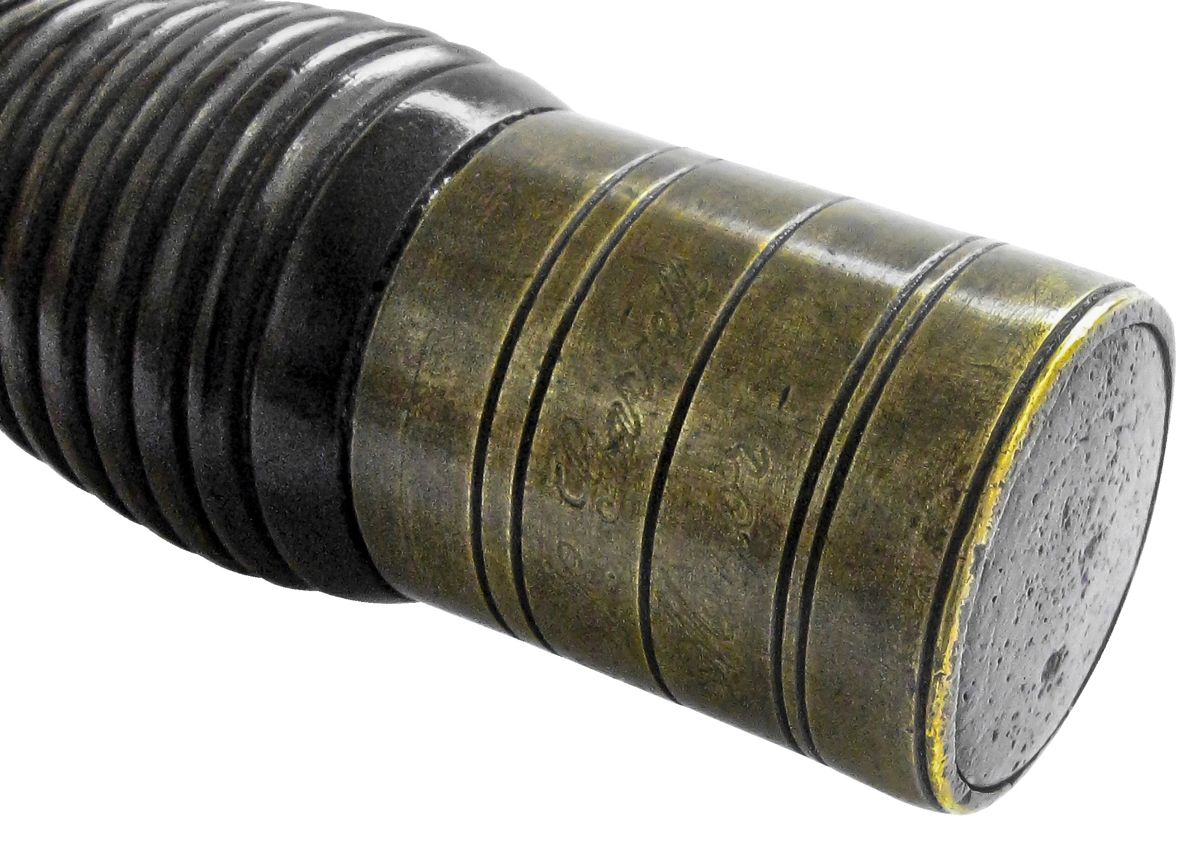
Among the most unusual personal weapons in the author’s collection is a compact hardwood club engraved “G. W. Garrett” and “Major.” The object is 12 inches long, weighs 11.9 ounces, and has a turned grip made of dense, dark wood, ring-decorated brass caps at both ends, and a leather lanyard passing through the grip end. The inscription attributes the club to Major George Washington Brooks Garrett, 23rd Mississippi Infantry Regiment, Confederate States Army.
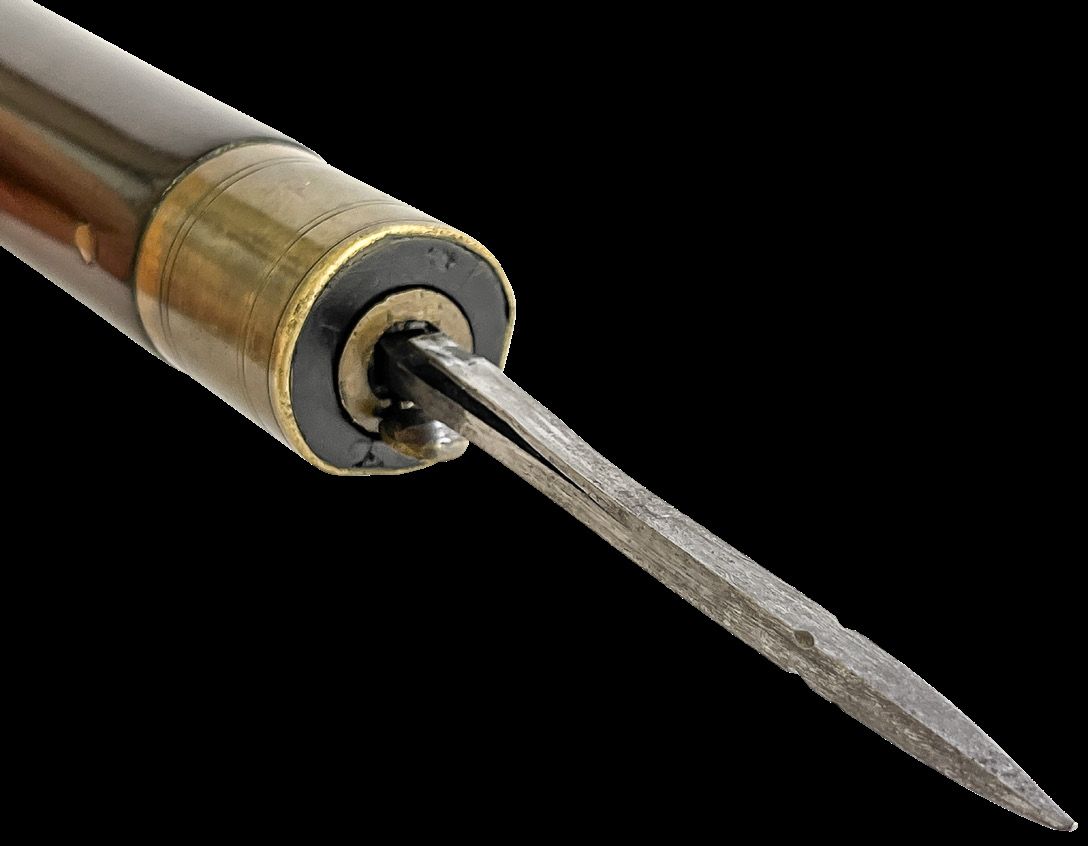
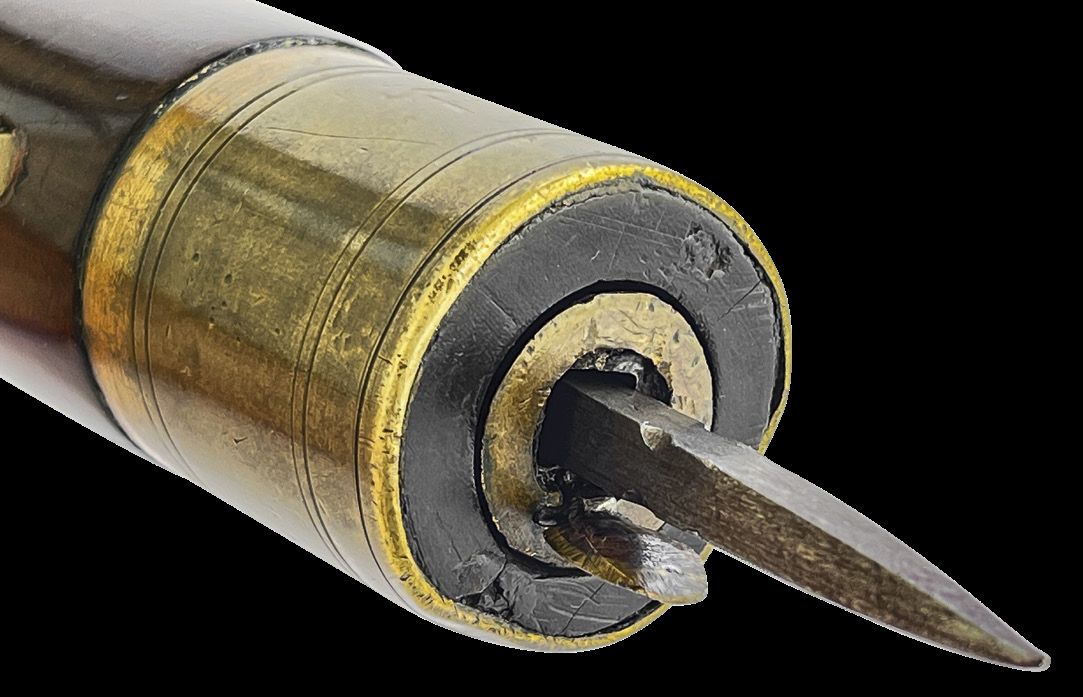
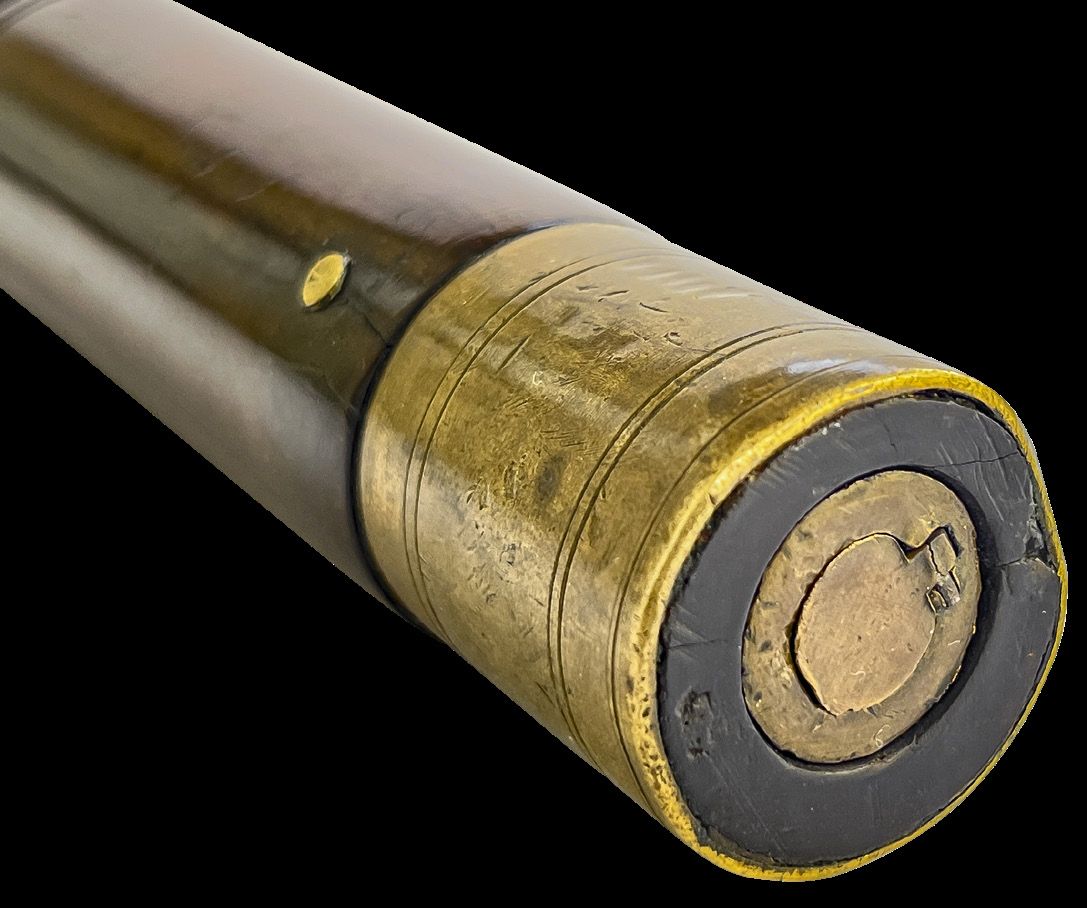
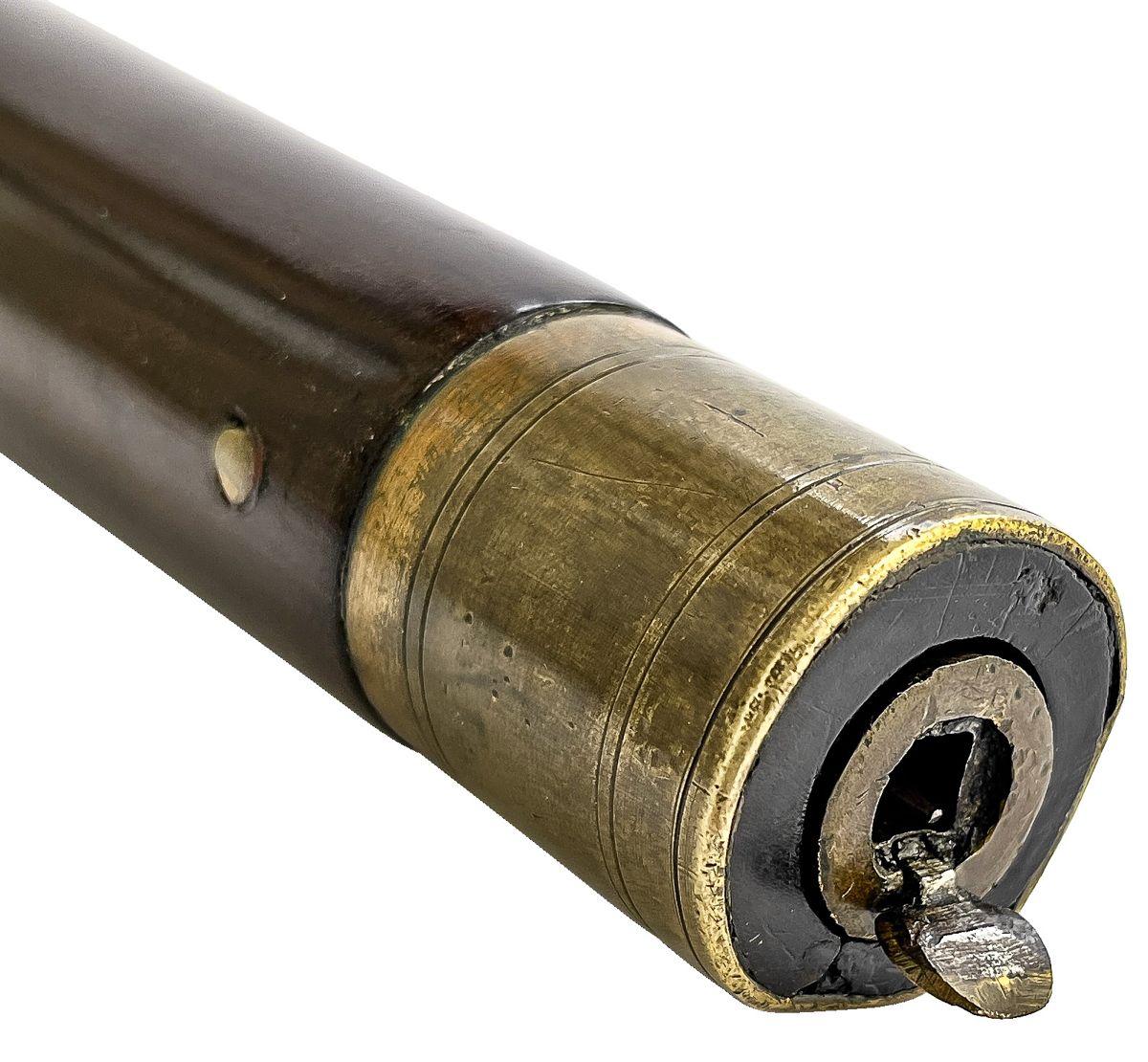
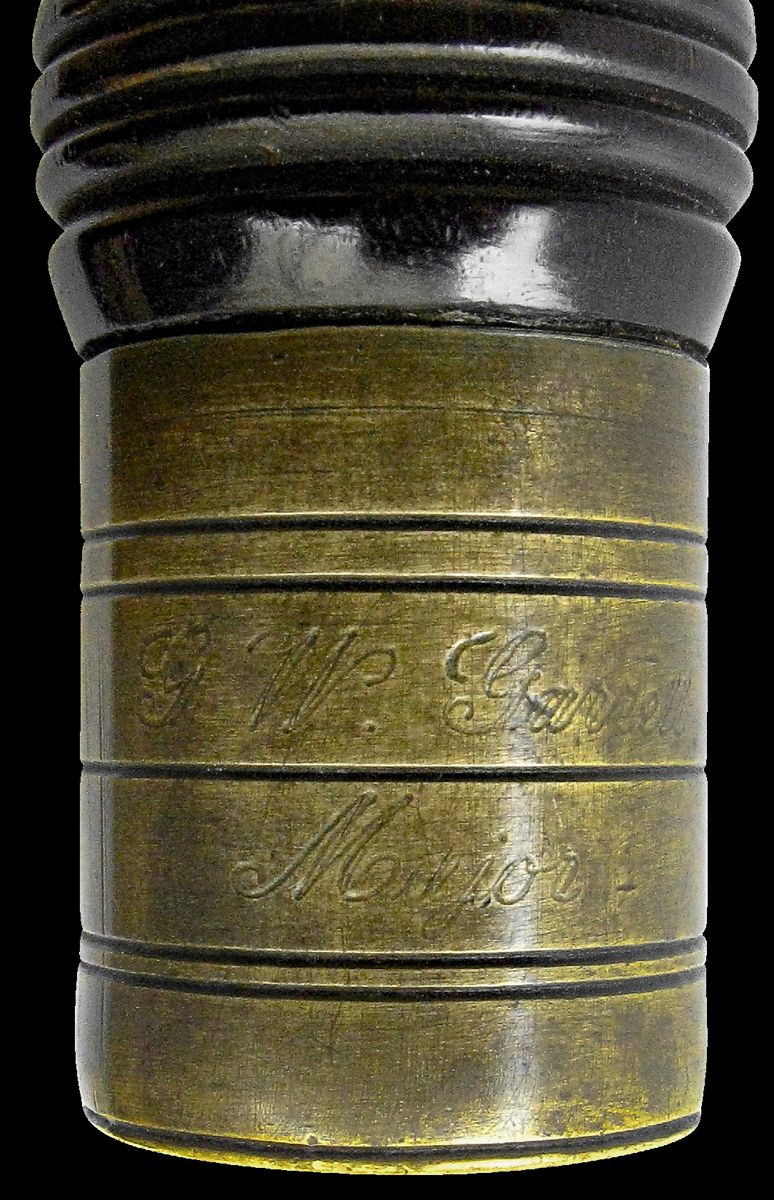
On closer inspection, this object is more than just a club. Its head conceals a lethal four-sided steel stiletto spike, four inches long, which is housed behind a brass trapdoor. Visible irregularities in the spike suggest hand-finishing. When deployed, the spike projects outward and locks in the extended position using a simple, yet precise mechanism. The lower brass cap is engraved in period copperplate script in two panels, separated by decorative ring grooves. The upper panel reads “G. W. Garrett,” and the lower panel reads “Major.” While the author has found a dozen or so men by this name in Union and Confederate military records dating from the club’s period of manufacture, which is from the late 1840s through the late 1860s, only one of these men achieved the rank of major. It is to him that this club is attributed, and his life and service are presented in this article.
Concealed-blade club attributed to Major G.W. Garrett: twelve inches overall, turned hardwood body, ring-decorated brass caps, leather lanyard, and concealed steel spike.
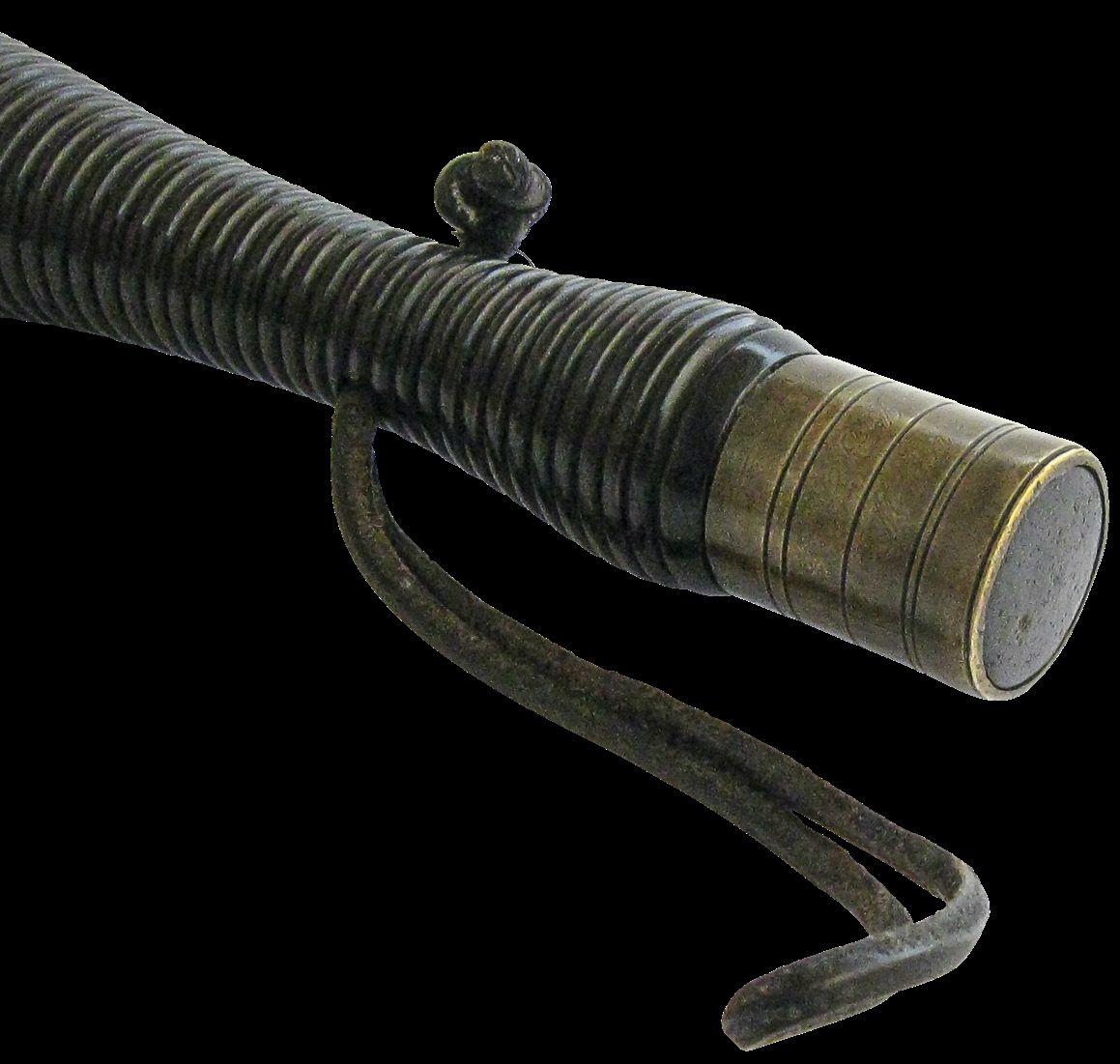
The blade-end brass cap with the trapdoor closed, left, and opened, right.
The approximately four-inch, four-sided stiletto spike in the deployed position.
The lower brass cap engraved “G. W. Garrett” and “Major.”
The Man: Major George Washington Brooks Garrett
George Washington Brooks Garrett served with the 23rd Mississippi Infantry Regiment through nearly every major campaign of the Western Theater, from the fall of Fort Donelson in February 1862 to the collapse of Hood’s Army at Nashville in December 1864. He commanded the regiment for the last two years of the war. The club, with its concealed blade, lanyard loop, and named engraving, belongs to the type of practical personal weapon that fighting men of the time kept close. It is compact and light enough for a coat pocket and was clearly made for a man such as the one whose name it bears, intended to be kept on his person.
George Garrett was born on March 5, 1840, in Union District, South Carolina, to Henry and Elizabeth Garrett. He shared, by an odd coincidence, the same birthday as his father, Henry, who was born in 1808. The family, part of the Scotch-Irish settler culture of the Carolina backcountry, relocated to Tippah County, Mississippi, in 1851 when George was 11.
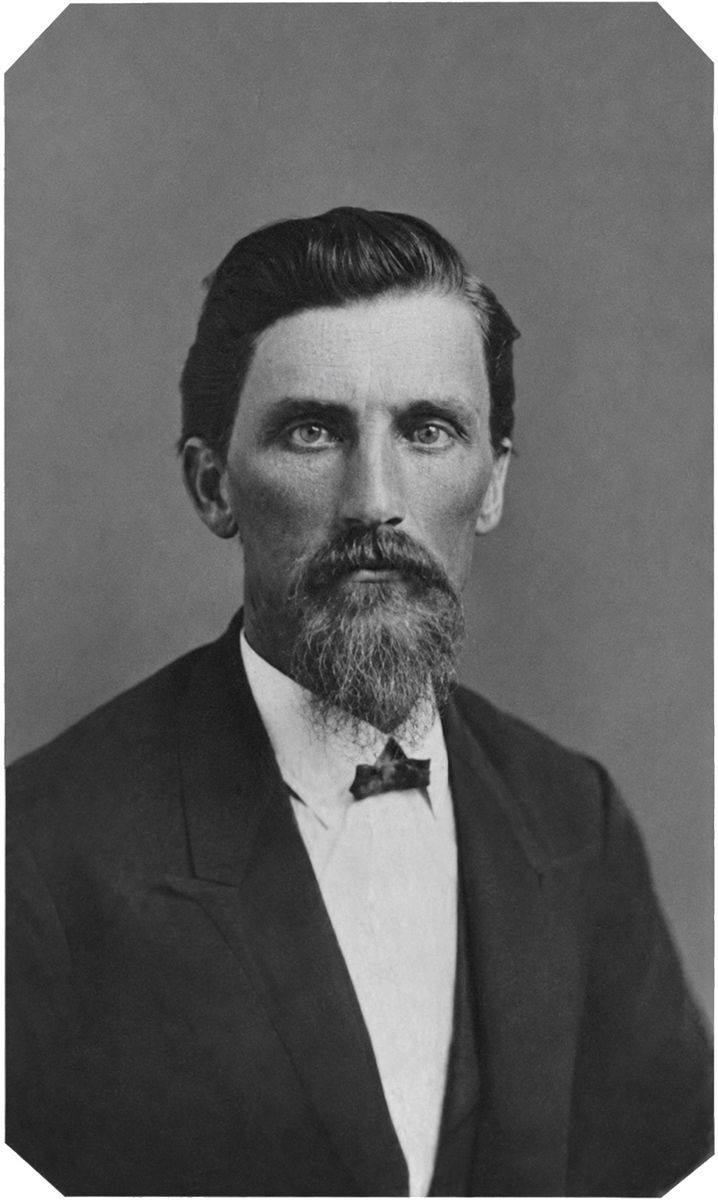
Major G. W. Garrett as a young man. Tintype, circa late 1860s–early 1870s. (Courtesy of the Battle of Franklin Trust.)
At age 16, George joined the Missionary Baptist Church. By 1860, he was 20 years old, working as a farmer in the same Tippah County community that would provide the young men who filled the ranks of his future regiment. When Mississippi seceded from the Union in January 1861, Garrett was farming in Tippah County. That August, he volunteered for military service in support of the Confederacy.
On August 24, 1861, he enlisted as a 2nd Lieutenant in Company C of the 2nd Mississippi Volunteers, known as the Tippah Tigers, part of the unit that became the 23rd Mississippi Infantry Regiment.
The regiment, which mustered in at Corinth, Mississippi, was composed of men from what are now Franklin, Tippah, Alcorn, and Monroe counties. It was transferred into Confederate service on September 19, 1861, and formally redesignated the 23rd Mississippi Infantry by Special Order No. 228 on November 19, 1861. The regiment’s roster reads like a catalog of the rural Mississippi world that this conflict would send into battle: the Blount Guards, the Kossuth Volunteers, and the Plentitude Invincibles. Garrett’s abilities were recognized quickly, and on November 19, 1861, within just three months of his enlistment, he was promoted to captain of the Tippah Tigers.
Fort Donelson, Johnson’s Island, and the Making of a Major
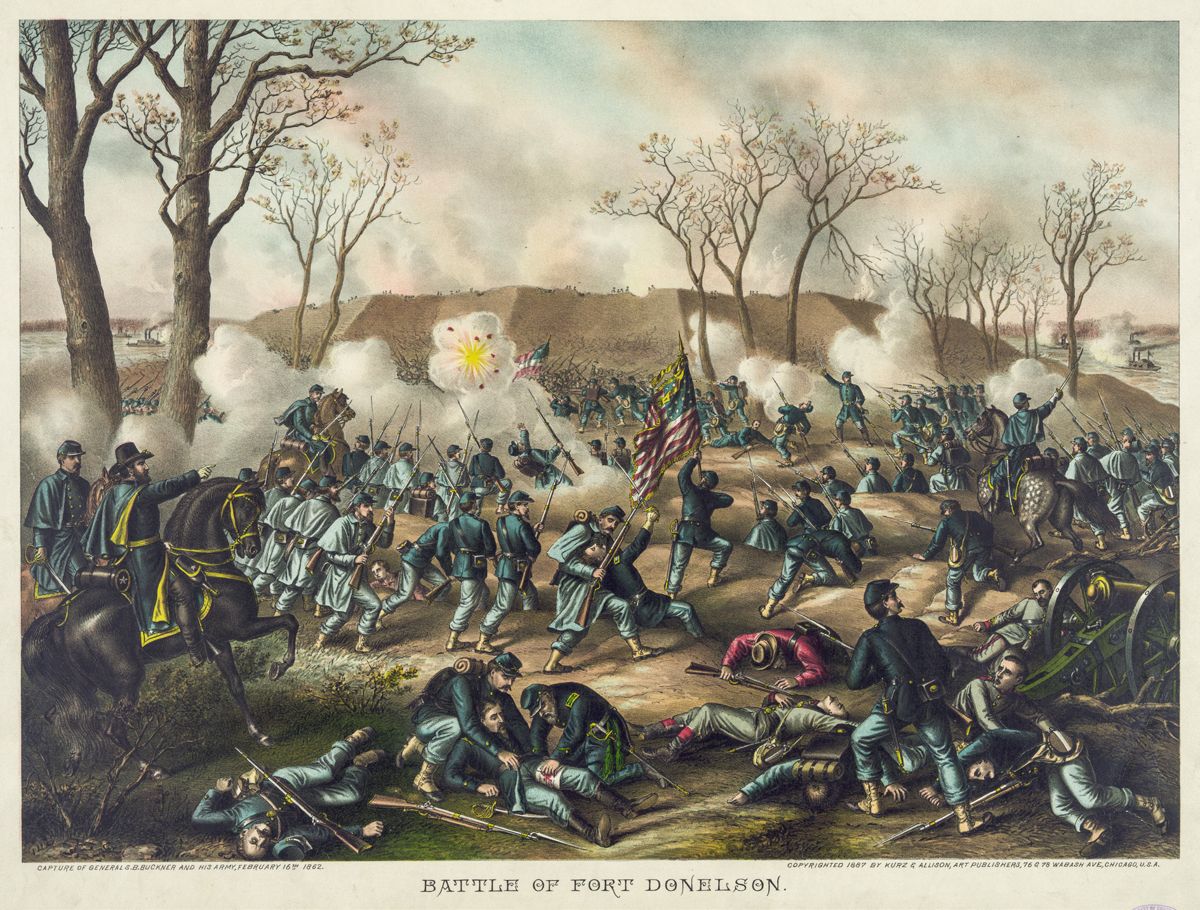
The 23rd Mississippi Infantry Regiment’s first notable engagement came in frigid weather in February 1862 at Fort Donelson on the Cumberland River in Tennessee, where it was deployed in perimeter defensive works. The Confederate command, divided among three brigadier generals, proved disastrous against Brigadier General Ulysses S. Grant’s advancing forces. While a breakout attempt on February 15 was briefly successful, it was squandered by command confusion, and on February 16, 1862, the fort’s garrison surrendered.
In the aftermath, more than 12,000 Confederate soldiers passed into captivity, including nearly the entire roster of the 23rd Mississippi, which suffered 5 killed and 46 wounded of the 546 men engaged. According to his wife, Garrett was nearly killed in this battle, when a ball cut across the top of his head, leaving him with a scar for life.
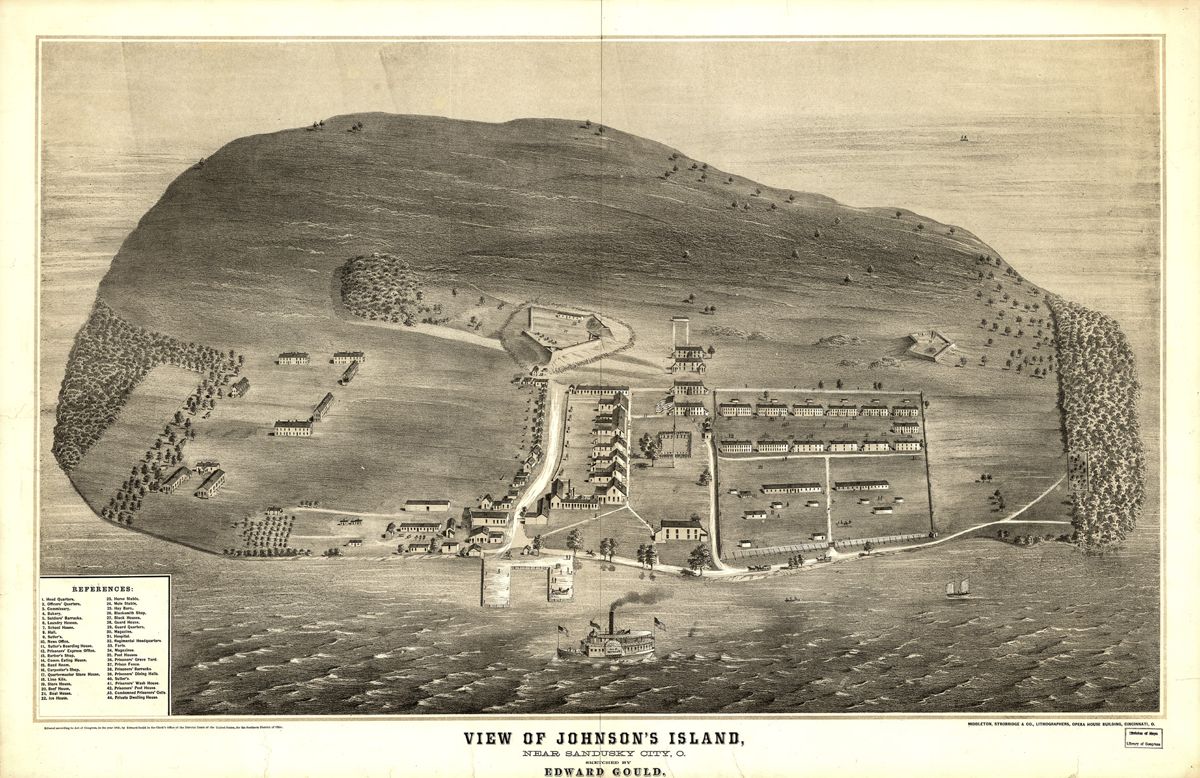
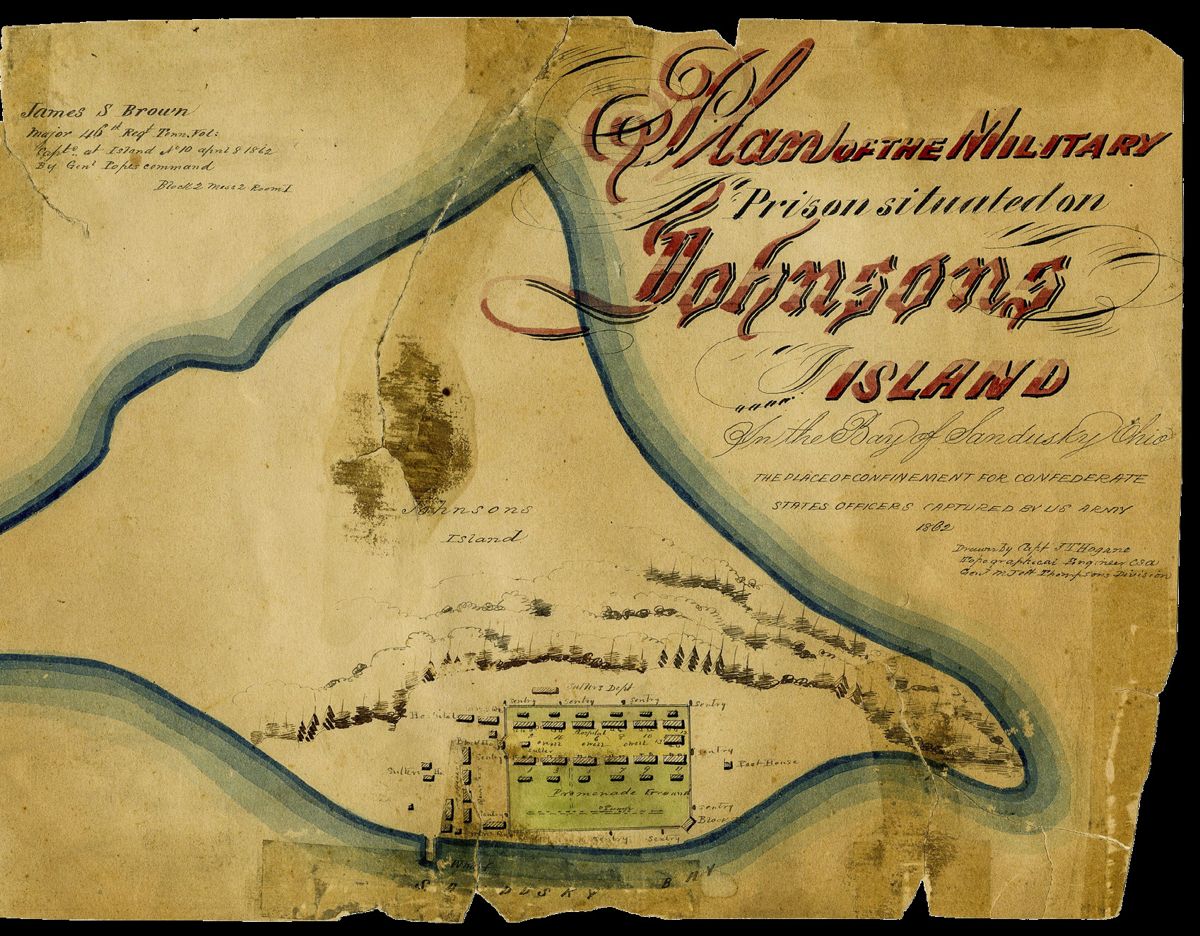
Of the regiment’s officers, Colonel Thomas J. Davidson was sent to Fort Warren in Massachusetts on April 16, 1862, where he died of acute diarrhea 13 days later. Garrett was received at Camp Chase, Ohio, on March 1 and transferred to Johnson’s Island, a Union prison camp near Sandusky, on April 17.
While he sat imprisoned behind the Johnson’s Island stockade, the Confederate Army promoted Garrett to Major on April 24, 1862, a promotion during imprisonment that attested both to the man’s abilities and to the attrition that had stripped the regiment of its senior officers. When Garrett was exchanged at Vicksburg on September 1, 1862, the exchange papers recorded his physical description: 5 feet 8 inches, light hair, light complexion, and blue eyes. He was just 22 years old and had already spent more than six months as a prisoner of war. It is in this context that the club deserves particular attention. A man who experienced war, was captured at gunpoint, and then imprisoned, had every reason to carry a weapon such as this club after captivity: hidden on his person and ready to be deployed at a moment’s notice.
Garrett’s service record where he is promoted to captain on Nov. 19, 1861. (NARA)
Battle of Fort Donelson—Capture of General Simon B. Buckner and His Army, February 16, 1862, Kurz & Allison, 1887. (Library of Congress)
View of Johnson’s Island, near Sandusky City, Ohio, sketched by Edward Gould and published by Middleton, Strobridge & Co. (Library of Congress)
Garrett Takes Command: From Champion Hill to Atlanta
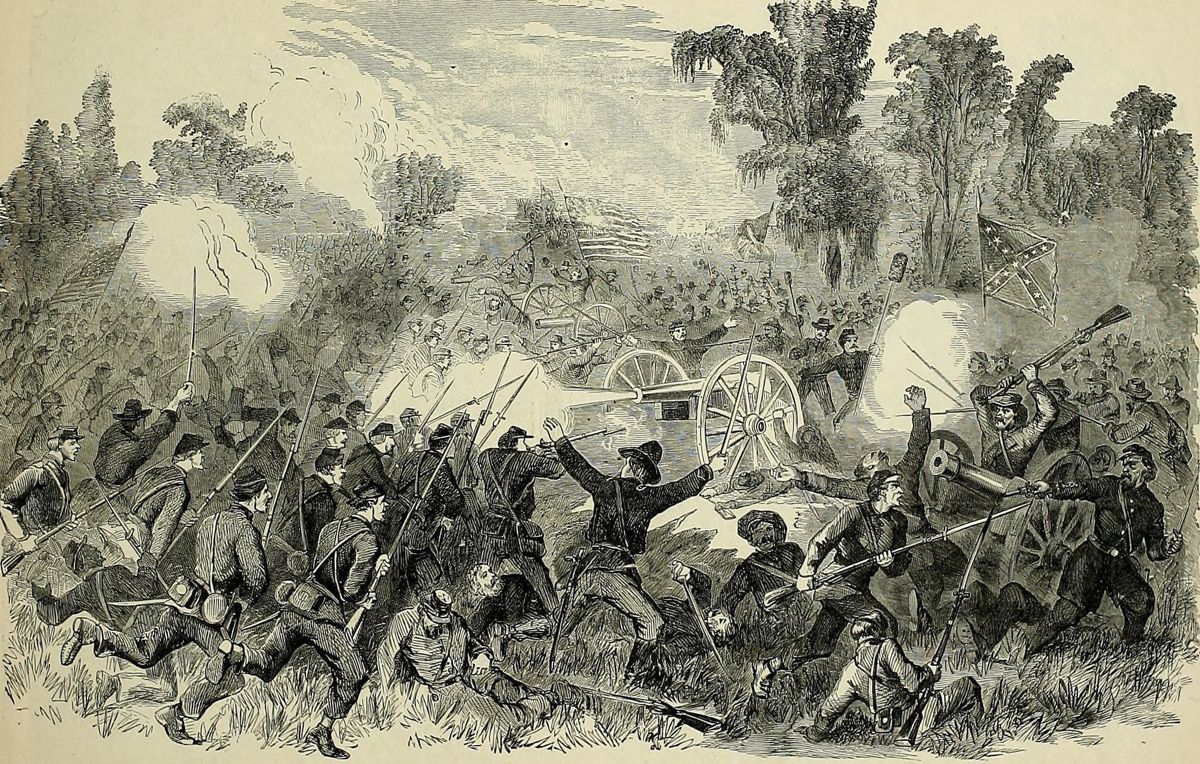
The reconstituted 23rd Mississippi returned to active service in late 1862, assigned successively to brigades under Brigadier General William E. Baldwin and then Lloyd Tilghman, in the Department of Mississippi and East Louisiana. A few short months later, at the Battle of Champion Hill on May 16, 1863, in what was one of the most decisive actions in the Western Theater of the Civil War, the Confederate Army under Lieutenant General John C. Pemberton retreated toward Vicksburg.
In the ensuing chaos, Major General William W. Loring’s Division, which included the 23rd Mississippi, found itself cut off from the retreat route. General Loring did not want to force a desperate passage through converging Union forces, nor did he want to be trapped inside Vicksburg’s doomed defenses. As such, Loring marched eastward, away from the city, ultimately operating independently of Pemberton’s besieged army and later rejoining Confederate forces under General Joseph E. Johnston. Because of General Loring’s controversial maneuver, when Vicksburg fell on July 4, 1863, the 23rd Mississippi was not among the 30,000 Confederate soldiers who surrendered there. Major Garrett’s regiment thus escaped the trap and remained in the fight.
As the war ground on, the 23rd Mississippi steadily lost its senior officers. Lieutenant Colonel Moses McCarley was captured while on medical leave in June 1863 and shipped to Johnson’s Island, and Colonel Joseph M. Wells, in failing health, was no longer able to take the field. From the summer of 1863 onward, command of the regiment rested in practice with Major Garrett—including through the whole of the grueling Atlanta Campaign of 1864 and its battles at New Hope Church, Peach Tree Creek, Ezra Church, and Jonesboro. Wells formally resigned on September 3, 1864, as the campaign drew to a close.
A January 1864 listing of Adams’s Brigade, Loring’s Division, reprinted in the Clarion-Ledger’s “This Week in 1864,” recorded simply: “23rd, Maj. G.W.B. Garrett.” Garrett’s wife, Elizabeth, later wrote that “[h]e was the only regimental officer on the field most of the time,” and that his men respected both his conduct in battle and his efforts to secure their rations.
The Georgia campaign was hard on Major Garrett. According to his wife’s memoir, he sustained multiple wounds: a gunshot passed through his leg above the knee, leaving scars on both the front and back, and he was also hit in the foot and ankle. On another occasion, a partially spent ball struck his chest, forcing him to double over, at which point word quickly spread along the line: “Our Major is shot!” The sight of Major Garrett going down raised the risk of panic, especially since no other regimental officer was immediately available to assume command, but as soon as he was able to do so, Garrett reassured his men that he was still alive. By the time the Confederate Army turned north in the autumn of 1864, Major Garrett, the only regimental officer regularly present for duty, was leading a force that had fought itself down to a shadow of its previous strength.
Battle of Baker’s Creek (Champion Hill), May 16, 1863, engraving after sketches by Edwin Forbes, Alfred Waud, and James E. Taylor, published in The Soldier in Our Civil War.
Franklin, Nashville, and Second Capture
On November 30, 1864, Confederate General John Bell Hood, commanding the Army of Tennessee, ordered a massive attack against well-defended Union positions commanded by Major General John M. Schofield. Some 20,000 Confederate soldiers marched across nearly two miles of open ground before engaging the Federal troops in desperate hand-to-hand combat. During this action, known as the Battle of Franklin, the 23rd Mississippi advanced as part of Brigadier General John Adams’s Brigade, in the division of Major General William W. Loring.
Major Garrett commanded the 23rd, which was at first held in reserve, behind the front two brigades. The Major and his men were positioned near a stone fence on the edge of John McGavock’s property (Carnton plantation), approximately 200 yards from the Federal earthworks. When the Union defense line was breached near the Carter farm, General Adams moved his brigade toward the gap and ordered, “Move forward, Major Garrett!” Although Garrett and his men attacked with great courage, they were beaten back, and many died in the ensuing carnage. Six Confederate generals were also killed or mortally wounded that afternoon, including General John Adams. Although Major Garrett survived, that day brought him personal grief of another kind: among the Confederate dead at Franklin was his own brother, William Roy Garrett, serving in Co. K of the 6th Arkansas Infantry. William was later buried at McGavock Confederate Cemetery, Franklin, Tennessee.
Just two weeks later, at Nashville on December 15, 1864, Garrett again commanded the 23rd Mississippi southwest of Belmont College, near the Granny White Pike, which ran north-south through what is now the southern part of Nashville. He had two guns of the Pointe Coupée Artillery attached to his line, as he occupied ditches on the east side of a ridge facing Union forces. In the tense, quiet moments before the fighting began, Louisiana French Creoles were preparing to bleed alongside Mississippi farm boys in one of the last major battles of the war in the Western Theater. Major Garrett’s orders were to hold the position at all hazards.
As Union forces enveloped his position from three sides, Garrett asked his men to remember Franklin and to hold their fire until the enemy came very close, then addressed them:
I have been with you in many battles, and have ever found you at your places ready for duty as courageous soldiers. Let this day add fresh laurels to the fame of the 23d Mississippi.
Plan of the Military Prison Situated on Johnson’s Island, drawn by Capt. James T. Hogane, C.S.A., 1862. Tennessee State Library and Archives.
The men did their duty well, as testified by the many Union dead and wounded in front of them. As for the Federal forces, they fought with equal courage, but Garrett later reported that their fire was not accurate. Garrett later recalled that when about two Union regiments passed around his left and to his rear, their commanding officer ordered him to raise a white flag. Garrett replied that his regiment had none. It made no difference; he was already surrounded.
Major Garrett surrendered for the second and final time in the conflict that he and his men called the War for Southern Independence. He was then shipped back to Johnson’s Island in a horse car that had not been mucked out, with no place to sit or lie except in the filth. This time, Garrett arrived on the island in the dead of winter on December 20, 1864, and he would not be released until July 25, 1865, nearly three months after the war ended. His wife’s memoir records that the Major’s second imprisonment, endured through a frigid Lake Erie winter, reduced him severely. Although he was reportedly not sick a day in captivity, Garrett entered the camp weighing approximately 165 pounds and emerged weighing just over 90 pounds.
Coming Home and the Postwar Years
When Major Garrett was paroled from Johnson’s Island on July 25, 1865, he was 25 years old, twice a prisoner, and had lost his brother at the Battle of Franklin. He spent the better part of four years at war and came home with almost nothing, except hope for a better future.
On January 9, 1866, Garrett married Elizabeth Jane Bouton in Tippah County, Mississippi. The family memoir records that during his second captivity on Johnson’s Island, using only a pocketknife, he handcrafted a ring for his future wife from a button, a silver dime, a pearl from Lake Erie, and the gold from his coat insignia. That he made such a ring reveals much about the character of this resourceful young man: he had the patience and skill to make something meaningful from very little indeed.
After the Civil War, the Major built a prosperous life. He did so, as his wife later recalled, reflecting the political sentiments of the postwar South, “[w] ith a brave heart, with cheerfulness, with wonderful perseverance … [building] a life of hard work and strict economy in a country devastated by fire and sword and pillage, plundered and robbed of everything which the Federals would have, ground down under carpetbag dominion by our enemies.”
True to his wife’s words, Garrett first engaged in farming after his father gave him some land, before going on to establish several successful commercial enterprises. In October 1899, he began constructing a permanent home on the crest of Fort Robinett hill in Corinth, Mississippi, the site of a Union artillery redoubt from the 1862 Battle of Corinth. A Confederate officer had chosen to build his home on ground the Federals once fortified.
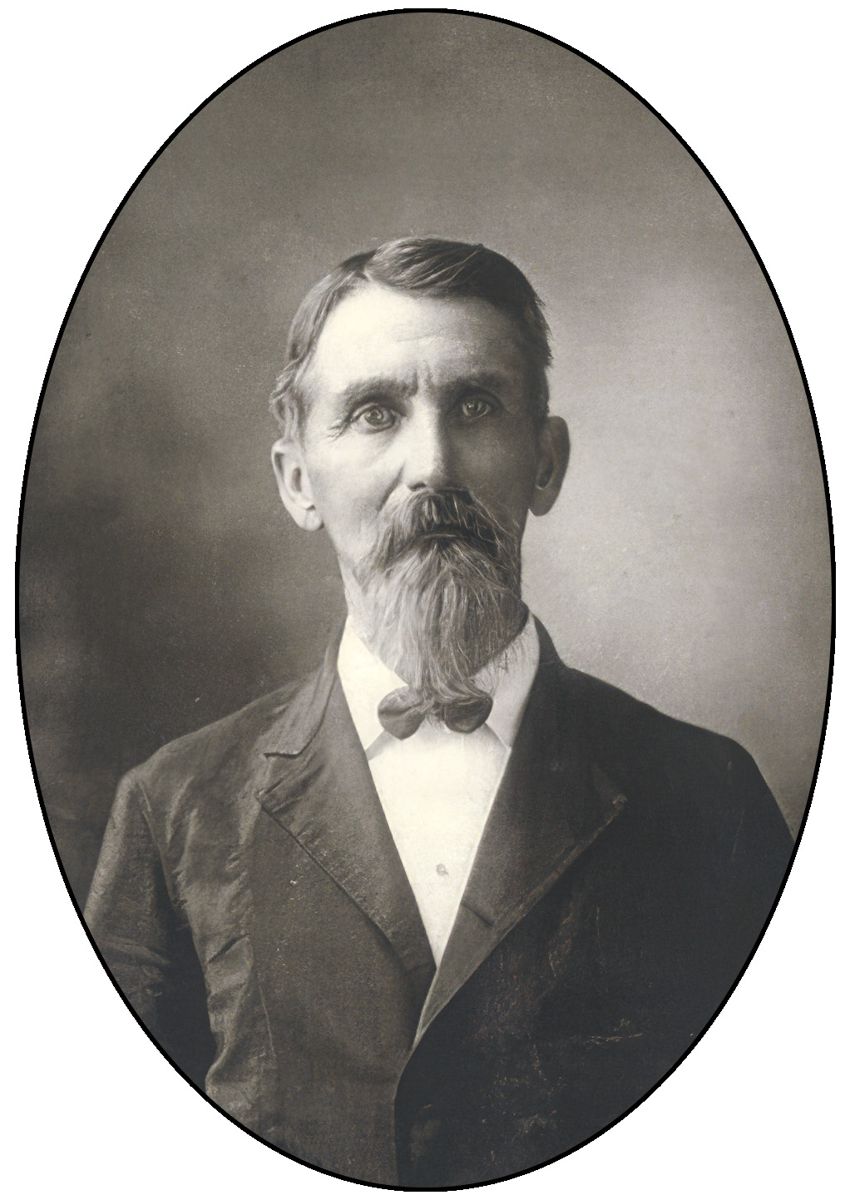
Major G. W. Garrett in later life, circa 1880s–1890s. (Find a Grave, memorial no. 9791796.)
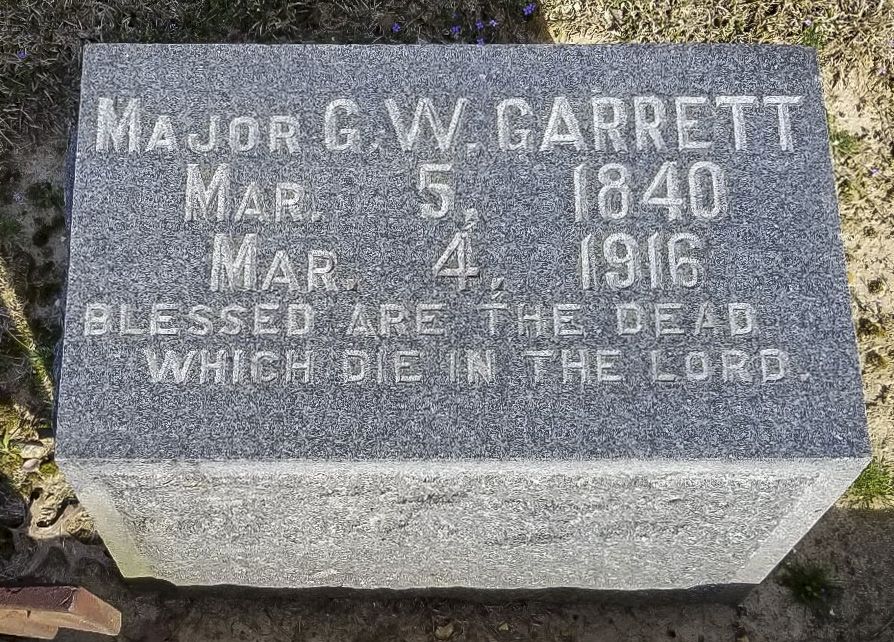
Gravestone of Major G. W. Garrett, Henry Cemetery, Corinth, Mississippi. (Find a Grave, memorial no. 9791796.)
Major G. W. Garrett lived a good life after the war, and he did not forget his years of service. Even as a civilian, as late as August 1898, 33 years after Appomattox, he was still drilling 700 Confederate veterans at the Tippah County Camp reunion at Chalybeate Springs. Garrett died in Alcorn County, Mississippi, on March 4, 1916, one day before his 76th birthday, and was interred at Henry Cemetery in Corinth, Mississippi.
The Name on the Brass Cap
The engraving on the club reads “G. W. Garrett / Major,” and not G.W.B. Garrett or George Washington Brooks Garrett. Although the middle initial is absent, this is consistent rather than anomalous. Garrett’s gravestone, his 1910 account in Confederate Veteran, and many other wartime records all bear the name simply as “G. W. Garrett.” The club’s engraver used the form Major Garrett himself used.
Major Garrett experienced brutal war firsthand. Promoted at 22, he is described in John C. Rigdon’s regimental report as one of the youngest Confederate majors. He fought in hand-to-hand combat again and again, and undoubtedly needed a small and lethal weapon such as this stiletto club when his bullets ran out.
The stiletto spike, the locking mechanism hidden within this club, and the fitted brass trapdoor all point to the work of someone who had the patience and skill to work metal. Whether Major Garrett had this stiletto spike made professionally, or whether he had a hand in crafting it, we do not know. What we do know is this: according to his wife’s memoir, with no tools beyond a prisoner-of-war’s pocketknife, Garrett fashioned a wedding ring from a button, a silver dime, a lake pearl, and some gold taken from his coat insignia. A man capable of such fine work is also capable of fabricating a stiletto spike and fitting it inside a club.
Sources:
• American Battlefield Trust. “Champion Hill.” Accessed March 23, 2026. https://www.battlefields.org/learn/civil-war/battles/champion-hill.
• Battle of Franklin Trust. “The Battle of Franklin.” Accessed March 23, 2026. https://boft.org/history.
• Battle of Franklin Trust. “Garrett, George W. B., Major, 23rd Mississippi Infantry, CS.” Compiled Confederate military service records fact sheet, 2021. Accessed March 23, 2026. https://static1.squarespace.com/static/575ad69260b5e91314f0c856/t/615c72d3cda4e902984d7d10/1633448693793/_Garrett%2C+George+W.B.+Major%2C+23rd+Miss+Inf%2C+CS.pdf.
• [Confederate veterans meeting, Chalybeate Springs, Tippah County]. Commercial Appeal (Memphis, TN), August 21, 1898, 8.
• Fleming, Dale, and Pearl Fleming. “This Week in 1864.” Clarion-Ledger (Jackson, MS), January 19, 1964, 15.
• Garrett, Elizabeth Jane Bouton. “A Brief Biography of Major G. W. Garrett Written for His Children by His Wife.” Undated manuscript, ca. 1890s–1910s. Accessed March 23, 2026. https://www.msgw.org/confederate/garrett.htm.
• Garrett, G. W. “The First Day’s Battle at Nashville.” Confederate Veteran 18 (1910): 470–71.
• [Garrett Fort Robinett Residence Notice]. Weekly Corinthian (Corinth, MS), October 25, 1899, 8.
• “George Washington Brooks Garrett.” Find a Grave. Memorial no. 9791796. Accessed March 23, 2026. https://www.findagrave.com/memorial/9791796/george_washington-brooks-garrett.
• Goodspeed Publishing Company. “Biographical Sketches—Hardeman County.” In History of Tennessee, from the Earliest Time to the Present. Chicago: Goodspeed Publishing Co., 1887. Transcribed by David Donahue. Accessed March 23, 2026. https://www.tngenweb.org/goodspeed/hardeman/#garrett.
• McDonough, James Lee, and Thomas L. Connelly. Five Tragic Hours: The Battle of Franklin. Knoxville: University of Tennessee Press, 1983.
• Rigdon, John C. “Report of the 23rd Mississippi Infantry Regiment.” In MTS Regiment Reports, 76. Compiled from the Official Records, compiled Confederate service records, and Confederate Veteran. N.p., n.d.
• Schenawolf, Harry. “Loaded Cane—How Revolutionary War Officers and Gentlemen Protected Themselves from Drunken Soldiers and Muggings.” Revolutionary War Journal, June 28, 2019. https://revolutionarywarjournal.com/loaded-cane-how-revolutionary-war-officers-andgentlemen-dealt-with-drunken-soldiers-and-riff-raff/.
• “William Roy Garrett.” Find a Grave. Memorial no. 6562344. Accessed March 23, 2026. https://www.findagrave.com/memorial/6562344/william-roy-garrett.
• Wynne, Ben. “Battle of Champion Hill.” Mississippi Encyclopedia. Center for Study of Southern Culture, July 10, 2017. https://mississippiencyclopedia.org/entries/battle-of-champions-hill/.
About the Author Ori Ben-Chorin is a retired management consultant and an avid collector of antique guns and edged weapons. He received his B.S.B.A. from Boston University’s School of Management and his J.D. from American University in Washington, DC. The author would like to thank Charles Pate and Timothy Hedley for their assistance.
Historical images: Public Domain. · Club photographs: Author’s Collection.