
A Colt for a Gentleman of Lima. The Nimschke-Engraved, Thuer-Converted Model 1862 Police Revolver
By Jack W. Melton Jr. · Originally published November-December 2026 · pp. 64–70
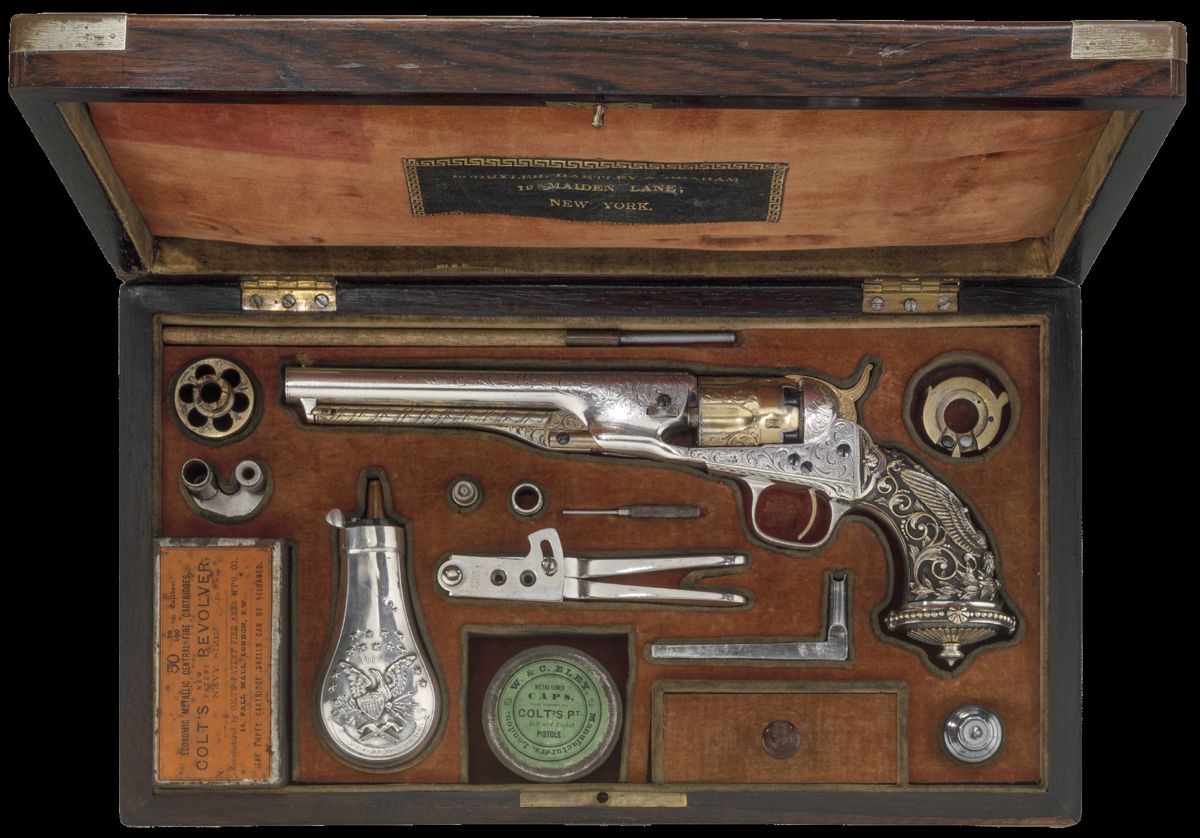
Every so often a gun comes along that stops even a seasoned collector in his tracks. The cased Colt Model 1862 Police revolver, serial number 9174, in the Arms and Armor collection of the Metropolitan Museum of Art is one of those guns.1 It is silver-plated and gold-washed, engraved from the muzzle back to the hammer, fitted with a cast metal grip that belongs as much to the world of Victorian sculpture as to the gun trade, and inscribed to a gentleman of Lima, Peru. It also wears Colt’s Thuer cartridge conversion, patented by F. Alexander Thuer in 1868, which means this one revolver manages to tell the story of the New York luxury arms trade, the most celebrated engraver in American firearms history, and Colt’s awkward first steps into the metallic cartridge era, all in a rosewood case measuring just 15 x 9 inches.
The House on Maiden Lane
To understand the gun, one has to start with the retailer. Schuyler, Hartley and Graham was organized on March 1, 1854, at 13 Maiden Lane in New York City by Jacob Rutsen Schuyler, Marcellus Hartley, and Malcolm Graham. Soon after the firm opened its doors, Schuyler and Hartley sailed for Europe and spent about four months buying stock and establishing relationships with manufacturers and wholesalers, relationships the firm would draw on for decades. The gamble paid off handsomely, and by 1860 Schuyler, Hartley and Graham had become the largest firearms dealer in the United States, operating stores at 19 Maiden Lane and 22 John Street by 1861.2 During the war Hartley was appointed the special and confidential agent of the United States Government for the purchase of arms in Europe, a job he began in July of 1862, and after the war the partners went on to found the Union Metallic Cartridge Company and eventually to control E. Remington and Sons. That is a story for another day. What matters here is the retail floor, where displays of engraved Colts hung alongside officers’ uniforms, dress swords, and every other article of military finery a gentleman with money could want. The trade label sewn into the lid of this case carries the 19 Maiden Lane address.
The complete cased set, accession number 1985.264a-r. The Schuyler, Hartley and Graham trade label at 19 Maiden Lane, New York, is sewn into the lid. Note the Thuer conversion cylinder at upper left, the Thuer conversion ring at upper right, and the London-made box of fifty Thuer cartridges at lower left. (The Metropolitan Museum of Art, New York, Gift of Mr. and Mrs. Jerry D. Berger, 1985)
Nimschke
Louis Daniel Nimschke was born on July 4, 1832, at Ebersdorf in the little Thuringian principality of Reuss, and like so many of the German craftsmen who shaped the American arms trade, he came up through the rigorous German trade school tradition before emigrating to the United States in 1850 at the age of eighteen. He started out engraving jewelry, silverware, and watch cases in New York.3 Nimschke had his own shop in New York City and took work on a contract basis, and his best customer, by a wide margin, was Schuyler, Hartley and Graham. Over a career that ran from about 1850 until his death in Brooklyn in 1904, he decorated something on the order of 5,000 firearms for more than 100 makers and dealers, and his client list ran from George Armstrong Custer and Buffalo Bill Cody to Napoleon III.4
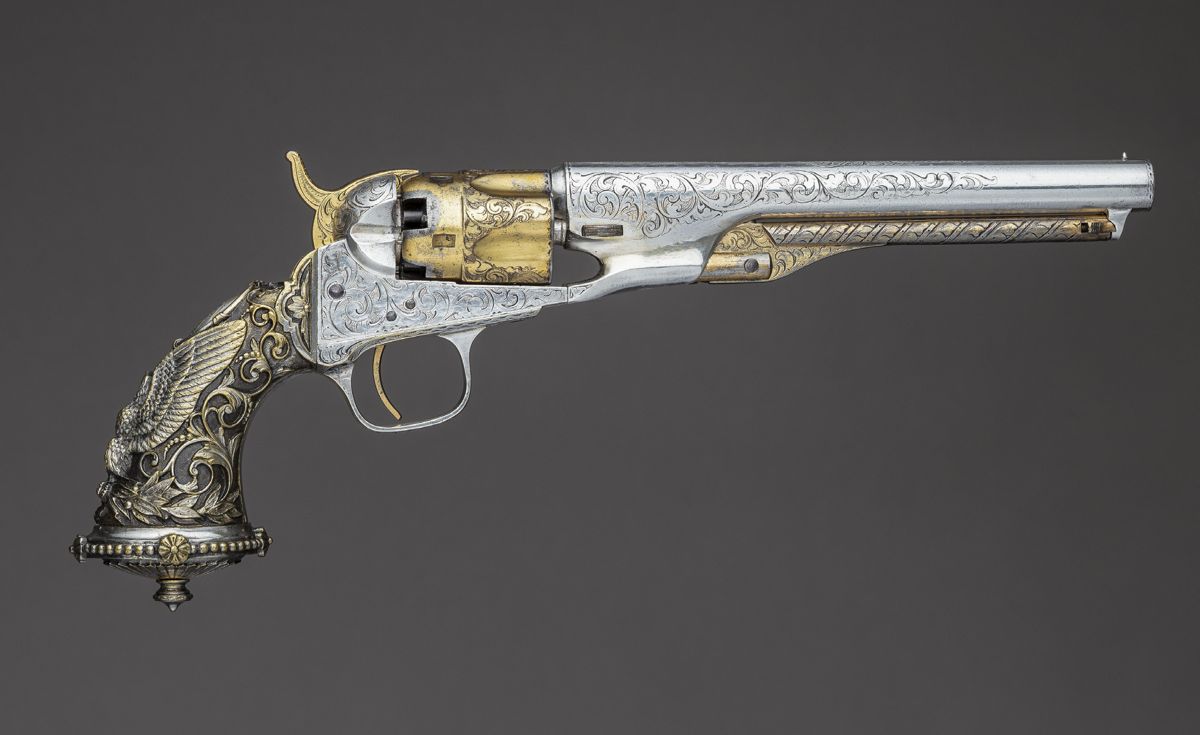
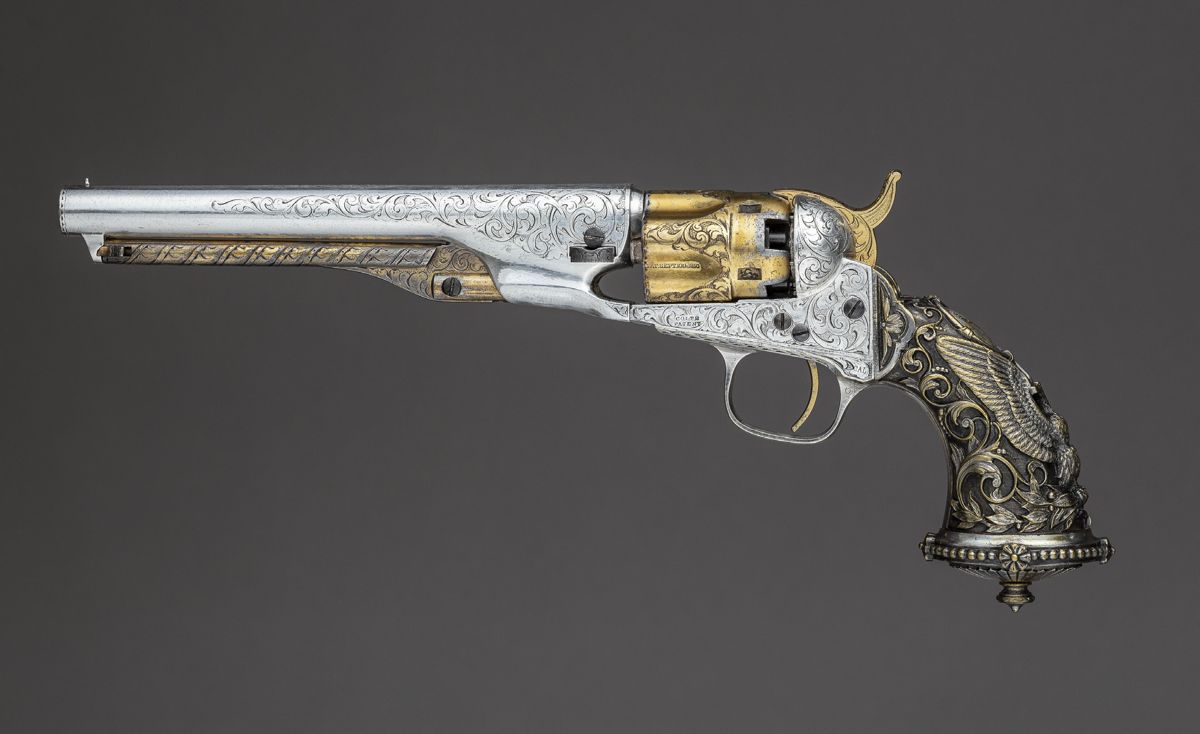
Nimschke only occasionally signed his work, which would make attribution a guessing game were it not for the remarkable record book he kept, a workbook filled with hundreds of inked impressions, called pulls, taken directly from the guns as he finished them. R.L. Wilson published the record in 1965 as L. D. Nimschke, Firearms Engraver, and the workbook itself, along with a set of sixty-two of his engraving tools, now resides at the Metropolitan Museum as well.5 His style, broad open scrollwork with rounded terminals against a punch-dot background, became so widely imitated that collectors simply call it the New York style, or the Nimschke school. The engraving on serial number 9174 is attributed to Nimschke rather than documented, which is the case with the bulk of his output, but the flowing scroll coverage running the full length of the round barrel, over the frame, loading lever, and backstrap, and across the rebated cylinder is textbook New York work of the highest grade.
The Grip
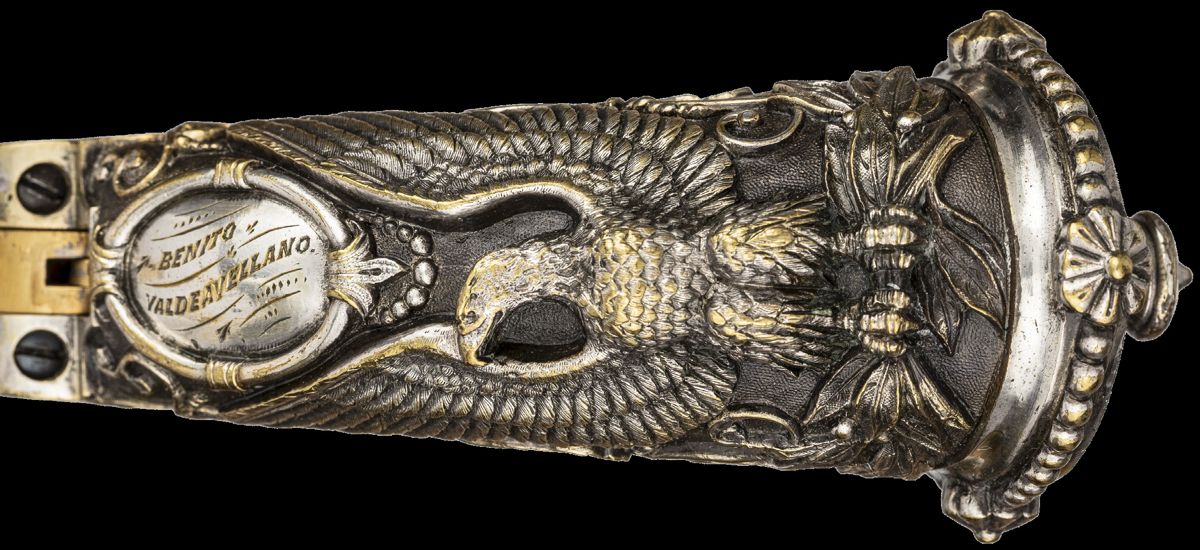
As fine as the engraving is, the grip stops most people cold. The entire one-piece grip is cast metal, modeled in high relief with a spread-winged eagle grasping a serpent, surrounded by scrolling foliage and laurel, above a beaded pommel cap with a rosette and pendant finial. An oval escutcheon on the backstrap side is engraved with the owner’s name in flowing script: BENITO VALDEAVELLANO. Collectors have long lumped these cast relief grips together under the label of Tiffany grips, because Tiffany & Company retailed similar patterns on deluxe revolvers, but Schuyler, Hartley and Graham offered them as well; the firm’s 1864 catalog listed “Style 422, Colt’s New Model, 5 ½ inch, engraved bronzed handle, plated and gilt.”6 Exactly who modeled which pattern is a question collectors still argue about, and the honest answer is that the record is thin. In this instance, the Metropolitan attributes the cast metal grip to the sculptor Charles L. H. Muller, a German-born artist who, like Nimschke, emigrated from the old country, worked in New York, and took commissions from the Maiden Lane trade. Muller was born at Coblenz in 1820 and died in New York in 1887, and frustratingly little else has been published about him, a gap that awaits some enterprising researcher in this hobby.7
The cast metal grip in detail. The oval escutcheon is engraved BENITO VALDEAVELLANO, and the spread-winged eagle grasping a serpent rises above laurel and a beaded pommel cap.
Right side of the revolver. The half-fluted, rebated five-shot cylinder identifies the Police pattern at a glance.
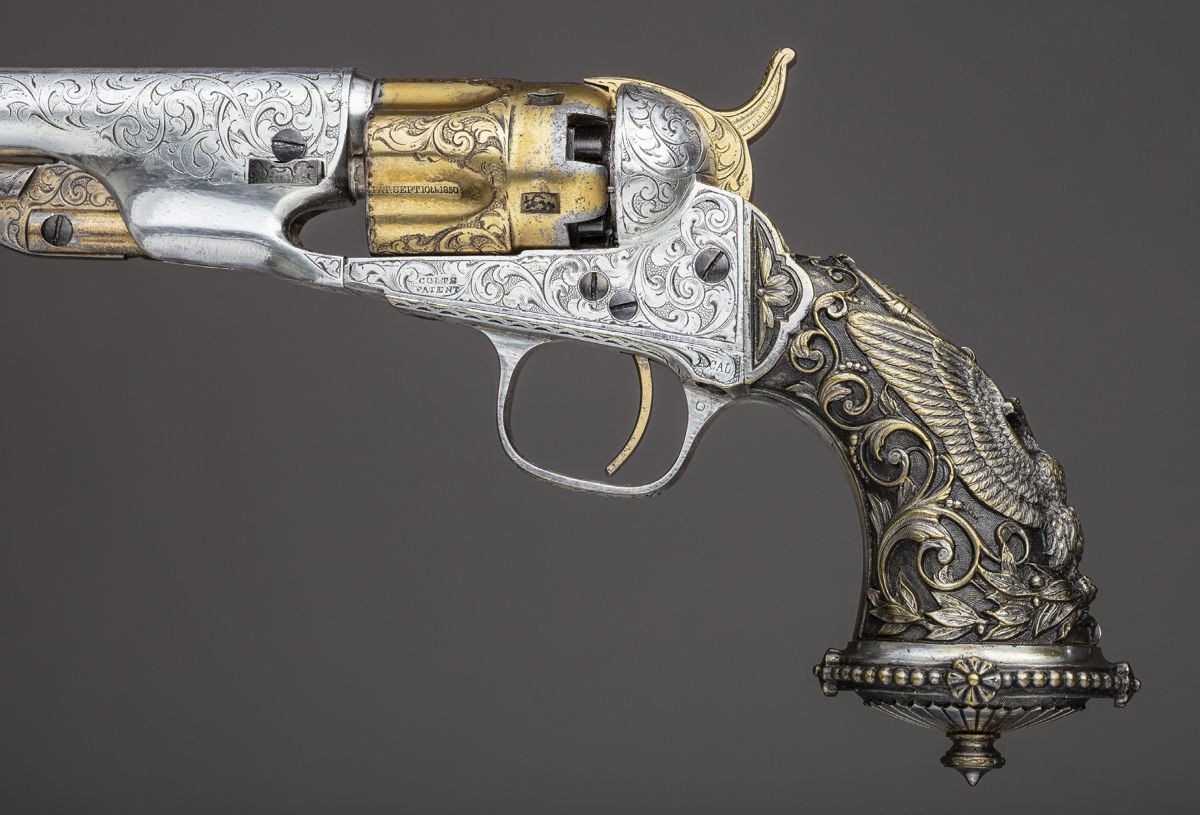
Left side of the Model 1862 Police revolver, serial number 9174, showing the New York style scroll engraving attributed to Louis D. Nimschke and the cast relief grip attributed to the sculptor Charles L. H. Muller.
The Revolver Underneath
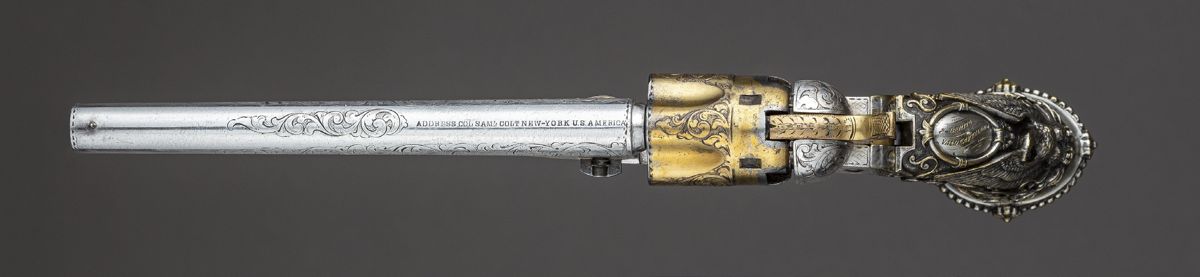
Strip away the silver, the gold, and the sculpture, and the platform underneath is one of the more interesting revolvers of the percussion era in its own right. In 1861, Colt introduced two new pocket-sized revolvers in the more potent .36 caliber, the Model 1862 Police and the Model 1862 Pocket Navy, and despite the model designations, both went into production in 1861 and remained in the catalog until the end of Colt percussion manufacture in 1873. The Police was essentially a scaled-down Model 1861 Navy built on a Pocket-size frame, with a round barrel, the creeping-style loading lever, and a distinctive five-shot, half-fluted, rebated cylinder. The two models shared a single serial number range that ran to about 47,000, and Wilson estimated that roughly 60 percent of that production, something like 28,000 guns, was of the Police pattern.8 Serial number 9174 carries the standard markings of the type: ADDRESS COL SAML COLT NEW-YORK U.S. AMERICA on the barrel, COLTS PATENT on the frame, PAT. SEPT. 10th 1850 in a cylinder flute, and .36 CAL on the trigger guard, and its serial number places its manufacture in 1862, the same year the model’s namesake, Sam Colt himself, died at Hartford in January at only forty-seven years of age.
The Thuer Conversion
Here is where the set gets genuinely interesting to a student of the trade. Rollin White’s 1855 patent on the bored-through cylinder, licensed exclusively to Smith and Wesson, effectively locked Colt out of the metallic cartridge revolver business until the patent expired in 1869. Colt employee F. Alexander Thuer devised a workaround, patented September 15, 1868, as United States Patent No. 82,258, that neatly sidestepped White’s claim.9 The rear of the percussion cylinder was milled away and replaced with a rotating conversion ring carrying a firing pin, and the ammunition, a slightly tapered centerfire metallic cartridge, was loaded from the front of the cylinder, just as a paper cartridge would have been. Rotating the ring to the position marked E allowed the falling hammer to actuate an ejector that kicked the spent case forward and out of the chamber. The face of the loading lever plunger was drilled and tapped to accept Thuer’s reloading tools, which rather cleverly turned the gun’s own lever into a reloading press, and the orange-label box of fifty Thuer cartridges in this case, put up at Colt’s London agency at 14 Pall Mall, promises right on the label that the empty shells can be reloaded.
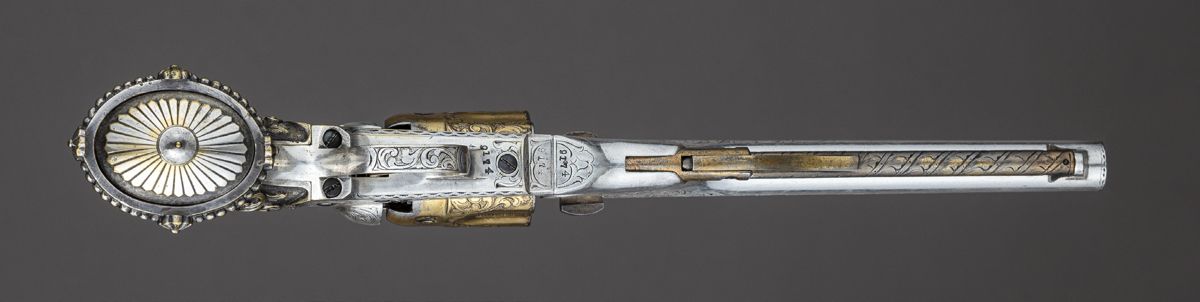
Top view showing the ADDRESS COL. SAML COLT NEW-YORK U.S. AMERICA barrel address.
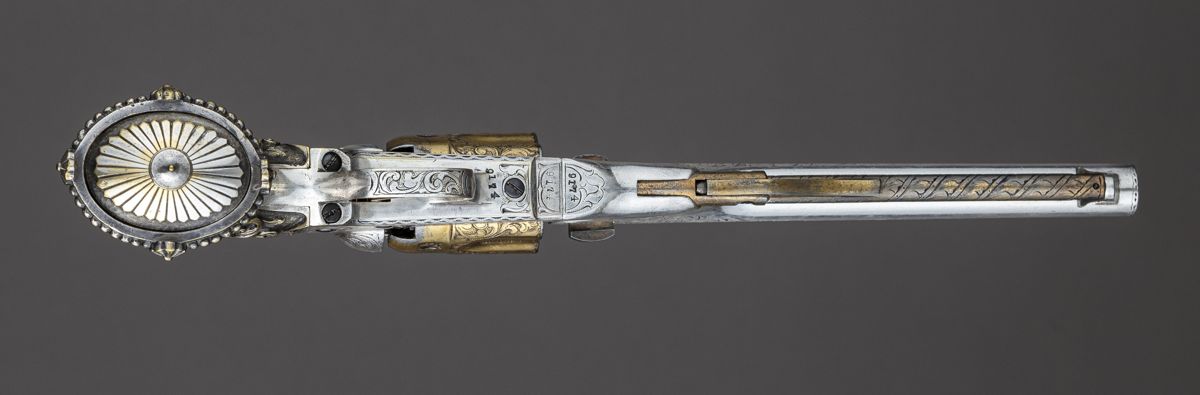
Bottom view showing the serial numbers and exquisite engraving.
The system was complicated, the ammunition was proprietary, and the whole affair became pointless the moment White’s patent expired, so fewer than 5,000 Thuer conversions were executed across all of Colt’s percussion models between about 1869 and 1872, making a Thuer-converted Model 1862 Police a rarely encountered gun.10 The beauty of the Thuer arrangement was that it was fully reversible, and this cased set retains both the percussion fittings and the conversion, along with the eagle-pattern powder flask, a tin of W. and C. Eley caps, the combination tool, and the balance of the accessories, so the owner could shoot cap and ball or self-contained cartridges as the mood struck him. It also tells us something about the set’s chronology: while the revolver left Hartford in 1862, the outfit as we see it today could not have reached its final form before late 1868 at the very earliest, which suggests a valued arm that was returned for updating rather than a gun that sat forgotten in a drawer.
The Gentleman of Lima
And that brings us to the man whose name is engraved on the grip and on the case, Benito Valdeavellano, whom the Metropolitan identifies as a resident of Lima, Peru, living from 1823 to 1903.11 Period Lima sources mention a Spanish-born merchant of that name active in the city’s commercial life in the 1880s, but it cannot yet be stated with confidence that he is the same man, and no published research documents when or how the revolver made its way to Peru. What can be said is that the deluxe New York trade did a healthy business south of the border throughout this period, and richly decorated Colts with Mexican, Central American, and South American associations turn up often enough that the pattern is unmistakable. A silver and gold Colt from Maiden Lane was exactly the sort of thing a prosperous gentleman of Lima might commission, carry on occasion, and keep cased in the study the rest of the time, and the survival of this set in essentially complete condition argues that it led exactly that sort of pampered life.
Detail of the right side showing the PAT. SEPT. 10th 1850 cylinder marking, the COLTS PATENT frame stamp, and the depth and quality of the scrollwork.
Provenance
The set came to the Metropolitan in 1985 as the gift of Mr. and Mrs. Jerry D. Berger, and at this writing it is on view at the Met Fifth Avenue in Gallery 372, well worth a visit for any collector passing through New York.12
Endnotes
- Cased Colt Model 1862 Police Revolver, Serial no. 9174, with Thuer Conversion for Self-contained Cartridges, and Accessories, accession number 1985.264a-r, The Metropolitan Museum of Art, New York, www.metmuseum.org/art/collection/search/24921.
- Schuyler, Hartley & Graham Papers, MS 034, McCracken Research Library, Buffalo Bill Center of the West, Cody, Wyoming, collection finding aid.
- Herbert G. Houze, Winchester Repeating Arms Company (Iola, WI: Krause Publications, 2004), 348-357.
- R.L. Wilson, L. D. Nimschke, Firearms Engraver (Teaneck, NJ: John J. Malloy, 1965).
- Workbook Recording the Engraved Firearms Ornament of Louis D. Nimschke, accession number 2018.856.19, and Set of Sixty-Two Engraving Tools of Louis D. Nimschke, The Metropolitan Museum of Art, New York.
- “Tiffany’s, Old and New,” GUNS Magazine, quoting the Schuyler, Hartley and Graham catalog of 1864.
- Object record for accession number 1985.264a-r, The Metropolitan Museum of Art, New York.
- R.L. Wilson production estimates for the Model 1862 Police and Model 1862 Pocket Navy, as summarized in The Book of Colt Firearms; approximately 28,000 Police pattern revolvers within the shared serial range of about 47,000.
- F. Alexander Thuer, United States Patent No. 82,258, September 15, 1868.
- Dennis Adler, Metallic Cartridge Conversions: The History of the Guns and Modern Reproductions (Iola, WI: Krause Publications, 2002).
- Object record for accession number 1985.264a-r, The Metropolitan Museum of Art, New York.
- Object record for accession number 1985.264a-r, The Metropolitan Museum of Art, New York.
Jack W. Melton Jr. is the Publisher of The Rampant Colt magazine and the Publications Chairman for the Colt Collectors Association Inc. He is a publisher, photographer, and military historian specializing in American arms, accouterments, and material culture, with a particular emphasis on the Civil War era. He is the owner of Historical Publications LLC, and also publisher of Civil War News and Military Antique Collector magazines. His work centers on historical firearms, edged weapons, artifacts, and the research, photography, and interpretation of significant military collectibles.