
The Sword at Washington’s Side
Compiled Resources by Jack W. Melton Jr. · Originally published September-October 2026 · pp. 28–34
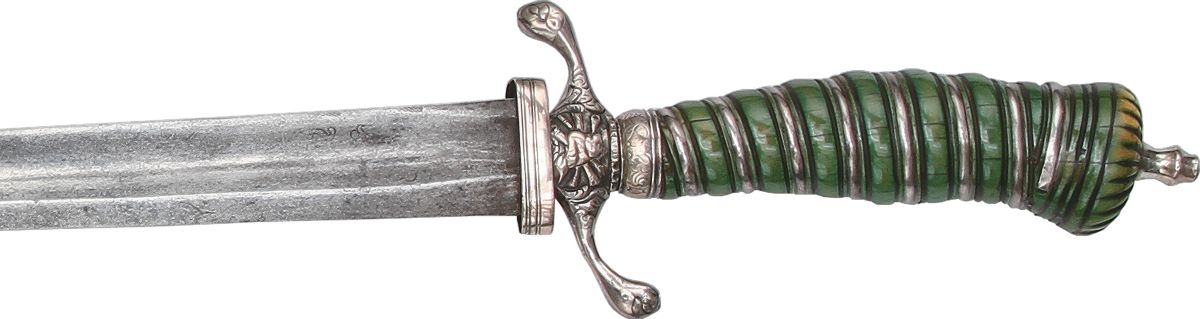
For the collector of American militaria, provenance is everything, and no chain of ownership carries more weight than one that begins with George Washington. Among the general’s surviving swords, one stands apart: a plain, silver-mounted hanger with a green-stained ivory grip, forged in the Hudson Valley during the Revolutionary War and worn by Washington himself at the head of the Continental Army. Today it rests in the Smithsonian’s National Museum of American History, cataloged simply as “George Washington’s Battle Sword and Scabbard.” It is neither the most ornate blade Washington owned nor the most valuable by auction standards. Its importance lies elsewhere: in an unbroken record that runs from the commander in chief’s own hip, through his will, into the hands of a nephew, and finally to the American people. This is what a documented command object looks like, and it rewards study on its own terms.¹
A Sword as a Badge of Command In the eighteenth century, a sword worn by a general officer was less a weapon of first resort than an emblem of rank and an instrument of leadership. It marked the wearer as a gentleman and an officer, it signaled orders on a noisy field, and it embodied the authority of the man who carried it. Edged combat still happened, but for a commander, the blade was more often worn, pointed, and raised than swung. Erik Goldstein, author of The Swords of George Washington, states the case plainly: Washington had a sword at his side every time he put on his uniform, whether in the French and Indian War, throughout the Revolution, or as president. Yet it would be a mistake, Goldstein cautions, to picture Washington hacking through ranks of redcoats like a brigand. A gentleman knew what to do, and what not to do, with a sword, and it is a safe bet that Washington’s blade spent most of the great battles in its scabbard.² Washington acquired many swords across Title page: Charles Willson Peale’s 1779 portrait of Washington as commander in chief; the hilt of the Bailey cuttoe is visible at his side. Sword hilt of George Washington’s battle sword. (The Smithsonian’s National Museum of American History. Photo by Stuart C. Mowbray)
his life, and the survivors map his career. There is the silver-hilted smallsword tied to the Braddock campaign of the French and Indian War, several dress smallswords, a lion-head cuttoe acquired around 1770, at least two American cuttoes carried during the Revolution, and later diplomatic gifts from European admirers. The green-ivory Bailey hanger belongs to the last years of the war, and it is the one Washington’s descendants and later generations came to call simply his battle sword.³
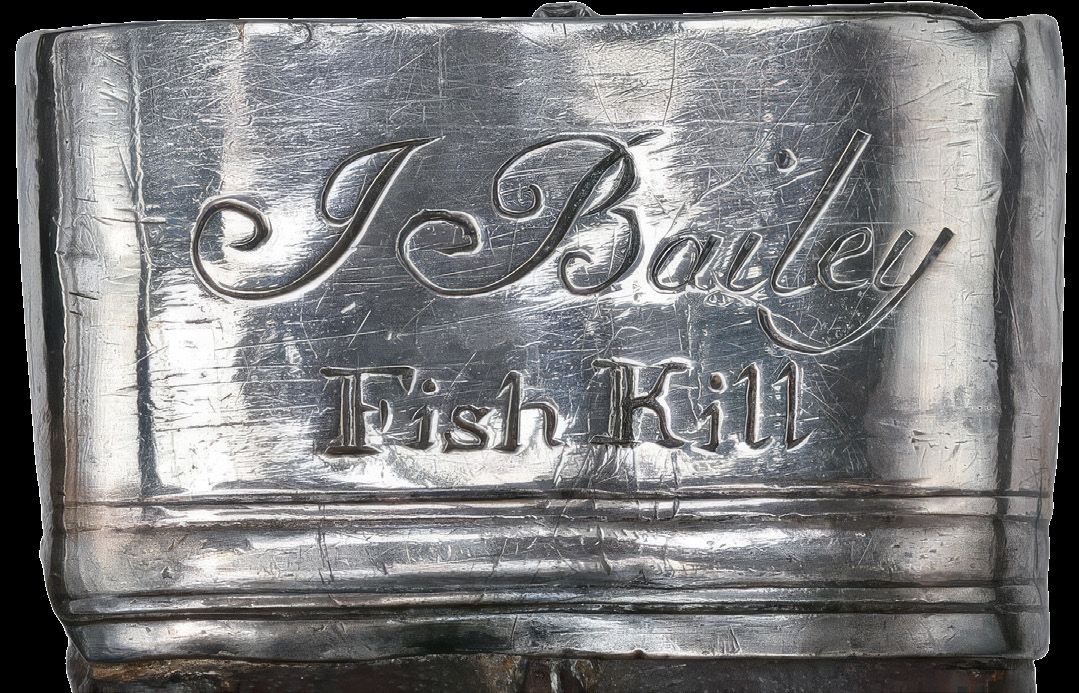
The Artifact: Blade, Hilt, and Scabbard The Smithsonian describes the piece as a hanger-type sword of forged steel with a grooved blade, a green-dyed ivory grip with silver strip decoration, and a leather scabbard with silver trim.⁴ In a collector’s vocabulary, it is a cuttoe, from the French couteau, the short, slightly curved, single-edged hunting-style sword that fashionable officers favored for its practicality as much as its style. The blade is slightly curved and fullered, of forged steel. The hilt is silver-mounted: a silver crossguard and pommel frame a grip of greenstained ivory bound with silver strip. The quillons of the crossguard turn in an S curve ending in serpent heads, and the pommel is carved in a shell design, features consistent with Bailey’s finest surviving work. The leather scabbard carries silver mounts at the throat and middle, the middle band fitted with a carrying ring, and a silver tip at the point. Most telling of all, the silver throat mount is engraved “J. Bailey / Fish Kill,” recording both the maker and the place of manufacture.⁵ For dimensions, the museum records an overall length of roughly 36 ¼ inches, about 92 centimeters.⁶ In the hand, it is a light, businesslike weapon rather than a parade piece, which is precisely the point: this was a working officer’s sword, not a jeweled court blade. A word of caution on materials and dates, because an object of this age carries the marks of long cataloging. The museum’s prose consistently describes a forged-steel blade, silver mountings, and an ivory grip, while its raw materials fields include legacy entries such as “silver (blade material)” and “bone (overall material)” that reflect older record-keeping rather than a considered attribution. Collectors should read the descriptive text, not the tags. On dating, the museum lists two figures, ca. 1765 and ca. 1778. The later date fits the scholarly consensus: Mount Vernon, drawing on Goldstein’s research, dates the sword to 1778 or 1779, when Bailey was working near Fishkill. The earlier ca. 1765 date is best treated with caution.
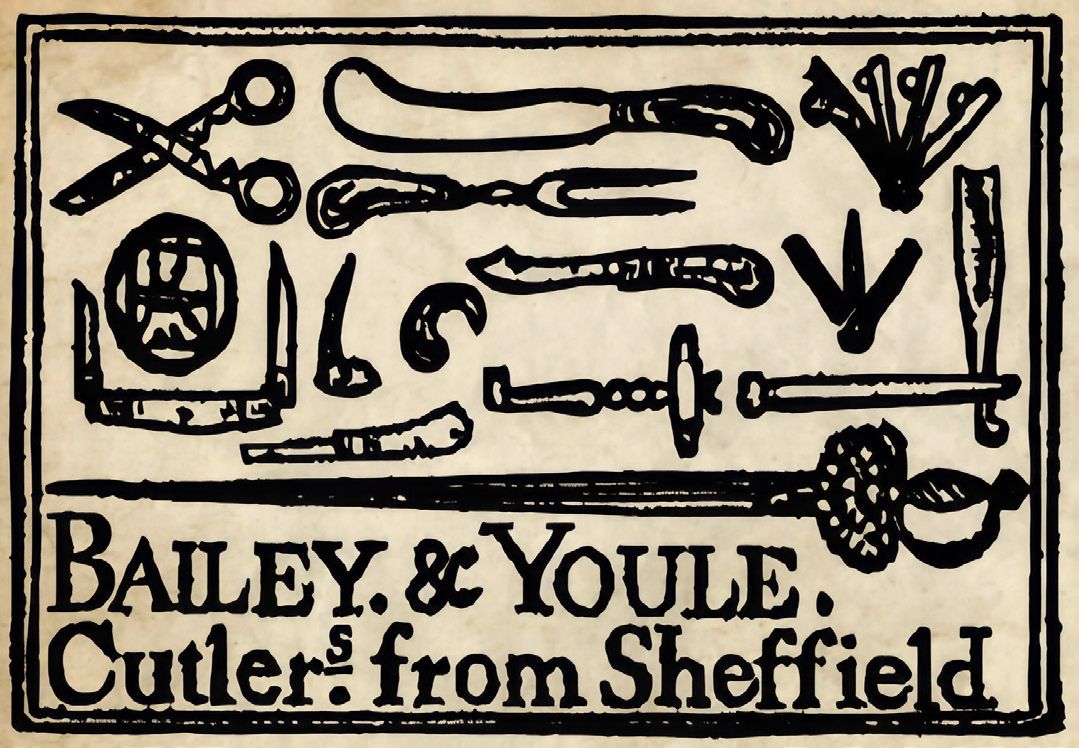
John Bailey of Fishkill The signature on the scabbard points to one of the most capable cutlers working in Revolutionary America. John Bailey was born in Yorkshire, England, around 1736, trained as a cutler in Sheffield, and emigrated to New York City in 1755 at the age of nineteen. By March 1771, he had formed a partnership, Bailey and Youle, with fellow Sheffield cutler John Youle, advertising swords alongside surgeons’ instruments, trusses, and silversmiths’ tools near the city’s Merchant’s Coffee House.⁷ When war reached New York in 1775, Bailey moved his operation up the Hudson, working at
Newspaper advertisement for Bailey & Youle. (The New-York Gazette and the Weekly Mercury, March 4, 1771.)
Detail of the silver throat mount engraved “J. Bailey / Fish Kill,” the inscription that fixes both maker and place of manufacture. (Stuart C. Mowbray)
Fishkill and later at Fredericksburgh, the town now known as Patterson. Fishkill had become a principal Continental supply depot, and Bailey’s shop turned out finely finished swords for American officers. His surviving pieces are distinguished by silver hilts, green-stained ivory grips, and, on some examples, sculptural pommels in the form of a lion’s or dog’s head. The market confirms the regard in which they are held: a signed 1777 Bailey sword once owned by Francis Dana brought $102,000 at a 2017 auction.⁸ Of all Bailey’s productions, however, the sword he made for Washington remains the most famous.⁹ After the war, Bailey returned to New York City, entered a bell-founding partnership in 1794, and died on January 22, 1815, his business carried on by his son.¹⁰
Fact, Tradition, and the Trouble with Paintings Here, the collector must tread carefully, because Washington’s swords have attracted more legend than almost any other class of American relic. The documented facts are modest and sturdy. Washington owned two American-made cuttoes during the Revolution: one thought to have been made in Philadelphia by an unknown craftsman, the other the Bailey hanger from Fishkill.¹¹ Mount Vernon associates the Bailey sword with the later years of the war and notes that it has long been celebrated as the general’s battle sword.¹² Portraiture supplies the strongest visual evidence. Charles Willson Peale painted Washington from life more often than any other artist. In his 1772 canvas, Washington wears his 1767 smallsword; a few years later, painting Washington as commander in chief, Peale depicted him wearing the Bailey silverand-ivory cuttoe, and the hilt of the Bailey sword is visible in Peale’s celebrated George Washington at Princeton of 1779.¹³, ¹⁴ With photography still decades in the future, such images are the closest thing we have to a contemporary record of the sword at Washington’s side. But paintings also breed confusion, and this is where accuracy matters most. The sword most often linked in the popular imagination to the crossing of the Delaware was not the Bailey hanger at all, but the earlier lion-head cuttoe, acquired around 1770 and carried in the early battles at Boston, Long Island, and Trenton.¹⁵ When Emanuel Leutze painted Washington Crossing the Delaware in 1851, he included what Goldstein calls an ill-informed interpretation
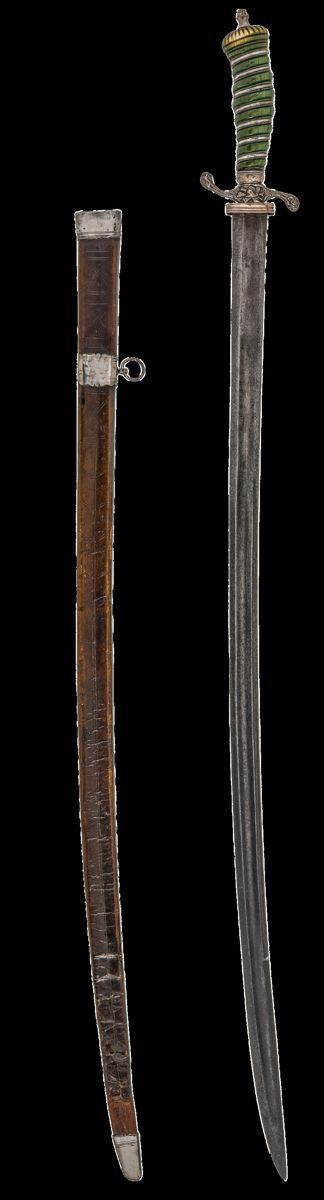
Facing page: George Washington’s battle sword and scabbard, made by cutler John Bailey near Fishkill, New York, with its greenstained ivory grip and silver-mounted, signed leather scabbard. (Institution: National Museum of American History, Smithsonian Institution)
of the sword.¹⁶ The lesson for collectors and writers alike is simple: a sword’s appearance in a painting proves what an artist chose to depict, not where a blade actually was on a given day. No responsible source places the Bailey battle sword at a specific engagement by name, and neither should we.
From the General’s Hip to the Nation Provenance is the heart of this object’s value, and it is unusually clean. In his last will and testament, dated July 9, 1799, Washington left five swords to five nephews, to be chosen in the order named. The bequest carried one of the most quoted injunctions in American arms history:
To each of my Nephews, William Augustine Washington, George Lewis, George Steptoe Washington, Bushrod Washington and Samuel Washington, I give one of the Swords or Cutteaux of which I may die possessed; and they are to chuse in the order they are named. These Swords are accompanied with an injunction not to unsheath them for the purpose of shedding blood, except it be for self defence, or in defence of their Country and its rights; and in the latter case, to keep them unsheathed, and prefer falling with them in their hands, to the relinquishment thereof.17
as
The Bailey cuttoe passed to the nephew Samuel Washington, identified in later records Samuel T. Washington, an army captain.¹⁸ The swords remained in family hands into the 1840s. Then, in 1843, Samuel’s son offered the Bailey cuttoe to Congress, making the American people the first public recipient of one of these swords.¹⁹ The Smithsonian records the donation to the United States government in that year; the object later entered the national collections and is today held by the National Museum of American History, credited to the U.S. Department of State.²⁰ The distinction is worth savoring for a collector: while Washington’s other swords remained cherished family relics for generations, this one became public property within half a century of his death.
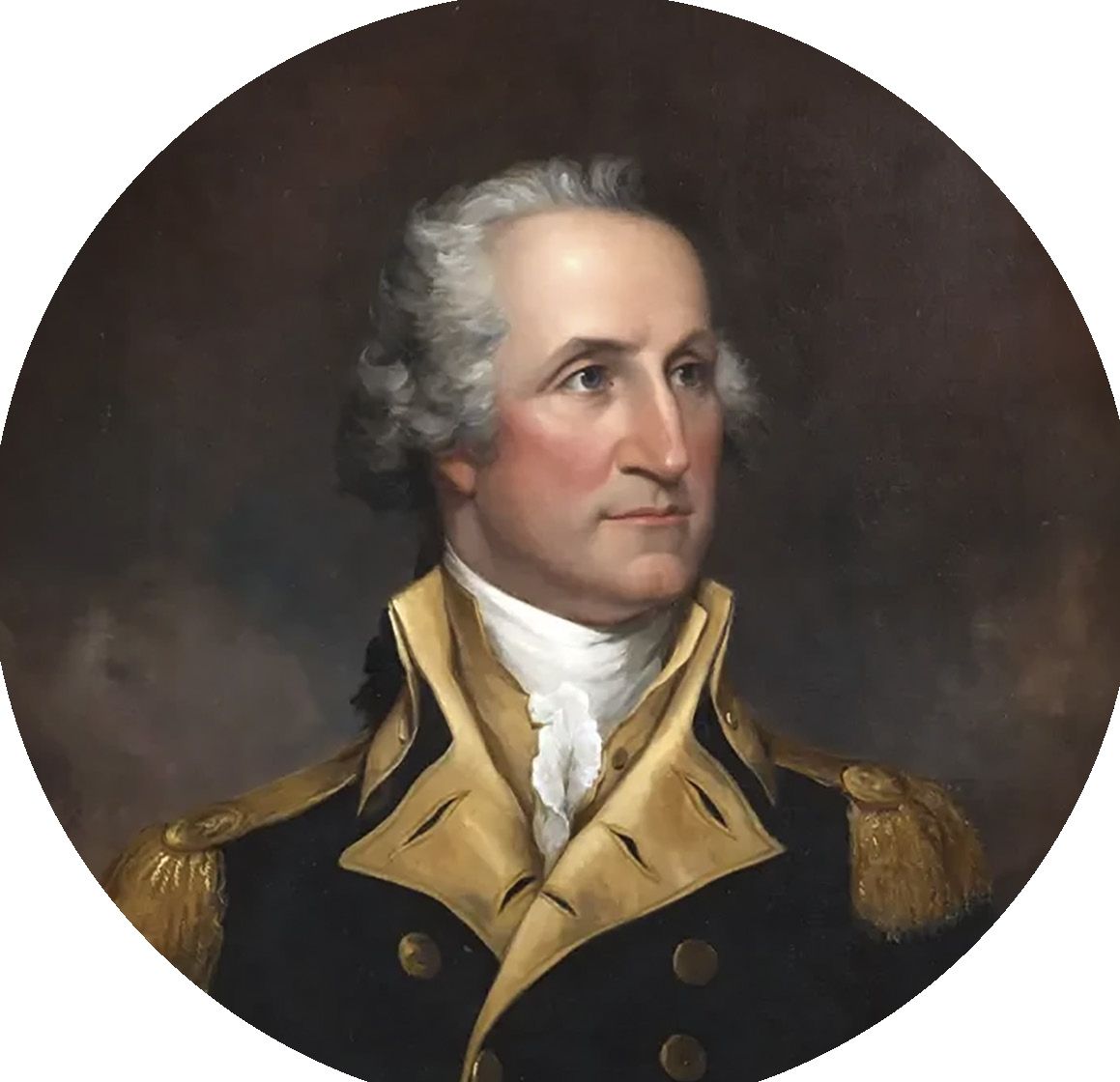
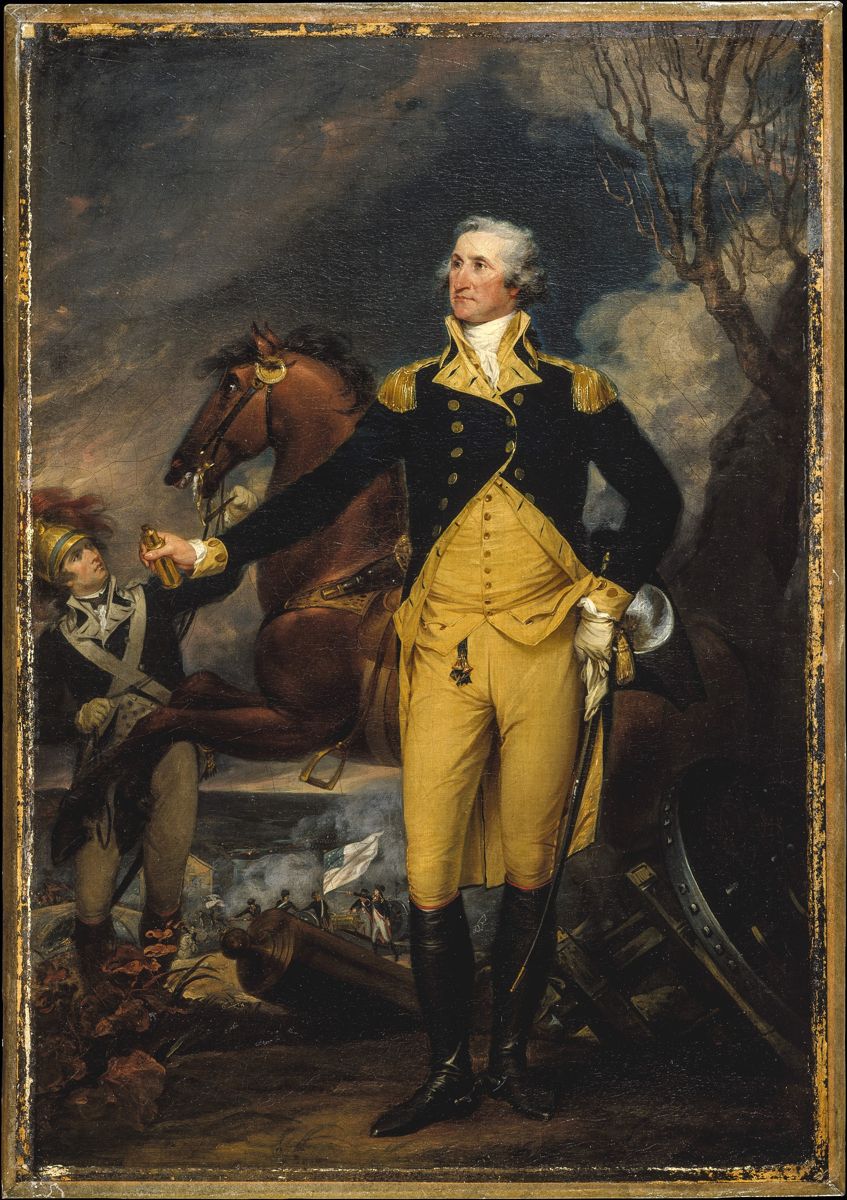
This Sword’s Importance to Collectors For the collector, the Bailey battle sword is a master class in the factors that drive value and confidence. Provenance leads: the chain from Washington to nephew to Congress is documented in the will and the congressional record, not merely asserted, which is the difference between a relic and a story. Maker attribution follows: the signed scabbard removes the guesswork about who made the sword and where, a luxury rarely afforded to eighteenth-century American arms. Original materials and condition matter just as much. The sword retains its period hilt and, crucially, its original signed leather scabbard with silver mounts. Scabbards are usually the first casualties of time, so a matched, signed example is a considerable rarity. Institutional custody plays a double role: a museum home both protects the object and removes it from the market, which in turn concentrates demand on the far scarcer Bailey and Revolutionary War officers’ swords that remain in private hands. Finally, there is symbolic association. The will’s injunction transformed these blades from personal effects into moral objects, and that meaning travels with the artifact. The practical takeaways are straightforward. Signed Bailey pieces are scarce and expensive, as the six-figure Dana sword attests. A documented officer’s cuttoe retaining its original signed scabbard Facing page: George Washington sat for Trumbull in Philadelphia in 1792; from that sitting, the artist created a fullsize canvas (Yale University Art Gallery, New Haven, Conn.) and this smaller version. The general is shown on the evening before the pivotal Battle of Trenton in late 1776. He looks upward, conceiving his strategy against the vastly superior approaching enemy. The significance of the moment is expressed in the drama of the threatening sky and by the excitable horse, held in check by a soldier groom. (Metropolitan Museum of Art, Bequest of Grace Wilkes, 1922)
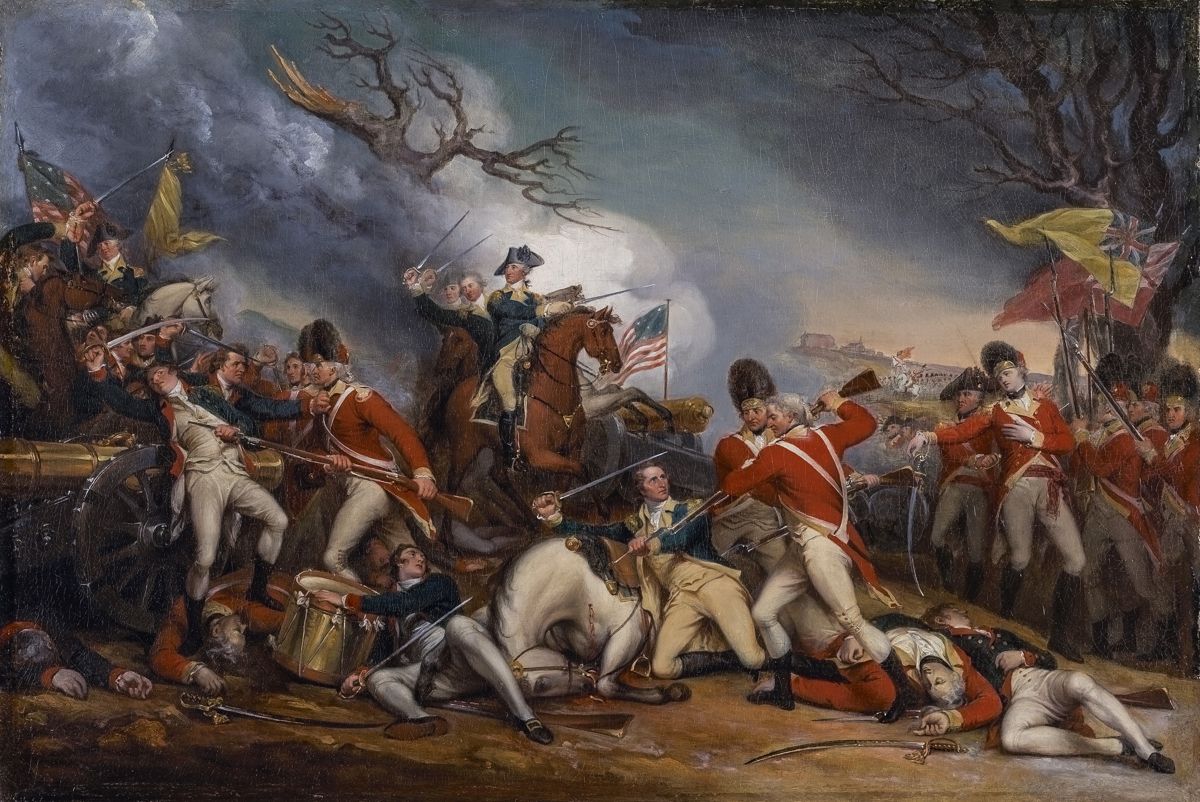
Trumbull’s battle scene, with Washington on horseback in the middle distance rallying his troops; a period depiction of command under fire. John Trumbull, artist. (Yale University Art Gallery)
is the gold standard for the type. Attributions to famous owners that rest on family tradition or portraiture alone should be treated with skepticism until documents corroborate them. And a museum benchmark like the Washington sword sets the standard against which privately held Bailey and Revolutionary War swords are measured.
More Than a Relic The Bailey battle sword is more than an object behind museum glass. It is a documented weapon of command, made by a skilled immigrant cutler in a Hudson Valley supply town, worn by the commander in chief through the war’s decisive years, and then deliberately handed down as a lesson in restraint. Washington’s instruction, to keep the blade sheathed except in defense of country and rights, turned an implement of war into an argument for self-government. For the collector, the historian, and the museum visitor alike, it is that rare artifact that carries its own meaning, engraved on the silver of its scabbard for anyone willing to read it.
Endnotes
- National Museum of American History, Smithsonian Institution, “George Washington’s Battle Sword and Scabbard,” object no. AF.32010, https://americanhistory.si.edu/collections/object/nmah_434865. “
- Washington’s Swords: An Interview with Erik Goldstein,” George Washington’s Mount Vernon, https://www.mountvernon.org/preservation/collections-holdings/washingtons-swords/washingtons-swords-an-interview-with-erik-goldstein. “
- Washington’s Swords,” George Washington’s Mount Vernon, https://www.mountvernon.org/preservation/collections-holdings/washingtons-swords.
- National Museum of American History, “George Washington’s Battle Sword and Scabbard” (physical description, materials, and measurements), object no. AF.32010.
- John F. Kennedy Presidential Library and Museum, “Replica of General George Washington’s Sword and Scabbard” (describing the original’s hilt and scabbard, including the throat inscription “J. Bailey / Fish Kill”), https://jfk.artifacts.archives.gov/objects/2879.
- National Museum of American History, “George Washington’s Battle Sword and Scabbard” (overall length), object no. AF.32010.
- The American Revolution Institute of the Society of the Cincinnati, “American Officer’s Sword made by John Bailey,” https://www.americanrevolutioninstitute.org/masterpieces-in-detail/american-officers-sword-made-by-john-bailey/.
- Rick Russack, “A $102,000 Revolutionary War Sword Tops a Strong McInnis Auction,” Antiques and The Arts Weekly, 2017, https://antiquesandthearts.com/a102000-revolutionary-war-sword-tops-a-strong-mcinnisauction/.
- American Revolution Institute, “American Officer’s Sword made by John Bailey.”
- American Revolution Institute, “American Officer’s Sword made by John Bailey.” “
- Washington’s Swords: An Interview with Erik Goldstein,” George Washington’s Mount Vernon. “
- Special Collection of George Washington Swords,” George Washington’s Mount Vernon, https://www.mountvernon.org/plan-your-visit/calendar/exhibitions/special-collection-of-george-washington-swords. “
- Washington’s Swords: An Interview with Erik Goldstein,” George Washington’s Mount Vernon.
- American Revolution Institute, “American Officer’s Sword made by John Bailey.” “
- Special Collection of George Washington Swords,” George Washington’s Mount Vernon. “
- Washington’s Swords: An Interview with Erik Goldstein,” George Washington’s Mount Vernon. “
- George Washington’s Last Will and Testament, 9 July 1799,” Founders Online, National Archives, https://founders.archives.gov/documents/Washington/06-04-02-0404-0001; transcription also at Encyclopedia Virginia.
- National Museum of American History, “George Washington’s Battle Sword and Scabbard” (provenance to Samuel T. Washington), object no. AF.32010. “
- Special Collection of George Washington Swords,” George Washington’s Mount Vernon.
- National Museum of American History, “George Washington’s Battle Sword and Scabbard” (donation of 1843; U.S. Department of State credit line), object no. AF.32010.