
The Armory at Springfield
By Jacob Abbott · Originally published September-October 2026 · pp. 46–66

Jacob Abbott’s “The Armory at Springfield” was published in Harper’s New Monthly Magazine, vol. 5, no. 26 (July 1852), pages 145–161.
EDITORIAL INTRODUCTION When Jacob Abbott visited Springfield Armory in the early 1850s, he encountered one of the most important government manufacturing establishments in the United States. The Armory occupied two interconnected landscapes: the carefully arranged Hill Shops, where administration, inspection, assembly, and storage took place, and the water-powered workshops along the Mill River, where much of the heavy barrel work was performed. Abbott’s article led readers from the pastoral Connecticut River Valley into the forge, boring bank, grinding room, proving house, stocking shop, assembly bench, and newly completed arsenal.1, 3 For collectors, the article is especially valuable because it describes the manufacture of the U.S. Model 1842 percussion musket near the end of its production era. The Model 1842 was a .69-caliber smoothbore arm and represented a major step in American military manufacturing. Its components were produced through increasingly standardized machine processes and controlled by gauges, patterns, inspections, and detailed piecework accounts. Abbott did not consistently name the model, but the date, manufacturing sequence, bayonet description, and Armory product line place his narrative squarely within the Model 1842 context.2, 4 The article also documents the industrial culture surrounding the weapon. Abbott followed iron from barrel plate to welded tube, described repeated boring and straightening operations, watched barrels pass through proof, and explained the division of labor behind locks, furniture, stocks, bayonets, and final assembly. He was fascinated by interchangeability and by the ability to select components from separate bins and assemble them without individual fitting. Modern research supports the general substance of this observation: by the 1840s, improved machine tools and gauges had made fully interchangeable manufacture practical at Springfield, although Abbott sometimes used expansive language to dramatize the achievement.4, 10 Abbott wrote for a general magazine audience, not as an Ordnance Department inspector or a later industrial historian. His prose therefore mixes careful observation with promotional enthusiasm, moral reflection, rhetorical exaggeration, and statements attributed to workmen or officials. Several precise figures in the article, including costs, wages, proof failures, assembly time, and manufacturing-operation totals, have not been independently confirmed in the modern sources consulted for this edition. They remain in the text because they are part of the historical document, but they are identified where necessary as contemporary claims rather than established statistical facts.1 The most significant factual correction concerns James Wolfe Ripley. Abbott called him “Colonel Ripley,” but Ripley commanded Springfield Armory as a major from April 1841 through August 1854. Under his administration, the Armory grounds, buildings, rules, accounts, and manufacturing system underwent extensive changes. The Main Arsenal was built from 1847 to 1850 and could hold as many as 300,000 firearms. The Commanding Officer’s Quarters was built from 1845 to 1847. Both structures appear in the original engravings and remain central to the Armory’s architectural history.5, 6, 7 Abbott’s repeated prediction that most government muskets would remain permanently in storage is perhaps the article’s most revealing error. Less than a decade later, the Civil War created an emergency demand for arms on a scale he did not anticipate. Springfield Armory became the Union’s principal federal small-arms manufacturing center, and stored older weapons were drawn into service. Read in that light, “The Armory at Springfield” is more than a manufacturing tour. It is a detailed portrait of American arms production on the eve of the conflict that would test the system Abbott so admired.9 Editorial sources and verification are documented in the endnotes following the complete reprint.
THE COMPLETE 1852 ARTICLE Original text by Jacob Abbott. Modern captions and editor’s notes are visually separated from the reprint.
THE ARMORY AT SPRINGFIELD By Jacob Abbott
SPRINGFIELD. The Connecticut river flows through the State of Massachusetts, from north to south, on a line about half way between the middle of the State and its western boundary. The valley through which the river flows, which perhaps the stream itself has formed, is broad and fertile, and it presents, in the summer months of the year, one widely extended scene of inexpressible verdure and beauty. The river meanders through a region of broad and luxuriant meadows which are overflowed and enriched by an annual inundation. These meadows extend sometimes for miles on either side of the stream, and are adorned here and there with rural villages, built wherever there is a little elevation of land—sufficient to render human habitations secure. The broad and beautiful valley is bounded on either hand by an elevated and undulating country, with streams, mills, farms, villages, forests, and now and then a towering mountain, to vary and embellish the landscape. In some cases a sort of spur or projection from the upland country projects into the valley, forming a mountain summit there, from which the most magnificent views are obtained of the beauty and fertility of the surrounding scene. There are three principal towns upon the banks of the Connecticut within the Massachusetts lines: Greenfield on the north—where the river enters into Massachusetts from between New Hampshire and Vermont—Northampton at the centre, and Springfield on the south. These towns are all built at points where the upland approaches near to the river. Thus at Springfield the land rises by a gentle ascent from near the bank of the stream to a spacious and beautiful plain which overlooks the valley. The town is built upon this declivity. It is so enveloped in trees that from a distance it appears simply like a grove with cupolas and spires rising above the masses of forest foliage; but to one within it, it presents every where most enchanting pictures of rural elegance and beauty. The streets are avenues of trees. The houses are surrounded by gardens, and so enveloped in shrubbery that in many cases they reveal themselves to the passer-by only by the glimpse that he obtains of a colonnade or a piazza, through
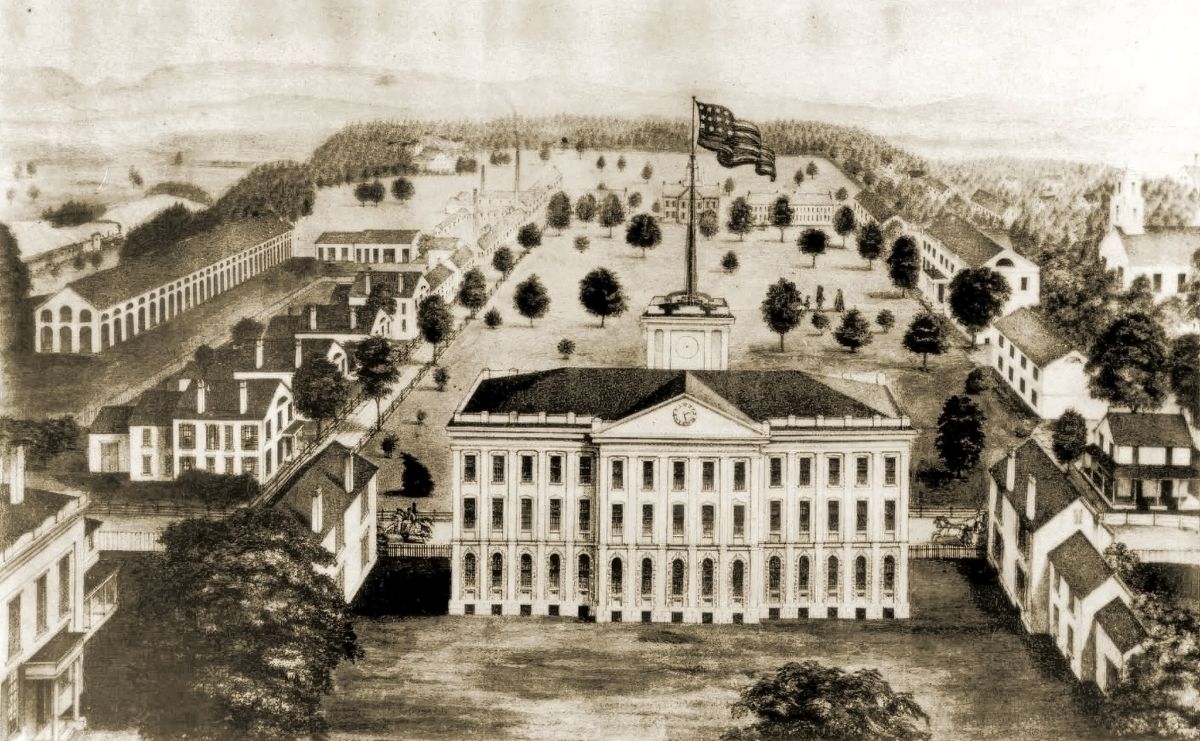
General view of Springfield Armory’s Hill Shops from the east. Abbott identified the central cupola-topped building as the Office; the large square-towered structure behind it was the New Arsenal, now known as the Main Arsenal. Original engravings published in 1852.
some little vista which opens for a moment and then closes again as he passes along. At one point, in ascending from the river to the plain above, the tourist stops involuntarily to admire the view which opens on either side, along a winding and beautiful street which here crosses his way. It is called Chestnut-street on the right hand, and Maple-street on the left—the two portions receiving their several names from the trees with which they are respectively adorned. The branches of the trees meet in a dense and unbroken mass of foliage over the middle of the street, and the sidewalk presents very precisely the appearance and expression of an alley in the gardens of Versailles.
THE ARMORY GROUNDS. On reaching the summit of the ascent, the visitor finds himself upon an extended plain, with streets of beautiful rural residences on every hand, and in the centre a vast public square occupied and surrounded by the buildings of the Armory. These buildings are spacious and elegant in their construction, and are arranged in a very picturesque and symmetrical manner within the square, and along the streets that surround it. The grounds are shaded with trees; the dwellings are adorned with gardens and shrubbery. Broad and neatly-kept walks, some graveled, others paved, extend across the green or along the line of the buildings, opening charming vistas in every direction. All is quiet and still. Here and there a solitary pedestrian is seen moving at a distance upon the sidewalk, or disappearing among the trees at the end of an avenue; and perhaps the carriage of some party of strangers stands waiting at a gate. The visitor who comes upon this scene on a calm summer morning, is enchanted by the rural beauty that surrounds him, and by the air of silence and repose which reigns over it all. He hears the distant barking of a dog, the voices of children at play, or the subdued thundering of the railway-train crossing the river over its wooden viaduct, far down the valley—and other similar rural sounds coming from a distance through the calm morning air—but all around him and near him is still. Can it be possible, he asks, that such a scene of tranquillity and loveliness can be the outward form and embodiment of a vast machinery incessantly employed in the production of engines of carnage and death? It is, however, after all, perhaps scarcely proper to call the arms that are manufactured by the American government, and stored in their various arsenals, as engines of carnage and destruction. They ought, perhaps, to be considered rather as instruments of security and peace; for their destination is, as it would seem, not to be employed in active service in the performance of the function for which they are so carefully prepared; but to be consigned, when once finished, to eternal quiescence and repose. They protect by their existence, and not by their action; but in order that this, their simple existence, should be efficient as protection, it is necessary that the instruments themselves should be fitted for their work in the surest and most perfect manner. And thus we have the very singular and extraordinary operation going on, of manufacturing with the greatest care, and with the highest possible degree of scientific and mechanical skill, a vast system of machinery, which, when completed, all parties concerned most sincerely hope and believe will, in a great majority of cases, remain in their depositories undisturbed forever. They fulfill their vast function by their simple existence—and thus, though in the highest degree useful, are never to be used.
EDITOR’S NOTE — A PROPHECY OVERTAKEN BY EVENTS
Abbott’s description of government arms as weapons likely to remain in “eternal quiescence” was optimistic even in 1852. The Mexican War had
Springfield Armory National Historic Site. (Victoria Stauffenberg)
ended only four years earlier, and within nine years the Civil War transformed Springfield into the Union’s principal federal small-arms manufactory. Older percussion and converted muskets were drawn from storage and issued in large numbers. Abbott’s passage is valuable as antebellum rhetoric, not as an accurate forecast.9
THE BUILDINGS.
The general appearance of the buildings of the Armory is represented in the engraving placed at the head of this article. The point from which the view is taken, is on the eastern side of the square—that is, the side most remote from the town. The level and extended landscape seen in the distance, over the tops of the buildings, is the Connecticut valley—the town of Springfield lying concealed on the slope of the hill, between the buildings and the river. The river itself, too, is concealed from view at this point by the masses of foliage which clothe its banks, and by the configuration of the land.
The middle building in the foreground, marked by the cupola upon the top of it, is called the Office. It contains the various counting-rooms necessary
for transacting the general business of the Armory, and is, as it were, the seat and centre of the power by which the whole machinery of the establishment is regulated. North and south of it, and in a line with it, are two shops, called the North and South Filing Shops, where, in the several stories, long ranges of workmen are found, each at his own bench, and before his own window, at work upon the special operation, whatever it may be, which is assigned to him. On the left of the picture is a building with the end toward the observer, two stories high in one part, and one story in the other part. The higher portion—which in the view is the portion nearest the observer—forms the Stocking Shop, as it is called; that is the shop where the stocks are made for the muskets, and fitted to the locks and barrels. The lower portion is the Blacksmith’s Shop. The Blacksmith’s Shop is filled with small forges, at which the parts of the lock are forged. Beyond the Blacksmith’s Shop, and in a line with it, and forming, together with the Stocking Shop and the Blacksmith’s Shop, the northern side of the square, are several dwelling-houses, occupied as the quarters of certain officers of the Armory. The residence of the Commanding Officer, however, is not among them. His house stands on the west side of the square, opposite to the end of the avenue which is seen opening directly before the observer in the view. It occupies a very delightful and commanding situation on the brow of the hill, having a view of the Armory buildings and grounds upon one side, and overlooking the town and the valley of the Connecticut on the other.
THE WATER SHOPS. Such is the general arrangement of the Arsenal buildings, “on the hill.” But it is only the lighter work that is done here. The heavy operations, such as rolling, welding, grinding, &c., are all performed by water-power. The stream which the Ordnance Department of the United States has pressed into its service to do this work, is a rivulet that meanders through a winding and romantic valley, about half a mile south of the town. On this stream are three falls, situated at a distance perhaps of half a mile from each other. At each of these falls there is a dam, a bridge, and a group of shops. They are called respectively the Upper, Middle, and Lower Water Shops. The valley in which these establishments are situated is extremely verdant and beautiful. The banks of the stream are adorned sometimes with green, grassy slopes, and sometimes with masses of shrubbery and foliage, descending to the water. The road winds gracefully from one point of view to another, opening at every turn some new and attractive prospect. The shops and all the hydraulic works are very neatly and very substantially constructed, and are kept in the most perfect order: so that the scene, as it presents itself to the party of visitors, as they ride slowly up or down the road in their carriage, or saunter along upon the banks of the stream on foot, forms a very attractive picture.
A little to the south of the entrance to the Commanding Officer’s house, stands a large edifice, called the New Arsenal. It is the building with the large square tower—seen in the view in the middle distance, and near the centre of the picture. This building is used for the storage of the muskets during the interval that elapses from the finishing of them to the time when they are sent away to the various permanent arsenals established by government in different parts of the country, or issued to the troops. Besides this new edifice there are two or three other buildings which are used for the storage of finished muskets, called the Old Arsenals. They stand in a line on the south side of the square, and may be seen on the left hand, in the view. These buildings, all together, will contain about five hundred thousand muskets. The New Arsenal, alone, is The Middle Water Shops on the Mill River. Waterpower drove trip hammers, grindstones, intended to contain three hundred polishing machinery, and lathes used in the heavier stages of small-arms production. thousand.
EDITOR’S NOTE — THE WATER SHOPS Modern National Park Service research confirms that Springfield used three Mill River sites known as the Lower, Middle, and Upper Water Shops. In 1852, heavy barrel work remained divided between the Middle and Upper Shops. The Lower Shops had already closed in 1845; the Middle Shops were demolished in 1856, and production was consolidated at the Upper Water Shops by 1855.3
THE MUSKET BARREL. The fundamental, and altogether the most important operation in the manufacture of the musket, is the formation of the barrel; for it is obvious, that on the strength and perfection of the barrel, the whole value and efficiency of the weapon when completed depends. One would suppose, that the fabrication of so simple a thing as a plain and smooth hollow tube of iron, would be a very easy process; but the fact is, that so numerous are the obstacles and difficulties that are in the way, and so various are the faults, latent and open, into which the workman may allow his work to run, that the forming of the barrel is not only the most important, but by far the most difficult of the operations at the Armory—one which requires the most constant vigilance and attention on the part of the workman, during the process of fabrication, and the application of multiplied tests to prove the accuracy and correctness of the work at every step of the progress of it, from beginning to end.
Inside the barrel-welding room. Heated iron barrel plates were formed around mandrels and welded into tubes beneath waterpowered tilt hammers.
The barrels are made from plates of iron, of suitable form and size, called scalps or barrel plates. These scalps are a little more than two feet long, and about three inches wide. The barrel when completed, is about three feet six inches long, the additional length being gained by the elongating of the scalp under the hammer during the process of welding. The scalps are heated, and then rolled up over an iron rod, and the edges being lapped are welded together, so as to form a tube of the requisite dimensions—the solid rod serving to preserve the cavity within of the proper form. This welding of the barrels is performed at a building among the Middle Water Shops. A range of tilt hammers extend up and down the room, with forges in the centre of the room, one opposite to each hammer, for heating the iron. The tilt hammers are driven by immense waterwheels, placed beneath the building—there being an arrangement of machinery by which each hammer may be connected with its moving power, or disconnected from it, at any moment, at the pleasure of the workman. Underneath the hammer is an anvil. This anvil contains a die, the upper surface of which, as well as the under surface of a similar die inserted in the hammer, is formed with a semi-cylindrical groove, so that when the two surfaces come together a complete cylindrical cavity is formed, which is of the proper size to receive the barrel that is to be forged. The workman heats a small portion of his work in his forge, and then standing directly before the hammer, he places the barrel in its bed upon the anvil, and sets his hammer in motion, turning the barrel round and round continually under the blows. Only a small portion of the seam is closed at one heat, eleven heats being required to complete the work. To effect by this operation a perfect junction of the iron, in the overlapping portions, so that the substance of iron shall be continuous and homogeneous throughout, the same at the junction as in every other part, without any, the least, flaw, or seam, or crevice, open or concealed, requires not only great experience and skill, but also most unremitting and constant attention during the performance of the work. Should there be any such flaw, however deeply it may be concealed, and however completely all indications of it may be smoothed over and covered up by a superficial finishing, it is sure to be exposed at last, to the mortification and loss of the workman, in the form of a great gaping rent, which is brought out from it under the inexorable severity of the test to which the work has finally to be subjected.
EDITOR’S NOTE — THE MUSKET BEING DESCRIBED At the time this article appeared, Springfield’s principal shoulder arm was the U.S. Model 1842
.69-caliber percussion smoothbore musket, not a rifle-musket. The .58-caliber Model 1855 rifle-musket followed several years later. Abbott’s manufacturing descriptions and engravings should therefore be read primarily in the context of Model 1842 production.2
RESPONSIBILITY OF THE WORKMEN. We say to the loss as well as to the mortification of the workman, for it is a principle that pervades the whole administration of this establishment, though for special reasons the principle is somewhat modified in its application to the welder, as will hereafter be explained, that each workman bears the whole loss that is occasioned by the failure of his work to stand its trial, from whatever cause the failure may arise. As a general rule each workman stamps every piece of work that passes through his hands with his own mark—a mark made indelible too—so that even after the musket is finished, the history of its construction can be precisely traced, and every operation performed upon it, of whatever kind, can be carried home to the identical workman who performed it. The various parts thus marked are subject to very close inspection, and to very rigid tests, at different periods, and whenever any failure occurs, the person who is found to be responsible for it is charged with the loss. He loses not only his own pay for the work which he performed upon the piece in question, but for the whole value of the piece at the time that the defect is discovered. That is, he has not only to lose his own labor, but he must also pay for all the other labor expended upon the piece, which through the fault of his work becomes useless. For example, in the case of the barrel, there is a certain amount of labor expended upon the iron, to form it into scalps, before it comes into the welder’s hands. Then after it is welded it must be bored and turned, and subjected to some other minor operations before the strength of the welding can be proved. If now, under the test that is applied to prove this strength—a test which will be explained fully in the sequel—the work gives way, and if, on examination of the rent, it proves to have been caused by imperfection in the welding, and not by any original defect in the iron, the welder, according to the general principle which governs in this respect all the operations of the establishment, would have to lose not only the value of his own labor, in welding the barrel, but that of all the other operations which had been performed upon it, and which were rendered worthless by his agency. It is immaterial whether the misfortune in such cases is occasioned by accident, or carelessness, or want of skill. In either case the workman is responsible. This rule is somewhat relaxed in the case of the welder, on whom it would, perhaps, if rigidly enforced, bear somewhat too heavily. In fact many persons might regard it as a somewhat severe and rigid rule in any case—and it would, perhaps, very properly be so considered, were it not that this responsibility is taken into the account in fixing the rate of wages; and the workmen being abundantly able to sustain such a responsibility do not complain of it. The system operates on the whole in the most salutary manner, introducing, as it does, into every department of the Armory, a spirit of attention, skill, and fidelity, which marks even the countenances and manners of the workmen, and is often noticed and spoken of by visitors. In fact none but workmen of a very high character for intelligence, capacity, and skill could gain admission to the Armory—or if admitted could long maintain a footing there.
EDITOR’S NOTE — WORKMEN’S MARKS AND INTERCHANGEABILITY Abbott’s statement that every workman stamped every component describes an accountability system, but it should not be confused with the older assembly or mating marks used when lock parts required individual hand fitting. National Park Service interpretation states that by the 1840s machine production and gauges had made hand fitting of locks unnecessary and those older identification marks were no longer required. Inspection, contractor, and work-accountability marks could still be applied for different purposes.4 The welders are charged one dollar for every barrel lost through the fault of their work. They earn, by welding, twelve cents for each barrel; so that by spoiling one, they lose the labor which they expend upon eight. Being thus rigidly accountable for the perfection of their work, they find that their undivided attention is required while they are performing it; and, fortunately perhaps for them, there is nothing that can well divert their attention while they are engaged at their forges, for such is the incessant and intolerable clangor and din produced by the eighteen tilt hammers, which are continually breaking out in all parts of the room, into their sudden paroxysms of activity, that every thing like conversation in the apartment is almost utterly excluded. The blows of the hammers, when the white-hot iron is first passed under them and the pull of the lever sets them in motion, are inconceivably rapid, and the deafening noise which they make, and the showers of sparks which they scatter in every direction around, produce a scene which quite appalls many a lady visitor when she first enters upon it, and makes her shrink back at the door, as if she were coming into some imminent danger. The hammers strike more than six hundred blows in a minute, that is more than ten in every second; and the noise produced is a sort of rattling thunder, so overpowering when any of the hammers are in operation near to the observer, that the loudest vociferation uttered close to the ear, is wholly inaudible. Some visitors linger long in the apartment, pleased with the splendor and impressiveness of the scene. Others consider it frightful, and hasten away.
FINISHING OPERATIONS.—BORING. From the Middle Water Shops, where this welding is done, the barrels are conveyed to the Upper Shops, where the operations of turning, boring and grinding are performed. Of course the barrel when first welded is left much larger in its outer circumference, and smaller in its bore, than it is intended to be when finished, in order to allow for the loss of metal in the various finishing operations. When it comes from the welder the barrel weighs over seven pounds: when completely finished it weighs but about four and a half pounds, so that nearly one half of the metal originally used, is cut away by the subsequent processes. The first of these processes is the boring out of the interior. The boring is performed in certain machines called boring banks. They consist of square and very solid frames of iron, in which, as in a bed, the barrel is fixed, and there is bored out by a succession of operations performed by means of certain tools which are called augers, though they bear very little resemblance to the carpenter’s instrument so named. These augers are short square bars of steel, highly polished, and sharp at the edges—and placed at the ends of long iron rods, so that they may pass entirely through the barrel to be bored by them, from end to end. The boring parts of these instruments, though they are in appearance only plain bars of steel with straight and parallel sides, are really somewhat smaller at the outer than at the inner end, so that, speaking mathematically, they are truncated pyramids, of four sides, though differing very slightly in the diameters of the lower and upper sections. The barrels being fixed in the boring bank, as above described, the end of the shank of the auger is inserted into the centre of a wheel placed at one end of the bank, where, by means of machinery, a slow rotary motion is given to the auger, and a still slower progressive motion at the same time. By this means the auger gradually enters the hollow of the barrel, boring its way, or rather enlarging its way by its boring, as it advances. After it has passed through it is withdrawn, and another auger, a very little larger than the first is substituted in its place; and thus the calibre of the barrel is gradually enlarged, almost to the required dimensions. Almost, but not quite; for in the course of the various operations which are subsequent to the boring, the form of the interior of the work is liable to be slightly disturbed, and this makes it necessary to reserve a portion of the surplus metal within, for a final operation. In fact the borings to which the barrel are subject, alternate in more instances than one with other operations, the whole forming a system far too nice and complicated to be described fully within the limits to which we are necessarily confined in such an article as this. It is a general principle however that the inside work is kept always in advance of the outside, as it is the custom with all machinists and turners to adopt the rule that is so indispensable and excellent in morals, namely, to make all right first within, and then to attend to the exterior. Thus in the case of the musket barrel the bore is first made correct. Then the outer surface of the work is turned and ground down to a correspondence with it. The reverse of this process, that is first shaping the outside of it, and then boring it out within, so as to make the inner and outer surfaces to correspond, and the metal every where to be of equal thickness, would be all but impossible.
TURNING. After the boring, then, of the barrel, comes the turning of the outside of it. The piece is supported in the lathe by means of mandrels inserted into the two ends of it, and there it slowly revolves, bringing all parts of its surface successively under the action of a tool fixed firmly in the right position for cutting the work to its proper form. Of course the barrel has a slow progressive as well as rotary motion during this process, and the tool itself, with the rest in which it is firmly screwed, advances or recedes very regularly and gradually, in respect to the work, as the process goes on, in order to form the proper taper of the barrel in proceeding from the breech to the muzzle. The main work however in this turning process is performed by the rotation of the barrel. The workman thus treats his material and his tools with strict impartiality. In the boring, the piece remains at rest, and the tool does its work by revolving. In the turning, on the other hand, the piece must take its part in active duty, being required to revolve against the tool, while the tool itself remains fixed in its position in the rest. Among the readers of this article there will probably be many thousands who have never had the opportunity to witness the process of turning or boring iron, and to them it may seem surprising that any tool can be made with an edge sufficiently enduring to stand in such a service. And it is indeed true that a cutting edge destined to maintain itself against iron must be of very excellent temper, and moreover it must have a peculiar construction and form, such that when set in its proper position for service, the cutting part shall be well supported, so to speak, in entering the metal, by the mass of the steel behind it. It is necessary, too, to keep the work cool by a small stream of water constantly falling upon the point of action. The piece to be turned, moreover, when of iron, must revolve very slowly; the process will not go on successfully at a rapid rate; though in the case of wood the higher the speed at which the machinery works, within certain limits, the more perfect the operation. In all these points the process of turning iron requires a very nice adjustment; but when the conditions necessary to success are all properly fulfilled, the work goes on in the most perfect manner, and the observer who is unaccustomed to witness the process is surprised to see the curling and continuous shaving of iron issuing from the point where the tool is applied, being cut out there as smoothly and apparently as easily as if the material were lead.
THE STRAIGHTENING. One of the most interesting and curious parts of the process of the manufacture of the barrel, is the straightening of it. We ought, perhaps, rather to say the straightenings, for it is found necessary that the operation should be several times performed. For
A barrel straightener sights through the polished bore toward a reflected diagonal line and corrects deviations by carefully bending the barrel over a small anvil.
example, the barrel must be straightened before it is turned, and then, inasmuch as in the process of turning it generally gets more or less sprung, it must be straightened again afterward. In fact, every important operation performed upon the barrel is likely to cause some deflection in it, which requires to be subsequently corrected, so that the process must be repeated several times. The actual work of straightening, that is the mechanical act that is performed, is very simple—consisting as it does of merely striking a blow. The whole difficulty lies in determining when and where the correction is required. In other words, the making straight is very easily and quickly done; the thing attended with difficulty is to find out when and where the work is crooked; for the deflections which it is thus required to remedy, are so extremely slight, that all ordinary modes of examination would fail wholly to detect them; while yet they are sufficiently great to disturb very essentially the range and direction of the ball which should issue from the barrel, affected by them. The engraving represents the workman in the act of examining the interior of a barrel with a view to ascertaining whether it be straight. On the floor, in the direction toward which the barrel is pointed, is a small mirror, in which the workman sees, through the tube, a reflection of a certain pane of glass in the window. The pane in question is marked by a diagonal line, which may be seen upon it, in the view, passing from one corner to the other. This diagonal line now is reflected by the mirror into the bore of the barrel, and then it is reflected again to the eye of the observer; for the surface of the iron on the inside of the barrel is left in a most brilliantly polished condition, by the boring and the operations connected therewith. Now the workman, in some mysterious way or other, detects the slightest deviation from straightness in the barrel, by the appearance which this reflection presents to his eye, as he looks through the bore in the manner represented in the drawing. He is always ready to explain very politely to his visitor exactly how this is done, and to allow the lady to look through the tube and see for herself. All that she is able to see, however, in such cases is a very resplendent congeries of concentric rings, forming a spectacle of very dazzling brilliancy, which pleases and delights her, though the mystery of the reflected line generally remains as profound a mystery after the observation as before. This is, in fact, the result which might have been expected, since it is generally found that all demonstrations and explanations relating to the science of optics and light, addressed to the uninitiated, end in plunging them into greater darkness than ever. The only object which the mirror upon the floor serves, in the operation, is to save the workman from the fatigue of holding up the barrel, which it would be necessary for him to do at each observation, if he were to look at the window pane directly. By having a reflecting surface at the floor he can point the barrel downward, when he wishes to look through it, and this greatly facilitates the manipulation. There is a rest, too, provided for the barrel, to support it while the operator is looking through. He plants the end of the tube in this rest, with a peculiar grace and dexterity, and then, turning it round and round, in order to bring every part of the inner surface to the test of the reflection, he accomplishes the object of his scrutiny in a moment, and then recovering the barrel, he lays it across a sort of anvil which stands by his side, and strikes a gentle blow upon it wherever a correction was found to be required. Thus the operation, though it often seems a very difficult one for the visitor to understand, proves a very easy one for the workman to perform.
OLD MODE OF STRAIGHTENING. In former times a mode altogether different from this was adopted to test the interior rectitude of the barrel. A very slender line, formed of a hair or some similar substance, was passed through the barrel— dropped through, in fact, by means of a small weight attached to the end of it. This line was then drawn tight, and the workman looking through, turned the barrel round so as to bring the line into coincidence successively with every portion of the inner surface. If now there existed any concavity in any part of this surface, the line would show it by the distance which would there appear between the line itself and its reflection in the metal. The present method, however, which has now been in use about thirty years, is found to be far superior to the old one; so much so in fact that all the muskets manufactured before that period have since been condemned as unfit for use, on account mainly of the crookedness of the barrels. When we consider, however, that the calculation is that in ordinary engagements less than one out of every hundred of the balls that are discharged take effect; that is, that ninety-nine out of every hundred go wide of the mark for which they are intended, from causes that must be wholly independent of any want of accuracy in the aiming, it would seem to those who know little of such subjects, that to condemn muskets for deviating from perfect straightness by less than a hair, must be quite an unnecessary nicety. The truth is, however, that all concerned in the establishment at Springfield, seem to be animated by a common determination, that whatever may be the use that is ultimately to be made of their work, the instrument itself, as it comes from their hands, shall be absolutely perfect; and whoever looks at the result, as they now attain it, will admit that they carry out their determination in a very successful manner.
CINDER HOLES. Various other improvements have been made from time to time in the mode of manufacturing and finishing the musket, which have led to the condemnation or alteration of those made before the improvements were introduced. A striking illustration of this is afforded by the case of what are called cinder holes. A cinder hole is a small cavity left in the iron at the time of the manufacture of it—the effect, doubtless, of some small development of gas forming a bubble in the substance of the iron. If the bubble is near the inner surface of the barrel when it is welded, the process of boring and finishing brings it into view, in the form of a small blemish seen in the side of the bore. At a former period in the history of the Armory, defects of this kind were not considered essential, so long as they were so small as not to weaken the barrel. It was found, however, at length that such cavities, by retaining the moisture and other products of combustion resulting from the discharge of the piece, were subject to corrosion, and gradual enlargement, so as finally to weaken the barrel in a fatal manner. It was decided therefore that the existence of cinder holes in a barrel should thenceforth be a sufficient cause for its rejection, and all the muskets manufactured before that time have since been condemned and sold; the design of the department being to retain in the public arsenals only arms of the most perfect and unexceptionable character. At the present time, in the process of manufacturing the barrels, it is not always found necessary to reject a barrel absolutely in every case where a cinder hole appears. Sometimes the iron may be forced in, by a blow upon the outside, sufficiently to enable the workman to bore the cinder hole out entirely. This course is always adopted where the thickness of the iron will allow it, and in such cases the barrel is saved. Where this can not be done, the part affected is sometimes cut off, and a short barrel is made, for an arm called a musketoon.
EDITOR’S NOTE — CONDEMNED BARRELS The claim that earlier muskets were condemned chiefly because their barrels were crooked is too sweeping to accept without qualification. Barrel straightness was essential, and the Armory repeatedly straightened barrels during manufacture, but no corroborating source located for this edition supports Abbott’s broad assertion about the principal cause for condemning older arms. It is retained as his contemporary report.
THE GRINDING. After the barrel is turned to nearly its proper size it is next to be ground, for the purpose of removing the marks left by the tool in turning, and of still further perfecting its form. For this operation immense grindstones, carried by machinery, are used, as seen in the engraving. These stones, when in use, are made to revolve with great rapidity—usually about four hundred times in a minute—and as a constant stream of water is kept pouring upon the part where the barrel is applied in the grinding, it is necessary to cover them entirely with a wooden case, as seen in the engraving, to catch and confine the water, which would otherwise be thrown with great force about the room. The direct action therefore of the stone upon the barrel in the process of grinding is concealed from view. The workman has an iron rod with a sort of crank-like handle at the end of it, and this rod he inserts into the bore of the barrel which he has in hand. The rod fits into the barrel closely, and is held firmly by the friction, so that by means of the handle to the rod, the workman can turn the barrel round and round continually while he is grinding it, and thus bring the action of the stone to bear equally upon every part, and so finish the work in a true cylindrical form. One of these rods, with its handle, may be seen lying free upon the stand on the right of the picture. The workman is also provided with gauges which he applies frequently to the barrel at different points along its length, as the work goes on, in order to form it to the true size and to the proper taper. In the act of grinding he inserts the barrel into a small hole in the case, in front of the stone, and then presses it hard against the surface of the stone by means of the iron lever behind him. By leaning against this lever with greater or less exertion he can regulate the pressure of the barrel against the stone
Grinding a musket barrel against a large water-driven stone. The operator used a rest and hand lever to control pressure while rotating the barrel to bring its exterior to the required profile.
at pleasure. In order to increase his power over this lever he stands upon a plate of iron which is placed upon the floor beneath him, with projections cast upon it to hold his feet by their friction; the moment that he ceases to lean against the lever, the inner end of it is drawn back by the action of the weight seen hanging down by the side of it, and the barrel is immediately released. The workman turns the barrel continually, during the process of grinding, by means of the handle, as seen in the drawing, and as the stone itself is revolving all the time with prodigious velocity, the work is very rapidly, and at the same time very smoothly and correctly performed.
DANGER. It would seem too, at first thought, that this operation of grinding must be a very safe as well as a simple one; but it is far otherwise. This grinding room is the dangerous room—the only dangerous room, in fact, in the whole establishment. In the first place, the work itself is often very injurious to the health. The premises are always drenched with water, and this makes the atmosphere damp and unwholesome. Then there is a fine powder, which, notwithstanding every precaution, will escape from the stone, and contaminate the air, producing very serious tendencies to disease in the lungs of persons who breathe it for any long period. In former times it was customary to grind bayonets as well as barrels; and this required that the face of the stone should be fluted, that is cut into grooves of a form suitable to receive the bayonet. This fluting of the stone, which of course it was necessary continually to renew, was found to be an exceedingly unhealthy operation, and in the process of grinding, moreover, in the case of bayonets, the workman was much more exposed than in grinding barrels, as it was necessary that a portion of the stone should be open before him and that he should apply the piece in hand directly to the surface of it. From these causes it resulted, under the old system, that bayonets, whatever might have been their destination in respect to actual service against an enemy on the field, were pretty sure to be the death of all who were concerned in making them. The system, however, so far as relates to the bayonet is now changed. Bayonets are now “milled,” instead of being ground; that is, they are finished by means of cutters formed upon the circumference of a wheel, and so arranged that by the revolution of the wheel, and by the motion of the bayonet in passing slowly under it, secured in a very solid manner to a solid bed, the superfluous metal is cut away and the piece fashioned at once to its proper form, or at least brought so near to it by the machine, as to require afterward only a very little finishing. This operation is cheaper than the other, and also more perfect in its result; while at the same time it is entirely free from danger to the workman. No mode, however, has yet been devised for dispensing with the operation of grinding in the case of the barrel; though the injury to the health is much less in this case than in the other.
BURSTING OF GRINDSTONES. There is another very formidable danger connected with the process of grinding besides the insalubrity of the work; and that is the danger of the bursting of the stones in consequence of their enormous weight and the immense velocity with which they are made to revolve. Some years since a new method of clamping the stone, that is of attaching it and securing it to its axis, was adopted, by means of which the danger of bursting is much diminished. But by the mode formerly practiced— the mode which in fact still prevails in many manufacturing establishments where large grindstones are employed—the danger was very great, and the most frightful accidents often occurred. In securing the stone to its axis it was customary to cut a square hole through the centre of the stone, and then after passing the iron axis through this opening, to fix the stone upon the axis by wedging it up firmly with wooden wedges. Now it is well known that an enormous force may be exerted by the driving of a wedge, and probably in many cases where this method is resorted to, the stone is strained to its utmost tension, so as to be on the point of splitting open, before it is put in rotation at all. The water is then let on, and the stone becomes saturated with it—which greatly increases the danger. There are three ways by which the water tends to promote the bursting of the stone. It makes it very much heavier, and thus adds to the momentum of its motion, and consequently to the centrifugal force. It also makes it weaker, for the water penetrates the stone in every part, and operates to soften, as it were, its texture. Then finally it swells the wedges, and thus greatly increases the force of the outward strain which they exert at the centre of the stone. When under these circumstances the enormous mass is put in motion, at the rate perhaps of five or six revolutions in a second, it bursts, and some enormous fragment, a quarter or a third of the whole, flies up through the flooring above, or out through a wall, according to the position of the part thrown off, at the time of the fracture. An accident of this kind occurred at the Armory some years since. One fragment of the stone struck the wall of the building, which was two or three feet thick, and broke it through. The other passing upward, struck and fractured a heavy beam forming a part of the floor above, and upset a work-bench in a room over it, where several men were working. The men were thrown down, though fortunately they were not injured. The workman who had been grinding at the stone left his station for a minute or two, just before the catastrophe, and thus his life too was saved.
POLISHING. We have said that the grinding room is the only dangerous room in such an establishment as this. There is one other process than grinding which was formerly considered as extremely unhealthy, and that is the process of polishing. The polishing of steel is performed by means of what are called emery wheels, which are wheels bound on their circumference by a band of leather, to which a coating of emery, very finely pulverized, is applied, by means of a sizing of glue. These wheels, a large number of which are placed side by side in the same room, are made to revolve by means of machinery, with an inconceivable velocity, while the workmen who have the polishing to do, taking their stations, each at his own wheel, on seats placed there for the purpose, and holding the piece of work on which the operation is to be performed, in their hands, apply it to the revolving circumference before them. The surface of the steel thus applied, receives immediately a very high polish—a stream of sparks being elicited by the friction, and flying off from the wheel opposite to the workman. Now although in these cases the workman was always accustomed to take his position at the wheel in such a manner as to be exposed as little as possible to the effects of it, yet the air of the apartment, it was found, soon became fully impregnated with the fine emery dust, and the influence of it upon the lungs proved very deleterious. There is, however, now in operation a contrivance by means of which the evil is almost entirely remedied. A large air-trunk is laid beneath the floor, from which the air is drawn out continually by means of a sort of fan machinery connected with the engine. Opposite to each wheel, and in the direction to which the sparks and the emery dust are thrown, are openings connected with this air-trunk. By means of this arrangement all that is noxious in the air of the room is drawn out through the openings into the air-trunk, and so conveyed away. The sparks produced in such operations as this, as in the case of the collision of flint and steel, consist of small globules of melted metal, cut off from the main mass by the force of the friction, and heated to the melting point at the same time. These metallic scintillations were not supposed to be the cause of the injury that was produced by the operation of polishing, as formerly practiced. It was the dust of the emery that produced the effect, just as in the case of the grinding it was the powder of the stone, and not the fine particles of iron. The emery which is used in these polishing operations, as well as for a great many similar purposes in the arts, is obtained by pulverizing an exceedingly hard mineral that is found in several of the islands of the Grecian Archipelago, in the Mediterranean. In its native state it appears in the form of shapeless masses, of a blackish or bluish gray color, and it is prepared for use by being pulverized in iron mortars. When pulverized it is washed and sorted into five or six different degrees of fineness, according to the work for which it is wanted. It is used by lapidaries for cutting and polishing stones, by cutlers for iron and steel instruments, and by opticians for grinding lenses. It is ordinarily used in the manner above described, by being applied to the circumference of a leathern covered wheel, by means of oil or of glue. Ladies use bags filled with it, for brightening their needles. Emery is procured in Spain, and also in Great Britain, as well as in the Islands of the Mediterranean.
PROVING. When the barrels are brought pretty nearly to their finished condition, they are to be proved, that is to be subjected to the test of actual trial with gunpowder. For this proving they are taken to a very strong building that is constructed for the purpose, and which stands behind the Stocking Shop. Its place is on the right in the general view of the Armory buildings, and near the foreground—though that view does not extend far enough in that direction to bring it in. The exterior appearance of this building is represented in the above engraving. It is made very strong, being constructed wholly of timber, in order to enable it to resist the force of the explosions within. There are spacious openings in lattice work, in the roof and under the eaves of the building, to allow of the escape of the smoke with which it is filled at each discharge; for it is customary to prove a large number of barrels at a time. The barrels are loaded with a very heavy charge, so as to subject them to much greater strain than they can ever be exposed to in actual service. The building on the left, in the engraving, is used for loading the barrels, and for cleaning and drying them after they are proved. The shed attached to the main building, on the right hand, contains a bank of clay, placed there to receive the bullets, with which the barrels are charged. The arrangement of the interior of this building, as well as the manner in which the proving is performed, will be very clearly understood by reference to the engraving below.
The proving house, where finished barrels were subjected to proof charges before acceptance. The small timber building isolated the hazardous operation from the principal workshops.
On the right hand end of the building, and extending quite across it from side to side, is a sort of platform, the upper surface of which is formed of cast-iron, and contains grooves in which the muskets are placed when loaded, side by side. A train of gunpowder is laid along the back side of this platform, so as to form a communication with each barrel. The train passes out through a hole in the side of the building near the door. The bank of clay may be seen sloping down from within its shed into the room on the left. The artist has represented the scene as it appears when all is ready for the discharge. The barrels are placed, the train is laid, and the proof-master is just retiring and closing the door. A moment more and there will be a loud and rattling explosion; then the doors will be opened, and as soon as the smoke has cleared away the workman will enter and
Interior of the proving house. Barrels rested in iron grooves and were fired in groups by a connected powder train, with the projectiles received by a clay-filled stop.
ascertain the result. About one in sixty of the barrels are found to burst under the trial. The pieces that fail are all carefully examined with a view to ascertain whether the giving way was owing to a defect in the welding, or to some flaw, or other bad quality, in the iron. The appearance of the rent made by the bursting will always determine this point. The loss of those that failed on account of bad welding is then charged to the respective operatives by whom the work was done, at a dollar for each one so failing. The name of the maker of each is known by the stamp which he put upon it at the time when it passed through his hands. The barrels that stand this first test are afterward subjected to a second one in order to make it sure that they sustained no partial and imperceptible injury at the first explosion. This done they are stamped with the mark of approval, and so sent to the proper departments to be mounted and finished. The bayonets, and all the other parts of which the musket is composed are subjected to tests, different in character indeed, but equally strict and rigid in respect to the qualities which they are intended to prove, with that applied to the barrel. The bayonet is very carefully gauged and measured in every part,
Testing a socket bayonet for straightness, dimensions, and spring temper. The finished bayonet had to withstand prescribed bending and loading tests before acceptance.
in order to make sure that it is of precisely the proper form and dimensions. A weight is hung to the point of it to try its temper, and it is sprung by the strength of the inspector, with the point of it set into the floor, to prove its elasticity. If it is found to be tempered too high it breaks; if too low it bends. In either case it is condemned, and the workman through whose fault the failure has resulted is charged with the loss.
THE FORGING. The number of pieces which are used in making up a musket is forty-nine, each of which has to be formed and finished separately. Of these there are only two—viz., the sight and what is called the cone-seat, a sort of process connected with the barrel—that are permanently attached to any other part; so that the musket can at any time be separated into forty-seven parts, by simply turning screws, and opening springs, and then put together again as before. Most of these parts are such that they are formed in the first instance by being forged or rather swedged, and are afterward trimmed and finished in lathes, and milling engines, or by means of files. Swedging, as it is called, is the forming of irregular shapes in iron by means of dies of a certain kind, called swedges, one of which is inserted in the anvil, in a cavity made for the purpose, and the other is placed above it. Cavities are cut in the faces of the swedges, so that when they are brought together, with the end of the iron rod out of which the article to be formed between them, the iron is made to assume the form of the cavities by means of blows of the hammer upon the upper swedge. In this way shapes are easily and rapidly fashioned, which it
A blacksmith or drop-forge operator forms small lock and furniture components in shaped dies. Fan-assisted forges and mechanized hammers increased uniformity and reduced subsequent hand finishing.
would be impossible to produce by blows directed immediately upon the iron. The shop where this swedging work is done at the Armory contains a great number of forges, one only of which however is fully represented in the engraving. The apparatus connected with these forges, differing in each according to the particular operation for which each is intended, is far too complicated to be described in this connection. It can only be fully understood when seen in actual operation under the hands of the workman. The visitor however who has the opportunity to see it thus, lingers long before each separate forge, pleased with the ingenuity of the contrivances which he witnesses, and admiring the wonderful dexterity of the workman. There is no appearance of bellows at any of these works. The air is supplied to the fires by pipes ascending through the floor from a fan blower, as it is called, worked by machinery arranged for the purpose above.
The Stocking Shop, so called, is the department in which the stocks to which the barrel and the lock are to be attached, are formed and finished. The wood used for gun stocks in this country is the black walnut, and as this wood requires to be seasoned
Springfield Armory National Historic Site, Springfield, Massachusetts. (Wikimedia)
some years before it is used, an immense store of it is kept on hand at the Armory—sufficient in fact for four years’ consumption. The building in which this material is stored may be seen on the right hand side in the general view placed at the head of this article. It stands off from the square, and behind the other buildings. The operations conducted in the stocking shop are exceedingly attractive to all who visit the establishment. In fact it happens here as it often does in similar cases, that that which it is most interesting to witness is the least interesting to be described. The reason is that the charm in these processes consists in the high perfection and finish of the machines, in the smoothness, grace, and rapidity of their motions, and in the seemingly miraculous character of the performances which they execute. Of such things no mere description can convey any adequate idea. They must be seen to be at all appreciated.
THE STOCKING SHOP.
EDITOR’S NOTE — BLACK WALNUT AND SEASONING
Abbott correctly identified black walnut as the Armory’s principal stock wood. Modern National Park Service research indicates that gunstock blanks were commonly air dried for two to eight years, depending upon moisture and storage conditions.
His statement that the Armory held four years of consumption is plausible, but it has not been independently confirmed here.8 A gun stock, with all the innumerable cavities, grooves, perforations, and recesses necessary to be made in it, to receive the barrel, the lock, the bands, the ramrod, and the numerous pins and screws, all of which require a separate and peculiar modification of its form, is perhaps as irregular a shape as the ingenuity of man could devise—and as well calculated as any shape could possibly be to bid defiance to every attempt at applying machinery to the work of fashioning it. The difficulties however in the way of such an attempt, insurmountable as they would at first sight seem, have all been overcome, and every part of the stock is formed, and every perforation, groove, cavity, and socket is cut in it by machines that do their work with a beauty, a grace, and a perfection, which awaken in all who witness the process, a feeling of astonishment and delight. The general principle on which this machinery operates, in doing its work, may perhaps be made intelligible to the reader by description. The action is regulated by what are called patterns. These patterns are models in iron of the various surfaces of the stock which it is intended to form. Let us suppose, for example, that the large cavity intended to receive the lock is to be cut. The stock on which the operation is to be performed is placed in its bed in the machine, and over it, pendant from a certain movable frame-work of polished steel above, is the cutting tool, a sort of bit or borer, which is to do the work. This borer is made to revolve with immense velocity, and is at the same time susceptible of various other motions at the pleasure of the workman. It may be brought down upon the work, and moved there from side to side, so as to cut out a cavity of any required shape; and such is the mechanism of the machine that these vertical and lateral motions may be made very freely without at all interfering with the swift rotation on which the cutting power of the tool depends. This is effected by causing the tool to revolve by means of small machinery within its frame, while the frame and all within it moves together in the vertical and lateral motions. Now if this were all, it is plain that the cutting of the cavity in the stock would depend upon the action of the workman, and the form given to it would be determined by the manner in which he should guide the tool in its lateral motions, and by the depth to which he should depress it. But this is not all. At a little distance from the cutter, and parallel to it is another descending rod, which is called the guide; and this guide is so connected with the cutting tool, by means of a very complicated and ingenious machinery, that the latter is governed rigidly and exactly in all its movements by the motion of the former. Now there is placed immediately beneath the guide, what is called the pattern, that is a cavity in a block of iron of precisely the form and size which it is intended to give to the cavity in the wooden stock. All that the workman has to do therefore, when the machine is put in motion is to bring the guide down into the pattern and move it about the circumference and through the centre of it. The cutting tool imitating precisely the motions of the guide, enters the wood, and cutting its way in the most perfect manner and with incredible rapidity, forms an exact duplicate of the cavity in the pattern. The theory of this operation is sufficiently curious and striking— but the wonder excited by it is infinitely enhanced by seeing the work done. It is on this principle substantially that all the machines of the Stocking Shop are constructed; every separate recess, perforation, or groove of the piece requiring of course its own separate mechanism. The stocks are passed from one of these engines to another in rapid succession, and come out at last, each one the perfect facsimile of its fellow.
DIVISION OF LABOR. We have said that the number of separate parts which go to compose a musket is forty-nine; but this by no means denotes the number of distinct operations required in the manufacture of it—for almost every one of these forty-nine parts is subject to many distinct operations, each of which has its own name, is assigned to its own separate workman, and is paid for distinctly and by itself, according to the price put upon it in the general tariff of wages. The number of operations thus separately named, catalogued and priced, is three hundred and ninety-six.
EDITOR’S NOTE — COUNTING MANUFACTURING OPERATIONS Abbott counted 396 separately named and paid operations in manufacturing a musket. Such totals depend upon the arm, the year, and the accounting method. For comparison, Superintendent Roswell Lee reported 194 separate operations for a flintlock musket in 1825. Abbott’s larger figure is consistent with a more granular mid-century piecework tariff, but it should not be treated as a timeless number for every Springfield musket.9 These operations are entirely distinct from one another—each constituting, as it were, in some sense a distinct trade, so that it might be quite possible that no one man in the whole establishment should know how to perform any two of them. It is quite certain, in fact, that no man can perform any considerable number of them. They are of very various grades in respect to character and price—from the welding of the barrel which is in some points of view the highest and most responsible of all, down to the cutting out of pins and screws of the most insignificant character. They are all however regularly rated, and the work that is performed upon them is paid for by the piece.
ASSEMBLING THE MUSKET. When the several parts are all finished, the operation of putting them together so as to make up the musket from them complete, is called “assembling the musket.” The workman who performs this function has all the various parts before him at his bench, arranged in boxes and compartments, in regular order, and taking one component from this place, and another from that, he proceeds to put the complicated piece of mechanism together. His bench is fitted up expressly for the work which he is to perform upon it, with a vice to hold without marring, and rests to support without confining, and every other convenience and facility which experience and ingenuity can suggest. With these helps, and by means of the dexterity which continued practice gives him, he performs the work in a manner so adroit and rapid, as to excite the wonder of every beholder. In fact it is always a pleasure to see any thing done that is done with grace and dexterity, and this is a pleasure which the visitor to the Armory has an opportunity to enjoy at almost every turn. The component parts of the musket are all made according to one precise pattern, and thus when taken up at random they are sure to come properly together. There is no individual fitting required in each particular case. Any barrel will fit into any stock, and a screw designed for a particular plate or band, will enter the proper hole in any plate or band of a hundred thousand. There are many advantages which result from this precise conformity to an established pattern in the components of the musket. In the first place the work of manufacturing it is more easily performed in this way. It is always the tendency of machinery to produce similarity in its results, and thus although where only two things are to be made it is very difficult to get them alike, the case is very different where there is a call for two hundred thousand. In this last case it is far easier and cheaper to have them alike than to have them different; for in manufacturing on such a scale a machinery is employed, which results in fashioning every one of its products on the precise model to which the inventor adapted the construction of it. Then, besides, a great convenience and economy results from this identity of form in the component parts of the musket, when the arms are employed in service. Spare screws, locks, bands, springs, &c., can be furnished in quantities, and sent to any remote part of the country wherever they are required; so that when any part of a soldier’s gun becomes injured or broken, its place can be immediately supplied by a new piece, which is sure to fit as perfectly into the vacancy as the original occupant. Even after a battle there is nothing to prevent the surviving soldiers from making up themselves, out of a hundred broken and dismantled muskets, fifty good ones as complete and sound as ever, by rejecting what is damaged, and assembling the uninjured parts anew.
Assembling a musket from standardized components at a dedicated bench. In 1852, the principal Springfield shoulder arm was the U.S. Model 1842 .69-caliber percussion smoothbore musket.
EDITOR’S NOTE — INTERCHANGEABLE MANUFACTURE
The central claim is broadly correct. By the 1840s, improved machine tools, hardened gauges, and controlled patterns allowed Springfield to assemble weapons without the extensive hand fitting characteristic of earlier production. Abbott’s phrase “any plate or band of a hundred thousand” is best read as an emphatic illustration of the system, not as a documented statistical test of 100,000 randomly selected parts.4, 10
To facilitate such operations as these the mechanism by which the various parts of the musket are attached to each other and secured in their places, is studiously contrived with a view to facilitating in the highest degree the taking of them apart, and putting them together. Each soldier to whom a musket is served is provided with a little tool, which, though very simple in its construction, consists of several parts and is adapted to the performance of several functions. With the assistance of this tool the soldier sitting on the bank by the roadside, at a pause in the middle of his march, if the regulations of the service would allow him to do so, might separate his gun into its forty-seven components, and spread the parts out upon the grass around him. Then if any part was doubtful he could examine it. If any was broken he could replace it—and after having finished his inspection he could reconstruct the mechanism, and march on as before. It results from this system that to make any change, however slight, in the pattern of the musket or in the form of any of the parts of it, is attended with great difficulty and expense. The fashion and form of every one of the component portions of the arm, are very exactly and rigidly determined by the machinery that is employed in making it, and any alteration, however apparently insignificant, would require a change in this machinery. It becomes necessary, therefore, that the precise pattern both of the whole musket and of all of its parts, once fixed, should remain permanently the same. The most costly of the parts which lie before the workman in assembling the musket is the barrel. The value of it complete is three dollars. From the barrel we go down by a gradually descending scale to the piece of smallest value, which is a little wire called the ramrod spring wire—the value of which is only one mill; that is the workman is paid only one dollar a thousand for the manufacture of it. The time expended in assembling a musket is about ten minutes, and the price paid for the work is four cents.
THE ARSENAL. The New Arsenal, which has already been alluded to in the description of the general view of the Arsenal grounds, is a very stately edifice. It is two hundred feet long, seventy feet wide, and fifty feet high. It is divided into three stories, each of which is calculated to contain one hundred thousand muskets, making three hundred thousand in all. The muskets when stored in this arsenal are arranged in racks set up for the purpose along the immense halls, where they stand upright in rows, with the glittering bayonets shooting up, as it were, above. The visitors who go into the arsenal walk up and down the aisles which separate the ranges of racks, admiring the symmetry and splendor of the display. The Arsenal has another charm for visitors besides the beauty of the spectacle which the interior presents—and that is the magnificent panorama of the surrounding country, which is seen from the summit of the tower. This tower, which occupies the centre of the building, is about ninety feet high—and as it is about thirty feet square, the deck at the top furnishes space for a large party of visitors to stand and survey the surrounding country. Nothing can be imagined more enchanting than the view presented from this position in the month of June. The Armory grounds upon one side, and the streets of the town upon the other lie, as it were, at the feet of the spectator, while in the distance the broad and luxuriant valley of the Connecticut is spread out to view, with its villages, its fields, its groves, its bridges, its winding railways, and its serpentine and beautiful streams.
EDITOR’S NOTE — THE MAIN ARSENAL The New Arsenal, now the Main Arsenal, constructed from 1847 to 1850 under Major James W. Ripley. Its three floors were designed to hold as many as 300,000 firearms.
The arsenal’s 300,000-arm capacity is confirmed by National Park Service documentation. Construction occurred from 1847 to 1850 under Major James W. Ripley. Abbott estimated the tower at about ninety feet; the National Park Service gives its height as 84½ feet. His dimensional description otherwise reflects the newly completed building as visitors encountered it in 1852.5
THE ADMINISTRATION OF THE ARMORY. The manufacture of muskets being a work that pertains in some sense to the operations of the army, should be, for that reason, under military rule. On the other hand, inasmuch as it is wholly a work of mechanical and peaceful industry, a civil administration would seem to be most appropriate for it. There is, in fact, a standing dispute on this subject both in relation to the Armory at Springfield and to that at Harper’s Ferry, among those interested in the establishments, and it is a dispute which, perhaps, will never be finally settled. The Springfield Armory is at this time under military rule—the present commanding officer, Colonel Ripley, having been put in charge of it about ten years ago, previous to which time it was under civil superintendence. At the time of Col. Ripley’s appointment the works, as is universally acknowledged, were in a very imperfect condition, compared with the present state. On entering upon the duties of his office, the new incumbent engaged in the work of improvement with great resolution and energy, and after contending for several years with the usual obstacles and difficulties which men have to encounter in efforts at progress and reform, he succeeded in bringing the establishment up to a state of very high perfection; and now the order, the system, the neatness, the almost military exactness and decorum which pervade every department of the works are the theme of universal admiration. The grounds are kept in the most perfect condition—the shops are bright and cheerful, the walls and floors are every where neat and clean, the machinery and tools are perfect, and are all symmetrically and admirably arranged, while the workmen are well dressed, and are characterized by an air of manliness, intelligence, and thrift, that suggests to the mind of the visitor the idea of amateur mechanics, working with beautiful tools, for pleasure.
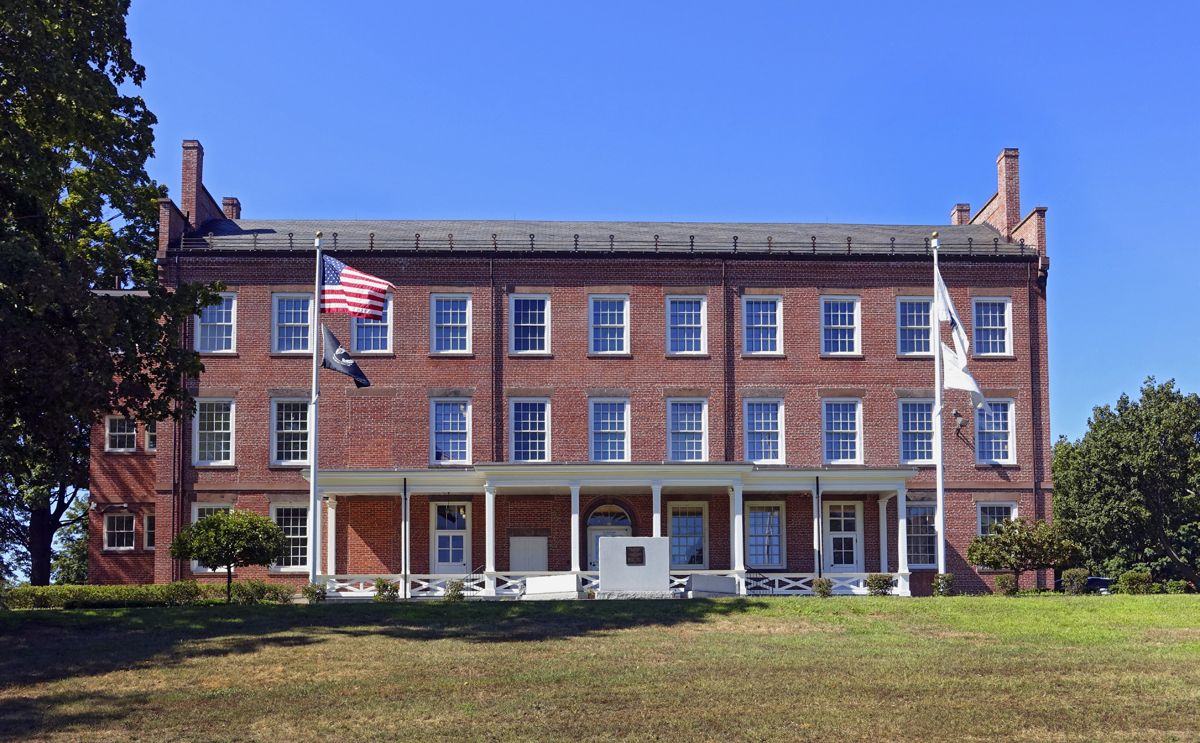
EDITOR’S NOTE — RIPLEY’S RANK Abbott refers to the commandant as “Colonel Ripley.” The officer in charge was James Wolfe Ripley, who commanded Springfield Armory from April 1841 to August 1854 and held the rank of major during this period. “Colonel” was therefore incorrect as a formal rank in this 1852 context, even if used socially or loosely.6 And yet the men at first complained, sometimes, of the stringency of rules and regulations required to produce these results. These rules are still in force, though now they are very generally acquiesced in. No newspapers of any kind can be taken into the shops, no tobacco or intoxicating drinks can be used there, no unnecessary conversation is allowed, and the regulations in respect to hours of attendance, and to responsibility for damaged work are very definite and strict. But even if the workmen should be disposed in any case to complain of the stringency of these requirements, they can not but be proud of the result; for they take a very evident pleasure in the gratification which every visitor manifests in witnessing the system, the order, the neatness, and the precision that every where prevail.
The Commanding Officer’s Quarters, or Quarters 1, erected under Major James W. Ripley from 1845 to 1847. The residence became a visible symbol of military administration at the Armory.
Nothing can be more admirably planned, or more completely and precisely executed than the system of accounts kept at the offices, by which not only every pecuniary transaction, but also, as would seem, almost every mechanical operation or act that takes place throughout the establishment is made a matter of record. Thus every thing is checked and regulated. No piece, large or small, can be lost from among its hundreds of fellows without being missed somewhere in some column of figures—and the whole history of every workman’s doings, and of every piece of work done, is to be found recorded. Ask the master-armorer any questions whatever about the workings of the establishment, whether relating to the minutest detail, or to most comprehensive and general results, and he takes down a book and shows you the answer in some column or table. After all, however, this neatness, precision, and elegance in the appearance and in the daily workings of an establishment like this, though very agreeable to the eye of the observer, constitute a test of only secondary importance in respect to the actual character of the administration that governs it. To judge properly on this point, the thing to be looked at is the actual and substantial results that are obtained. The manufacture of muskets is the great function of the Armory, and not the exhibition of beautiful workshops, and curious processes in mechanics for the entertainment of visitors. When we inquire, however, into the present arrangement of this establishment, in this point of view, the conclusion seems to be still more decidedly in its favor than in the other. The cost of manufacturing each musket immediately before the commencement of the term of the present commander was about seventeen dollars and a half. During the past year it has been eight dollars and three quarters, and yet the men are paid better wages now per day, or, rather, they are paid at such rates for their work, that they can earn more now per day, than then. The saving has thus not been at all made from the pay of the workmen, but wholly from the introduction of new and improved modes of manufacture, better machines, a superior degree of order, system, and economy in every department, and other similar causes. How far the improvements which have thus been made are due to the intrinsic qualities of military government, and how far to the personal efficiency of the officer in this case intrusted with the administration of it, it might be somewhat difficult to decide. In fact, when judging of the advancement made during a period of ten years, in an establishment of this kind, at the present age of the world, some considerable portion of the improvement that is manifested is due, doubtless, to the operation of those causes which are producing a general progress in all the arts and functions of social life. The tendency of every thing is onward. Every where, and for all purposes, machinery is improving, materials are more and more easily procured, new facilities are discovered and new inventions are made, the results of which inure to the common benefit of all mankind. It is only so far as an establishment like the Armory advances at a more rapid rate than that of the general progress of the age, that any special credit is due to those who administer its affairs. It always seems, however, to strangers visiting the Armory and observing its condition, that these general causes will account for but a small portion of the results which have been attained in the management of it, during the past ten years.
EDITOR’S NOTE — COST AND PRODUCTIVITY CLAIMS The quoted reductions in unit cost, the four-cent assembly price, and the ten-minute assembly time are important contemporary claims, but they have not been independently verified against surviving Armory cost ledgers for this edition. They should be cited as Abbott’s reported figures. The broader trend is well supported: powered machinery, gauges, specialized labor, and standardized components greatly increased output and reduced labor per arm.9, 10
CONCLUSION. As was stated at the commencement of the article, it is only a small part of the hundreds of thousands of muskets manufactured, that are destined ever to be used. Some portion of the whole number are served out to the army, and are employed in Indian warfare, others are destined to arm garrisons in various fortresses and military posts, where they are never called to any other service than to figure in peaceful drillings and parades. Far the greater portion, however, are sent away to various parts of the country, to be stored in the national arsenals, where they lie, and are to lie, as we hope, forever, undisturbed, in the midst of scenes of rural beauty and continued peace. The flowers bloom and the birds sing unmolested around the silent and solitary depositories, where these terrible instruments of carnage and destruction unconsciously and forever repose.
EDITOR’S NOTE — WHAT HAPPENED TO THE STORED ARMS The article closes by again imagining most stored muskets remaining permanently untouched. The Civil War overturned that expectation. Springfield’s manufacturing system expanded rapidly, federal arsenals issued older arms, and the Armory’s investment in standardized production became strategically important to the Union war effort. The conclusion is historically revealing precisely because it captures the confidence of the decade before 1861.9
ENDNOTES 1.
Jacob Abbott, “The Armory at Springfield,” Harper’s New Monthly Magazine 5, no. 26 (July 1852): 145–161. Digital transcription in Project Gutenberg eBook no. 42693, produced from public-domain University of Michigan scans; Project Gutenberg identifies the work as public domain in the United States. Springfield Armory National Historic Site, “The Federal Armories,” National Park Service, accessed July 23, 2026. This source identifies the Springfield Model 1842 as a .69-caliber percussion musket and distinguishes it from the later .58-caliber Model 1855 rifle-musket. Springfield Armory National Historic Site, “The Water Shops,” National Park Service, accessed July 23, 2026. The page documents the Lower, Middle, and Upper Water Shops, their use of Mill River power, the closing of the Lower Shops in 1845, demolition of the Middle Shops in 1856, and consolidation at the Upper Shops by 1855. Springfield Armory National Historic Site, “How to Make a Gun,” National Park Service, accessed July 23, 2026. The interpretation explains that machine tools and gauges made interchangeability practical and that by the 1840s locks no longer required individual hand fitting or the earlier identification marks. Springfield Armory National Historic Site, “The Main Arsenal,” National Park Service, accessed July 23, 2026. The building was constructed from 1847 to 1850 under
Major James W. Ripley, held up to 300,000 firearms, and has an 84½-foot tower. 6. Springfield Armory National Historic Site, “Superintendents and Commandants of Springfield Armory,” National Park Service, accessed July 23, 2026. The command list records Maj. James W. Ripley from April 1841 to August 1854. 7. Springfield Armory National Historic Site, “Commanding Officer’s Quarters,” National Park Service, accessed July 23, 2026. Quarters 1 was built under Major James W. Ripley from 1845 to 1847. 8. Springfield Armory National Historic Site, “Building 19,” National Park Service, accessed July 23, 2026. This source identifies black walnut as the principal gunstock wood and gives an air-drying period of two to eight years. 9. Springfield Armory National Historic Site, “The Armory and the City,” National Park Service, accessed July 23, 2026. Superintendent Roswell Lee reported 194 separate operations in manufacturing a flintlock musket in 1825; the same interpretation emphasizes the Civil War value of powered machinery, standardized gauges, and interchangeable parts. 10. American Society of Mechanical Engineers, “Springfield Armory,” National Historic Mechanical Engineering Landmark, accessed July 23, 2026. The landmark history credits Thomas Blanchard’s stock-turning lathe, Thomas Warner’s work in interchangeable production, and Cyrus Buckland’s precision gauges.
This illustration from 1850 shows the growth of Springfield Armory since its inception in 1794. The building in the foreground is the Main Arsenal building that acts as the Springfield Armory National Historic Site visitor center today. (Public Domain)