
Old Hickory’s Duelers—Andrew Jackson’s Pistols
By Jack W. Melton Jr. · Originally published September-October 2026 · pp. 36–44
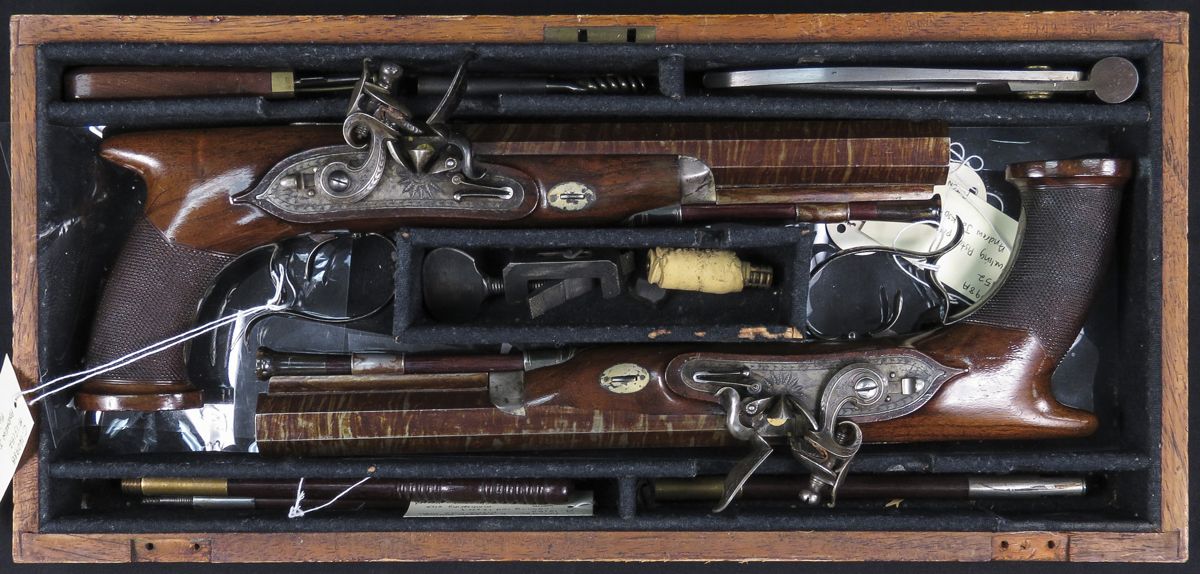
The Smithsonian Institution holds a matched pair of flintlock pistols that has long been associated with Andrew Jackson. The National Museum of American History catalogs the arms separately as AF.16089A and AF.16089B, with catalog numbers 16098A and 16098B. Both carry accession number 13152. One online record describes its pistol as “one of a pair of cased dueling pistols presented to President Andrew Jackson,” while the other omits the word “cased” but repeats the presentation claim.1
T That brief description leaves the most important questions unanswered. The public records do not identify the presenter, the date or occasion of presentation, or the evidence connecting the pair to Jackson. No case is shown, and no separately cataloged case has been located. The pistols may indeed have belonged to Jackson, but the public database does not provide a chain of ownership.
New research does, however, move the documented history of the pair farther back than the 1926 museum photographs previously cited. The key is accession number 13152. It places the pistols within a large body of historical relics transferred from the United States Patent Office to the National Museum in 1883. That establishes an institutional provenance for the pair. It does not, by itself, prove that Andrew Jackson owned them.
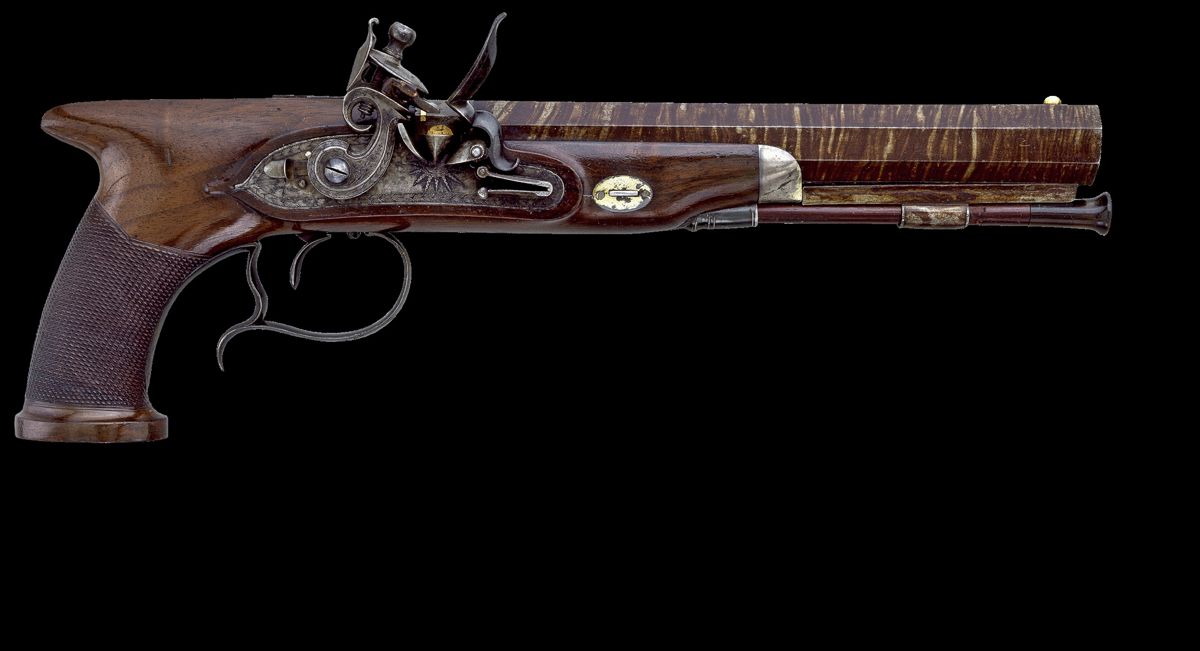
A Closer Look at the Pistols The museum catalogs both pistols as American-made, flintlock, smoothbore, muzzle-loading, single-action arms of .64 caliber. Each is recorded as measuring 13½ inches overall. The online entries do not identify a maker, a specific place of manufacture, or a date.2 The recorded .64-inch bore is large for a pistol of this form and should be confirmed by direct measurement. Museum caliber entries are sometimes
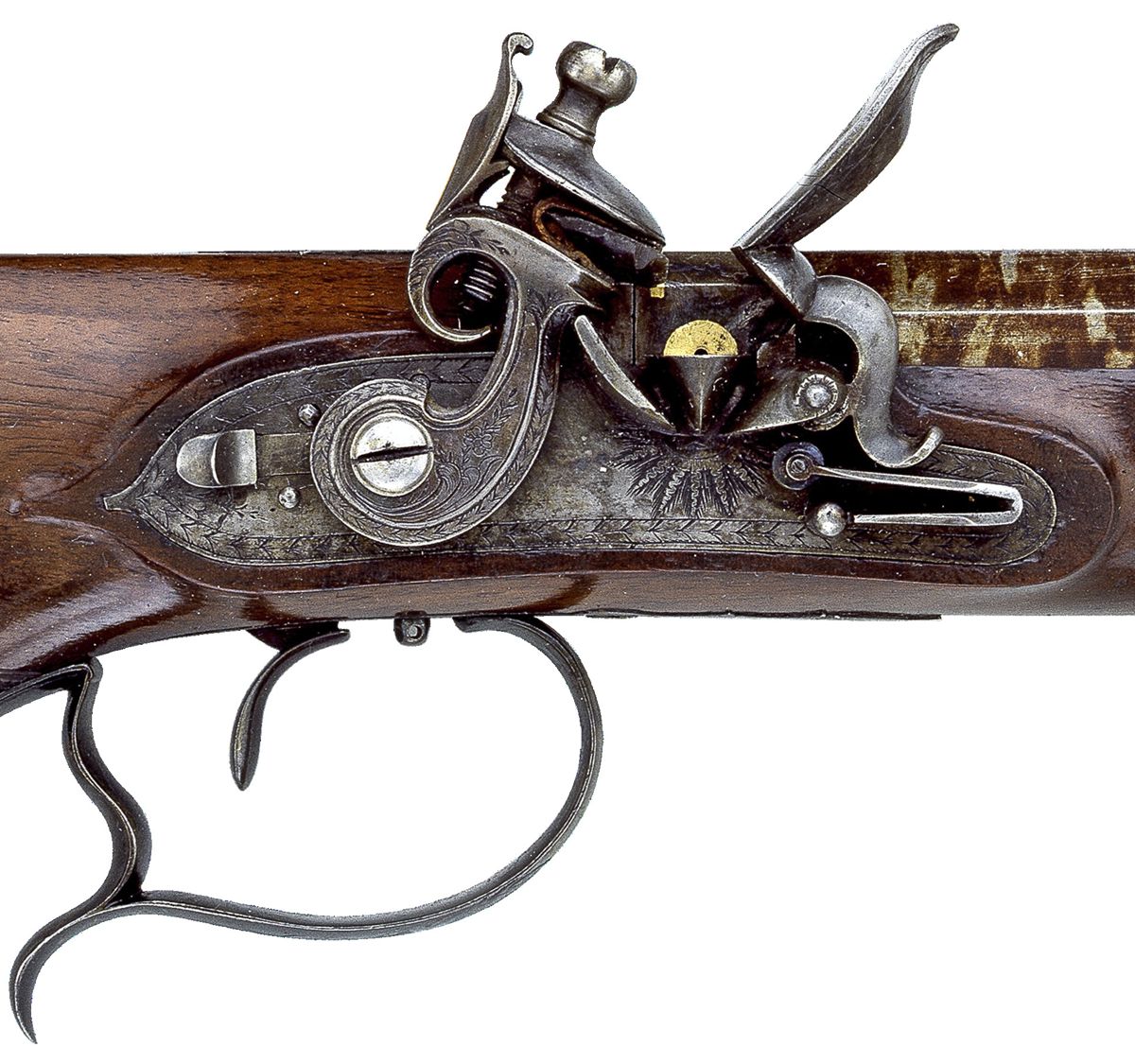
nominal, and no final technical description should be published without examining the bores, breeches, and any concealed markings. The Smithsonian photograph shows a wellmatched brace of half-stocked pistols with octagonal barrels. Both have flat, engraved locks with beveled edges, gooseneck cocks, roller-bearing frizzen springs, and double-set triggers within large trigger guards. The finely checkered grips terminate in flared, dished butt caps. The short forestocks are secured by transverse keys passing through oval escutcheons and are finished with white-metal caps. The barrels show bold figuring that may represent browned twist or laminated construction. Each pistol appears to have a low front sight and a shallow rear sight near the breech.
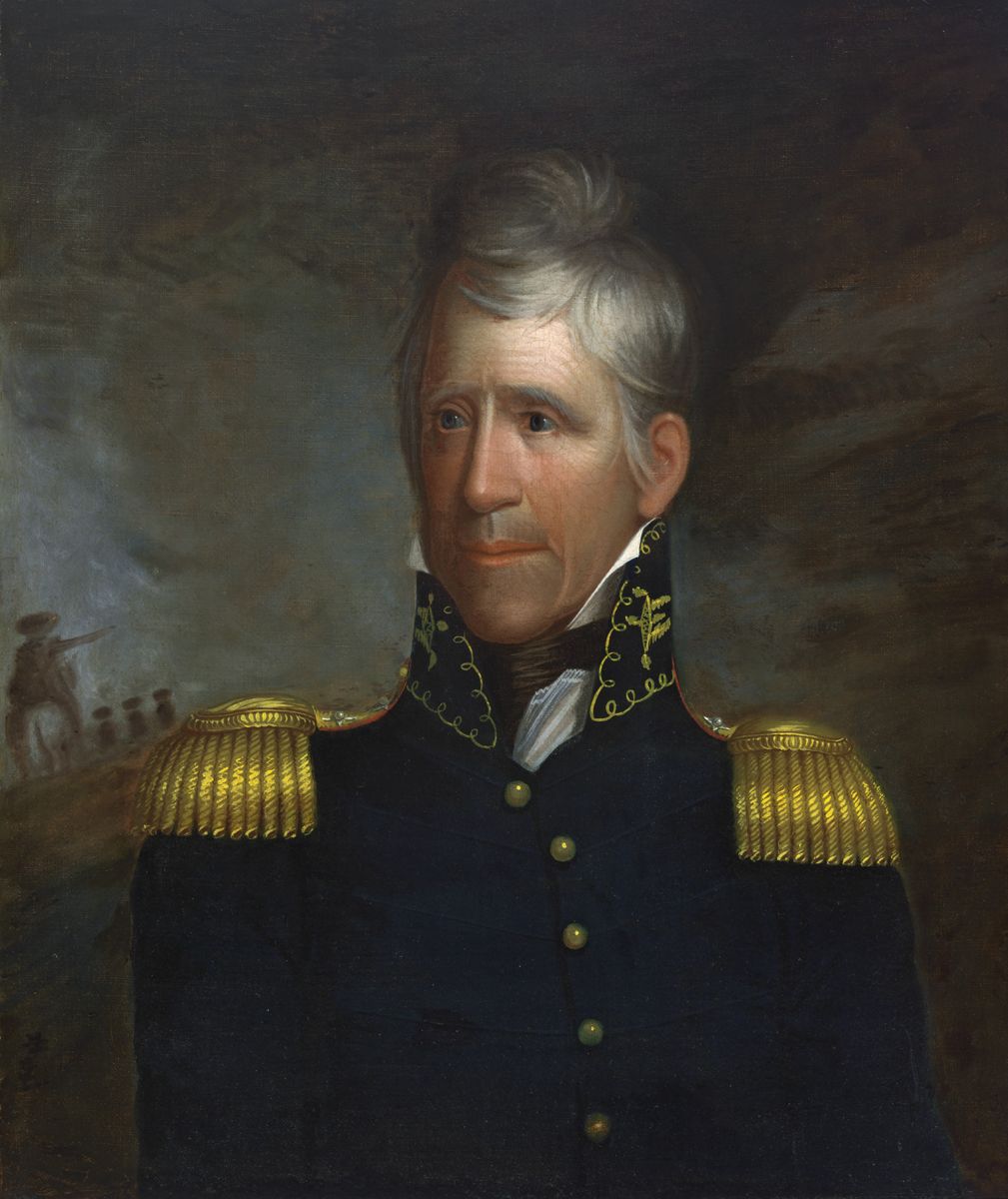
Andrew Jackson, oil on canvas by Ralph Eleaser Whiteside Earl, 1817. Earl painted Jackson at Nashville two years after New Orleans and became, in effect, his official portraitist. (National Portrait Gallery, Smithsonian Institution, NPG.65.78; transfer from the National Gallery of Art, gift of the A.W. Mellon Educational and Charitable Trust, 1942.)
The pair as it survives. Both pistols of the Smithsonian set, shown obverse with the muzzles to the right. Note the half stocks, the boldly figured octagonal barrels, the white metal forend caps, the oval key escutcheons, the double set triggers within a plain bow guard, and the flared, dished butt caps. The architecture argues for American manufacture in the 1820s or 1830s. (National Museum of American History, AF.16089A and AF.16089B (catalog 16098A and 16098B), accession 13152. Smithsonian photograph SIA-94-9996-000002.)
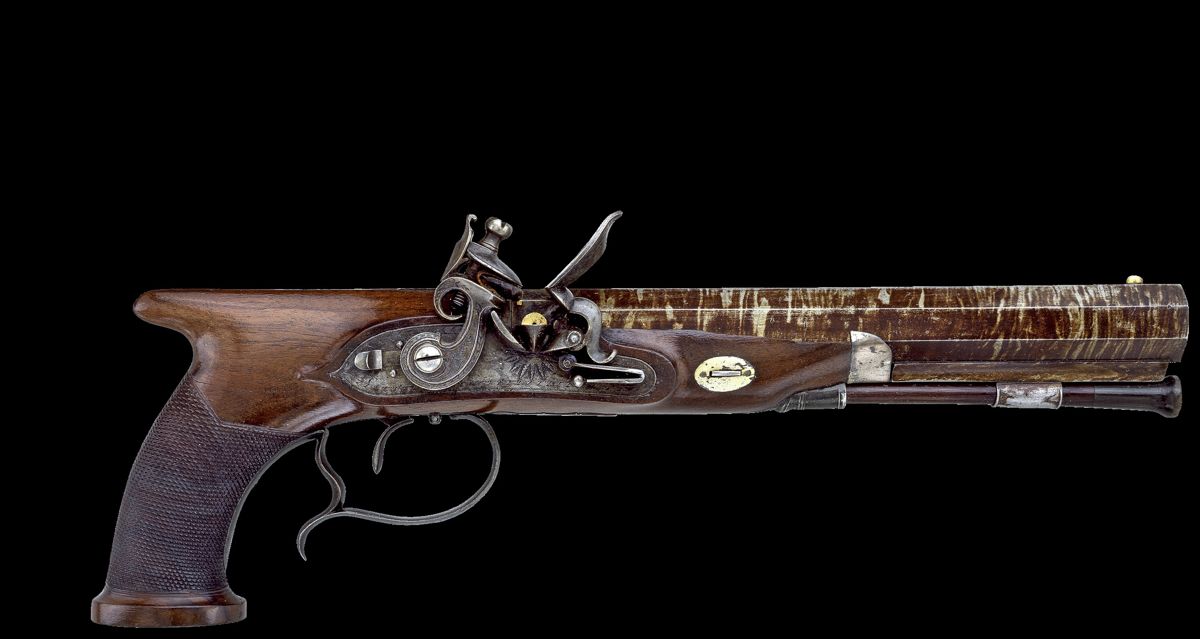
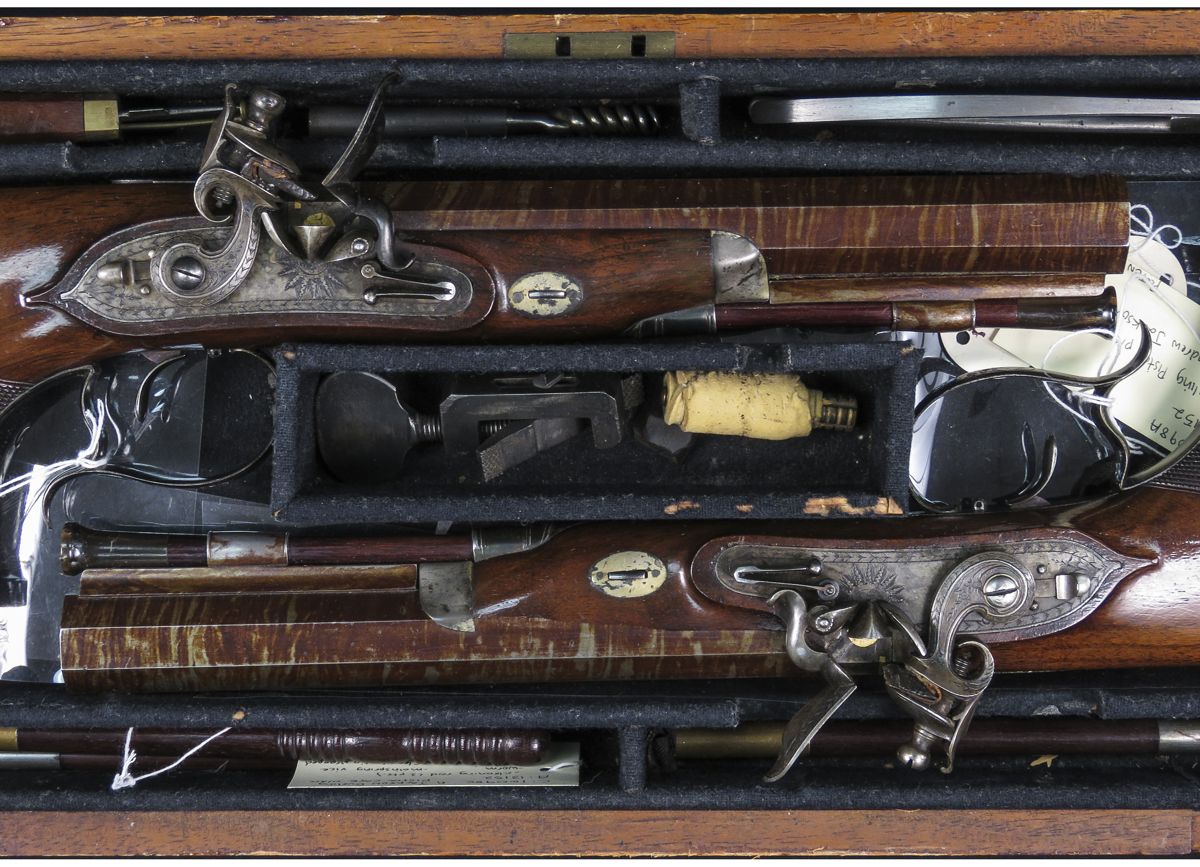
Set of two pistols, flintlock: AF16098B and AF16098A. (Smithsonian Institution)
Interior case, AF16098C, of set containing two pistols, flintlock: AF16098B and AF*16098A.
Those observations are based on photographs rather than a hands-on examination. The half stocks, set triggers, roller frizzens, grip form, and barrel treatment are consistent with American target or dueling pistols made during the 1820s or 1830s. That date should remain provisional until the locks and barrels can be removed and examined for signatures, assembly marks, proof marks, or inscriptions.
What Accession No. 13152 Tells Us The Smithsonian Institution Archives describes the United States National Museum accession records as the official documentation of the national collections. These records may include accession cards, memoranda, correspondence, specimen lists, and later material documenting the history of an acquisition. Since 1862, accession numbers were assigned sequentially, and post-1880 files generally followed a more regular format.3 The Smithsonian’s annual report for 1883 states that relics of George Washington and “other distinguished persons,” which had been displayed for many years in the Patent Office, were placed in the charge of the National Museum by the Commissioner of Patents during that year. The report adds that the objects were installed in temporary exhibition cases with related historical material already owned by the museum.4 Current Smithsonian records connect numerous objects under accession 13152 directly to that transfer. A surveyor’s compass is described as having been acquired in 1883 with other historical relics housed in the Patent Office. A panel from George Washington’s coach is said to have entered the Smithsonian with the Patent Office historical relic collections in 1883. Washington’s uniform, which also bears accession 13152, is likewise identified as coming from the Patent Office in that year.5 Because Jackson’s pistols carry the same accession number, the evidence strongly indicates that they were part of the same 1883 transfer. This is an archival inference based on the shared accession and the Smithsonian’s own descriptions of other objects in that accession. The accession file should still be examined before the statement is treated as fully documented at the individual-object level. This finding changes the provenance discussion in an important way. The pair did not simply appear in a twentieth-century firearms catalog. It belonged to an older federal collection of national relics and almost certainly came to the National Museum from the Patent Office in 1883. What remains unknown is when the Patent Office received the pistols, from whom it received them, what documentation accompanied them, and whether the Jackson identification was based on an early label, a family statement, a presentation inscription, or institutional tradition.
The Catalog Numbers The current records contain a numbering discrepancy that should be preserved in any research request. The database lists the identification numbers as AF.16089A and AF.16089B, but gives the catalog numbers as 16098A and 16098B. The museum photograph is captioned AF16098A and AF16098B. The available evidence does not establish when or why the digits were transposed. Researchers should cite both number sequences, along with accession 13152 and record numbers nmah_414380 and nmah_414381. The Smithsonian also warns that its online collection database is a work in progress and that records may be revised as research continues. That warning is especially relevant here because the public entries are brief, internally inconsistent, and unsupported by visible provenance documentation.6
Jackson and the Dueling Tradition An association with Jackson is plausible. Few American political figures were more closely identified with personal violence, dueling, and the code of honor. His best-known duel took place on May 30, 1806, at Harrison’s Mill in Kentucky, where he faced Charles Dickinson. Dickinson fired first and struck Jackson in the chest. Jackson remained standing, attempted to fire, recocked after his pistol stopped at half cock, and mortally wounded Dickinson. The ball that struck Jackson remained in his body.7 The familiar statement that Jackson fought one hundred duels should not be repeated as an established fact. Contemporary opponents gathered duels, quarrels, brawls, military executions, and other violent episodes into political attacks, and later retellings often treated every incident as a formal duel. John Binns’s 1828 coffin handbill is a primary example of how Jackson’s reputation for violence was used against him during the presidential campaign.8 That reputation helps explain why admirers might have presented him with a pair of pistols. A finely made cased set was expensive, personal, and politically meaningful. Such a gift recognized its recipient as a gentleman of standing and as a man prepared to defend his honor. The historical setting makes the museum’s description credible in a general sense, but plausibility is not provenance.
The pistol as political liability. John Binns’s coffin handbill of 1828, “Some account of some of the bloody deeds of General Jackson.” The six coffins across the head of the broadside stand for six militiamen executed under Jackson’s orders; the woodcut at lower right shows Jackson stabbing Samuel Jackson in the streets of Nashville. (Library of Congress)
The Armstrong Family Tradition
A public comment added to the museum’s website in August 2021 presents an Armstrong family tradition. The commenter stated that the pistols had belonged to George Washington and that Jackson later gave them to Colonel James “Trooper” Armstrong in recognition of General Robert Armstrong’s service and friendship. The statement may preserve part of an older family history, but it is not a museum accession record, presentation letter, or documented chain of custody.9
Robert Armstrong’s relationship with Jackson is independently supported by surviving correspondence in the Andrew Jackson Papers. That connection makes an Armstrong association possible, but correspondence between the men does not prove that these pistols passed between them. No located letter mentions this pair, its case, or a presentation.10 The George Washington portion of the family account does not fit the known material evidence. The famous Lafayette-Washington pistols are French-made saddle pistols dating from the Revolutionary era. They passed to Jackson in 1824, were later sent to Lafayette’s son, and are now preserved at Fort Ligonier. They are entirely different arms from the American half-stocked, set-trigger pistols at the Smithsonian.11 The most reasonable explanation is that two traditions became joined over time: a possible Armstrong connection to Jackson and the well-known story of Jackson receiving Washington’s pistols. The Washington claim should be removed from the provenance of the Smithsonian pair unless independent documentary evidence is found.
Another Jackson Pistol in the Same Accession
The National Museum of American History also holds a flintlock pistol associated with Major Lemuel P. Montgomery. Its record states that it was one of a pair Jackson presented to Montgomery when he was commissioned a major in the 39th United States Infantry. Montgomery was killed at Horseshoe Bend on March 27, 1814. Significantly, that pistol also carries accession number 13152.12 The shared accession number shows that the Patent Office transfer contained several arms and relics connected with Jackson and other prominent Americans. It does not mean that every historical statement attached to those objects is equally well documented. Each object still requires its own supporting
Flintlock pistol associated with Major Lemuel P. Montgomery. (NMAH)
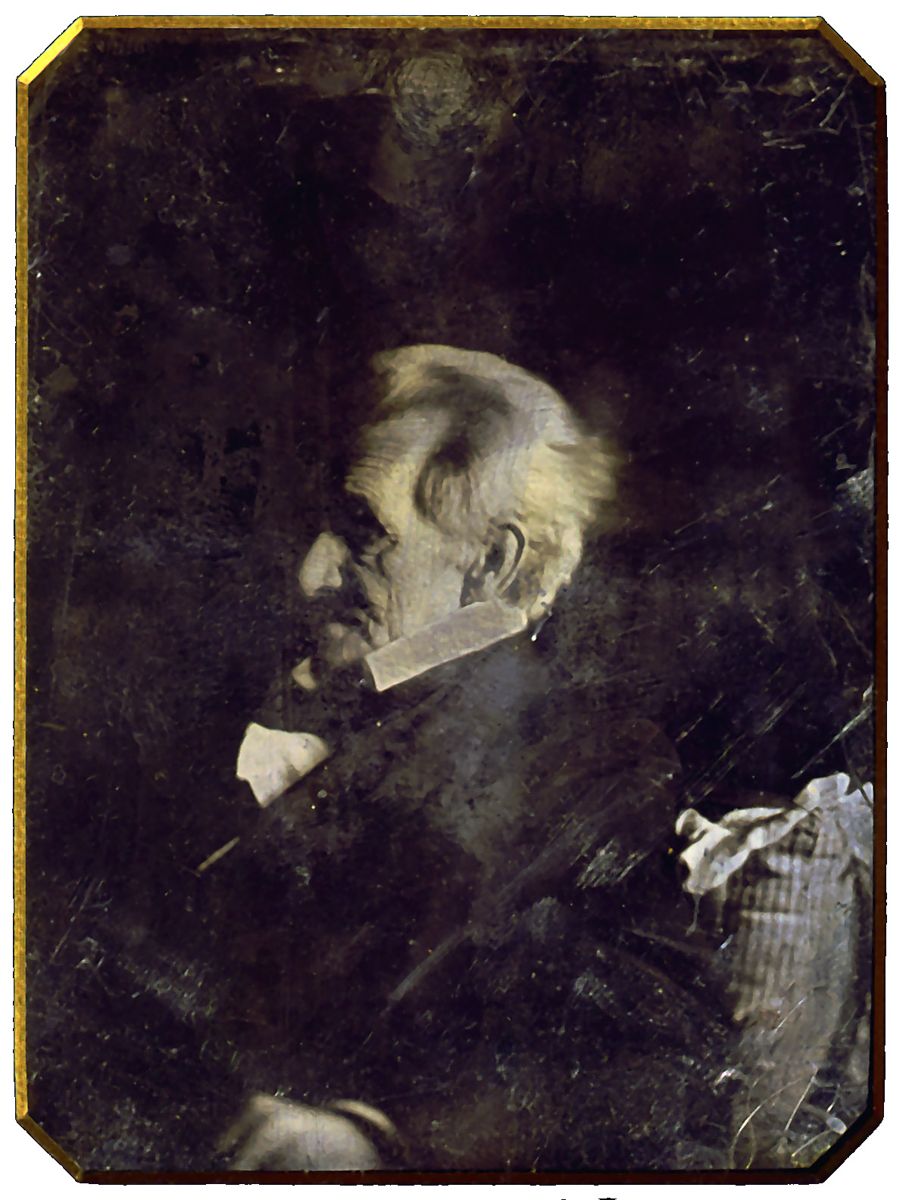
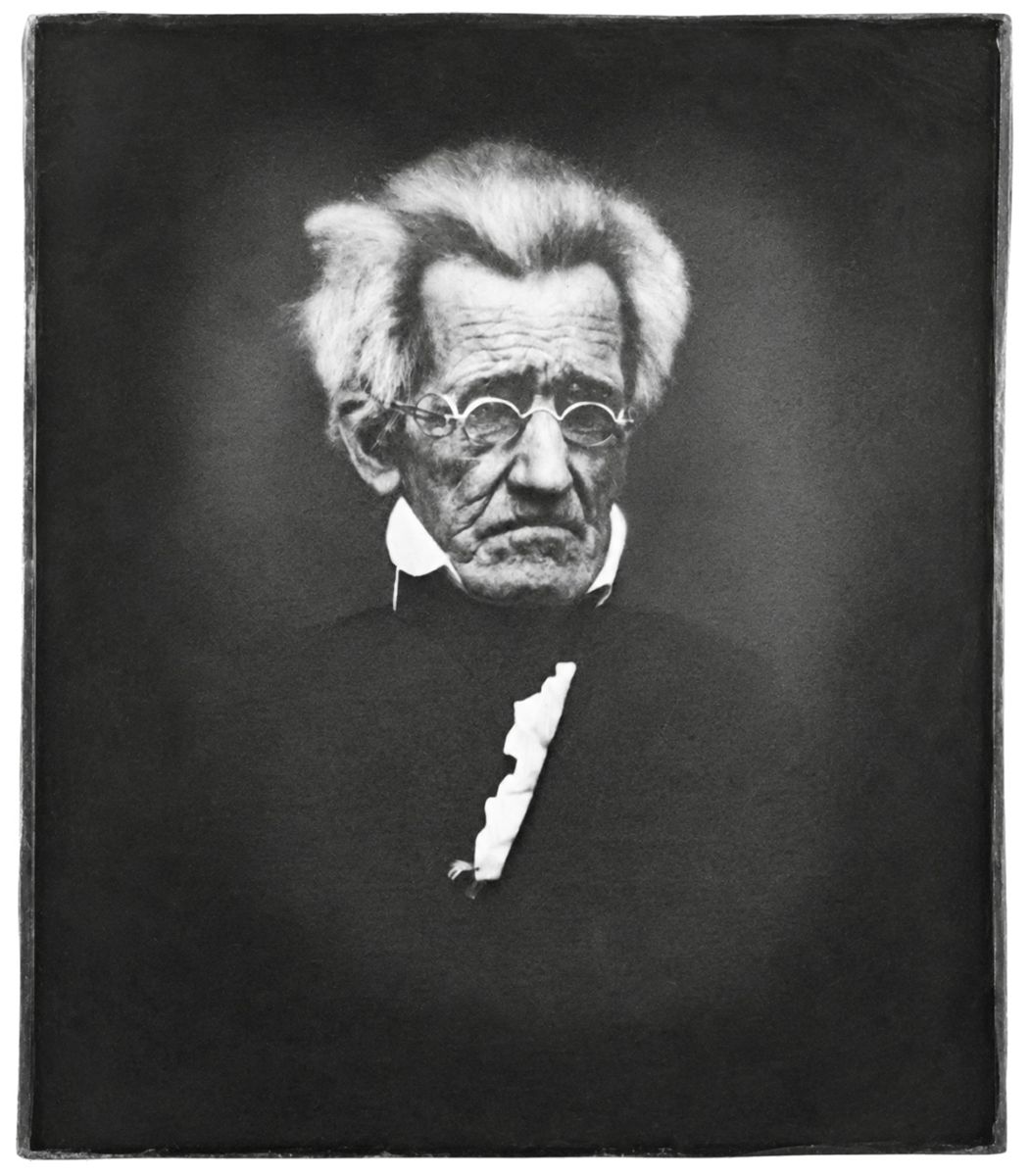
Daguerreotype taken of former US President, Andrew Jackson, circa 1844/45. (Public Domain)
label, correspondence, inventory entry, or other record. The Montgomery pistol’s named recipient and occasion provide a more specific claim than the anonymous presentation attached to the dueling pair, but its supporting file should also be reviewed before drawing a complete chain of custody.
The Pistols by 1926 By 1926, the pair was publicly identified at the National Museum as President Andrew Jackson’s dueling pistols. A National Photo Company image preserved by the Library of Congress shows museum employee Grace Stockman holding the pair. The catalog title supplies the Jackson identification and the date of the photograph.13 The photograph proves that the Jackson attribution was established within the museum by 1926. It does not reveal the source of that attribution. A high-resolution comparison should be made between the 1926 negatives and the current Smithsonian object photographs, but the visible form of the arms strongly suggests that the same pair is shown.
What Can Be Said With Confidence The surviving evidence now supports a more precise description than either an unqualified presidential presentation or a wholly undocumented museum tradition. The pistols are a matched pair of American flintlock arms cataloged as smoothbore, .64-caliber dueling pistols. Their architecture is consistent with manufacture during the 1820s or 1830s, although the date and maker remain unconfirmed. The pair carries accession number 13152, strongly linking it to the historical relics transferred from the United States Patent Office to the National Museum in 1883. By 1926, the museum was publicly identifying the arms as Andrew Jackson’s dueling pistols. What has not been documented in the material located for this article is the original
Andrew Jackson, head-and-shoulders portrait, nearly in profile to left, leaning against pillow of which ticking appears. (Library of Congress)
Old Hickory’s duelers on exhibition. Miss Grace Stockman of the National Museum displays a pair of pistols identified as Andrew Jackson’s dueling pistols, Washington, D.C., 1926. The photograph documents how the National Museum understood and presented these arms two generations before the current cataloging system was created. (Library of Congress)
presenter, the date and occasion of presentation, Jackson’s personal possession of the pair, the path by which the pistols reached the Patent Office, or the existence and disposition of the reported case. The Armstrong family story remains unverified, and its George Washington claim conflicts with the form and date of the pistols and with the documented Lafayette-Washington pair. Until the accession and curatorial files are examined, the most accurate publication caption would be: “Pair of American flintlock pistols, probably 1820s–1830s, transferred with the Patent Office historical relic collection to the United States National Museum in 1883 and long attributed to Andrew Jackson.”
Endnotes
- National Museum of American History, “Andrew Jackson Dueling Pistol,” object record nmah_414380, ID number AF.16089A, catalog number 16098A, accession number 13152, https://americanhistory.si.edu/collections/object/nmah_414380; and “Dueling Pistol presented to Andrew Jackson,” object record nmah_414381, ID number AF.16089B, catalog number 16098B, accession number 13152, https://americanhistory.si.edu/collections/object/nmah_414381. Both accessed July 2026.
- Ibid. The records describe the pistols as American-made flintlock, smoothbore, muzzle-loading, single-action arms of .64 caliber and give overall measurements of 13½ by 6½ by 2½ inches. See also Smithsonian photograph SIA-94-9996-000002, captioned “Pistol set. Dueling pistols presented to Andrew Jackson. AF16098A, AF16098B. Obverse view.”
- Smithsonian Institution Archives, “Accession Records, 1834–1958 (accretions to 1976),” SIA RU000305, https:// siarchives.si.edu/collections/siris_arc_216874. The finding aid describes the accession files as the official documentation of the national collections and notes that post-1880 files usually contain an accession card, memorandum, correspondence, and specimen lists.
- Smithsonian Institution, Annual Report of the Board of Regents of the Smithsonian Institution for 1883 (Washington, D.C.: Government Printing Office, 1885), 53, 178, https://archive.org/details/annualreportofbo1883smit. The report states that relics of George Washington and other distinguished persons, long displayed in the Patent Office, were placed in the charge of the National Museum by the Commissioner of Patents during 1883.
- National Museum of American History, “Compass (Surveyor’s Plain),” object record nmah_747313, https://americanhistory.si.edu/collections/object/nmah_747313; “George Washington Coach Panel and Label,” object record nmah_515709, https://americanhistory.si.edu/collections/object/nmah_515709; and “George Washington’s Uniform,” object record nmah_434863, https://americanhistory.si.edu/collections/object/nmah_434863. Each carries accession number 13152 and identifies the 1883 Patent Office transfer.
- National Museum of American History, “About the Online Collection,” https://americanhistory.si.edu/collections/about-online-collection, accessed July 2026.
- Robert Brammer, “Frontier Racing and Injured Pride: The Duel Between Andrew Jackson and Charles Dickinson,” In Custodia Legis, Library of Congress, April 15, 2015, https://blogs.loc.gov/law/2015/04/frontierracing-and-injured-pride-the-duel-between-andrewjackson-and-charles-dickinson/; Charles Dickinson to Andrew Jackson, January 6, 1806, Andrew Jackson Papers, Manuscript Division, Library of Congress.
- John Binns, “Some Account of Some of the Bloody Deeds of General Jackson,” broadside, 1828, Library of Congress Rare Book and Special Collections Division, https://www.loc.gov/item/2008661734/.
- Comment posted by Richard Colton Armstrong on August 10, 2021, to the National Museum of American History object page for AF.16089A, https://americanhistory.si.edu/collections/object/nmah_414380.
- Andrew Jackson Papers, Manuscript Division, Library of Congress, MSS27532, https://lccn.loc.gov/mm79027532; Robert Armstrong to Andrew Jackson, June 24, 1836, https://www.loc.gov/item/maj015064/; Andrew Jackson to Robert Armstrong, June 26, 1840, https://www.loc.gov/item/maj024671/. “
- The Lafayette/Washington Pistols,” American Rifleman, https://www.americanrifleman.org/content/the-lafayette-washington-pistols/; Fort Ligonier, “The George Washington Gallery,” https://www.fortligonier.org/museum/george-washington-gallery/; Frederick M. Winship, “Historic Pistols Bring Almost $2 Million,” United Press International, January 18, 2002, https:// www.upi.com/Odd_News/2002/01/18/Historicpistols-bring-almost-2-million/76861011397722/.
- National Museum of American History, “Major Lemuel Montgomery’s Pistol,” object record nmah_676661, ID number AF.16090, accession number 13152, https://americanhistory.si.edu/collections/object/nmah_676661. “[
- Miss Grace Stockman with President Andrew Jackson’s Dueling Pistols, at the National Museum],” 1926, National Photo Company Collection, Library of Congress Prints and Photographs Division, reproduction number LC-USZ62-113714, https://www.loc.gov/item/95507718/; and “Grace Stockman of National Museum with Andrew Jackson Pistols,” https://www.loc.gov/item/2016841821/.