
Interview with Shannon Pritchard
Originally published September-October 2026 · pp. 16–24
-
How did your journey as a collector begin, and what was it about Civil War artifacts, especially Confederate material, that first drew your interest? My family had no interest in the War and never talked about it or anything, but for some reason, I was setting up old beer cans and shooting the “Yankees” down with a .22 when I was eight. My next exposure came when my older sister’s boyfriend relic-hunted on the farm and gave me a couple of bullets when I was twelve. Then, by 16, I was relic hunting with friends, and I began reading Civil War history as a means of finding “spots.” I became a fanatic relic hunter and a fanatic reader. 2. At what point did you decide to move from collecting to dealing, and what motivated that transition? I had never purchased a relic; I only had what I found. By the time I was 24, I had been blessed to build a successful Snap On Tool business and had some extra money, so I purchased a stamped Virginia belt plate and a tray of buttons from one of my customers. I had always wanted to find one, but I had never found a state seal or CS-marked plate. I spent the next six months learning everything about the plate that I could, so I started going to shows.
-
Could you describe your earliest acquisition as a dealer that made you feel this business could succeed? I was at the Richmond show and had just had a discussion with a dealer about the Virginia plate. He handed it back to me, and I turned around and was face-to-face with the well-known, but unknown to me, Bob Dailey of Middleburg. Bob said, “do you want to sell that?” I had never thought of selling it, but what the heck, I shot him the same price that I had paid for both the plate and the tray of buttons, and he bought it. And I thought, mmmm, something to this. I still never thought of going into business. What I thought about was that I could take that money, buy something else, and study it. Heck, I did not even recognize that it could be a full-time business. I had a successful business that I loved, and I assumed that I would own it for the rest of my days. So I began going to shows to find something else to buy. 4. Did others play into your business as well? Yes, both the good guys and the crooks: one showed me what not to be, and the other showed me what to be. Lewis Leigh Jr. had a big influence on me. Lewis was respected both for his knowledge
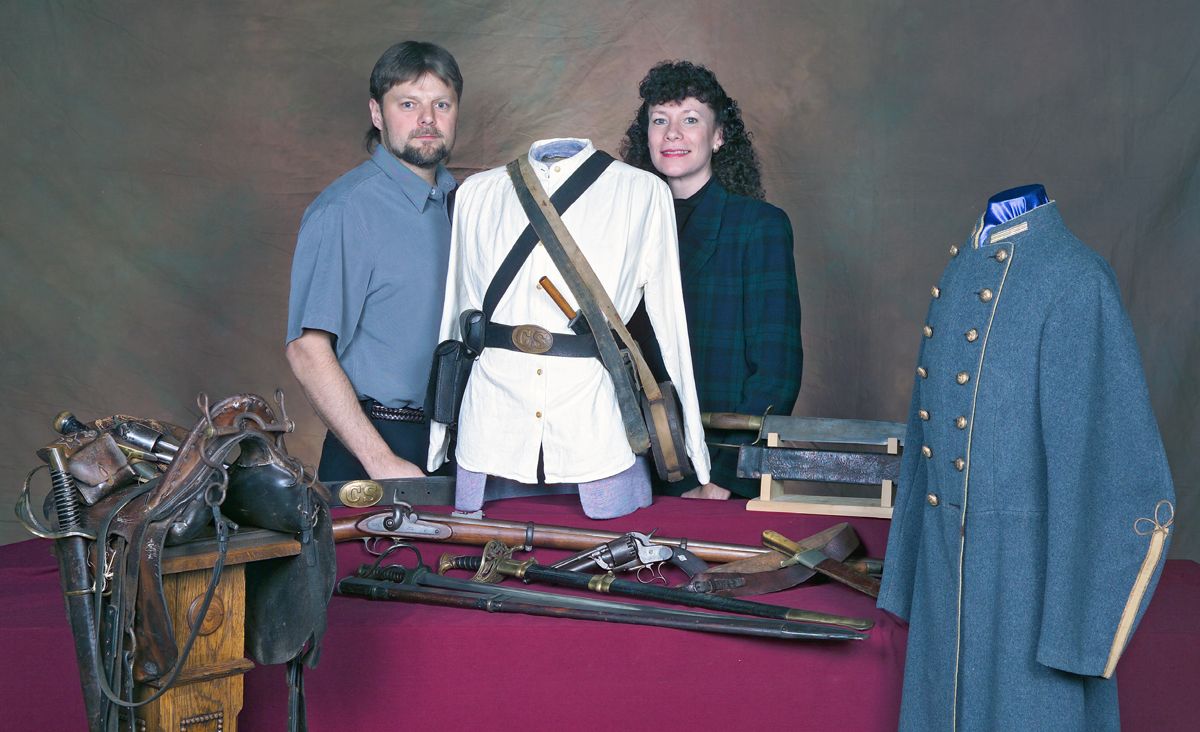
Jack Melton took this promotional photograph in February 2005, during the Dalton, Georgia Show. Our son Caleb is in Lesia’s 7 month belly, hiding behind the mannequin.
and his integrity, and I wanted that. In fact, I once told him that “in twenty years I want to have your reputation.” 5. How did that eventually turn into a business? After attending shows for a good while, I got the idea that all the good stuff was traded on Friday night. That proved untrue, but it got me started setting up at shows. You should have seen my first show. I had a crappy plastic table cover covered with shell fragments. LOL. But it got me in the door on Friday. Well, my hopes for Friday proved untrue, but by working the shows and being there the full three days, I was able to study a lot more artifacts and get to know a lot of the dealers, diggers, and dilettantes. Yes, big word; it comes from all that reading. I never passed tenth-grade English, yet now I write books and articles. Read, kiddies, read a lot. Anyway, that process of buying, studying, documenting, and selling became faster and faster. A lot of the stuff that I studied and documented eventually became my first book, Collecting the Confederacy. I should have mentioned that, during all this time, I was only studying Confederate items. Not because of some plan, but because that was where my interest was. And the more I read, the more I realized that the South was an innocent victim of the War and of the accepted history. As a result, I gradually became a crusader for true history. During the course of my collecting, I had ordered perhaps a dozen things from various dealers’ catalogs. You remember them: black and white, no pictures, just a description in those days? Well, not a single one of those items were as described. That
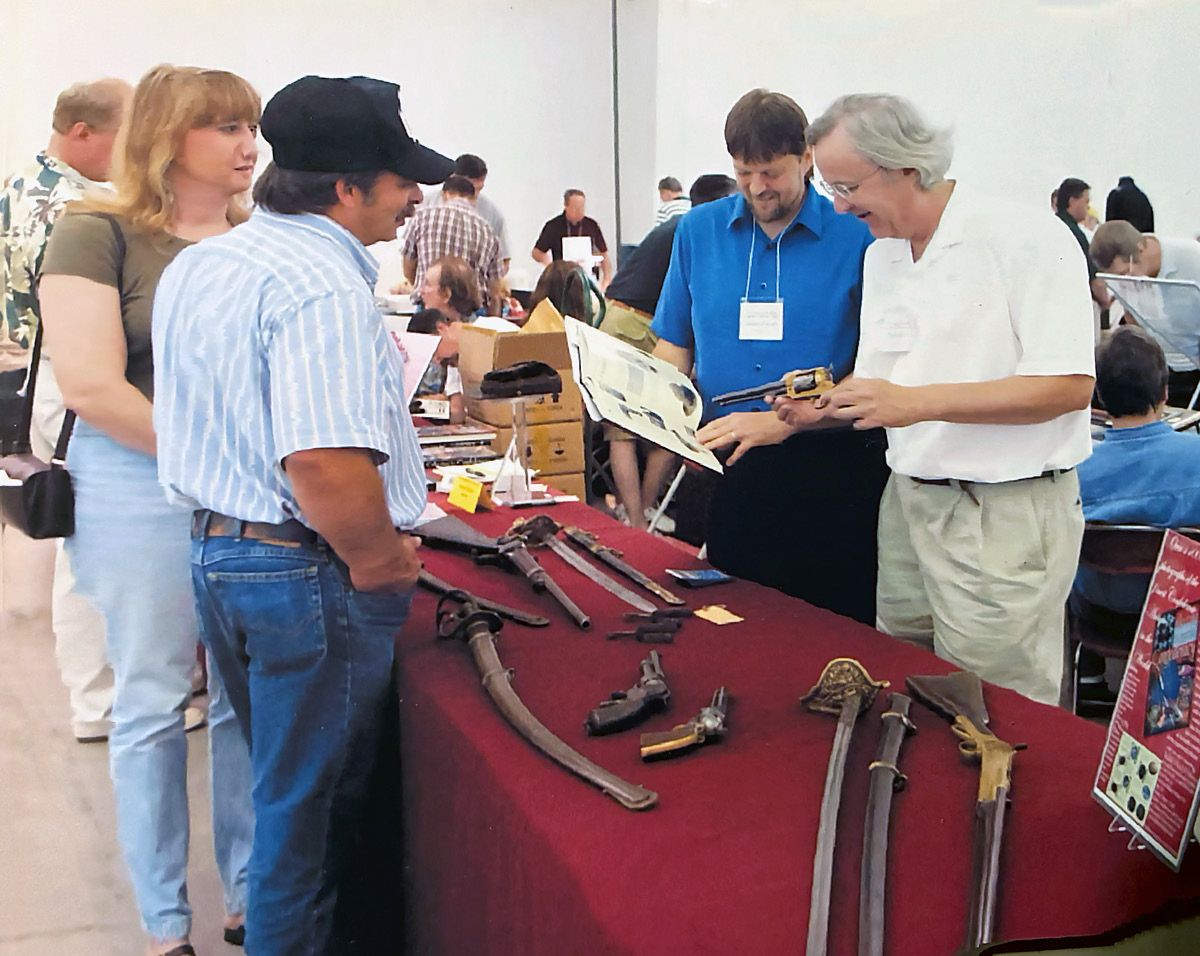
Gettysburg Show in 2005, debut of Collecting the Confederacy, with friends Jim Robson and Kenny and Becky Fleming.
gave me the idea to put out the first color catalog. It looked great compared with the black-and-white descriptions. I cringe when I look at them now; my goodness, they are awful. But back then, with slide photography, they were a heck of a lot of work to put together, and remember, this was still a hobby to me. But I was having fun getting to own and handle so many Confederate items, which, at the time, was my only goal. What really changed it was getting Lyme disease. My Snap On business was getting too hard for me in my condition, and I could no longer relic hunt. Then God gave me Jeb Stuart’s presentation sword. Not to say He did not make me work for it and sweat blood for it, but nevertheless, He gave it to me. Researching that led me to find other unknown Stuart items: his Military Dispatch book, his dress Virginia belt, his personal flag, which I rediscovered, and other lesser items. I sold my Snap On business and have been playing at making a living ever since. As it has been said, “If you love what you do, you will never work a day” 6. What does “quality” mean to you when selecting inventory? When do you decline something because it isn’t up to your standard? This takes me back to my previous answer: “not a single one of those items were as described.” I know the sinking feeling a collector gets when he buys something; he treasures it, respects it, and, may I say, “loves it.” Then, usually when he goes to sell it, someone points out the problems with it. Who in collecting hasn’t had that truth bomb ruin his day? I could never respect myself if I caused someone to have that terrible feeling. That is, in fact, the secret to my success, I believe. Far too many dealers think it is proper to make a sales pitch, à la the typical used-car salesman; i.e., make the good points sound better than they are and not mention the bad points. But that leads to the sinking feeling I mentioned. My idea of quality is that I can point out the good points honestly and point out the bad points honestly, and the buyer still wants it. That can only be done by buying items that are genuine, original, and in good condition, not by buying cheap stuff and talking it up to get more money out of it. It makes me sick to hear a dealer talk about how bad something is when buying it and how good it is when selling it, yet this is all too common. Provenance is another hot-button issue with me. I see people selling “identified” items with nothing more than a story and three initials, or a written provenance from some unknown individual that is not notarized or countersigned. My standard is that the provenance is such that I could present it to a jury of

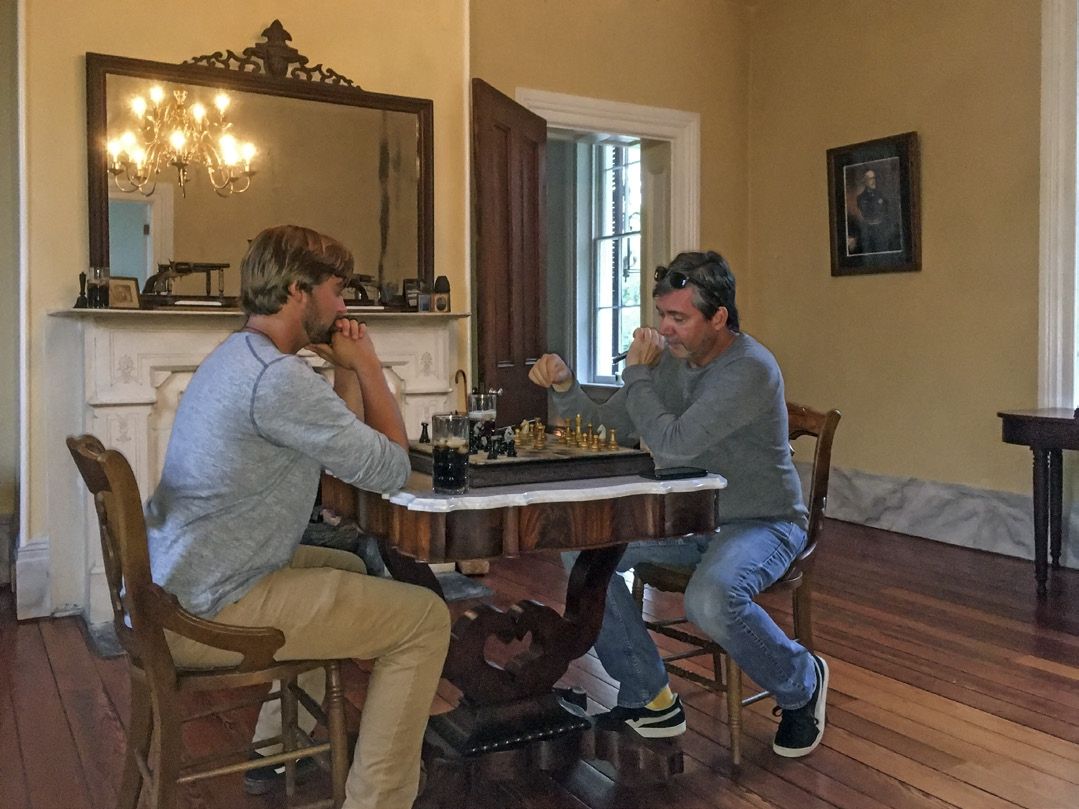
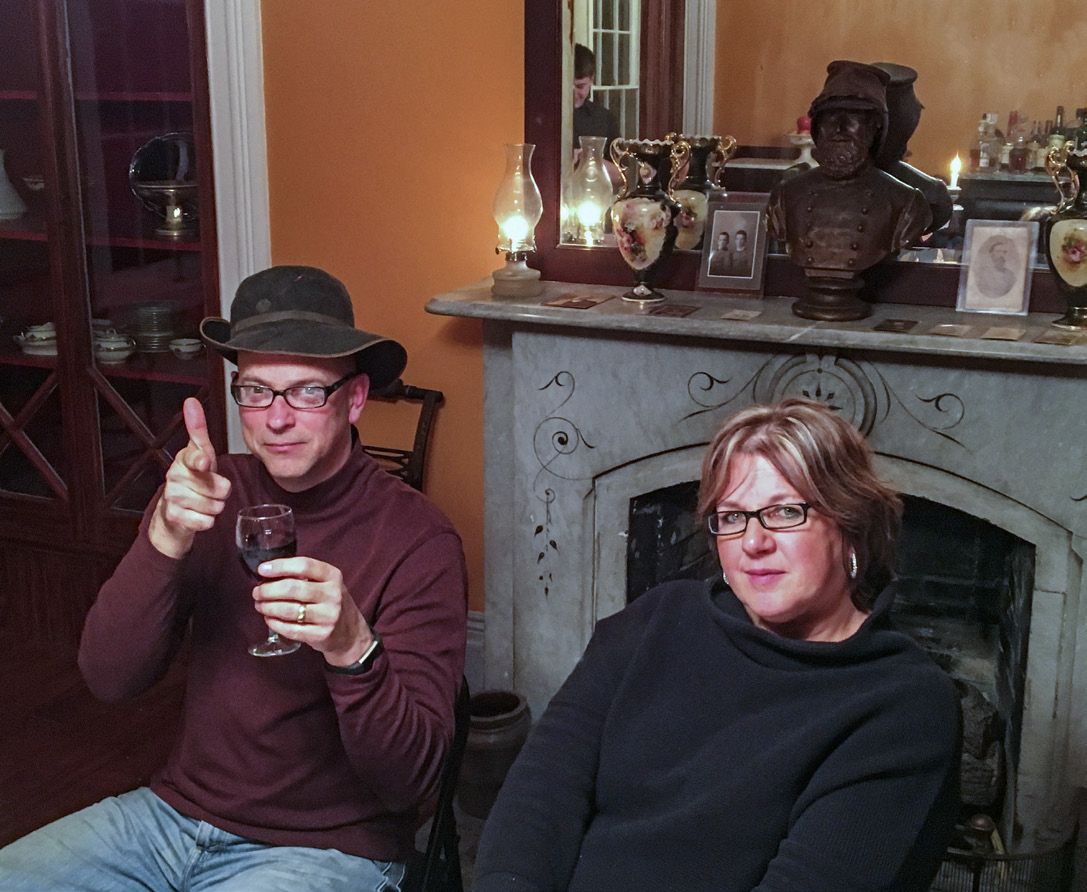
First-class Civil War dealer Nick Periut and his buddy Paul Alter playing on a 150-year-old chess set belonging to the Wickhams in the ladies’ parlor of General Wickham’s Plantation, Hickory Hill, Ashland, Virginia.

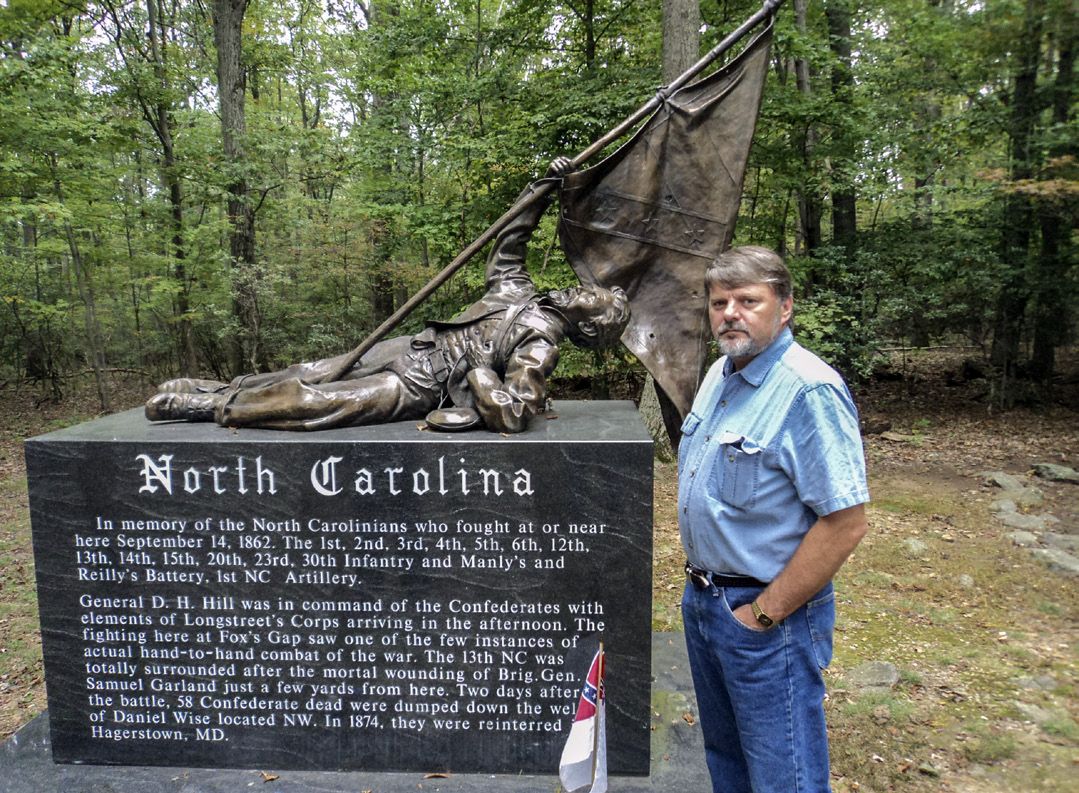
Me standing next to the North Carolina monument on South Mountain battlefield.
One of many speaking engagements. This one at the Delaware Grays Camp SCV.
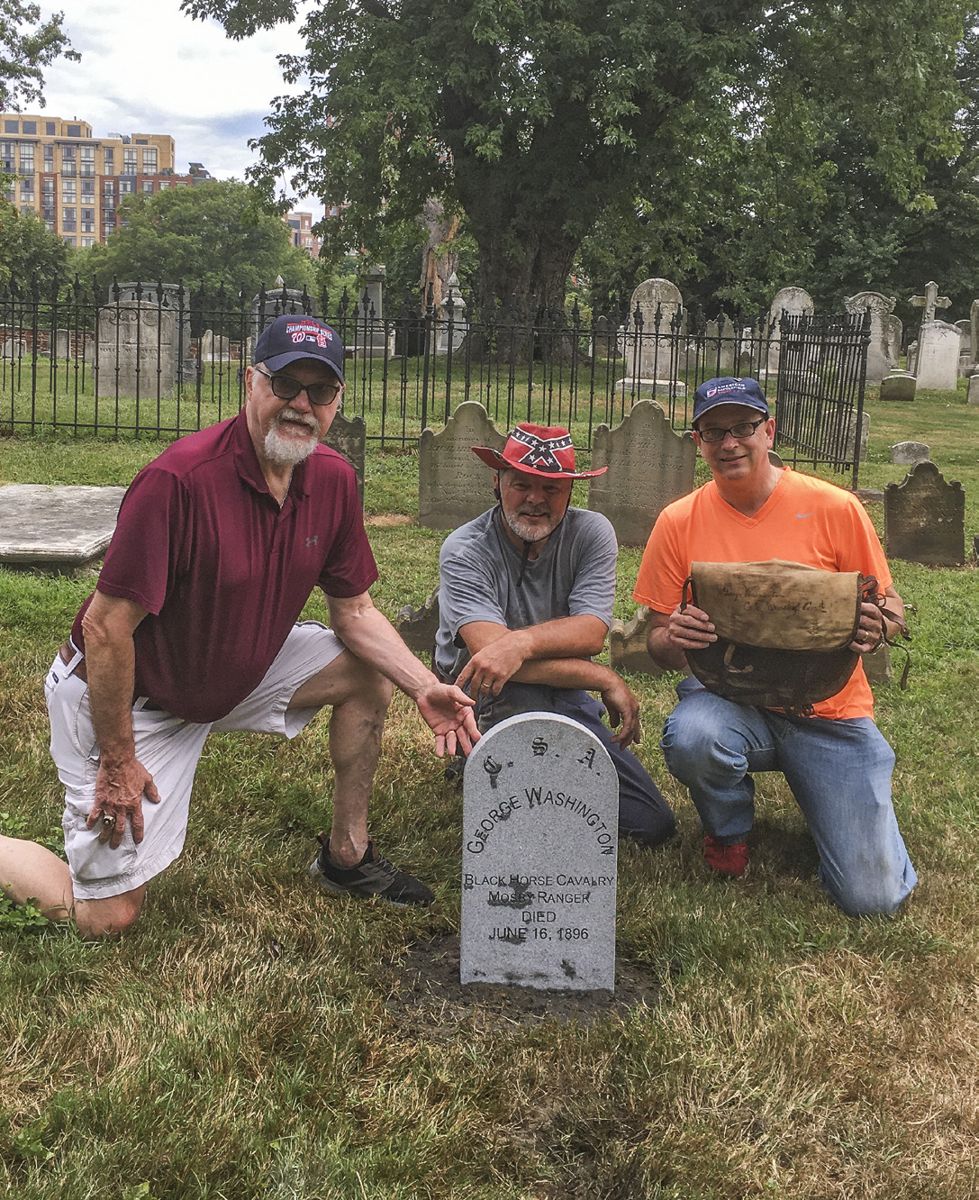
Author and Mosby aficionado Don Hakenson, Shannon Pritchard and Steve Basheda, installing Black Horse Cavalry and Mosby Ranger George Washington’s headstone. Steve is holding Washington’s saddlebags.
God, Family, South, in that order.
my peers, and they would agree that it is solid. Only if an item meets my condition standard when it is unidentified, and my provenance standard when it is identified, will I buy it or sell it on consignment.
- Of all the categories you deal in (long arms, handguns, edged weapons, bayonets, knives, sabers, etc.), which do you personally enjoy handling most and why?
I am more concerned about condition than what an item is. I like them all, but I don’t do much with bayonets, bullets, or buttons. I am not smart enough; there are too many variants. All kidding aside, I just never had a passion for them. 8. What is the most dramatic, rare, or unusual edged weapon you’ve handled or sold (firearm, bayonet, fighting knife, etc.)? That is easy to answer: Jeb Stuart’s one-of-a-kind presentation Kraft, Goldsmith & Kraft sword. This is from both a rarity standpoint and the extraordinary circumstances of researching it. And also from an emotional standpoint, all these years later, all I have to do is think about it, and the hair on my neck and a third of the way down my spine tingles. It is right now!

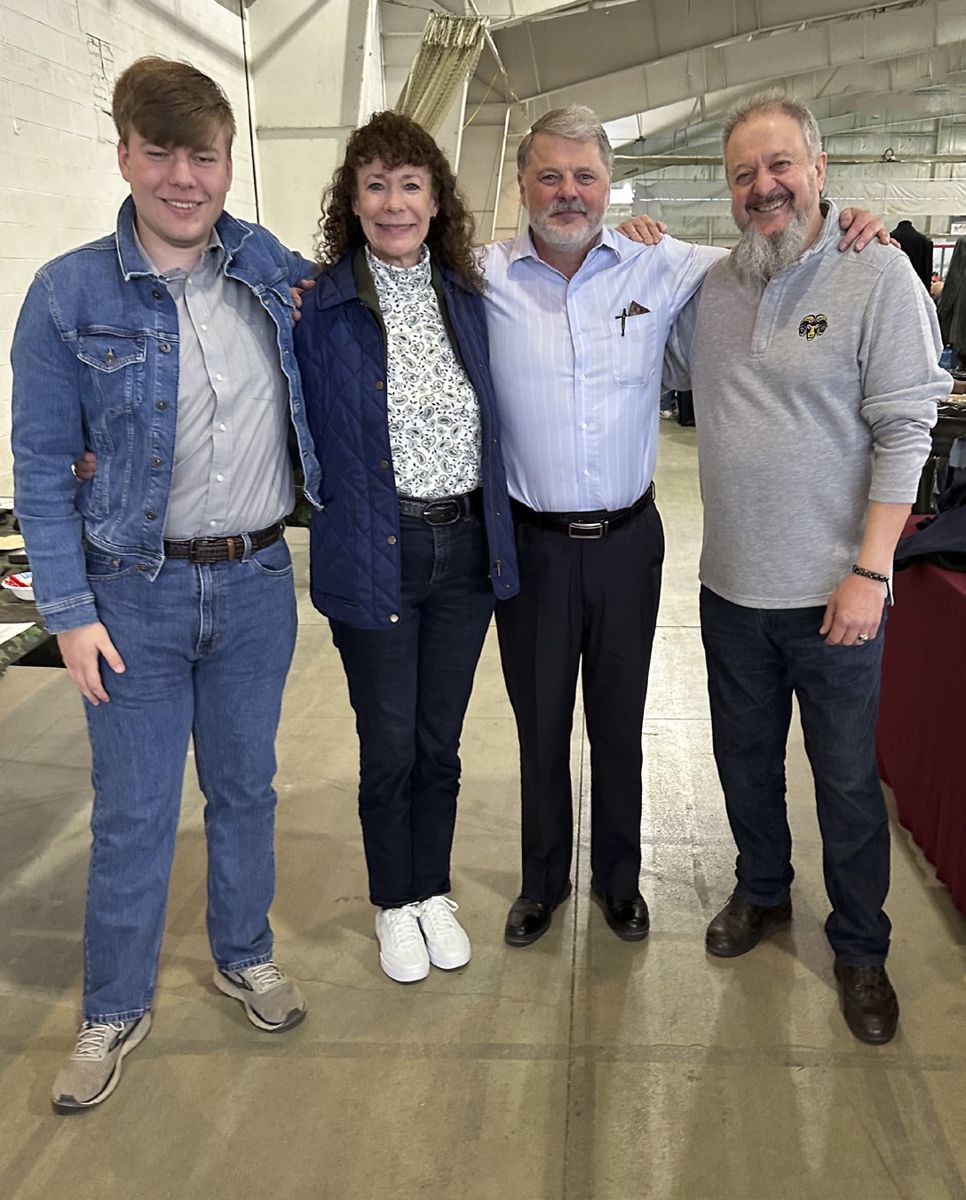
The Old South Crew, Caleb, Lesia and Shannon Pritchard and our friend and Confederate Collecting Frenchman, Jean Luc Nonnemacher at the Gettysburg Show in 2025.
- In terms of firearms, is there a single piece— revolver, rifle, shotgun—that you found particularly meaningful (emotionally, historically, or personally)?
This one is easy, too. That would be Colonel John Mosby’s pair of Colt Army revolvers. No one knew these existed when I discovered them. I see this as another gift from God. I spent months researching them, dug out all of their history, went where Mosby carried them the night he lost them, went to where he lost them, then tracked the man who took them and the man who received them when the captor was killed, all the way down through his children. I was able to document it all. There I go, getting chills again. I love this business!
- How do you assess provenance and authenticity, especially for high-stakes items? Could you share a case in which questions of authenticity were tricky? This would require an article or two or more to cover properly because it is different for every item and every case. I can offer some general rules that are appropriate for each and every item. What are the facts? I see “identified” items with pages and pages of paperwork that are supposedly a provenance, but really they are just a smokescreen. It is the “baffle them with bull” sales approach. I don’t care if you have 50 pages of records relating to someone. How is it identified to that someone? Because so-and-so said so is not a provenance. A receipt that says that is what so-and-so bought is not a provenance. A list of collectors who owned it
The King and Queen of Confederate Cavalry Collectors, Dr. Steve and Lynn Basheda. Steve is wearing Briscoe B. Ranson’s slouch hat that still shows the effects of his (Ranson, not Steve) being struck in the head by a sabre.
in the past is not a provenance. It comes back to this: What are the facts? Do you have a letter written by someone purporting to be a descendant? That is not a provenance unless it is notarized, or the person who signed it can be contacted and provide a notarized statement. If you get that, you almost have a provenance; you still have to do your own family research and see if the person who signed it really is a descendant of the person to whom it is identified. You would be surprised how often letters of provenance are written by people claiming to be descendants who are not. Then there is the item itself. Is it manufactured correctly, i.e., with the correct materials and the correct technique? If you don’t know what is correct beforehand, you are playing with fire. However, if you can get a genuine item to compare it to, and you understand metals, textiles, leather, and the effects of time on each of them, comparison is valid. Let me give you a case in point. I was approached by a man named “famous general” who had his ancestor’s sword, which had been passed from a famous general to his son, then to his son, and then to “famous general,” who had the same name as his famous-general grandfather. “Famous general” looked like the famous general to a striking degree. He provided me with a letter stating the above, and it was signed and notarized by “famous general.” He showed me his driver’s license, and he was indeed “famous general.” I could have easily sold the famous general’s sword for several hundred thousand dollars based on what I had in hand. However, following my standard practice before closing the deal, I researched his ancestry. I researched it to the ends of the earth, which consumed time and travel. What I learned was that the
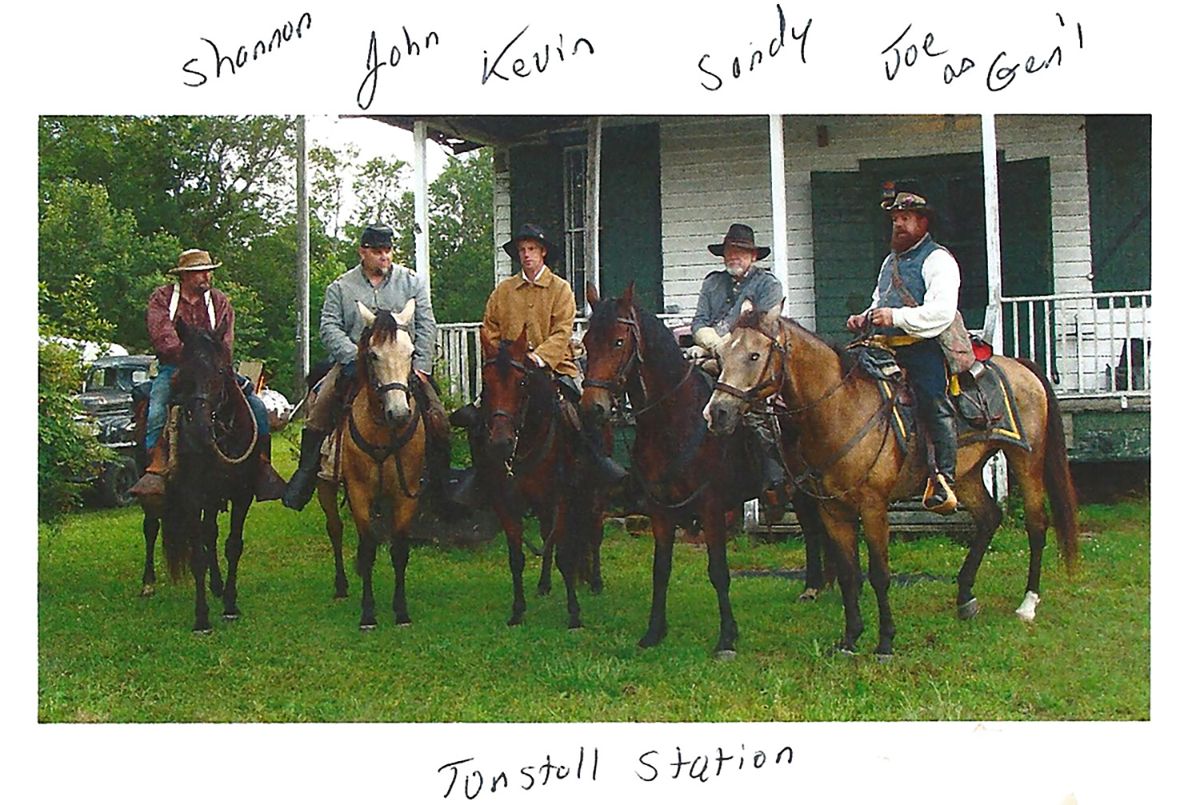
The longest ride of my life. This is my fellow misfits and me following Stuart’s “Plume” around McClellan 150 years later. My legs would not hold me up that night. “Midnight” got me through. The next day, she rolled backward over me when a Yankee cannon blasted her in the face.
famous general had no children… I have no doubt that “famous general” had been told by his father that he was a descendant of the famous general. He was absolutely crushed, but apparently his family name was the same as the famous general’s, and his father named him after the famous general and told him that the sword had been carried by the famous general. But the facts are what they are; it was just a story, a really good story, but a story nonetheless. I expect to see it again someday, having been sold several times as the famous general’s sword. Science plays a part, too. Sometimes chemical, textile, and even metal analysis plays a part. All in all, there is an art to getting at the facts. But focus on separating the facts from stories. 11. Has there ever been a purchase you regretted—maybe because later evidence changed, or the condition was worse than expected? What did you learn from that? Oh my goodness, of course! Early on, it was a regular occurrence. I was sold total or partial fakes on a regular basis. But those were the ones that taught me how best to navigate the minefield, and I usually got my money back because, in those days, I was very persistent, and it was dangerous to refuse. I have learned everything I know the hard way, but I always operated with the wisdom of Gomer Pyle: “fool me once shame on you, fool me twice, shame on me” I never made the same mistake twice, and eventually I quit making mistakes. Of course, I am not so foolish as to think there are no new mistakes to make, but it’s going to take some doing. I once bought a uniform from a respected collector that had a letter of examination from Fonda Thomsen of the Textile Preservation Association stating that she believed it was authentic. She was the gold standard in those days. I sold it to a friend based on that letter. Someone told him they thought it was a veteran’s uniform, and he wanted to return
“I’m floating on memories; fortunately, I remembered how. All the sensible people got out upstream.”
it. I objected because it had the “gold standard” with it. At his insistence, I researched it myself and found that he was correct. I gave him his money back and an additional $5,000 to cover what he lost on something he sold to buy it. Fortunately, the gentleman I bought it from stood behind it and gave me my money back, so I was only out $5,000. But what was worse, I never had the same relationship with the friend I had sold it to, and, to me, that loss is much more than money. After that, I never fully trusted anyone else’s opinion. I gave them due weight, but I learned how to tell for myself. 12. Which sale (or sales) do you consider the most successful—not just in terms of profit, but in historical significance or for advancing the reputation of Old South Antiques? Several items were very prominent, the first being the sword presented to Jeb Stuart by Colonel Heros Von Borke; Stuart’s Military Dispatch book, in which he recorded the campaign of the last eleven days of his life; Colonel Mosby’s Colt Army revolvers; General Cheatham’s presentation silver spurs; Heros Von Borke’s sword; and the presentation battle flag of the 42nd Alabama Infantry. These are the standout items that come to mind, but I have been blessed to have owned and studied so many truly important historical items that it’s hard to narrow them down. 13. What are the main challenges you face as a dealer in antique firearms and edged weapons, especially in terms of legal, ethical, or logistical issues? The biggest challenge is dealing with clients who wish to consign or sell something and send me the artifact they have treasured for years, and I have to tell them they did not get exactly what was described when they purchased it elsewhere. There can be no winner here. They are hurt that someone they trusted took advantage of them. They are hurt that it is not worth what they paid for it, and, in many cases, they will never collect again. Yet I have to break this news to them, and just as likely, I will have someone else in the community pissed at me for telling them the truth. In most cases, they have no realistic recourse; only the person who caused the problem came out ahead. Fortunately, I firmly believe in Divine justice. 14. How has the market for militaria and antique arms evolved over the years of your business, particularly with online sales, shows, and shifting collector interests? Both the market and the shows have changed dramatically over the last forty years. Forty years ago, a collector had to go to shows in order to collect. Yes, there were a few print catalogs, but they usually did not have pictures, and if they did, it was one grainy black-and-white picture. And as I referenced earlier in my answer to question 5, the items I received did not match the descriptions in the print catalogs. So most collectors would save their money until the next show, then go to the show prepared to spend that money. It was an impractical system, but it was the best the technology of the time allowed. I began what I believe was the very first color print catalog; I certainly had never seen one before. The problem was that I had to buy up and hold a small fortune in artifacts until I could compile, print, and mail the catalogs, or most of it would have been sold before subscribers received their catalogs. That makes for very unhappy collectors. I was using a personal computer in my previous business at a time when almost no one else did, so I got the idea to start a web-based catalog, OldSouthAntiques.com. This, too, was a first as far as I know. At first, no one went to it. Few people were using computers, and of those who did, they were mostly younger people who had not yet developed the wherewithal to buy high-end Confederate items. But whenever I spoke with a potential client on the phone, I asked them if they had seen my website. At first, they just said, “I don’t have a computer,” but then, as time went on, I noticed that their answers became apologetic; i.e., “No, I need to get a computer.” So I knew that was where the market was going, and I had a professional website built with the help of the publisher of this magazine and stopped the print catalog. The rest is history, so to say. The computer caused a revolution in the collecting world. No longer did a Confederate long-arm collector from Texas have to take days off from work, fly to distant cities, and hope there was something for sale at the show that he needed, which, on an individual-show basis, was unlikely. Digital photography made it easy to take multiple high-quality images. When I started the print catalog, I would take a whole roll of film of one item, have it developed, only to find that most of the pictures were poor quality. Thank God for digital cameras! Before digital photography and web-based catalogs, if that same collector in Texas expressed interest in an item, the dealer had to take a few pictures, have them developed, and mail them to the client so he could make a decision. This process took a week at best. The market has changed greatly over the years, especially since the crash of 2008. Leading up to the crash, the market was so hot that anything Confederate sold and sold quickly. And it is not only the Civil War market that changed; art, antiques, and, in fact, most, if not all, collectibles changed. This seems to be because many low-end collectors dropped out altogether. So the high-quality items recovered relatively quickly and continued to rise, while the low and middle markets recovered much more slowly and appreciated much more slowly. As a result, the difference between the high-end and middle- and low-end markets continues to widen, and I fully expect this trend to continue. As to the changes in collector interest, the more it changes, the more it stays the same. The market fluctuates. Sometimes handguns are hot, like now, but a decade ago, handguns were in the doldrums, and a decade or so before that, handguns were hot. I have seen the same with canteens, knives, swords, images, etc. The market changes, but stays the same. 15. As someone who writes and researches (books, articles, appraisal work), how does that research inform your work as a dealer? From the very beginning, I wanted to know everything about an artifact. Who used it? How? Who made it? How? How and to whom was it issued? Over the years, other serious researchers and I have been able to add a wealth of information to the knowledge base by identifying the ownership of items like the Nuxubee Blues buckle; discovering Jeb Stuart’s presentation sword, Colonel Mosby’s revolvers, the Mahler-made CSA buckle, and many others; or correcting old information, such as the Vicksburg Sharpshooters buckle that, for many years, was known as the Vermont Sharpshooters buckle. Or take the “Kenansville” D-guard, which is in dozens of collections as a North Carolina product. My new research demonstrates conclusively that these were made by Burger/Boyle & Gamble in Richmond, Virginia. And just as important as writing about these items to share the information with current collectors and researchers is the ability, through magazines like Military Antique Collector, to move the ball forward, so to speak, for future researchers. We all build on each other’s research, which leads to other discoveries. The collecting community is exceptionally good about helping each other with information and research.
Besides being an aid to my fellow researchers, publishing my research has been of great help to me by bringing me lots of new information and some out-of-the-woodwork inventory, and it has helped to position me as a nationally recognized expert. 16. What is the best collection you ever sold or broke up, and what made it exceptional? I have only had two collections in the multimillion-dollar range and a few around a million dollars,
but collections come in all sizes. Size is not what matters; quality is what matters. People collect in all sorts of ways. Some collections are just flags, some just uniforms, some just guns, accoutrements, canteens, ad infinitum. Those can be a challenge because I have to be careful to avoid flooding the market. The market can only stand so many flags or uniforms at one time. Not that the items don’t sell well, but I have to keep them from overexposure. My favorite collection is one that has the best of everything: a couple of good flags, a couple of good uniforms, a few great swords, guns, etc. Those are the most fun and easiest to sell. But the overriding thing is that they be of good quality and have the best provenance. If I can get good quality, most of my work is done; the rest is fun. I have turned down large collections because they had too many low-quality items, which I have no use for. I have no market for low-quality items; I have never built a market for them because I don’t deal in them. Though, if I can possibly make it work, I will buy the whole collection even if it has low-quality items in it, keep what I want, and then sell the remainder to other dealers at my cost. That way, I get what I want, the client is happy, and so are the other dealers. When I can make that work, it’s a three-way win. 17. Is there a particular item in your inventory (past or present) that you would have liked to keep for your personal collection? Why did it mean so much? Oh, most definitely. The items associated with my ancestors’ service are must-keeps. When I owned Hickory Hill Plantation in Ashland, Virginia, I collected anything and everything I could get related to the plantation’s owner, Brigadier General Williams
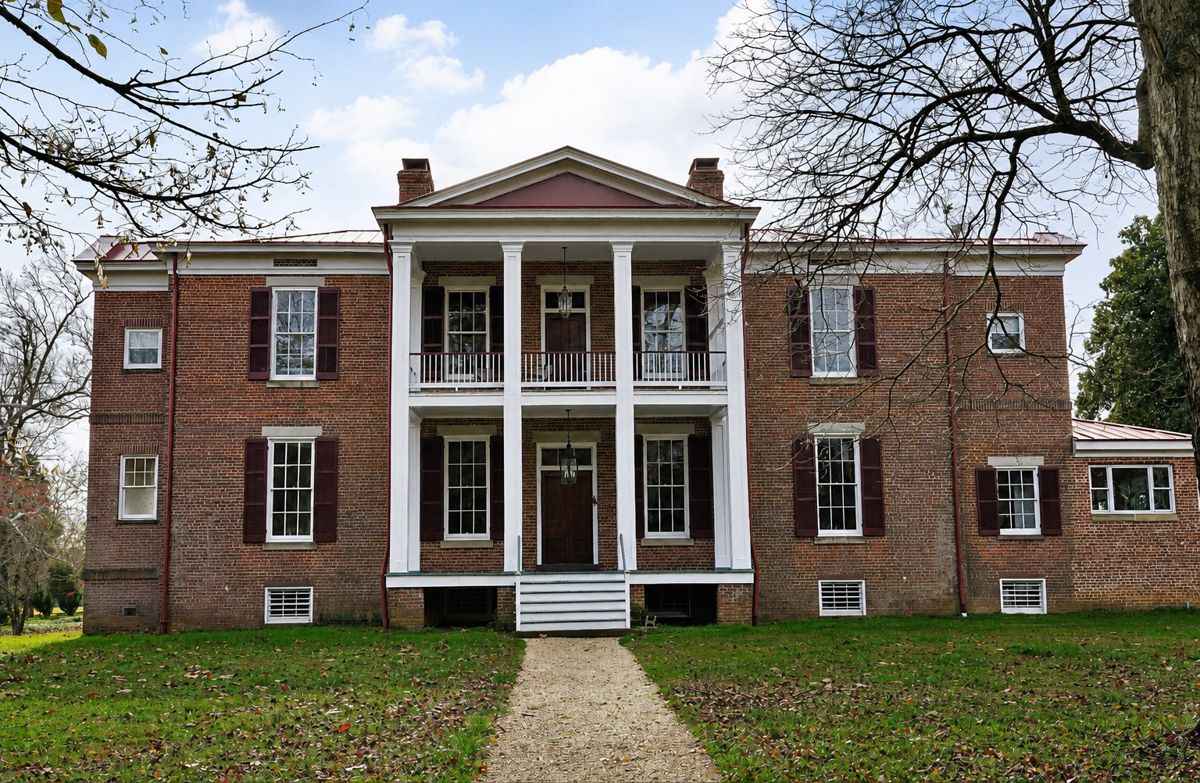
Hickory Hill Plantation, Ashland, Virginia. (Photo by John Musgrove)
Carter Wickham; items related to the Hanover Dragoons, which were raised by Captain Wickham at Hickory Hill; and, lastly, the 4th Virginia Cavalry, of which Wickham was colonel before his promotion. When I left Virginia (or Virginia left me), I sold Hickory Hill and the collection. But the items stayed together and went into one of the very finest Southern cavalry collections ever to exist, if not the finest. Since that time, I have been somewhat of a wanderer. I collect Confederate staff and field swords. I love them for their history and admire them for their beauty. Many of them cross over into art. 18. Do you have any memorable stories from shows—finding unexpected items, bidding wars, dramatic consignments, or surprising buyers? I don’t do bidding wars. I know what items are worth, and when I get to 90 percent of their worth, I am finished. My theory is that it is better to regret losing something… than to regret getting it. When I considered surprising buyers, it brought a smile to my face. Yes, I have had some surprising buyers. There was the Amish collector (I don’t actually remember the denomination, but the term Amish paints the picture) who showed up wearing the straw hat, dark coat, etc., of his denomination. He wasn’t playing dress-up; he was the sincere, real deal, but collected Confederate arms. He was a fascinating and kind gentleman. Then there was the lady who bought the $35,000 sword. I made the mistake of assuming that it was a present for her husband, which occurs pretty often, but she set me straight in a nice way: it was not for her husband; it was going into her collection. And I have had clients from England, Norway, Germany, France, Australia, and Canada.
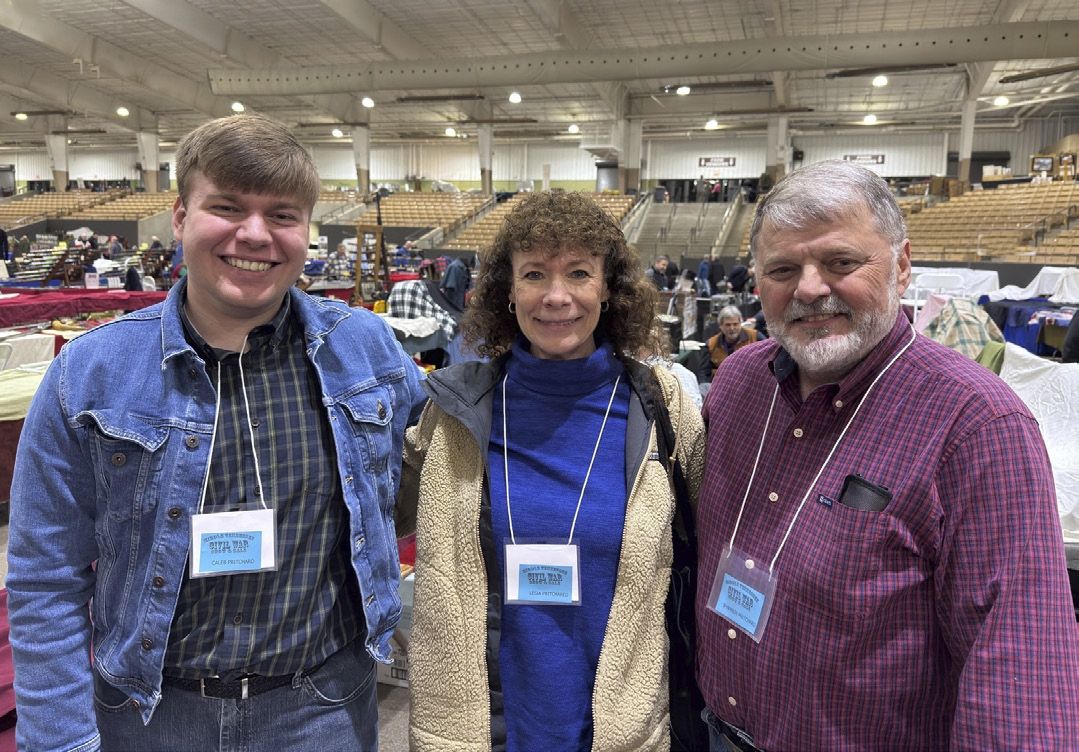
Caleb, Lesia, and Shannon at the December 2025, Middle Tennessee Franklin Civil War Show.
- What are some of the legal or ethical dilemmas that dealers like you must navigate when dealing with edged weapons, firearms, and militaria (especially relating to provenance, repatriation, or cultural heritage)? I had not had any problems dealing overseas until the tariff war. Now the French—and probably others, but I can only speak of the French—intentionally try to make it so difficult to ship stuff in that it is not worth the trouble. The last sword I sent to France was held up for months. I could not move it on; I could not get it back. I eventually accused them of trying to steal it, and that must have scared them. I got it back right away, but it was not packed in any way; it was just thrown loose in a box. Other than that, I have never had any legal difficulties. 20. Looking ahead, what hopes or concerns do you have for the future of arms and militaria collecting, and where do you see yourself going in the next 5–10 years? The biggest threat to the collecting of historical artifacts is that history is no longer taught. When young people are not exposed to history in school, relatively few will find their way to a love of history. That, in turn, will, in my opinion, cut down on the number of collectors in the future. I don’t think this will affect me, or anyone who is dealing in the world’s best of any historical collectible, because the supply of such items is so limited that I think there will always be buyers. But I worry that there will not be enough new collectors in the future to absorb common items like U.S. belt plates or bayonets, Vietnam-era uniforms, or Indian War cartridge boxes, etc. But the ultimate goal 10 years from now is that my son Caleb is having as much fun as I had providing the world’s best Confederate artifacts to the world’s best collectors.