
Gold, Palmetto, and Provenance—General Wade Hampton’s Buckle
By Scott Riddle · Originally published September-October 2026 · pp. 6–12
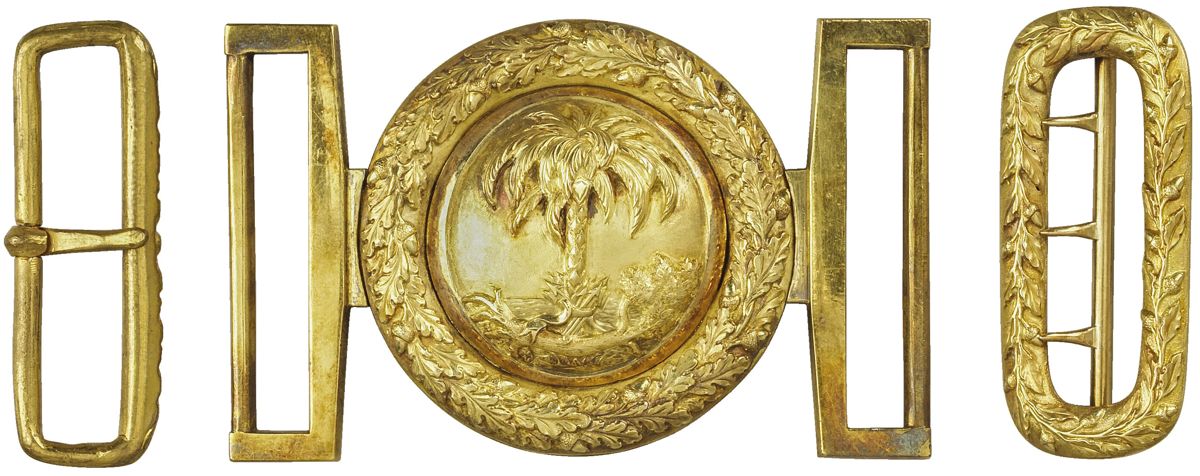
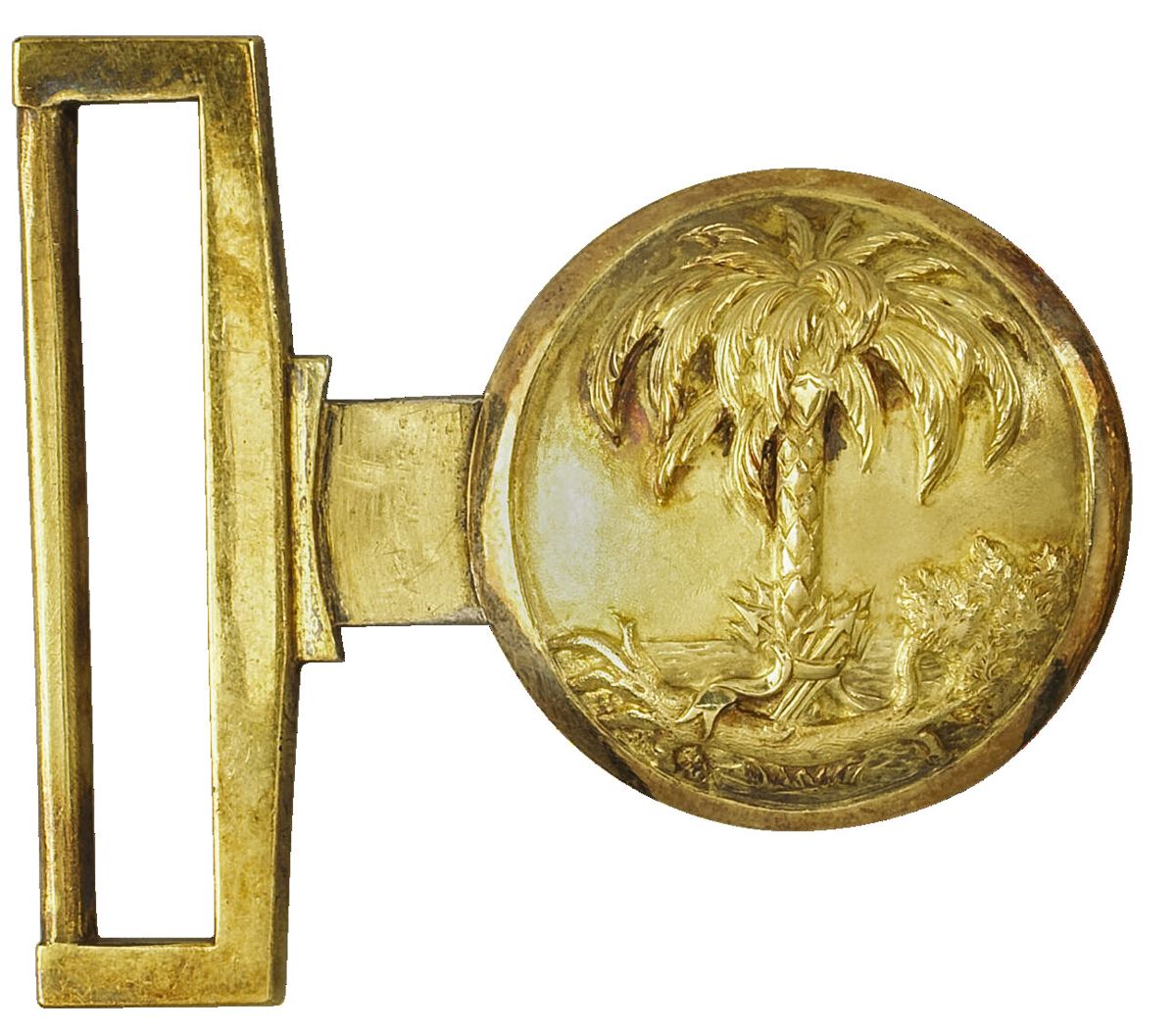
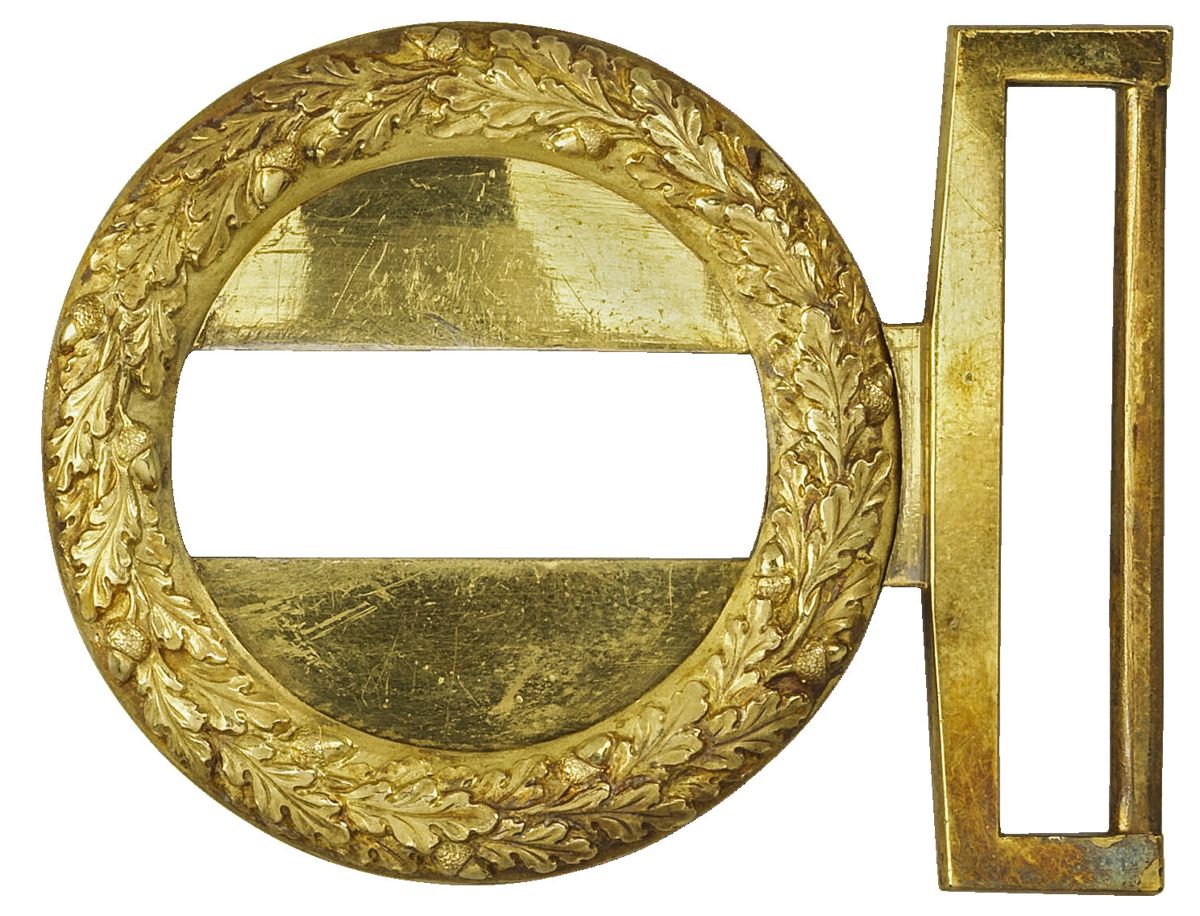
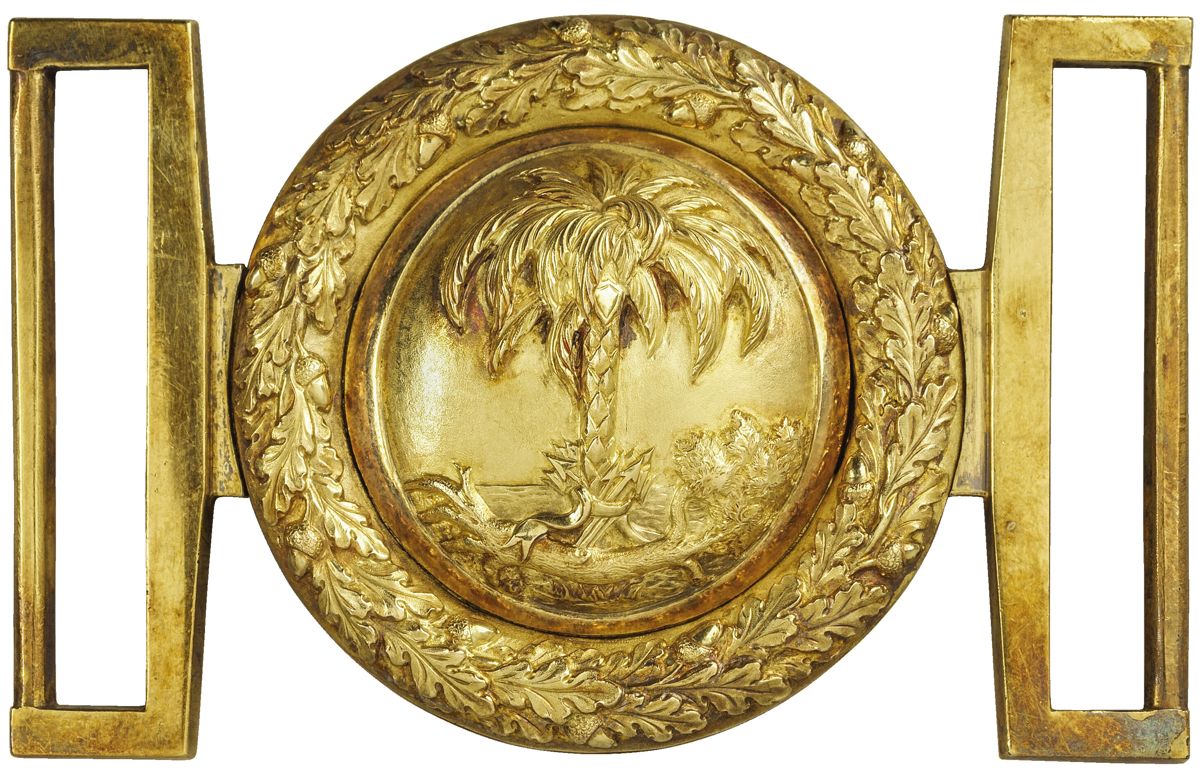
A South Carolina Plate in Gold Of all the Confederate waist belt plates known today, this is one that is hard to overlook. The center of the plate carries the South Carolina palmetto tree in gold, surrounded by a heavily decorated wreath. It is accompanied by matching slides and adjustment fittings, making a complete five-piece belt assemblage. This was not a common issue plate, and it was never intended to be. It was a special piece made for a man who could afford the very best. The buckle is made in the familiar two-piece tongue-and-wreath pattern. The tongue has the palmetto tree inside a raised oval bezel, while the outer wreath is covered with oak leaves. The complete set includes two rectangular slides and two open fittings. One has a roller and bar, and the other is decorated with an oak-leaf design that matches the wreath. The pieces were made to go together and have the appearance of a jeweler-made belt set rather than military parts assembled from different sources. The exact buckle is pictured on pages 608–609 of Buckles and Plates of the Confederacy. It is listed as a South Carolina pattern dating from approximately 1861–1862. The plate measures 3.26 × 2.04 inches, or 83 × 52 millimeters. It is classified as non-dug and assigned rarity 10, the highest rarity rating used in the book.1 The metal content is just as unusual as the design. The tongue and wreath are listed as 18-karat gold, with a 14-karat-gold bezel. When Heritage Auctions sold the assemblage in 2007, the catalog gave the same general description and stated that the pieces had been professionally tested for gold content. Heritage also noted that one of the adjustment fittings was gold-plated.1,2 The buckle has been described as lost-wax cast and then finished by hand. That method would account for the depth of the palmetto tree, the raised border, and the detail in the wreath. A close examination of the reverse, solder joints, tool marks, and casting traces would tell more about how it was made. Whatever shop produced it, the workmanship is far above that seen on an ordinary military issue plate.
The Hampton Association This belt assemblage has been associated with Wade Hampton III for many years. The identification did not begin when the buckle appeared at auction. Heritage Auctions reported that the well-known author and collector William A. Albaugh III obtained it from direct descendants of Hampton. The Hampton identification followed the plate through the collector literature and was later recorded in Buckles and Plates of the Confederacy.1,2,4 Not every name and receipt in the chain of ownership has been published, but this is not a new or recently added story. The plate was known to collectors, was pictured in major reference books, and carried the Hampton association before the 2007 Heritage sale. That kind of long-standing family and collector history is important when studying a Confederate artifact. The buckle has also been attributed to Hayden & Whilden, the Charleston jewelry and silver firm. Heritage stated that Hampton ordered the set in 1860, just before South Carolina left the Union. The reference-book entry dates it to approximately 1861–1862. The dates differ slightly, but both place the buckle in the secession period and the opening years of the war.1,2 No maker’s mark can be seen in the published photographs. That does not eliminate the Hayden & Whilden attribution. Jewelry firms of the period often designed, retailed, commissioned, and sold fine metalwork, even when another craftsman performed part of the work. The firm could have made the plate in its Charleston shop, ordered it from another goldsmith, or handled the commission for Hampton. Until an invoice, letter, or marked reverse is located, the exact shop arrangement remains unknown, but the Charleston attribution fits the quality of the buckle and Hampton’s connections.3
Wade Hampton and His Legion Wade Hampton III was born in Charleston on March 28, 1818, and graduated from South Carolina College in 1836. Before the Civil War, he served in both houses of the South Carolina legislature, was one of the wealthiest planters in the South, and ranked among the nation’s largest slaveholders. He belonged to one of the state’s most powerful families and had the money and social standing needed to order a solid-gold belt plate from a leading Charleston jeweler.7 That background helps explain the buckle. Very few Confederate officers could have purchased a belt set like this. Hampton could. A gold palmetto plate would have been a strong symbol of South Carolina, and it would have been entirely in keeping with a privately equipped officer from one of the state’s leading families.
The five-part belt assemblage associated with Wade Hampton III. The central two-piece palmetto plate is accompanied by keepers and adjustment hardware, some decorated with leaf-and-acorn motifs. (Courtesy Heritage Auctions, HA.com)
After South Carolina seceded, Hampton raised and equipped Hampton’s Legion largely at his own expense. The Legion originally contained infantry, cavalry, and artillery. In the older military use of the word, a legion was a combined command made up of more than one branch of service. Six companies of the Legion’s infantry reached the battlefield at First Manassas on July 21, 1861, and fought under Hampton’s personal command. The men went into action on the Confederate left during some of the hardest fighting of the day. Hampton was wounded but remained with his command.8 Hampton was promoted to brigadier general in 1862. He served during the Peninsula Campaign and the fighting around Richmond before moving into cavalry service under Maj. Gen. J.E.B. Stuart. He had no West Point education and no Regular Army background, but he proved to be a strong field commander and one of the Confederacy’s best cavalry leaders. At Gettysburg, Hampton commanded a large cavalry brigade made up of the 1st North Carolina Cavalry, the 1st and 2nd South Carolina Cavalry,
Cobb’s Legion, the Jeff Davis Legion, and Phillips’s Legion. His official report described the fighting near Hunterstown on July 2, 1863, and the cavalry battle east of Gettysburg on July 3. During the July 3 action, Hampton rode forward to regain control of two regiments that had advanced too far and was badly wounded in close combat.9 After Stuart was mortally wounded at Yellow Tavern in May 1864, Hampton eventually took command of the cavalry corps of the Army of Northern Virginia. His later operations included Trevilian Station and the Beefsteak Raid, where Confederate cavalry captured approximately 2,400 cattle and drove them into the Petersburg lines. He was promoted to lieutenant general in 1865.10 It has often been said that Hampton never lost a battle. That statement is difficult to apply literally to every cavalry action, since the result can depend on the objective, the ground held, casualties, or what happened after the fighting. What can be said with certainty is that Hampton became one of the most capable senior cavalry commanders in Confederate service.10
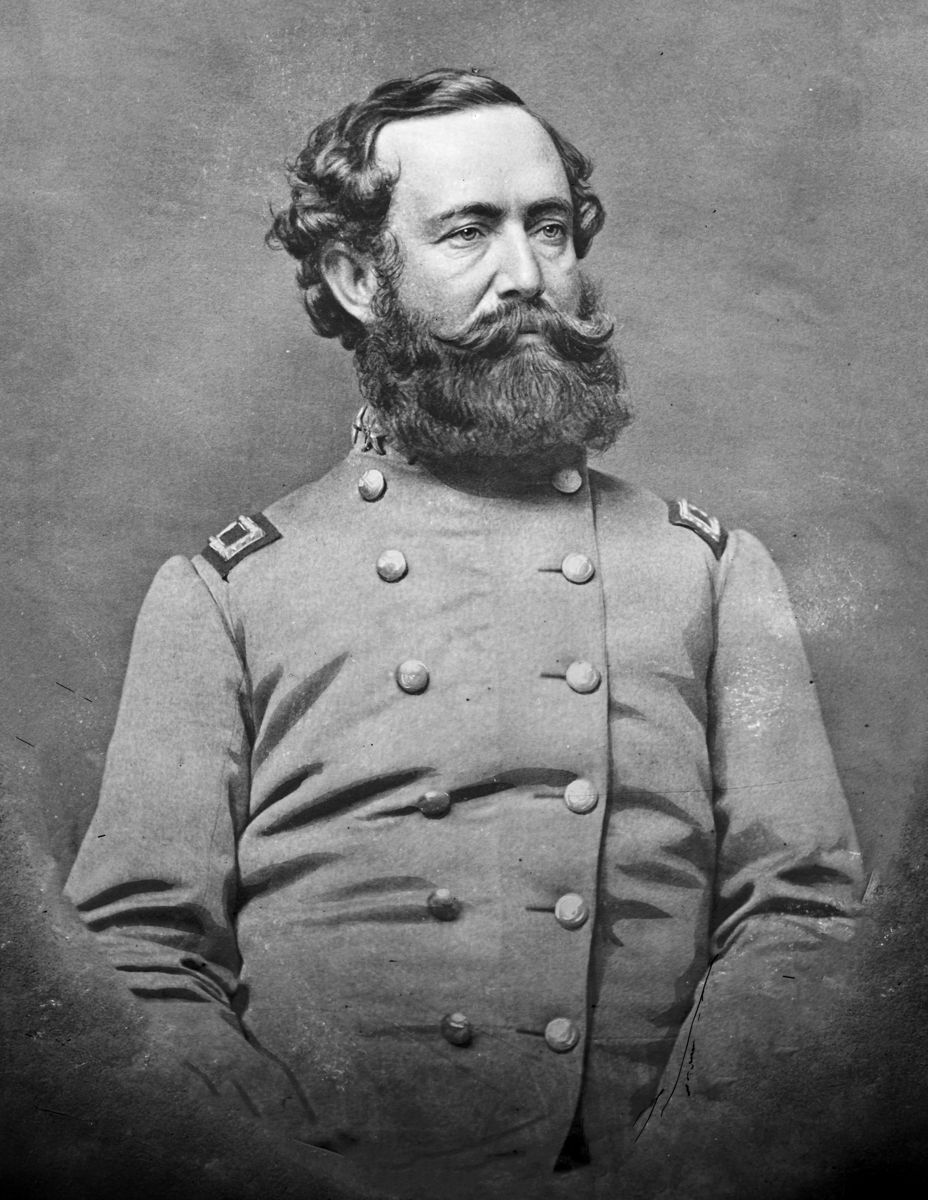
General Wade Hampton III. (Library of Congress)
Was the Plate Worn in the Field? A gold buckle of this quality was not made for ordinary campaigning. It was a dress piece, a presentation-quality object, or a private symbol of rank and state identity. The Buckles and Belt Plates of the Confederacy entry notes that the plate shows very little wear and was probably not used in the field.1 There has been an old suggestion that Hampton wore the buckle at First Manassas. The date makes that possible if the 1860 attribution is correct. The condition of the plate, however, raises a question. There is no known wartime photograph showing Hampton wearing this exact buckle, and no written account has been located that places it on his belt during the battle.1,2 The only thing that can be said with certainty is that the buckle was made to be seen. It may have been worn for dress, public appearances, formal military occasions, or early-war service. It could have belonged to Hampton at the time of First Manassas without being carried through the fighting. Its light wear suggests that it was treated as an important personal object rather than a piece of hard-used campaign equipment.
The Collector Record The published history of this buckle is stronger than that of many Confederate plates. Heritage reported that it appeared as plate 284 on page 193 of Michael J. O’Donnell and J. Duncan Campbell’s American Military Belt Plates. It is also identified on page 160 of Steve E. Mullinax’s Confederate Belt Buckles and Plates, with a modified form shown on page 180. An earlier caption cited page 117 of a work identified as Gilkerson’s American Military Belt Plates. The exact title and edition of that last reference should be checked against the original book, but the important point is that the Hampton plate has been known and published for many years.4,5 The complete five-piece assemblage is pictured in Buckles and Plates of the Confederacy on pages 608–609 as M370. The entry records the South Carolina pattern, approximate date, dimensions, gold construction, rarity 10, non-dug condition, Hayden & Whilden attribution, and the association with Wade Hampton III.1 The buckle sold at Heritage Auctions on December 1, 2007, for $47,800. The price reflected several things working together: the gold construction, the South Carolina palmetto design, the Hampton association, the complete set of fittings, and the plate’s long publication history.6
The plate has been described as the only known solid-gold Confederate waist belt plate. Claims using the words “only known” are always hard to prove because important pieces can remain unpublished in private collections. At present, however, no comparable solid-gold Confederate plate has been widely illustrated in the standard references. It is fair to call this the only presently published example of its kind.
Hampton After the War Hampton’s public career continued after Appomattox. In 1876, he became the Democratic candidate for governor of South Carolina during the disputed election that ended Republican Reconstruction rule in the state. Hampton called publicly for restraint and sought support from some black voters, but the campaign also took place amid intimidation and violence by Red Shirt organizations against Republican leaders and black citizens. He took office in 1877 after the withdrawal of federal troops.11 He later represented South Carolina in the United States Senate from 1879 to 1891 and served as a federal railroad commissioner. Hampton died in Columbia on April 11, 1902.12 To collectors, Hampton is remembered as the wealthy citizen-soldier who raised his own command, fought from First Manassas through the final campaigns, and rose to lieutenant general. His long military and political career is one reason objects connected with him have always attracted attention.
Final Thoughts This buckle does not need an exaggerated story to make it important. The piece speaks for itself. It is a complete, jeweler-made South Carolina belt assemblage constructed largely of gold and decorated with the palmetto tree. It has been pictured in the leading belt-plate references and has carried a long-standing association with Wade Hampton through family and collector history. The exact details of the original order may never be known. A Hampton family receipt, a letter from Hayden & Whilden, William Albaugh’s notes, an early photograph, or the original gold-testing report could answer some of the remaining questions. Until something new is found, the plate should be described for what the surviving record supports: an extraordinary South Carolina waist belt plate with a serious and long-established association to Lt. Gen. Wade Hampton III. The gold catches your attention first. The palmetto tree, the workmanship, and the history are what make you keep looking.
REFERENCE-BOOK DOCUMENTATION The exact buckle is illustrated in Buckles and Plates of the Confederacy (2026), pages 608–609, Mullinax reference M370. The entry identifies it as the waist belt plate of Wade Hampton III; assigns it to South Carolina and dates it to approximately 1861–1862; gives dimensions of 3.26 × 2.04 inches (83 × 52 mm); lists an 18-karat-gold tongue and wreath with a 14-karat-gold bezel; assigns rarity 10; and classifies the piece as non-dug.
ENDNOTES 1.
Scott S. Riddle, Buckles and Plates of the Confederacy (2026), 608–609, reference Steve E. Mullinax, Confederate Belt Buckles and Plates (Alexandria, Virginia: O’Donnell Publications, 1991), 160 and 180; M370. The entry identifies the assemblage with Wade Hampton III and records its South Carolina pattern, approximate 1861–1862 date, dimensions, construction, rarity 10, non-dug status, Hayden & Whilden attribution, and lack of field wear. Heritage Auctions, “Confederate General Wade Hampton’s Jeweler Made Solid Gold Two Piece Interlocking South Carolina Waist Belt Plate,” Lot 72288, December 1, 2007. The catalog reports the Hampton-family provenance, Hayden & Whilden attribution, gold-content testing, and construction details. Antiques Roadshow, “Hayden & Whilden Silver Presentation Cup, ca. 1860.” The appraisal discusses Hayden & Whilden as a Charleston retailer and illustrates the varied ways nineteenth-century jewelry firms commissioned, retailed, and sold fine metalwork. Heritage Auctions, Lot 72288, and the earlier Military Antique Collector caption supplied with the project. These sources identify the plate’s appearances in the collector literature and its reported acquisition by William A. Albaugh from direct descendants of Wade Hampton.
Michael J. O’Donnell and J. Duncan Campbell, American Military Belt Plates (Alexandria, Virginia: O’Donnell Publications, 1996), plate 284, 193; Steve E. Mullinax, Confederate Belt Buckles and Plates (Alexandria, Virginia: O’Donnell Publications, 1991), 160 and 180; and Scott S. Riddle, Buckles and Plates of the Confederacy (2026), 608–609. 6. Heritage Auctions, Lot 72288. The archived sale result records a price of $47,800 on December 1, 2007. 7. Biographical Directory of the United States Congress, “Hampton, Wade”; University of South Carolina, Presidential Commission on University History, “Wade Hampton College”; and Scott S. Riddle, Buckles and Plates of the Confederacy, 608–609. 8. U.S. Army Center of Military History, Battle of First Bull Run Staff Ride and The Civil War Begins: Opening Clashes, 1861. These works describe the arrival and fighting of the six infantry companies of Hampton’s Legion under Col. Wade Hampton. 9. Wade Hampton, official report dated August 13, 1863, reproduced by Gettysburg National Military Park. Hampton described the fighting near Hunterstown on July 2, the cavalry action east of Gettysburg on July 3, his wounds, and the transfer of command to Col. Laurence S. Baker. 10. Biographical Directory of the United States Congress, “Hampton, Wade”; National Park Service military histories; and Encyclopedia Virginia entries on Trevilian Station, Yellow Tavern, and the Petersburg Campaign. 11. South Carolina State Library digital publications on Wade Hampton and Reconstruction; University of South Carolina historical research; and scholarship on the South Carolina election of 1876. 12. Biographical Directory of the United States Congress, “Hampton, Wade.” Hampton served as governor, United States senator, and federal railroad commissioner and died in Columbia on April 11, 1902. 5.
About the Author Scott Riddle is a retired Firefighter/Arson Investigator after 30 years of employment with the City of Smyrna Fire Department just outside Atlanta, Ga. He has been an avid relic hunter and historian focusing on the battlefields, camps, and troop movements in North Georgia. Scott became passionate about Confederate belt plates after finding his first CSA plate in 1981. Riddle’s comprehensive book, Belt Buckles and Plates of the Confederacy, was published in 2026, and is an extensive work on the subject of Confederate and Southern State belt plates. Riddle has one of the largest collections in the southeast. He also owns Code Compliant Inspection Service based in Kennesaw, Ga., and has authored several articles on Civil War history and relic hunting in Cobb County, Ga.