
British Cannon Production for the Confederacy
By Jack Bell · Originally published September-October 2026 · pp. 68–71
The Confederate efforts at cannon manufacturing were materially supported by private British companies already making cannon for the British government. These companies worked around British government export restrictions and supplied both cannon and projectiles to the Confederacy for the duration of the war. Blakely (and others that produced its cannon) was particularly active in supplying Confederate forces with both field and large-caliber cannon, with projectiles: In 1862, Blakely (and their contractor foundries) provided eight of their large-caliber cannon (7-inch or 8.12-inch rifles) to make the CSS Alabama the most formidable ship opposing the Union fleet at that time.1
They supplied a 68-pounder (7.5-inch) Blakely rifle to the Confederates that was mounted at Shipping Point on the Potomac River, located today where the Quantico Marine base is. Today the cannon rests at the Washington Navy Yard as “Trophy No. 7.”2 Many Blakely-designed cannon were manufactured by other English foundries for the Confederates, including Fawcett Preston & Co.; Vauxhall Foundry, Low Moor, and Vavasseur. Many rifled calibers were provided by these foundries, ranging from 2.5-inches, 2.9-inches, 3.5-inches, 3.75-inches, 4-inches, and 12.75-inches.3 In 1863, the SS Gibraltar delivered two 12.75inch Blakely cannon (made by Vauxhall Foundry) to the Confederates in Wilmington. They were Title page: 8-inch Armstrong Gun in Fort Fisher, N.C. Today this gun is currently displayed at Trophy Point at the United States Military Academy at West Point. (Library of Congress, colorized, 2026)
Whitworth 12-pounder rifle on wharf awaiting shipment in Richmond, Virginia. Note that Richmond Arsenal is stenciled on the trail. (Library of Congress)
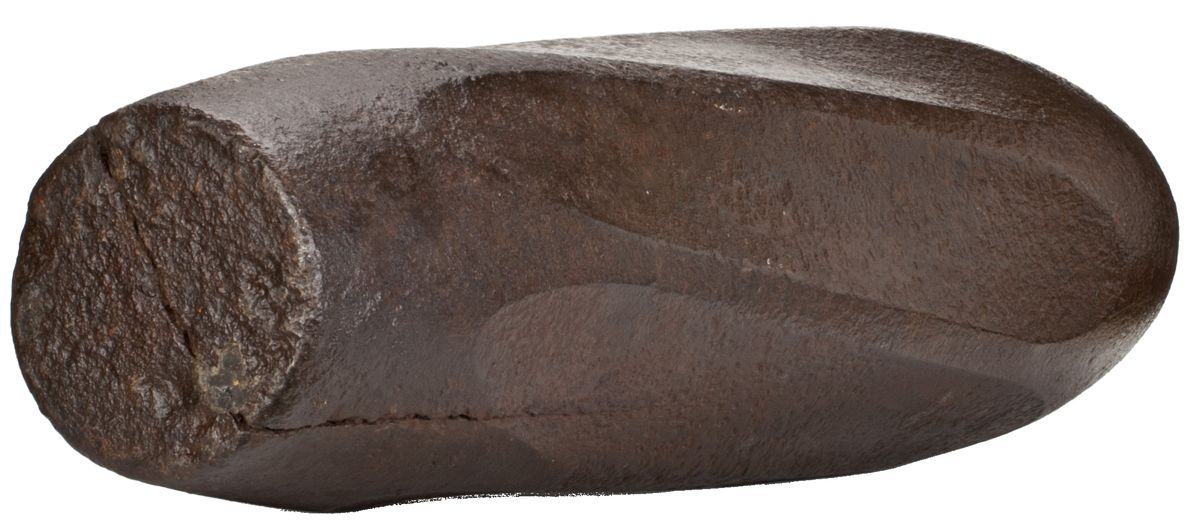
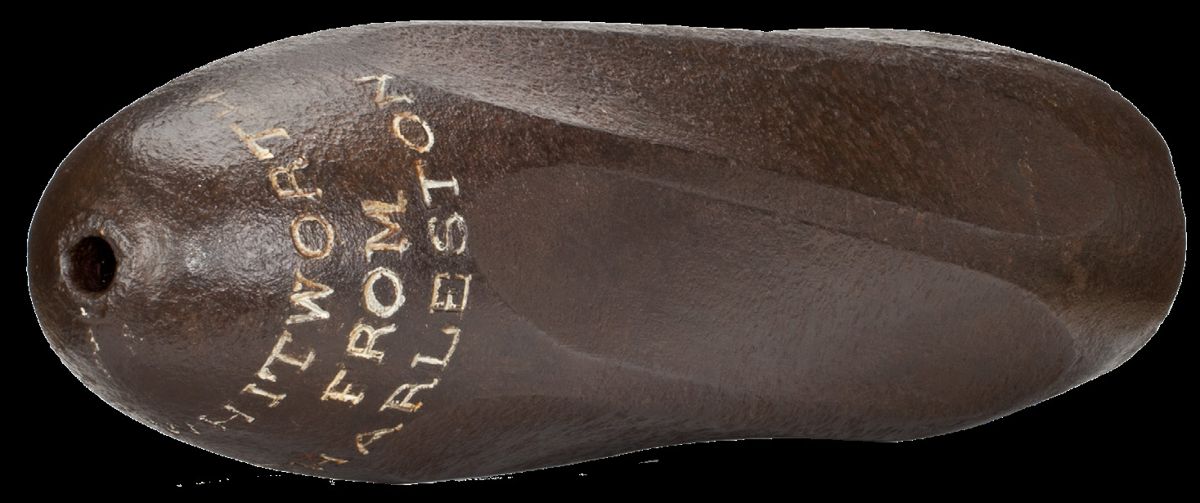
Whitworth Pattern/Sub-Pattern: II Diameter: 5 inches Bore Diameter: 5.0 inches Cannon: 5-inch Whitworth rifle Overall Length: 21.25 inches Weight: 66 pounds Construction: Shell then transported by rail to Charleston and mounted at White Point Battery and Frazier’s Wharf to defend the inner harbor. But they were never used in battle and were destroyed by the Confederates.4 Similarly, Armstrong supplied several large-caliber rifled cannon to the Confederacy, including two 8-inch Armstrong rifles. One was deployed at Fort Fisher and another at nearby Fort Caswell. They also supplied a number of field-caliber rifled cannon, of which seven have survived.5 Armstrong also sold to the Confederacy several massive Armstrong rifles to be put aboard the CSS Stonewall—one 300-pounder (10-inch), and two 150-pounders (8-inch)6, including projectiles. Before the Civil War ended, the CSS Stonewall never arrived in the battle area along the Atlantic seaboard, where it could have destroyed most ships in the Union fleet.
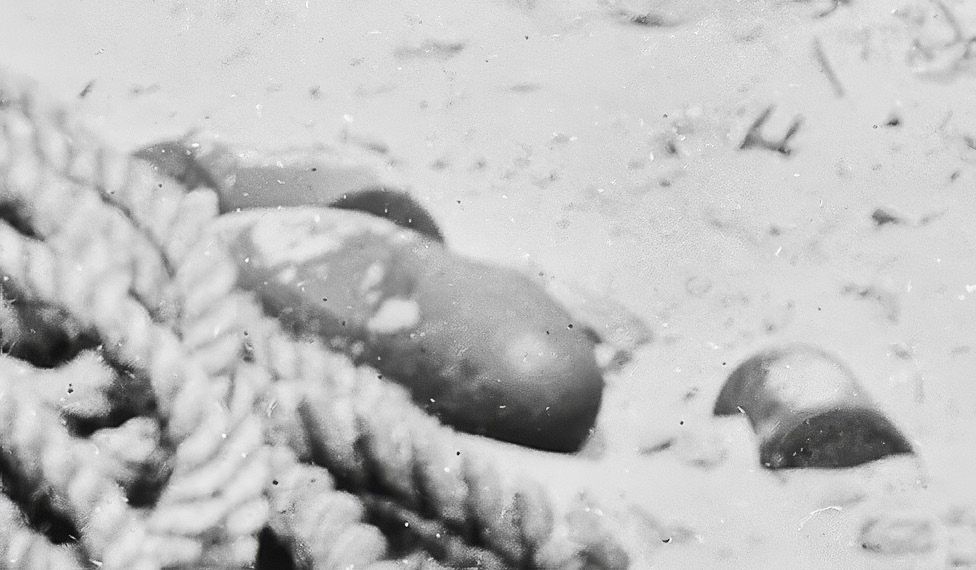
Closeup of a similar Whitworth projectile lying in the sand, just to the right of the soldier on the left side of the facing pages photo.
Courtesy The Atlanta History Center’s Thomas Swift Dickey Sr. Collection.
Whitworth also sold a number of guns and rifled projectiles to the Confederates in a wide range of calibers, from 1.7-inches to 6.4-inches.7 However, they were never deployed in enough mass to have any significant impact on the battles in which they were deployed.8 Records are not available on the total number of English cannon that were sold to the Confederacy. A total of 77 have survived in all calibers.9 An additional 15 large-caliber British guns are documented to have been delivered.10
Endnotes
- The Big Guns, by Olmstead, Stark , and Tucker, p. 139
- Ibid., p. 138.
- Field Artillery of the Civil War, by Hazlett, , Olmstead, & Parks, pp. 196-206
- The Big Guns, by Olmstead, Stark , and Tucker, p. 139
- Ibid., p. 171.
- Navy ORs, Series II, Vol. 1, p. 267.
- The 6.4-inch Whitworth cannon never reached the Confederacy. Speculation has been that they were thrown overboard by the CSS Ella when t was being chased by the Union blockading fleet ,which later caused it to run aground in shallow water. Whitworth projectiles in the 6.4-inch caliber from the Ella have been recovered and are stored in the State of North Caroline’s conservation center at Fort Fisher.
- Whitworth projectiles have been very popular with collectors. However, many have been imported from England after the Civil War and sold as U.S. Civil War usage.
- The Big Guns, pp. 171-176.
- Navy ORs, Series II Volume 1; multiple pages on individual Confederate ships and their armaments. There are a few other known survivors, but they have not been fully documented.
About the Author Jack Bell, a Marine Corps Vietnam veteran, wrote a technical book, Civil War Heavy Explosive Ordnance, which is still selling 23 years later. As a senior executive at the Department of Defense, he also served in both Afghanistan and Iraq.
Union Naval Battery on Morris Island, South Carolina. Two 80-pounder Whitworth guns and crew, part of breaching battery against Fort Sumter. (Library of Congress)