
The Girardoni Air Rifle: An 18th-Century Leap to Repeating Fire
By Jack W. Melton Jr. · Originally published May-June 2026 · pp. 63–71
In the closing decades of the 18th century, when European armies still measured firepower by how quickly a man could bite a cartridge, pour powder, and ram a ball down a fouled barrel, a onehanded gunsmith in a Vienna suburb was quietly assembling something that had no business existing yet. The Girardoni air rifle, known in German as the Windbüchse, or “wind rifle,” could fire 22 aimed shots in under a minute, left no cloud of smoke to betray a shooter’s position, and made a sound that eyewitnesses compared less to a musket than to a sharp knock on a door. By every measure of 18th-century military thinking, it should not have been possible. That it was possible, and that it briefly entered the service of the most powerful army in central Europe, is the story worth telling.
Origins: A Ladin Craftsman and a Dangerous Idea Bartolomeo Girardoni was born on May 30, 1744, in Cortina d’Ampezzo, a village tucked into the Dolomite Alps that was then part of the County of Tyrol under Habsburg rule, though its people were Ladin-speaking, not German. The Ladins are a Rhaeto-Romance people whose language and culture set them apart from the German Tyroleans to the north and the Italian-speaking Venetians to the south. That detail matters because some sources, including the most authoritative ones, describe Girardoni consistently as a “Ladin artisan,” a craftsman from a community defined by its own distinct identity within the Habsburg world.
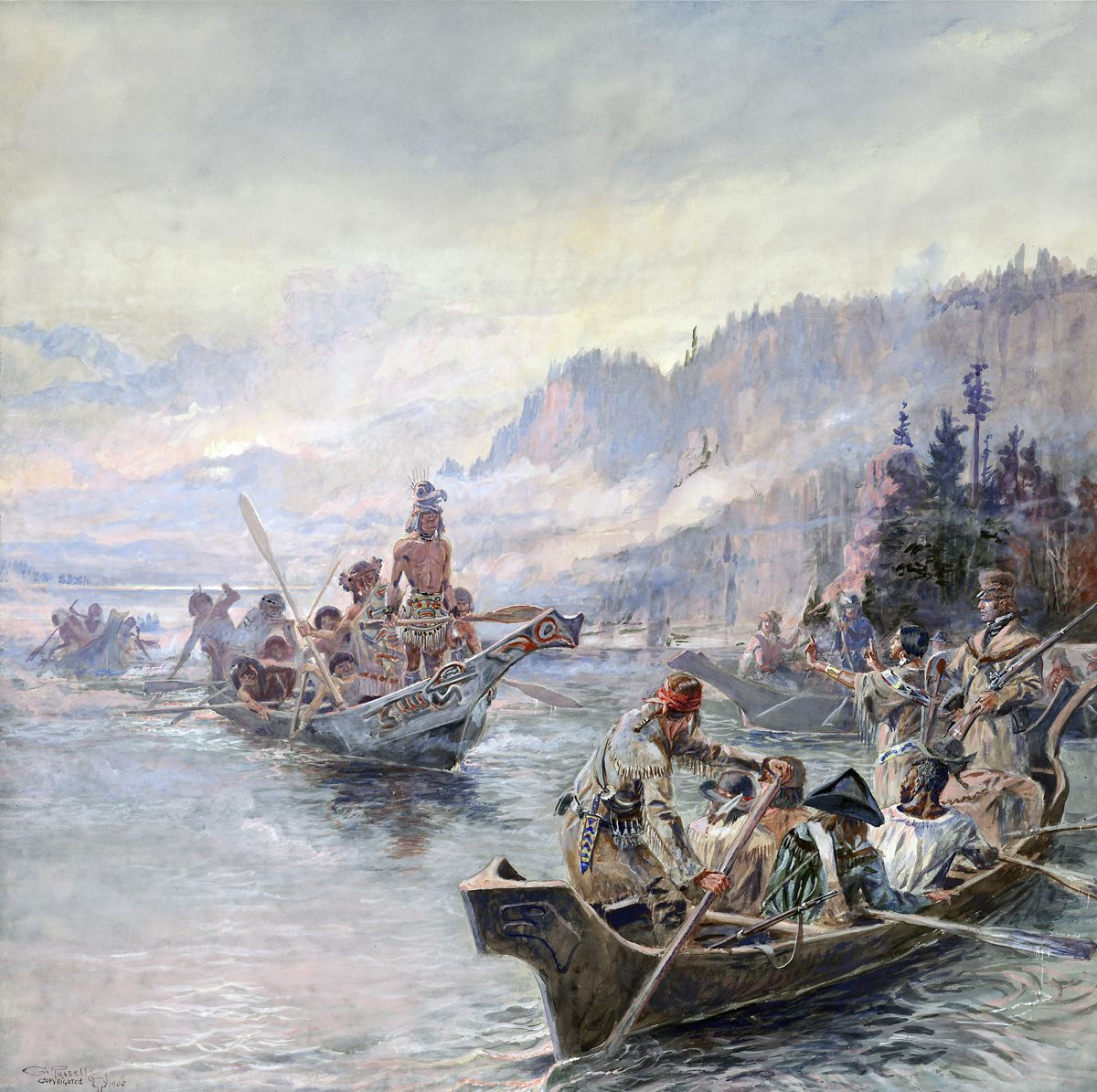
Lewis and Clark on the Lower Columbia, 1905, Charles M. Russell (1864–1926). (Amon Carter Museum of American Art, Fort Worth, Texas; 1961.195.)
By the 1770s, Girardoni had settled in Vienna and was working as both a watchmaker and gunsmith, two disciplines that, as it turned out, were the perfect combination for what he had in mind. His first attempt at a repeating military firearm was gunpowder-based, a multi-shot musket. The experiment was not merely a failure; it was a catastrophe. The weapon exploded during testing, and the blast killed his son. Whether that loss was what decisively turned Girardoni toward compressed air as a propellant is not recorded, but the timing is hard to dismiss. By early 1779, word of his pneumatic repeating design had reached Austrian Field Marshal Franz Moritz von Lacy, who submitted a favorable report to Emperor Joseph II. Lacy proposed that Girardoni be contracted to produce 1,000 flintlock rifles and 500 air guns, with delivery to Field Marshal Wenzel Joseph von Colloredo. In December of that year, Girardoni relocated to Penzing, on the outskirts of Vienna, bringing his family, his assistant Franz Colli, and two workers with him. There, he organized what amounted to an early form of manufacturing, each worker producing specific components, with Girardoni assembling the finished arms himself. Not long after the move, he lost his left hand in a gun accident. He responded by fashioning an iron prosthetic hand for himself and returning to work. Production was slow. By 1784, the shop had turned out only 111 flintlocks and 274 air guns, far short of the contracted quantities, and the army said so plainly. Relieved of flintlock production to concentrate on air guns, Girardoni focused on solving what was genuinely hard: making air reservoirs, valves, seals, and pumps precise enough to be interchangeable across rifles. That requirement for interchangeable parts was itself a radical idea in 1780. The formal military adoption came in 1780, making this the first repeating rifle issued to a European army as a service arm.
Design and Technical Innovations At a glance, a Girardoni rifle could pass for a standard infantry musket of the period, roughly four feet long, weighing about ten pounds, within normal range for the arms a soldier of the era was expected to carry. The resemblance ended there. The rifle’s driving innovation was a detachable iron reservoir built into the club-shaped buttstock, pre-charged with compressed air to approximately 800 psi using a hand pump. That reservoir powered a tubular magazine holding twenty to twenty-two .46-caliber lead balls (some sources cite .51 caliber, and a detailed German study in Visier magazine put
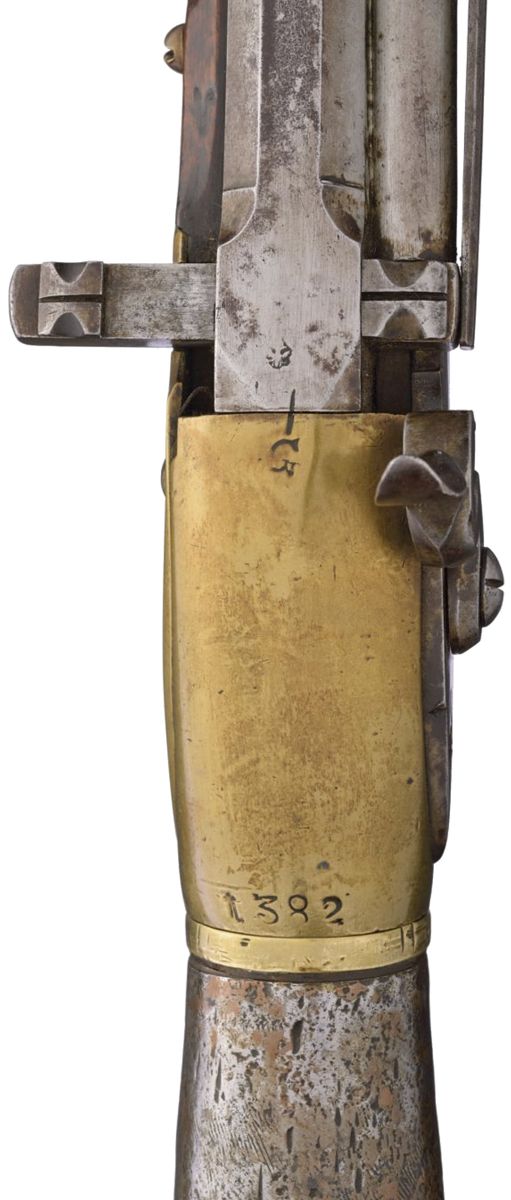
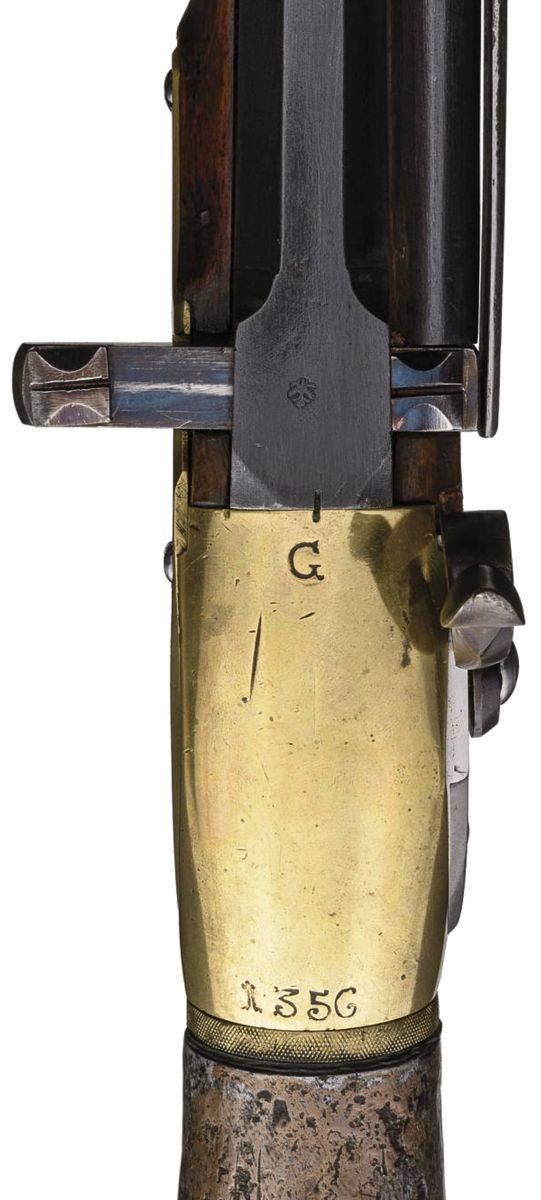
Top view of the breech of No. 1382, an 18th-century Austrian Military Model 1780 Girardoni repeating stock-reservoir air rifle. This is like the kind believed to have been carried on the Lewis and Clark Expedition. This rifle realized $32,313 at Rock Island Auction Company’s May 17, 2024, auction.
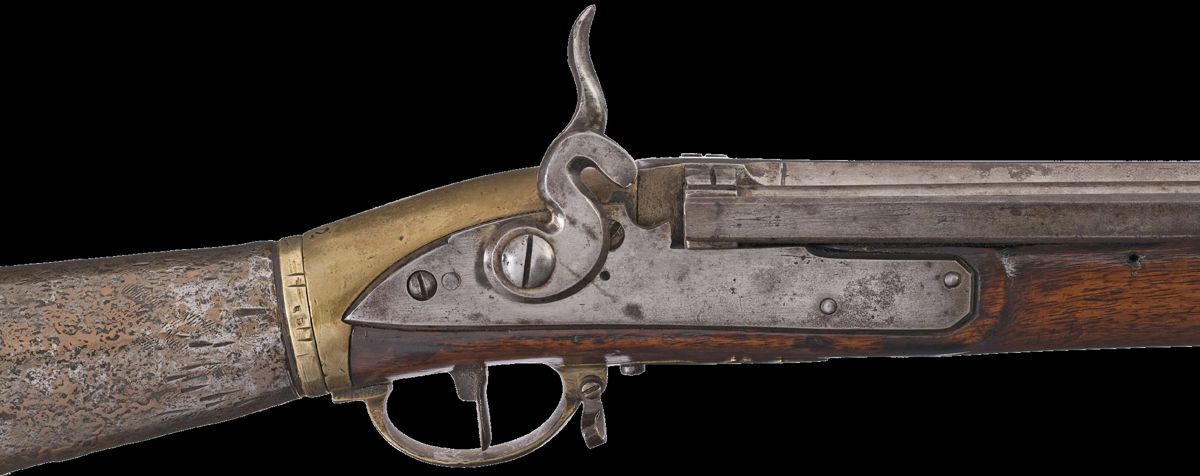
No. 1382 overall obverse view. (All rifle photographs courtesy Rock Island Auction Company)
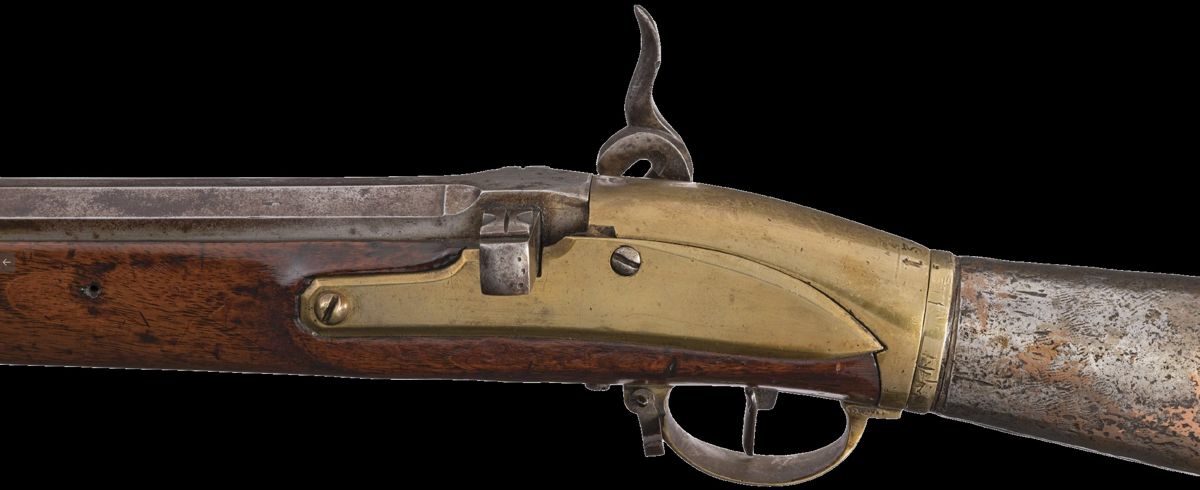
No. 1382 overall reverse view.
No. 1382 lock area.
No. 1382 reverse lock view.
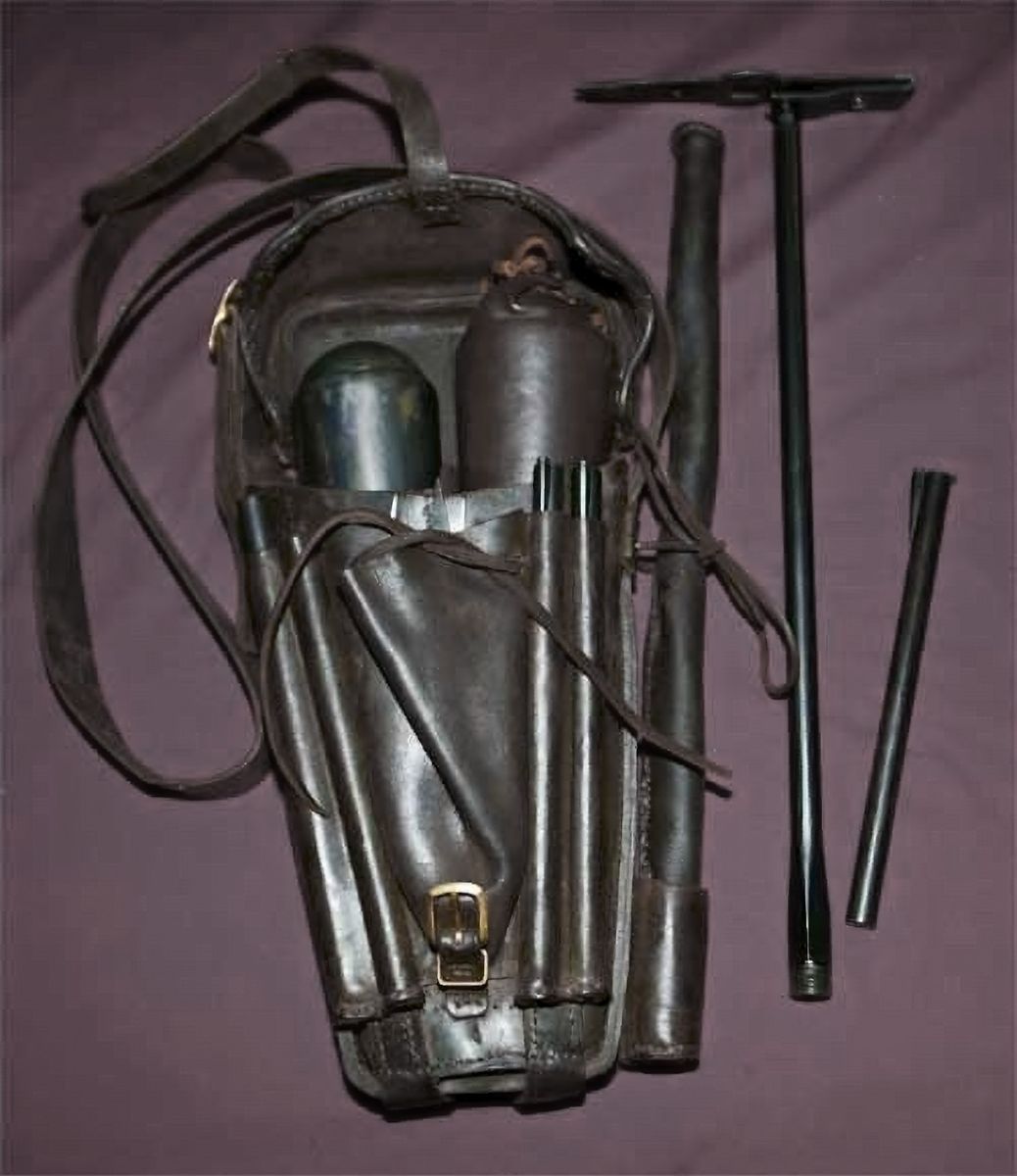
the bore at .463 inches; the precise figure remains a subject of specialist debate). Loading the next round required no standing, no powder, no ramrod. The shooter pushed a spring-loaded transverse slide that allowed one ball to drop from the magazine into the breech, then released it to snap back into firing position. A trained man could maintain continuous fire while lying flat on the ground, an operational advantage over flintlock muskets, which required a soldier to stand to reload. On a full charge, the reservoir could drive 30 shots at combat-useful velocity. The first ten, fired while pressure remained highest, were effective out to around 150 paces. The middle group extended to roughly 120–125 paces, and the final ten dropped off to about 100 paces, a graduated decline of power that a skilled rifleman learned to account for, as documented by military writer August Haller in his 1891 treatise on the rifle. Muzzle velocity on the original arms, per testing of surviving examples, ran in the range of 400 to 450 feet per second, lower than the figures sometimes cited in secondary literature, but entirely adequate at the engagement distances of the era. One point the original article glosses over deserves emphasis: the Girardoni was not silent. Contemporary observers who described it as nearly noiseless were probably comparing it to the ear-splitting crack of a black powder musket fired nearby. It had a distinct report. What it lacked was the smoke cloud that instantly revealed a shooter’s position and, after several volleys, turned a battle line into a fog bank. That tactical advantage was real and significant, even if the “silent rifle” reputation was somewhat exaggerated. Recharging the reservoir was, by contrast, anything but effortless. The hand pump required roughly 1,500 strokes to bring a depleted reservoir back to working pressure, a task that consumed considerable time and physical effort, typically done by support personnel rather than the rifleman himself. Austrian regulations issued on January 24, 1788, specified the complete kit every rifleman was expected to carry: the rifle itself, three air reservoirs (one fitted to the stock and two spares), a hand pump, cleaning rod, lead ladle, and 100 lead balls, one in the chamber, 19 in the magazine, and the remaining 80 distributed across four tin tubes that functioned as what we would today call speed loaders. Everything not attached directly to the rifle rode in a purpose-made leather knapsack. The leather gaskets sealing the reservoir required frequent moistening to prevent air from bleeding off quietly over hours, which meant that a rifle left unattended on a campaign could arrive at the fight with a fraction of its intended pressure.
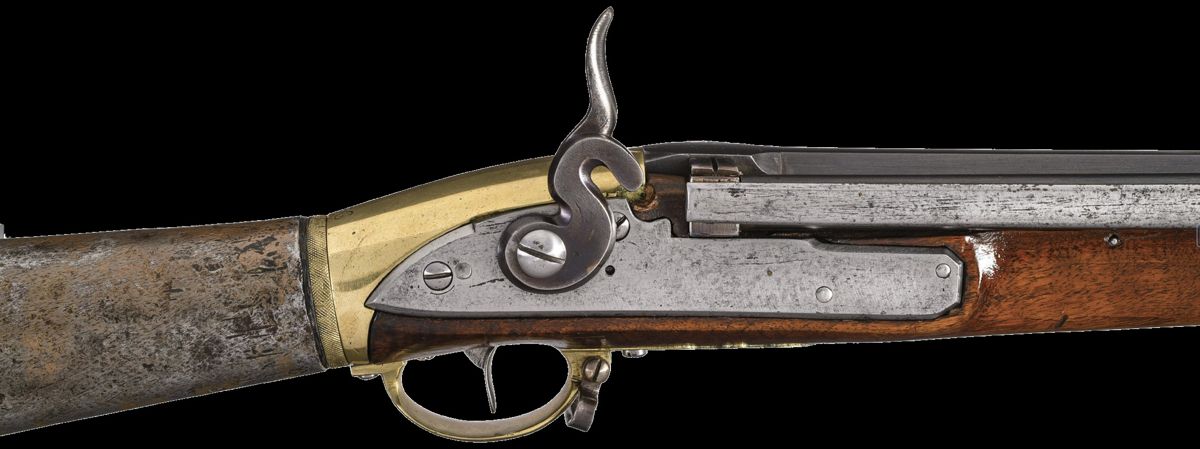
Top view of the breech of No. 1356, an 18th-century Austrian Military Model 1780 Girardoni repeating stock-reservoir air rifle. This is like the kind believed to have been carried on the Lewis and Clark Expedition This rifle brought $55,813 at Rock Island Auction Company’s December 8, 2023, auction.
No. 1356 overall obverse view.
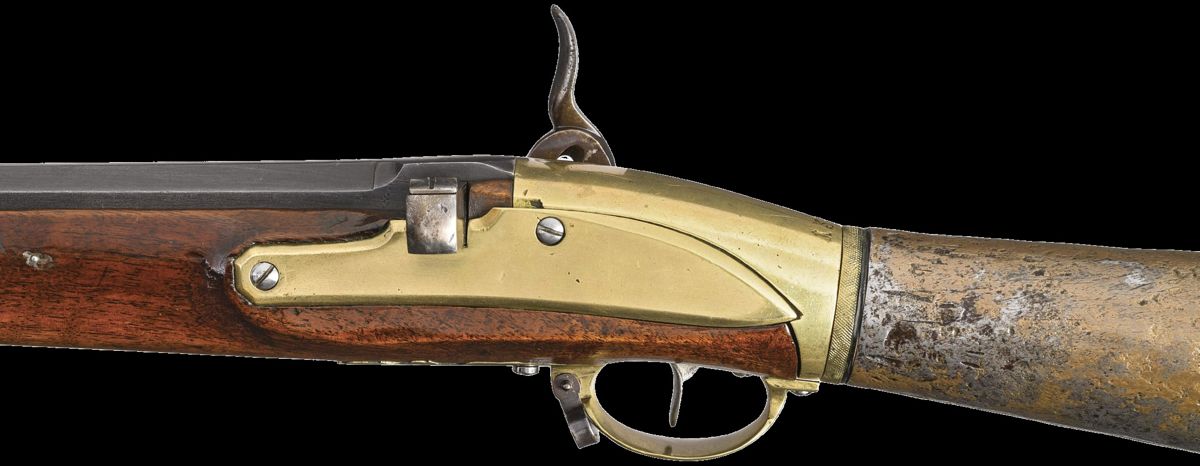
No. 1356 overall reverse view.
No. 1356 lock area.
No. 1356 reverse lock view.
Combat Service: Tactics, Limitations, and the Record Straightened The Girardoni’s service history is more complicated than the original article suggests, and getting the timeline right matters. The rifle was adopted in 1780 but withdrawn from regular service by Imperial order in 1788, just eight years later, and in the same year, the regulations kit was formalized. The 1788 Austro-Turkish War saw the rifle employed by Tyrolean sharpshooter units in the Balkans, where its smokeless fire proved effective in ambushes from dense cover. But by the time that conflict ended in 1791, the limitations were well established: the reservoirs, hammered from sheet iron and sealed by brazing, were difficult to manufacture and fragile in the field. Supply was chronically short; of the roughly 1,000 air guns produced by 1788, only 200 complete sets had been delivered to the depot at Petrovaradin Fortress, with another 500 arriving in April of that year, many without the full complement of reservoirs and pumps. When war resumed in the 1790s, the rifle was reissued to Tyrolean sniper units in 1792. Contrary to what some sources implie, no solid evidence places the Girardoni in significant use during the

Napoleonic Wars proper. Defense Media Network’s detailed account of the rifle states flatly that it “apparently never” served in Austria’s Napoleonic-era campaigns, a conclusion consistent with the logistical picture. By approximately 1810, documented use had ended. It was formally withdrawn by 1815. That service arc, adopted in 1780, removed from line units in 1788, reissued to specialists in 1792, effectively retired by 1810, is more compressed and less triumphant than the “three decades” the original article describes. What it actually reflects is a weapon that outpaced the logistical capacity of its era. The Austrian army could never produce reservoirs fast enough, repair them reliably enough, or keep the hand pumps functional enough in the field to sustain the Girardoni’s potential. When percussion firearms arrived, and improved manufacturing made conventional rifles more reliable and far easier to maintain, the practical argument for the Windbüchse collapsed. Girardoni himself did not live to see the full arc of his invention’s fate. He died in Vienna on March 21, 1799, the same year he signed his name to the last recorded document attributed to him.
Across the Atlantic: The Lewis and Clark Connection By 1803, one of the Girardoni rifles had made its way to Philadelphia. Meriwether Lewis, then serving as President Thomas Jefferson’s private secretary before being commissioned to lead the Corps of Discovery, acquired the piece there, though he recorded neither where exactly he bought it nor from whom. Some historians have argued that the airgun Lewis carried was made by Philadelphia gunsmith Isaiah Lukens rather than being an Austrian military arm. The argument collapses on a single piece of contemporary evidence. On September 8, 1803, Colonel Thomas Rodney visited Lewis’s keelboat and recorded in his journal that Lewis showed the party his airgun, which “fired 22 times at one charge.” Every known Lukens airgun is a single-shot muzzleloader. Twenty-two shots from one charge of air describe, precisely, a Girardoni.
Recreation of an Austrian Girardoni system accoutrements bag, including bullet mold, air pump, spare air flasks, wrenches and ladle. (Courtesy of U.S. Army)
Lewis brought the rifle with him on the Corps of Discovery’s journey from 1804 to 1806, and it became one of the expedition’s most effective diplomatic tools, though not in the way firearms are usually employed. At meetings with nearly every Native American nation the expedition encountered along the Missouri River and beyond, Lewis staged formal demonstrations of the rifle, firing multiple shots without powder and without reloading, in front of audiences who had never encountered anything remotely like it. Lewis himself recorded the effect in his journal entry of January 24, 1806: the Native people could not comprehend how the gun fired so many times without powder, and they regarded it as powerful medicine.
The most consequential of these demonstrations came during a tense parley with the Brulé Sioux in September 1804. Whether the airgun was the decisive factor in avoiding open conflict is impossible to say with certainty, but Lewis clearly believed that
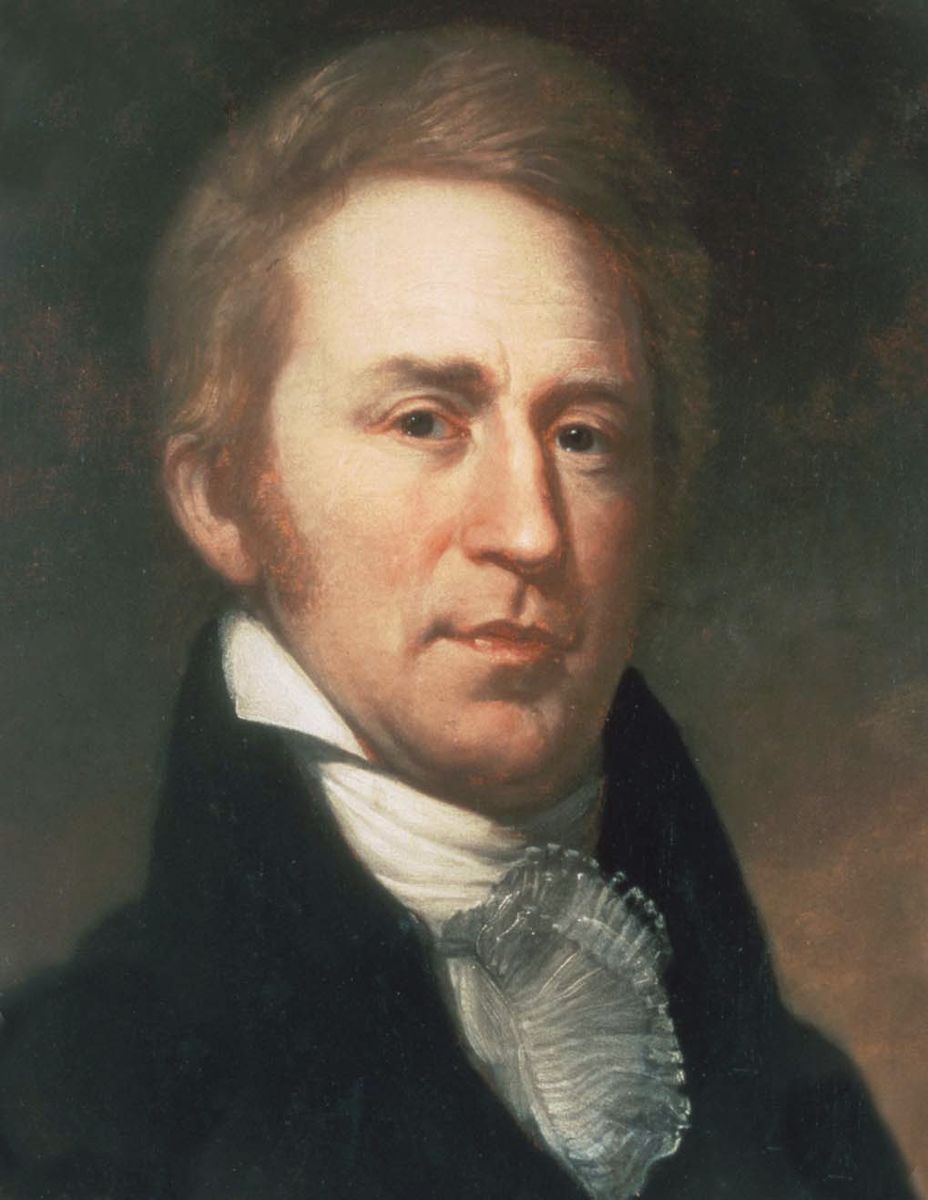
William Clark. Charles Willson Peale, artist. (Public Domain)
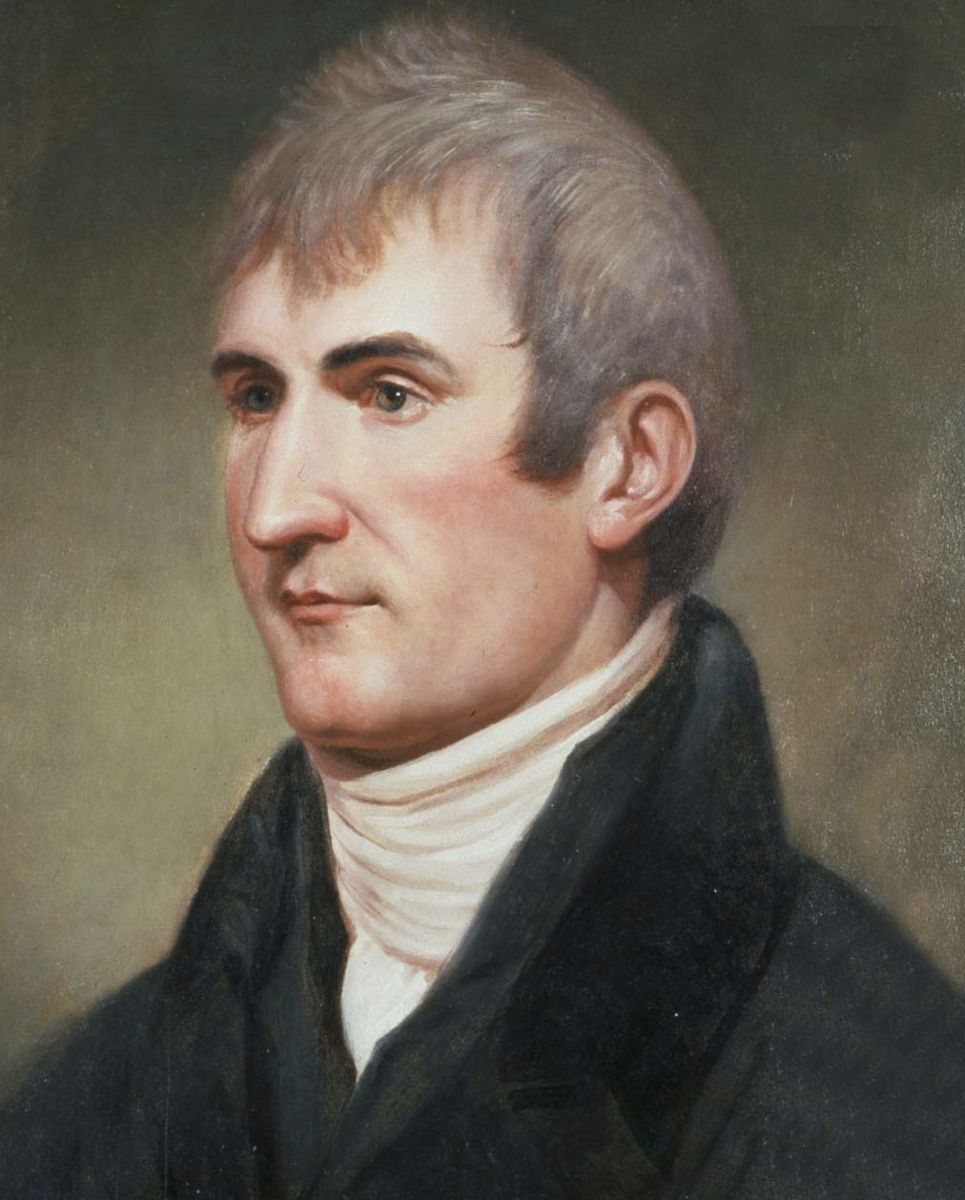
Meriwether Lewis. Charles Willson Peale, artist. (Public Domain)
the display of technological capability shaped the course of the negotiations. He used it deliberately as a statement of strength without provoking violence. There are no recorded instances of the Girardoni being used in personal defense or combat during the expedition. Its role was purely theatrical, and in that role, it may have done more for American interests than any weapon fired in anger on the frontier.
Legacy and Collector Significance Surviving Girardoni rifles are among the rarest and most sought-after arms in any collection touching the 18th century. Originals are preserved in the Kunsthistorisches Museum in Vienna, in private collections, and, in the form of the example associated with the Lewis and Clark expedition, on long-term loan to and display at the Pentagon, after collector Robert Beeman donated it to the U.S. Army War College at Carlisle, Pennsylvania. The NRA National Firearms Museum also holds a documented example. What makes them significant to a collector is not novelty alone. The Girardoni represents the convergence of three ideas that would not find mainstream military expression again until the mid-19th century: a detachable magazine, repeating fire from a single charge, and propulsion without gunpowder. When the Spencer and Henry rifles finally put those ideas in soldiers’ hands, it was understood as a revolution. The Girardoni had already demonstrated all of it, 80 years earlier, in the workshops of a one-handed Ladin watchmaker working in a Vienna suburb. The rifle’s association with Lewis and Clark adds a layer of American mythology that keeps it in public consciousness well beyond the specialist world of 18th-century arms collecting. But for the serious collector or historian, the deeper fascination lies in what the Windbüchse reveals about the relationship between technological ambition and material limits. Girardoni’s design was not ahead of its time in the sense that no one understood it; the Austrian army understood it perfectly well and wanted it badly enough to issue it to its troops. It was ahead of its time in the more frustrating sense: the metallurgy, the sealing compounds, the manufacturing precision required to sustain it in the field simply did not exist at the scale needed. The idea worked. The infrastructure to support it didn’t. That tension, between what a weapon can do in ideal conditions and what an army can actually sustain in the mud and chaos of a campaign, is one of the oldest stories in military history. The Girardoni just tells it with unusual clarity.
A Note on Terminology and Spelling The inventor’s name appears in period sources and modern scholarship as Girardoni, Girandoni, Gilardoni, and Girandony. The spelling “Girardoni” with an r is considered the correct family spelling, confirmed by research into surviving family documents. The widespread “Girandoni” variant with an n appears to trace to a typographical error in a mid-20th-century publication that was then copied extensively. Both spellings appear in legitimate historical sources, and neither is wrong in common usage, but purists favor the r spelling.
Sources ◊ ◊ ◊
◊ ◊ ◊ ◊ ◊ ◊ ◊ ◊ ◊
Girardoni air rifle. Wikipedia. Accessed January 2026. https://en.wikipedia.org/wiki/Girardoni_air_rifle Garry, Jim. Weapons of the Lewis and Clark Expedition. Norman, Oklahoma: The Arthur H. Clark Co., 2012. pp. 96–103. Rodney, Thomas. A Journey Through the West: Thomas Rodney’s 1803 Journal from Delaware to the Mississippi Territory, ed. Dwight L. Smith and Ray Swick. Athens, Ohio: Ohio University Press, 1997. p. 50. Moulton, Gary. The Journals of the Lewis and Clark Expedition. 13 vols. Lincoln, Nebraska: University of Nebraska Press. Vol. 6, p. 233. Danielski, John. “The Girardoni Air Rifle.” Military History Now, December 12, 2022. “The Girandoni Air Rifle.” Defense Media Network. defensemedianetwork.com. Haag, Luke. Video presentation on the 1780 Girardoni air rifle, AFTE Conference, Seattle, 2014. Cited in Forgotten Weapons, forgottenweapons.com. Haller, August. Die österreichische Militär-Repetier-Windbüchse, 1891. Dolleczek, Anton. Die Entwicklung der Handfeuerwaffen im österreichischen Heere, 1896. Baker, G. and Currie, C. The Austrian Army Repeating Air Rifle, 2nd ed., 2007. (Reproduces the January 24, 1788, Vienna regulations letter.) Beeman, Robert. Girardoni air rifle articles. Cited in NRA Museum documentation. nramuseum.org. Wier, S.K. “The Firearms of the Lewis and Clark Expedition.” 2005. PDF.
Jack W. Melton Jr. is a publisher, photographer, and military historian specializing in American arms, accouterments, and material culture, with particular emphasis on the Civil War era. He is the owner of Historical Publications LLC, publisher of Civil War News, Military Antique Collector, and The Rampant Colt magazines. His work focuses on historical firearms, edged weapons, artifacts, and the research, photography, and interpretation of significant military collectibles.