
Lieutenant John Low, CSN
By Larry Babits · Originally published May-June 2026 · pp. 41–61
Introduction
Lieutenant John Low (born January 24, 1836, Tulloch, Aberdeen, Scotland) was a distinguished officer of the CSS Alabama. Having previously served in the British Merchant Service, he emigrated to Savannah, Georgia, in 1856, where he established a maritime supply business well before the American Civil War began. At the start of the war, he enlisted with the Georgia Hussars but transferred into the Confederate States Navy, where he was soon commissioned as an Acting Master on November 5, 1861. He assisted in procurement missions in England, helped purchase the ironclad Fingal, which was converted into the ironclad CSS Atlanta, and another ship that became CSS Florida. In August 1862, he went aboard the Alabama as its Fourth Lieutenant.
During his time aboard the Alabama, and later the captured bark Conrad (recommissioned as the CSS Tuscaloosa), he brought his prior naval experience and trans-Atlantic background to bear while capturing numerous prizes. Following the war, he settled in Liverpool, England, where he became a prosperous and influential citizen until his death on September 6, 1906. The artifacts associated with Lieutenant Low, his pistols, uniform, sword, and belt rig, provide tangible links to Confederate naval operations and also illuminate the international dimensions of Confederate efforts, and the personal journey of a Scottish-born naval professional in the service of the Confederacy. The assemblage of artifacts tied to Lt. John Low, his pair of Colt fluted Model 1860 revolvers, his Confederate naval frock coat, and his complete belt‑rig with sword, constitutes a remarkably coherent and documented collection. Each piece bears strong provenance, traced directly to Low’s service aboard the CSS Alabama and subsequent commands, his transition to life post‑war in Liverpool, and his familial preservation of those items. For military historians and collectors focused on Confederate naval material culture, this grouping offers an exceptional case study adding a material culture element to the documented logs of the Alabama and Tuscaloosa, published accounts of Low’s career, including William Stanley Hoole’s Four Years in the Confederate Navy.
The international dimension, including his Scottish birth, English upbringing, Confederate naval service, and postwar British residence in Liverpool, adds to the collection’s legacy and provides insight into the global connections of mid‑nineteenth‑century maritime warfare. Each artifact not only illustrates the personal narrative of Lieutenant Low, but also reflects broader themes of Confederate commerce raiding, procurement networks in England, and the material culture of Confederate naval officers.
Revolvers
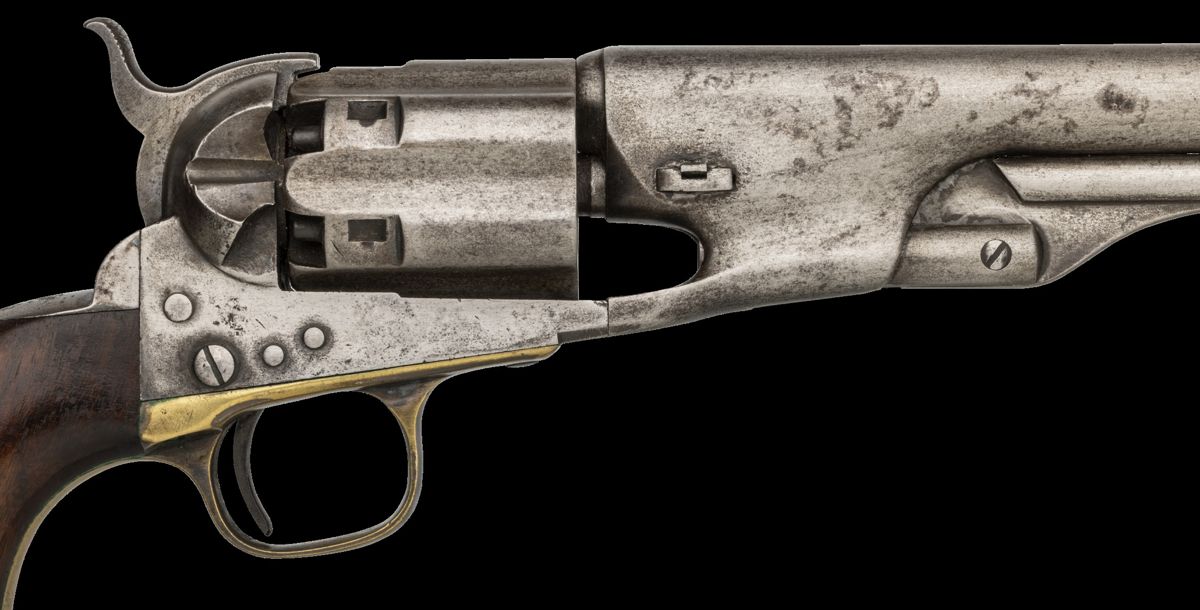
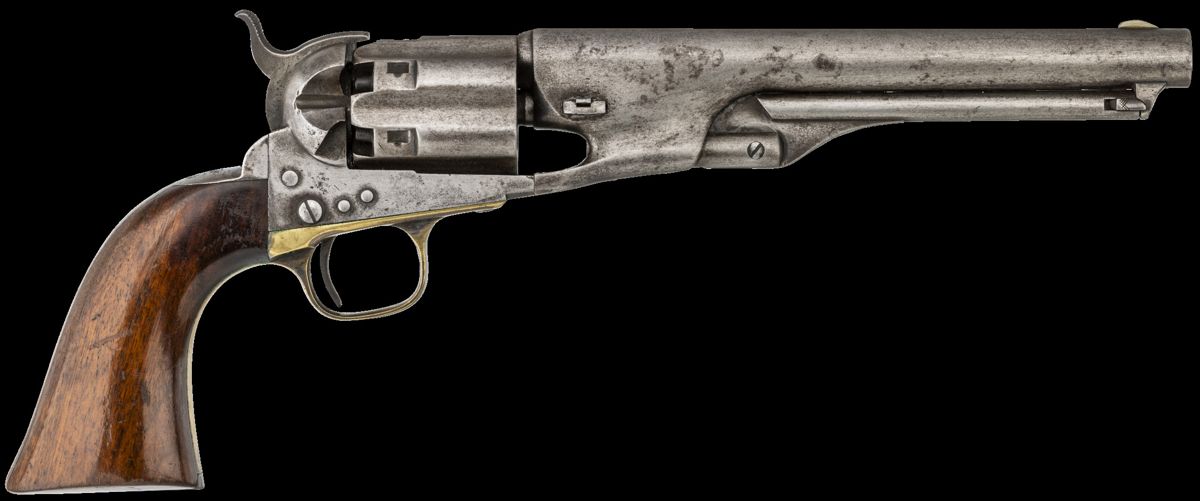
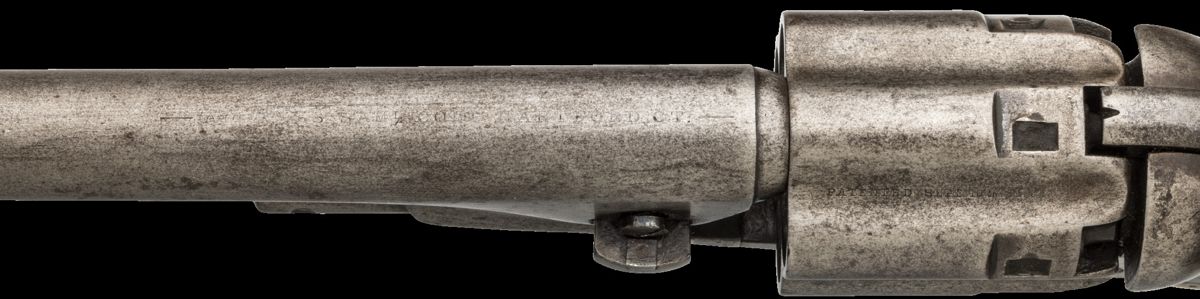
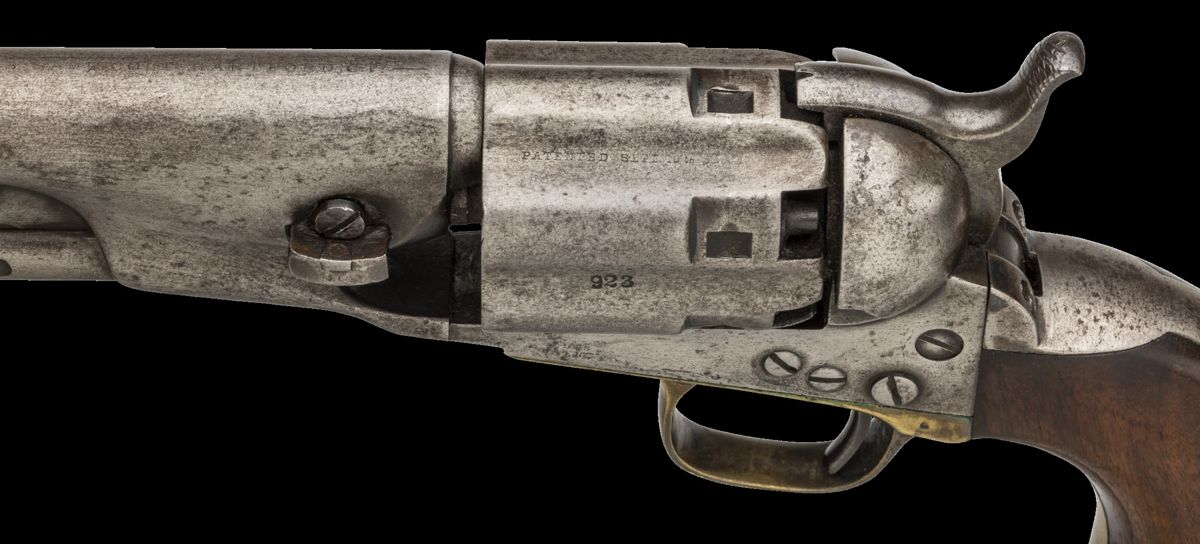
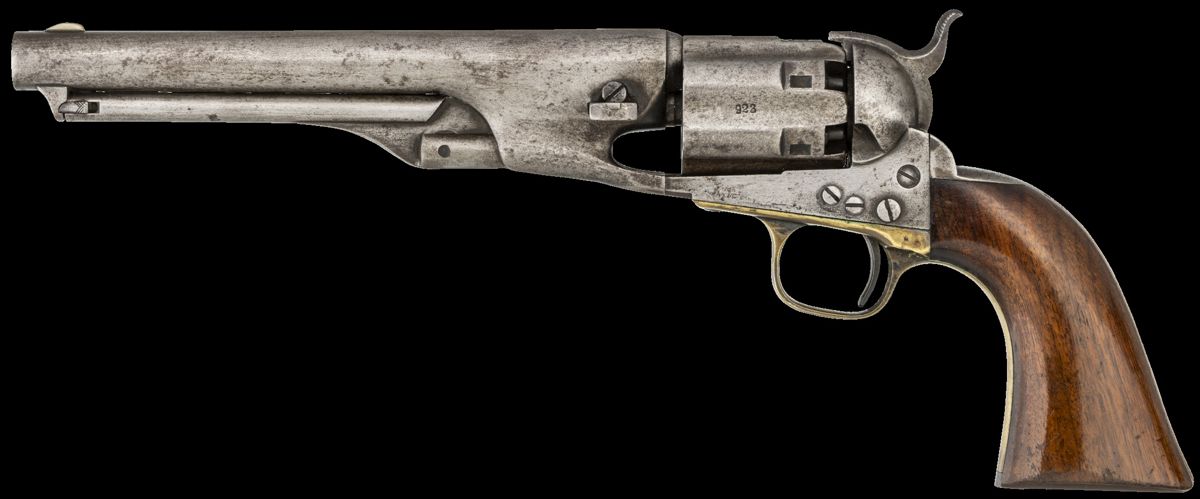
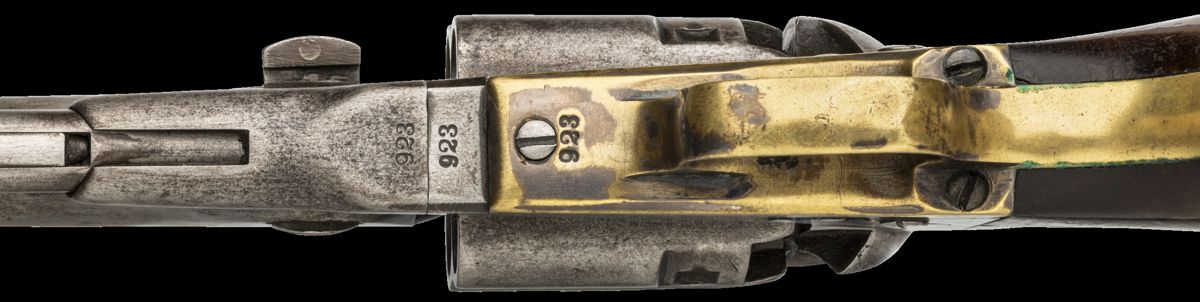
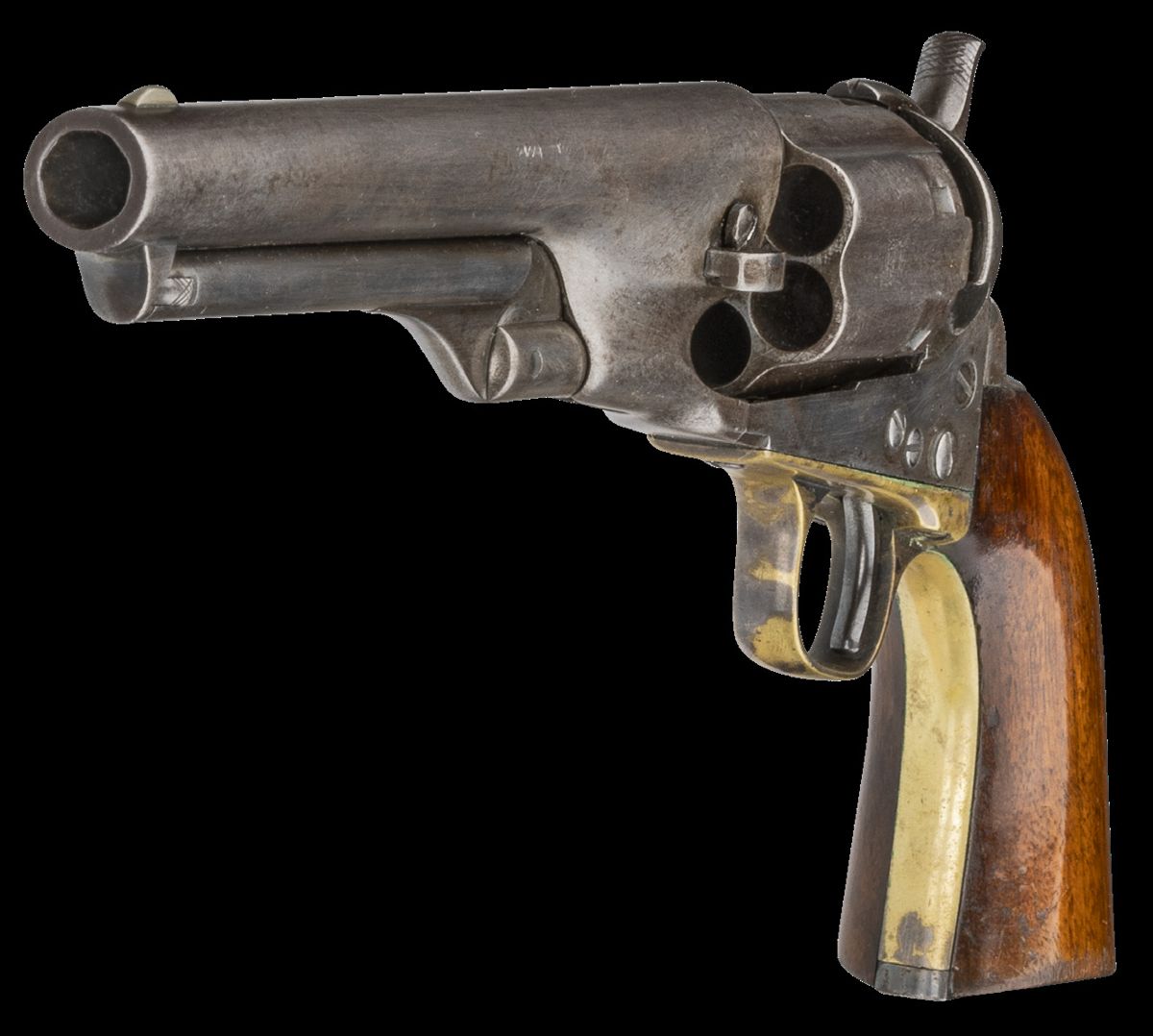
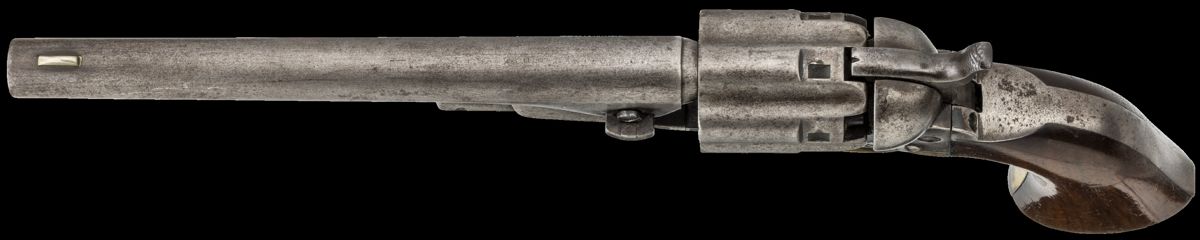
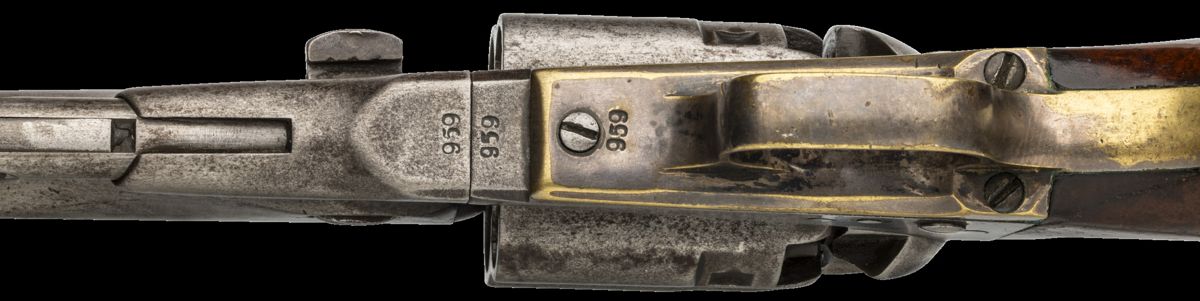
The pair of Colt Model 1860 ‘Fluted Army’ revolvers owned by Lt. John Low bear serial numbers 923 and 959. They are .44‑calibre standard configuration arms, shipped via Adams Express to Richmond,
Virginia, on April 15, 1861, as documented by a Colt factory letter. Further research by John Parsons indicated these guns, along with others, were conveyed to Peter Williams & Co., Richmond, Virginia, that same date, just three days after the Civil War commenced. The shipment’s pistol serial numbers ranged from number 161 through one as high as 1812.
SN 923
They represent some 500 revolvers sent to the State of Virginia that were subsequently taken by the Confederate government, explaining how a Confederate naval officer such as Lieutenant Low could have acquired them. Low carried these revolvers through the Civil War. For context, Captain Raphael Semmes, also of Alabama fame, carried the fluted Colt Army, serial number 3770, now displayed at the former Museum of the Confederacy. The revolvers remained in the Low family for generations, until sold in 1983 as part of Miss Doreen Low’s estate; the pair were featured in a cover story by John G. Hamilton in the August 1984 issue of The Gun Report. These arms, given their documented transit, serial numbers, and association via the Low family, offer a strong connection to Civil War Confederate naval service.
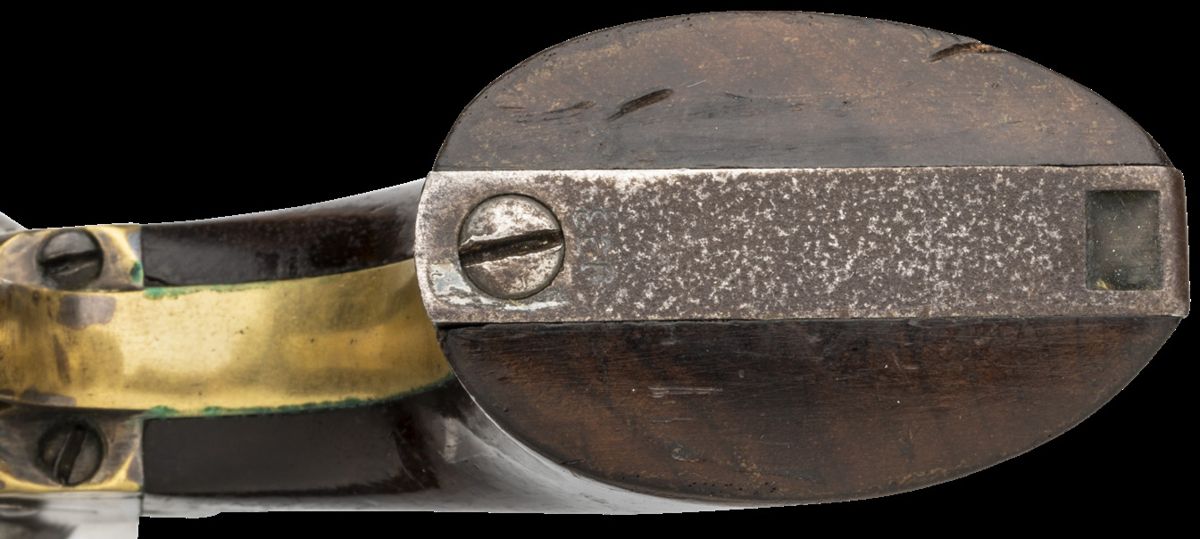
SN 923
SN 923
SN 959
SN 959
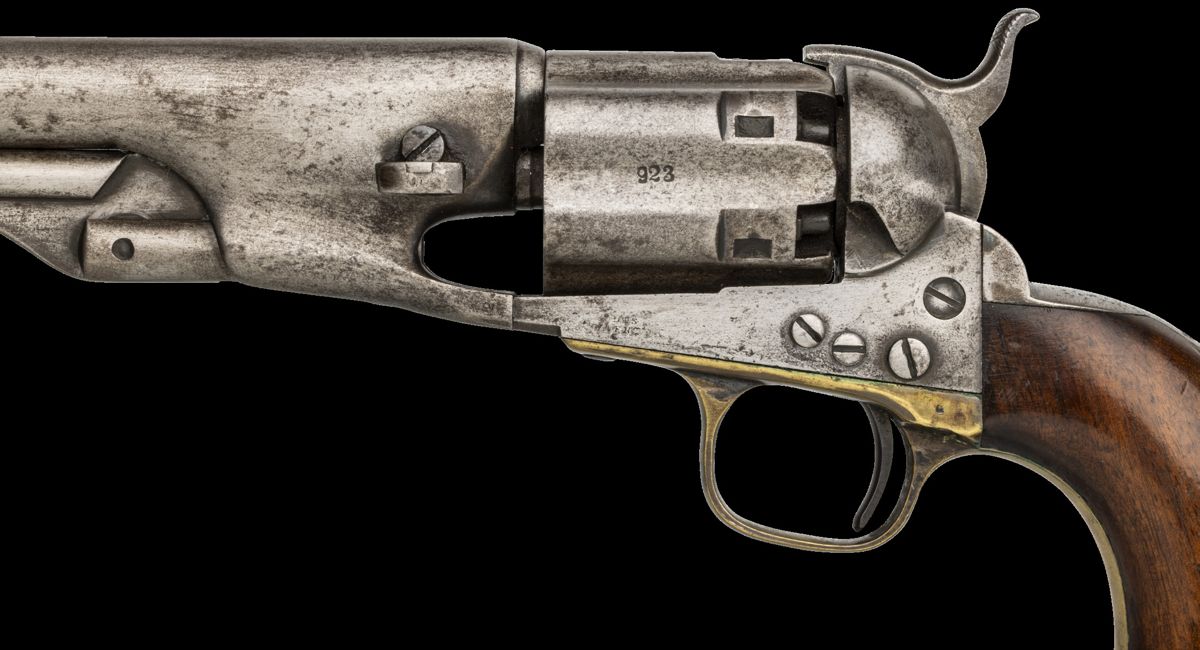
SN 959
Uniform
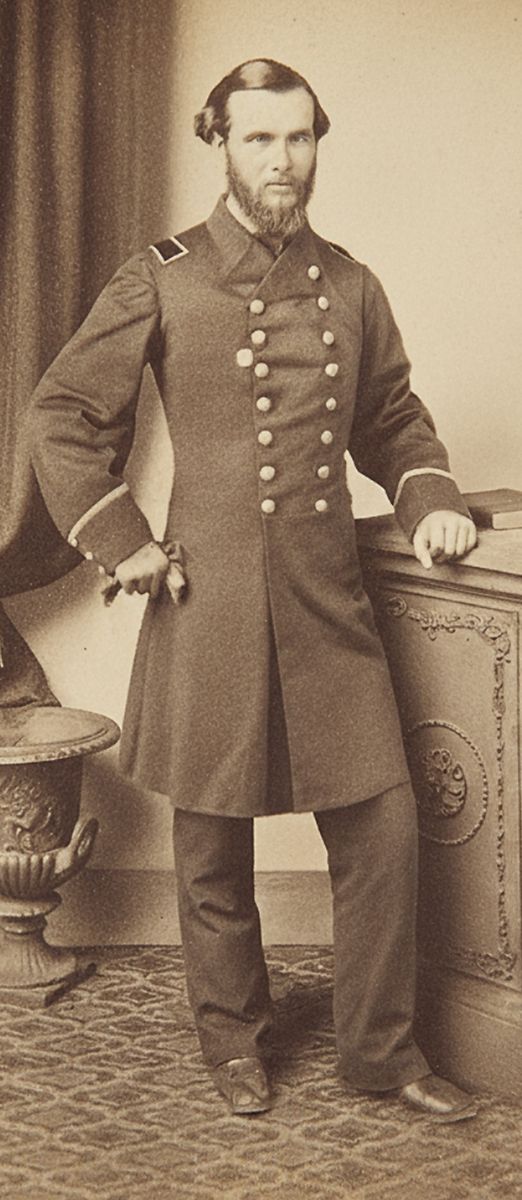
Lt. John Low’s Confederate uniform coat is arguably among the finest known in public or private hands. Crafted of high‑grade medium‑gray wool, the double‑breasted frock coat is lined with linear patterned gray/green cotton. The two-piece sleeves are lined with tan patterned cotton. A short hanging strap is stitched at the back of the collar (3 ⅛ inches in height). Typically, for CSN uniforms, the bottom edge of the coat remains raw as the lining is turned under a half inch above the edge. There is a hanging pocket located inside each breast inner facing. The pocket openings are slanted down toward the coat opening, possibly to avoid the button stitching. Each cuff features the regulation ½‑inch bullion tape loop indicating a Confederate Navy lieutenant beginning roughly three inches above the cuff end. The shoulder straps consist of light blue wool edged in bullion with a centrally located single gold star conforming to period CSN regulations for the lieutenant’s rank. Low’s coat displays two rows of nine CSN “coat‑size” buttons (type CS‑53A) down the front. All are back‑marked “S. ISSACS CAMPBELL & CO LONDON 71 JERMYN ST.” Four further matching buttons are found on the coat’s tails. The cuffs bear smaller anchor‑motif buttons, back‑marked “C. & J. WELDONS NAVAL QUALITY WARRANTED.” The stitching attaching the buttons appears to be original three ply linen thread. Accompanying the coat is a carte de visite image of Lieutenant Low wearing the uniform, holding gloves in his hand, and sporting an unidentified badge on his right breast. The image is back‑marked “The London School of Photography,” indicating its British origin and familial preservation.
Lt. John Low. Colorized 2026, Historical Publications LLC.
Four matching CSN buttons are found on the coat’s tails. The cuffs bear smaller anchor‑motif buttons, back‑marked “C. & J. WELDONS NAVAL QUALITY WARRANTED.”
The shoulder straps consist of light blue wool edged in bullion with a centrally located single gold star conforming to period CSN regulations for the lieutenant’s rank.
Each cuff features the regulation ½‑inch bullion tape loop indicating a Confederate Navy lieutenant beginning roughly three inches above the cuff end.
All buttons are back‑marked “S. ISSACS CAMPBELL & CO LONDON 71 JERMYN ST.”
A hand-drawn coat‑of‑arms documenting the Low family tree accompanied the sword and belt.
Sword
The sword bears a 27 ¼‑inch blade etched with floral/scroll motifs, the English seal with motto on the obverse, and a crown over anchor motif on the reverse. The reverse ricasso reads “ISAAC/CAMPBELL/& CO 21/ST JAMES’S ST/ LONDON,” and the obverse incorporates a small inlaid brass disc marked “Proved.” The hilt is brass, with a lion‑head pommel, crown‑over‑anchor cast on the guard, and a fish‑skin grip wrapped with double-strand brass wire. The provenance suggests this sword was originally issued with the belt, making the set a rare, near‑complete naval officer’s accoutrement tied to Confederate naval operations abroad.
(Sword, photograph of Lt. John Low, and belt rig on this page provided by Heritage Auctions)
The reverse ricasso reads “ISAAC/CAMPBELL/& CO 21/ ST JAMES’S ST/LONDON.”
Belt Rig
Low’s English‑made two‑piece interlocking Confederate Navy waist belt plate mounted on original leather is accompanied by his Isaac Campbell & Co. naval officer’s sword. The gilt‑brass belt plate (80 mm × 54 mm) retains 98% of its original gilt finish on the front, with an untouched patina on the reverse. The design features crossed cannons surmounting a fouled anchor, the letters “C. N.” and a wreath of tobacco and cotton plants symbolizing the Confederate economy. A brass adjusting loop is mounted on the leather belt, and uniquely, a braided leather hanging cord terminating in a gilt‑brass snap swivel is used instead of the conventional flat sword suspension strap; a gilt‑brass suspension hook is also affixed.
CN waist belt rig photographs by Wallace Markert.
CSS Alabama
CSS Alabama was the Confederacy’s most famous commerce raider and one of the most consequential warships of the Civil War. Built secretly at Birkenhead, England, as hull “290,” she was slipped to the Azores, armed there, and commissioned under Capt. Raphael Semmes on August 24, 1862. Designed for long cruising under sail and steam, Alabama carried a retractable propeller and collapsible funnel, features that conserved coal and improved sailing performance on distant stations. Her battery included six naval guns, and Semmes eventually brought her crew to nearly 150 officers, seamen, and marines aboard. During a career of roughly twenty-two months, Alabama ranged across the Atlantic, Gulf of Mexico, South Atlantic, and Indian Ocean, capturing or destroying about sixty-five Union merchantmen and sinking the gunboat USS Hatteras off Galveston in January 1863. Her real value to the Confederacy was strategic and psychological. She drove up marine insurance, forced Federal merchantmen into foreign registry, disrupted oceanic trade routes, and compelled the United States Navy to divert ships from blockade duty in pursuit of her. For collectors and historians, Alabama remains especially significant because she connects naval warfare, Confederate procurement abroad, and the international controversy later known as the Alabama Claims. Artifacts recovered from the wreck off Cherbourg, France, including ordnance-related material and shipboard equipment, offer rare physical evidence of a hard-used cruiser that operated on a truly global circuit. Alabama met her end on June 19, 1864, when USS Kearsarge defeated her off Cherbourg, but her legend long outlived the ship itself.
Painting of CSS Alabama. By Rear Admiral J. W. Schmidt.
Lt. John Low’s original framed “Certificate of Competency as MASTER” issued by the British Privy Council for Trade on July 17, 1865, just over three months after the Confederate surrender at Appomattox Court House.
Number 3 is stamped on the wreath and tongue.
About the Author Battlefield archaeologist Larry Babits earned degrees from Maryland and Brown leading to a teaching and research career at Washington and Lee, Armstrong State, and East Carolina. He has been reenacting since 1961 with an interruption whilst serving in B Company, 1st Bn, 21st Infantry (Gimlets) during 1963–1966. A retired rugby player, referee, and coach, he is now working on finishing Nathanael Greene’s 1781 Southern Campaign focusing on Hobkirk’s Hill, Augusta/Ninety Six, and Eutaw Springs. Along the way, he continues researching the Revolutionary War’s private soldier and shooting with the N-SSA’s First Maryland Blackhats.