
Tranter Revolvers & Their Southern Service
By Tim Prince · Originally published March-April 2026 · pp. 47–59
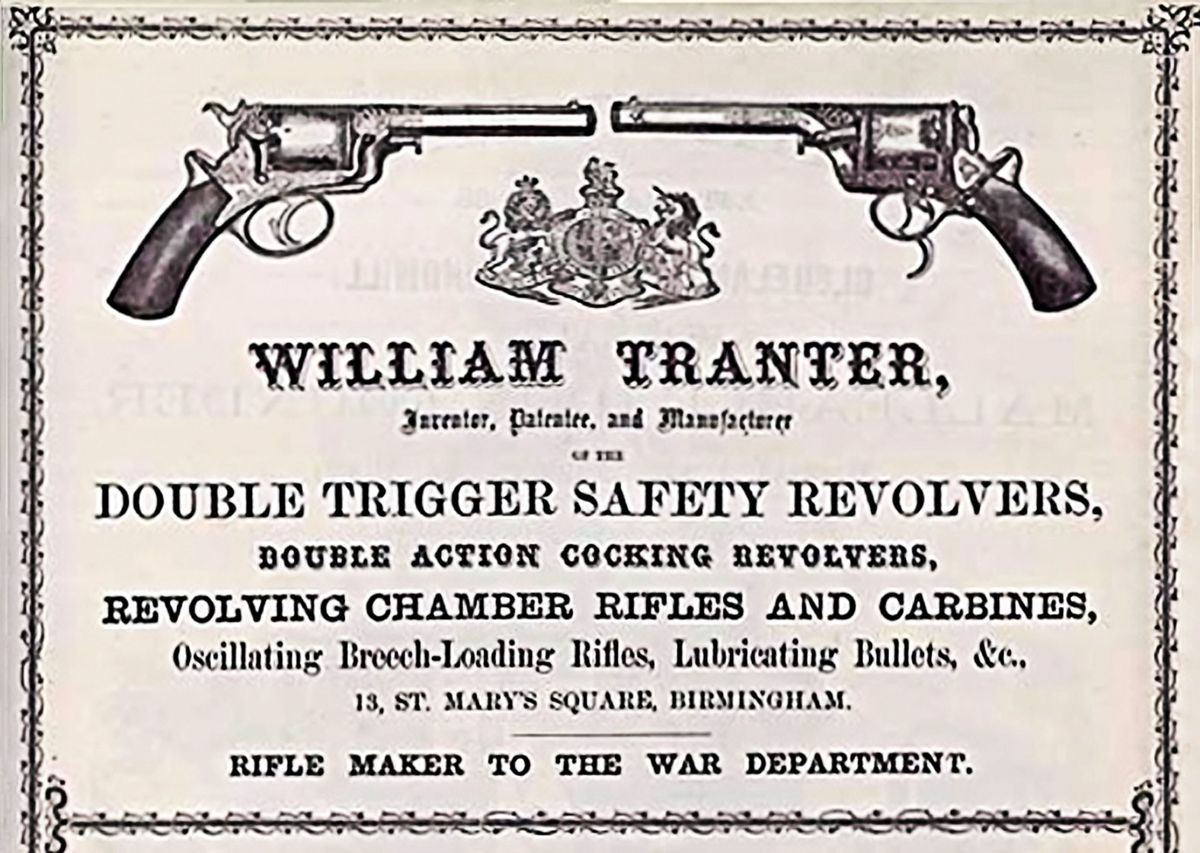
The revolvers produced by English gunmaker William Tranter were some of the most advanced and modern handgun designs to see use by the Confederacy during the course of the American Civil War. Tranter was born in 1816 and died in 1890, and during his working life, he was one of the most prominent gun, rifle and pistol makers in the Birmingham (England) gun trade. He went into business for himself circa 1840, after completing his apprenticeship with Hollis Brothers & Co., which he had begun in 1830. Tranter continued in the trade until 1885, just five years before his death. In 1840, after spending a decade learning Advertisement for Tranter revolvers. the gun trade at Hollis Bros & Co. (later Hollis & Sheath), Tranter bought the estabintroduced in 1853. The earliest revolvers utilized lished gun making business of Robert Dugard at 29 Robert Adams’ patent for a solid, one-piece frame ½ Whitehall Street. Over the next decade, he worked and barrel that were machined from a single forgfor himself and was also involved in joint ventures ing. Tranter’s initial production run of revolvers with his old employers John & Isaac Hollis as well as included both Adams 1851 patent lock works, and with Isaac Sheath. Tranter’s own patented lock works. The original “Tranter” type revolvers, known to collectors as By 1850, he had located his primary business at 1st Model Tranter revolvers had no provision for a 50 Loveday Street, where he was listed in a period fixed loading lever. The lever swiveled on a stud that directory as having “shops, sheds, steam machinery, projected from the left side of the frame, which had yard & premises.” Tranter secured his first British no provision to retain the lever when it was mounted patent related to firearms in October 1849, when he on the revolver. The lever was intended to be stored registered a “pepperbox mechanism and lever catch in a case or carried in the pocket; hardly a practical for pistol locks.” In January 1853 he registered British solution if the user had to reload the revolver in the Patent Number 212 (1853) for a pair of “self-cocking” field. pistol mechanisms and a safety mechanism. Most of these guns were manufactured on In December of the same year, he registered Adams patent frames and have Adams patent serial designs for a double-action revolver mechanism, numbers (really patent tracking numbers to pay lubricated bullets and wadding, and a breech loadroyalties to Adams) and these numbers are followed ing mechanism, all of which were covered by British by a Y suffix. The 2nd Model Tranter revolvers also Patent Number 2921 (1853). In August 1856, he had a pin on the frame that allowed the attachment registered the designs for a “double trigger revolver of a removable loading lever, but the pin had a small mechanism,” along with several other designs, all of projection that allowed the lever to remain attached which were covered by British Patent Number 1913 to the gun unless a notch in the lever was aligned (1856). Tranter continued patenting firearm designs with the stud projection to remove it. The later as late as 1887, even though he was no longer examples of these guns, manufactured after about directly active in the gun trade. 1856, have Tranter patent serial numbers and end with a T-suffix. These guns not only include Tranter Tranter’s most successful series of arms were patent lock works, but also a newly improved his “self-cocking” revolvers, which were initially version of the Adams solid frame, which was patented by Tranter in 1856. At this point, Tranter revolvers rarely have Adams serial numbers. The 3rd Left: This ambrotype of English gunmaker, William Tranter, and is Model Tranter revolvers had a more permanently the only known illustration of him. He is holding one of his 1855 attached loading lever, which was secured by a model revolvers which is fitted with a detachable loading lever.
Patent: William Tranter A.D. 1863, 27th July. № 1862 Revolving Fire-arms. LETTERS PATENT to William Tranter, of Birmingham, in the County of Warwick, Gun Maker, for the Invention of “Improvements in Breech-loading and other Revolving Fire-arms.” Sealed the 18th September 1863, and dated the 27th July 1863. PROVISIONAL SPECIFICATION left by the said William Tranter at the Office of the Commissioners of Patents, with his Petition, on the 27th July 1863. I, William Tranter, of Birmingham, in the County of Warwick, Gun Maker, do hereby declare the nature of the said Invention for “Improvements in Breech-loading and other Revolving Fire-arms,” to be as follows:— My Invention consists in the several combinations of parts herein-after described. The first part of my Invention consists in the adaptation and application to such fire-arms of a plunger for forcing out the empty cartridge case, such plunger being worked by a lever having its fulcrum on the upper part of the frame, the plunger being thereby retained in its position when not required for use. The second part of my Invention consists in forming the shield at the back of the revolving chamber with a hole for the insertion of the cartridge in the chamber, which hole is closed, after loading, by means of a stud fixed on n plate working on a pin screwed into the frame, the plate being retained in its position by means of a click or otherwise. The third part of my Invention consists in forming the butt cap with two segmental projections, or with two or more studs, for the purpose of fixing the stocks to the handles of revolving pistols, such projections or studs being driven into the ends of the stocks. And the last part of my Invention consists in adapting and applying to the front part of the cock or hammer a spring click working in combination with the lever for retaining the revolving chamber as required, which lever is formed with a projection in front of the cock capable of being acted on by the said click. SPECIFICATION in pursuance of the conditions of the Letters Patent, filed by the said William Tranter in the Great Seal Patent Office on the 27th January 1864. TO ALL TO WHOM THESE PRESENTS SHALL COME, I, William Tranter, of Birmingham, in the County of Warwick, Gun Maker, send greeting. WHEREAS Her most Excellent Majesty Queen Victoria, by Her Letters Patent, bearing date the Twenty-seventh day of July, in the year of our Lord One thousand eight hundred and sixty-three, in the twenty-seventh year of Her reign, did, for Herself, Her heirs and successors, give and grant unto me, the said William Tranter, Her special license that I, the said William Tranter, my executors, administrators, and assigns, or such others as I, the said William Tranter, my executors, administrators, and assigns, should at any time agree with, and no others, from time to time and at all times thereafter during the term therein expressed, should and lawfully might make, use, exercise, and vend, within the United Kingdom of Great Britain and Ireland, the Channel Islands, and Isle of Man, an Invention for “Improvements in Breech-loading and other Revolving Firearms,” upon the condition (amongst others) that I, the said William Tranter, by an instrument in writing under my band and seal, should particularly describe and ascertain the nature of the said Invention, and in what manner the same was to be performed, and cause the same to be filed in the Great Seal Patent Office within six calendar months next and immediately after the date of the said Letters Patent. NOW KNOW YE, that I, the said William Tranter, do hereby declare the nature of my said Invention, and in what manner the same is to be performed, to be particularly described and ascertained in and by the following statement, reference being had to the Drawings hereunto annexed, and to the letters and figures marked thereon (that is to say):— My Invention of Improvements in Breech-loading and other Revolving Fire-arms” consists in the several combination of parts herein-after described.
The first part of my Invention consists in the adaptation and application to such fire-arms of a plunger for forcing out the empty cartridge case, such plunger being worked by a lever having its fulcrum on the upper part of the frame, the plunger being thereby retained in its position when not required for use. The second part of my Invention consists in forming the shield at the back of the revolving chamber, with a hole for the insertion of the cartridge in the chamber, which hole is closed, after loading, by means of a stud fixed on a plate working on a pin screwed into the frame, the plate being retained in its 15 position by means of a click or otherwise. The third part of my Invention consists in forming the butt cap with two segmental projections, or with two or more studs, for the purpose of fixing the stocks to the handles of revolving pistols, such projections or studs being driven into the ends of the stocks. And the last part of my Invention consists in adapting and applying to the front part of the cock or hammer a spring click working in combination with the lever for retaining the revolving chamber as required, which lever is formed with a projection in front of the cock capable of being acted on by the said click. Having thus stated the nature of the said Invention, I will proceed to describe more particularly in what manner the same is to be performed by the aid of the accompanying Drawings, in which are represented the parts of fire arms above referred to.
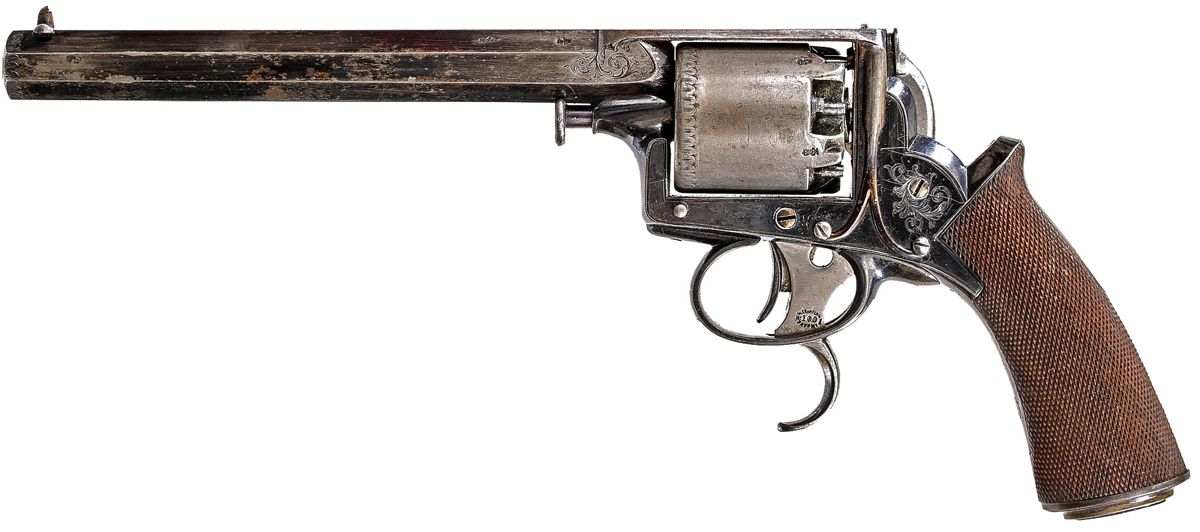
Fig. 1
Fig. 5
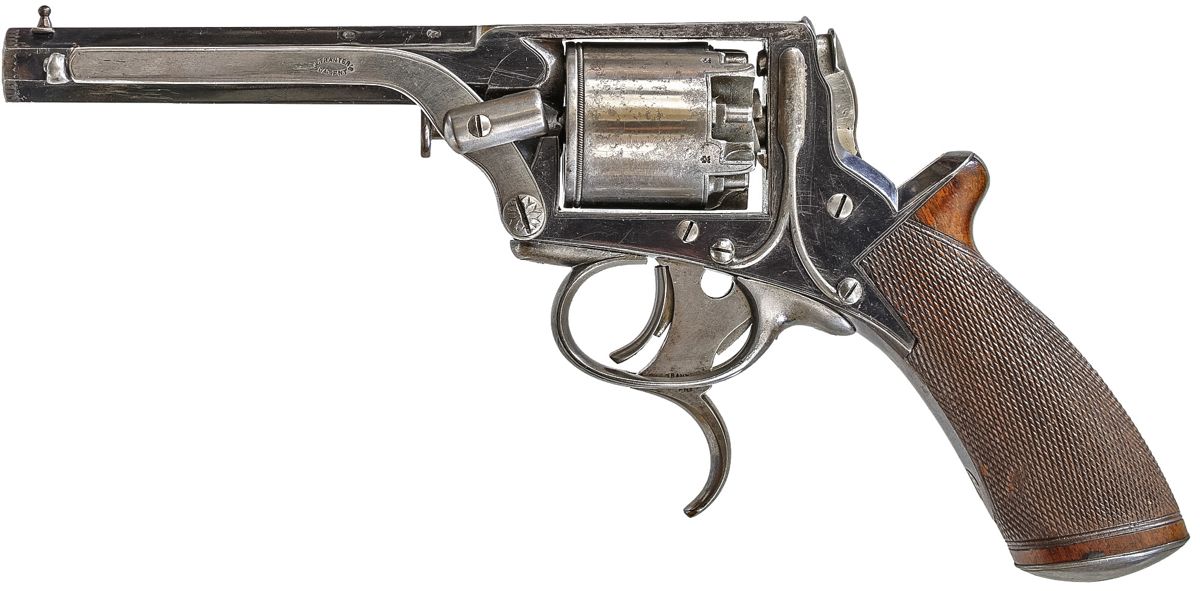
Fig. 2
Fig. 3 Fig. 4
Description of the Drawings In Fig. 1, A is the plunger for unloading or for forcing out empty cartridge cases; this plunger is connected by a swivel B to the lever C, having its fulcrum in the upper part of the frame at D. The lever C is fixed in the position represented in the figure by its outer end, having a cavity formed on its inner side, such cavity fitting on to a stud fixed in the barrel of the fire-arm, the lever having sufficient elasticity to admit of its being sprung on to the fixed stud; and the lever is moved into the position shewn by dotted lines, when it is required to unload or to force out an empty cartridge case from one of the loading chambers,by which means the plunger A will be driven forward as required. The swivel B may be dispensed with if preferred, by forming a slot in the end of the plunger for an arm of the lever C to work in. In the same Figure, E is the cover for the shield F at the back of the revolving chamber, such cover consisting of a plate working on a pin or pivot G screwed into the frame. The shield F has a hole affording access to the loading chamber, which hole is closed, after loading, by the entrance into it of a corresponding projection on the inner face of the plate or cover E. This plate or cover is retained in the closed position (as represented) by means of a click at the lower end, or otherwise. Figures 2, 3, and 4, represent my improved form of butt cap. Fig. 2 showing the same formed with two segmental projections H, H; Fig. 8 shewing the same formed with two studs, and Fig. 4 being a transverse section of the cap. The stocks are inserted and held at one end by the frame of the pistol, and they are held at the butt end by the projections or studs on the cap, which are driven into the wood or caused to enter suitable cavities previously formed therein. In Fig. 5 is represented the last part of my Invention, consisting of a spring click in the front part of the cock or hammer, acting in combination with the lever I for stopping the revolving chamber. When the cock or hammer is first raised (into the position shewn by dotted lines) n shoulder on the spring click K is caused to act on the hooked end of the lever I, and by lifting that end of the lever to remove the stud on the opposite end thereof out of the notch of the revolving chamber and release the same. As, however, the cock or hammer is further raised, the shoulder of the spring click is removed from the hooked end of the lever I, which lever is thus free to be acted upon by its spring, so as to carry the stud on its end into the next notch on the revolving chamber, which is thereby held as required. Having thus described the nature of the said Invention, and in what manner the same is to be performed, I hereby declare that what I claim as of my Invention is,— First, the plunger worked by a lever as described for unloading or for forcing out empty cartridge cases. Secondly, the shield with a hole in it for the purpose of affording access to each loading chamber combined with a cover working on a pivot fixed in the frame, such cover having a projection on its inner face adapted to close the bole of the shield, as herein-before described. Thirdly, the mode described of forming butt caps, either with segmental projections or studs for the purpose of entering the wood at the end of the stocks, and thereby fastening them securely. And, lastly, the spring click in the front part of the cock or hammer combined with the lever for retaining the revolving chamber, such spring click being caused, by the rising of the cock or hammer, to act on the said lever, so as to withdraw the stud on the lever from the notch of the chamber and allow it to enter another notch in the manner described. In witness whereof, I, the said William Tranter, have hereunto set my hand and seal, the Twenty-seventh day of January, in the year of our Lord One thousand eight hundred and sixty-four. WILLIAM TRANTER. (L.S.) Witness, William Spence, 50, Chancery Lane, Patent Agent.
1ST MODEL TRANTER
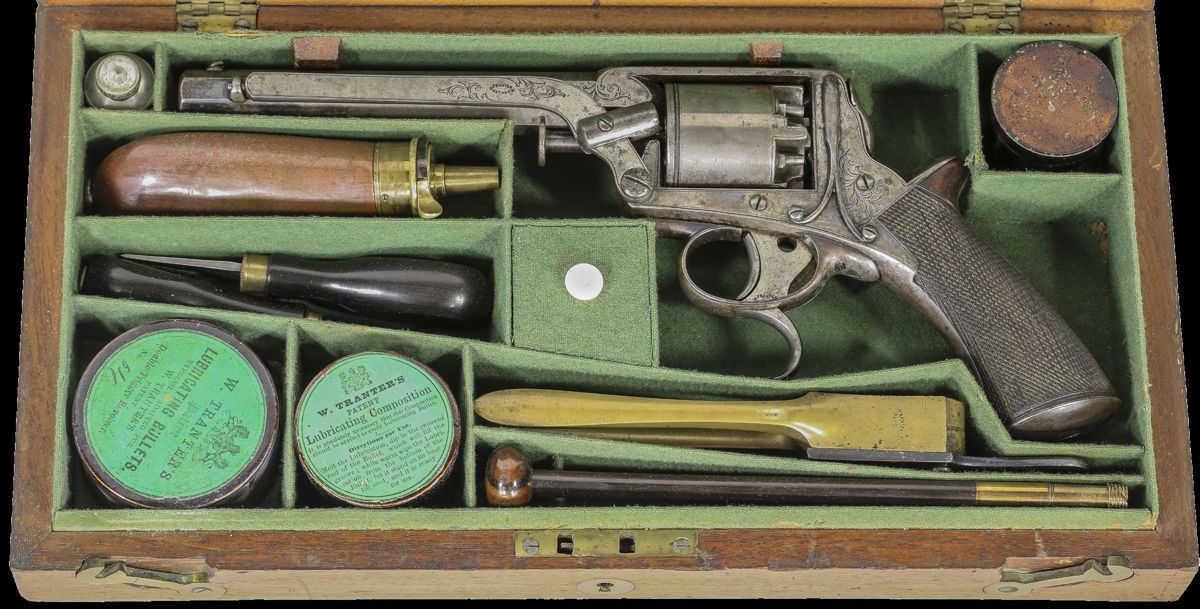
1st Model Tranter “Double Trigger” Revolver, 36-bore, with Adams patent “Y” suffix serial number, retailer marked by Hyde & Goodrich of New Orleans. (Tim Prince)
3RD MODEL TRANTER
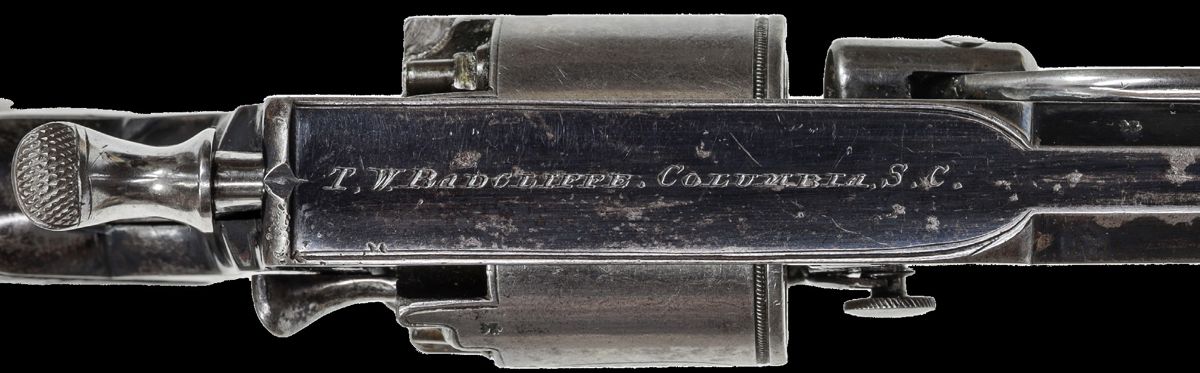
3rd Model Tranter “Double Trigger” Revolver, 80-bore, with Tranter patent “T-suffix” serial number, retailer marked by T.W. Radcliffe of Columbia, S.C.
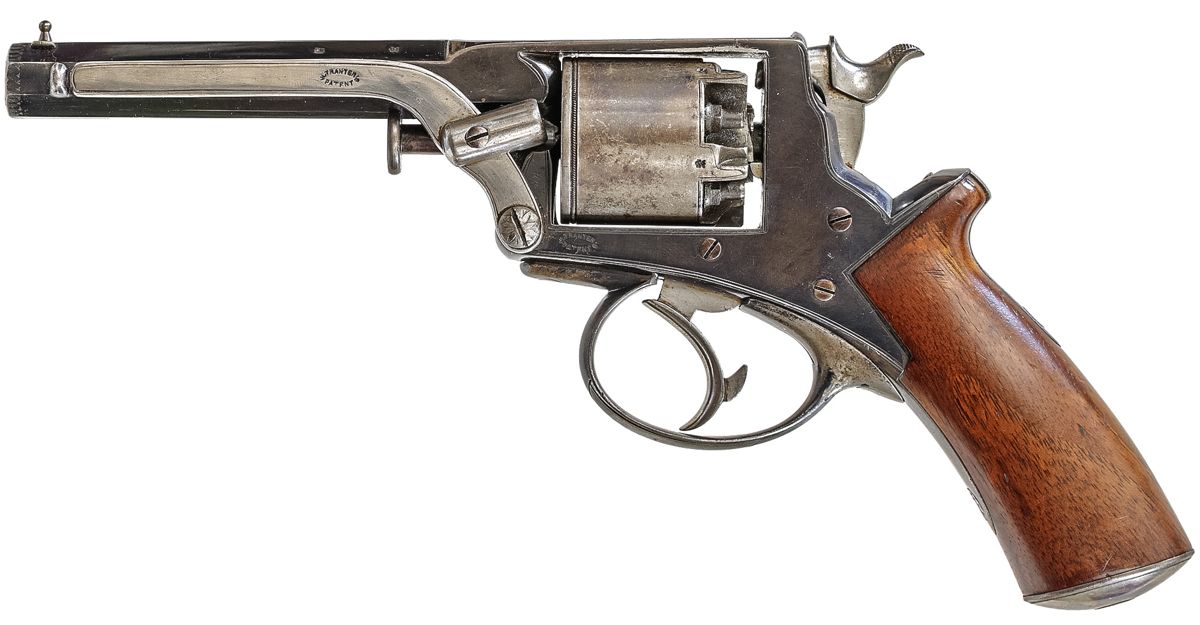
4TH MODEL TRANTER
4th Model Tranter “Single Trigger” Revolver, 80-bore, with Tranter patent “T-suffix” serial number and special order smooth grips, retailer marked by T.W. Radcliffe of Columbia, S.C.
screw. The 3rd Models appear to have all been produced in the T suffix Tranter serial number range. All three of these models were based on his “doubletrigger” system (initially referred to as his “hesitating mechanism” on the early production guns), which utilized a second “trigger” under the trigger guard to rotate the cylinder and cock the hammer. The trigger inside the trigger guard was used to trip the sear and release the hammer to fire the revolver. The 4th Model Tranter revolvers (which were introduced in 1856 and are all in the Tranter T-suffix series) used a single trigger and utilized a lock work that would be referred to as a conventional “double action” mechanism today. All of the Tranter revolver patterns were produced in a variety of calibers, with 54-bore (.442)
“Holster Size” and 120-bore (.338) “Pocket Size” revolvers being the most commonly encountered calibers and frame sizes, and the mid-sized 80-bore (.387) “Belt Size” being less often encountered. Some of the guns were also produced in the exceptionally large and powerful 36 and 38 bore sizes, which were larger versions of the holster size guns, and were about .50 caliber! Barrel lengths varied as well, with the larger caliber arms typically having longer barrels and the smaller caliber guns having shorter barrels. All of the guns were 5-shot percussion revolvers, and typically featured checkered one-piece walnut grips, although smooth wooden grips and other grip materials are known to have been used on a special order basis.
Lt. Julian Pratt’s squad inventory of 17 English revolvers listed by serial number and carried by members of 18th Va. Cav., one of the very few known listings of Confederate revolvers by serial number.
“FINE ENGLISH REVOLVERS. Just received from England, six Tranter’s fine REVOLVING PISTOLS, 80 and 120 bore. Price $220 each. Address H. E. NICHOLS, COLUMBIA, S. C.” (Richmond Daily Dispatch (Richmond, Virginia), Tuesday, March 10, 1863, p. 1.)
The Tranter patent revolver was the primary competitor with the Adams and Adams-Beaumont patent revolvers in England and was also exported widely. Pre-Civil War Tranter revolvers are known with U.S. retailer marks, indicating that his designs were at least somewhat successful in the United States. The majority of the retailer marked guns are from the southern states, with the largest majority of them being marked by New Orleans retailers. Based upon extant examples, the firm of Hyde & Goodrich (later Thomas, Griswold & Co.) appears to have been the primary importer of Tranter patent revolvers into the southern United States. Most of these retailer marked guns were sold cased with accessories, although some guns were certainly sold without the expensive casings and accouterments. During the American Civil War, it appears that the importation of Tranter revolvers was somewhat limited, at least regarding Confederate central government purchases. However, period advertisements in the south and extant examples with Southern provenance make it clear that the guns were imported by blockade-runners as speculative items for sale in the south. Such famous Confederates as General John Hunt Morgan (3rd Model #3758T), General J.E.B. Stuart (4th Model #8673T), General John Magruder and Colonel Dabney H. Maury (3rd Model #7993T), who served on the staff of General Earl Van Dorn, all owned documented 54-bore Tranter revolvers. The famous “Pratt Roll,” which lists the revolvers in the possession of Lt. Julian Pratt’s squad of troopers in Company H of the 18th Virginia Cavalry in July 1864, lists two Tranter revolvers, with the serial numbers 15465 and 15476. This indicates that Tranter revolvers in the mid 15XXX serial number range were in use by southern forces, and in the field by that time. While models are not listed in the list, it is assumed that these guns were either 3rd of 4th model revolvers and were likely 54-bore. Other Tranter revolvers with southern provenance include guns which are retailer marked by T.W. Radcliffe of Columbia, S.C. Additionally, a March 10, 1863, advertisement in the Richmond Daily Dispatch for H.E. Nichols of Columbia, S.C., read in part: “FINE ENGLISH REVOLVERS. Just received from England, six Tranter’s fine REVOLVING PISTOLS, 80 and 120 bore. Price $220 each.” All of this evidence indicates that at least some of the Tranter revolvers produced during, as well as prior to, the Civil War, saw Confederate use.
Record of Lt. Julian G. Pratt, Co. H, 18th Virginia Cavalry in the National Archives.
Dating Tranter revolvers based upon their serial numbers is somewhat problematic, as frames were sometimes produced in advance and the guns completed at a later date. What we do know is that the “T” serial number suffix came into use around serial number 2200, sometime between 1854 and 1856. We also know that Tranter produced revolvers using Adams patent serial numbers and a “Y” suffix from about 1853 through about 1856. These guns appear in several serial number ranges, as assigned by Adams, including the 2XXXX range. All “Y” suffix guns predate the Civil War by at least four or five years. From extant examples of Tranters with specific dates, presentations and usage associated with them, it appears that those Tranter revolvers with serial numbers through about the 20XXX range (and possibly some of the early guns in the 21XXX range) with T suffixes appear to have been produced prior to the end of 1865, making them “Civil War era.” PostCivil War Southern retailer marks begin to appear in the 21XXX range, suggesting that these guns are likely 1865 production, or possibly slightly later. While Tranter revolvers were not utilized by the
Confederacy to the same extent as the English made Kerr revolvers and domestically produced revolvers were, they were used in sufficient quantities to qualify them as a secondary Confederate martial revolver. The fact that such a small sample of revolvers in the field represented by the Pratt list includes two Tranters out of a total of seventeen handguns suggests that they were probably used more than we tend to think that they were. The robust solid-frame design, double action lockwork and availability in serious combat calibers certainly made the Tranter revolver a logical choice for use by those Confederate soldiers that relied upon a revolver for combat during the American Civil War.
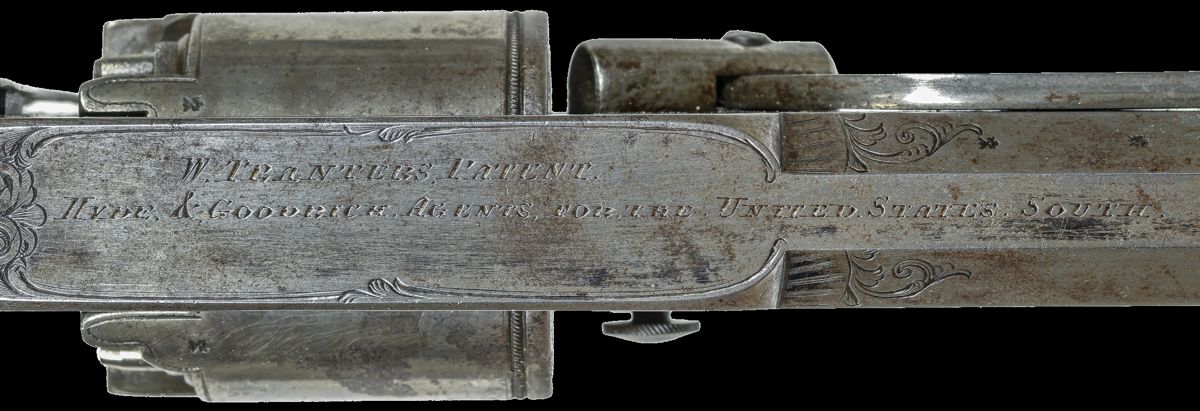
Retailer marking “W. TRANTERS. PATENT./HYDE & GOODRICH, AGENTS, FOR THE UNITED STATES SOUTH.”
An uncommon cased Hyde & Goodrich marked 3rd Model Tranter revolver, #9342T with additional retailer marking that reads “Agents United States South,” suggesting that Hyde & Goodrich was the distributor for Tranter revolvers in the southern United States during the Antebellum period.
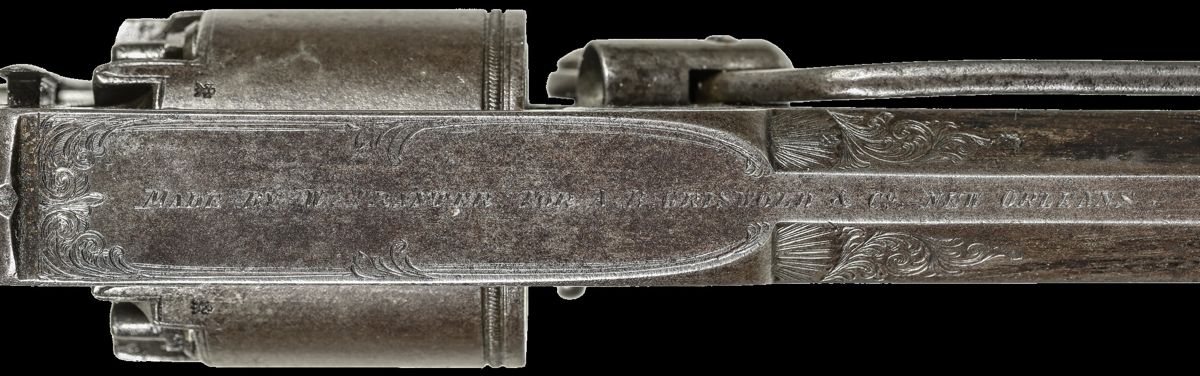
Marked “MADE BY W. TRANTER FOR A. B. GRISWOLD & CO. NEW ORLEANS.” The firm of A.B. Griswold & Company was the last incarnation of the famous New Orleans based merchant, importer, retailer and jeweler Hyde & Goodrich. The firm was initially established in 1819 at the corner of Canal and Royal streets in New Orleans. The firm became Thomas, Griswold & Company in 1861, and by 1865 was doing business as A.B. Griswold & Co.
A cased 3rd Model Tranter revolver #35854T with the post-Civil War retailer mark of A. B. Griswold of New Orleans, the successor to Hyde & Goodrich and later Thomas, Griswold & Co.
Retailer marking “T.W. RADCLIFFE OF COLUMBIA, S.C.,” on a 3rd Model Tranter revolver.
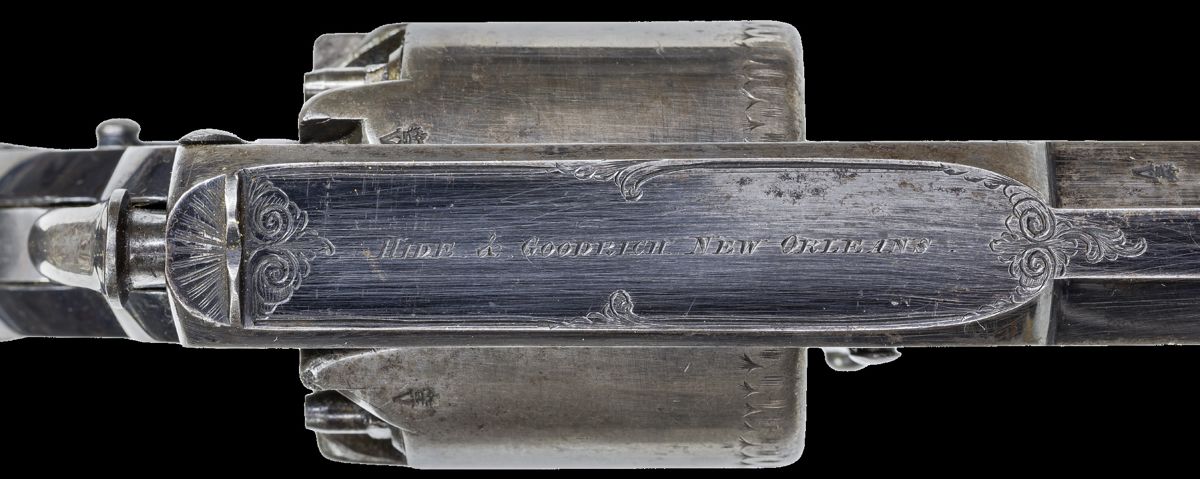
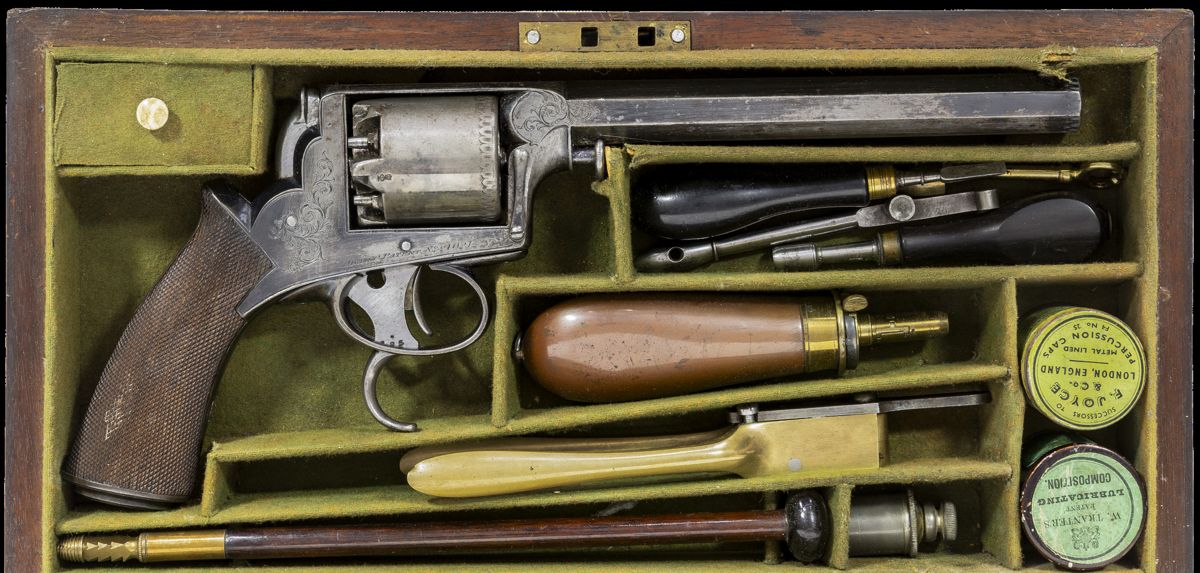
Retailer misspelled marked “HIDE & GOODRICH NEW ORLEANS” on the 1st Model Tranter revolver, serial number 21021Y.
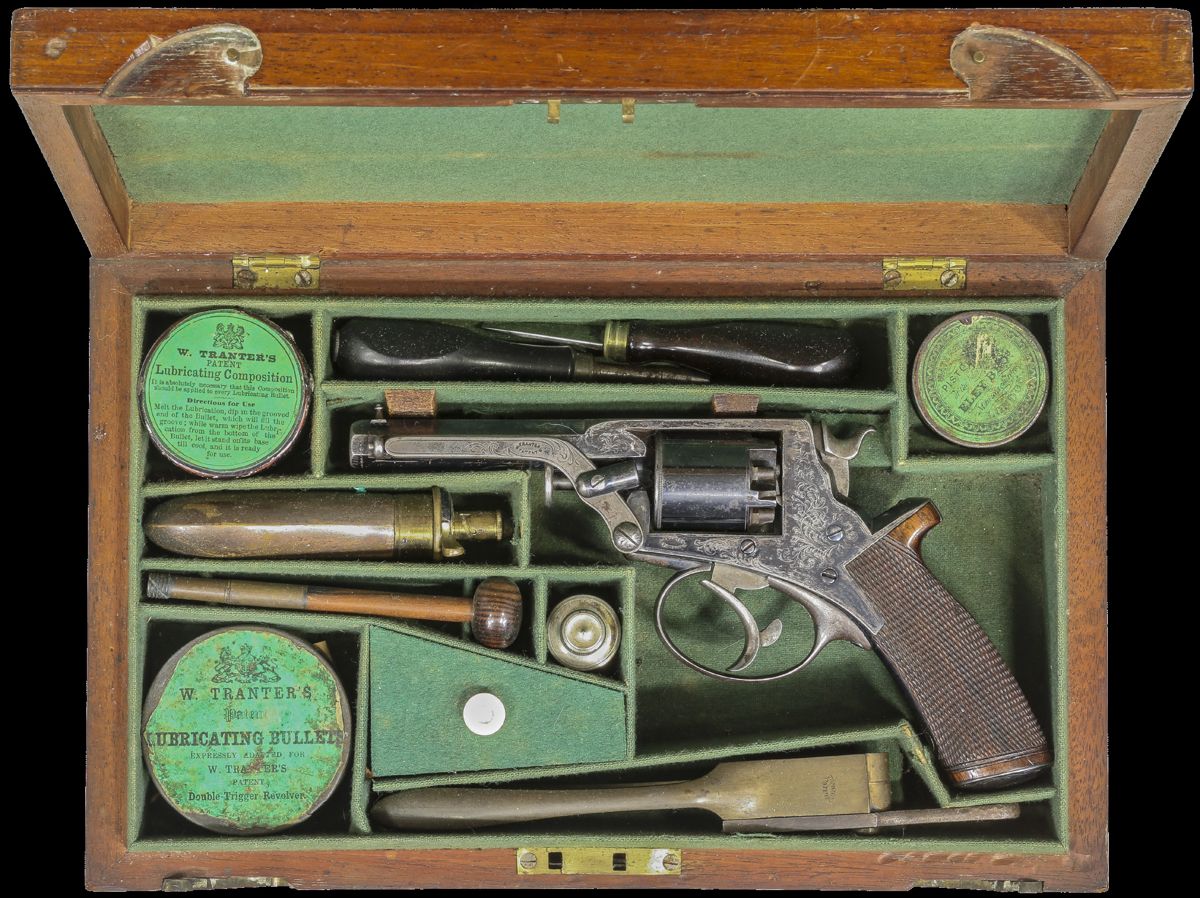
This cased Hyde & Goodrich retailer marked the 1st Model Tranter revolver with the Adams patent serial number 21021Y. This early production revolver from New Orleans has the name “Hyde” misspelled as “Hide,” suggesting the retailer’s engraving was done in England rather than in New Orleans. To the author’s knowledge, this is the only known example with the firm’s name misspelled. The gun is also a rare, large-caliber 36 bore firearm, approximately .50 caliber.
Tranter broadside for his patent double-action cocking revolver.
About the Author Tim Prince is a full-time dealer in fine and collectible military arms from the Colonial Period through WWII. He operates College Hill Arsenal, a web-based antique arms retail site. A long-time collector and researcher, he has been a contributing author to two major book projects about Civil War era arms including The English Connection and a book on southern retailer-marked and Confederate-used shotguns. He is the author of over 75 articles on weapons in Civil War News and Military Antique Collector. Tim is also a featured Arms & Militaria appraiser on the PBS Series Antiques Roadshow and serves as a Senior Consulting Specialist to the Arms & Armor department of Cowan’s, a Freeman’s | Hindman Company.
Bullet-struck artifacts are highly collectible today. From the Civil War through World War I and World War II, an artifact with a bullet strike brings the brutality of combat to life. Some of the rarest of these pieces are from the American Revolution, specifically the first day of the war, April 19, 1775. Often referred to as the battle of “Lexington and Concord,” the fighting took place in many other towns along the route the British regulars took to get back to the relative safety of Boston. Bullet-struck objects and architectural elements were highly prized in the early to mid-19th century as mementos of the fighting that took place during the founding of our nation, as they still are today. As if the fighting at Lexington Green in the dawn hours, the battle at Concord’s North Bridge, and the fighting in Lincoln as the British retreated to Boston weren’t brutal enough, the fighting in the late afternoon of April 19 grew in intensity as the day wore on. Many provincial militia and minute companies came into the fight along the route, as did 1,000 British reinforcements under Lord Hugh Earl Percy, who came out to defend the column returning from Concord. As more men entered the fight, it became more vicious. Reverend William Gordon visited the battlefield the next day and wrote: “But a little on this side Lexington Meeting-House where they were met by the Brigade, with, cannon, under Lord
Percy, the scene changed. The inhabitants had quitted their houses in general upon the road, leaving almost every thing behind them, and thinking themselves well off in escaping with their lives. The soldiers burnt in Lexington three houses, one barn, and two shops, one of which joined to the house, and a mill-house adjoining to the barn; other houses and buildings were attempted to be burnt, and narrowly escaped. You would have been shocked at the destruction which has been made, by the Regulars, as they are miscalled, had you been present with me to have beheld it. Many houses were plundered of every thing valuable that could be taken away, and what could not be carried off was destroyed; looking-glasses, pots, pans, &c, were broke all to pieces; doors when not fastened, sashes and windows wantonly damaged and destroyed.”1 As Rev. Gordon noted, “the scene changed” once the angry British reinforcements arrived. An unknown British officer from the 4th Regiment of Foot who was with Percy’s relief force wrote about the disarray among the retreating troops, “there never was any set of Men behaved with greater Courage than the soldiers, their officers
Painting of “The Fight on Lexington Common, April 19, 1775,” by Howard Pyle, 1898. (Delaware Art Museum)