
“the Dreadful Trophies of War”
By Joel Bohy and Douglas Scott · Originally published March-April 2026 · pp. 60–69
could not restrain them, they dashed into every Danger & when they had dislodged the Enemy they straggled into the Main Body by 3 & 4 at a time without the least order & threw everything into confusion, in short every body did as they pleased some ran this way some that way wherever there was any opposition & for the last 10 miles you could neither find yr. Regiment, Company, Colours nor any thing else, & you could see no more than 6 or 8 men of any Regiment together all mixed & interspersed as if they had been shook out of a Bag…from eagerness you would see a Party of Soldiers firing at the front of a House & another on its rear whilst the main body were pelting away at the upper windows by which means many of our own people fell even after they were in the House, & all the World could not prevent it.”2
“The houses on the road of the march of the british, were all perforated with balls, & the windows broken. Horses, cattle & swine lay dead around. Such were the dreadful trophies of war, for about 20 miles!”3 As the combined British forces left Lexington and entered the Cambridge village of Menotomy (now Arlington), the ferocity of the battle grew. Houses along the road were shot up by the retreating British and struck by overshot from the advancing provincials. One of those houses along the road was heavily hit, the Captain William Adams house which sat along Concord Road (current day Massachusetts Avenue) near the intersection of Mass. Ave and Medford Road (Rt. 60).
Reverend David McClure came out from Boston to see what had happened, and on April 20 he wrote in his diary,
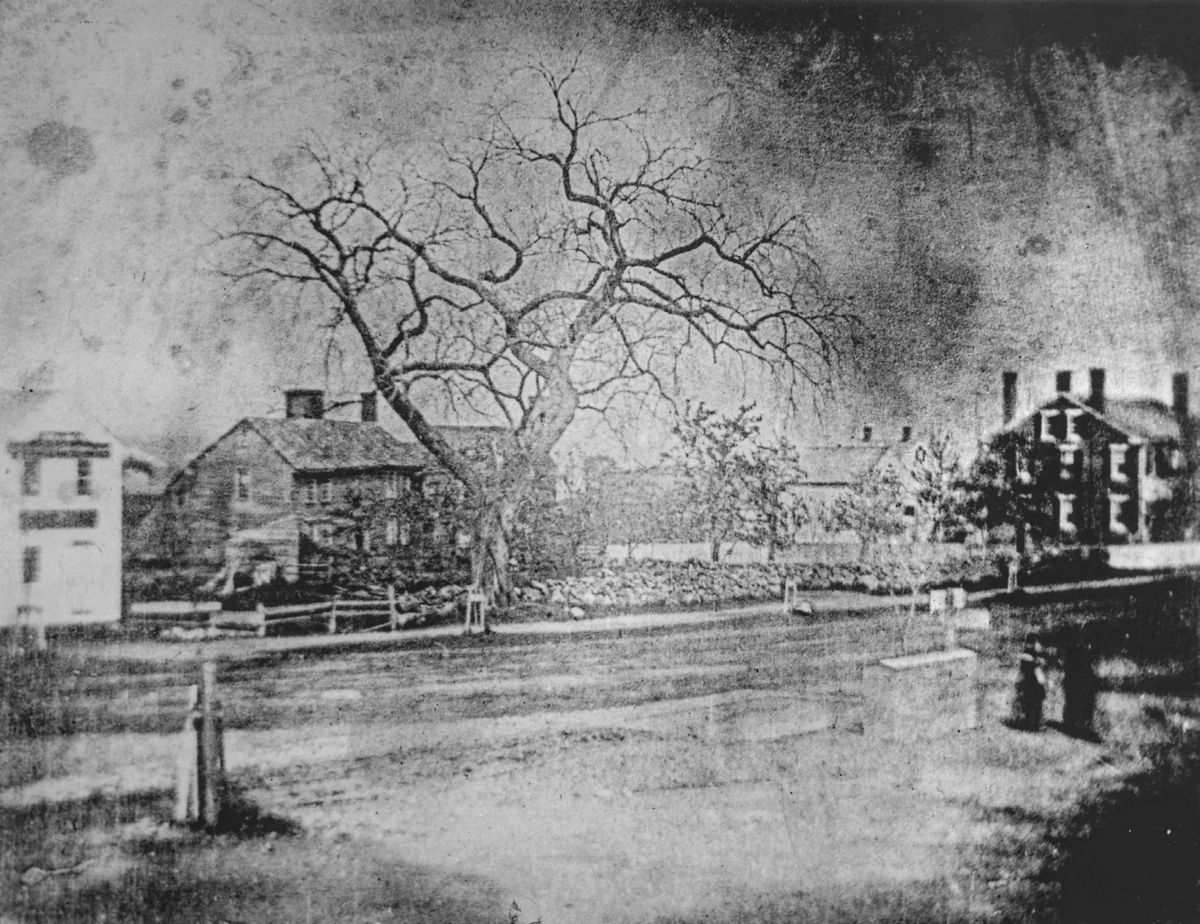
The Captain William Adams (1725–1787) house was built circa 1680. In 1846, a part of the house was taken down for the new railroad which was to pass
Daguerreotype image of the Captain William Adams house before it was razed in 1855. Arlington Historical Society collection.
behind it. An August 5, 1846, article described what was found: “REVOLUTIONARY RELICS.– The workmen this morning in demolishing the venerable old building, known as the “Adams estate,” in West Cambridge, opposite to the New Depot of the Lexington and West Cambridge Railroad, occupied for many years by Mrs. Easterbrooks, found several ounce balls imbedded in the walls. They were undoubtedly lodged there by the British troops on their retreat from Lexington as a smart fire was kept up by the opposing parties, at this point, and this old building was a particular object of search by the British on the morning of that day, as it was supposed that Samuel Adams for whose head a reward was offered, was concealed there.—Boston Journal”4
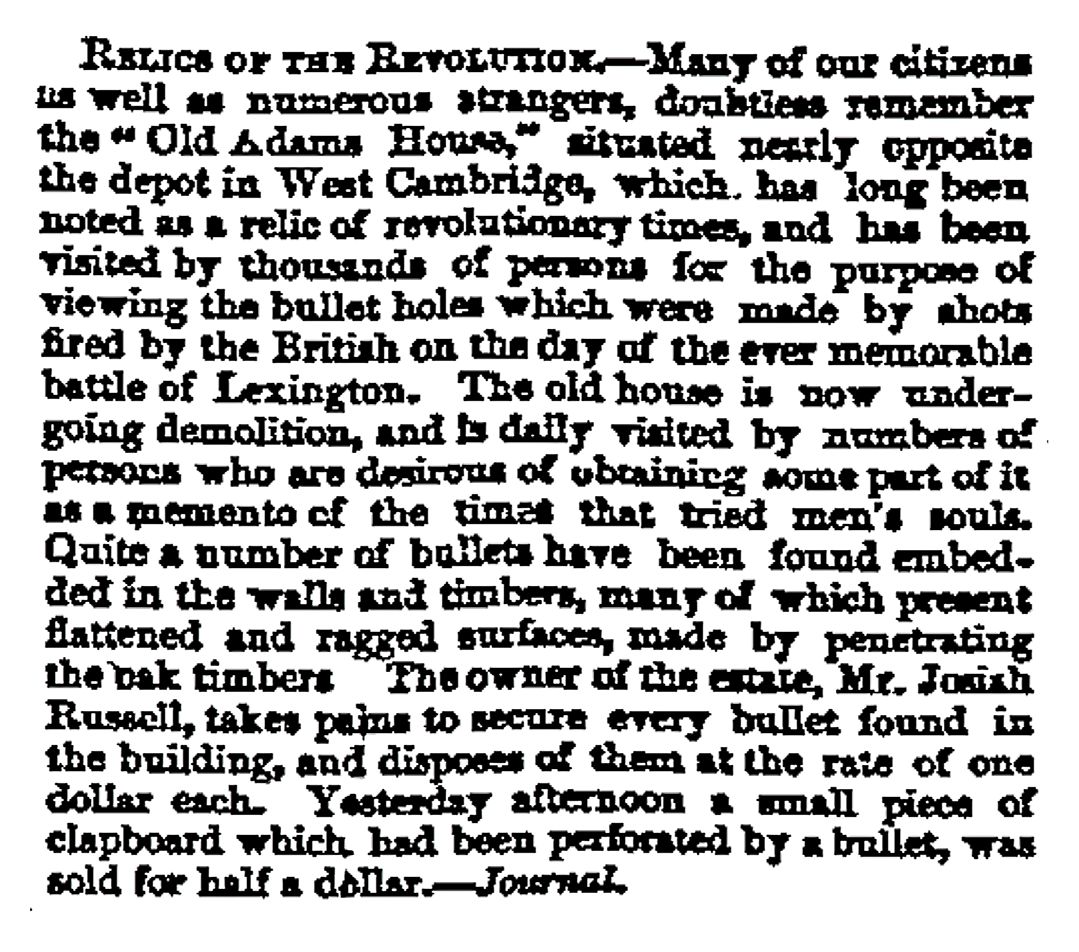
The final coup de grâce for the Capt. William Adams’ house came in July 1855. The rest of the house was to be razed to make way for urban sprawl. But the current owner made the best of the bullets and bullet-struck objects he found as this newspaper article mentions: “RELICS OF THE REVOLUTION.— Many of our citizens as well as numerous strangers, doubtless remember the “Old Adams House,” situated nearly opposite the depot in West Cambridge, which has long been noted as a relic of revolutionary times, and has been visited by thousands of persons for the purpose of viewing the bullet holes which were made by shots fired by the British on the day of the ever memorable battle of Lexington. The old house is now undergoing demolition, and is daily visited by numbers of persons who are desirous of obtaining some part of it as a memento of the times that tried men’s souls. Quite a number of bullets have been found embedded in the walls and timbers, many of which present flattened and ragged surfaces, made by penetrating the oak timbers. The owner of the estate, Mr. Josiah Russell, takes pains to secure every bullet found in the building, and disposes of them at the rate of one dollar each. Yesterday afternoon a small piece of clapboard which had been perforated by a bullet, was sold for half a dollar.—Journal.”6
Others took note of the old “Adams estate” and the bullets and bullet strikes also. In 1847, New Hampshire Governor Isaac Hill visited the house: “At the time of the first spilling of blood in the Revolution at Lexington, some object of annoyance was presented by this house to the passing British army, causing it to be riddled with bullets. Upon that part of the house which remains, the bullet holes through the outside clapboards may yet be seen. The house was built of wood, bricked up between the inside and outside finishing. In that part of it torn down last year, there were taken out, lodged in the bricks, many musket bullets discharged in the sharp conflict that took place there with the British when retreating back from Concord to Boston.”5 However, only a section of the house had been removed in August 1846, and the rest remained intact.
Another newspaper article written a few days later noted that the house, “received a peppering by the British, on their way to [from] Lexington, in 1775, was recently pulled down, and some twenty bullets, which were found imbedded in the wood, sold quick for one dollar each.”7
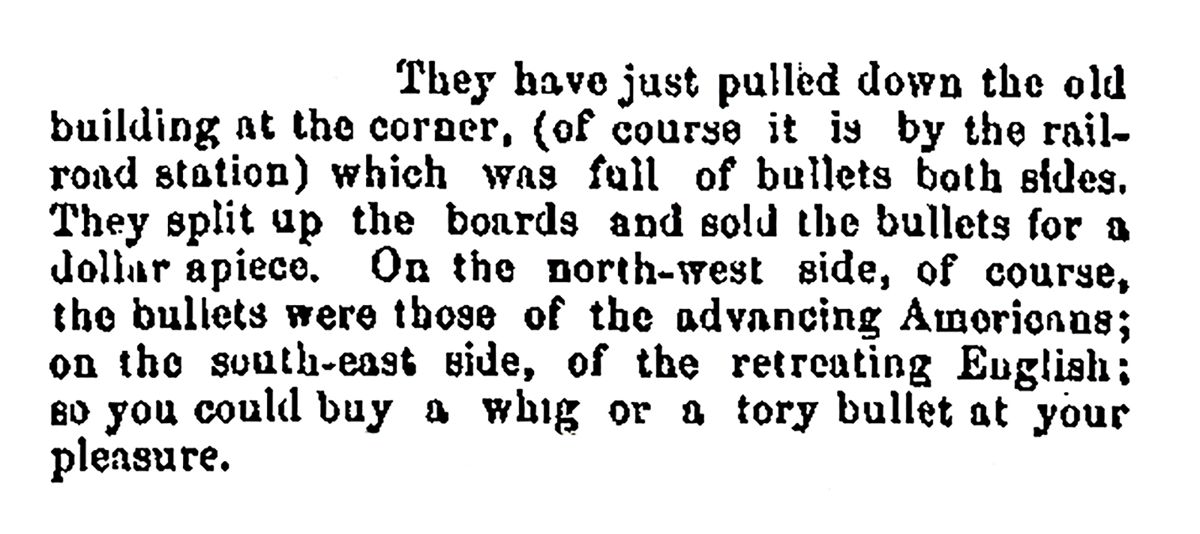
A dollar for a bullet in 1855 was a lot of money, the equivalent of about $37 today. In April 1858, the house was again discussed in the newspapers and the article mentioned which bullets belonged to each of the opposing forces:
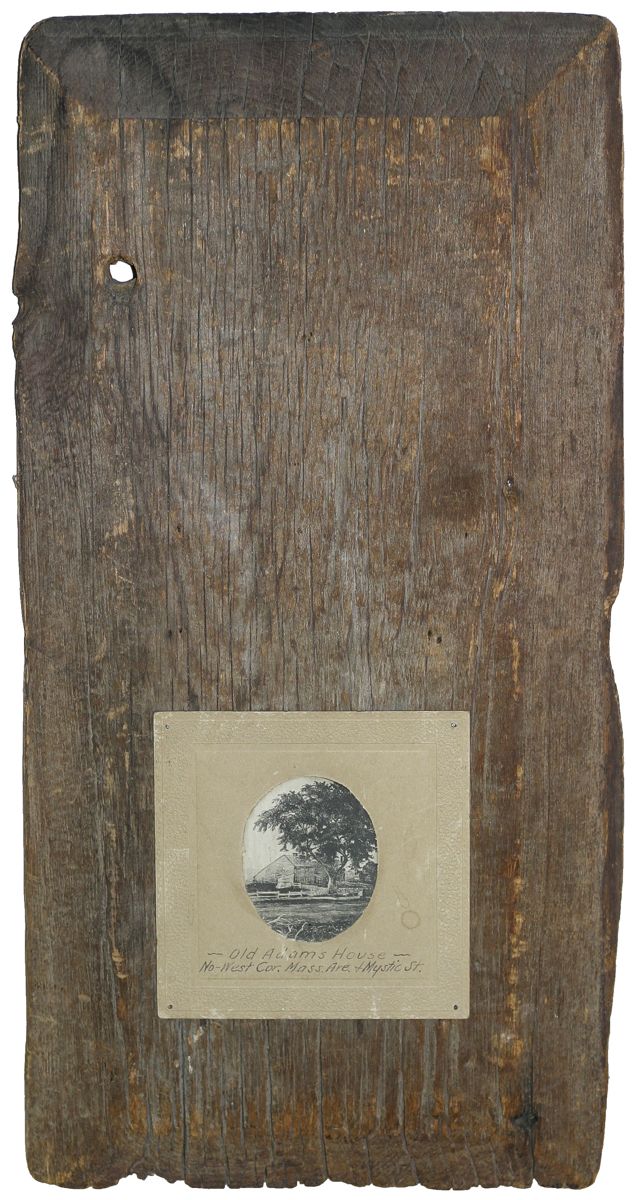
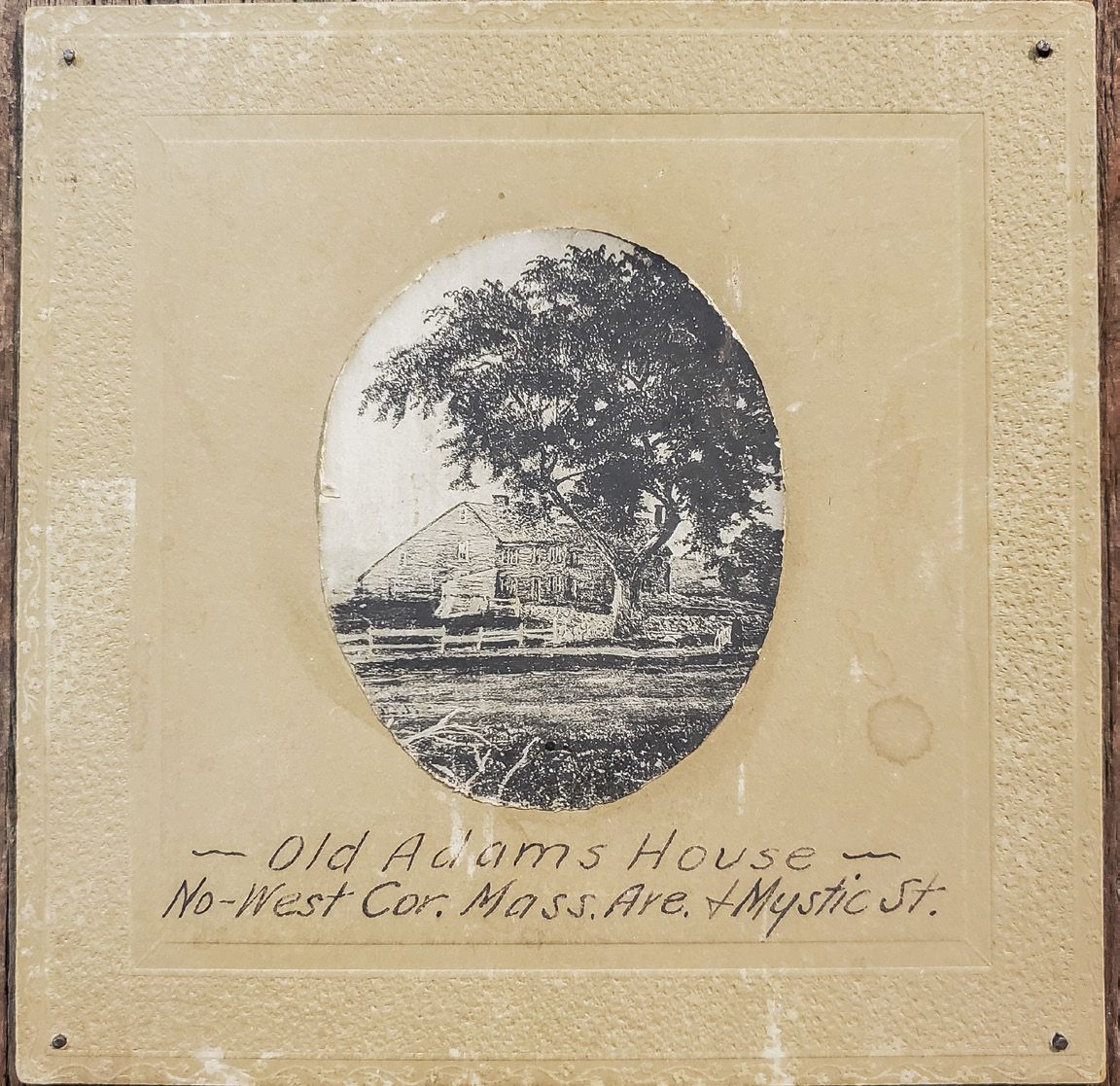
displayed during a Boston Centennial exhibition and listed in the exhibit catalog “Front Door Panel Of The Capt. William Adams House, Arlington, pierced by a British Bullet, April 19, 1775.”9 It is weathered on the exterior and shows age. The rear, or indoor side of the panel is painted with black splotches very similar to the interior kitchen ceiling of the Jason Russell house (just to the west of the Adams house and also riddled with bullets) which was probably painted in the late 17th century. It features another great 19th-century image of the house, with the same large tree in the foreground, although this image shows the tree with foliage. The image is mounted on pasteboard, tacked to the bottom of the panel, and is marked “-Old Adams House-/No. West Cor. Mass. Ave.+ Mistic St.”
“They have just pulled down the old building at the corner which was full of bullets both sides. They split up the boards and sold the bullets for a dollar apiece. On the north-west side, of course, the bullets were those of the advancing Americans; on the south-side, the retreating English; so you could buy a whig or tory bullet at your pleasure.”8
While researching the collection of the Arlington Historical Society, a fantastic daguerreotype image of the Adams house was found. It shows the house in its original and almost haunting state. It looks to have not had major alterations since the 18th century. Around it sits more modern (1830s-40s) structures and the home looks out of place nestled between the other structures. There is a large tree in the front yard with no foliage, so the image was clearly made between late fall and spring.
Surviving Adams House Artifacts Adams House Door Panel One of the more interesting objects sold and saved from the Adams house is a door panel, which was
Adams’ house door panel with a bullet strike on the upper left corner. (Arlington Historical Society collection, Joel Bohy photograph.)
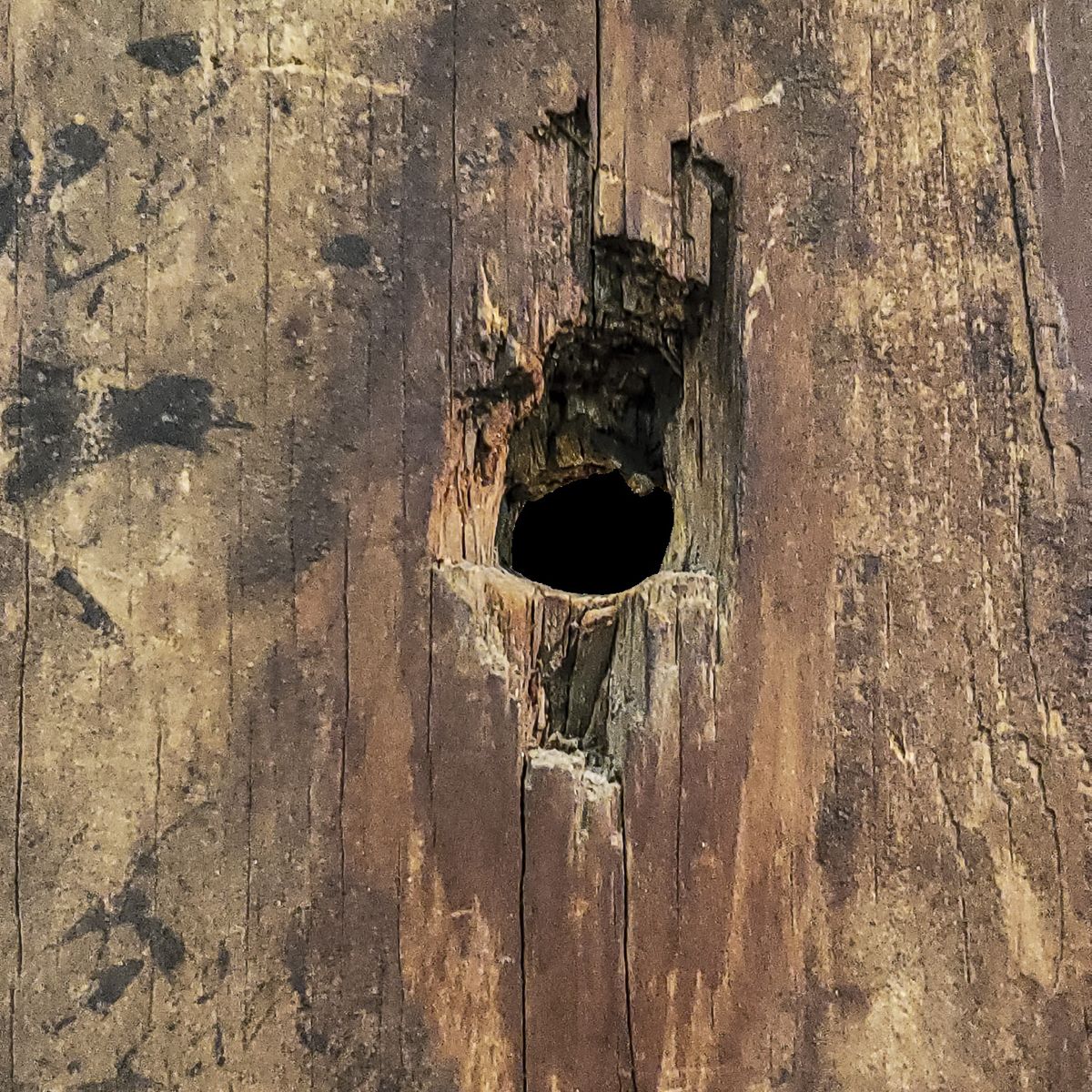
On the upper left corner of the panel is a bullet hole that is .58-inch on the major axis, and .60-inch on the minor axis. Based upon the size of the hole, it more than likely is an overshot fired from a provincial fowling piece and not fired from a British musket (if British, the hole would have to be between .67 and .72 inches). The panel measures 21 x 10 ½ inches and is currently on display at the Arlington Historical Society’s April 19, 1775, exhibit.
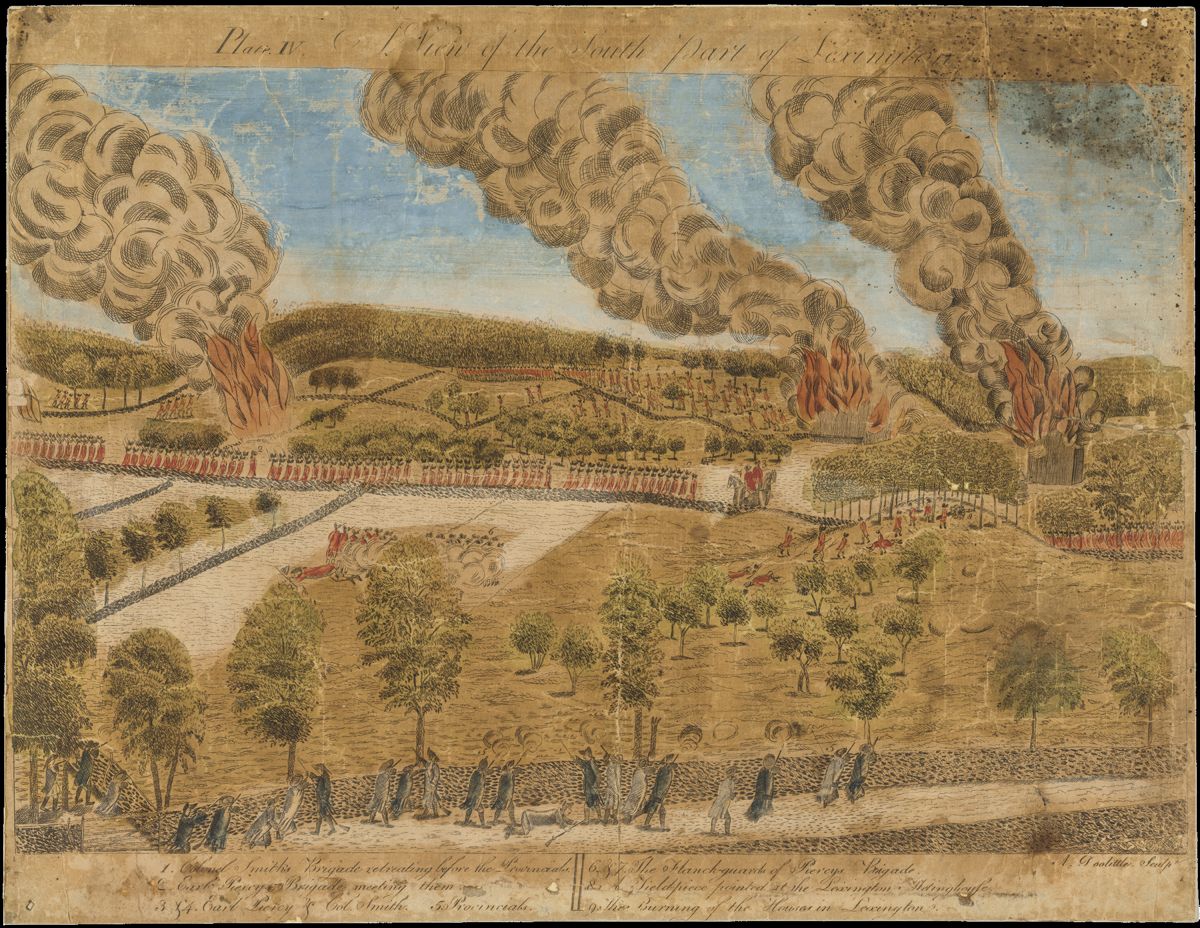
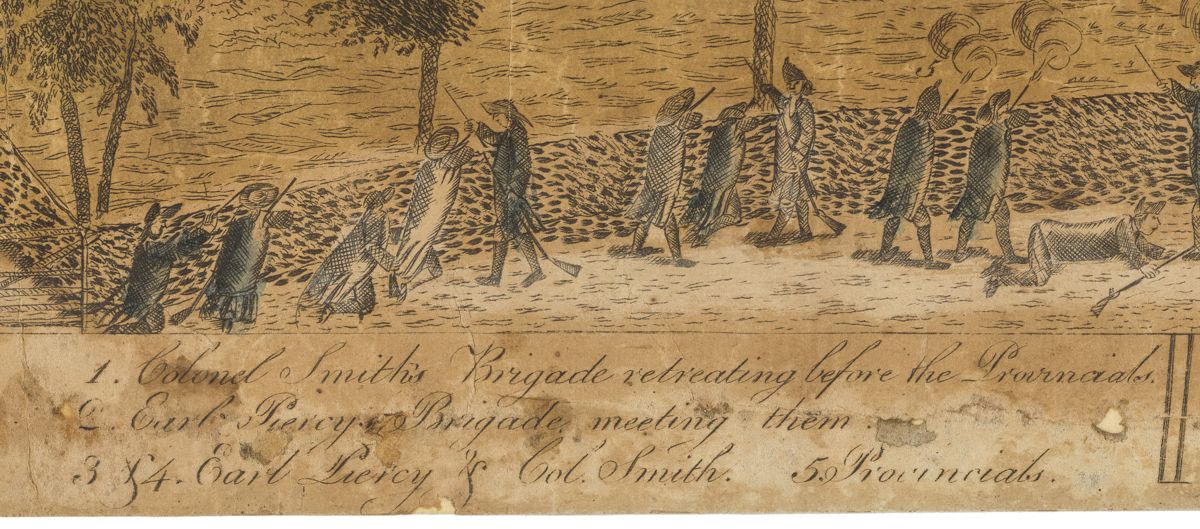
Amos Doolittle’s Plate IV “A View of the south part of Lexington” with Lord Percy’s relief force meeting up with Lt. Col. Smith’s force retreating from Concord, 1775. (The Miriam and Ira D. Wallach Division of Art, Prints and Photographs: Print Collection, The New York Public Library)
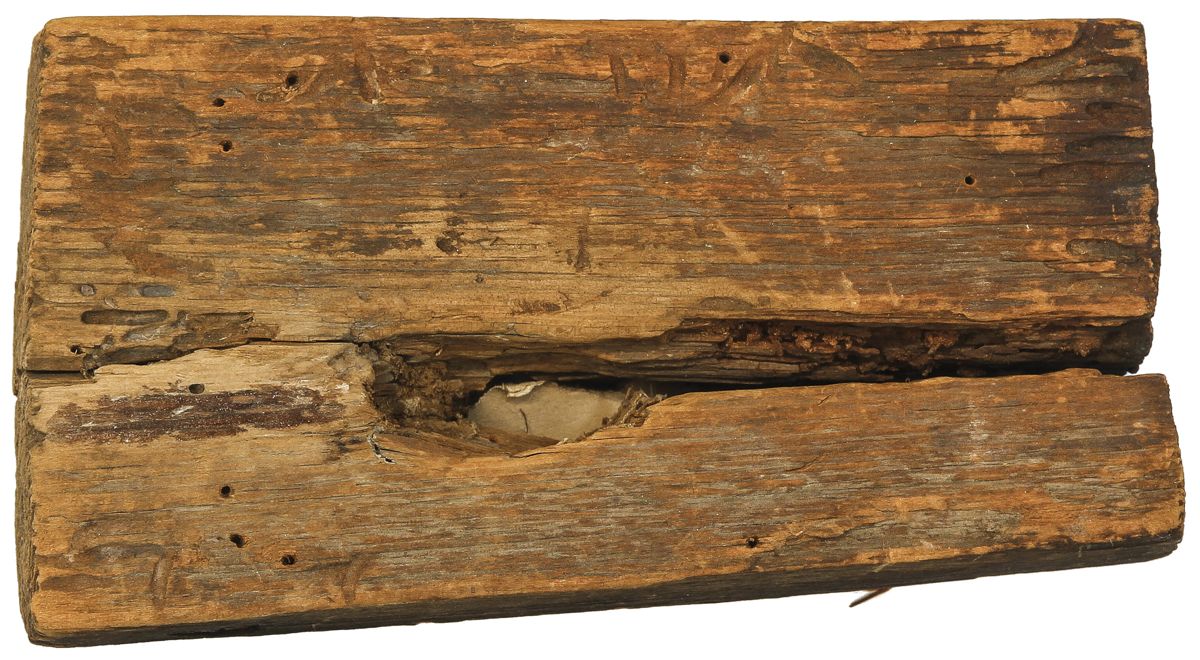
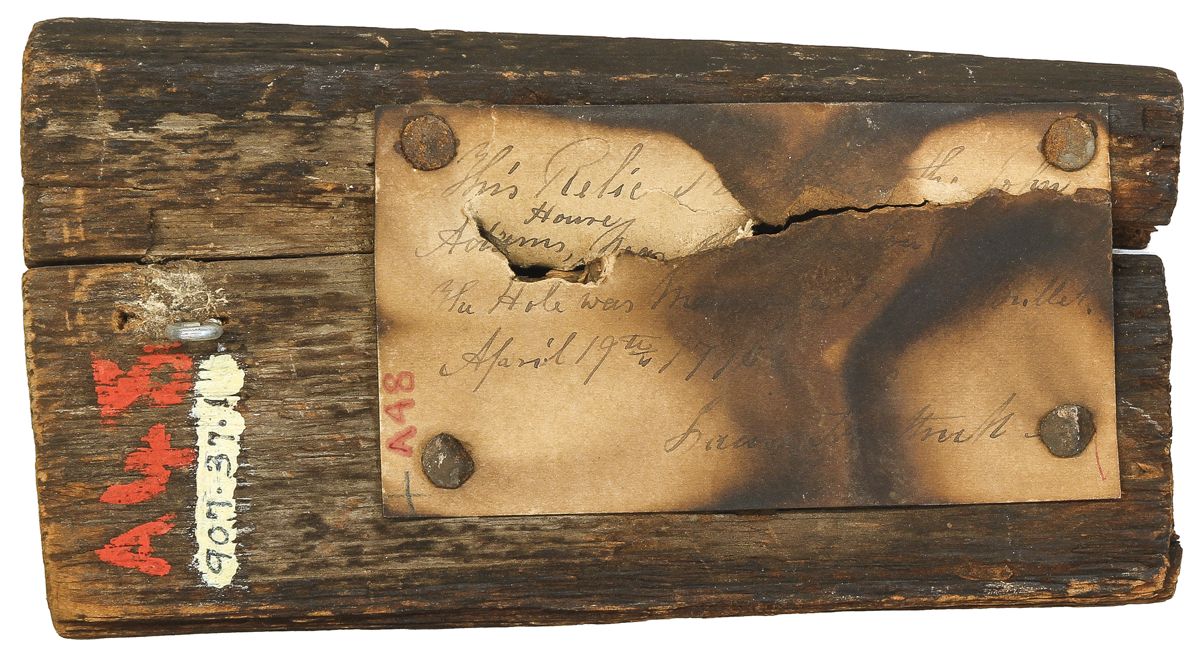
Adams House Wood Fragment Another survivor of the Adams house is a piece of paneling, sheathing, or trim. There is a note tacked to the back that is worn and very hard to read. It reads in part: “This Relic is from [illegible] the John/Adams House near [illegible]/ The Hole was made [illegible]/April 19th 1775.” It is split on one end, and the hole is long, so the bullet may have struck at an angle. The fragment measures 5 ¾ x 2 ¾ inches and is in the collection of the Arlington Historical Society. It is also on display with the door panel mentioned above.
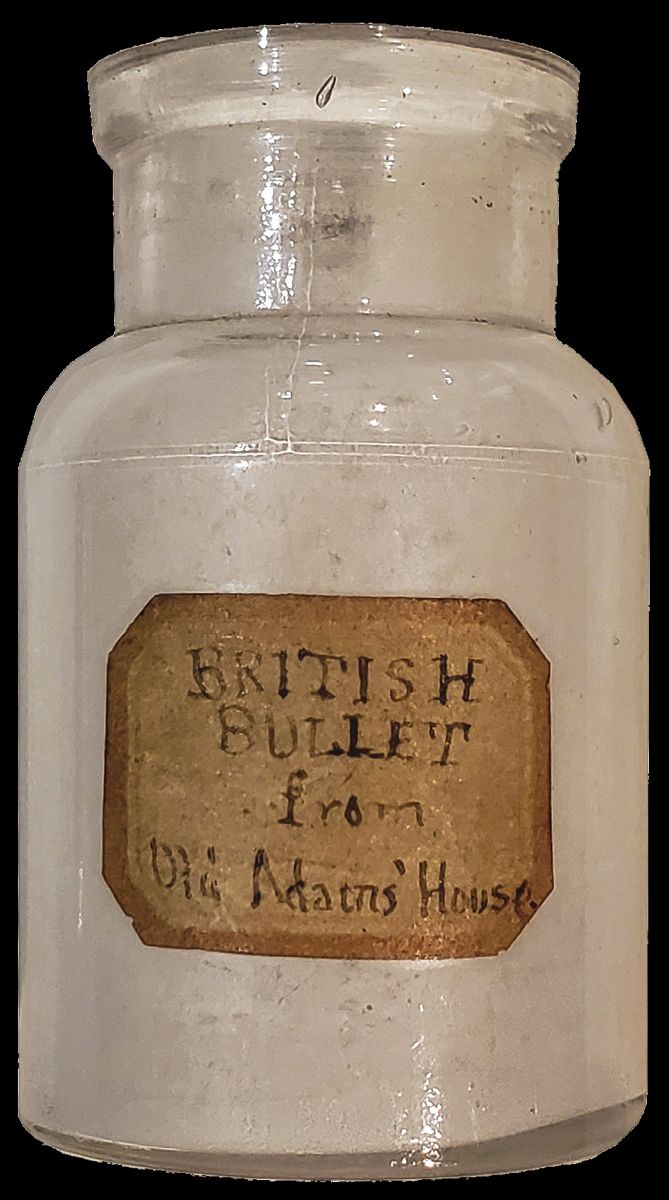
Adams House Deformed Ball A highly deformed ball in the collection of the Arlington Historical Society is now held in a small 19th-century glass bottle/jar with a label marked “BRITISH/BULLET/from/Old Adams’ House.” It may have been one of the balls mentioned above and sold for a dollar. The ball weighs 22.7 grams, and using the Sivilich formula10 to calculate its approximate caliber would make it a nominal .632-caliber ball, although some lead was probably lost. It was possibly fired from a provincial fowling piece or a musket, based on the caliber.
Adams House Bullet-Struck Clapboard
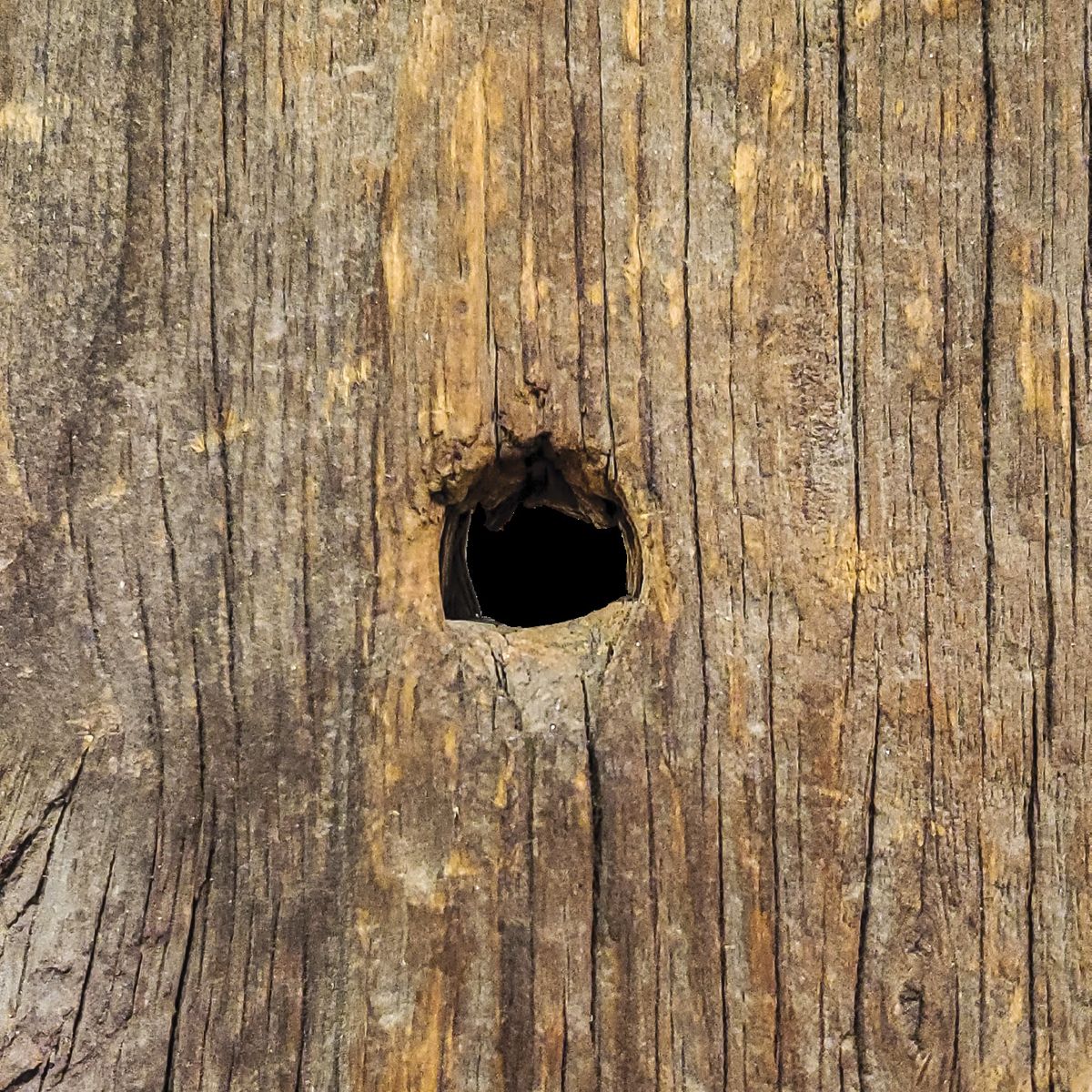
In late December 2024 we began to receive messages about something new. It seems a curious fragment of wood appeared at an auction house in Massachusetts and was scheduled for auction on January 4, 2025. As soon as we saw the images we knew when it was found. As the newspaper mentioned above states: “Mr. Josiah Russell, takes pains to secure every bullet found in the building, and disposes of them at the rate of one dollar each. Yesterday afternoon a small piece of clapboard which had been perforated by a bullet, was sold for half a dollar.—Journal.”11 A few days later, we made the trip up to Amesbury, Massachusetts, to see the piece. A mahogany frame had been made for it after its purchase, with a glass window on either side to see the hole. On one end of the frame was “Jarad Sparks” written in what appears to be iron gall ink. Jarad Sparks (1789–1866) was an influential Unitarian minister, historian of the Revolution, as well as the president of Harvard College from 1849 to 1853, and lived in Cambridge, Massachusetts, at the time that the Adams house was being razed. On the clapboard is a printed note which reads: “Clapboard from the Old Adams House in West Cambridge [current day Arlington, Massachusetts], attacked by the British on their return from Concord, April 19th, 1775. The hole was made by a bullet at that time. The house was taken down in July, 1855.” The clapboard fragment itself measures 5 ¾ x 2 ¹⁄₁₆ inches. The mahogany frame measures 8 x 5 inches and is 1 ½ inches thick. The hole is weathered and has had some loss from being out in the elements for about 80 years since it was struck. The holes measure 1.233 inches on the major axis and .823-inch on the minor axis.
Deformed bullet removed from the Adams house and sold in 1885, along with the jar it was stored in. (Arlington Historical Society collection, Joel Bohy photographs.)
The auction estimate placed on this interesting historical object was $1,000 to $2,000. Within a week, it jumped to $4,750. We knew many of the possible bidders, and on January 4, we sat back and watched the auction. It ended at $25,000 plus the buyer’s
Adams’ house, bullet-struck clapboard originally sold in July 1855, was sold again in January 2025. (Steven Lucas collection, John McInnis Auctions photographs.)
premium, so the buyer paid around $30,000 for the weather-beaten piece of clapboard with a bullet strike. After the auction, we figured that whoever purchased the piece would reach out to us, but we heard nothing. Then in late March, we received a message from the buyer on Instagram who didn’t have any of the information we had collected. We sent the current owner the information that should be with the weathered clapboard, so it will hopefully stay with it forever.
Collecting and Rarity Learning from preserved objects is nothing new to collectors, historians, and archaeologists alike. We have all held the notion that these objects are a source of information and knowledge about the past. Objects, more specifically the bullet-riddled artifacts, can be used not only to elucidate the past but to teach an appreciation of our shared history today.12 We have presented more information on this subject in our book, Bullet Strikes From the First Day of the American Revolution, published in 2025, by Mowbray Publishing and available online at gunandswordcollector.com.
The reason for collecting and preserving these objects of violence has changed over time, particularly how we 21st-century folk view the retained and curated objects. Objects have the ability to intrigue, motivate, and challenge the public who see them.13 They are objects of memorialization and remembrance that carry on even today. As rescued fragments of a historical event, they are intended to remind us of another time and place; a signal event in our nation’s history.14 They have several meanings to different viewers, as material evidence of the past, as reflections of a specific past event, and as items that can educate a new generation.15 These bullet struck objects are physical reminders and consequences of the events of April 19, 1775, the day that the “Shot Heard Round the World” happened. Acknowledgments: The authors would like to thank Matthew Beres and Robert Brazile of the Arlington Historical Society, Sara Lundberg, Stuart C. Mowbray, Steven Lucas, and Dr. Gary Milan. Endnotes: 1. 2.
American Archives, v2:630. Bullet Strikes From the First Day of the American Revolution, Joel Bohy and Douglas Scott, Mowbray Publishing,
Depiction of the Battle of Lexington, Asa Warren Coolidge, engraver. (Scottish Rite Masonic Museum & Library, Lexington, Massachusetts)
Woonsocket, RI, 2024, p. 126. Diary of David McClure, Doctor of Divinity, 1748–1820, Privately printed, The Knickerbocker Press, New York, 1899, p. 162. 4. Gloucester Telegraph, August 5, 1846. 5. Town of Arlington Past And Present, A Narrative Of Larger Events and Important Changes In The Village Precinct And Town From 1637 to 1907, Charles S. Parker, 1907, C.S. Parker & Son, pp. 195-196. 6. Daily Atlas, July 12, 1855. 7. Boston Recorder, July 26, 1855. 8. Boston Semi-Weekly Advertiser, April 21, 1858. 9. Catalogue Of The Revolutionary Relics Exhibited At No. 56, Beacon Street, June 1875, Ladies Centennial Commission, 1875, Boston, Mass., p. 25. 10. Musket Ball And Small Shot Identification A Guide, Daniel M. Sivilich, 2016, University of Oklahoma Press, Norman, pp. 26-27. The formula is based on the density of lead, expressed in grams per cubic inch, and is a mathematical calculation that uses the lead density 3.
and the weight of an impact-deformed ball in grams to produce an approximate bullet diameter in fractional inch measurement. Daily Atlas, July 12, 1855. Teaching with Artifacts and Special Collections, Lois Hendrickson, 2016, Bulletin of the History of Medicine 90(1), pp. 136-140. A Rationale of Collecting, Thomas G. Tanselle, G. Thomas, 1998, Studies in Bibliography 51, pp. 1-25. Collecting Printed Ephemera, M. Rickards,1988, Phaidon, Oxford, UK. Universals of Culture, Alice A. Cleaveland, Jean Craven, and Maryanne Dansfeler, 1992/1993, Perspectives in Education, p. 20.
About the Author
Joel Bohy is a historic arms specialist at Blackstone Valley Auctions and a frequent appraiser of Arms & Militaria on the PBS series Antiques Roadshow. He has also appeared on NOVA, History Hit, and American Rifleman TV, is an active member of the American Society of Arms Collectors, as well as the Company of Military Historians, The Colonial Society of Massachusetts, an instructor for Advanced Metal Detecting for the Archaeologist, and a technical advisor for American Veterans Archaeological Recovery. He is the co-author of Bullet Strikes from the First Day of the American Revolution, as well as many material culture articles in Man at Arms for the Gun and Sword Collector magazine, American Rifleman magazine, and other publications. Growing up in Concord, Massachusetts, helped lead to his passion for April 19, 1775, the Battle of Bunker Hill, historic arms & militaria, conflict archaeology, historic arms and ballistics, and the study of bullet strikes from the first day of the American Revolution.
About the Author
Doug Scott is an American archaeologist renowned for pioneering methods in battlefield archaeology—especially through his landmark work at the Little Bighorn site. Over a 23-year span, he led field investigations that reshaped our understanding of the battle’s sequence, corrected errors in memorial headstones, and even contributed to identifying soldiers’ skeletal remains. Beyond Custer’s Last Stand, Scott has directed or assisted excavations at other historic conflict sites such as Big Hole, Sand Creek, Wilson’s Creek, Pea Ridge, and Monroe’s Crossroads. His expertise in forensic archaeology has also carried over to global human rights investigations, including work with the United Nations commissions on El Salvador, Yugoslavia, and Rwanda. A recipient of the Department of Interior’s Meritorious Service Award and the J. C. Harrington Award from the Society for Historical Archaeology, Scott served as president of that society in 2006–2007 and remains active in both archaeological and forensic communities.