
The Guns of Theodore Roosevelt
By Joe Engesser · Originally published September-October 2025 · pp. 24–43
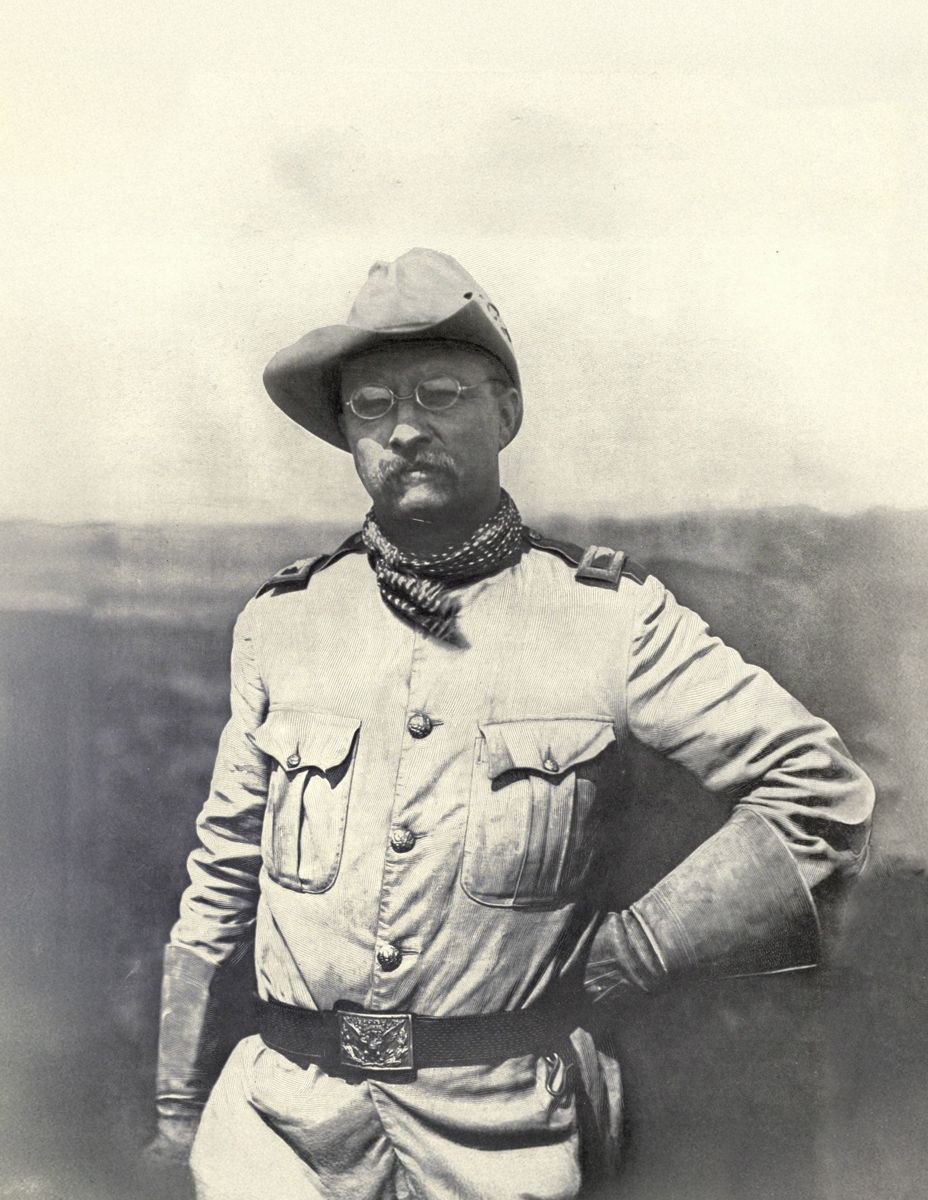
Theodore Roosevelt as a Rough Rider, circa 1898.
Theodore Roosevelt
THE
GUNS OF
In the collecting world, the most coveted firearms are prized for their rarity, artistry, condition, and history. Where provenance is concerned, few names add more weight to a gun’s value than the legendary Theodore Roosevelt. America’s 26th president was a paradox in motion, blending the rugged spirit of a frontier cowboy with the bourgeois refinement of an Eastern aristocrat. Roosevelt was a man of his time and, ahead of his time, a bridge between eras, cultures, and coasts. His respect for tradition and eye for innovation are both reflected in the firearms he acquired throughout his storied career as a hunter, a soldier, and a statesman.
While some of the most famous firearms owned by Roosevelt reside in institutional collections, such as the Sagamore Hill National Historic Site and The Autry Museum of the American West, many significant guns linked to Roosevelt have made their way into the private market over the decades. Two recent examples have set auction records, taking the titles for the most expensive Smith & Wesson and the most expensive Hawken rifle. In December 2021, Theodore Roosevelt’s Colt Single Action Army achieved a stunning $1,466,250 at Rock Island Auction Company, the third most expensive Colt SAA ever sold.
Theodore Roosevelt’s hunting knife was passed down through generations of the Roosevelt family.
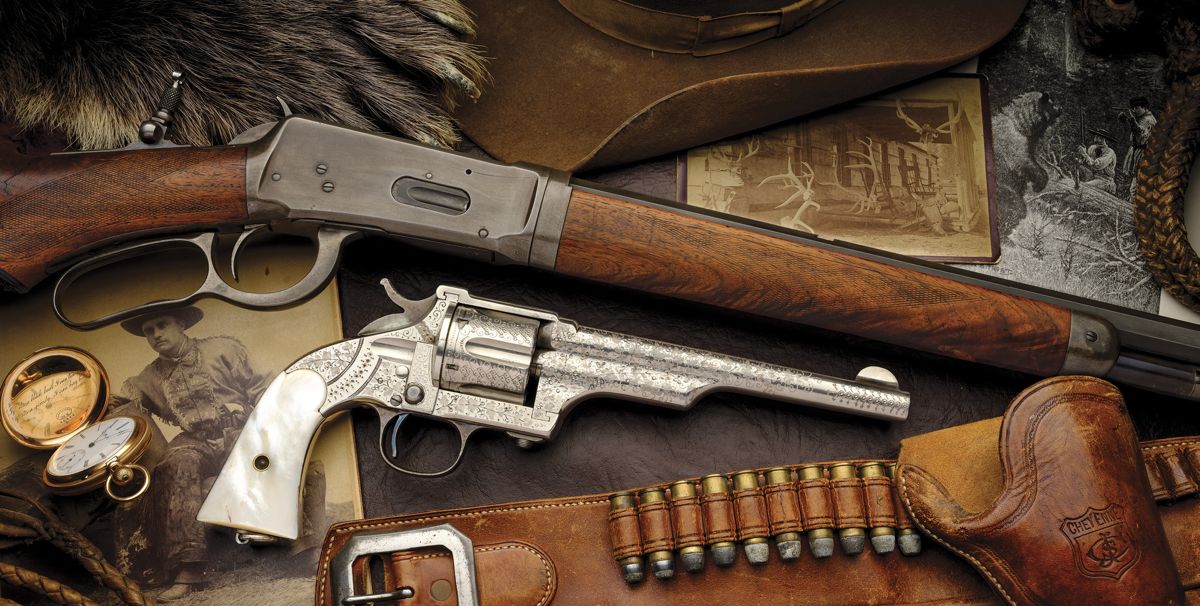
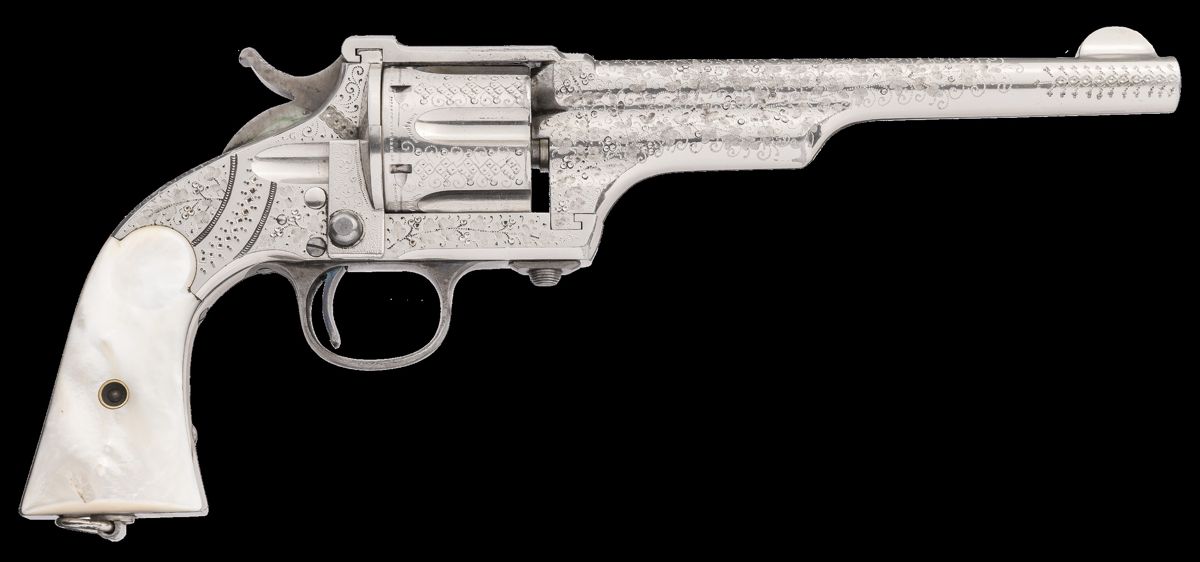
Firearms presented by the Bull Moose also hold impressive value in the collecting community, as exemplified by the Third Model Merwin Hulbert & Co. Army Single Action revolver Roosevelt had inscribed for his friend, ranching partner, and hunting guide, William Arthur Merrifield.
Roosevelt gifted a Merwin Hulbert revolver to his friend Arthur William Merrifield while he was living in the Dakota Territory in the 1880s.
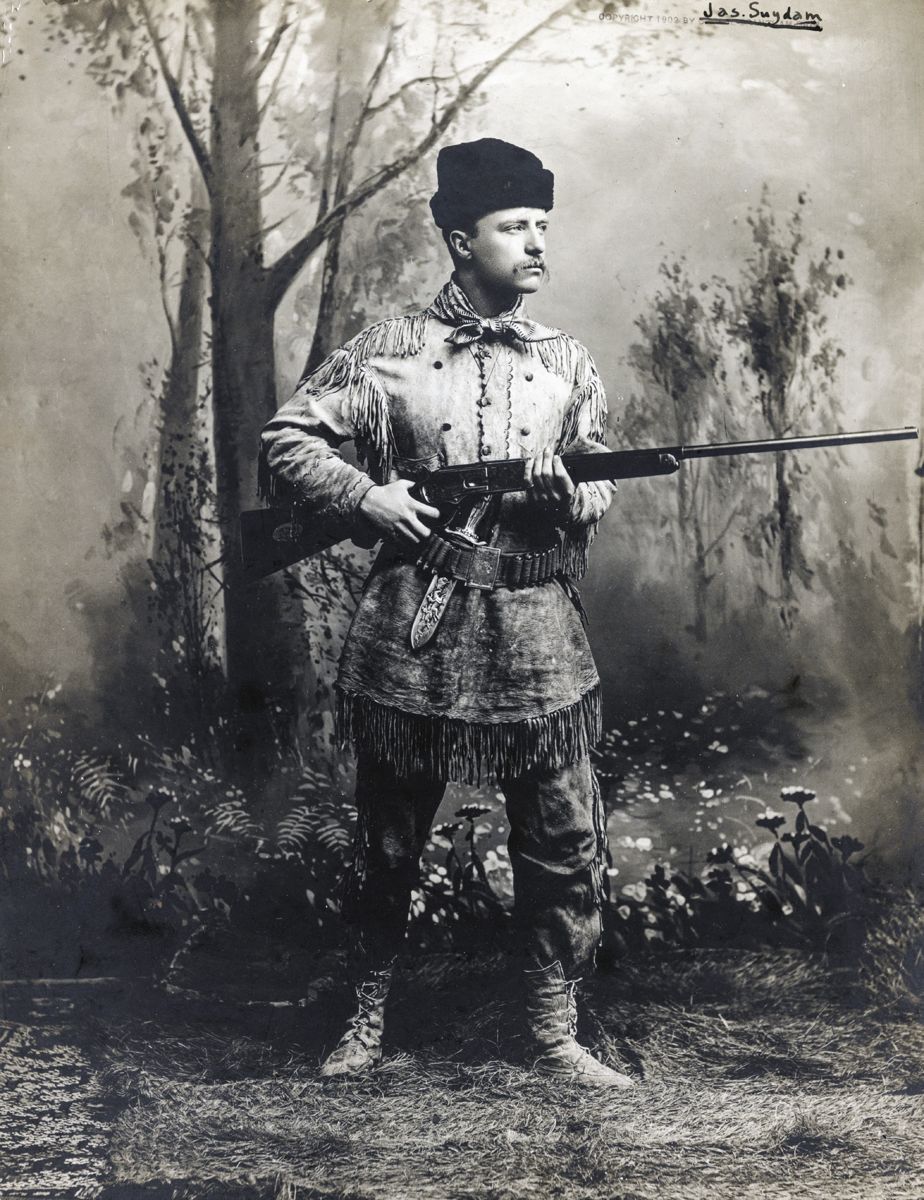
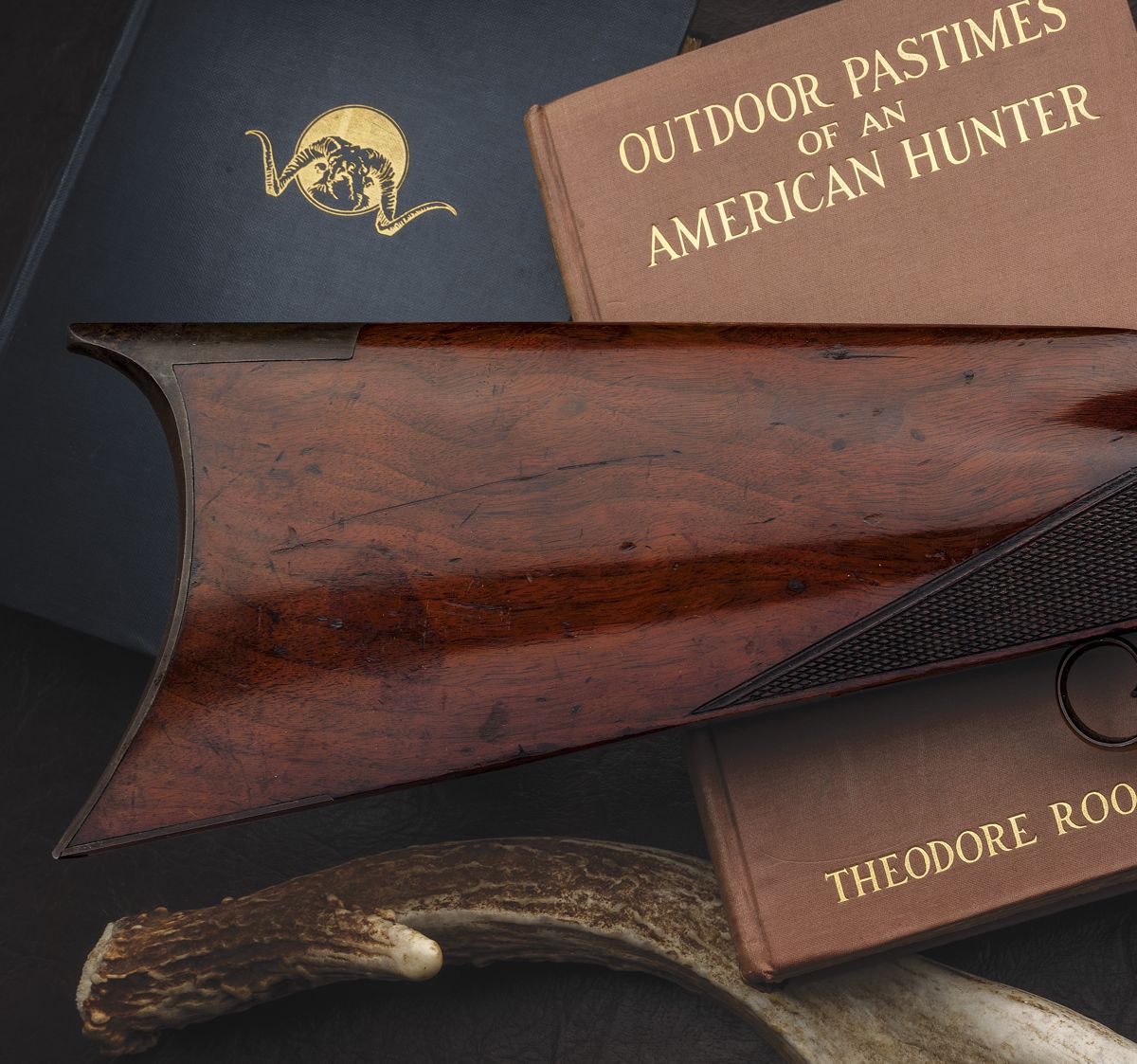
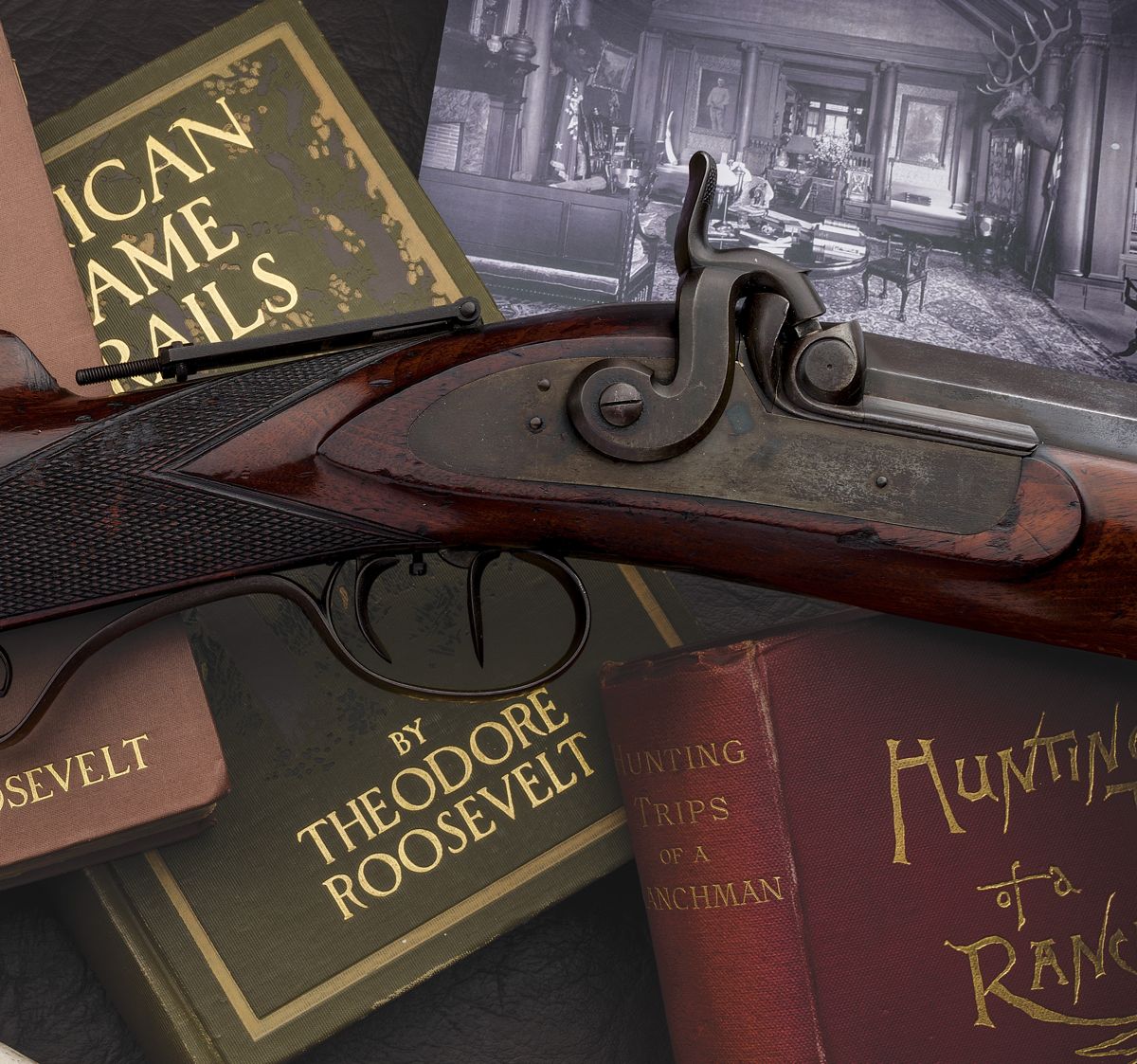
Guns of the West At age 14, young Theodore Roosevelt received his first firearm, a Lefaucheux pinfire double barrel shotgun, marking the beginning of the future president’s lifelong collection. Growing up, Roosevelt honed his hunting skills in the Maine backwoods. His passion for the sport would draw him out West, where he harvested his first bison at age 24. He returned to the Dakota Territory a year later following the heartbreaking loss of his wife and mother, immersing himself fully in the ranching lifestyle and forging a bond with the land that would forever shape his legacy. While carving out a life on the Little Missouri River, Roosevelt acquired various shotguns, single-shot rifles, Winchester repeaters, and revolvers. The future Rough Rider welcomed “the strenuous life” and viewed the frontier as a proving ground, a challenge where he could embrace physical hardships as he’d done growing up to overcome youthful infirmities. Roosevelt grew up admiring frontiersmen like Kit Carson and later purchased a bronze of Carson on horseback depicting the legendary Westerner clutching a Hawken rifle. In 1893, he acquired two Hawken rifles from the son of Edward Fitzgerald Beale, a naval officer who had served with Carson during the American conquest of California. Carson credited Beale with saving his life.
Roosevelt’s consecutively numbered Model 1876s would be the first of many Winchesters owned by the future president.
Pres iden t Th eod ore
Roo seve lt’s b ig-b ore
Haw ken rifle
, att ribu ted to K it Ca rson
.
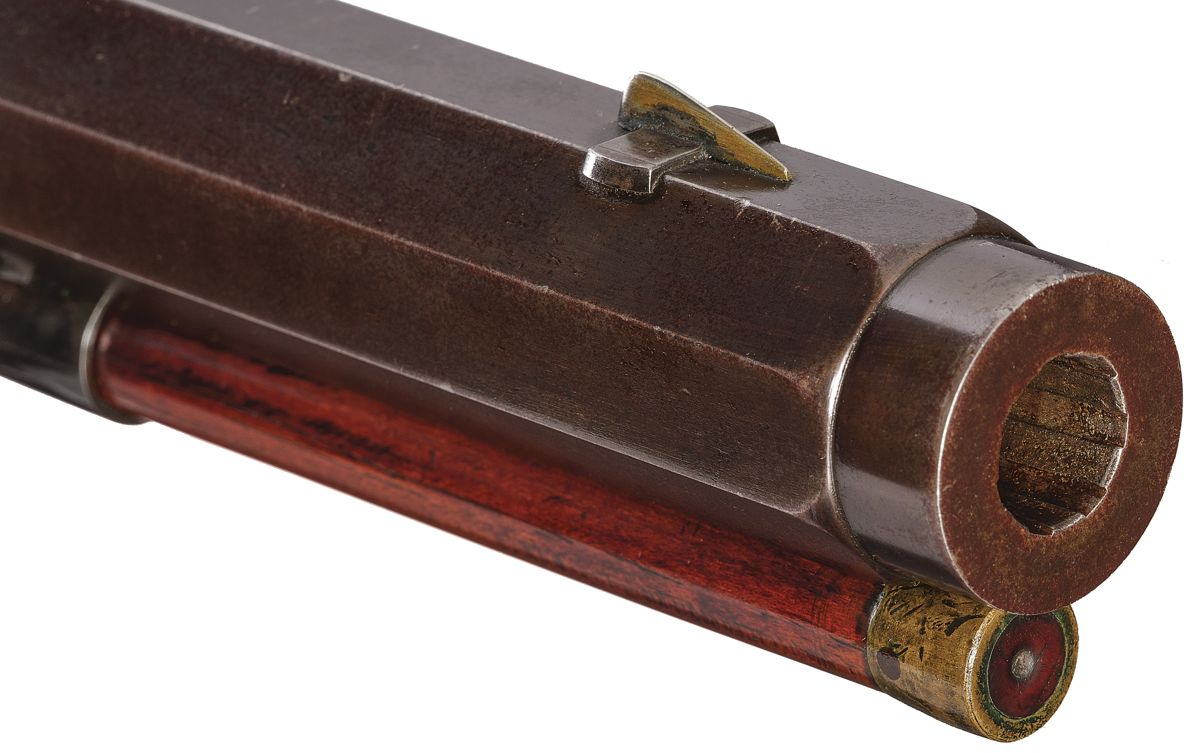
After Roosevelt died in 1919, both Hawken rifles were given to the Boone & Crockett Club, the conservation organization Roosevelt helped found in 1887. The rifles were sold from the Boone & Crockett Club Collection in 1972, along with 28 other pieces. While most Hawken rifles are .54 caliber and under, this world record example features a .70 caliber barrel. Roosevelt’s massive Hawken exhibits several other rare features for the genre, including an adjustable peep sight fitted to an integral base on the upper tang. Rather than the barrel wedges found on a typical Hawken, the rifle’s heavy barrel is secured with a screw passing through a winged iron washer in the bottom of the forend. The rifle’s unique configuration suggests a buffalo gun intended to be fired from a rest, such as a pair of shooting sticks.
President Theodore Roosevelt’s Hawken rifle.
This impressive Hawken rifle packed serious firepower with its heavy .70 caliber barrel and was likely used for hunting big game in the American West before being given to Theodore Roosevelt.
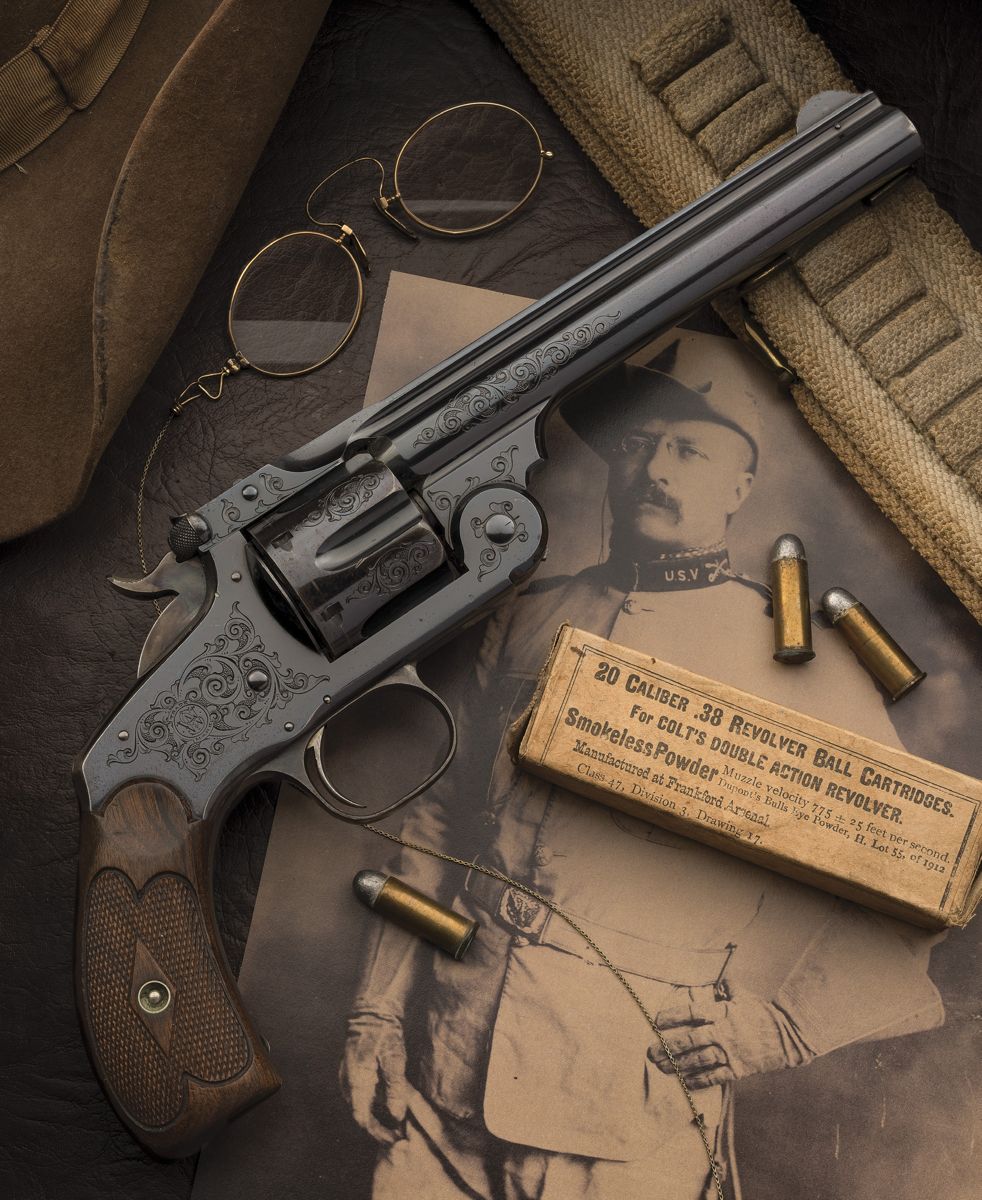
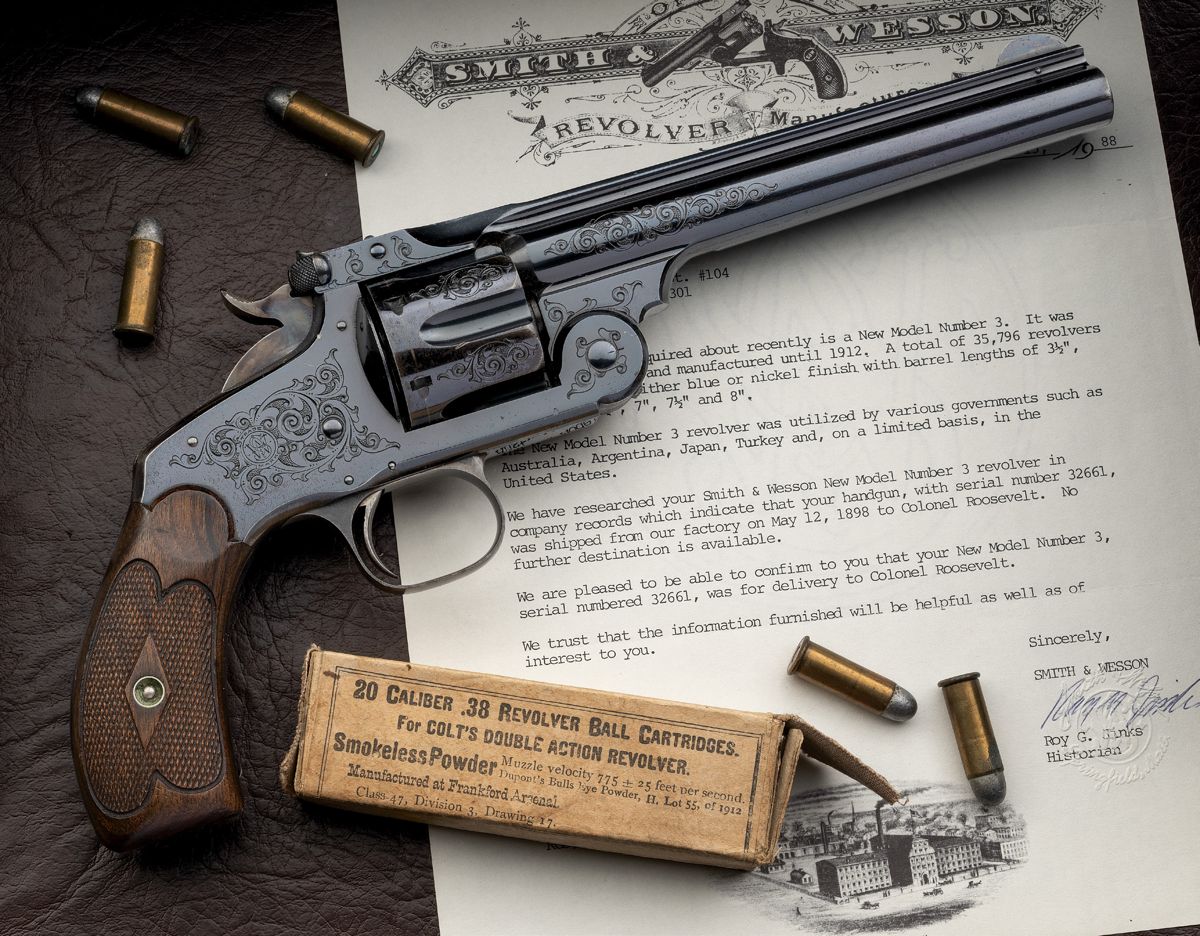
Six days after receiving his official commission as a lieutenant colonel, Smith & Wesson shipped a New Model No. 3 revolver to “Colonel Roosevelt.” This was the same day Roosevelt left the East Coast for San Antonio to train with the 1st U.S. Volunteer Cavalry, which the media dubbed “The Rough Riders.” Roosevelt took immense pride in the title “Colonel,” a name that stuck with him among friends and journalists long after his time as a Rough Rider.
Roosevelt’s New Model No. 3 Roosevelt returned to New York in 1887 and swiftly ascended the political ladder, driven by the same tenacity that had defined his frontier years. In 1897, President McKinley appointed him Assistant Secretary of the Navy, a post Roosevelt used to champion a stronger, more modern fleet. When war with Spain erupted in 1898, Roosevelt resigned his post to form the 1st U.S. Volunteer Cavalry, eager to lead men on the battlefield and prove himself in combat.
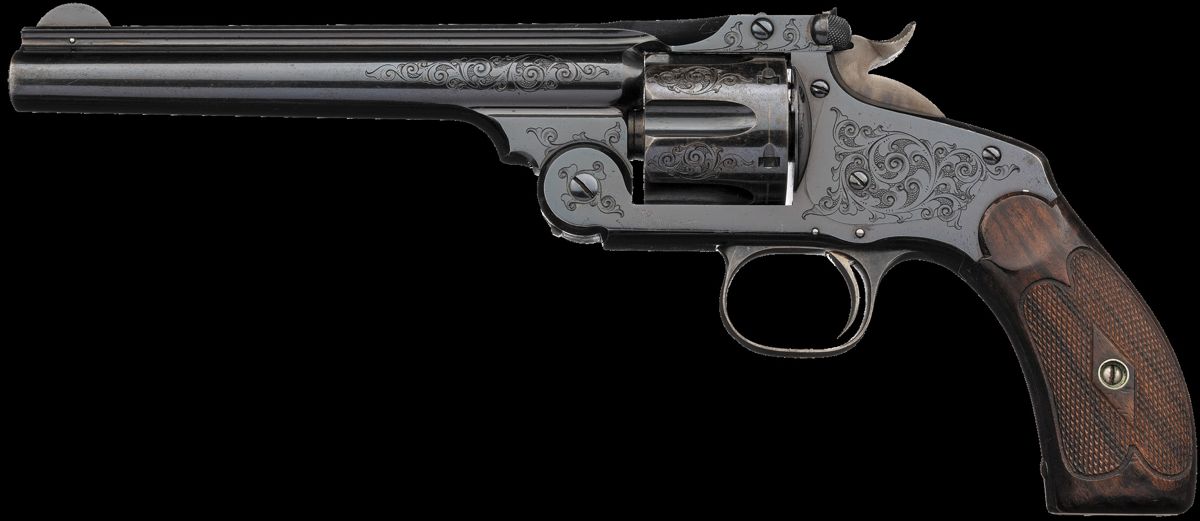
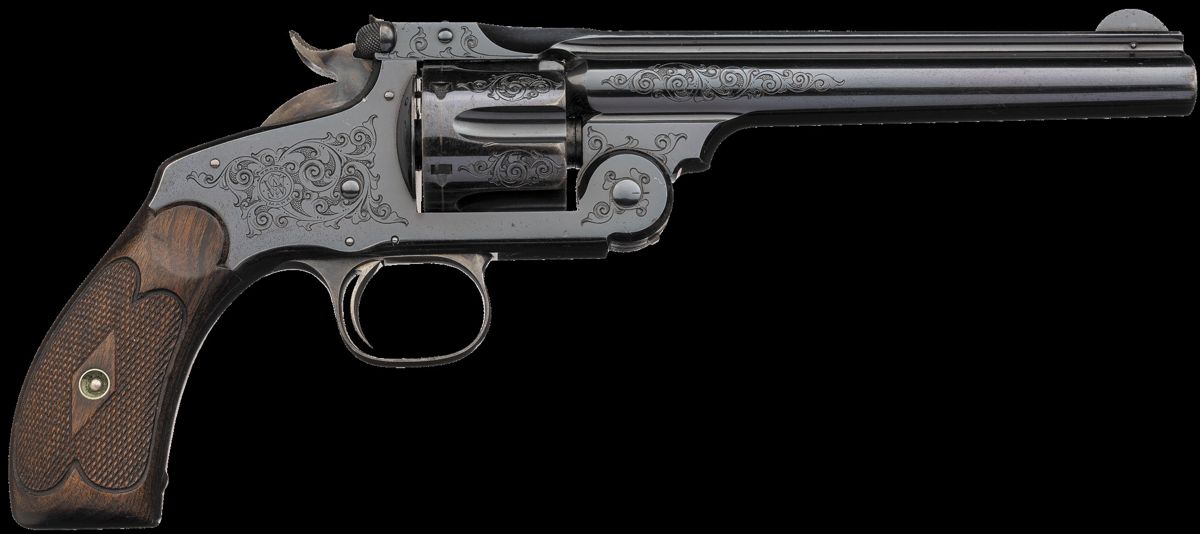
In addition to the revolver’s outstanding provenance, Theodore Roosevelt’s Smith & Wesson New Model No. 3, SN 32661, features incredible engraving and is chambered in .38 Long Colt. This was the
This revolver is chambered in .38 Long Colt, the standard U.S. service cartridge of the period. This caliber is very rare in the New Model No. 3 but makes perfect sense as a choice for Roosevelt as he was heading off to fight in the Spanish-American War. Matching serial numbers are on the barrel, latch, cylinder, butt, and inside of the right grip.
The revolver has a pinned rounded blade front sight, notch rear sight on the barrel latch, “+SMITH & WESSON SPRINGFIELD, MASS. U.S.A.+” on top of the rib.
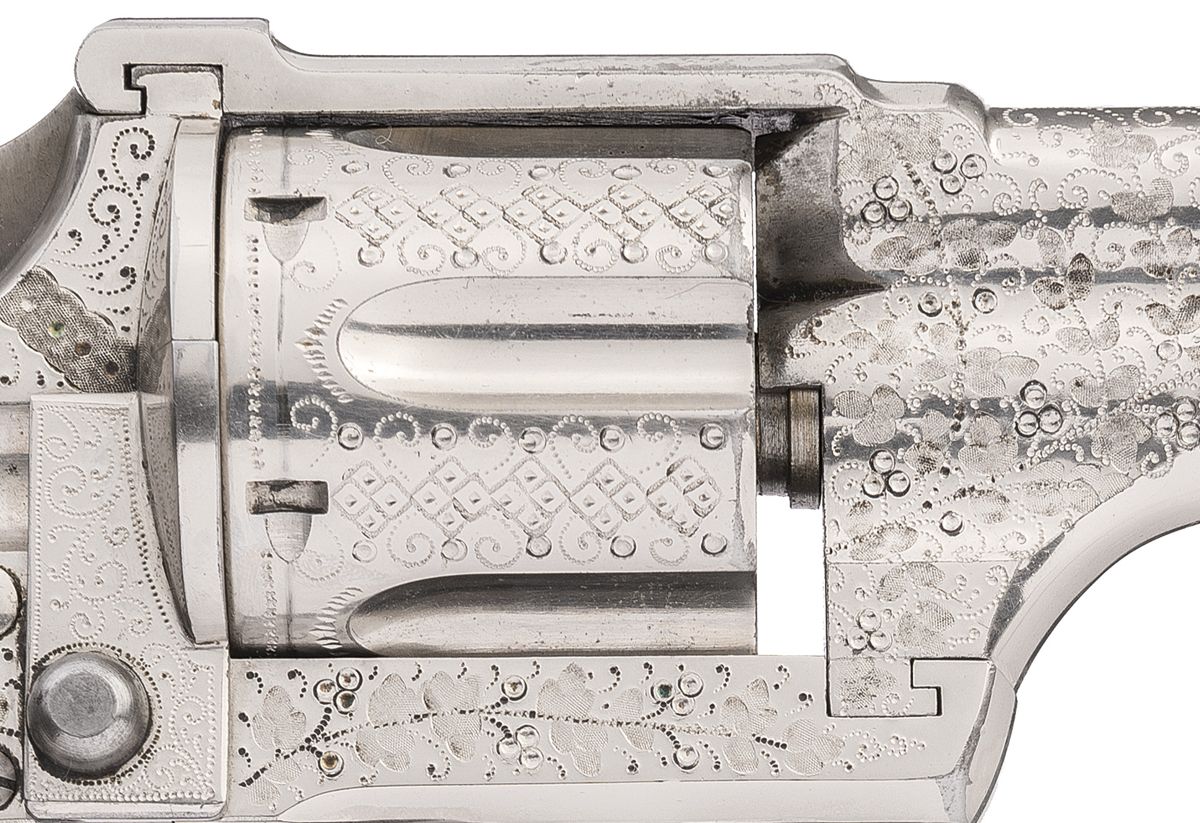
The factory engraving by the Youngs is also fitting given Roosevelt’s other engraved firearms. The embellishment is elegant and fairly understated rather than flashy, again fitting for an officer headed off to war. It consists of flourishes of scroll engraving with beaded backgrounds on the barrel, cylinder, and frame.
Roosevelt’s engraved New Model No. 3 set a record for the most expensive Smith & Wesson ever auctioned.
The factory letter confirms this Smith & Wesson New Model No. 3 was shipped to “Colonel Roosevelt” on May 12, 1898, the same day Roosevelt left for San Antonio, Texas, and the same day as the bombardment of San Juan during the Spanish-American War. On May 6th, Roosevelt had been officially sworn in as a lieutenant colonel in the 1st U.S. Volunteer Cavalry. He was previously expected to be in San Antonio around the 10th but was delayed, so the revolver was likely Texas-shipped and was intended to be Roosevelt’s personal sidearm for the campaign in Cuba.
U.S. service cartridge at the time, and Roosevelt’s revolver is one of a scant few New Model No. 3s known in this configuration. Considering the gun’s shipping date, Theodore Roosevelt appears to have planned on carrying this stunning Smith & Wesson into battle. He would ultimately choose a Colt M1892 double-action revolver instead. The Colt had been recovered from the wreck of the USS Maine, whose sinking triggered the war. The M1892 was presented to Roosevelt by his brother-in-law, Naval Commander William S. Cowles.
Right: Print shows Theodore Roosevelt leading the Rough Riders into battle against the Spanish in Cuba during the SpanishAmerican War. Published by Keppler & Schwarzmann, July 27, 1898. (Library of Congress)
Colonel Roosevelt and his Rough Riders at the top of the hill, which they captured, Battle of San Juan, July 1898. ( Library of Congress)
The Colt M1892 was worn in tribute to the sailors lost in Havana Harbor, and he carried it when leading the Rough Riders in their famous charge up San Juan Hill. Roosevelt describes discharging the revolver as he rallied his men, gunning down at least one Spanish soldier in the fray. Roosevelt’s Colt M1892 has a colorful history, being stolen and recovered twice from its home in the Sagamore Hill Museum, but it has never been available for public sale. The story of the Colonel’s Smith & Wesson New Model No. 3 is more enigmatic, though a trail of intriguing clues have been discovered that illustrate the gun’s importance. According to documentation, Roosevelt’s Smith & Wesson New Model No. 3 entered the collecting sphere after being purchased “from the descendants of the bodyguard or valet of President Theodore Roosevelt.”
Rough-Riders, Col. Theodore Roosevelt, U.S.V. Commander. Published by Kurz & Allison. (Library of Congress)
James E. Amos is the most likely candidate as the intermediate owner. Amos served as Roosevelt’s valet/bodyguard and was close friends with the President and his family. The Theodore Roosevelt Center noted that Roosevelt called Amos “the best shot that I have ever seen” and indicated that Amos “offered advice on Roosevelt’s gun collection and purchased and tested all of his firearms.” In his 1927 book, Theodore Roosevelt: Hero to His Valet, James Amos wrote,
“While President he [Roosevelt] often went armed. I have in my home now a large revolver that Mr. Roosevelt placed at the side of his bed every night while in the White House. It was given me by Mrs. Roosevelt after his death.” Use as a nightstand gun would explain how this revolver has survived in such exceptional condition. The notion of a president sleeping with a revolver within arm’s reach may seem antiquated in today’s world of layered security and Secret Service precision, but the standards in Roosevelt’s era were far less thorough. Having witnessed Abraham Lincoln’s funeral procession in 1865, and then ascended to the presidency in the wake of McKinley’s assassination, the pragmatic Roosevelt understood all too well the dangers that shadowed the office. In 1912, Roosevelt’s wariness would prove prophetic when he found himself in the crosshairs, a threat he responded to with the trademark defiance of a bull moose.
Colonel Theodore Roosevelt in his Rough Riders uniform on October 26, 1898, by Rockwood. (Library of Congress)
Roosevelt’s Colt Model 1902 As president, Theodore Roosevelt maintained a strong commitment to military preparedness. On January 4, 1905, Roosevelt famously rejected the rod bayonet on the Springfield Model 1903 rifle, declaring it “about as poor an invention as I ever saw” in a letter to Secretary of War William Howard Taft and asserting “it ought to be a sword that can do damage.” In early March 1903, Roosevelt received a Colt Model 1902 from Frank Julian Price, the President of Colt Firearms. The gun, a Colt Model 1902 military pistol with an original ‘Ideal Patent’ combination leather holster/wire stock, left the factory on March 1. The gold inlaid initials “T.R.” appear on the right side of the slide just below the ejection port.
The initials “T.R.” are inset in gold just below the ejection port on this Model 1902 Colt.
President Roosevelt carrying his modified M1903 rifle in preparation for a bear hunt.
The factory presentation Colt Model 1902 pistol. The pistol has the checkered cross hatched (finger nail file) serrations on the front of the slide, rounded rear sight, rounded casehardened hammer, squared grip, 8 round magazine and casehardened lanyard loop on the lower left side of the frame. The pistol is fitted with black checkered hard rubber grips with “COLT” in a banner at the top and circled Rampant Colt in the center, which have been adopted for use with the Ideal combination leather holster/wire stock.
The pistol has the high polish commercial blue finish, niter blue screws, rear sight, slide pin and trigger, blue barrel and unmarked blue magazine. The right side of the slide is marked: “AUTOMATIC COLT / CALIBRE 38 RIMLESS SMOKELESS” behind the ejection port and “MODEL 1902” in front of the port. The opposite side of the slide is marked “”BROWNING’S PATENT” / PAT’D APR. 20. 1897 / SEPTEMBER. 9. 1902.” in a two line block followed by “COLT’S PATENT FIRE ARMS MFG. CO. / HARTFORD. CONN. U.S.A.” The Rampant Colt motif is stamped on the left rear.
The practice of presenting special firearms to diplomats and other high-ranking officials had been famously pioneered by Samuel Colt in the early 1850s in his efforts to win favorability and solicit potential military contracts. The Model 1902 presented to President Roosevelt was one of the first 100 manufactured and appears to have been the Commander in Chief’s first direct encounter with Colt’s revolutionary semi-automatic design. The Model 1902 had started its testing in field trials the previous year at Forts Riley and Leavenworth in Kansas, as well as Jefferson Barracks in Missouri. Three days after the factory shipped the pistol, Roosevelt wrote a letter to Price, noting, “I am very much obliged to you for the Colt Automatic. I shall use it at the first opportunity.” The president also scribbled in a handwritten question, “Are its cartridges smokeless?” Mr. Price replied the following day, writing,
“I am very glad you like the Colt Automatic. As to the cartridges, the weapon takes either the 38 calibre Automatic Colt or the .38 calibre Rimless Smokeless. Personally I know nothing of the merits of the latter cartridge, but the former I can recommend highly having used a good many.”
Letter written by Frank Julian Price to Honorable Theodore Roosevelt, dated March 5, 1903. Price wrote “I am very glad you like the Colt Automatic…”
Though the U.S. military never adopted the Colt Model 1902, the platform experienced modest success in the civilian market. During Roosevelt’s tenure as president, the 1904 Thompson–LaGarde Tests would be conducted to determine the future U.S. military handgun caliber. With the Moro Rebellion still raging in the Philippines, the U.S. Ordnance Department was pushing for a stronger cartridge to combat those zealous fighters. The .45 ACP won out, and in a series of military trials over the following six years John Moses Browning and Colt would develop the foundation of the M1911 pistol.
Factory ledger documenting the gold-inlaid initials “TR” and shipment billed to the Colt Presentation account, c/o Frank Julian Price on March 1, 1903.
African Game Trails After leaving the White House, firearms continued to play a significant role in Roosevelt’s life. In April 1909, the former president and his son Kermit participated in the Smithsonian-Roosevelt African Expedition, which helped solidify his image as the quintessential adventurer and outdoorsman. Kermit served as the official photographer, and Roosevelt dedicated his book, African Game Trails, to his son, “My Side Partner in our ‘Great Adventure.’” Theodore and Kermit spent months preparing for the endeavor, selecting and testing numerous guns and cartridges. One of the most significant collaborators was Winchester Repeating Arms Co. In a letter to
Kermit Roosevelt’s Parker Brothers 20 Gauge VH Grade double barrel hammerless shotgun.
company Vice President Winchester Bennet, Roosevelt wrote,
“I shall take my 45-70 take-down Winchester which certainly ought to be good for lion, zebra, and the smaller antelopes in the bush and probably a double-barreled 450 cordite English rifle. Your rifles will be shooting in competition with the latter, so I want to be sure they are good ones.” Over a span of nearly 12 months, Roosevelt’s party captured or harvested 11,400 specimens for preservation and scientific study, including 512 big game animals. The expedition exemplified the golden age of the African safari, with the legendary Frederick Courteney Selous helping the former president plan the trip and offering him detailed advice in the months leading up to the undertaking. The two met at the beginning of the venture, sailing together to British East Africa. One of the most iconic guns carried by Roosevelt was a Holland & Holland .500/.450 Royal Grade double rifle nicknamed the “Big Stick.” A gift from 58 British friends and dignitaries, the rifle was used to bring down 13 rhinos and eight elephants. Today, it resides in the Frazier Historical Arms Museum.
The Smithsonian–Roosevelt African Expedition is widely considered the most famous safari of all time.
The Bull Moose Single Action Army When Roosevelt returned to America, he would quickly clash with President William H. Taft over policy. Roosevelt challenged Taft for the Republican nomination but eventually ran as the newly formed Progressive Party’s presidential candidate in 1912. On October 14, 1912, during a campaign stop in Milwaukee, Wisconsin, Roosevelt was shot by would-be assassin John Schrank, who used a .38 caliber Colt Police Positive Special revolver. Despite a dime-sized hole in his chest, Roosevelt famously went on to deliver a 90-minute speech. Upon taking the stage, the Colonel shocked his audience by revealing his bloodied shirt and his bullet-pierced notes, then stated, “I don’t know whether you fully understand that I have just been shot. It takes more than that to kill a bull moose.”
X-Ray of Roosevelt’s chest showing bullet fired by John F. Schrank during his attempted assassination of U.S. President Teddy Roosevelt. (Library of Congress)
The Bull Moose Single Action Army’s carved grips, and serial number stamped on the bottom of the revolver.
Factory letter from September 2020 lists serial number “342642” with the comment “See Remarks.” The Colt Historian gives priority to shipping records, and, as noted in the remarks, this revolver, 324642, was manufactured on October 12, 1912, but does not appear in the shipping records. This is clearly because of a clerical error transposing the first “2” and “4” because they note 342642 appears in the shipping records twice. Note: The revolver’s shipping date is just three days before Roosevelt’s 54th birthday and less than two weeks before the election.
Below: The revolver features over 75% coverage engraving by Colt Master Engraver Cuno Helfricht, detailed as #5 engraving in the Special Order Handgun Ledger, the highest level of factory embellishment.
Roosevelt’s bold declaration immediately defined his movement as “The Bull Moose Party” and the phrase became a popular nickname for the “Hero of San Juan Hill.” Just four days before the dramatic event, a special Colt Single Action Army revolver was ordered for Roosevelt, intended as a gift for his 54th birthday on October 27.
Just which large pistol Roosevelt was carrying has been lost to time. Considering how closely the Colt’s shipping date followed the assassination attempt, this Single Action Army could have been the large handgun in question, or perhaps it was a reference to the previously discussed Smith & Wesson New Model Army.
In the spring 2018 issue of The Rampant Colt, Colt Collectors Association historian Don Jones went into great depth about Roosevelt’s revolver in the article, A Special Order Birthday Colt for Colonel Roosevelt: A Much Coveted and Opportune Gift. Jones cited the Special Order Handgun Ledger that was salvaged by long-time Colt employee John Hintlian after the factory discarded them. These records confirm the Roosevelt revolver was ordered just two days before the manufacture date noted on the factory letter. The October 10, 1912, entry lists the gun by serial number as: “1 - 4 ¾ in 38 Colt S.A. Army Rev. Silver Engr #5 Ivory carved Steers Head for Col. Roosevelt. Must ship Oct. 23rd.”
A Collector’s Collector
It isn’t certain who purchased this gift for Roosevelt, but Don Jones points to author Owen Wister, a friend of Roosevelt’s dating back to their days at Harvard and a surrogate in Pennsylvania during the campaign. Other potential candidates include former U.S. Forest Service Chief Gifford Pinchot and Thomas B. Wanamaker, owner of the Philadelphia-based progressive newspaper The North American. In his article, Jones noted that Roosevelt always carried a gun after the assassination attempt and that “one winter occasion, an associate had mistakenly put on the Colonel’s heavy coat, and when his hands entered the pockets, he surprisingly found the Colonel’s large handgun easily accessible.”
After his 1912 election defeat, Roosevelt sought new challenges beyond politics, embarking on the perilous “River of Doubt” expedition through the uncharted wilderness of South America. Accompanied by his son Kermit, Roosevelt faced treacherous conditions that claimed the lives of three expedition members and left the Bull Moose stricken with recurring malaria. This affliction would shadow his remaining years. Roosevelt passed away quietly on January 1, 1919, leaving a legacy as enduring and monumental as his granite likeness on Mt. Rushmore. Vice President Thomas R. Marshall famously remarked, “Death had to take Roosevelt sleeping, for if he had been awake, there would have been a fight.” As a hunter, a war hero, and the most gun-savvy man to ever occupy The White House, it’s no surprise that Roosevelt is revered by generations of sportsmen, enthusiasts, and Americans of every stripe. In a collecting field where provenance and history reign supreme, few figures carry greater prestige than Colonel Roosevelt, and firearms connected to the American lion will continue to command the highest prices as long as guns are valued.
Firearm photographs Courtesy of Rock Island Auction Company.
About the Author
Joe Engesser is a writer for Rock Island Auction Company who enjoys learning about historic arms from every era, especially 19th century frontier rarities. When it comes to favorite gun models, films, books, sports, food, and travel
President Teddy Roosevelt at Yosemite Valley, California. 1903.
destinations,
Joel loves all things classic Americana.