
The Battle of Port Royal Sound
Originally published November-December 2025 · pp. 38–43
The Battle of
Port Royal Sound
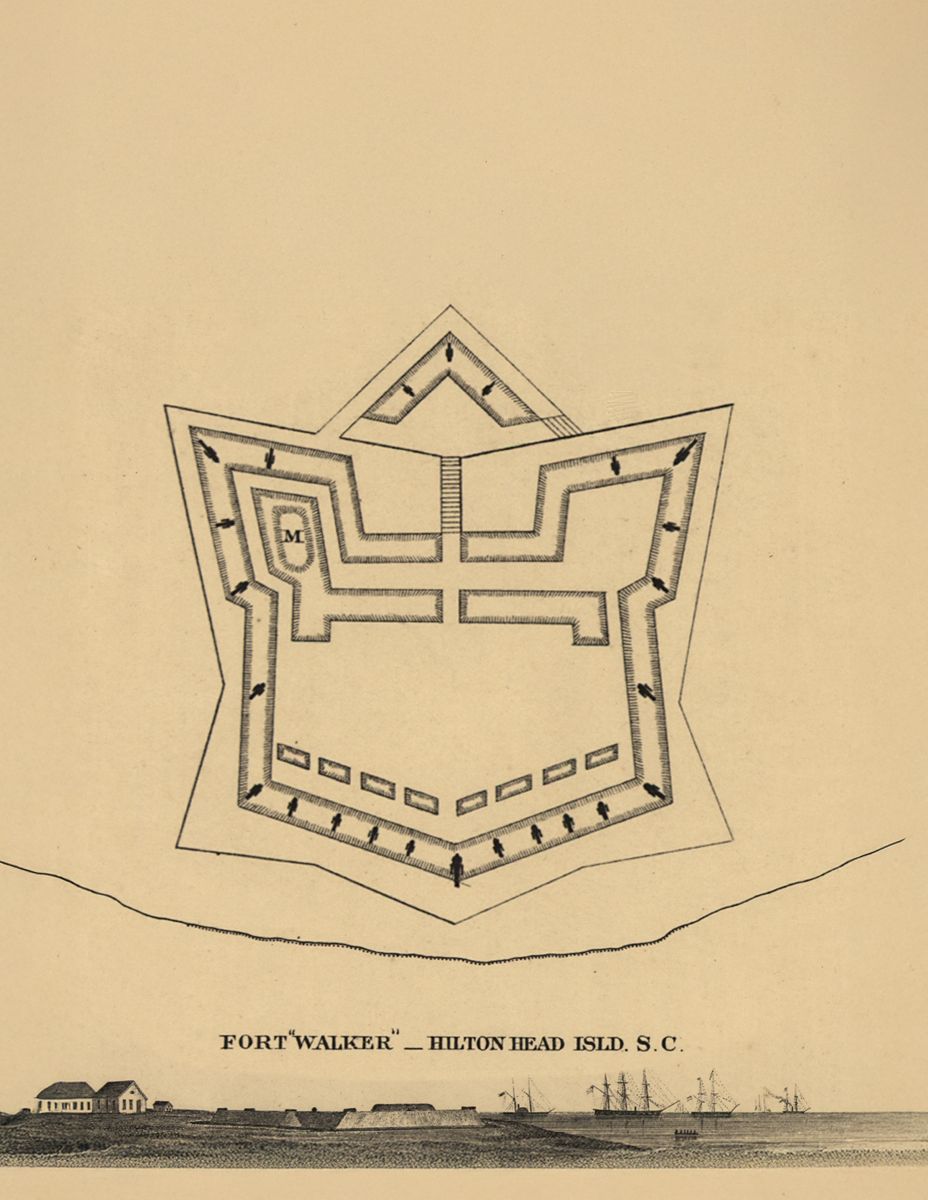
In the early days of the American Civil War, before the brutal bloodletting at Shiloh or Antietam defined the scale of the conflict, a significant, yet often overlooked, engagement unfolded along the South Carolina coast. On November 7, 1861, Union naval and land forces launched a coordinated assault on Port Royal Sound, a strategic deepwater harbor nestled between Savannah, Georgia, and Charleston, South Carolina. This daring operation, one of the first major amphibious assaults of the war, marked a pivotal moment in the Union’s evolving strategy to enforce a coastal blockade and tighten its grip on the rebellious South. Guarding the entrance to the sound were two Confederate strongholds: Fort Walker on Hilton Head Island, and Fort Beauregard across the channel on Phillip’s Island. Though bolstered by a small flotilla of four Confederate gunboats, the defenses were relatively light in comparison to the imposing fleet gathering just beyond the horizon. The Union expedition, commanded by Flag Officer Samuel F. Du Pont, had assembled offshore days earlier, arriving battered by a fierce coastal storm that had scattered vessels and caused the loss of essential Army landing craft. As a result, what had been envisioned as a joint Army-Navy operation was hastily revised into a naval-only engagement.
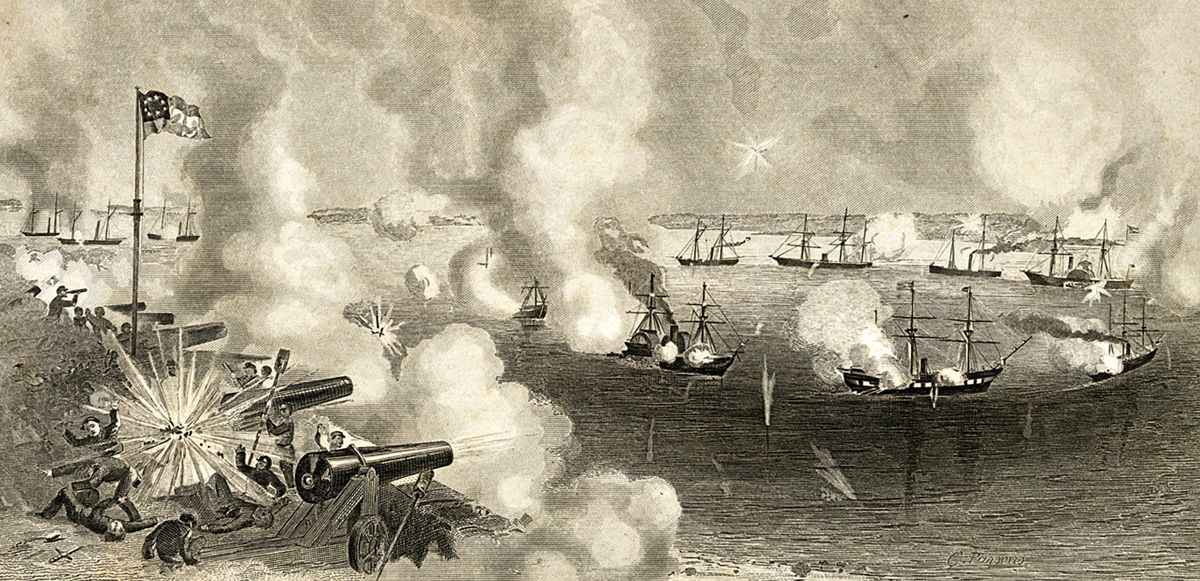
Despite the thunderous naval bombardment and the strategic importance of the engagement, the human toll was remarkably low. Union casualties amounted to just eight killed in the fleet, while Confederate losses totaled eleven dead with four missing. Fewer than 100 men were wounded or killed on both sides—a stark contrast to the carnage that would later define Civil War battles. The Battle of Port Royal stands as a milestone in the development of Union naval power and amphibious warfare. It demonstrated the effectiveness of coordinated maritime operations against coastal fortifications and delivered the Union one of its first significant footholds in the South. Moreover, the victory provided a critical base of operations for future blockading efforts and helped set the tone for Union dominance at sea for the U.S. Navy’s South Atlantic Squadron.
Du Pont wasted no time in adapting. On the morning of November 7, he launched a methodical attack, guiding his warships in a looping oval formation—shelling Fort Walker on one leg of the pass and Fort Beauregard on the return. The maneuver was inspired by tactics recently tested at Hatteras Inlet and was designed to deliver continuous, shifting bombardment that would outmatch static shore batteries. However, the plan faltered in execution, and many of Du Pont’s ships broke formation, instead positioning themselves to unleash a devastating enfilade on Fort Walker’s weaker flanks. By early afternoon, Fort Walker’s defenses had crumbled. Most of the Confederate guns had been silenced, and their crews retreated inland. Union sailors and Marines from the flagship moved ashore and claimed the abandoned fort. Across the sound, the commander of Fort Beauregard recognized the hopelessness of his position, isolated, outgunned, and facing imminent capture. He ordered an evacuation under cover of night. Union forces occupied the fort the next morning, raising the Stars and Stripes over another key Southern installation. Title page: USS Susquehanna, a sidewheel steam frigate, joined Flag Officer Samuel Francis DuPont’s expedition to South Carolina waters, which captured Port Royal Sound.
Map of the Union attack during the Battle of Port Royal. (Battles and Leaders of the Civil War, Vol. 1, page 708)
“Following the May 1861 recommendations of General P.G.T. Beauregard, Captain Francis D. Lee of the Confederate States Engineer Corps began construction of fortifications on Hilton Head in July, chiefly a battery located on Coggins Point Plantation near the entrance to Port Royal Sound. It was christened Fort Walker in honor of Confederate Secretary of War, L.P. Walker. Slave labor was used for cutting, hauling, and placing palmetto logs, digging trenches, constructing gun emplacements, and a powder magazine. Unfortunately, almost no heavy-caliber armament could be secured to furnish it. Col. William C. Heyward, Eleventh Regiment of South Carolina Volunteers, was in command with Gen. Thomas F. Drayton in charge of the overall defense of Port Royal Sound. When the most formidable expeditionary fleet ever assembled up to that time arrived to attack Hilton Head, the 24 guns of Fort Walker were quickly put out of commission, and General Drayton ordered its evacuation on November 7, 1861.” – (Peeples, “An Index to Hilton Head Island Names (Before the Contemporary Development)” p. 17)
“The battery built near the bluff was christened Fort Walker. No doubt the name was in honor of the Confederate Secretary of War, L.P. Walker, with the hope that the Secretary would somehow find the heavy artillery needed… Perhaps there was also some idea of honoring W.S. Walker, then in charge of the Third Military District, of which Hilton Head was a part. Work began in July, with the island planters furnishing the slave labor for hauling palmetto logs, digging trenches, erecting a powder magazine, constructing gun emplacements. The slaves sang as they worked … But as they sang they slurred the words whenever a white man was near … told of the coming freedom …” – “Hilton Head; A Sea Island Chronicle,” by Virginia C. Holmgren, 1959, p. 81.
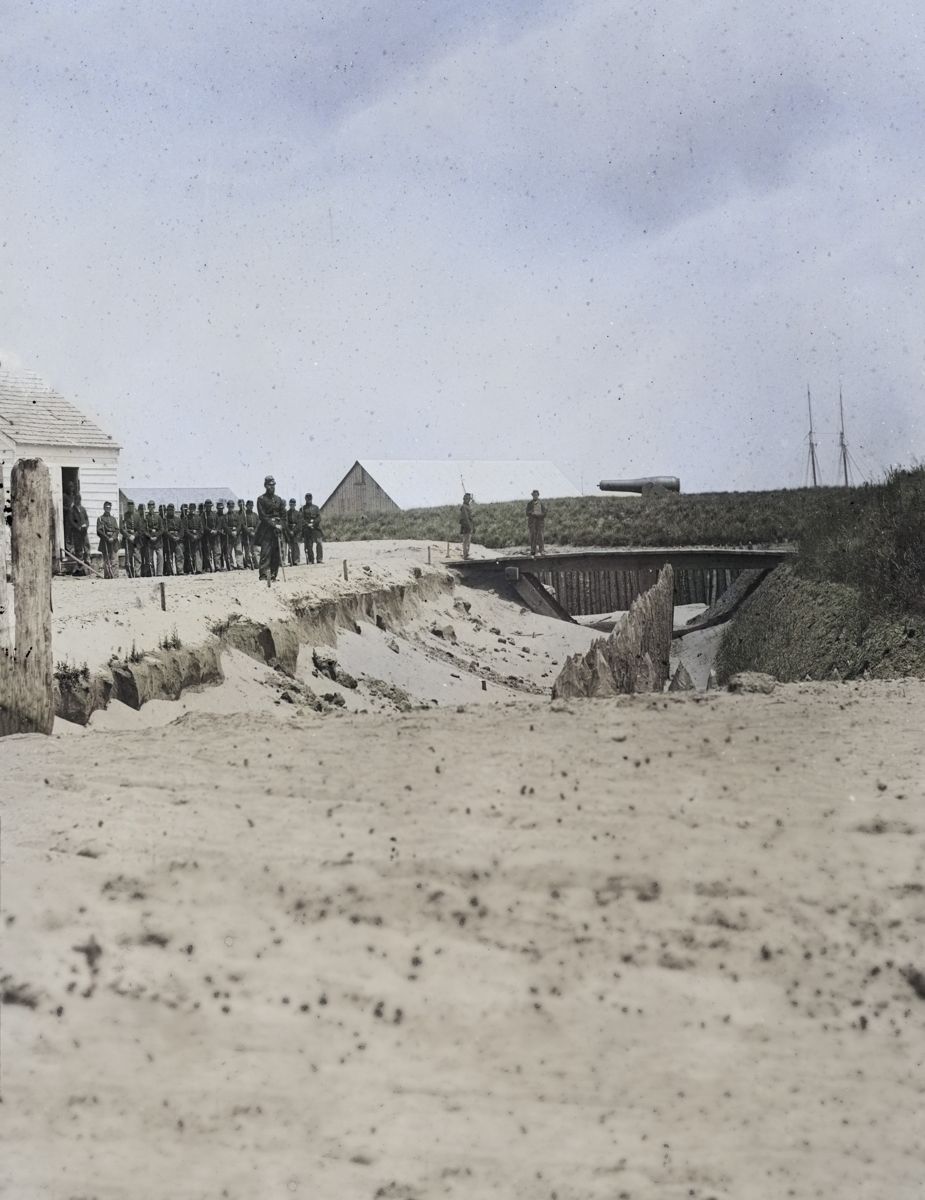
Rear view of Confederate Fort Walker, Hilton Head, S.C., after its capture by Union forces. (Library of Congress)
Personal Accounts of Port Royal by John C. Dalton Jr. Steamer Oriental, Hilton’s Head, Port Royal, Entrance, So. Ca., Thursday, November 7, [1861]. DEAR CHARLES,—… We engaged the rebel batteries here in earnest this morning at ten o’clock A.M. and at ¼ before 3 P.M. the American Flag was run up over what was beforehand a—Pirates hole and made a respectable place of it…The action was fought by the Wabash, Susquehanna, Seminole and five or six gunboats, while the transports waited behind and looked on just out of range. I watched it all from the fore topsail yard, and saw every flash. Hilton’s Head is a point to the south of the channel and had, as I mentioned, the strongest battery; just opposite is another point which had a battery of eleven guns, behind a breastwork; on Hilton’s head, the works proved a large and highly finished redoubt. The Wabash sailed up the channel to the right engaging the northern battery while passing, and then, after making a circuit came down again on the left, pitching hard into the fort on Hilton’s head. She repeated this operation twice. Meantime three or four vessels of war ran up the channels leading to the interior to keep at bay the rebel steamers from Charleston and Savannah, who had been firing at us day before yesterday, and watching us ever since, while the remainder of the gunboats took position to rake the Hilton’s head battery up and down. The battery replied with great rapidity at first and even after the Wabash had passed it twice worked four guns with great effect. But about two o’clock I noticed their firing less brisk, and half an hour afterwards had ceased. A boat with white flag at stem and American flag at stern then went off to shore from the Wabash, ran onto the beach without finding anybody to receive it. The flag then went along the silent parapet of the fort toward some barracks, and a big brown country house at its right where the rebel flag was flying yesterday, and in a few minutes the Stars and Stripes (very large pattern) ran up upon its top. ‘Twas the finest sight, I can tell you, I have seen for many months. I suppose we shall go on shore tonight, though the movements of the First Brigade are as yet somewhat uncertain. But I hope to get this off to you in the despatch-boat tomorrow morning…Love to all. Write as before. Your affectionate brother, JOHN. Friday m’g, Nov. 8th, [1861]. DEAR CHARLES,—We’ve not yet gone ashore from the Oriental, though five or six thousand troops are landed, and I expect all of the 2d and 3d Brigades (General Wright’s and General Stevens’) will go at once if they are not there already. The idea of the expedition was not to take any of the large Southern cities—for the present, at least. This harbor, of Port Royal, is one of the finest, if not the very best on the southern coast. They say it ranks with Charleston harbor about as Newport,
R. I., does with that of New York. It’s only accidental reasons that have made one the commercial capital of this part of the country rather than the other. At any rate it’s a splendid harbor capable (so the Coast Pilot says) of riding the largest navy in the world. We are anchored, with the Wabash and all the other big vessels in a crowd, right on the shore almost, and in perfect security in five or six fathoms of water. Our success too is more gratifying than I thought it to be yesterday. The work on Hilton Head, which was the one principally engaged yesterday, is a complete fortification which was the first one built on the coast immediately after the capture of Sumter. It’s not only extensive and strong, with its parapets revetted all over with sods, and as smooth and regular as you would wish, but contains 15 Columbiads (best quality) many of them 11 inches, and mounted on the inland side of the fort as well as the water side. Only three were dismounted yesterday—the rest are all perfect—the rebels left, at last, in such haste that not a gun was spiked, and all their tents and camp equipage and many muskets were also left behind. The fort is fully supplied with shot, shell and ammunition. As soon as this work on Hilton Head was surrendered yesterday, the enemy abandoned the other one on “ Bay Point” on the north side of the channel, and the flag is floating this morning all round us… Yours, JOHN. Hilton Head, December 19th, ‘61. DEAR CHARLES,—…Your speaking of my sending home captured swords, muskets, etc., reminded me for the first time that I could send home my bulky relics, that I’ve been keeping in my trunk ever since we landed, in the vague impression I should have to cart them round with me until I could return to the North myself…The broken gunstock I picked up inside of Fort Walker immediately after the battle (next morning). There were entire muskets enough that I suppose I could have got, but I thought the damaged one would be more interesting as a relic than if it were whole, as one musket looks pretty much like another. The two pieces of shell I found inside a stockade in one of the trenches. Hold on to them all and if I’ve a chance I’ll [send] you something more when I can…JNO. C. D., JR. Source: Proceedings of the Massachusetts Historical Society, Oct., 1922 – Jun., 1923, Third Series, Vol. 56. Massachusetts Historical Society. Pages 379-382. John Call Dalton, Jr. (1825–1889), an army surgeon, writes to his brother Charles Henry Dalton (1826–1908), assistant quartermaster-general of the Massachusetts militia, from his position at Hilton Head. Dalton describes collecting souvenirs inside the recently captured Fort Walker.
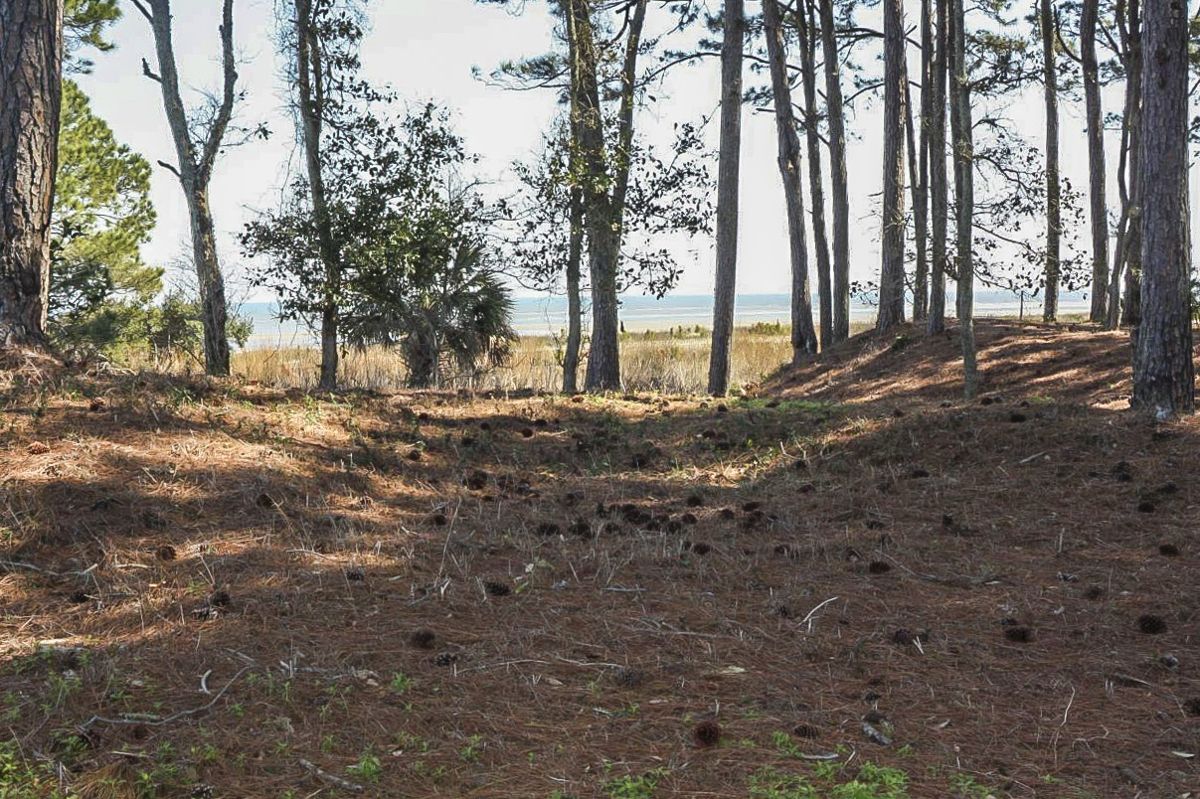
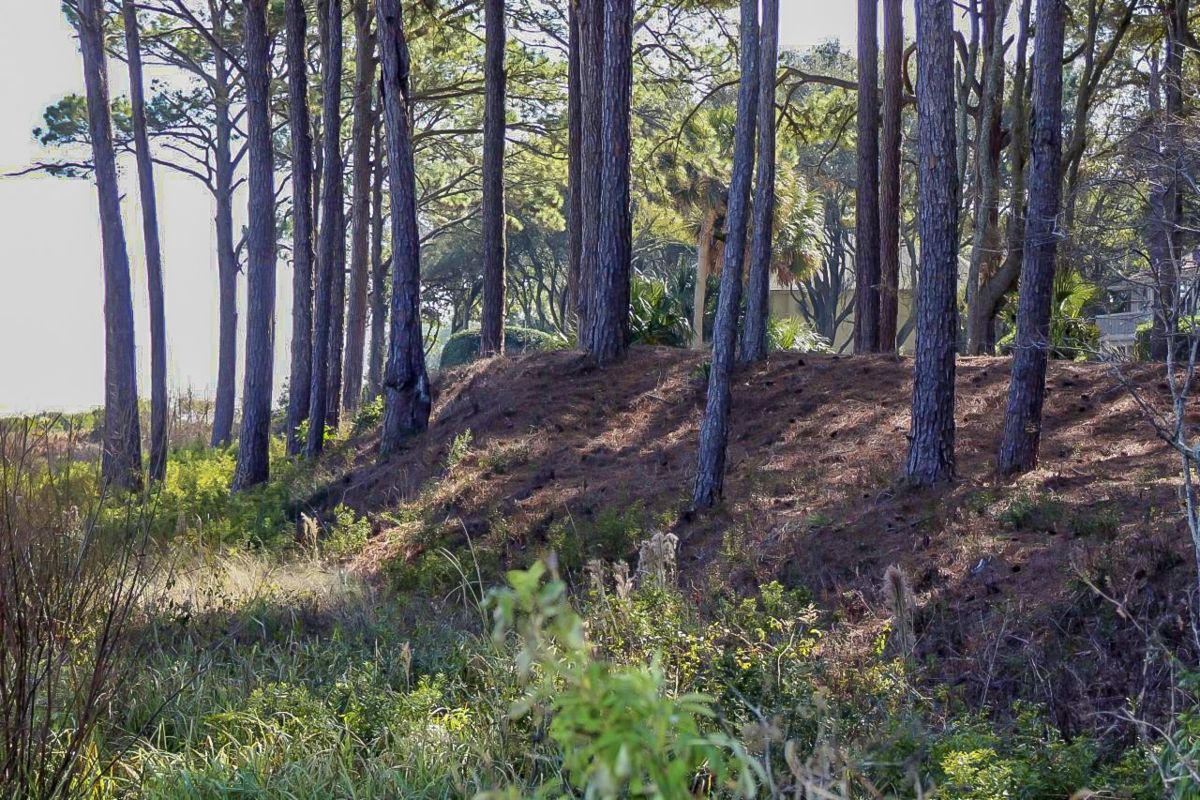
Fort Walker Today Fort Walker earthworks overlooking Port Royal Sound. (Mike Stroud)
Remains of earthworks at Fort Walker. (Mike Stroud)
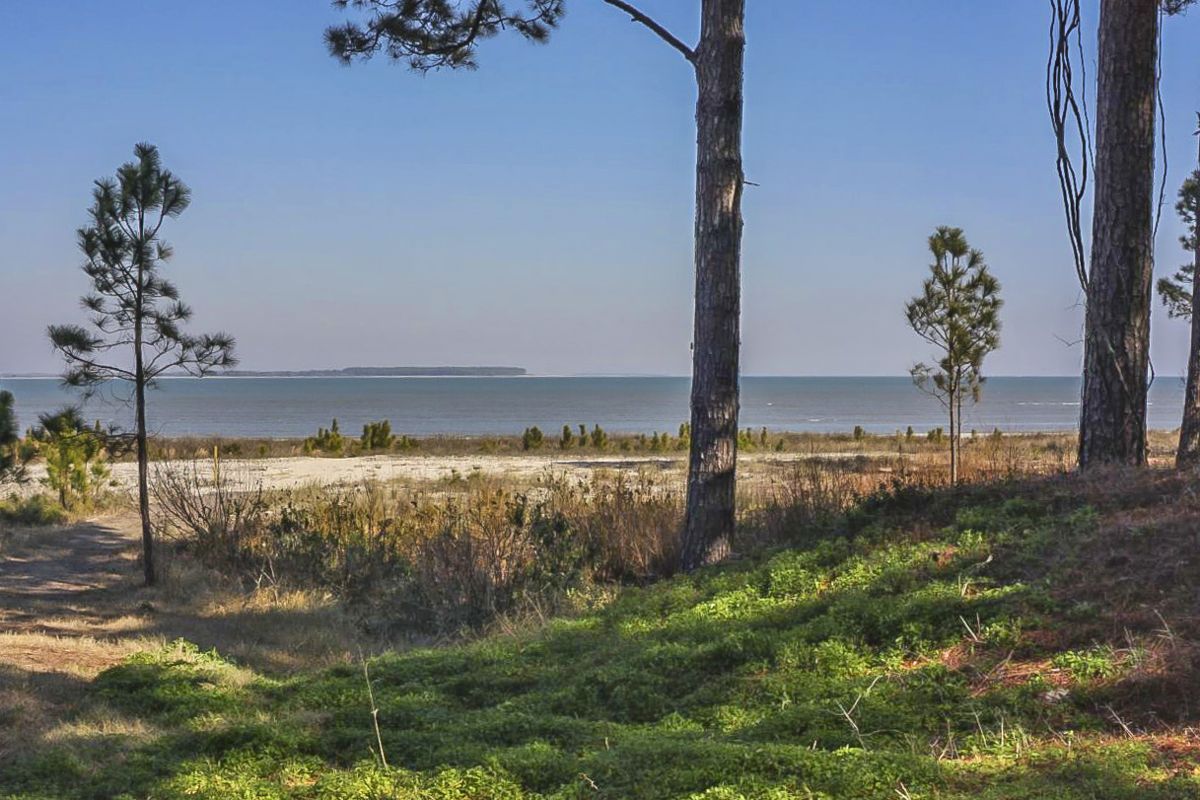
Beach at Fort Walker where Union troops landed ashore. Port Royal Sound and site of Fort Beauregard in background. (Mike Stroud)