
Oak Leaves, Acorns, Ropes, and Sea Serpents
By Ori Ben-Chorin · Originally published November-December 2025 · pp. 60–71
Oak Leaves, Acorns, Ropes, and Sea Serpents: Profile of a U.S. Navy Rear Admiral and his Military Contract “1 of 500” Model 1852 Pattern Naval Officers Sword By Ori Ben-Chorin
Lieutenant Joseph Foster Green was already a 25-year Navy veteran when he received his Model 1852 Pattern Naval Officers Sword. He was most likely unaware that this ornate-edged weapon, known to collectors today as a rare, martially marked “1 of 500” of its kind, represented the first and last time the U.S. Navy ever ordered swords for its officers as part of a military contract for such arms. All other Navy swords are not from a U.S. contract but rather are private purchases by Navy officers.
just 15 years old. He literally grew up in the Navy during the Antebellum period. At the time, the Navy was beginning to flex its muscles by deploying small naval squadrons internationally. For the next 20 years, Green served on several warships, actively protecting American interests and shipping lanes abroad and combating piracy along the South American coast, the Caribbean, and the South Atlantic. The type of vessels Green initially served on were wooden-hulled sailing ships, armed with 10-18 guns and a crew of about 120 men.
This is a story about a beautiful and rare variant of a sword that is still in use by Navy officers. More than that, it is a story about the Navy’s early days and the profile of a man who spent 46 years in faithful duty to his country, and who fought in many of our nation’s most storied naval battles. While the battles may be well-known to some, this officer is not, and he deserves to be. Before we focus on the sword, let’s discuss this naval officer’s career.
From 1832 to 1833, Midshipman Green attended the Naval School in Norfolk, Va. The school predated the U.S. Naval Academy, which was not founded until 1845. Norfolk was the school with the largest enrollment, although it did not typically have more than some two dozen students.1 At Norfolk on June 10, 1833, Green was promoted to passed midshipmen; one who passed his exams and was eligible for promotion. He spent the next few years serving on various ships of the Brazil Squadron protecting American commerce in the South Atlantic. Green also cruised the Mediterranean and the West Indies Station, suppressing piracy in the Caribbean, the Antilles, and the Gulf of Mexico. The 1840s ushered in the U.S. Navy’s age of steam propulsion. Green, who was commissioned lieutenant on February 28, 1838, had to brave only a few minor sea battles, and these were often punctuated by fairly comfortable berths in hospitable ports around the world, where dashing American officers were treated rather well. In 1840, the young officer married, and over the next few years, he fathered several children. As might be expected, at post and on duty, naval discipline had to be maintained. However, its sharper edge was primarily reserved for enlisted sailors, while the officers, especially the higher ranks, led a comfortable life. Younger officers like Green had to endure 10 or 20 years of service without advancement while cadres of aging, sometimes elderly, officers remained at their posts. Events can sometimes overtake the status quo, and this was the case when America annexed the Republic of Texas in 1845.
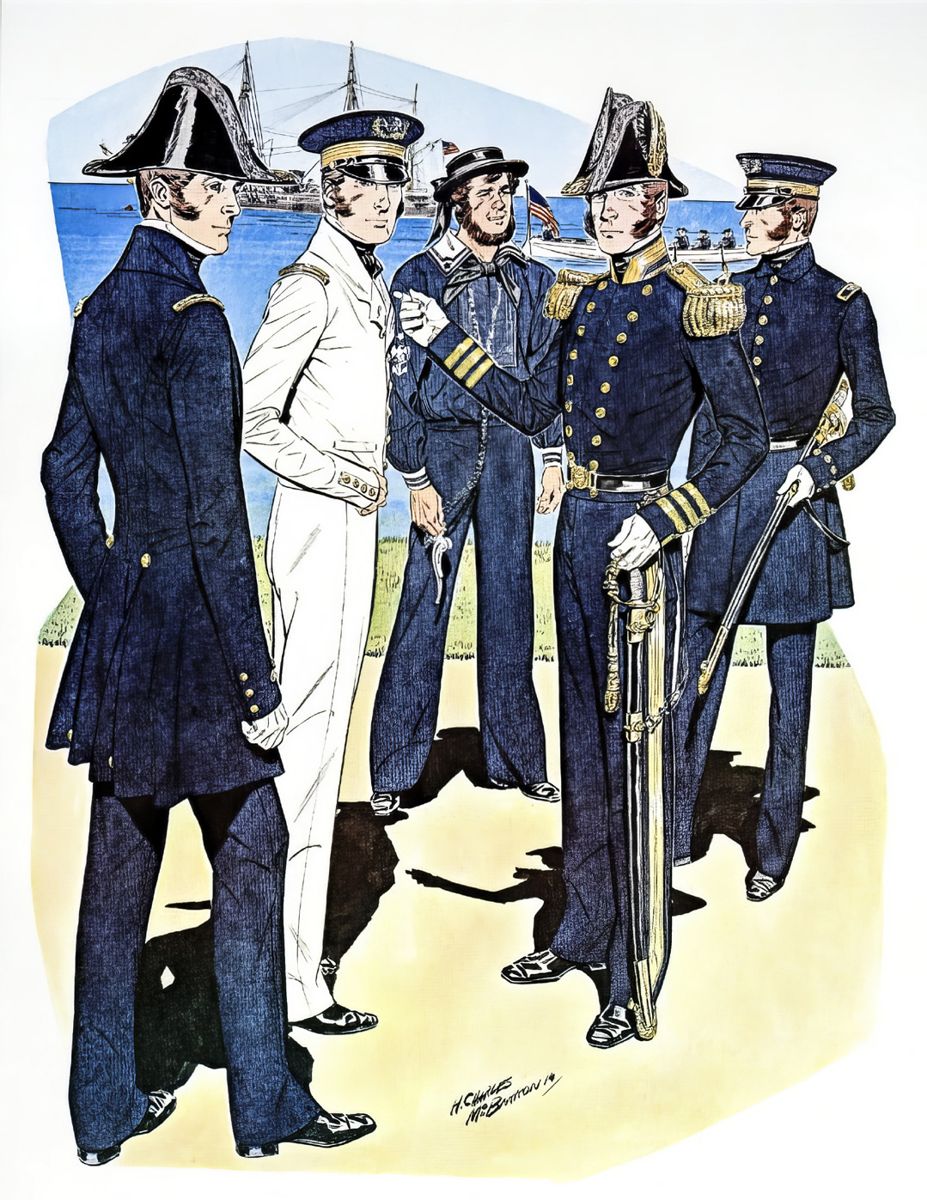
The U.S. Navy’s 1852 full dress uniforms and arms. (Naval History and Heritage Command)
The early years–growing up on the water Joseph Foster Green was born in Bath, Maine, on November 24, 1811. He joined the U.S. Navy as a Midshipman on November 1, 1827, when he was
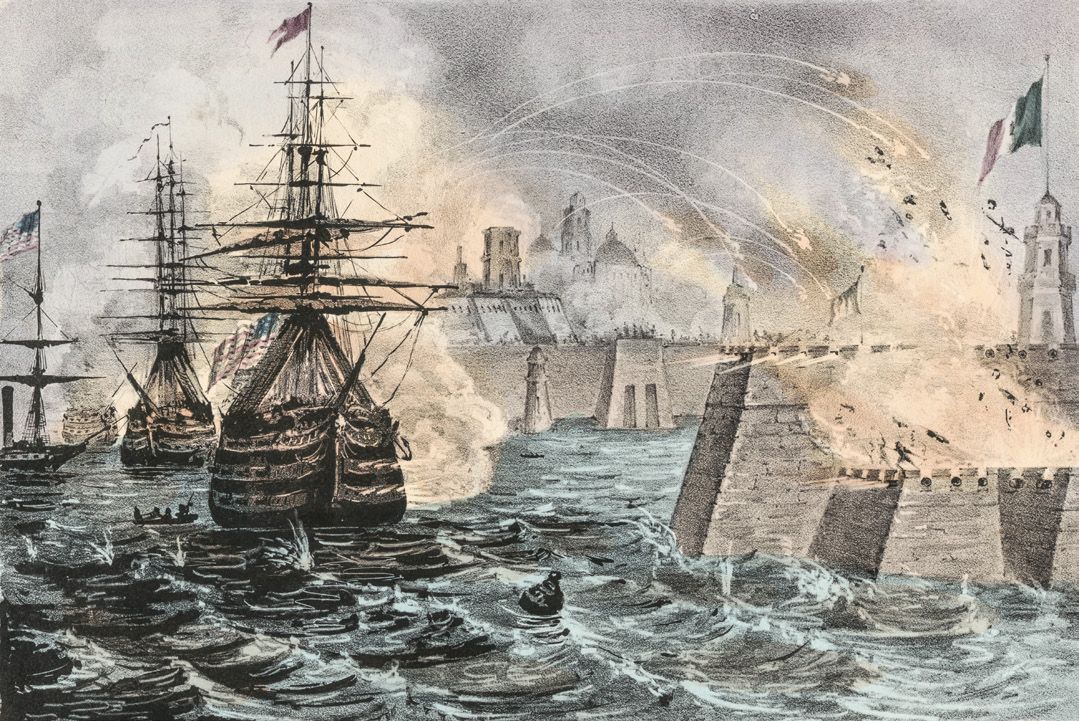
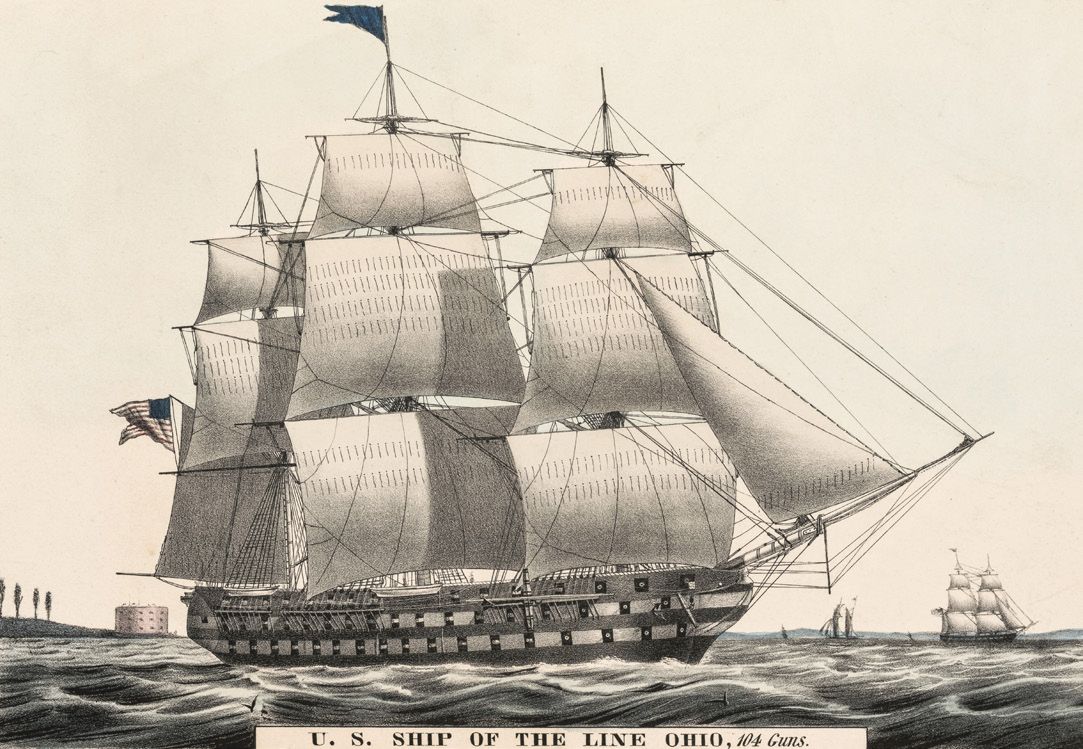
Lieutenant Green in the MexicanAmerican War (1846–1848) The clash with Mexico began with a border dispute and a territorial land grab, as our young nation’s desire to realize its Manifest Destiny compelled it to stretch its borders to the Pacific. The result was the Mexican-American War, a serious two-year conflict that, while fought mostly on land, frequently required the Navy to provide the Army with close support. At the time, the Navy was unable to attract enough recruits. Although U.S. President James K. Polk sought to increase the Navy’s force strength from 7,500 to 10,000 men, this target was never met. Nevertheless, the Navy remained a formidable adversary, able to maintain a tight naval blockade on the Mexican coast and conduct amphibious operations. As the war progressed, the Navy played a key role in capturing the Mexican province known as “Alta California,” which included today’s State of California, bombarding and landing an invasion force at Mexico’s heavily fortified port city of Vera Cruz, and even advancing overland to capture a number of fortified Mexican forts. Until 1850, Lieutenant Green served on board the USS Ohio, a ship-of-the-line, and took part in all the important naval actions of this conflict. Laid down in 1817 and launched in 1820, the wooden-hulled Ohio was the first ship built at the Brooklyn Navy Yard, and the first of several named after states in the Union. The vessel was recommissioned for war service in 1846 and was called by its admirers, “the most beautiful ship that ever floated.”2 Green was aboard the Ohio when it arrived at Vera Cruz on March 22, 1847. Two days later, with its guns blazing, Ohio bombarded the fortress of San Juan de Ulúa into submission.
Bombardment of Vera Cruz by N. Currier, 1847. (Library of Congress)
On March 29, 1847, the City of Vera Cruz surrendered. The fort’s garrison was taken as prisoners of war. Wasting no time, Commodore Perry assembled his men and marched against the remaining Mexican ports that dotted the Gulf of Mexico. Although the massive Ohio was unable to navigate the shallow Gulf coast during what became known as the “Tuxpan River Expedition,” the ship sent 16 officers and 320 sailors with Perry. Lieutenant Green was likely among those brave men who fought their way upriver, destroying several Mexican forts. The Mexican-American War ended in 1848 with a triumph for the combined forces of the U.S. Army and Navy. In the subsequent Treaty of Guadalupe Hidalgo, Mexico formally recognized Texas as part of the United States and relinquished a large portion of its territory, including California, Nevada, Utah, and most of Arizona and New Mexico. With the following peace, Lieutenant Green sailed on the Ohio to reinforce the Pacific Squadron in San Francisco Bay. He then spent the next two years protecting commercial interests in the Pacific and patrolling California’s coastline during the turbulent Gold Rush period.
The USS Ohio, a 104-gun Ship-of-the-Line, by N. Currier, 1847. (Library of Congress)
In a battle report sent to the Secretary of the Navy on March 25, 1847, Commodore Matthew Calbraith Perry described how
[d]etachments of boats from all the vessels are employed night and day in landing from the transports the stores and munitions of the army.” Perry added, “[i] n order to give all a chance to serve in the trenches, for the honor of which there is a great though generous strife, I have arranged that detachments from each ship, in charge respectively of lieutenants, and the whole commanded by a captain or commander, shall be relieved every twenty-four hours.
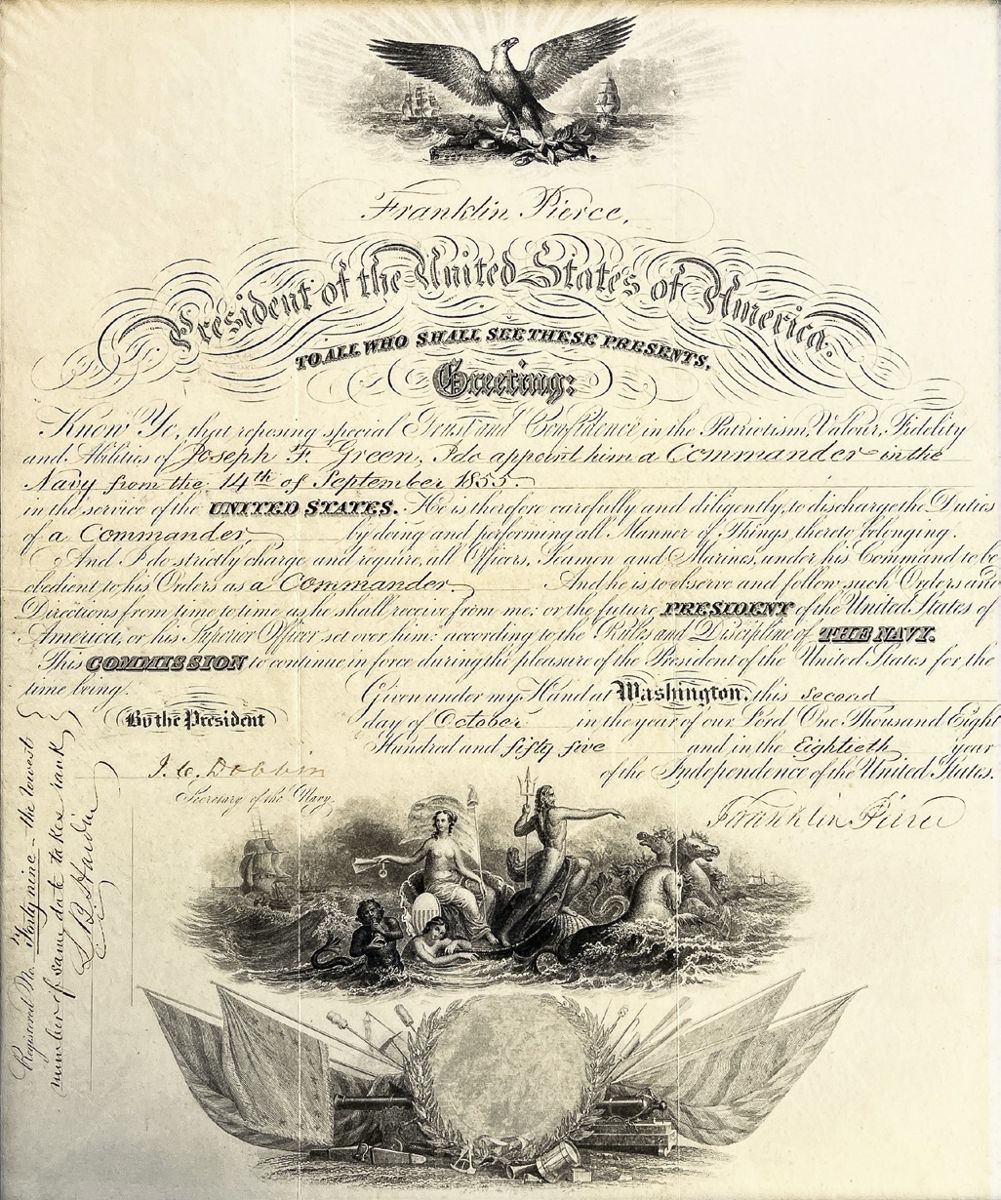
Commander Green at the U.S. Naval Academy (1855–1858) Lieutenant Green served aboard the USS Ohio until 1850, and then for the next few years, he was on ordnance duty at the Boston and Washington Navy Yards, managing weapon and munition stores. While this decade was initially one of relative calm, increasing tensions between the North and South and the gradual realization that the Southern States were serious about seceding from the Union served as a destabilizing force in both the political and military arenas. On September 14, 1855, Green was promoted to commander and ordered to the nascent U.S. Naval Academy in Annapolis, Md., as that institution’s
Assistant Executive Officer and its fourth Commandant of Midshipmen, essentially serving as the institution’s second-in-command, a position he held until 1858. Green was also the Academy’s instructor in practical seamanship, practical naval gunnery, and naval tactics, which allowed him to hone skills that would serve him well in the Civil War.
Commander Green’s U.S. Contract Model 1852 Pattern Naval Officers Sword In the U.S. Navy’s early years, no guidelines existed to regulate the style of swords worn by officers, and as such, they were privately purchased, typically following European patterns.3 In the 1830s, the Navy began to standardize uniforms, introducing the 1830 and 1841 Pattern swords.4 On March 8, 1852, the Secretary of the U.S. Navy issued new regulations that provided guidelines for yet another pattern of naval officer sword. The Navy’s new sword pattern was to have a cut and thrust blade, not less than twenty-six nor more than twenty-nine inches long, half basket hilt, grip white: Scabbards of black leather. Mountings of gilt; and all as per pattern.5 A month later, the Navy’s Board of Commissioners awarded a contract to the Ames Manufacturing Company of Chicopee, Mass., to supply new swords to the 487 qualified officers then on the Navy Register.6 Ames delivered 420 swords by December 10, 1852, and an additional 80 were delivered on January 5, 1853.
Commander Green wearing his U.S. Contract Model 1852 Pattern Naval Officers Sword. (Official U.S. Navy Photo)
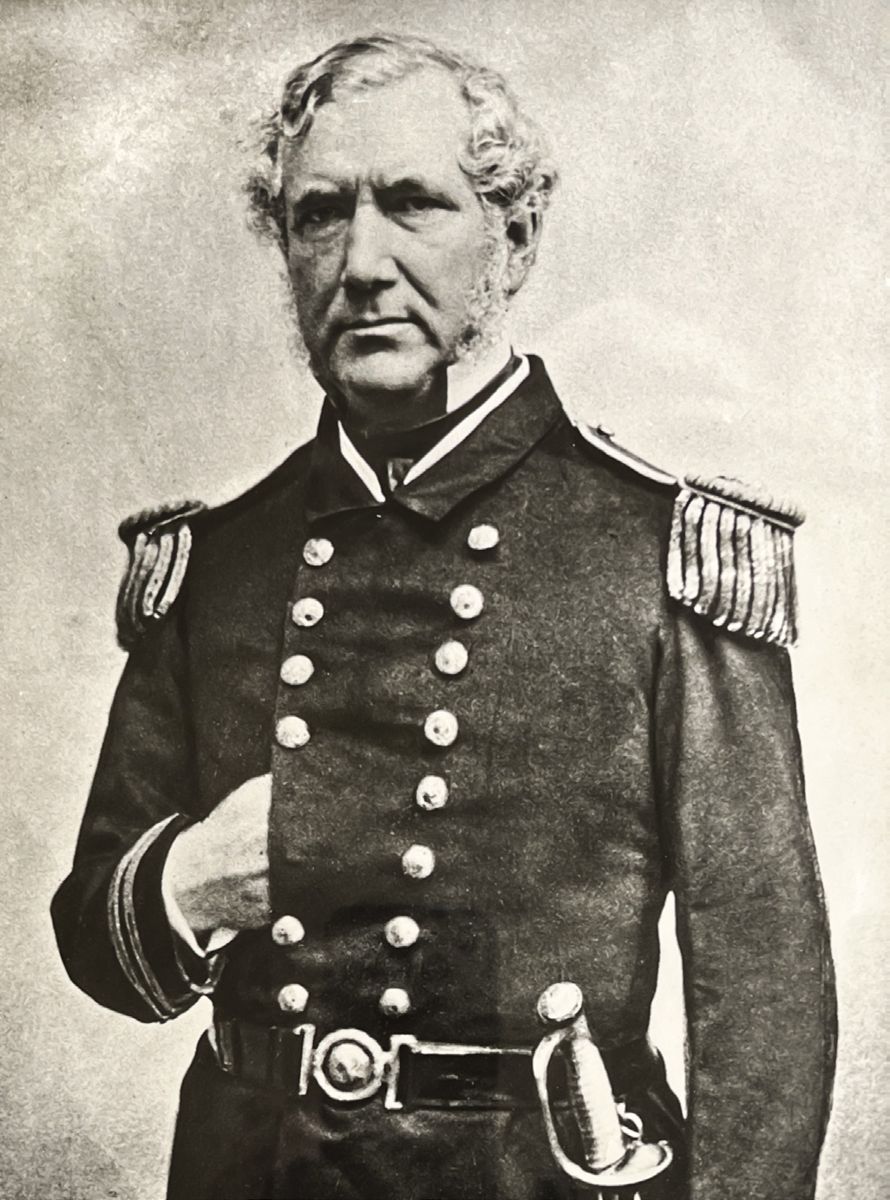
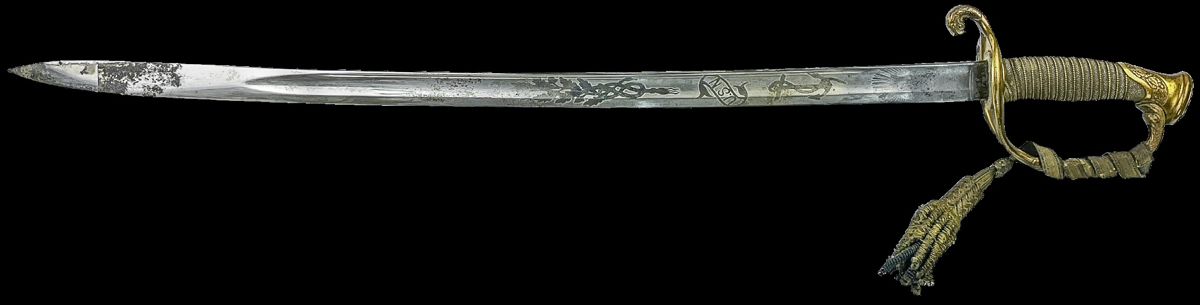
In the early part of the 1850s, while on duty at the Boston Navy Yard, Lieutenant Green obtained his Model 1852 Pattern Naval Officers Sword, which is the subject of this article. Green undoubtedly used this sword throughout his career and it, along with other artifacts of his military service, descended in his family until the sword was purchased with a copy of Green’s official U.S. Navy portrait and commission as commander, at the sale of the estate collection of the Admiral’s great-great granddaughter, Claire Juliette Geszty Gardiner, and her husband, Nicholas Randolph Burke. The sword blade features motifs characteristic of Model 1852 Pattern Naval Officer Swords of the period, all executed against a frosted background. These include a maker’s mark, “Ames Mfg. Co. / Chicopee / Mass.” and etchings of foliage, fouled anchor on a shield, an oval of stars, and a display of pole arms. The reverse shows an eagle atop a deck gun, a fouled anchor, a scroll with “U.S.N.,” rope, and foliage. A regulation sword knot of gold lace and gold bullion tassel is attached to the gilt-brass knuckle bow.
President Franklin Pierce signed Commander Green’s Commission, appointing him commander from September 14, 1855.
Rear Admiral Green’s Model 1852 Pattern Naval Officers Sword. (Sword photographs by Ori Ben-Chorin.)
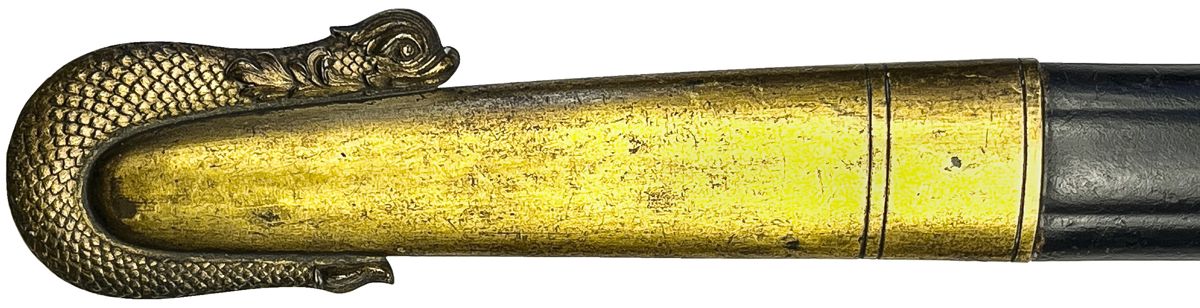
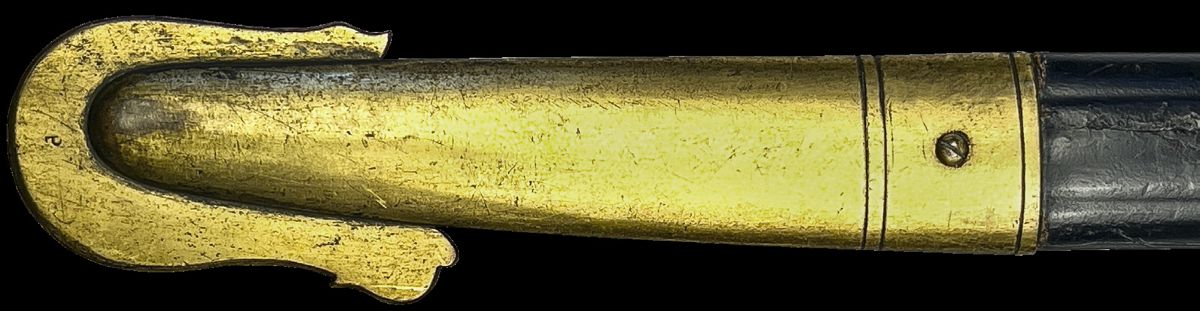
Green’s Model 1852 Patttern Naval Officers Sword’s original leather scabbard with brass mounts.
Sword blade ricasso, dated 1852.
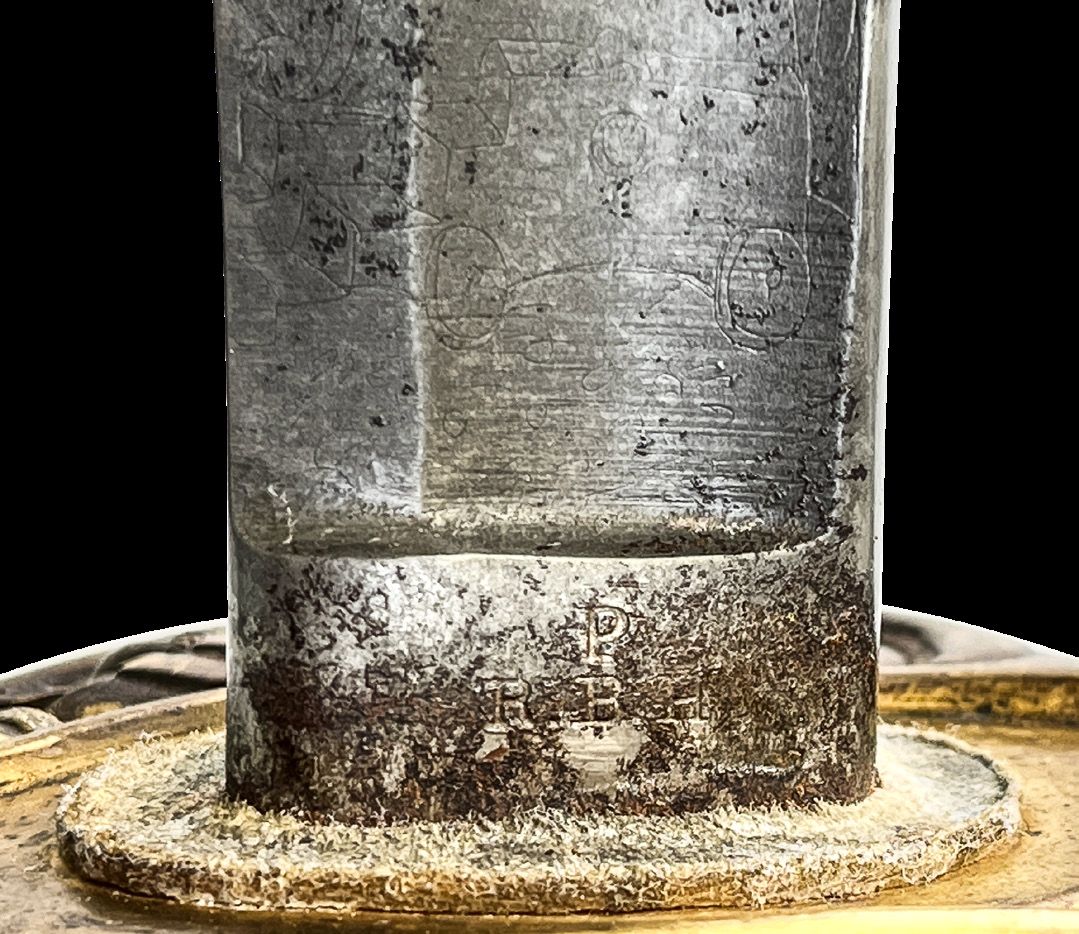
Sword blade ricasso, martially-marked “P” over “R.B.H.”
Scabbard drag front and the back (note sub-inspection mark “P” at foot of back).
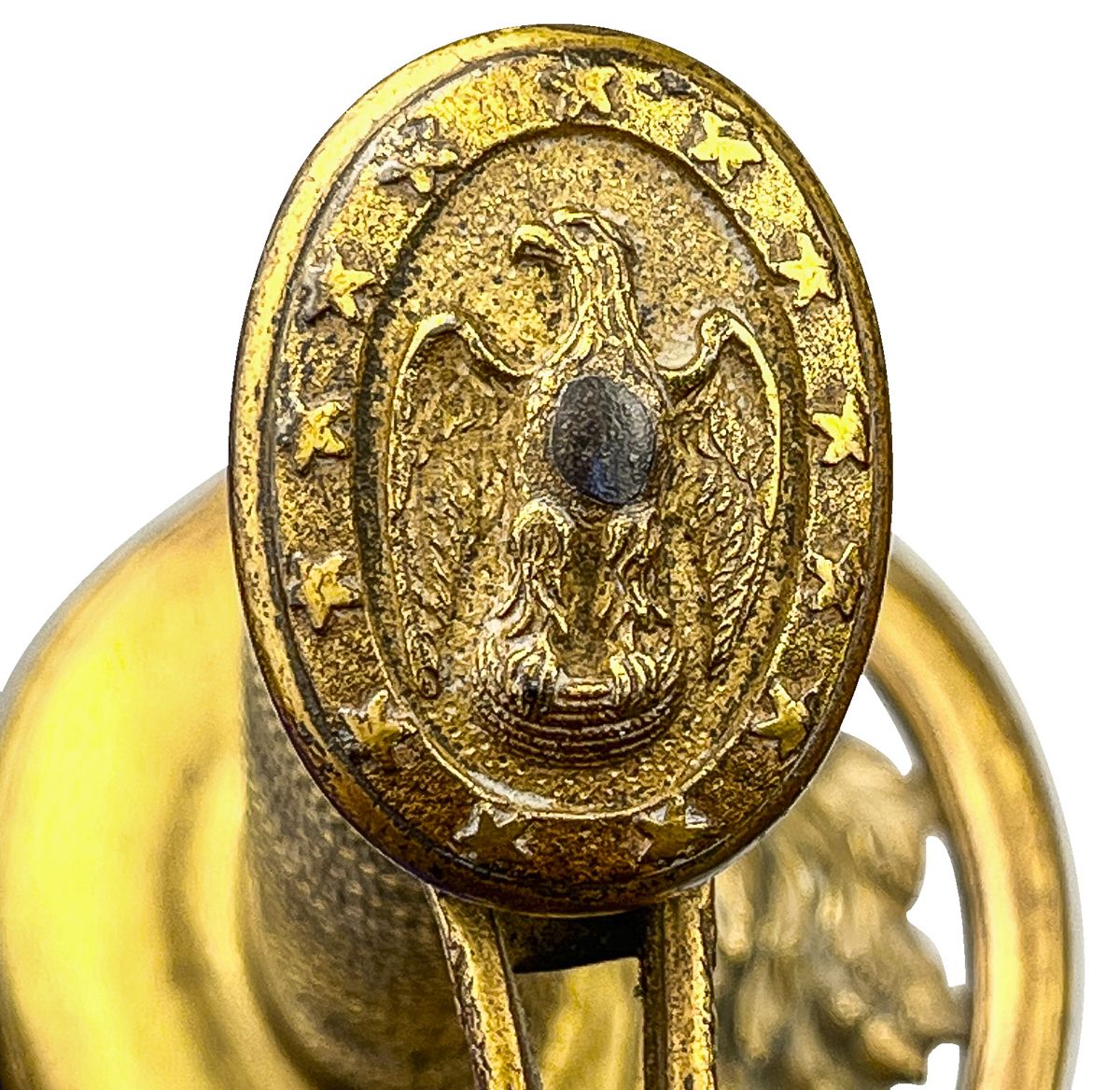
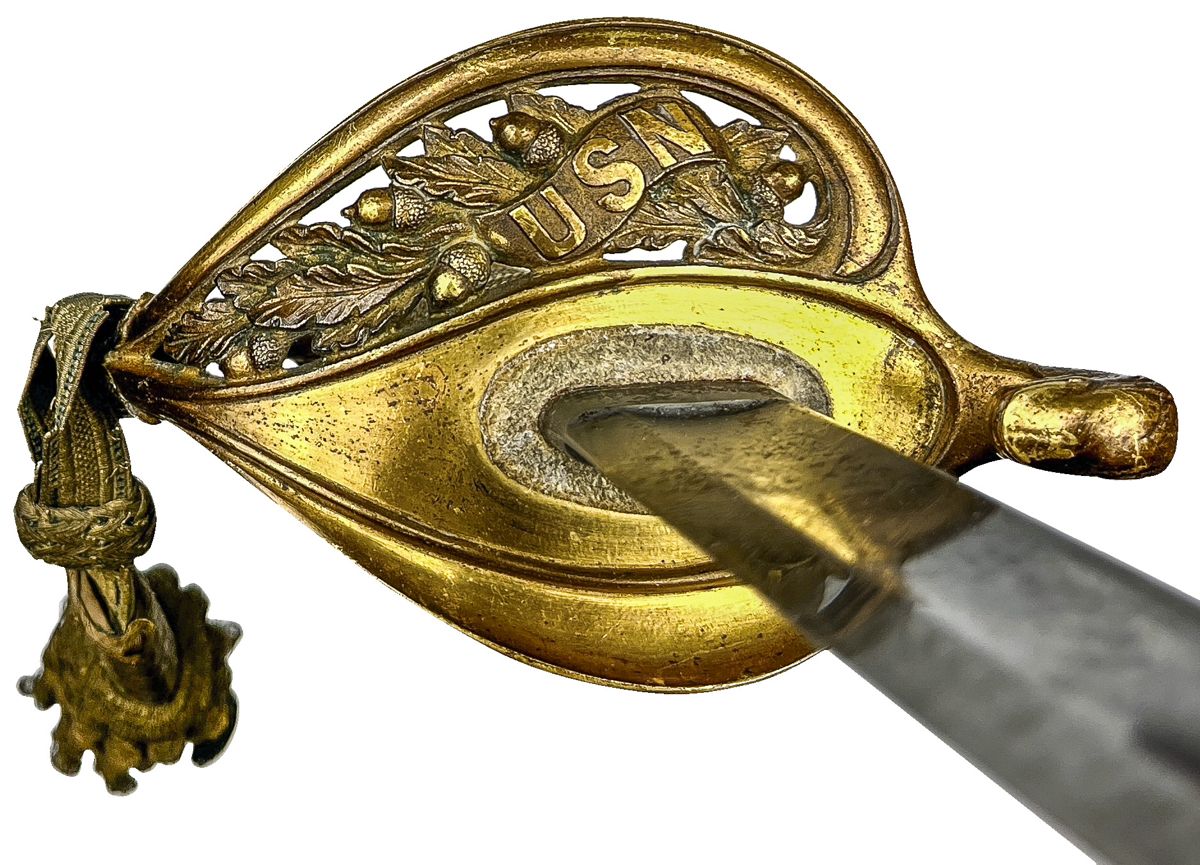
The grip’s pommel has an end cap displaying an eagle looking over its right shoulder, surrounded by thirteen stars, and a peened tang at its breast. The black stitched leather scabbard has mounts of giltbrass knots and its top mount bears the Ames company stamp. The brass-wired, shagreen-wrapped grip is contained inside a gilt-brass knuckle guard with “USN” in a scroll, decorated with acorns and oak leaves, all terminating in a sea serpent.
Commander Green at the Battle of Port Royal (November 7, 1861)
Gilt-brass knuckle guard with “USN” in a scroll, acorns, and oak leaves.
On November 6, 1860, a new election brought Abraham Lincoln to the presidency. Over the next few months, 25 of the U.S. Senate’s 66 members left to join the Confederacy.7 At the same time, things were also coming to a head in the U.S. Navy, which was literally being torn apart. Nearly a quarter of the Navy’s 1,457 commissioned officers resigned and headed South. Then, predictably, on April 12, 1861, about a month after Lincoln took office, Confederate troops fired on Fort Sumter in South Carolina’s Charleston Harbor. A day later, the fort fell, and the War Between the States commenced. Because the Confederacy depended in great part on foreign assistance, it was imperative for it to exchange its cash crops for military goods. One of the Union Navy’s primary goals was to prevent such foreign assistance from reaching the Southern states. Accordingly, the Union Navy tasked two of its squadrons to blockade the Gulf of Mexico coast and a further two, to block the Southern Atlantic coastline. The South Atlantic Squadron, without a supply depot or coaling station, set its sights on capturing Port Royal, on the South Carolina coast.
Pommel cap with Federal Eagle surrounded by 13 stars.
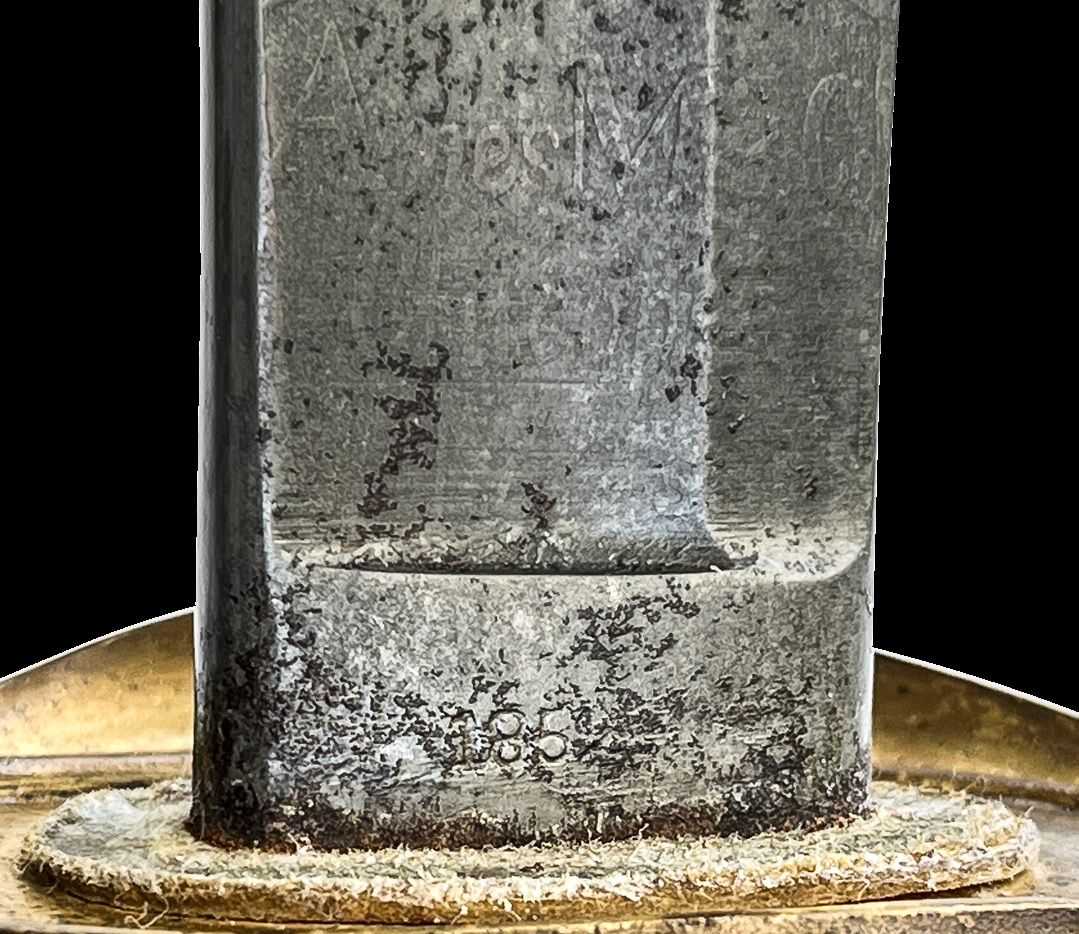
Rear Admiral Green’s Model 1852 Pattern Naval Officers Sword This sword, and the others in this single 500count military contract, have unique identifying features found on no other Navy swords. One side of the blade’s ricasso is martially-marked and bears government inspection marks “P” over “R.B.H.” The lower mark represents the initials of the Navy’s inspecting officer, Robert B. Hitchcock. The reverse of the ricasso is dated 1852. Similarly, the tip of the scabbard’s gilt-brass drag, which is decorated with a sea serpent, bears a second inspection mark “P.”
Ames mark on the top scabbard mount.
On November 7, 1861, Admiral Samuel Francis Du Pont attacked Port Royal with a flotilla of 18 warships, one of which was the USS Jamestown, a 22-gun sloop-of-war under the command of Joseph Foster Green.8 Commander Green’s actions on that day supported one of the earliest amphibious assaults of the Civil War. Once the expeditionary force captured the fort, it was able to secure a base to support Federal warships in their efforts to blockade the Southern coastline.
large quantity of tobacco came to and was quickly boarded. Canandaigua put a prize crew aboard to deliver the Cherokee to Union authorities.9 When it came to the Cherokee’s spoils-of-war, a Boston prize court later determined that Canandaigua alone would be entitled to the prize money.10
Captain Green and the USS Canandaigua blockading Charleston Harbor On July 16, 1862, Green was promoted to Captain. He took command of the USS Canandaigua, a 228foot long, wood-hulled, steam sloop-of-war that was ordered in October 1861 at a cost of $232,805.74. The Canandaigua was launched on March 28, 1862, and fitted with powerful Isherwood-designed engines built by the Atlantic Iron Works of Boston. It bristled with an armament of 10 Dahlgren guns. Captain Green and the Canandaigua reported for duty with the Union’s South Atlantic Squadron, blockading the well-fortified harbor at Charleston, S.C. The Canandaigua spent much of the War trying to prevent the Confederacy from selling cotton and tobacco, its most commercial crops and, in return, acquiring much-needed supplies to fuel what was known in the South as the “War Against Northern Aggression.” From 1862 to 1864, Captain Green commanded the Canandaigua during many successful actions against Confederate blockade runners. One typical example was the hot pursuit of the blockade runner Cherokee on May 7, 1863. Although Cherokee was a swift steamer, Canandaigua was even faster, and after a 3.5-hour chase, it caught up to Cherokee and fired a shot across the bow. The Cherokee, laden with 450 bales of cotton and a
The USS Canandaigua. (Library of Congress)
Rear Admiral John A. Dahlgren standing by a Dahlgren gun on deck of USS Pawnee, Charleston Harbor, S.C., 1865. (Library of Congress)
Captain Green at the First Battle of Charleston (April 7, 1863) Captain Green commanded the Canandaigua during many of the Civil War’s most iconic naval battles. One such battle took place in early 1863, when Rear Admiral Samuel Francis Du Pont tried to steam into Charleston Harbor past its well-defended fortifications, take the harbor, and train his guns on the city. Secretary of the Navy Gideon Wells wanted to take Charleston by using only naval forces. On April 7, 1863, in what became known as the First Battle of Charleston Harbor, a fleet of Union ironclad steamers crept into the harbor and opened fire on Confederate positions at Fort Sumter, Fort Moultrie, and Morris Island. During the battle, Captain Green was the senior officer in command of a squadron of wood-hulled warships. The attack was a complete failure. During the first two hours, Confederate gunners mauled the Union warships, which found it difficult to return effective fire. Many Federal vessels were damaged, including the USS Keokuk, which sank off Morris Island. Admiral Du Pont was summarily dismissed in the aftermath of the battle.
Captain Green at the amphibious assault on Fort Sumter (September 8, 1863) After the failed Union attack on April 7, 1863, Confederate forces strengthened Fort Sumter’s defenses in anticipation of further attacks. Dahlgren ordered a nighttime amphibious assault on Fort Sumter on September 8, 1863. He directed all Union warships, including the USS Canandaigua, to organize “special service” volunteer parties to attack the Fort in boats;14 Captain Green was ordered to send 40 men and three boats to join the attacking force.15
The Great Fight at Charleston S.C. April 7th, 1863, by Currier & Ives. (Library of Congress)
Captain Green at the Second Battle of Fort Wagner (July 18, 1863) In the summer of 1863, Union Brigadier General Quincy Adams Gillmore sought to close the harbor from the land. He first wanted to capture Battery Wagner on Morris Island. The fortification protected Morris Island and controlled the southern channels into Charleston Harbor. After Gilmore’s first attack on July 11 was repelled with heavy Union losses, the general ordered a second assault a week later. His battle plan called for the Union’s iron-clad ships and wooden-hulled ships to bombard Battery Wagner and nearby Fort Gregg.
A view of Fort Sumter from its sand bar, 1865. (Library of Congress)
Captain Green commanded the USS Canandaigua during this battle and maneuvered his ship over the bar in Charleston harbor without a pilot, after Admiral John A. Dahlgren failed to send him one.11 Green’s feat of difficult maritime navigation was lauded in newspaper accounts describing the battle. After Captain Green passed the Charleston Bar, he joined in shelling Battery Wagner with the Canandaigua’s “heavy battery in full blaze,”12 firing his first shot at half-past eleven o’clock.13 Although the bombardment of Battery Wagner lasted eight hours, it caused little damage, but it did kill eight men and wound a further 20. That evening, the Union Army’s land assault on Wagner commenced, with the 54th Massachusetts, commanded by Col. Robert Gould Shaw of Boston, Mass., leading the way. The land assault came up short, and Union forces were routed after suffering heavy losses in fierce fighting, including Colonel Shaw. Despite the losses, in the aftermath of the Second Battle of Battery Wagner, the Union blockade of Charleston Harbor continued, and Captain Green and Canandaigua continued seizing blockade-runners.
A view of the east face of Fort Sumter, 1865. A 10-inch Confederate Columbiad lies in the fort’s debris along with numerous Union projectiles. (Library of Congress)
In an unanticipated turn of events, the heavily-armed Confederate garrison of Fort Sumter was well-aware of the impending attack. When the assault force of some 350 Union sailors and 100 marines armed with carbines, pistols, and cutlasses landed on the sand bar and approached Fort Sumter’s high walls at night, they were met with a hailstorm of gunfire. Disoriented, the Union sailors tried to return fire but were not effective. The men who made their way onshore were pinned down, and the boats behind them were forced to beat a hasty retreat. In under 30 minutes, the Confederates landed a decisive victory, having suffered no casualties, while Union forces had many killed, wounded, and captured, including several men from the Canandaigua. Although Dahlgren kept his job, Fort Sumter was never again directly attacked by Union forces.
Captain Green rescues sailors of the USS Housatonic, sunk by Confederate submarine, H.L. Hunley (February 17, 1864) In 1864, the Union blockade strengthened and great efforts were made to capture Charleston Harbor and put an end to Confederate blockade running. At the same time, Captain Green, now the senior officer present off Charleston, continued to command the USS Canandaigua, an indispensable warship in the Union Navy’s South Atlantic Squadron. On January 15, 1864, Rear Admiral John A. Dahlgren wrote to Captain Green, explaining that the Navy Department received intelligence suggesting that Confederate forces were planning to blow up the Union Fleet. The intelligence was accurate; only a month later on February 17, 1864, the Confederate Navy leapt into the history books when the
Letter from Rear-Admiral Dahlgren to Captain Green, January 15, 1864. (Official Records of the Union and Confederate Navies in the War of the Rebellion; Series I - Volume 15: South Atlantic Blockading Squadron, 1902, U.S. Government Printing Office.)
H.L. Hunley, a cigar-shaped submarine, stealthily rammed a 16-foot spar with a “torpedo” into the starboard quarter of the USS Housatonic, a 13-gun sloop-of-war and twin to the Canandaigua.16 As a result of the explosion, the Housatonic was lifted two feet up in the air and sank in about eight minutes.17 Captain Green at once hoisted signals of distress and rushed to the Housatonic’s side, transferring the doomed warship’s surviving sailors to the Canandaigua and rendering all required help.18 Green wrote to Commodore Stephen C. Rowan the following day and reported:
I immediately slipped our cable and started for her anchorage, and on arriving near it, at 9.30, discovered her sunk with her hammock nettings under water; dispatched all boats and rescued from the wreck 21 officers and 129 men. There are missing, and supposed to be drowned, [a number of] named Officers and men.19 The H.L. Hunley’s success, the first time a submarine sank a ship, stunned the Union. The achievement also inspired navies around the world to design, build, and put into battle deadly submarines and low-profile torpedo boats, a practice that continues today. As it happened, Captain Green was not aware at the time that the Hunley also sank or that she was the Confederacy’s only submarine. Such facts were not known until many years later.
The sinking of the USS Housatonic by the Confederate submarine, H.L. Hunley. (Library of Congress)
Captain Green commands the USS John Adams as senior officer of the Charleston Blockade (1864-65) During the summer of 1864, Captain Green handed command of the USS Canandaigua to Captain Gustavus H. Scott. Green’s last entry in Canandaigua’s letter book was made on June 22, 1864. Although official U.S. Navy records do not appear to record Captain Green’s new duty station, this author’s research shows that Captain Green next took command of the USS John Adams, a frigate on the South Atlantic Blockading Squadron. The John Adams was stationed off Morris Island, inside Charleston Bar, and Green was the senior officer off Charleston, with John Adams serving as flagship of the inner blockade. In December 1864, Captain Green, who had not had a break since the start of the Civil War, was allowed to take a well-deserved furlough.20 Upon his return, he resumed blockading activities off Charleston for the remainder of the War. Research suggests that Green eventually sailed the John Adams into Charleston harbor after Confederate troops evacuated the city in February 1865.
Commodore Green commands the Southern Squadron of the North Atlantic Fleet (1870–1871) In the aftermath of the Civil War, Captain Green returned to the Boston Navy Yard, where he served on ordnance duty from 1866 to 1868. In testament to his value to the Navy during a time when, again, advancements were few and far between, Green was promoted to commodore on July 24, 1867. Just a few short years later, in early 1870, Commodore Green earned additional advancement. At the time, the Navy’s North Atlantic Fleet under Rear Admiral Charles Henry Poor was divided into two squadrons: the East Squadron, which patrolled the Atlantic Ocean north of the Chesapeake Bay, and the Southern Squadron, which patrolled the Atlantic Ocean further south. Despite the fact that seniorlevel command posts were hard to come by, on January 3, 1870, Rear Admiral James Alden wrote to Commodore Green, entrusting him with command of the Southern Squadron of the North Atlantic Fleet, then located at Key West, Fla. Commodore Green commanded the Southern Squadron from 1870 to 1871 with the USS Congress as his flagship.
Admiral Green commands the North Atlantic Fleet (1872–1873) On July 13, 1870, Commodore Green was promoted to rear admiral by order of President Ulysses S. Grant. After Rear Admiral Samuel Phillips Lee, commander of the North Atlantic Station, hauled down his flag at Hampton Roads, Va., on August 12, 1872, Rear Admiral Green succeeded Lee in the position. Green commanded the North Atlantic Fleet from his flagship, the USS Worcester. This peacetime fleet, 10 active warships with a total of 77 guns, was awaiting the delivery of six new sloops-of-war, and could quickly bring out other “reserve” vessels to form a larger fleet of 20 ships and 250 guns that could handle most conflicts on the high seas.21 The Navy’s official records show that Rear Admiral Green was officially retired from active duty on November 24, 1872. Nevertheless, Green was to have a second act! Despite his “retirement,” he was in fact retained in service by a special Act of the U.S. Congress. The efforts to keep Rear Admiral Green in service were because hasty actions taken to cause his retirement were made in error and deprived him of his right to command. In an unusual move and to remedy the situation, President Grant wrote to the U.S. Senate on January 6, 1873, recommending that Green be allowed to continue to serve, not to deprive him of his promotion, and his right of command. In late 1873, after 46 years of faithful service to the Nation, Rear Admiral Green relinquished his last command, the sidewheel-steam frigate USS Powhatan, the flagship of the North Atlantic Station. He retired to live quietly with his family outside Boston, Mass. Rear Admiral Joseph Foster Green died at home in Brookline, Mass., on December 9, 1897, aged 86, and was buried at Oak Grove Cemetery in his hometown of Bath, Maine.
Endnotes: 1.
The Flagship USS Congress, and smaller Polaris, at Disco Island, August 1871. (Published in Harper’s Weekly, May 1873)
Charles O. Paullin, “Beginnings of the United States Naval Academy,” United States Naval Institute Proceedings, Vol. 50, February 1924, No. 252, https://www.usni.org/magazines/proceedings/1924/february/beginnings-united-states-naval-academy#:~:text=In%20January%2C%201838%2C%20there%20
were,students%20at%20the%20Boston%20school.&text=A%20board%20of%20naval%20officers,years%20 its%20meetings%20were%20held. Louis H. Bolander, “The Ships of the Line of the Old Navy,” United States Naval Institute Proceedings, Vol. 64, October 1938, No. 428, https://www.usni.org/magazines/proceedings/1938/october/ships-line-old-navy#:~:text=The%20Ohio%2C%20called%20by%20 her,Henry%20Eckford. William B. Cogar, “Icons of Authority Bravery, & Honor,” Naval History, June 2006. Ibid. Regulations for the Uniform & Dress of the Navy and Marine Corps of the United States (T.K. and P.G. Collins 1852), Naval History and Heritage Command, accessed April 24, 2025, https://www.history.navy.mil/research/library/online-reading-room/title-list-alphabetically/u/1852.html John D. Hamilton, The Ames Sword Company, 1829–1935 (Andrew Mowbray Publishers, 1994), 154-155. “Civil War Begins,” U.S. Senate Website, accessed April 17, 2025, https://www.senate.gov/artandhistory/history/minute/Civil_War_Begins.htm#:~:text=Eventually%2C%2025%20of%20the%20Senate’s,remained%20 loyal%20to%20the%20Union. Edward Chauncey Marshall. History of the United States Naval Academy (D. Van Nostrand, 1862), pp. 107-108. “Capture of the British Blockade Runner Cherokee,” Detroit Free Press, May 19, 1863, p. 3.
- Pittsburgh Daily Post, January 13, 1864, p. 3. 11. “The Attack on Charleston.” Weekly National Intelligencer (Washington, DC), August 27, 1863, p. 2. 12. “Second Day’s Bombardment.” Cleveland Daily Leader, August 27, 1863, p. 2. 13. The Philadelphia Enquirer, August 24, 1863, p. 1. 14. Georgia Journal and Messenger, September 16, 1863, p. 3. 15. Ibid. 16. “H. L. Hunley Wreck (1864),” Naval History and Heritage Command, accessed April 17, 2025, https://www.history.navy.mil/research/underwater-archaeology/sites-and-projects/ship-wrecksites/hl-hunley. html#:~:text=Carrying%20a%20torpedo%20packed%20 with,again%20for%20over%20a%20century. 17. The Philadelphia Enquirer, February 29, 1864, pp. 1 and 4. 18. Vermont Watchman and State Journal, March 4, 1864, p. 2. 19. “Report of Captain Green, U.S. Navy, commanding USS Canandaigua, on the sinking of the Housatonic,” Naval History and Heritage Command, accessed April 23, 2025, https://www.history.navy.mil/research/library/online-reading-room/title-list-alphabetically/s/the-sinking-of-the-uss-housatonic-by-the-submarine-css-h-l-hunley.html 20. New York Daily Herald, December 4, 1865, p. 5. 21. “Our Navy.” Public Ledger (Memphis, Tenn.), November 18, 1873, p. 2.
About the Author Ori Ben-Chorin is a retired management consultant and an avid collector of antique guns and edged weapons. He received his B.S.B.A. from Boston
University’s School of Management and his J.D. from American University in Washington, D.C. The author would like to thank Charles Pate, Timothy Hedley, and Cmdr. Gerald Roxbury (U.S. Navy, Retired), for their assistance.
Fort Sumter, the day after its first bombardment. (Library of Congress)