
An Antebellum New Orleans Retailed English Bentley Revolver
By Tim Prince · Originally published November-December 2025 · pp. 12–28
An Antebellum New Orleans Retailed
English Bentley Revolver By Tim Prince
On December 4, 1852, Joseph Bentley received British Patent No. 960/1852 for a percussion revolver, and on April 4, 1854, he received an additional patent for “improvements to the revolver,” No. 768/1854. Bentley was a long time Birmingham, England, gunmaker, who specialized in handguns and was listed in directories of the time as a “Pistol Maker.” He opened his business in 1829 at 11 Steelhouse Lane, where he was listed as a “Saddle Pistol Maker,” specializing in the single shot, muzzleloading “military sized” handguns of the period.
fully pulled, an arm actuated by the trigger pivoted to engage the side of a wing on the cylinder’s rear that prevented the cylinder from rotating out of battery.
By 1839, he was working toward producing the new, innovative repeating pistols and received his first British Patent, shared with gunmaker George Stocker. Their patent, No. 8,024 issued on April 9 of that year, was for a pepperbox revolver. In 1844, he received British Patent 10,280 for “nipples mounted parallel with the bore of guns,” a concept essential to the eventual manufacture of revolving percussion pistols with a multi-shot cylinder and a single barrel, rather than the simpler “pepperbox” concept.
Bentley’s revolver was designed with a cast, malleable iron frame with an integral grip, and a wedge retained barrel secured to the central cylinder arbor pin that screwed into the rear of the frame. It is likely that the use of the Philip Webley patented “wedge frame” design gave rise to the long-standing reference to most of the revolvers produced along these lines as “Webley-Bentley’s,” essentially a misnomer.
It was, however, Bentley’s 1852 patent for a “self-cocking,” double action revolver design that would make his name synonymous with many mid-19th century major British handgun makers. His design was for a double-action only revolver with an open top frame, and a spurless hammer. Unlike the Colt design, Bentley’s did not incorporate a bolt-stop in the bottom of the frame that engaged a slot in the cylinder’s side to ensure positive lock up when the gun was indexed. Instead, Bentley’s system locked the cylinder from the rear. When the trigger was
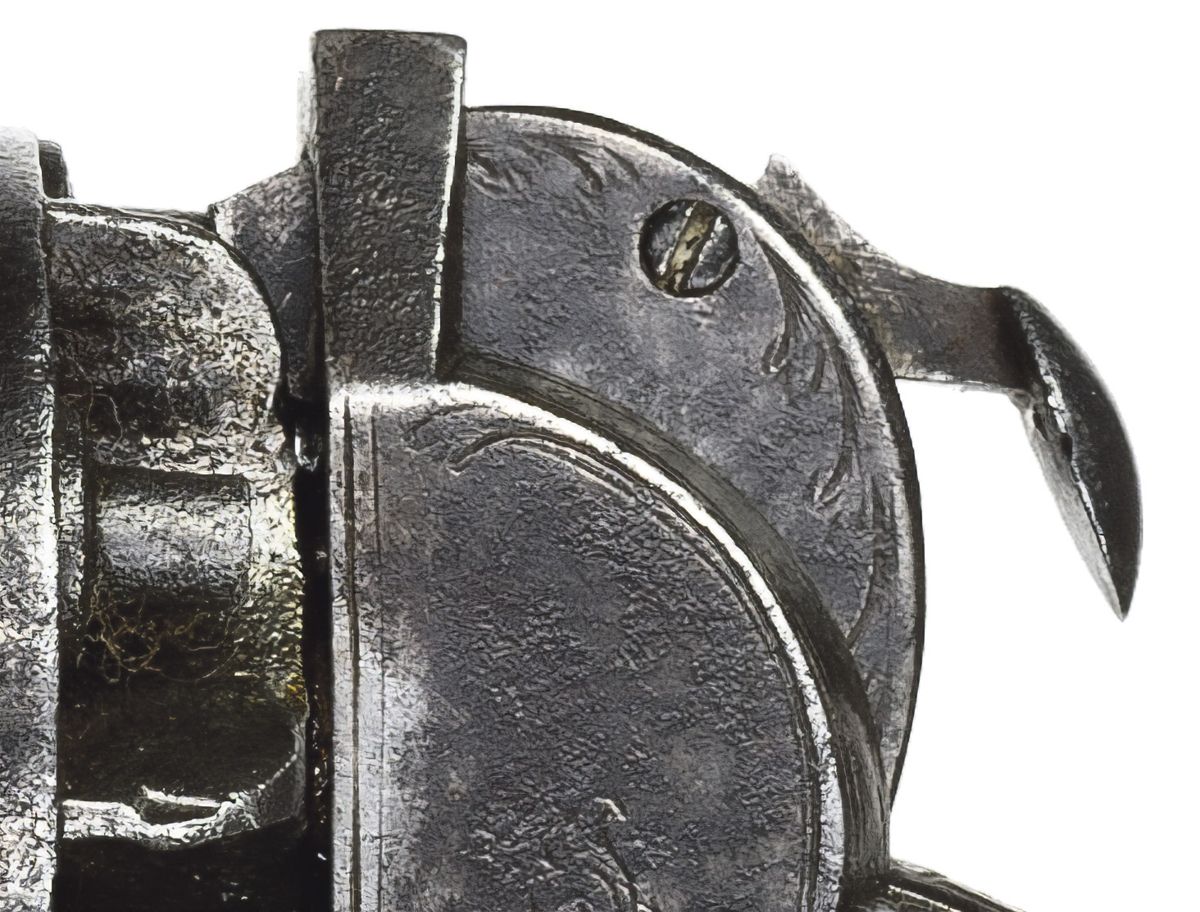
Rather than incorporating a half-cock mechanism to free the cylinder to rotate for loading, Bentley devised a simple hammer nose safety. This allowed the hammer to rest just off the cones on the cylinder’s rear, with the safety pressing against the frame. Pulling the trigger to fire the gun automatically disengaged the safety device.
Bentley certainly produced his own pattern of revolvers that did incorporate the wedge connection system between the frame and barrel, but the guns were otherwise based entirely on his own patents or designs in the public domain. Webley likely never produced a Bentley patent revolver, but probably sold some made by other Birmingham gun makers with his own retailer mark on them, thus adding to the confusion. However, the huge number of “Webley-Bentley” revolvers produced in Birmingham during the mid-19th century had little to do with either gunmaker.
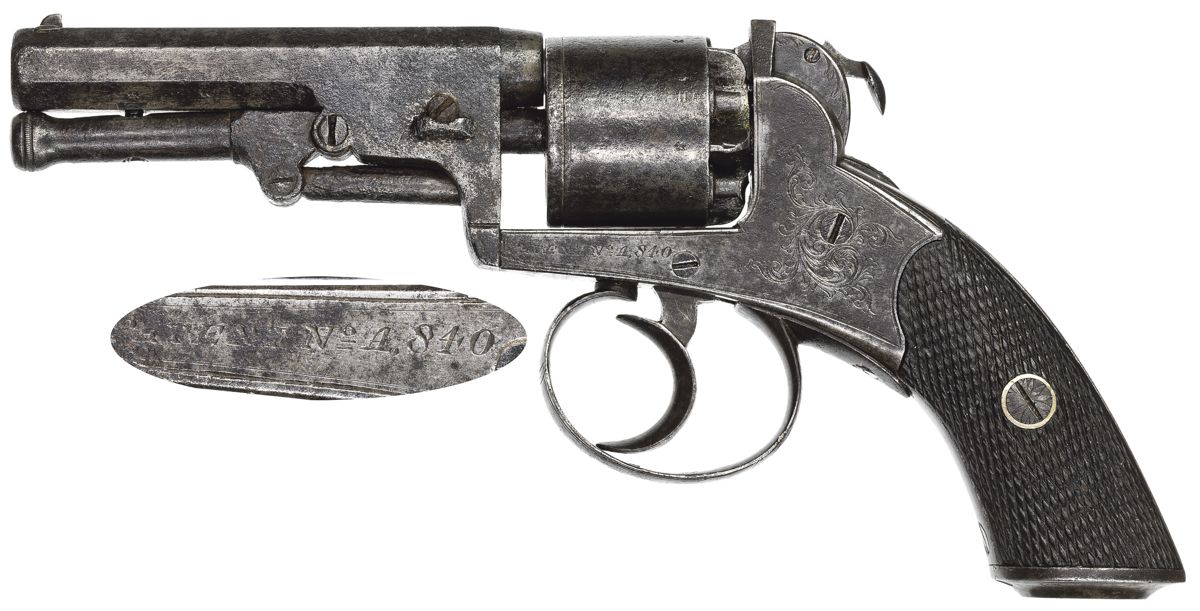
Overall reverse view of the Kernaghan marked Bentley. Inset showing the frame marking PATENT No A 840.
While the “Webley-Bentley” guns had the general appearance of the Bentley design, they were cheaply made and quite different. They rarely incorporated Bentley’s patent hammer safety, instead relying upon the simpler, frame mounted spring safety found on the Model 1851 Adams revolvers and other Continental designs like the French Perrin. These cheaper guns were almost always produced with a removable side plate for access to the action based on the Bentley double action lockwork. Bentley manufactured revolvers, on the other hand, were made with a solid cast iron frame without side plates, always used his patented hammer safety, and were nearly always produced with his own patented loading lever system, covered under 1854 Patent No. 768. The lever was based upon the Colt system but used a different retention latch. Interestingly, it appears that Bentley did not produce a large number of these guns, with British authors Taylerson, Andrews & Firth noting in The Revolver 1818–1865 the extant examples of Bentley revolvers are found in the 1 to 850 serial number range, with an “A” pre-fix appearing around #200. They suggest that his production of this model may have only been around 850 pieces, making a real Joseph Bentley made Bentley revolver rather scarce. They further note that most guns are marked by Bentley; although a handful do exist with the names other Birmingham gunmakers and retailers, these are far from common. Bentley would receive additional patents during his lifetime, including No. 780/1856 for a percussion breechloading rifle and No. 2657/1857 for additional improvements to his loading lever. Joseph Bentley would go on to partner with Charles Playfair, forming the firm of Bentley & Playfair and would leave the trade in 1864. The pictures accompanying this article show a real, Joseph Bentley manufactured Bentley percussion revolver, not a cheaper Birmingham knockoff.
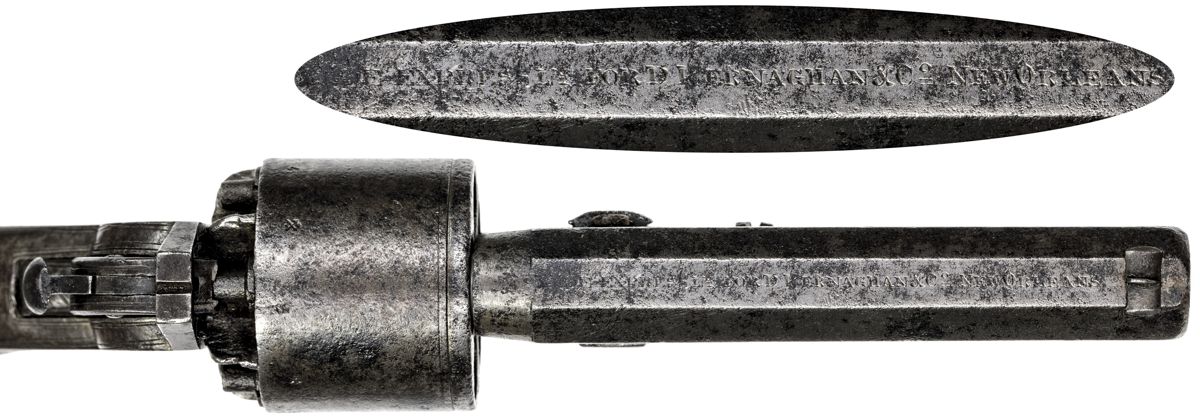
The gun has all the features that you would look for to identify a true “Bentley – Bentley.” It has a solid, cast-iron frame without a sideplate; it has Bentley’s patented hammer nose safety and loading lever, and has the Bentley production range serial number of A 840. However, the most intriguing feature of the gun is that barrel is engraved with the very scarce and desirable pre-Civil War retailer mark of Daniel Kernaghan of New Orleans. The barrel marking reads in a single line,
MADE EXPRESSLY FOR D. KERNAGHAN & Co NEW ORLEANS. Daniel Kernaghan and his brothers Alexander, Henry, and William were all born in Ireland between about 1818 and 1828, with William’s year of birth given as 1818, Alexander’s as 1828, and Daniel and Henry’s appearing during the 1820s. The family apparently emigrated to America between about 1848 and 1850 with Alexander arriving in New York in November 1848 and William arriving in May 1850. All the brothers eventually settled in New Orleans.
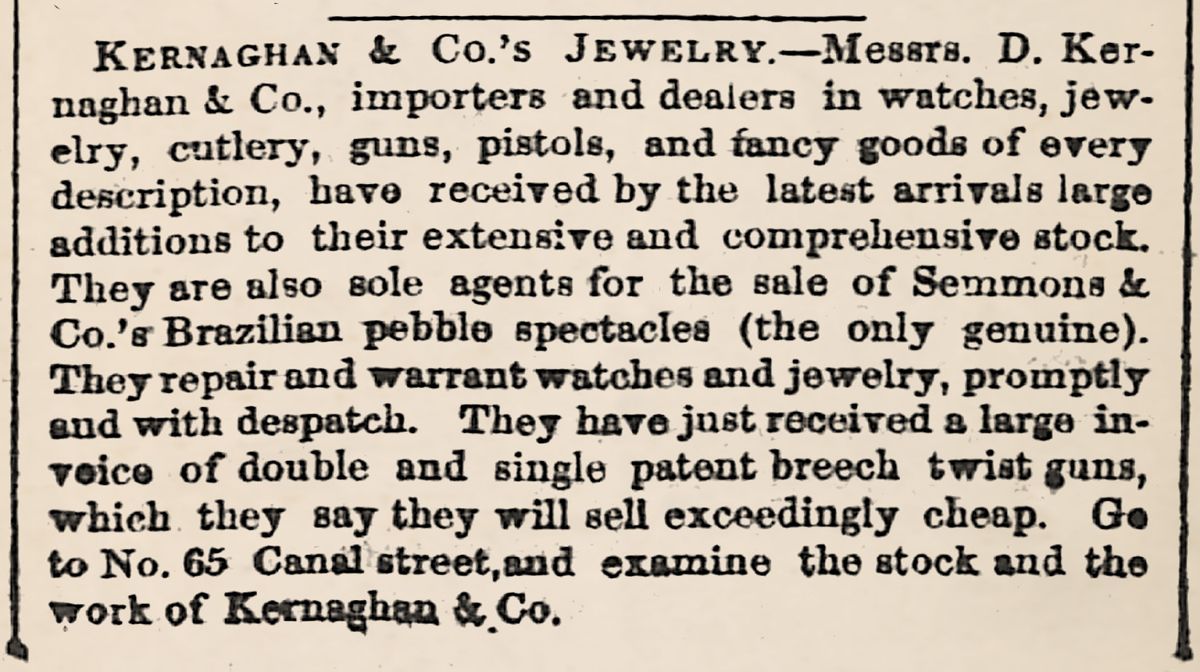
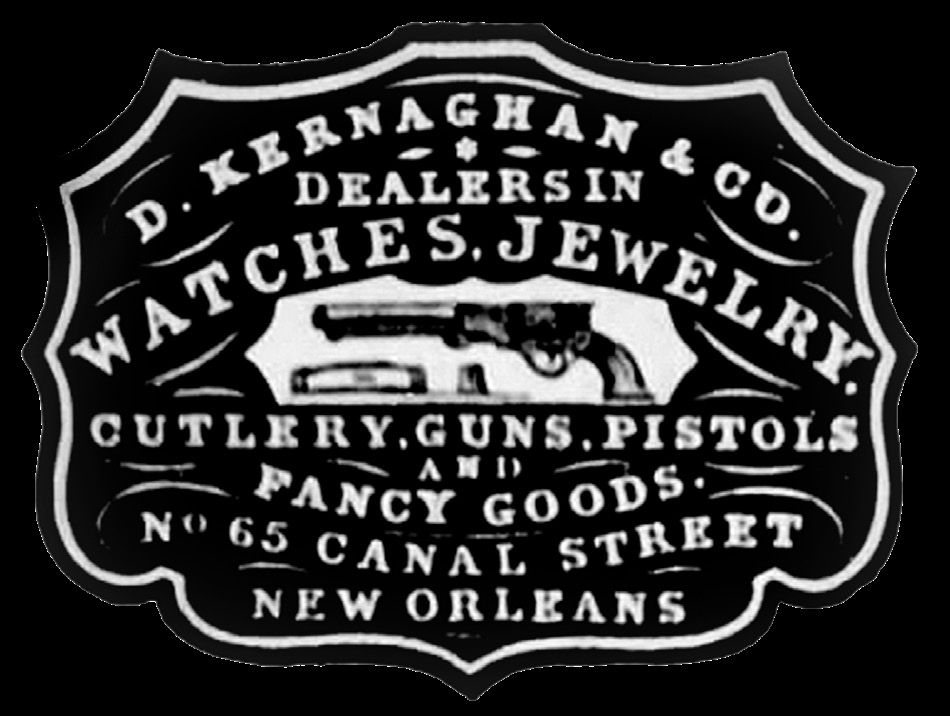
Advertisement for D. Kernaghan & Co. in the Times-Picayune, New Orleans, Louisiana, newspaper, Sunday, November 29, 1857, page 5.
Alexander initially found work in the stores of various New Orleans “Fancy Goods” merchants during his first years in the city; by 1854 he was listed in city directories as being a Fancy Good dealer himself, located at 91 Canal Street. During the period a “Fancy Goods” shop offered all sorts
Barrel marking of the Kernaghan marked Bentley revolver, inset showing the detail of the engraved retailer mark on the barrel.
of items, a class and grade above the typical “general store.” Typically, such merchants sold jewelry, watches, cloth and trimmings, notions, perfumes, firearms, and a wide variety of items that were often imported from England and France. Some also offered eyeglasses and even optician services. William went into the fancy goods business around 1853 and remained in that line until the fall of New Orleans. His shop was listed at 65 Canal Street between Camp and Magazine streets. More than likely he followed his brother Alexander’s path of learning the business by working for other retailers and establishing relationships with importers, suppliers, and learning the local market. It is not clear when Daniel Kernaghan emigrated to America, but he is first listed in the New Orleans directories in 1857, located at 65 Canal Street, the same address as his brother William’s business. A November 1857 advertisement in the Times-Picayune for the firm reads:
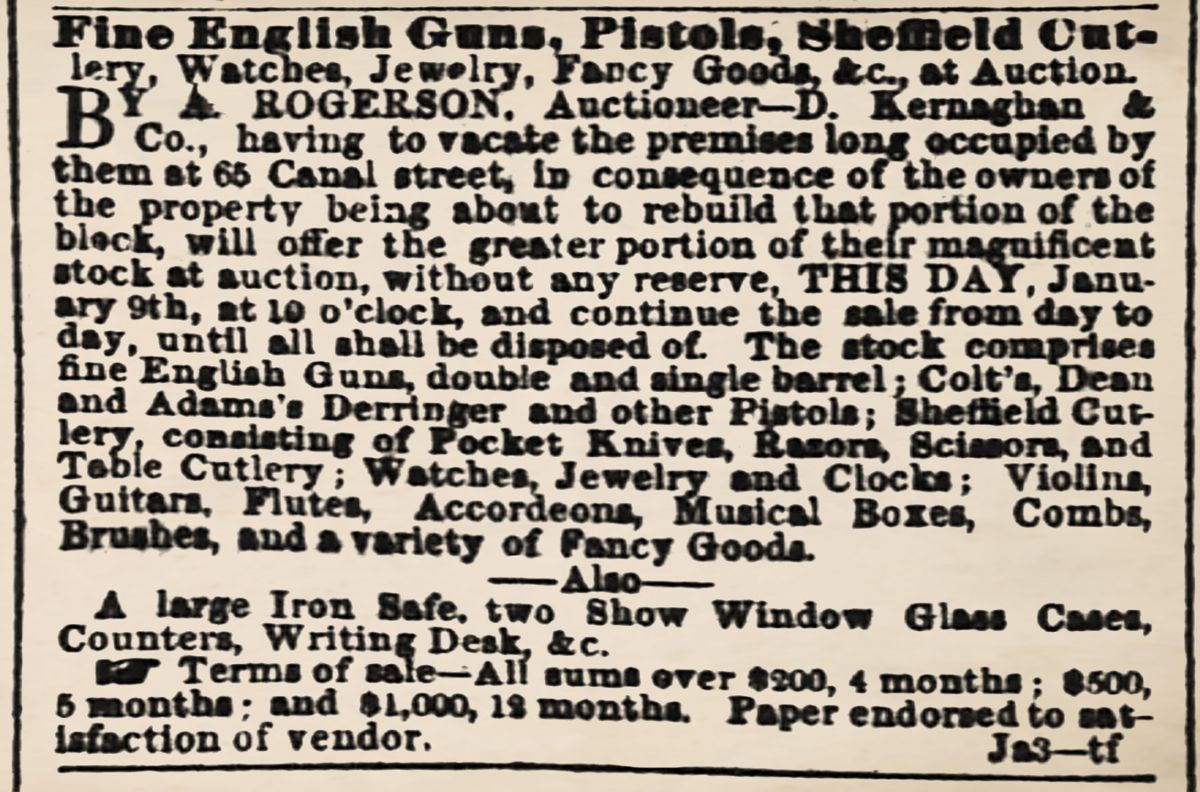
Kernaghan & Co.’s JEWELRY. – Messrs. D. Kernaghan & Co., importers and dealers in watches, jewelry, cutlery, guns, pistols and fancy goods of every description have received by the latest arrivals large additions to their extensive and comprehensive stock. They are also the sole agents for the sale of Semmons & Co.’s Brazilian pebble spectacles. They repair and warrant watches and jewelry, promptly and with despatch [sic]. They have just received a large invoice of double and single patent breech twist guns, which they say they will sell exceedingly cheap, Go to No. 65 Canal Street and examine the work of Kernaghan & Co. On January 2, 1858, another advertisement in the Times-Picayune announced that an auction would be held at the 65 Canal Street premises on January 4th for the sale of inventory, as the building was going to be torn down and the firm was moving. The notice read that the sale would commence “On Monday,
4th January, 1858, at 10 o’clock, and each succeeding day until the entire stock is disposed of, at their store.” The inventory listed was quite varied and included: “FINE ENGLISH GUNS; Colt’s Dean & Adams’s Deringer’s and other PISTOLS; FINE SHEFFIELD CUTLERY – Consisting of Pocket Knives, Razors, Scissors, and Table Cutlery; VIOLINS, FLUTES, GUITARS, ACCORDEONS [sic], MUSICAL BOXES; COMBS BRUSHES, CLOCKS, and a variety of FANCY GOODS; WATCHES JEWELRY, &c. &c. ALSO, The Show Windows, Glass Cases, Counters, Shelving and a large iron safe.”
Advertisement for auctioning inventory of D. Kernaghan & Co. in the Times-Picayune, New Orleans, Louisiana,·Saturday, January 9, 1858, page 3.
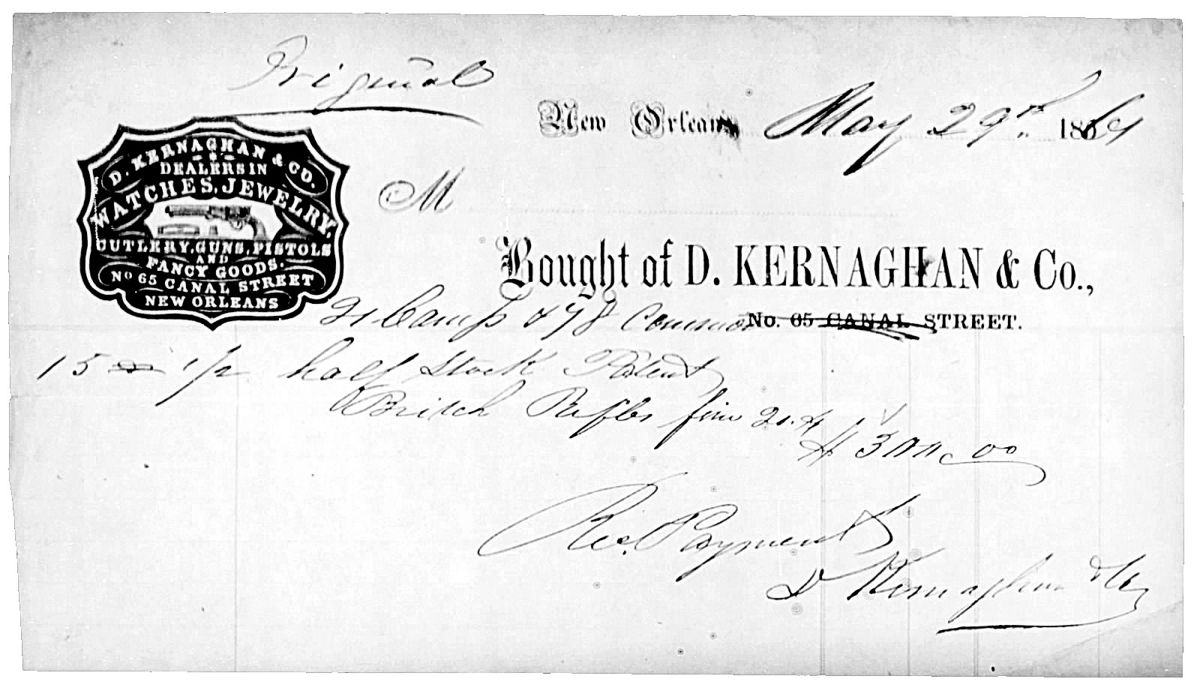
By the spring of 1858 the brothers were back in business at their new location, 21 Camp and 78 Common Street and were continuing to advertise their wide variety of imported and American produced goods with firearms comprising a large portion of their inventory. The firm continued to advertise through the period of secession and into the early period of the Confederacy, with more and more emphasis placed upon their optical business, with only that portion of their business being promoted more than their retail sales of firearms and jewelry. A search of the National Archives Record Group known as The Confederate Citizen Files reveals two invoices from D. Kernaghan & Co. to the Confederacy, both for the sale of firearms. These invoices were made out to Lieutenant Thomas B. Mills of the Confederate Navy. The first is dated May 27, 1861, is for the following items shown in invoice number 1:
Advertisement for Kernaghan & Company. (Times-Picayune, New Orleans, Louisiana, Sunday November 29, 1857, page 5.)
The second invoice, shown in invoice number 2, was dated two days later, on May 29th and is for:
Invoice number 1. (NARA, Business, Kernaghan and Co D, page 4.)
Invoice Number 1 full stock Rifles e/a 10 Davis Iron[?] stock do ½ stock Maple
$130 $160 $160
Invoice number 2. (NARA, Business, Kernaghan and Co D, page 6.)
Invoice Number 2 ½ half stock Patent British Rifles fine 20/ea
$300
Wilmington Station during 1863–1864, and would eventually command the famous casemate ironclad CSS Savannah and later the sidewheel gunboat CSS Sampson during 1864. Over the years a small number of Kernaghan marked imported shotguns and sporting rifles from various sources have been identified and survive in private collections today, but they are far from common. The above purchases suggest that some of these sporting rifles could have a Confederate naval association. Kernaghan also imported English revolvers as well as selling domestically produced revolvers. Today only a handful of Kernaghan marked revolvers are known.
The second invoice obviously indicates the sale of higher-end British percussion sporting rifles with patent (probably hooked) breeches; the price is indicative of the quality. The first invoice is most likely for domestically produced mid-grade sporting rifles. Dozens of men with the surname “Davis” were producing rifles in America during this period and these guns could have originated almost anywhere from upstate New York to Ohio, and nearly anywhere in between. Lieutenant Mills was a native Louisianian who had previously served in the United States Navy, achieving the rank of Master. He resigned from the service was commissioned into the Confederate States Navy on March 28, 1861. His promotions were Acting Lieutenant on September 19, 1861, 2nd Lieutenant on February 8, 1862, and 1st Lieutenant on October 2, 1862. His first duty station in 1861 was New Orleans and he was subsequently sent to special service at the Richmond Naval Station later that year. Over the next three years Mills would serve on the CSS Dalman and CSS Florida, both on the Mobile Station during 1862, the CSS North Carolina on the
Probably the most famous Kernaghan marked handgun known today is a double action Bentley revolver, serial number A 843, in the collection of the American Civil War Museum (formerly the Museum of the Confederacy). It is engraved on the top flat of the barrel the same as the one pictured in this article. The gun is identified to Robert Tilman Aunspaugh who served in the Bedford Virginia Light Artillery and the 10th Battalion Virginia Heavy Artillery, Company B. Aunspaugh was a 22-year-old merchant when he was commissioned as a 3rd Lieutenant in the Virginia Bedford Light Artillery on May 8, 1861. On October 4, 1862, he was discharged for promotion during the unit’s reorganization; on November 1, 1862, he was commissioned into Company B, 10th Battalion of Heavy Artillery as a 2nd Lieutenant. On December 23, 1863, he was promoted to 1st Lieutenant, and on April 15, 1864, was made the Acting Assistant Quartermaster. After the war Aunspaugh was a partner in the firm of Aunspaugh, Cobb & Co., and died in 1905, at the age of 68. To date only three other examples of authentic Kernaghan retailer marked revolvers are known to me, including the one in this article. All are the same type and pattern as this gun.
Closeup of the hammer.
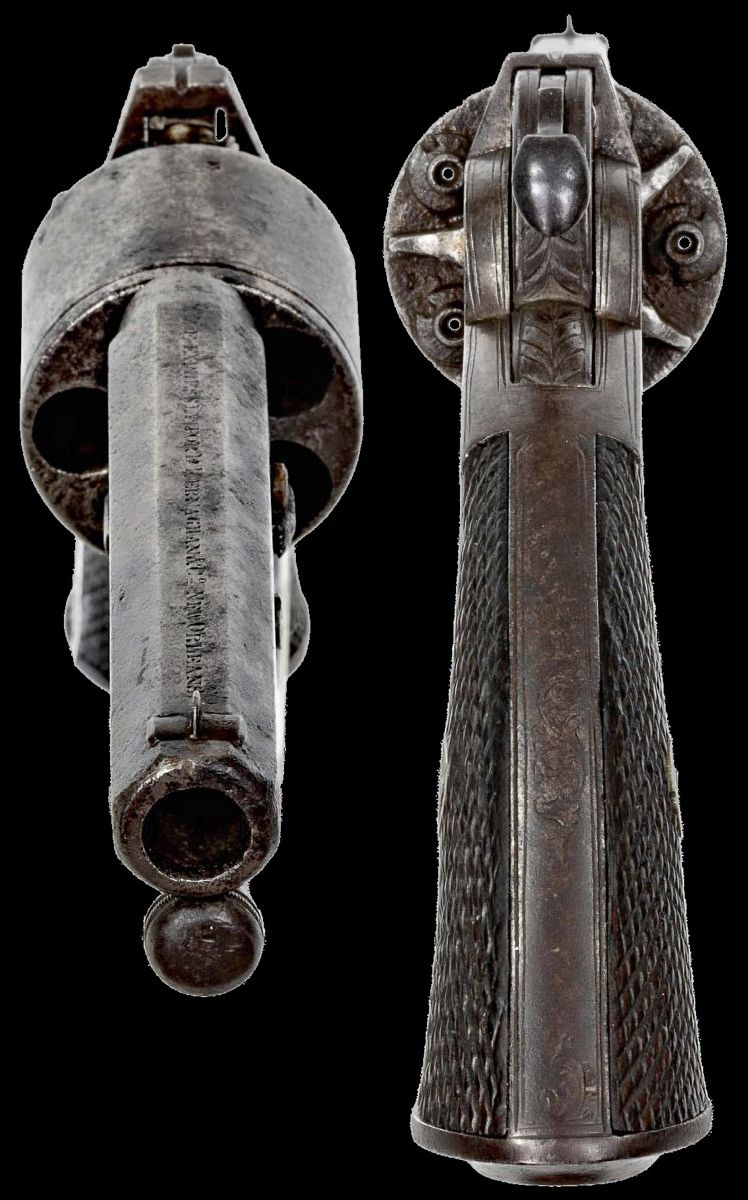
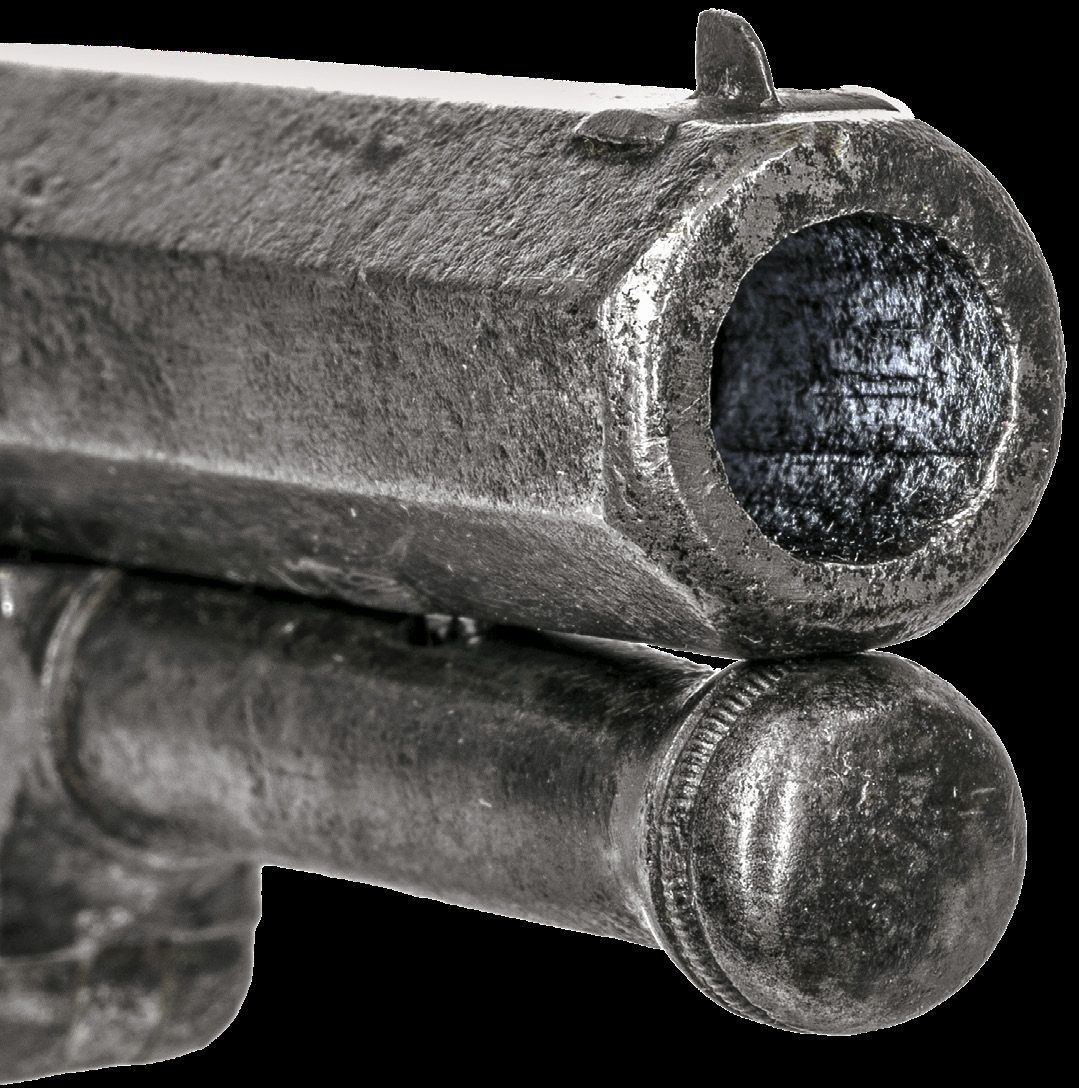
Close up of the muzzle of the Kernaghan marked Bentley, showing the multi-groove rifling.
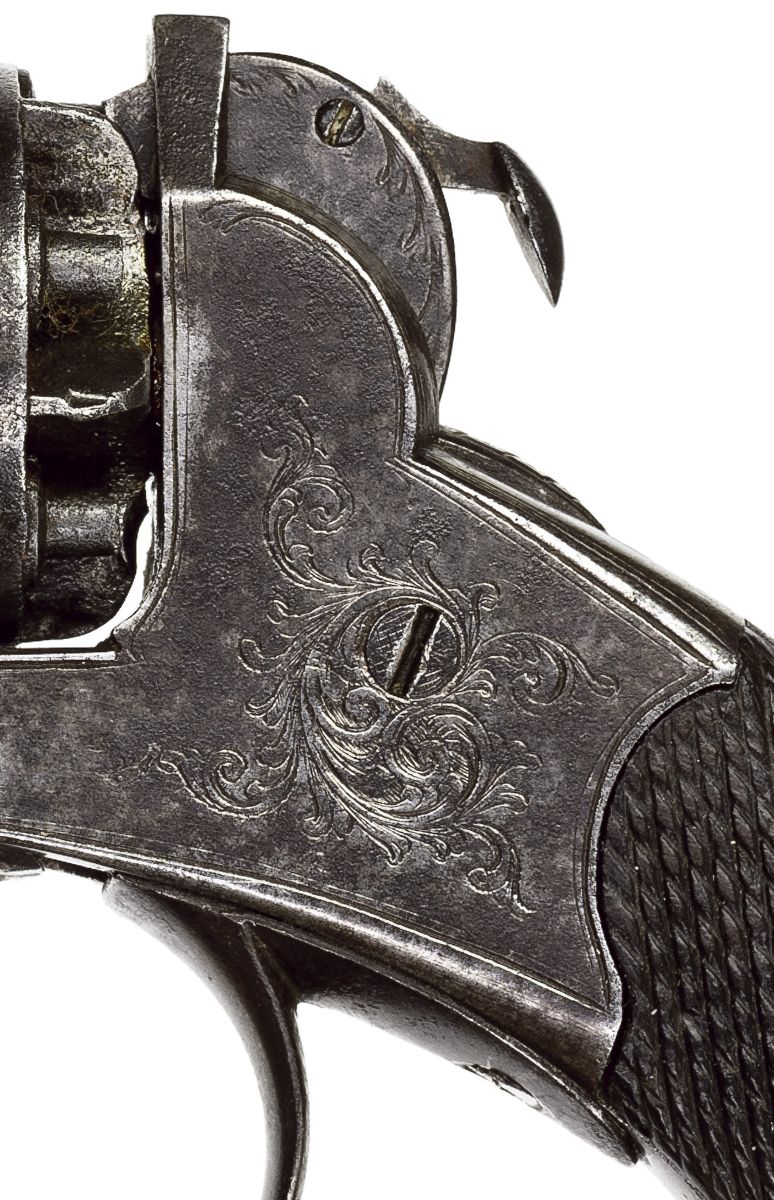
Floral engraving on the left side of the frame.
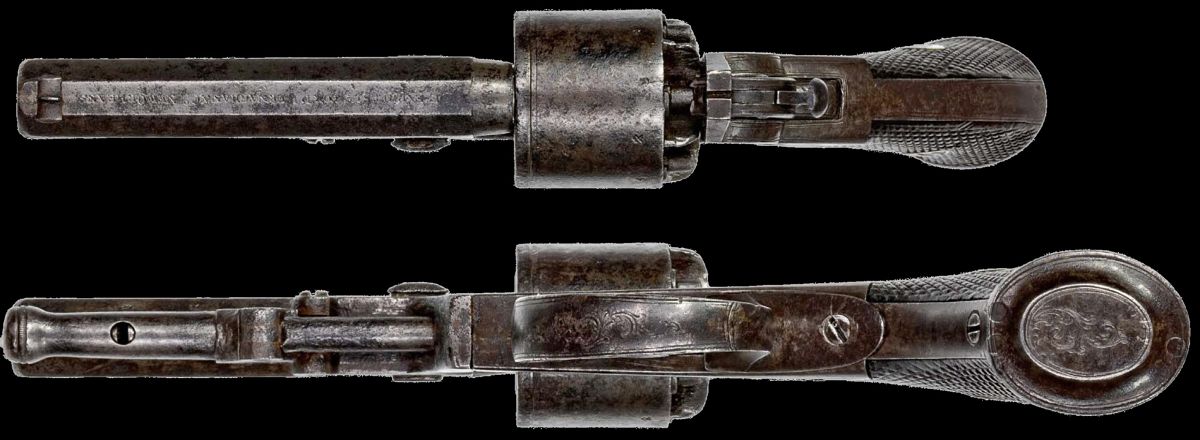
The D. Kernaghan New Orleans retailer marked percussion revolver pictured here is a mid-sized handgun that is 80-Bore, nominally about .38 caliber. The gun measures roughly 7.75-inches in overall length with a 3.5-inch, octagonal barrel rifled with fourteen narrow grooves that have a moderately fast rate of twist. The revolver has a “self-cocking,” double action only lockwork, a five-shot cylinder and a two-piece design with a wedge securing the barrel assembly to an arbor pin screwed into the iron frame. Bentley’s patented, Colt inspired loading lever is present under the barrel, as is his patented safety on the hammer. The frame is delicately engraved with simple floral motifs that are more open and flowing than the tight “bank note” style engraving that would become popular on high end English sporting arms during the next few decades of the 19th century. The frame is engraved behind the cylinder on both sides and below the cylinder on the right side. It is also engraved with the same flowing foliate motifs on the butt cap and triggerguard. The hammer edges are lightly engraved as well. The revolver was originally blued, with a color casehardened cylinder and butt cap, but retains no finish. The revolver is fitted with two-piece checkered walnut grips with round German silver escutcheons. A simple notch in the rear of the frame serves as a rear sight and a blade front sight is dovetailed into the top of the barrel, near the muzzle. Other than the retailer marking and serial number, the only other markings are the usual Birmingham commercial proof marks. These are found on the lower left angled flat of the barrel and between the cylinder chambers, along with chamber numbers on the cylinder.
About the Author
Tim Prince is a full-time dealer in fine and collectible military arms from the Colonial Period through WWII. He operates College Hill Arsenal, a webbased antique arms retail site. A long-time collector and researcher, he has been a contributing author to two major book projects about Civil War era arms including The English Connection and a book on southern retailer-marked and Confederateused shotguns. He is the author of over 75 articles on weapons in Civil War News and Military Antique Collector. Tim is also a featured Arms & Militaria appraiser on the PBS Series Antiques Roadshow and serves as a Senior Consulting Specialist to the Arms & Armor department of Cowan’s, a Freeman’s | Hindman Company.
Five Colt Family Members Named Samuel Colt Murder ~ Suicide~ Bribery ~ Lawsuits ~ Bastard Child ~ Fatal Accident ~ Bigamy also Samuel Theodore Colt 1864–1931 and his cased Colt New Service Target Revolver #7511
Whilst exhibiting at Wally Beinfeld’s show at the Riviera Hotel in Las Vegas, in January 2003, I spotted a cased Colt New Service Double Action Target revolver. The serial number was 7511, and it was chambered in .44 Russian calibre. It was on the table of the renowned dealer and auction boss, Pete Harvey, from Farmington, N.H. The gun looked great and was in near mint condition. What intrigued me most of all, was the Colt historical letter, that accompanied the revolver. It stated the following:
COLT NEW SERVICE TARGET REVOLVER Serial Number:
7511
Barrel Length:
7 ½”
Caliber:
.44 Russian
Finish:
Blue
Shipped To:
S.T. Colt (Armory)
Type of Stocks: Date of Shipment:
From various areas of research, I learned that S.T. Colt’s full name was Samuel Theodore Colt. He was a member of the Colt family. Samuel Theodore was born on September 27, 1864, and started work at the Colt Armory in Hartford, Connecticut, on March 1, 1882, as a machinist. The shipping date of serial number 7511 was September 24, 1902, which was only three days before his 38th birthday. In 1902, he also celebrated his twentieth anniversary of working at the Colt Armory. The gun may have been for a joint celebration. It may have been a gift from his employers for 20 years of service at the Colt factory, or maybe he bought it for himself. I also discovered that he died on the December 18, 1931, in a tragic road accident. Samuel Theodore Colt is buried at the Colt family plot in Cedar Hill Cemetery in Hartford, Connecticut, less than 20 yards from Samuel and Elizabeth Colt’s Memorial. This information answered my initial questions. Over the next 20 years or so I visited Hartford numerous times. I had the honor and privilege on many occasions of residing at Samuel Colt’s family home of Armsmear, in Wethersfield Avenue, Hartford. Sam built Armsmear as his home, in an Italianate villa style with Moorish elements from 1856 to 1857. It is now a retirement home for women
Not Listed
September 24, 1902
Number of Same Type Guns in Shipment: 1
After the usual bit of haggling, I bought the set. It was cased in a period English oak case lined in blue, with an attached leather carry handle, explicitly made for a Colt New Service Target revolver. The historical letter gave me a lot of information but immediately raised many more questions. Who was S.T. Colt? Was he a member of the famous Colt family? Why was this gun shipped to him at the Colt Armory in Hartford, on September 24, 1902? What happened to S.T. Colt? Where was he buried? These questions bothered me for many months. During this period, I contacted Kathy Hoyt at Colt, Larry Wilson, the noted Colt historian and expert on Colt firearms, and Dean Nelson, curator at the Connecticut State Library in Hartford, plus many more students of Colt folklore. I also sought the help of Kenneth A. Buckbee, a genealogist from Torrington, Connecticut.
Colt letter signed by Kathleen J. Hoyt, Historian.