
Confederate Purchased Bar on Band Enfield Rifles
By Tim Prince · Originally published May-June 2025 · pp. 36–42
Confederate Purchased
Bar on Band Enfield Rifles By Tim Prince
On January 25, 1856, one of the first and most important long arms to be derived from the Pattern 1853 Enfield Rifle Musket was officially approved for use in the British Army. The Pattern 1856 “Short Rifle” was an iron mounted long gun based upon the Pattern 1853 Rifle Musket with the same .577 caliber bore, the same 3-groove rifling with a 1:78-inch rate of twist, but with a shorter 33-inch barrel and an appropriately shorter stock. The most important new features that were debuted on the Pattern 1856 were an improved, “double freed” lock designed to minimize friction within the internal parts, a 1,100-yard rear sight, and a bayonet stud brazed to the barrel that accepted the new Pattern 1856 saber bayonet. The “Short Rifle” was intended for issue to the 60th Regiment of Foot, the Rifle Brigade, the Cape Mounted Rifles, and the Royal Canadian Rifles, as well as sergeants in all line infantry regiments. The shorter barrel and slightly lighter weight were both considered substantial improvements in the handling of the rifle versus the rifle musket for skirmishing and similar activities. By late November 1856, the first contracts for the new Pattern 1856 short rifle were being let to the Birmingham contractors, with more contracts to follow with both Birmingham and London makers. Almost immediately, concerns began to develop regarding the stability of the bayonet stud on the barrel and the possibility that the stud could be damaged or broken when the bayonet was used, or more seriously, the barrel itself could be damaged. There was also concern about damage that could be done to the barrel when the lug was brazed on, due to excessive heat. The remedy that was almost immediately suggested was that the bayonet lug be mounted on the upper barrel
Title page: Private Gustan Hartwell Kearney, Co. A, University Grays, 11th Mississippi Infantry with a Pattern 1858 bar on band Short rifle with fixed sword bayonet. He also appears to have an English revolver in a holster.
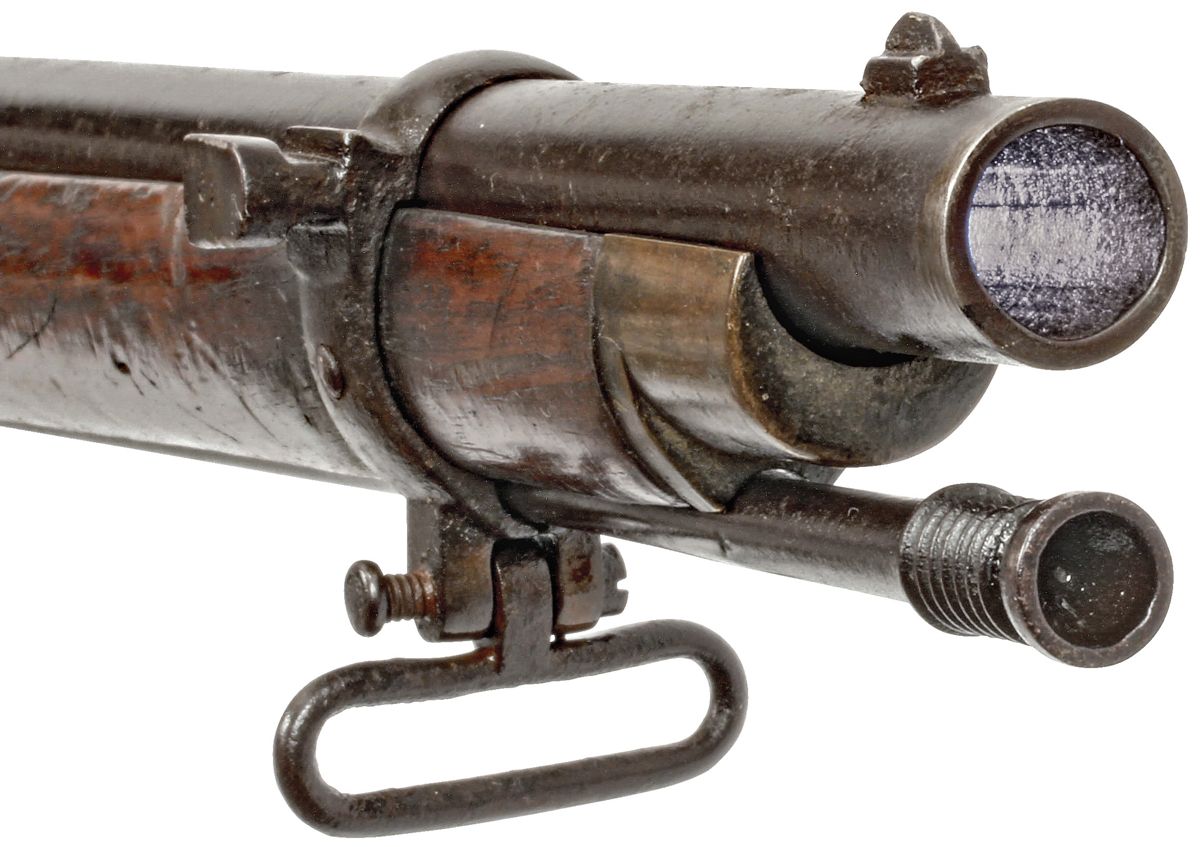
band, rather than the barrel itself. In order to make this a workable solution, the redesigned rifle was stocked to within 1 ¼-inch of the muzzle with the front band placed where the old bayonet stud had been located. Additionally, a metal pin was added, passing through both sides of the barrel band and the stock beneath the barrel to support the band and prevent it from deforming or rotating when the bayonet was mounted upon it.
Overall view of brass mounted Confederate purchased Pattern 1856 No. 2 “Bar on Band” rifle #3513 produced by Woodward & Sons. (All photos by Tim Prince)
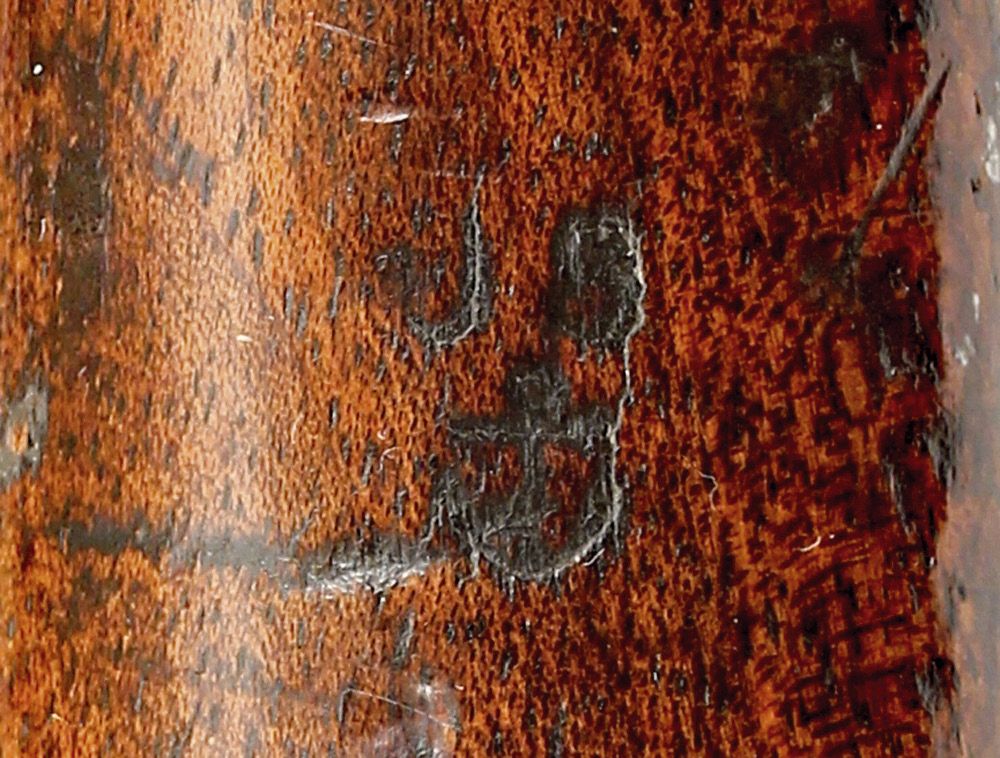
The J S / {ANCHOR} viewer’s mark in the belly of the stock of #3513.
This new design was officially approved on July 6, 1858, and became known as the Pattern 1856 Rifle No. 2, also designated the Pattern 1856/58 Rifle and sometimes as the Pattern 1858 Rifle as well. This last designation only created confusion, as the Royal Navy had adopted their rifle, designated as the Pattern 1858, a brass mounted short rifle with a heavier 33-inch barrel, rifled with 5-grooves and a much faster 1:39-inch rate of twist; twice as fast as the rifle musket. As a result, the War Department very quickly resorted to calling the gun what it would be known as by future collectors and arms enthusiasts, the “Bar on Band” rifle. It is not clear how quickly the contracts for the new No. 2 rifle were let, or whether the existing contracts were modified to meet the new “bar on band” specifications. However, the speculation is that only a few thousand rifles were manufactured. With the inherent lag and sluggishness by the Birmingham arms trade in adopting new pattern changes, it is unlikely that many (if any) short rifles of the “bar on band” configuration were manufactured before the summer of 1859. It is further likely that it was sometime in 1860 before bar on band rifles were being “set up”, inspected and accepted for service. About the time the new rifle was going into production with the contractors; the War Department
The muzzle view of the Bar on Band rifle #3513 clearly shows the band-mounted bayonet “bar” (lug) that gives the rifle its nickname.
cast a spanner into the works, and changed the specifications again. On February 22, 1860, the War Department officially recommended adoption of an army version of Pattern 1858 Naval Rifle to replace the Pattern 1856 and Pattern 1856 No. 2 rifles. This was to be officially designated the Pattern 1860 Short Rifle. Since acceptance of the short rifle pattern, it had been felt that the overall accuracy was not on par with that of the rifle musket. The navy designed 5-groove barrel with a rate of twist twice as fast as that previously adopted turned the lack luster short rifle into a highly accurate tack driver. The heavier barrel with slightly larger exterior diameter resolved the issues related to barrel strength and bayonet
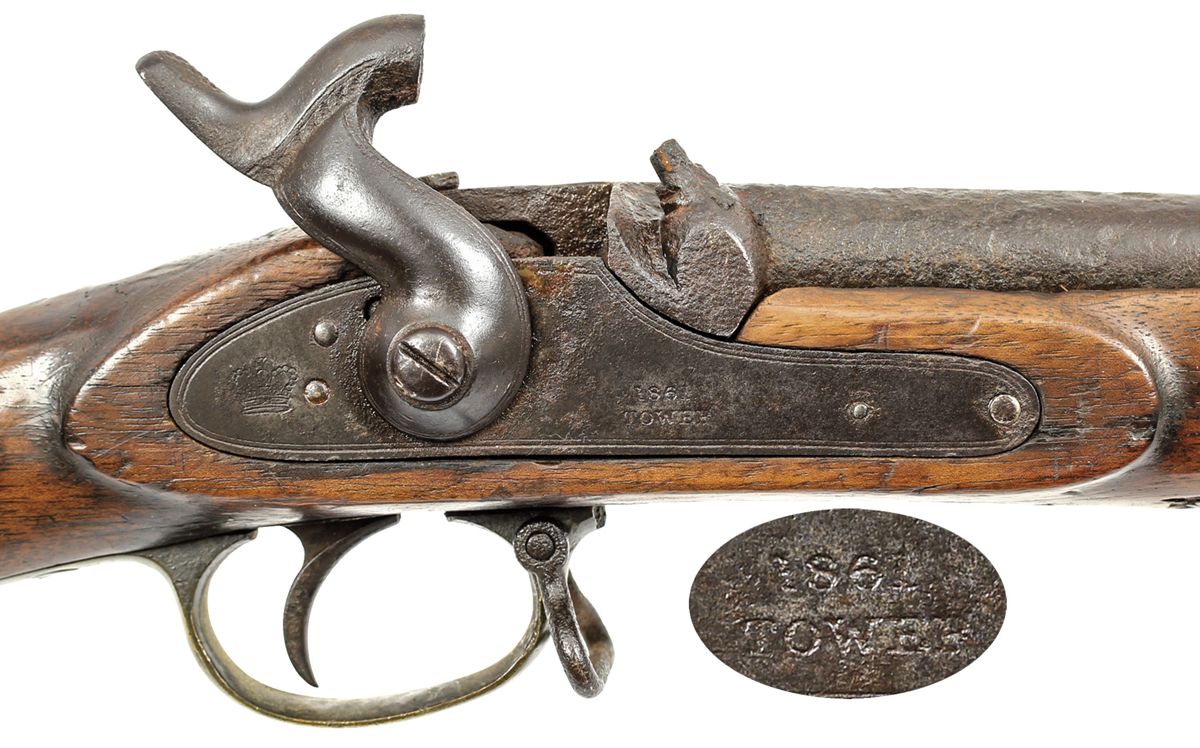
Close-up of the lock area of the well-used Bar on Band rifle #3513, which is dated “1861” over the word “Tower.”
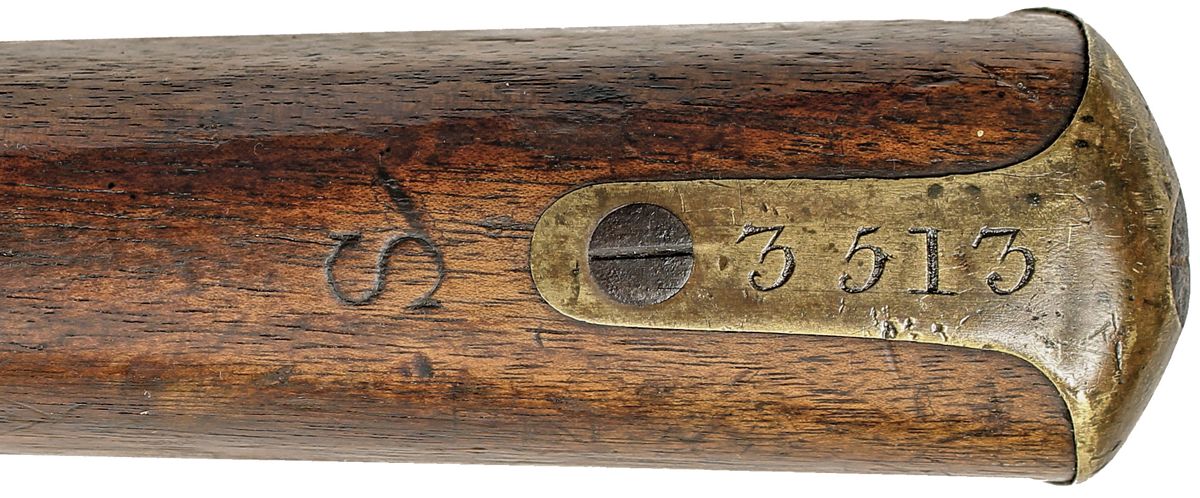
Buttplate of Confederate brass mounted Bar on Band rifle #3513, showing the engraved inventory number and the “S” furnisher’s mark indicating the rifle was delivered to Sinclair, Hamilton & Company by the firm of W&C Scott of Birmingham.
Pattern 1858 Naval Rifle
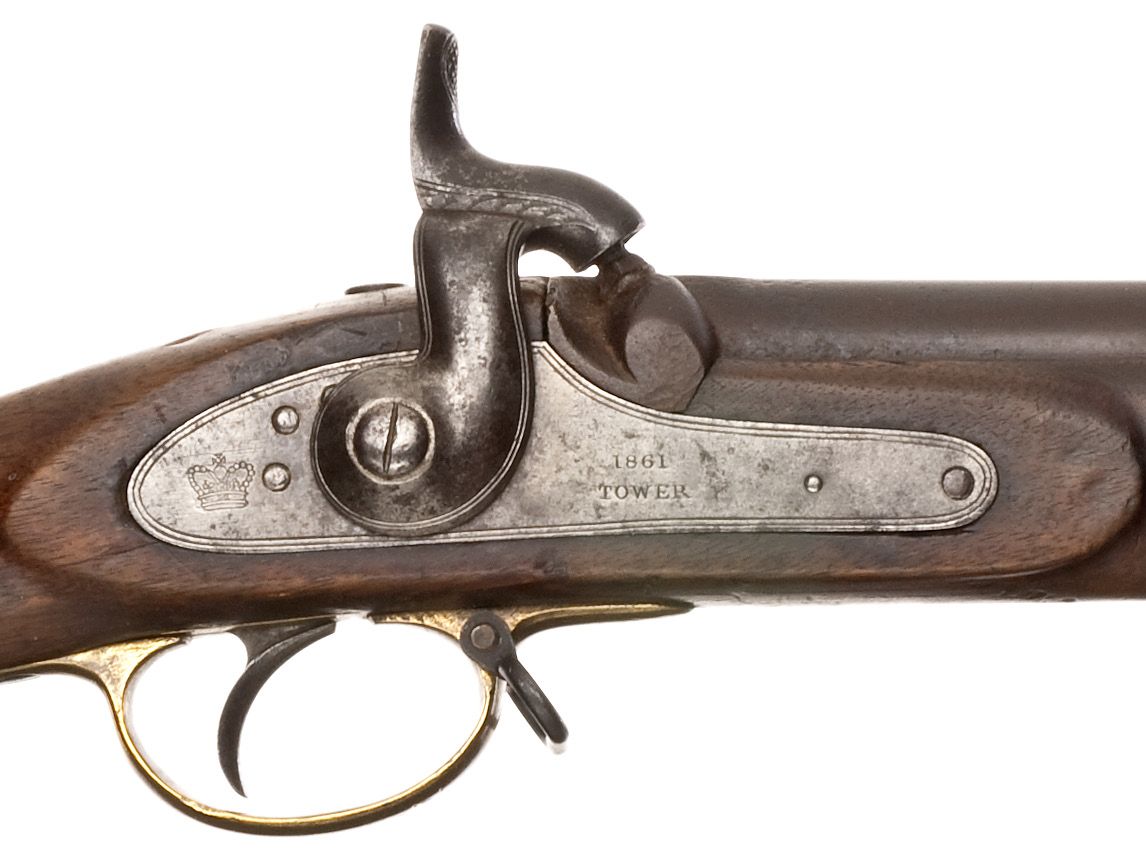
Lock area of Pattern 1858 Naval rifle with rear sling swivel mounted on trigger guard.
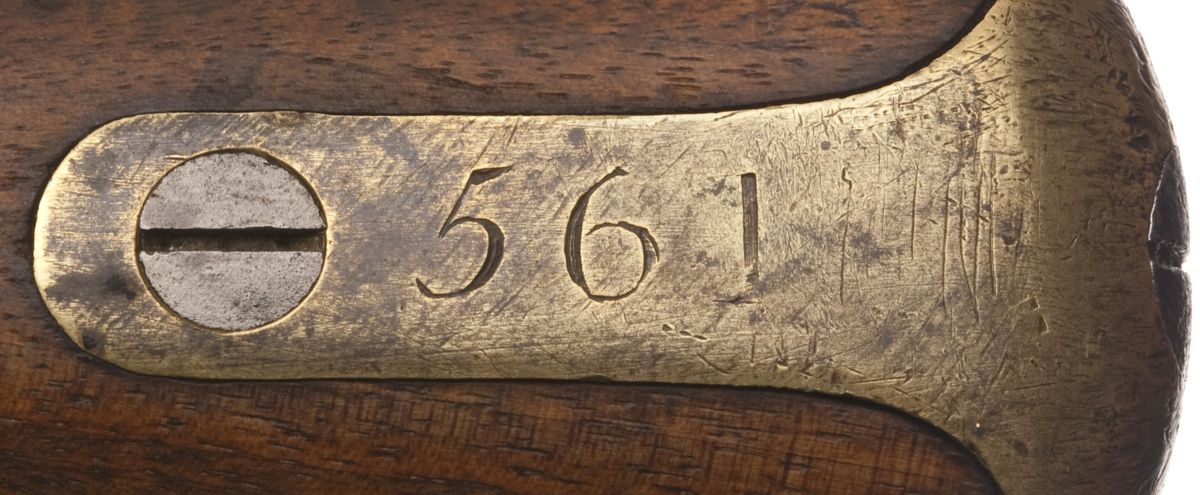
Engraved No. 561 on brass butt plate tang of this Naval rifle.
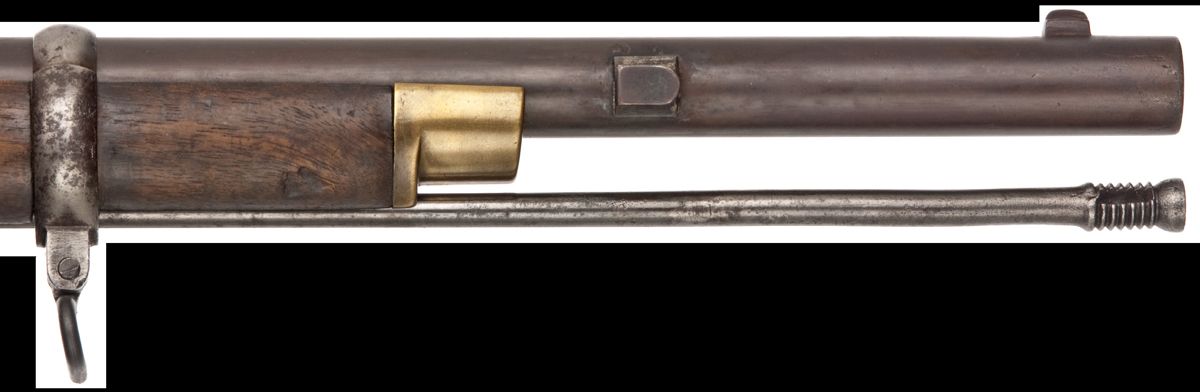
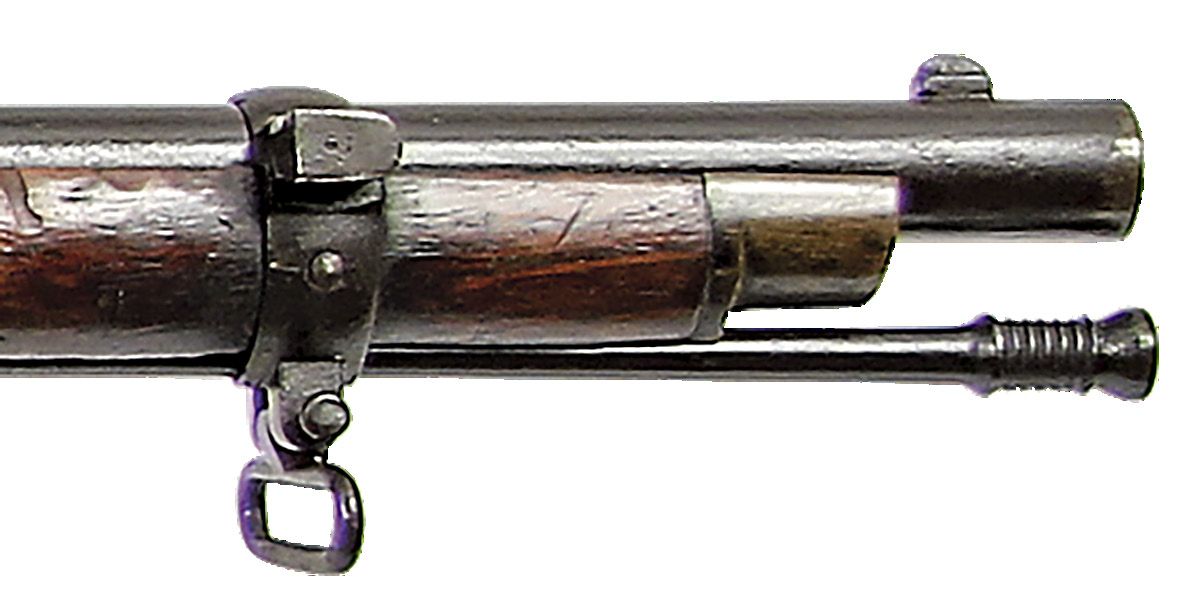
Muzzle of Naval rifle with short bayonet bar and brass nosecap.
Overall view of Pattern 1858 Naval rifle, No. 561.
lug problems and less than two years after being officially adopted, there was no longer any reason to produce the Pattern 1856 No. 2 Bar on Band Short Rifle. Again, the contractors slow walked the changeover in specifications, reverting to the older pattern stocks that were shorter and producing the new, heavier barrels, rifled in a new way. Pattern 1858 No. 2 rifles continued to be delivered in spurts though 1861 and early 1862, but after that date the Pattern 1860 Short Rifle and its immediate replacement the Pattern 1861 Short Rifle were produced for the British military. The existing stocks of leftover “bar on band” parts were to be used up on Volunteer pattern rifles for the British militia and commercially made rifles. A number of these commercial guns made from left over “bar on band” parts were purchased by the Confederacy, and during 1861–1862, a small number of the JS/{ANCHOR} inspected and inventory numbered short rifles purchased by the South were of the “bar on band” pattern, with both iron and brass mountings.
During 1861 and 1862, the Confederacy let a number of contracts for the delivery of “Enfield” pattern percussion long arms of all varieties. Many of these contracts are well documented in the papers of Confederate General Colin McRae, that now reside in the collection of the South Carolina Relic Room & Military Museum, in Columbia, S.C. While the majority of the purchases concentrated on Pattern 1853 Enfield rifle muskets for use by Confederate infantry, a number of “short rifles” and carbines (both artillery and cavalry) were obtained as well. Confederate documents reveal that one early order included 30,000 Pattern 1853 “Long Enfields” obtained from Sinclair, Hamilton & Company, as well as 10,000 “short rifles” of varying patterns. The 40,000 guns from these Confederate central government contracts are the ones found with both the JS/ {ANCHOR} viewer’s mark and Confederate inventory number markings. Some guns were also marked on top of the stock comb with a “furnisher’s” mark. This initial indicated the “Five Furnishers” who were responsible for delivering the guns to Sinclair,
The overall view of the iron-mounted Confederate inventory is numbered Bar on Band rifle #1761, which was manufactured by Isaac Hollis & Sons.
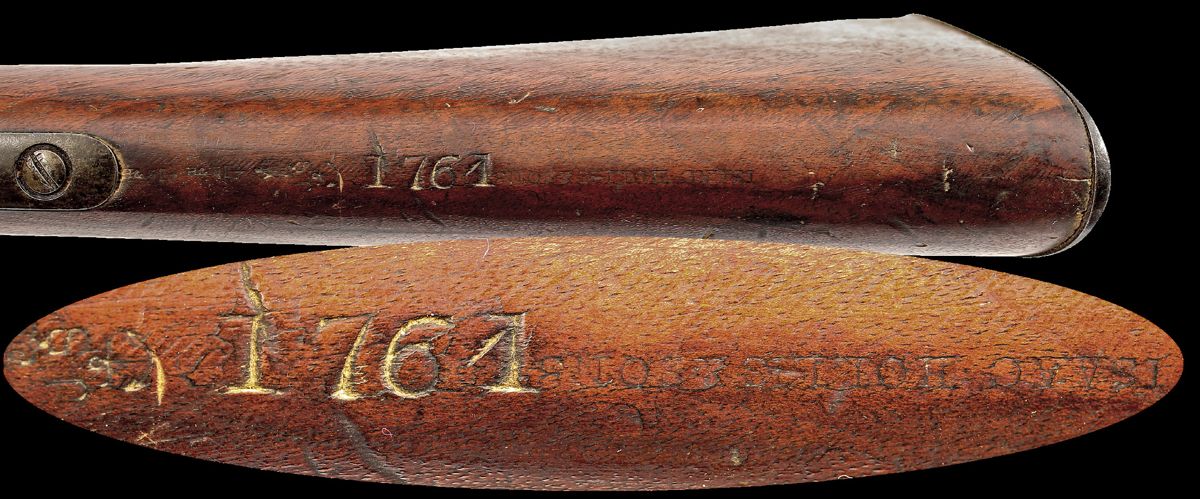
Close-up of the markings in the belly of the stock of iron mounted Bar on Band rifle #1761. Note that the J S / {ANCHOR} Confederate viewer’s mark and the fact that the inventory number is partially stamped over the contractor name of Isaac Hollis & Sons, the maker of the rifle.
Hamilton & Company. These contractors received the large order and then delivered the guns via a combination of producing the guns and subcontracting production to other makers. The Five Furnishers were the old-time Birmingham gun makers CW James and W&C Scott and the London makers EP Bond, Parker, Field & Son, and James Kerr. The initials used for their markings were J, S, B, F and K, respectively. The “Long Enfields” were serialized in three series, from 1-10,000, 1-10,000 / A, and 1-10,000 / B. The short rifles were simply serialized 1-10,000, without series or suffix letters. The short rifles were a mixture of standard Pattern 1856 and Pattern 1856 Type No. 2 (known as the Pattern 1858 “Bar on Band”) iron mounted rifles, as well as non-standard brass mounted Pattern 1856 and Pattern 1856 No. 2 rifles. A handful of the brass mounted Pattern 1858 Naval rifles, and iron mounted Pattern 1860 and Pattern 1861 rifles were also purchased. Today, a multi-decade survey of extant surviving Confederate marked and inventory numbered Enfield short rifles reveals that less than one hundred of these guns are known to have survived; about 1% of the total purchased. Of these, less than twenty are of the “Bar on Band” pattern. While some are in private collections, others reside in museums or other public collections where they can be viewed, but never owned by a collector. The most famous of these rifles is the gun carried by Sergeant Richard Kirkland of the 2nd South Carolina Volunteer Infantry. Kirkland is known to history as the “Angel of Marye’s Heights” for his heroic acts of taking water to wounded men from both sides during the Battle of Fredericksburg. Kirkland’s rifle was a brass mounted bar on band Enfield with the engraved inventory number 2370 on its buttplate. This rifle is in the collection of the South Carolina Confederate Relic Room & Military Museum (Catalog #4.109.1560.1977). Since at least one other numbered, brass mounted bar on band in a private collection has strong ties to South Carolina troops serving in Kershaw’s South Carolina brigade, all brass mounted Confederate bar on band rifles have developed this association. It is interesting to note that the brass mounted “Bar on Band” rifle was not a standard British military pattern, but rather a “volunteer” or commercial pattern rifle. However, it is encountered with Confederate markings at nearly twice the rate of the iron mounted version, which was the standard British military variant. The furniture of the “iron mounted” rifles was made of iron rather than brass and was color casehardened as well. Due to the difficulty of engraving a number in the case hardened buttplate tang, versus the much softer brass used on brass mounted guns, the iron mounted rifles that were inventory numbered were marked with their numbers stamped in the wood of the stock belly, between the triggerguard and buttplate. The various Enfield pattern “short rifles” were lighter and handier than rifle muskets and were preferred for use not only by Confederate infantry that functioned as skirmishers and sharpshooters, but by Confederate cavalry that tended to operate as mounted infantry, rather than as traditional heavy cavalry. Confederate cavalry commanders J.E.B. Stuart and Nathan Bedford Forrest were both proponents of issuing short rifles to their cavalry troopers. Short rifles with saber bayonets are known to have been issued to Confederate infantry regiments serving in Kershaw’s Brigade, the 10th, 16th, 18th, and 51st Georgia, the 13th, 17th, 18th, and 51st Mississippi, the 41st Tennessee, the 1st Battalion of Texas Sharpshooters, and the 5th Texas. Mounted Confederate units that are known to have been issued the “short Enfield rifle” were Cobb’s & Phillip’s Legions of Georgia, the 18th & 19th Mississippi cavalry (McCulloch’s Brigade of Forrest’s 2nd Cavalry), the 2nd North Carolina Cavalry, the 3rd, 6th, 9th & 27th Texas cavalry regiments (Ross’ Brigade) and the 7th Virginia Cavalry.
About the Author
Tim Prince is a full-time dealer in fine and collectible military arms from the Colonial Period through WWII. He operates College Hill Arsenal, a web-based antique arms retail site. A long-time collector and researcher, he has been a contributing author to two major book projects about Civil War era arms including The English Connection and a book on southern retailer-marked and Confederate-used shotguns. He is the author of over 75 articles on weapons in Civil War News and Military Antique Collector. Tim is also a featured Arms & Militaria appraiser on the PBS Series Antiques Roadshow and serves as a Senior Consulting Specialist to the Arms & Armor department of Cowan’s, a Hindman Company.