
Daniel Sickles, Murder, and Gettysburg
By Kurt Allemeier · Originally published July-August 2025 · pp. 3–17

Daniel Edgar Sickles might have been the worst best American of the 19th century.
He was a cad, whoremonger, accused thief, killer, fraudster, congressman, Civil War hero, and battlefield conservationist, though the war hero part is highly debatable. A politically appointed Union general in the Civil War, he often found himself at odds with his commanders and made tactical errors that cost Federal forces dearly at Gettysburg. After the Civil War, he became a true champion of preserving the Gettysburg battlefield and pushing for national park status.
of a wealthy and well-known Italian singing teacher, Antonio Bagioli, and his wife, Maria Cooke. Teresa spoke five languages by the time she was a young adult. Sickles, who had lived with Teresa’s grandfather and knew her growing up, proposed marriage, but Teresa’s parents refused to consent. Despite the opposition, the couple wed in a civil ceremony in September 1852. Then, when Teresa’s parents acquiesced, the couple was formally married by the Roman Catholic archbishop of New York.
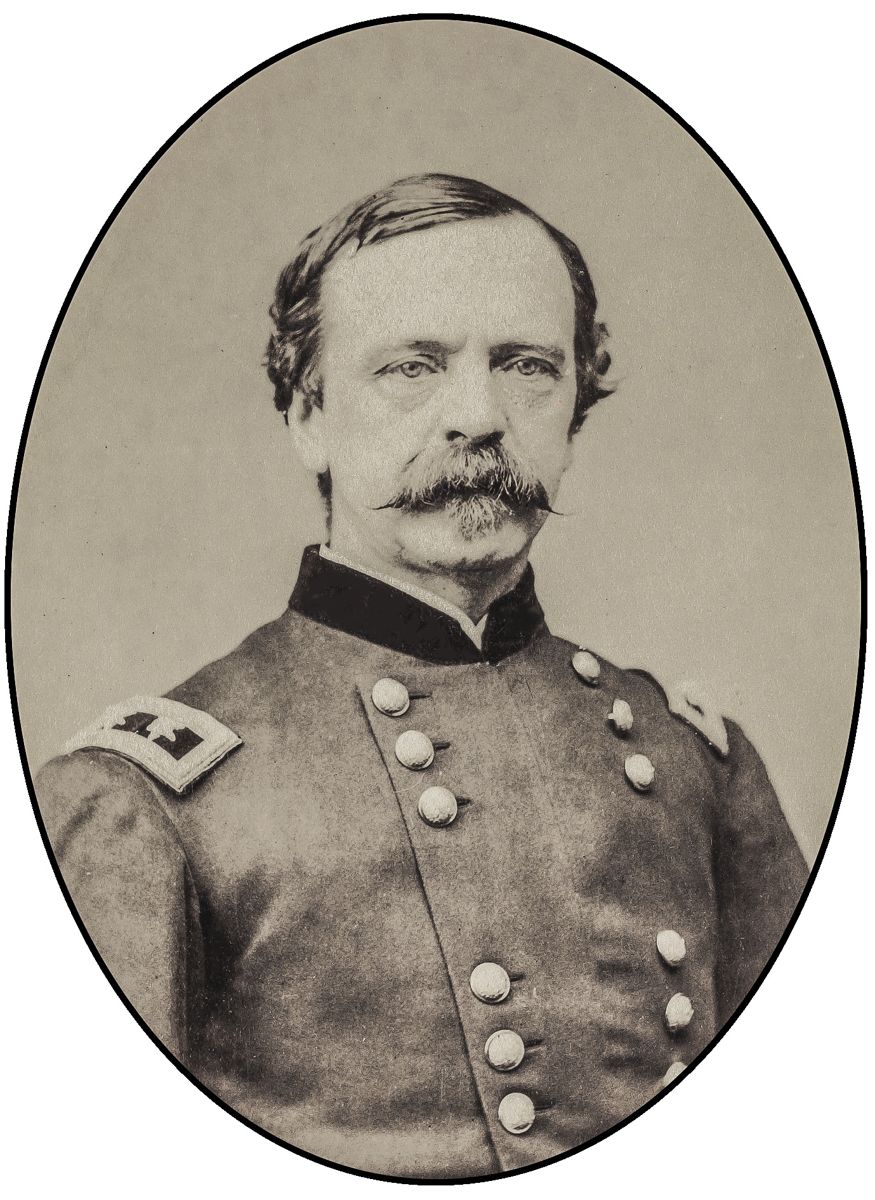
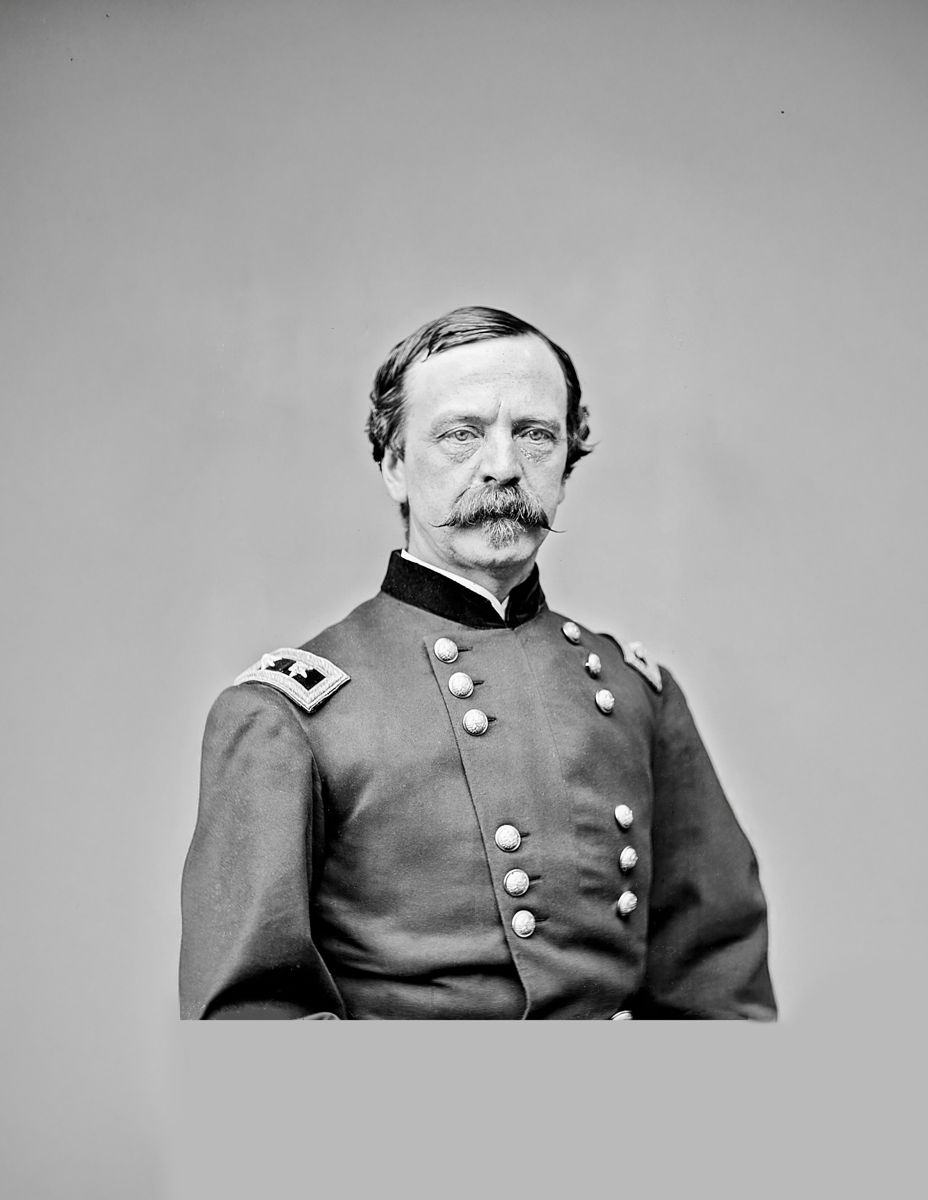
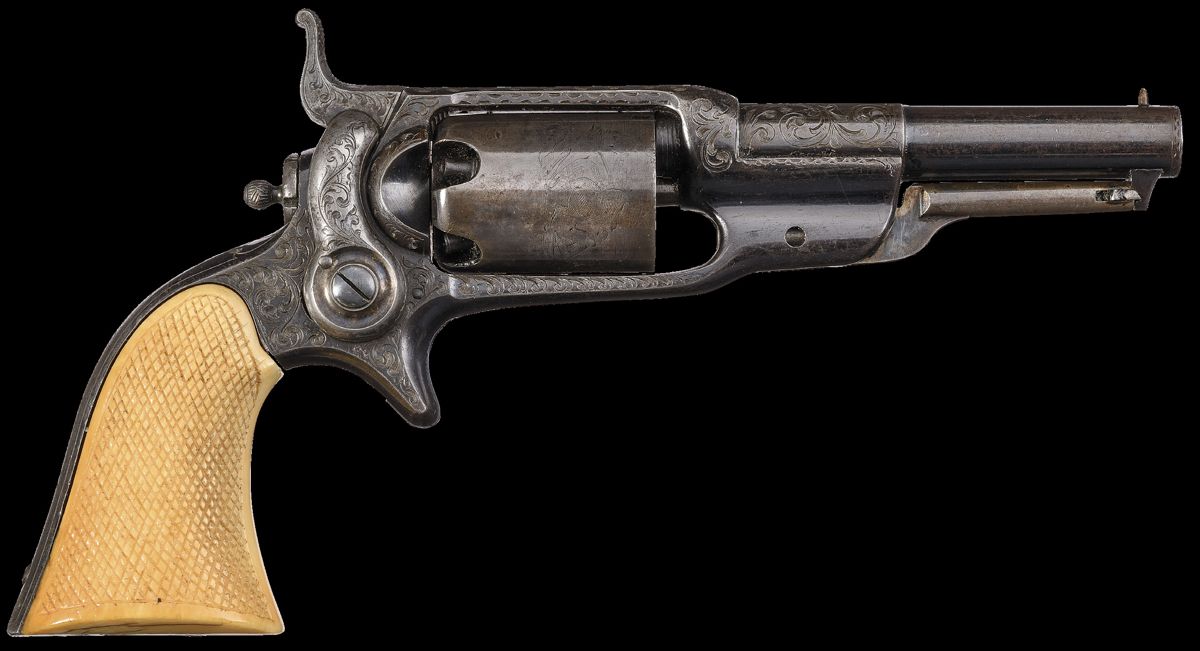
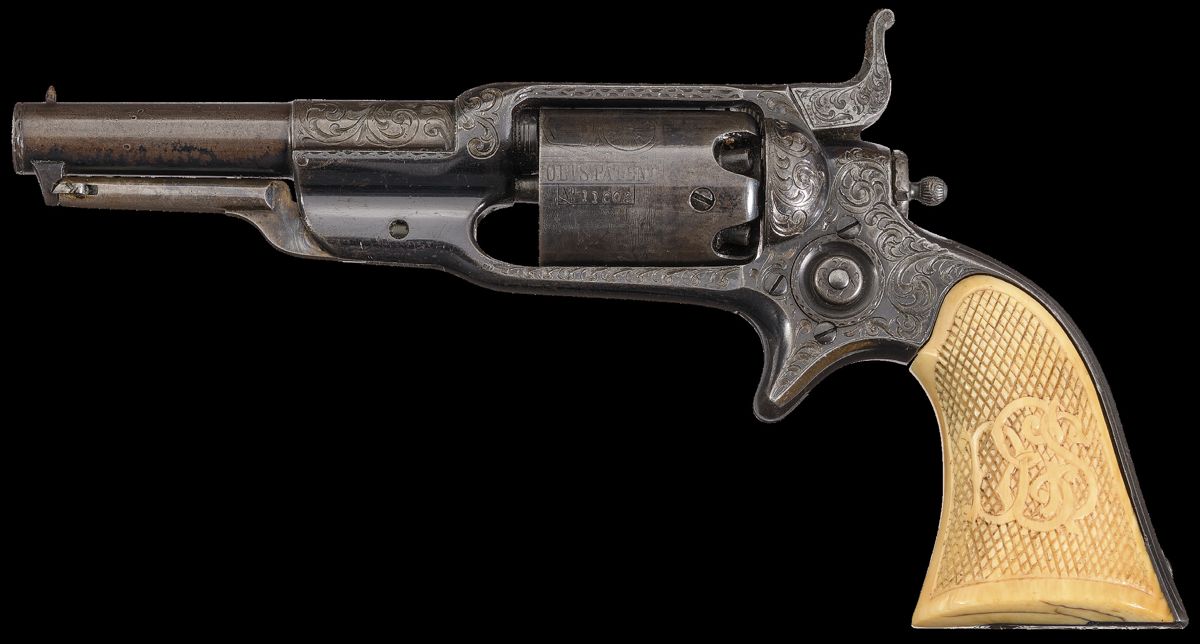
Despite his detractors and questionable ethics, he was recognized for his loyalty and service. In an 1861 portrait by famed Civil War photographer Mathew Brady, he can be seen wearing a gilt Tiffany & Co. knight pommel dress officer’s sword and gilt scabbard that had been presented to him when he was organizing the Excelsior Brigade early in the Civil War. After being wounded at the Battle of Gettysburg, he was given a cane by a former constituent, and after the war, a cased Colt Model 1855 “Root” percussion revolver Major General Daniel Edgar Sickles. (Library of Congress) was presented to him.
Daniel Sickles’ Early Bad Behavior Sickles was born on October 20, 1819 or 1825, depending on the source. Trained to be a lawyer, he hung out his shingle as an attorney in the early 1840s. He was soon known for his questionable business tactics and ethics. He was accused of stealing, obtaining money under false pretenses, stealing from the post office, and taking money meant for a political pamphlet. He worked his way into the Tammany Hall political machine in New York City, where he was linked to ballot tampering, bringing in voters from other districts, brawling, and more theft. For his efforts, he was named New York City Corporate Counsel. In 1852, Sickles married Teresa Bagioli, a teenager, when he was 33. Teresa was the adopted daughter

Within a year of their marriage and awaiting the birth of their only child, a daughter, Sickles accepted an appointment under future president James Buchanan at the London embassy. An inveterate womanizer, he was carrying on with a wellknown prostitute of the era named Fanny White and had been censured for escorting her to the floor of the New York State Assembly. Leaving his bride behind, Sickles was accompanied to London by White, whom he reportedly introduced to Queen Victoria as “Miss Bennett of New York,” using the surname of a political rival, New York Herald editor James Gordon Bennett Sr. He also created a furor for failing to toast the Queen’s health.
He returned to the United States in 1855 and was elected to the New York State Senate the following year. An advocate for Central Park, he obtained consensus on the location and convinced the governor to sign legislation creating a bipartisan park commission. Elected to Congress in 1856, he moved Teresa and their daughter to a home on Lafayette Square near the White House. They moved among the party scene and were society fixtures, hosting events weekly. When Sickles worked late, traveled, or cheated on Teresa, she was often escorted to parties by Philip Barton Key.
Daniel Sickles and Temporary Insanity Tall and handsome, Philip Barton Key II was the son of Francis Scott Key, author of the “Star Spangled Banner,” and a widower with four children. Supposedly in ill health and worried about his
Daniel E. Sickles shooting Philip Barton Key in President’s Square, Washington, D.C., 1859. (Frank Leslie’s Illustrated Newspaper, March 12, 1859)
position as a U.S. Attorney, Key sought out his friend Sickles to plead his case and successfully gained reappointment. Teresa Sickles was beautiful, 20 years old, and ignored by her husband. She and Key, who met at President Buchanan’s inauguration in March 1857, soon became lovers, often meeting at a rented house two blocks from the Sickles’ home on Lafayette Square. On Feb. 24, 1859, Sickles received an anonymous letter outlining his wife’s infidelity with Keys. Confronted, Teresa admitted to the affair. Sickles made her write a detailed confession, in which she described multiple rendezvous and even to kissing Key in their own house on numerous occasions. She signed the confession with her maiden name, Teresa Bagioli. Despite his philandering, Sickles was heartsick over the revelation. On February 27, 1859, at home alternately weeping and calling upon friends for advice, Sickles spotted Key, who had approached the Lafayette Square house several times that day, twirling a handkerchief, a signal to Teresa to join him for a dalliance. Sickles shouted,
“That villain has just passed my house! My God, this is horrible!” He raced to collect a revolver and two derringers. Sickles found Key near Pennsylvania Avenue across from the White House, where he shouted,
“Key, you scoundrel, you have dishonored my house; you must die!” He pulled a gun and shot Key at close range but merely grazed him. Sickles shot Key a second time, the bullet hitting below the groin and knocking him to the ground. A third shot misfired. Sickles cocked the gun once more and aimed it at Key’s chest, fatally shooting Key just below the heart. He also attempted to shoot Key in the head, but the gun misfired again. The Congressman admitted to killing the U.S. Attorney, an act that had numerous witnesses. His murder trial received sensational coverage with sympathy leaning toward Sickles while destroying Teresa’s reputation. Teresa’s confession, inadmissible in court, was leaked to the press by her husband. His own philandering wasn’t admissible either. His attorneys, including Edwin Stanton, who would serve as President Abraham Lincoln’s Secretary of War, argued that Sickles was briefly inflamed by the discovery of his wife’s adultery and not responsible for his actions. He was found not guilty, which was the first successful use of the defense of temporary insanity in the United States. To the shock of many, the couple reconciled and found themselves pariahs in Washington, D.C., society. Sickles declined to run for another term and practiced law in New York at the start of the Civil War.
Daniel Sickles and the Civil War
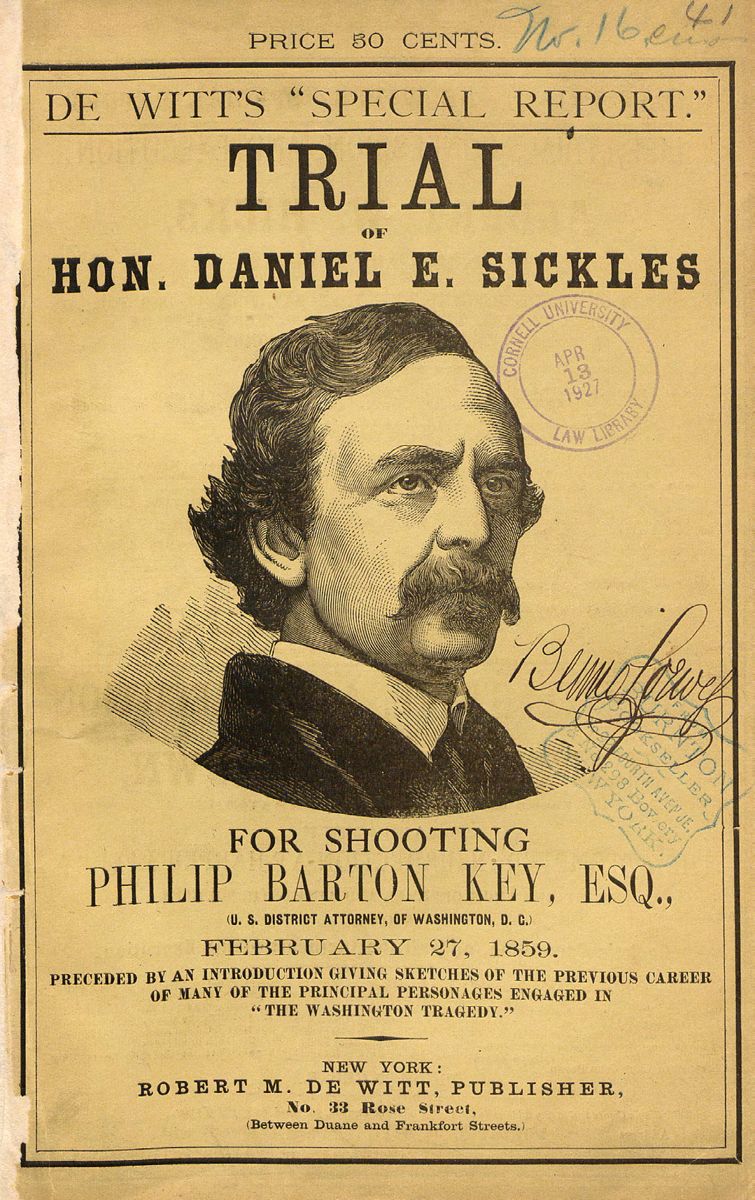
“De Witt’s “Special Report.” Trial of Hon. Daniel E. Sickles for Shooting Philip Barton Key, Esq.” (Robert M. De Witt, publisher)
As the Civil War began, Sickles and a friend discussed recruiting men for a regiment that Sickles would lead. He proved a good recruiter and gathered about 3,000 men to brigade strength. He called it the Excelsior Brigade after the New York state motto (Excelsior means “Ever Upward”). The unit mobilized in Washington, D.C., where Sickles, with no military experience but already appointed a colonel, awaited a commission as general, having wormed his way into President Lincoln’s good graces. Lincoln appointed him a brigadier general, but Congress refused to confirm his commission,
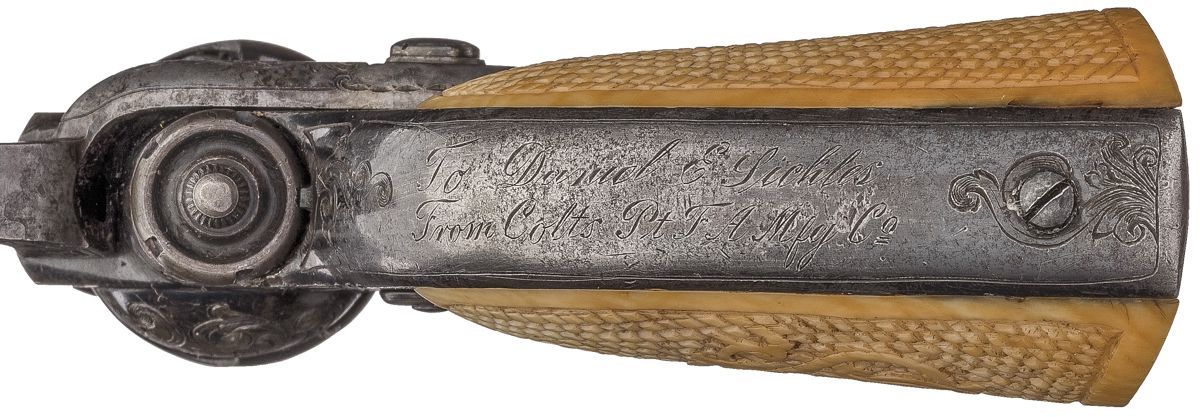
The backstrap of the Colt Model 1855 “Root” percussion revolver presented to Union general Daniel Sickles shows the inscription, “To Daniel E. Sickles/From Colts Pt F A Mfg Co.” (Revolver, sword, and cane photographs courtesy Rock Island Auction Company)
The cased Colt Model 1855 “Root” percussion revolver inscribed to Medal of Honor recipient and Civil War General Daniel Sickles shows the engraving, checkered grip, and Sickles’ “DES” initials on the revolver. Case also includes accessories.
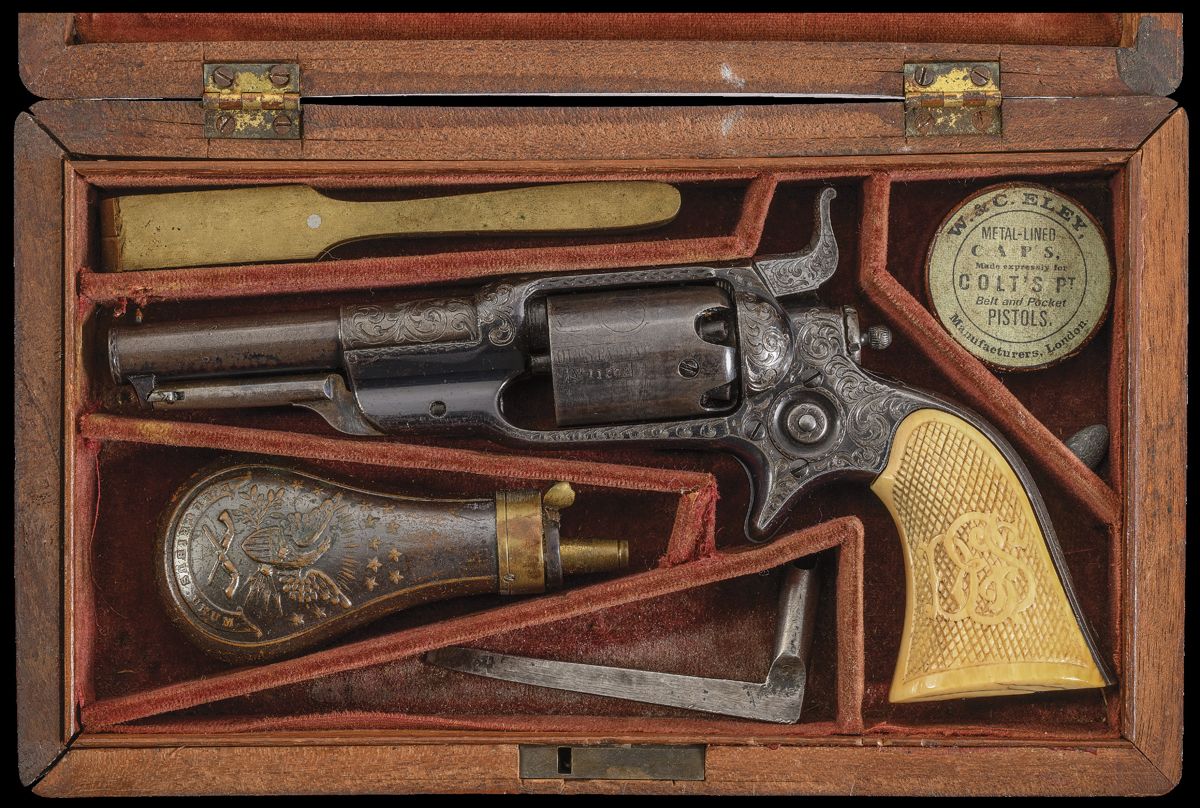
The right side of this Colt Model 1855 “Root” percussion revolver inscribed to Medal of Honor recipient Daniel E. Sickles and Union general who lost his right leg at the Battle of Gettysburg shows the scroll engraving along the frame, hammer, and top strap to the muzzle.
The scroll engraving on the rear of the frame, hammer, and along the top strap to the muzzle was common on late percussionera Colts like this one. The backstrap is inscribed “To Daniel E. Sickles/From Colt’s Pt F A Mfg Co.” The “DES” monogram on the checkered grips is also seen along with a rolled stagecoach scene on the cylinder.
and he had to step aside. He lobbied his Washington connections and regained his rank and command on May 24, 1862. Sickles and the Excelsior Brigade fought at Fair Oaks (also known as the Battle of Seven Pines) on June 1, 1862, as part of the Peninsula Campaign, and after-action reports praised the Excelsior Brigade. He saw more action during the Seven Days Battles in June before leaving for recruiting.
The Excelsior Brigade was assigned to Gen. Joseph Hooker’s III Corps, and as Hooker advanced in rank, Sickles did as well, promoted to command Hooker’s Second Division of III Corps after his return to the unit late in the year. At the Battle of Fredericksburg, Dec. 11-15, 1862, Sickles’ unit saw little action in the Union defeat. In the aftermath, Gen. Ambrose Burnside was relieved of command of the Army of the Potomac in January 1863.
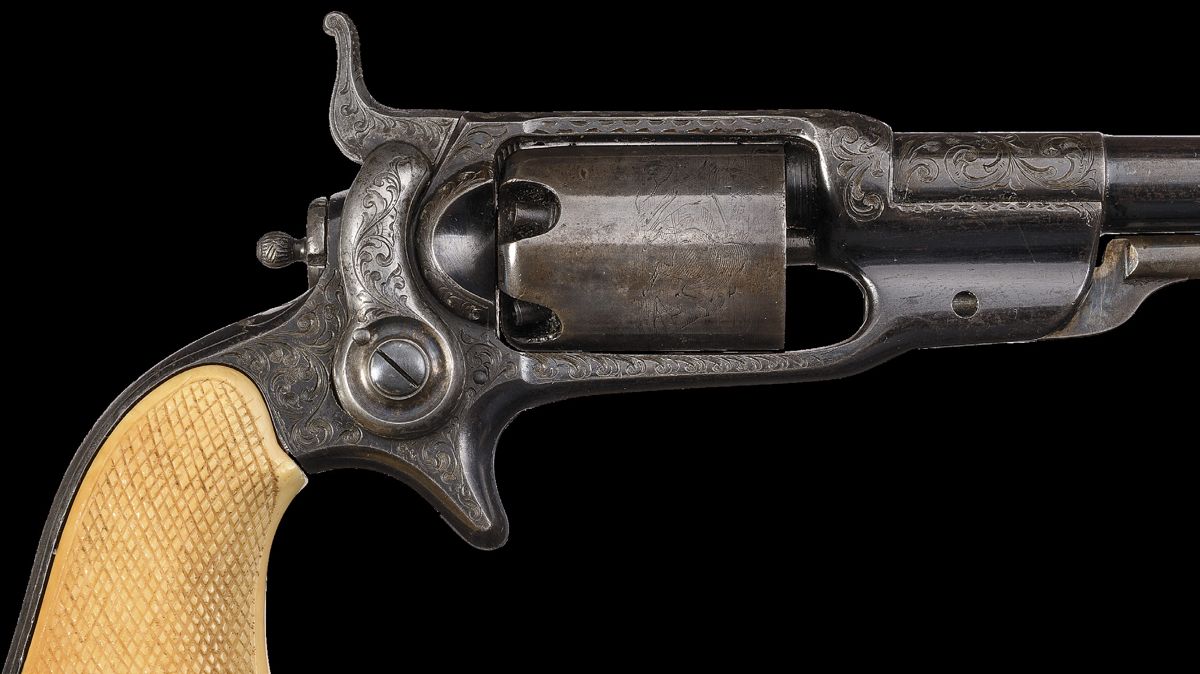
A close-up of the right side of the presentation Colt Model 1855 “Root” percussion revolver of Civil War general and Medal of Honor recipient Daniel Sickles shows the scroll engraving.
A closer look at the scroll engraving and the checkered grips with the initials of Civil War general Daniel Sickles on his presentation Colt Model 1855 “Root” percussion revolver. A roll-stamped stagecoach scene is just visible on the cylinder.
Hooker was promoted to lead the Army of the Potomac in January 1863, and following on his coattails, Sickles was given command of the III Corps, making him the highest-ranking non-West Point graduate in the Union Army. As the army over-wintered, Hooker named Gen. Daniel Butterfield, another non-West Pointer, as his chief of staff. This was quite a trio as Hooker was known as a heavy drinker and womanizer, Sickles killed the man who cuckolded him, and Butterfield had been arrested for arson in his youth. One officer said,
The Army of the Potomac sank to its lowest point. It was commanded by a trio, of each of whom the least said the better. During that winter when Hooker was in command, I can say from personal knowledge and experience that the headquarters of the Army of the Potomac was a place to which no self-respecting man liked to go, and no decent woman would go. It was a combination of bar room and brothel.
This is the right tibia and fibula of Maj. Gen. Daniel Sickles, commander of the Union Army of the Potomac’s Third Corps at the Battle of Gettysburg. Sickles was struck by a 12-pound artillery round during the second day of the battle. The injury resulted in the amputation of his leg above the knee. [AFIP 0379085] (Disclosure: This image has been cropped to emphasize the subject.) (National Museum of Health and Medicine Photo by Ian Herbst.)
As the campaign resumed in April, Hooker planned to trap Lee near Fredericksburg, Va., with 130,000 Union troops compared to the Army of Northern Virginia’s 60,000 soldiers. The armies engaged near Chancellorsville. Sickles misinterpreted Gen. Stonewall Jackson’s flank march as a retreat, so Hooker ordered III Corps to remain where it was, but a mile and a half from Union reinforcements. Unable to fight back to the main line, Sickles troops did take a key piece of high ground. The next day, Hooker ordered III Corps to withdraw from high ground, allowing Confederate artillery to take it and pummel the Union troops. Sickles’ troops suffered 4,100 of the 17,000 Federal casualties. After slugging it out with the Confederates, Hooker decided to end the fight, returning north. The victory emboldened Confederate Gen. Robert E. Lee to lead his troops into Pennsylvania. Hooker was quickly relieved of command and replaced by Gen. George Meade who was disliked by Sickles. The men’s animosity would play a role in the Battle of Gettysburg.
Daniel Sickles and the Battle of Gettysburg Sickles and III Corps were in a defensive position in Maryland as both armies moved toward Gettysburg. He was ordered to move his forces on July 1 up to Gettysburg as fighting intensified. To Meade’s chagrin, Sickles froze with indecision and didn’t reach Gettysburg until
The monument to Union Major General Daniel Sickles and the Trostle barn. (Jack W. Melton Jr.)
about 7 p.m. after the fighting ended for the day. His inability to reinforce the Union army likely made the Union’s first day defeat worse. The next day, Sickles was ordered to anchor the left side of the line on Cemetery Ridge and Little Round Top. Recalling lessons from Chancellorsville, the nearby low ground concerned Sickles, knowing enemy artillery could dominate the position and Union troops couldn’t see an enemy approach. Sickles tried to move his men in front of the main line and, despite being ordered to remain where he was, ordered his men forward to the Peach Orchard, thinning the Union defensive position. Meade went to confront his insubordinate general and order the troops back, but it was too late. Sickles troops were already under fire. Some historians say Sickles outright disobeyed Meade’s order on where to place his men. Sickles’ III Corps was set too far in advance of Meade’s Army to be well supported, with a half-mile of open ground between them. Sickles’ men were expected to occupy a 1,600-yard long line, but Sickles later claimed he didn’t have sufficient strength to cover it. The line his men actually covered was twice as long. Despite the indefensible location, Meade kept Sickles’ men in place and kept reinforcing III Corps to keep it from being overrun. Sickles’ men were forced to retreat to the original Union line with heavy losses in fierce fighting. During the battle as Sickles sat astride his horse on a grassy knoll on the Trostle Farm (see red circle on map) surveying his troops’ position, a 12-pound Confederate cannonball tore into his right leg. He lifted his tattered leg over the saddle and dismounted without help as aid rushed to his side. He was taken to a field hospital, and his mangled leg was amputated just above the knee. Confederate Gen. James Longstreet’s attack was to try to flank the Union line, but Sickles’ position extended the Confederate line, and the rebels failed to gain a strategic advantage in the battle’s second day of fighting. Years later, Sickles and Longstreet became friends and often defended each other’s actions at Gettysburg. Famously, Sickles donated his leg bones to the Army Medical Museum as he recuperated in Washington, D.C., where Lincoln visited him. The donation was received with a small card which read “With the Compliments of Major General D.E.S.,” In later years, he would often portray himself as a one-legged hero of Gettysburg. Sickles proved to be a quick healer and sought to return to the field only to be denied by Meade because he was no longer physically fit to serve. Mark Twain met Sickles years later and said he, “valued the leg he lost more than the one he’s got.”
Daniel Sickles after Gettysburg The following spring, Congress held hearings on the battle since Meade could not stop Lee’s army from returning to Virginia. Sickles, called as a witness, attacked Meade in the hearing, lying at times while boosting his role. Despite the criticism and political discomfort of the hearings, Meade remained in command of the Army of the Potomac. Sickles’ wife, Teresa, whose health failed after the murder scandal, died on Feb. 5, 1867, of tuberculosis at the age of 31. After the war, Sickles worked on Reconstruction duty, served as a diplomat to Columbia, as military governor of South Carolina, and as Minister to Spain. While in Europe, he had an affair with deposed Spanish Queen Isabella II in Paris and was called the “Yankee King of Spain” by the French press. In 1871, Sickles married again, this time to a court attendant of Queen Isabella, twenty-something Caroline de Creagh. The couple lived in Paris for several years and had a son and a daughter. When he returned to America, he traveled alone.
In 1892, Sickles was re-elected to Congress, where he introduced legislation in 1894 to create Gettysburg National Military Park. The legislation passed and was signed into law Feb. 11, 1895. The State of New York placed 88 monuments in the park. Thirty-five years after losing his leg at the battle, he was awarded the Medal of Honor on Oct. 30, 1897. The citation states he
Displayed most conspicuous gallantry on the field vigorously contesting the advance of the enemy and continuing to encourage his troops after being himself severely wounded. At the age of 93, he, along with 50,000 other veterans, attended the 50th anniversary of the battle in 1913. Losing his eyesight and being confined to a wheelchair, Sickles could no longer guide New York’s Monuments Commission. In fact, months before the anniversary, an audit of the commission’s bank accounts showed nearly $30,000 was missing, which led to his ouster. While many senior generals at Gettysburg have monuments honoring them, there is none for Sickles. A memorial to the Excelsior Brigade was to include a bust of its commander, but it was rumored the funds initially raised for that purpose was the amount missing. Asked why there was no memorial to him at Gettysburg, the aging general replied, “The entire battlefield is a memorial to Dan Sickles.” Sickles died less than a year later at the age of 94. He is buried at Arlington National Cemetery. The May 4, 1914, New York Times obituary of Sickles described him as a
Daniel Sickles, Monuments Man Sickles returned to the United States in 1879 and immediately became an advocate for preserving the Gettysburg battlefield. He was appointed to chair the New York Monuments Commission for the Battlefield of Gettysburg and devoted the rest of his life to raising money for monuments to all of New York’s regiments and making sure they were properly located.
…the last of that galaxy of corps commanders who made possible the achievement of Grant and brought our great civil strife to
The knight pommel on the gilt presentation 1861 dated Tiffany & Co. dress officer sword to Union general and Medal of Honor recipient Daniel Sickles. The sword’s scabbard is inscribed “’EXCELSIOR’/ Presented to/Genl Sickles,/By His Sincere Friend.” Sickles recruited and commanded the Excelsior Brigade of New York in the Civil War. The identity of the “sincere friend” is unknown, but one owner of the sword believed it to be President Abraham Lincoln, who knew Sickles and visited with him several times as he recuperated in Washington, D.C., after losing his right leg at the Battle of Gettysburg.
a triumphant close…Fighter, lawyer, politician, and diplomat…and in his closing years he looked back through a vista of decades in which strife and trouble were mixed in greater proportion than triumph. Sources:
N American Battlefield Trust N Daniel E. Sickles, “Essential Civil War Curriculum,” by James A. Hessler N U.S. Department of Defense
Union General Daniel Sickles. Hanging at his side is the gilt 1861 dated presentation Tiffany & Co. dress officer’s sword with a knight on the pommel. The scabbard is inscribed “’EXCELSIOR’/Presented to/Genl Sickles,/By His Sincere Friend.” (Library of Congress)
The ivory handle of a presentation cane inscribed to Civil War Union Gen. Daniel Sickles shows the brass band inscription “Presented to/ Maj Gen. Daniel E. Sickels[sic]/by P.D. Kilduff/Jan. 8th 1864.” Patrick Daily Kilduff was an Irish immigrant who owned a liquor store and billiard parlor in New York City in 1860 and likely knew Sickles from his Tammany Hall days before his election to Congress in 1856.
The elaborate handle and pommel of the gilt 1861 dated presentation Tiffany & Co. dress officer’s sword of Union general Daniel Sickles, who lost his leg at Gettysburg. The sword has a knight on the pommel, a silver grip, a twisted knuckle bow, and a lion head quillon.
About the Author
Kurt Allemeier, a long-time journalist, writes for Rock Island Auction Company, which will host its next Premier Auction Aug. 15-17, in Bedford, Texas.