
A Confederate Altered U.S. Model 1841 Mississippi Rifle
By Tim Prince · Originally published July-August 2025 · pp. 66–71
At the beginning of the American Civil War nearly 20,000 U.S. Model 1841 “Mississippi” rifles were in arsenals of the various states that seceded to form the Confederacy. Some 9,304 had been issued to the Southern states between the years of 1845 and 1859 under the Militia Act of 1808. These guns were largely manufactured by the four primary M1841 rifle contractors; Tryon, Remington, Robbins & Lawrence, and Whitney. Based upon the number manufactured, period documents, and surviving examples, it appears that the majority of the M1841 rifles in southern arsenals prior to 1859 were manufactured by Eli Whitney Jr., with the guns produced by Robbins & Lawrence being the second most numerous examples (“Distribution of Arms to the Militia Under the Act of 1808,” National Archives Record Group 156, Entry No. 118). Those 9,304 guns were sent to Virginia, North Carolina, South Carolina, Mississippi, and Texas. Of those guns, only 1,411 were Harpers Ferry produced M1841s modified with long range sights and bayonet lugs. An additional 10,000 M1841 rifles were sent to Southern states on December 30, 1859, by Secretary of War John B. Floyd. Floyd sent the rifles to Southern state militias, as a reaction to the John Brown raid on Harpers Ferry. Floyd was also motivated by his strong Southern sympathies, his general belief that war was probably on the horizon, and the fact that the arms would be sorely needed in the south. In general, the U.S. Model 1841 Mississippi rifles in the Southern arsenals on the eve of the War were in their original .54 caliber configuration, without any modification to their sights or caliber, or any way to mount a bayonet. With the start of the war, many unaltered U.S. M1841 Mississippi rifles were modified by Southern arsenals and gunsmiths to accept bayonets, that were typically the saber variety. While some alternations have been specifically attributed to Confederate gunsmiths like J. H. Happoldt of Charleston, S.C., the sources of the majority of these modifications remain unidentified and are often simply referred to as “Virginia” alterations as most of these saw use in the Virginia theatre and records of alterations by Virginia gunsmiths exist. Unfortunately, while some contracts and receipts do survive listing a specific gunsmith or company performing modifications to various guns, they are rarely specific enough to allow surviving examples to be directly attributed to a specific gunsmith.
3 and 3 ¾-inches from the muzzle. While the majority of these lugs were simple affairs, about ½-inch long without any “key” or “guide,” a handful were altered with a guide forward of the lug. Invariably, the saber bayonets provided with the newly altered rifles were copies of the U.S. Model 1855 saber bayonet with cast brass hilts and steel blades. The majority of the bayonets were not maker marked, but numerous well-known Southern makers delivered saber bayonets on contract to the Confederacy, including Cook & Brother, Boyle & Gamble, Burger & Brothers, and Louis Froelich, etc. Who performed the alterations on these rifles remains somewhat mysterious, as research into the Confederate Citizen Files (U.S. Archives Record Group 109) has revealed only a handful of gunsmiths and gunmakers who were altering U.S. M1841 rifles to accept saber bayonets. Among these were J. H. Happoldt of Charleston, S.C., who altered at least 353, and William B. & Cyrus Fisher of Lynchburg, Va., who “repaired” 65 rifles for “Captain George Field’s Company” in July 1861. Such alterations were likely performed by other gunsmiths in Virginia, North Carolina, South Carolina, and even Tennessee.
The Charleston Daily Courier (Charleston, South Carolina), Friday, May 17, 1861, page 2. (Newspapers.com)

Of the 19,304 Mississippi rifles in Southern hands at the beginning of the war, 17,893 were .54 caliber with no means of mounting a bayonet. The solution for many of these guns was to braze a saber bayonet lug to the right side of the barrel, typically between Left: Confederate soldier with Model 1841 Mississippi rifle and “Victory or Death!” sign. (Liljenquist Family Collection, Library of Congress)
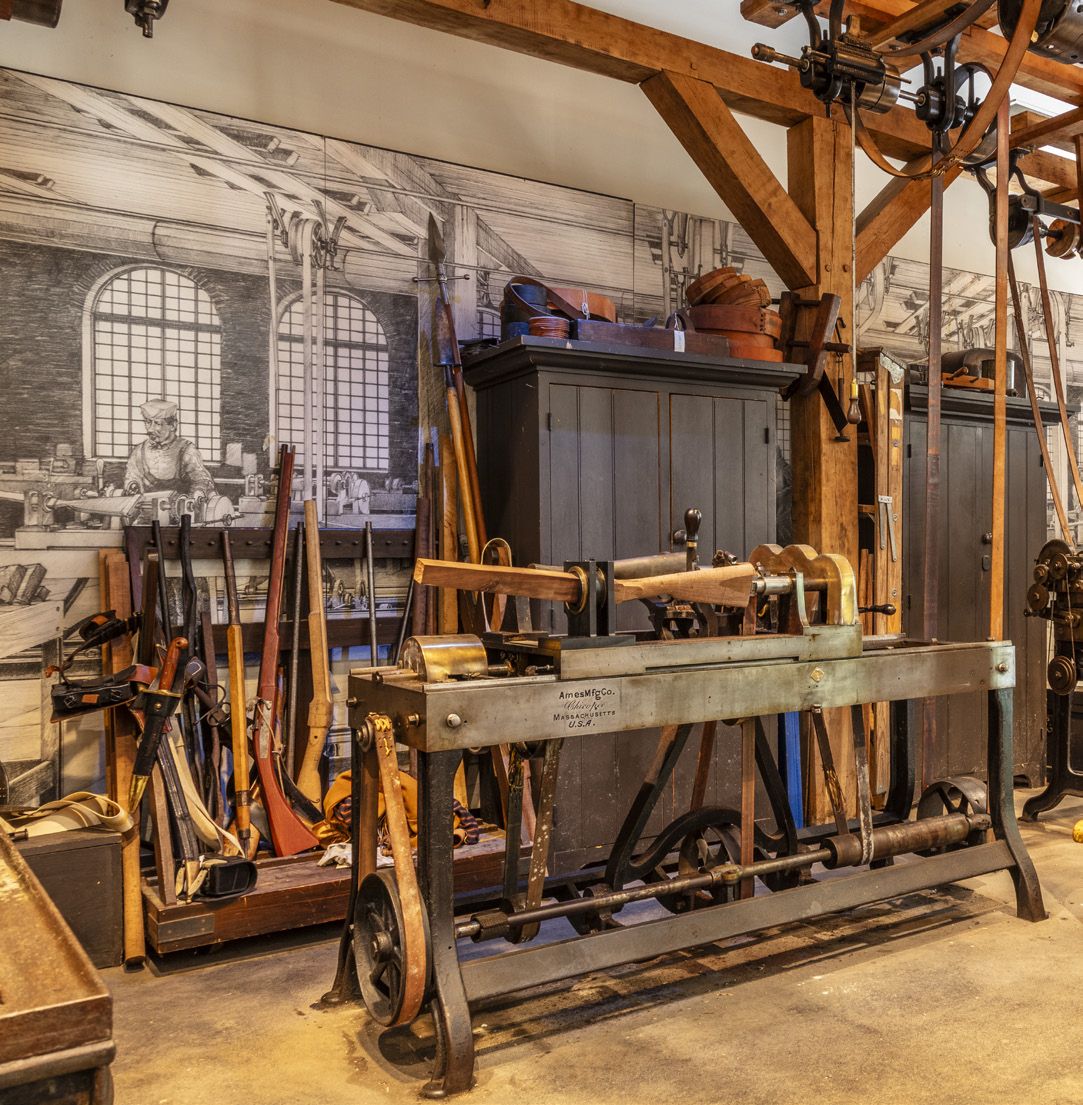
Machinery at Harpers Ferry National Historical Park.
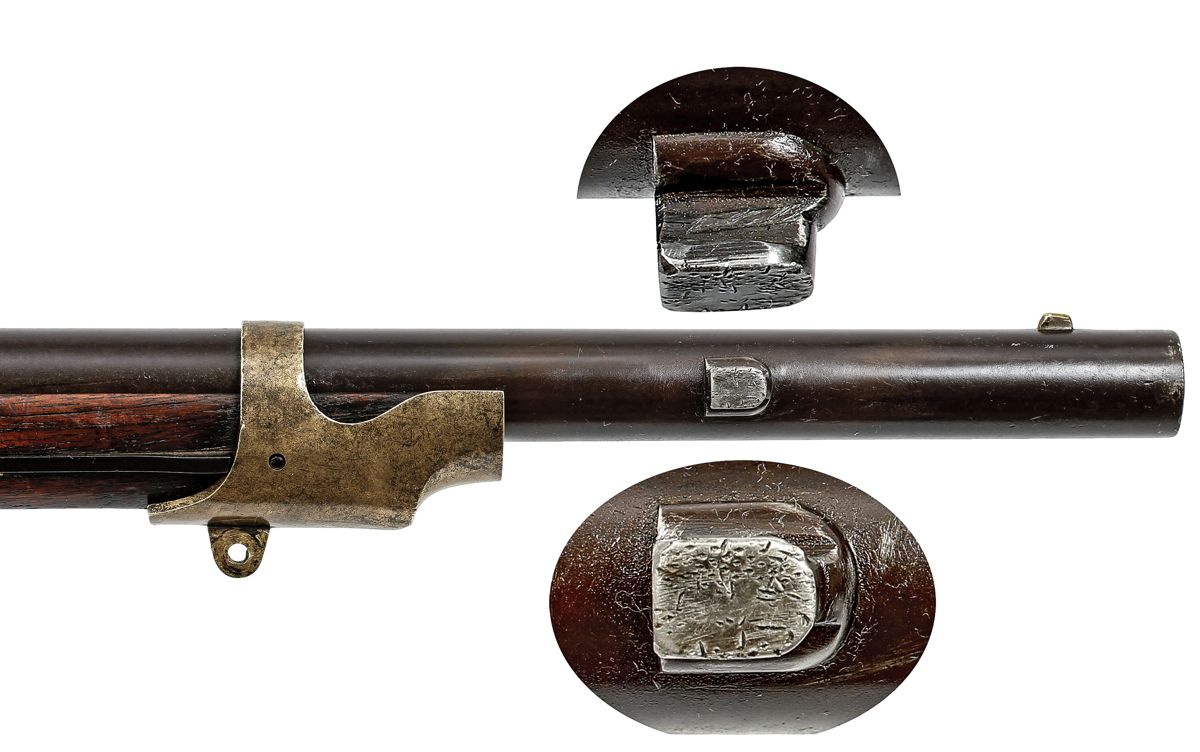
As noted, the alterations typically revolved around adding a saber bayonet lug to the right side of the barrel. This created a problem because the upper barrel band could not be removed after the lug was added. The solution utilized at Harpers Ferry was adopting a new, shorter barrel band that could be removed from the stock, and then rotated 90-degrees, allowing it to clear the lug. Southern gunsmiths did not have the time, budget, or often the ability to cast new upper bands for rifles they altered. Their solutions had to use parts already available on the gun with minimal fabrication. The Happoldt solution was to make a pair of cuts in the bottom lip of the barrel band that removed enough brass to allow the band to be slipped forward, rotated 90-degrees, and removed over the lug. This was a clean and simple alteration but required a level of skill in altering the barrel band. Most other, “unidentified” Confederate alterations involved cutting away the forward upper strap of the band, allowing it to pass over the applied lug. In some cases, the band was shortened as well. These “cut away band” alterations are on guns often generically referred to as “Virginia Alterations” by collectors. The accompanying photos show one of these “Virginia Altered” U.S. Model 1841 rifles. It is a classic example of a Confederate altered Mississippi rifle, with a cut away upper barrel band and applied saber bayonet lug, but with no modifications to the sighting system or caliber. The gun retains its original .54 caliber bore with seven-groove rifling and its original fixed sights. As is so common with these guns, there are practically no external marks to provide clues about where or by whom the gun was altered. However, one external clue does exist that might someday help identify the gunsmith who worked on this gun. The top of the buttplate is stamped with the number 6 near the toe of the stock. A Mississippi rifle
Overall obverse view of a Confederate altered Mississippi rifle by Whitney. (All photos by Tim Prince)
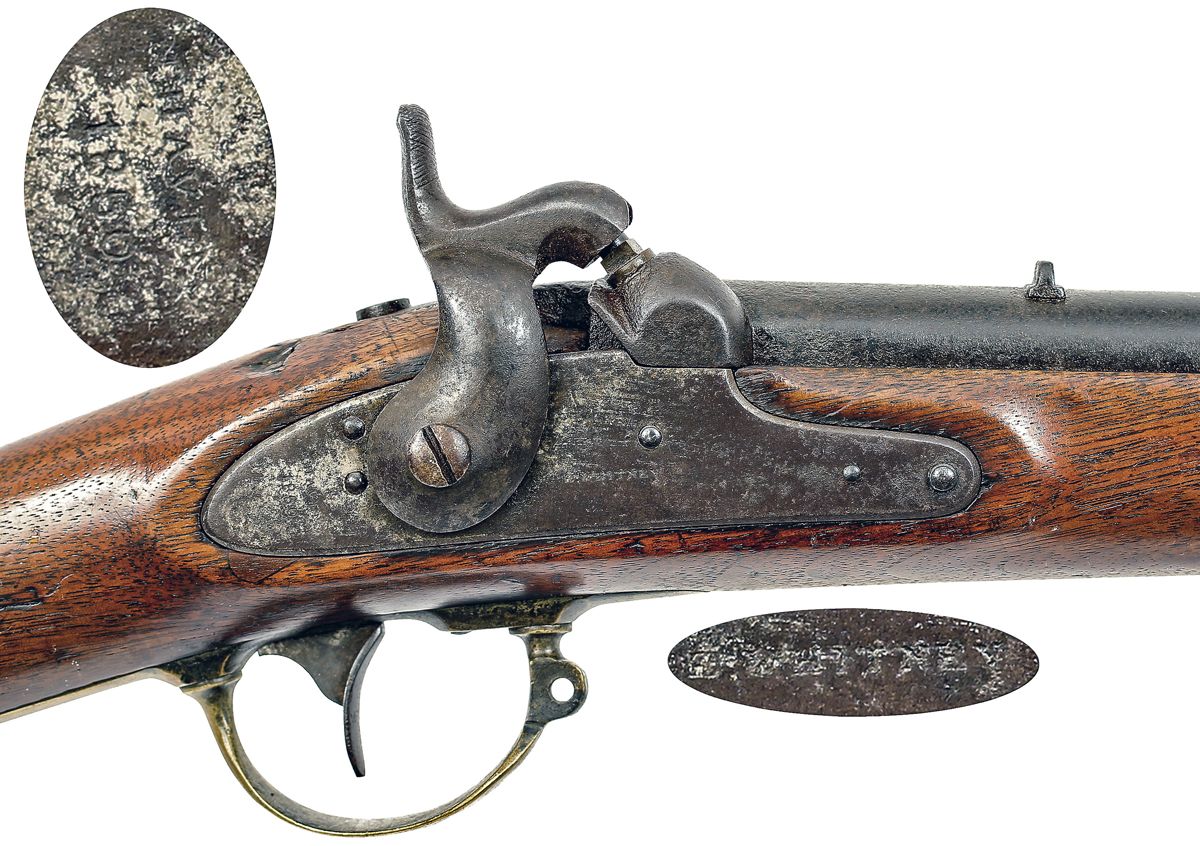
Lock area of the C.S. altered Whitney Mississippi rifle. Insets show the standard E. WHITNEY lock mark and two line NEW HAVEN over 1850 date at rear of lock.
Close up of the Confederate applied bayonet lug with insets showing details of the somewhat crudely filed and applied lug from two different angles.
Muzzle of the C.S. modified Mississippi rifle, note the original seven-groove rifling and original brass blade front sight retained from the original Whitney manufacturing.
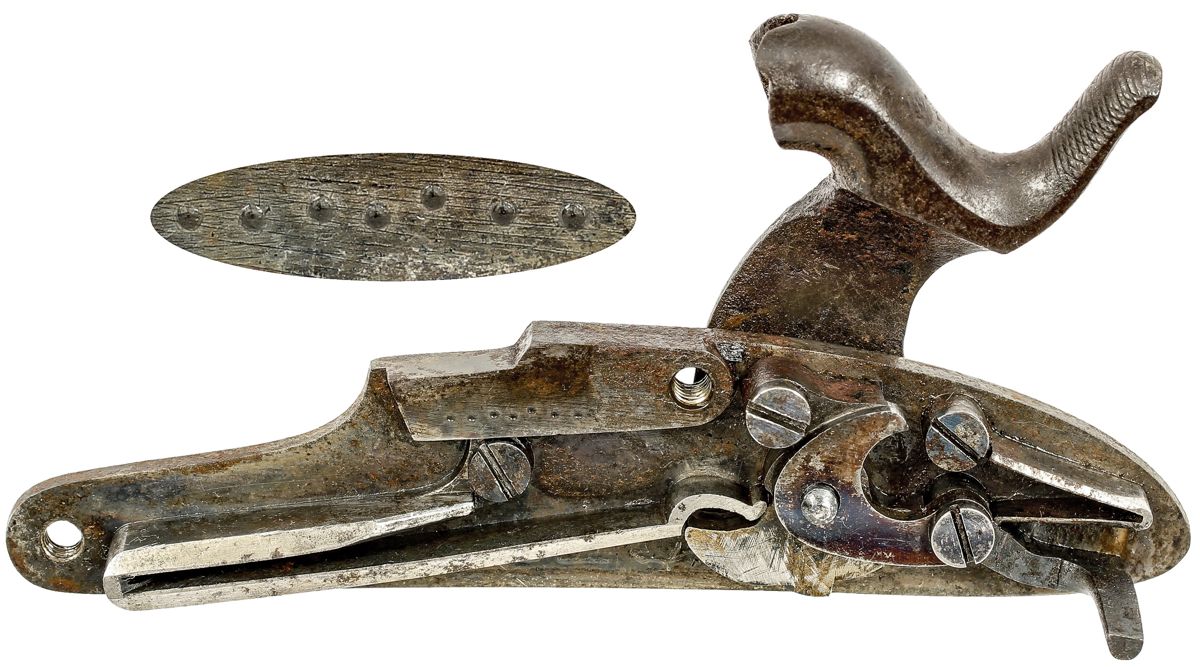
Interior of the C.S. altered Mississippi rifle’s lock showing the cryptic 7 dot marking and crudely replaced tumbler.
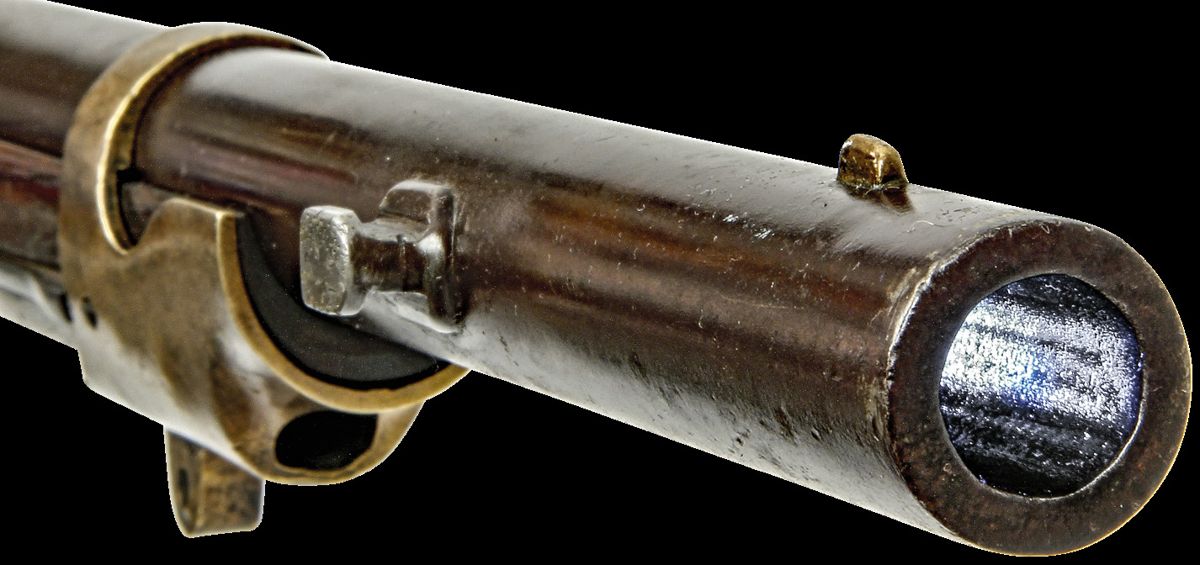
with the same type of bayonet lug and altered front barrel band is depicted in Murphy & Madaus’s Confederate Rifles & Muskets in plates 12 and 13 of Section XXIV and described on pages 352-354. The example pictured (from the Charles L. Foster Collection) is marked with the number 45 near the toe of the stock. This gun shows another Confederate trait that is less obvious and is most visible once the lock is removed. The tumbler appears to have been replaced during the period of use and is rather crude. The fit to the hammer is not very good, and the hammer has thin metal shims to improve its fit on the tumbler. The tumbler has a very crude, very low “half-cock” position that is much lower than typical U.S. arms. Inside, the lock is marked with seven crude and cryptic “punch dots” in a line along the reinforced upper edge. It appears that similar punch dots were also applied to the interior of the hammer neck, but due to oxidation and wear they are barely visible. This method of marking a lock interior is found on some “Mississippi Style” North Carolina rifles delivered by Gillam & Miller of Jamestown, N.C. An example of Gillam & Miller rifle No. 144 is shown on page 274 of Confederate Rifles & Muskets, with four cryptic punch dots inside the lock in the same location as the ones found in this rifle. This suggests that Gillam & Miller (or another North Carolina gunmaker) may have effected repairs on this rifle and may well have installed the saber bayonet lug and altered the upper barrel band as well. Other than the cryptic internal marks, the 6 on the buttplate, the added bayonet lug, and the upper band alteration, the gun is essentially a standard Eli Whitney Jr. produced M1841 Mississippi rifle, with standard Whitney markings and U.S. inspection marks. The Confederate applied saber bayonet lug is .53-inch long and has no key. It is brazed directly to the barrel. No dovetail was cut for the bayonet lug. The lug is mounted 3 ⅜-inches from the muzzle. The rifle is missing both sling swivels. Interestingly, the C.S. altered Mississippi rifle noted in Murphy & Madaus with the same type of numerical buttplate marking is missing both swivels as well. This begs the question if their removal was a wartime modification by soldiers who were rarely issued slings or a post-war modification when the rifle may have seen use putting game on the table. The pictured rifle is accompanied by an original, Confederate made, saber bayonet that fits it perfectly. The Confederate made brass handled saber bayonet is essentially a crudely made copy of the U.S. M1855 saber bayonet. The bayonet is unmarked, with the exception of the number 121 stamped into the obverse finial at the bottom of the cross guard, and the alphanumeric mark H / 24 stamped into the top of the hilt. The bayonet is 24 ⅜-inches in overall length, with a 4 ⅝-inch long cast brass hilt and a 19 ¾-inch semi-Yataghan blade. The blade is 1 ¼-inches wide at the ricasso and has a 14-inch fuller. The brass hilt is somewhat crudely cast and is roughly finished. The muzzle ring is slightly irregular, but mates with the rifle perfectly. The ring has a .883-inch muzzle diameter. The top of the hilt has a roughly finished 1-inch mortise cut into it. The rear
Overall obverse view of a Confederate-made copy of a U.S. M1855-style saber bayonet.
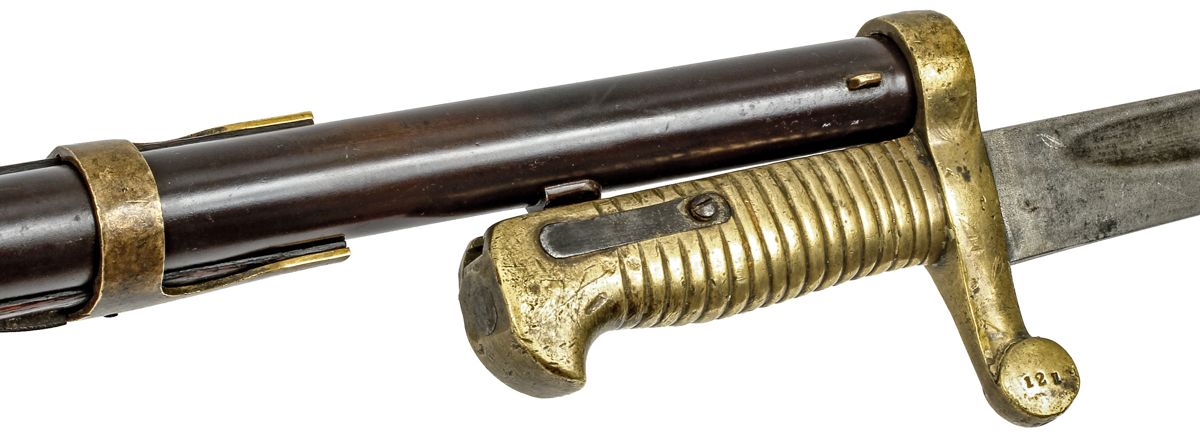
Saber bayonet mounted on the C.S. altered Mississippi rifle.
of the pommel has a flat profile, similar to the pommel caps of Boyle & Gamble bayonets, but without the exaggerated bird’s head pommel shape. The original locking mechanism is in place in the hilt and remains fully functional. The blade shows a couple of significant flaws, which are quite common on Confederate manufactured bayonets. Although collectors have called Confederate modified Mississippi rifles of this style “Virginia Alterations,” I feel that this particular gun is more likely the work of a North Carolina gunsmith, and the saber bayonet could well be the work of a North
Carolina shop as well. These saber bayonet equipped Mississippi rifles saw significant use early in the Civil War, with many being issued to men in Bate’s 2nd Tenn. (Provisional Army of Tenn.) and Hatton’s 7th Tenn. infantry regiments, as well elements of the 3rd and 6th Alabama Infantry and 21st Mississippi. These rifles were some of the best arms in Confederate hands in Virginia during the first year of the war and were no doubt highly prized over the percussion converted smoothbore muskets that so many Southern soldiers had to make do with during the first 12 to 18 months of the war.
About the Author
Tim Prince is a full-time dealer in fine and collectible military arms from the Colonial Period through WWII. He operates College Hill Arsenal, a web-based antique arms retail site. A long-time collector and researcher, he has been a contributing author to two major book projects about Civil War era arms including The English Connection and a book on southern retailer-marked and Confederate-used shotguns. He is the author of over 75 articles on weapons in Civil War News and Military Antique Collector. Tim is also a featured Arms & Militaria appraiser on the PBS Series Antiques Roadshow and serves as a Senior Consulting Specialist to the Arms & Armor department of Cowan’s, a Freeman’s | Hindman Company.