
Major General Martin Luther Smith’s Uniform
By John Sexton · Originally published January-February 2025 · pp. 21–31
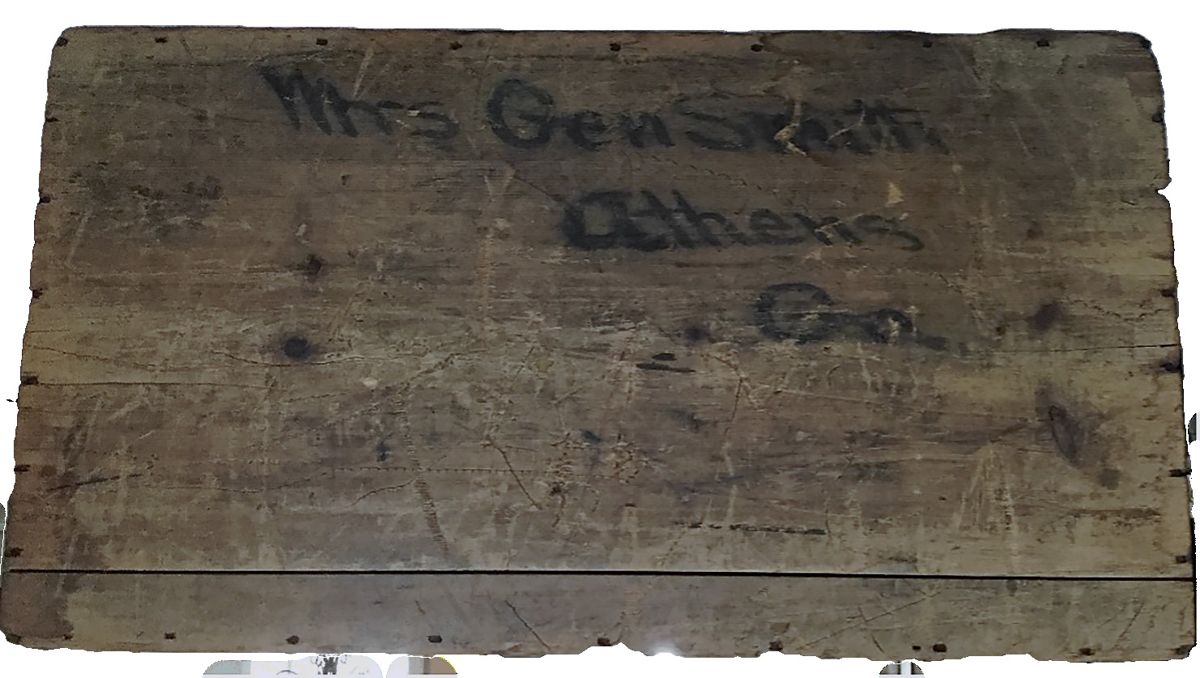
Bottom of box that all General Smith’s affects were found including uniforms, epaulets, insignia, and kepi.
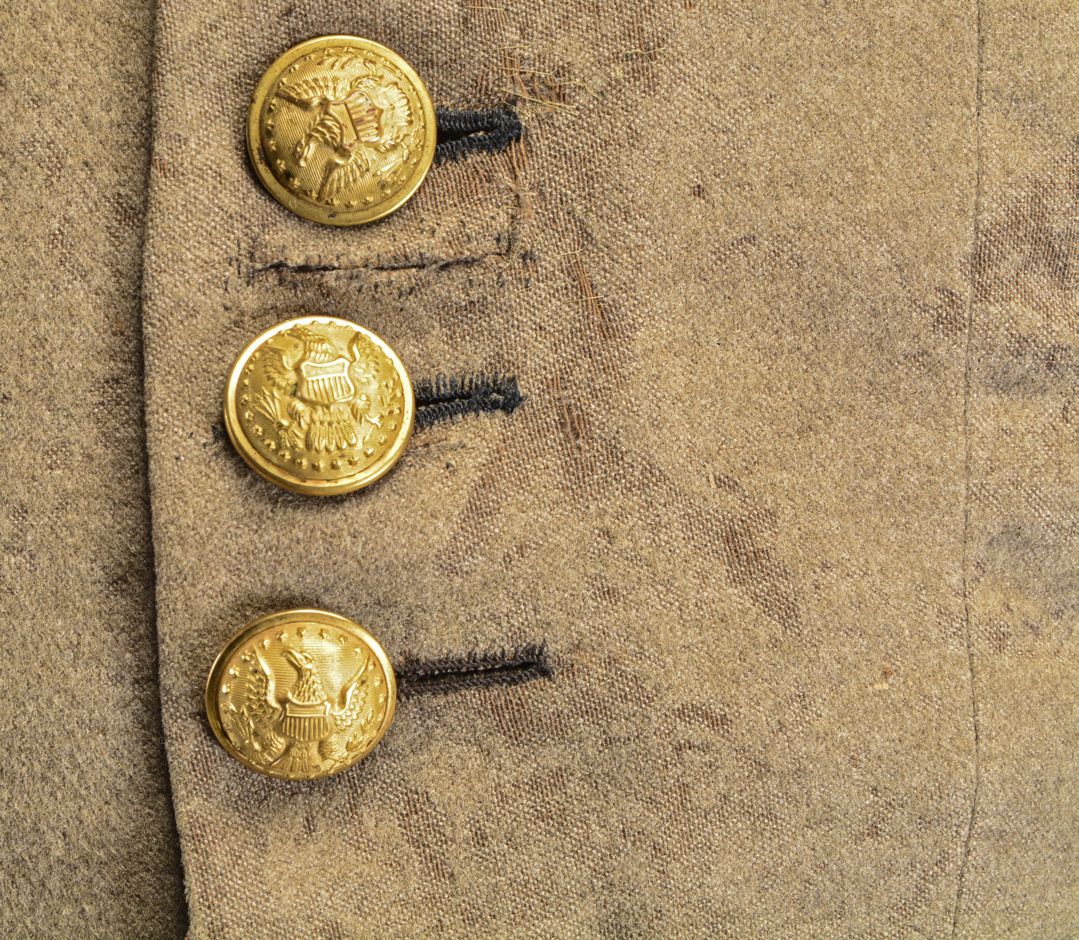
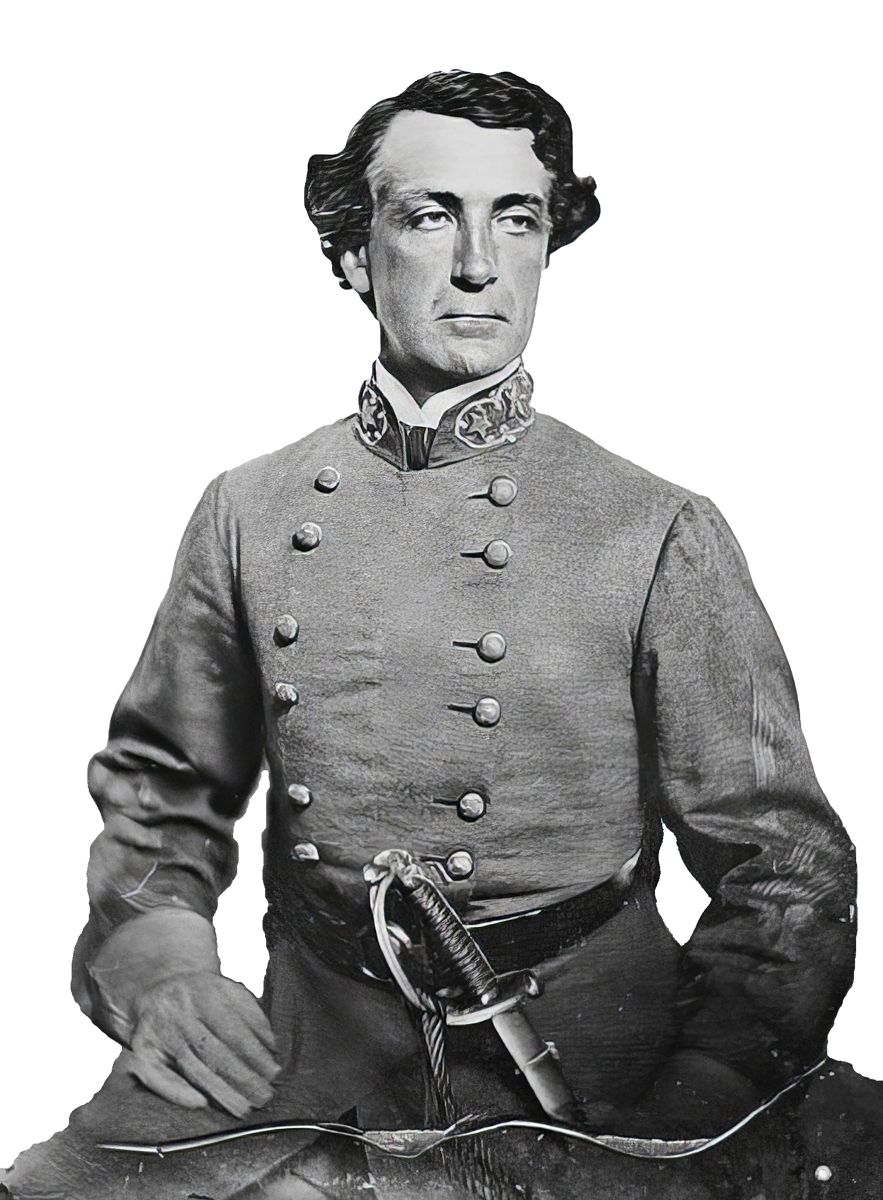
Smith was commissioned colonel of the 22nd Louisiana Infantry. He was soon promoted to brigadier general, and after the loss of New Orleans, Smith took command of an infantry division in Vicksburg while improving the city’s defenses and designing earthworks. Smith was confirmed as a major general in April 1863. During the siege of Vicksburg, Smith’s troops held the left side of the Confederate line, opposing Gen. William Tecumseh Sherman’s forces. Smith was captured with the fall of Vicksburg. In the spring of 1864, Major General Smith became Robert E. Lee’s Chief Engineer for the Army of Northern Virginia. By July, Smith was reassigned as Chief Engineer of the Army of Tennessee under Lt. Gen. John Bell Hood. His last assignment was in Mobile, Ala. As Chief Engineer of the Department of Alabama, Mississippi, and East Louisiana, he erected the defenses at Spanish Fort in Blakely. After Mobile fell, General Smith was paroled on May 8, 1865, and returned home to Georgia. After the War, he worked as an engineer for the Alabama & Tennessee railroad. He died July 29, 1866, in Savannah, Ga., at the age of 47. The New York Times reported that he was “attacked by an inflammation of the bowels” and was buried in Athens, Georgia. Martin Luther Smith was promoted to brigadier general on April 11, 1862, and had his photograph made in this coat with its brigadier general configuration. He was promoted to major general less than a year later in April 1863. The coat was then modified by quite expertly resewing button holes and changing the positions from groups of two to groups of three.
Courtesy Poulin Antiques & Auctions, Inc.
The gold/buff stand up collar has metallic braid hand stitched in scrolls which originally held three bullion stars on either side. The central star on each side is missing but the original sewing threads are still present outlining that star.
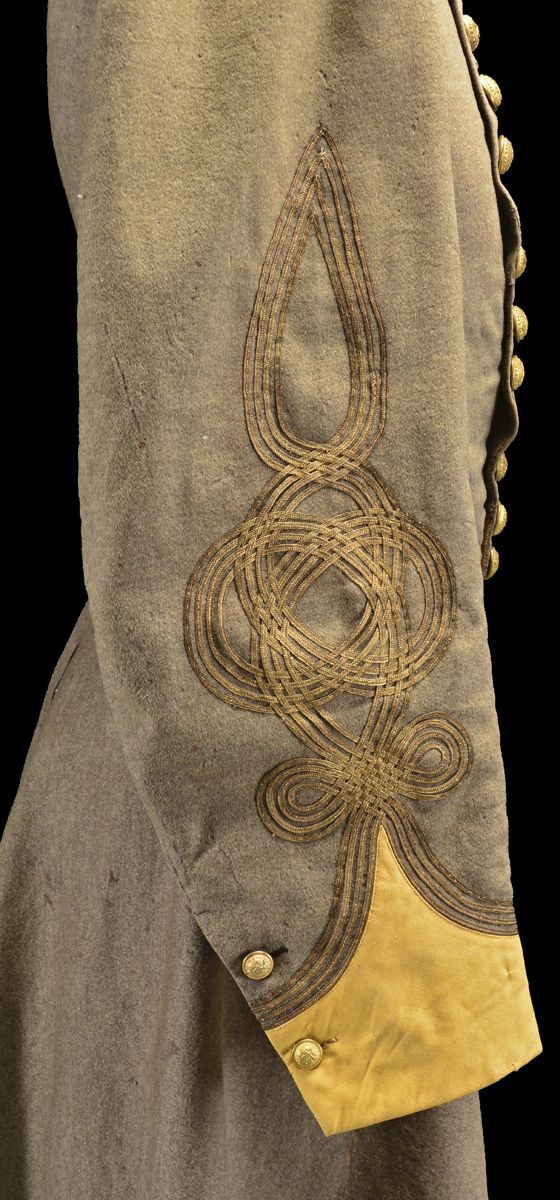
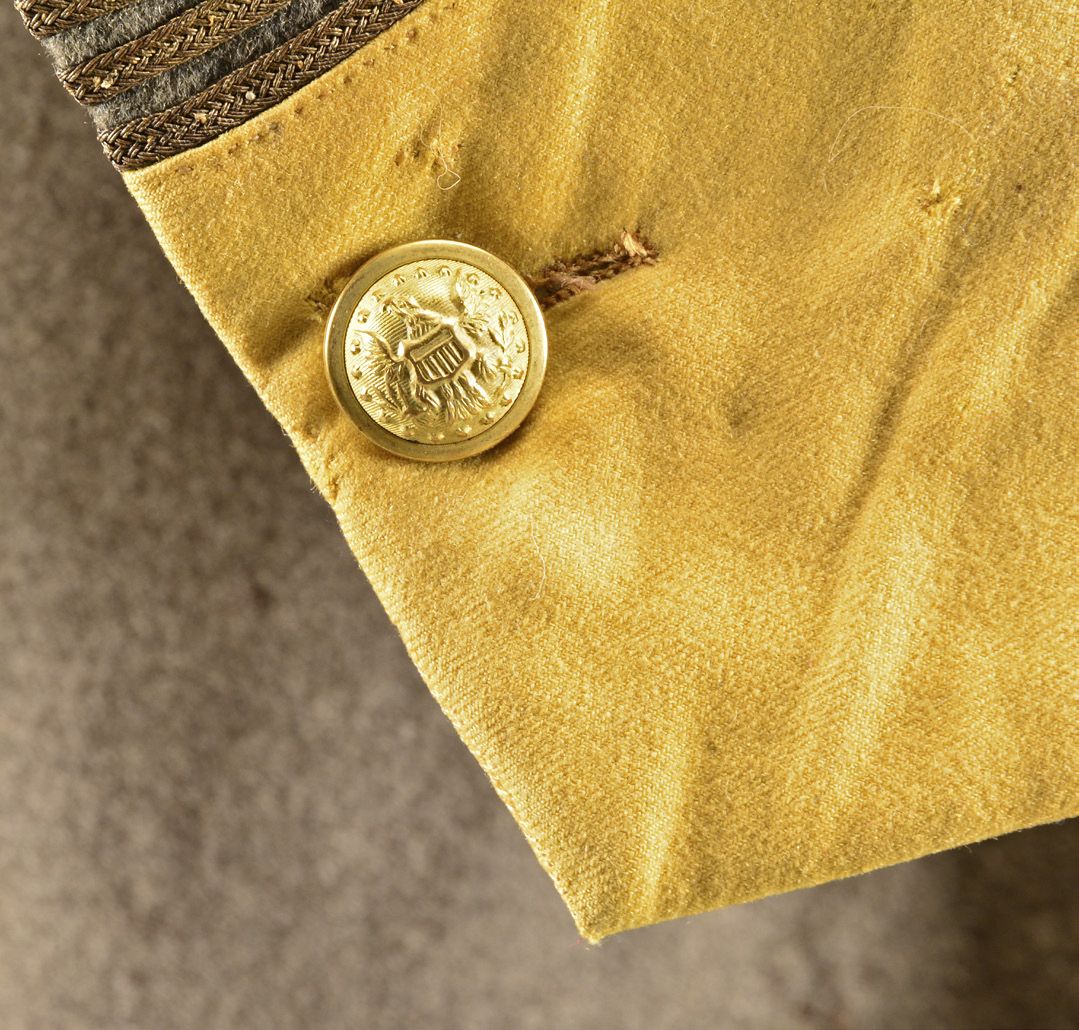
Sleeves balloon to 8 ½ inches at elbows with 4-strand flat metal quatrefoil braid terminating in regulation gold/buff 5 ½ inch cuffs. An ambrotype taken of Smith as a brigadier clearly shows the unique scrolled metallic braid.
Conservation using original nearly identical original embroidered star of correct matching size, amazing happenstance after two year search by conservator Henry Cooke IV Costume Services of Boston.
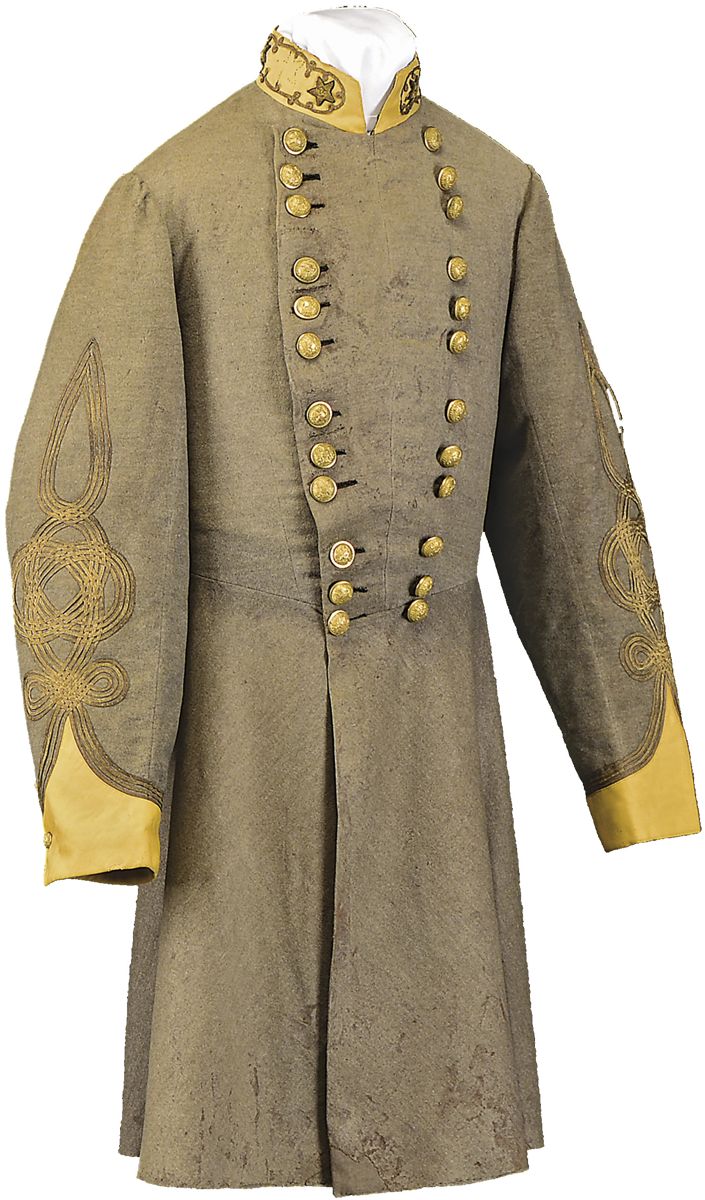
There are 32 general staff domed eagle buttons. The coat is finely lined with green/ olive silk and quilted on the breast panels. Two pockets on the inside of the tails are lined with a brown/red cotton twill.
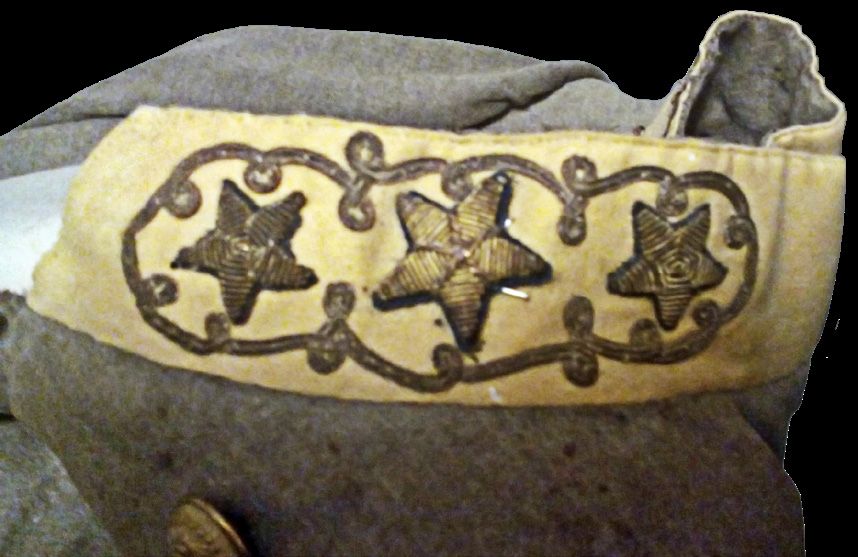
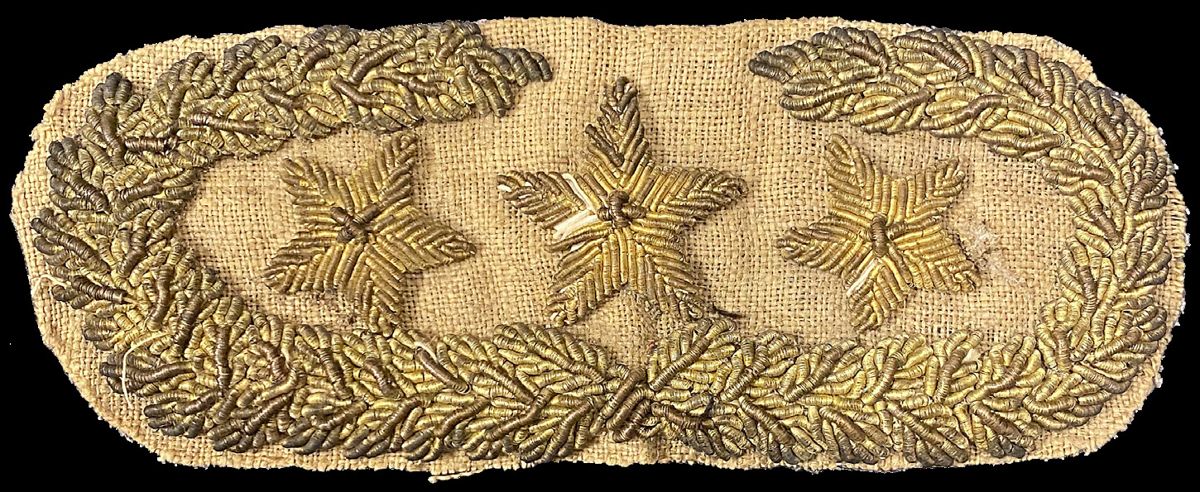
One of Maj. Gen. Martin Luther Smith’s uniform insignia.
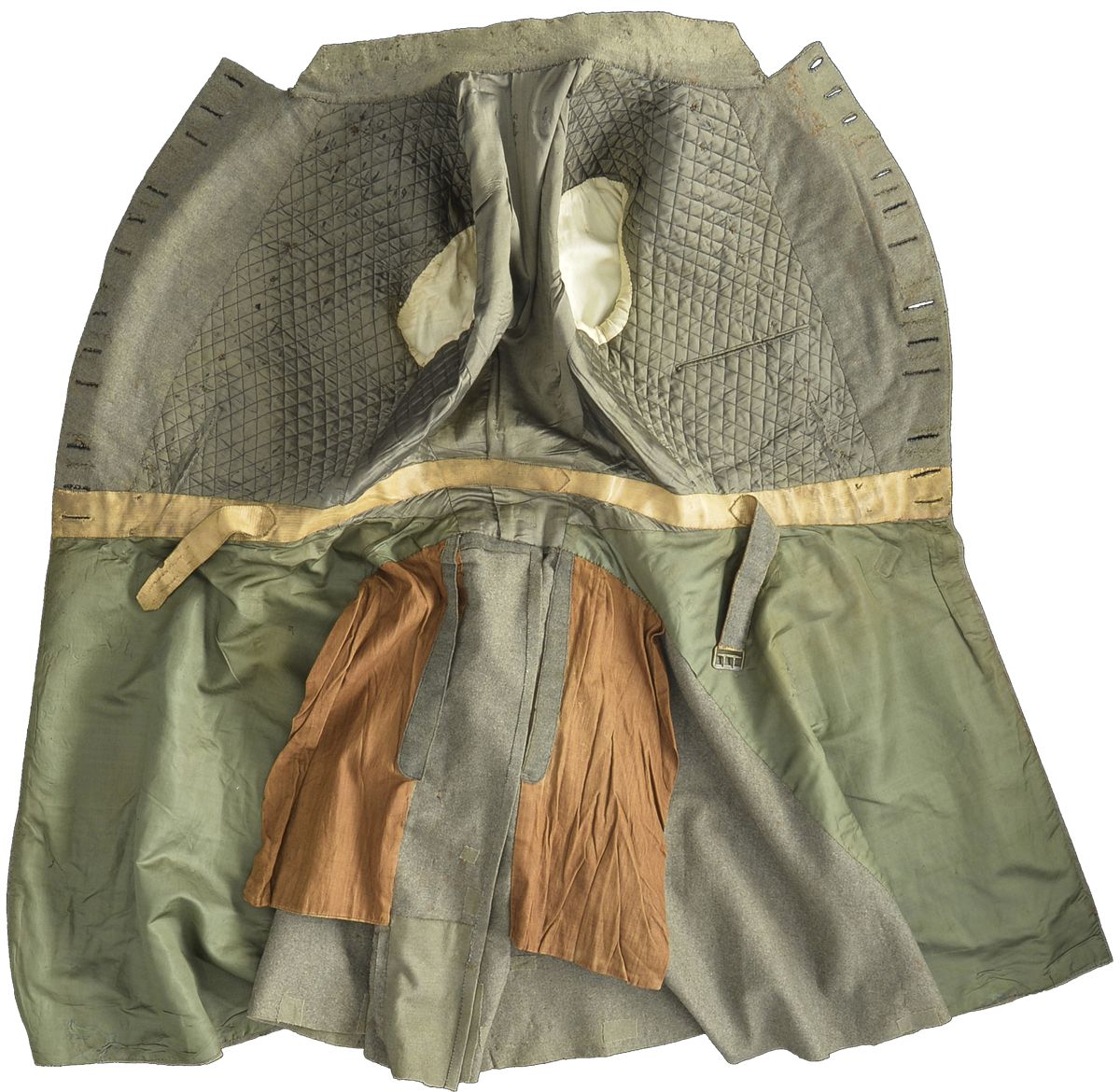
Inside of Smith’s frock coat. The body is lined and quilted, also typical tailoring, with a single interior pocket in the left breast and two tail pockets accessible from the inside. The coat has cloth belt loops on each side just above the waist.
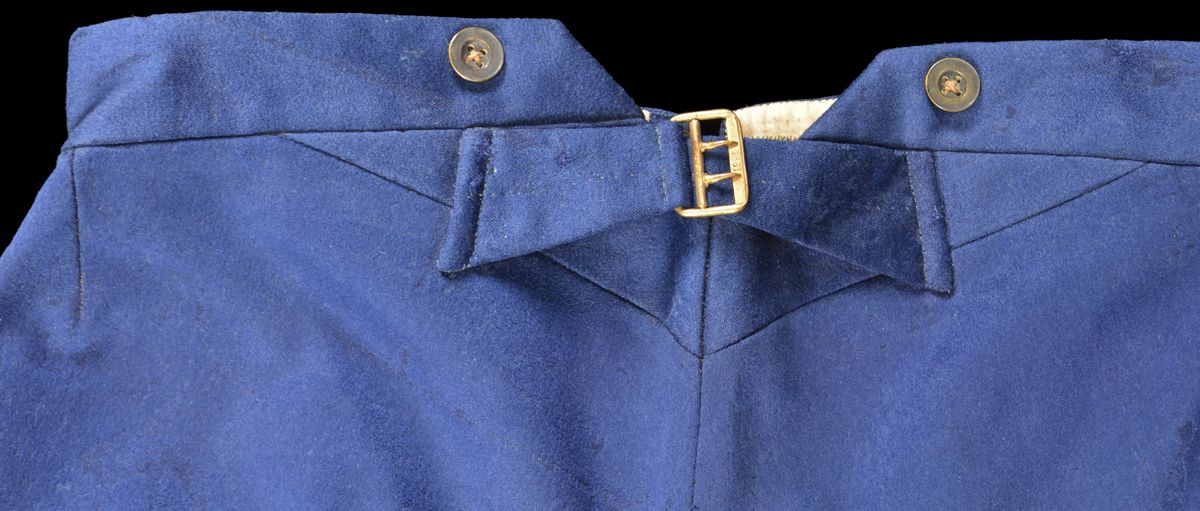
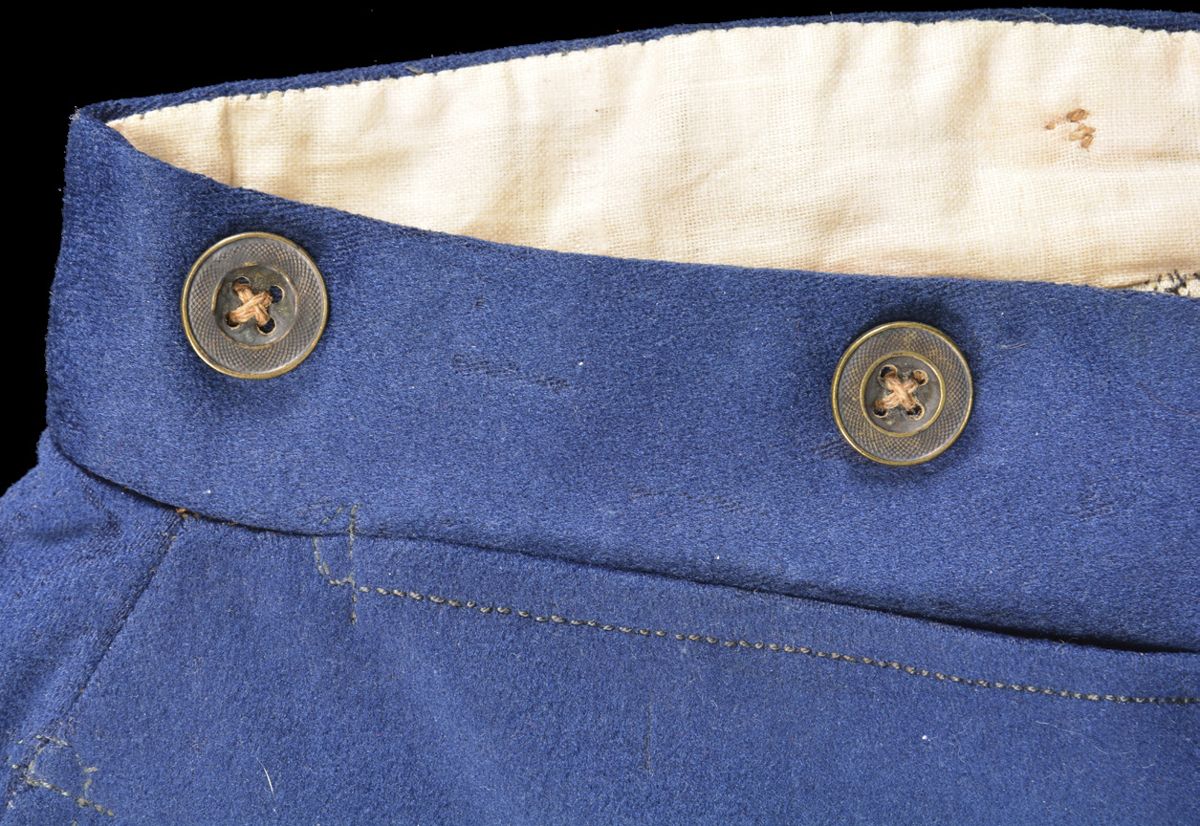
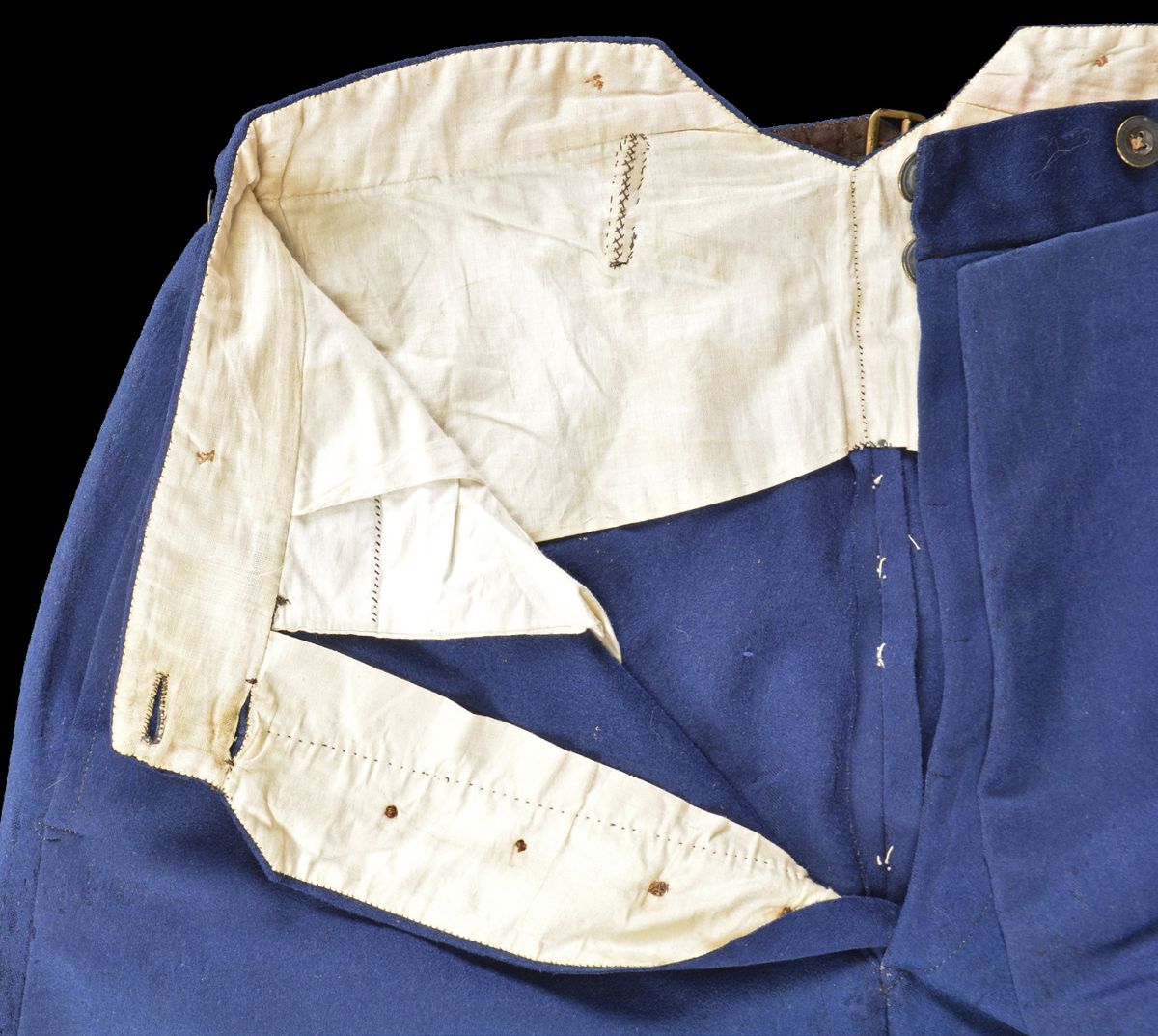
His blue wool military trousers have front button flap with four hand stitched bone buttons, two flat metal buttons in the waist band, cotton lined waist lining and pocket linings. The pant cuffs are partially lined in blue and white decorated silk. Identified military trousers are virtually non existent to Confederate General officers.
Mexican War Topographical Engineer Epaulets and Hat Insignia
Smith’s insignia from one of his epauletes.
These are the epaulets worn by Lieut. Martin L. Smith during the Mexican War. They feature 14 mm topographical engineer buttons at the ends for attachment, with gilt, raised brass borders and gold braid edging. The epaulets include cut-out silver letters in Old English script, “T” and “E,” with a small silver star positioned between them. Between the letters is a metallic embroidered shield measuring approximately 2 inches across. The embroidered hat insignia features the same shield design, enclosed within an oak leaf and acorn wreath.
Smith also had a heavier gray major general’s coat, devoid of collar or sleeve insignia decoration. When Smith was appointed chief engineer for Robert E. Lee, it made sense that a general inspecting forward positions and fortifications would want to avoid standing out to enemy sharpshooters. Rank could still be identified by the three-button groups, though these would not be noticeable from a great distance. However, quatrefoil and gold stars on the collar would have been more prominently visible.
Confederate Kepi with Oilcloth Rain Cover worn by
Maj. Gen. Martin Luther Smith
Regulation blue wool, five strands of quatrefoil stitched to the top of the kepi, and five strands of braid stitched over the roll of the crown at the front, back, and both sides of the kepi into the walls of the hat. Six strands of metallic braid are stitched around the perimeter of the kepi. A single strand of the same braid is on top at the base of the rolled edge. Kepi has a leather visor and leather chin strap. Kepi has a black silk lining. Kepi has a cardboard crown internally and a circular band of cardboard in the interior, which the quatrefoil and braid were sewn through during the manufacture. Kepi never had side buttons, as there is no evidence of sewing; though the chinstrap and oilcloth cover have button holes. This is a wonderful rarity, with no other Major General kepis extant in private hands.
Maj. Gen. Martin Luther Smith’s Confederate Sword Made by Thomas, Griswold & Co., New Orleans
This very rare New Orleans-made eagle head pommel Confederate staff officer’s sword was carried by General Martin Luther Smith during the Civil War. It is featured in an early-war photograph, where Smith is shown wearing the sword along with the uniform discussed in this article. The sword remains in the possession of the family to this day, along with several other artifacts highlighted in this article. It is in remarkable condition, retaining most of its original bright, lustrous, and intricately etched blade. The brass hilt and scabbard also preserve much of their original gold plating. Although the original twisted wire wrapping has come loose, it may still be meticulously restored to its proper position by a skilled conservator. This sword, along with several other items, remains in the care of Smith’s descendants.
Letters C. S etched on the blade.
About the Author
John Sexton holds the highest designations as certified appraiser of personal property with International Society of Appraisers (ISA-CAPP) and accredited senior appraiser with American Society of Appraisers (ASA) specializing in Civil War memorabilia. He authenticates and evaluates other rare and valuable historic items as well. He is coauthor of the book Confederate Bowie Knives (2012) with Jack Melton and Josh Phillips, published by Mowbray Publishing Inc., and author of many periodical articles on Confederate arms. John’s contact information: website: www.civilwarappraiser.com, email [email protected], cell 770-329-4984.