
John C. Hayes: Defender of Texas
By Robert Swartz · Originally published September-October 2024 · pp. 29–45
In 1832, the eighteen-year-old Connecticut Yankee Samuel Colt invented the modern revolver. Who would not want to trade in a single-shot pistol for one that could fire five times without reloading? After securing British and American patents, in 1837 Colt began manufacturing revolvers, pistols and rifles, at his Patent Firearms Company in Paterson, N.J. All he had to do was sit back and, like the proverbial inventor of the better mouse trap, wait for the world to beat a path to his door. It didn’t happen. The public wasn’t interested, the army’s Bureau of Ordnance was dead set against it, and the financial Panic of 1837 sent the national economy into a tailspin. Colt persevered, but in 1842 his company fell into receivership. Bankrupt and hoping to find something that would stick, Colt moved to New York where failure dogged him like his shadow.
The Republic of Texas Two years later and half a continent away in the Republic of Texas, unbeknownst to Colt, his invention was about to revolutionize frontier warfare. In 1835, settlers of the Mexican state Texas declared independence from Mexico, established the Republic of Texas, and went to war. The Texas War of Independence ended on April 21, 1836, when its army under General Sam Houston defeated the Mexican dictator Santa Anna at San Jacinto. The United States recognized the Republic, but the Mexican
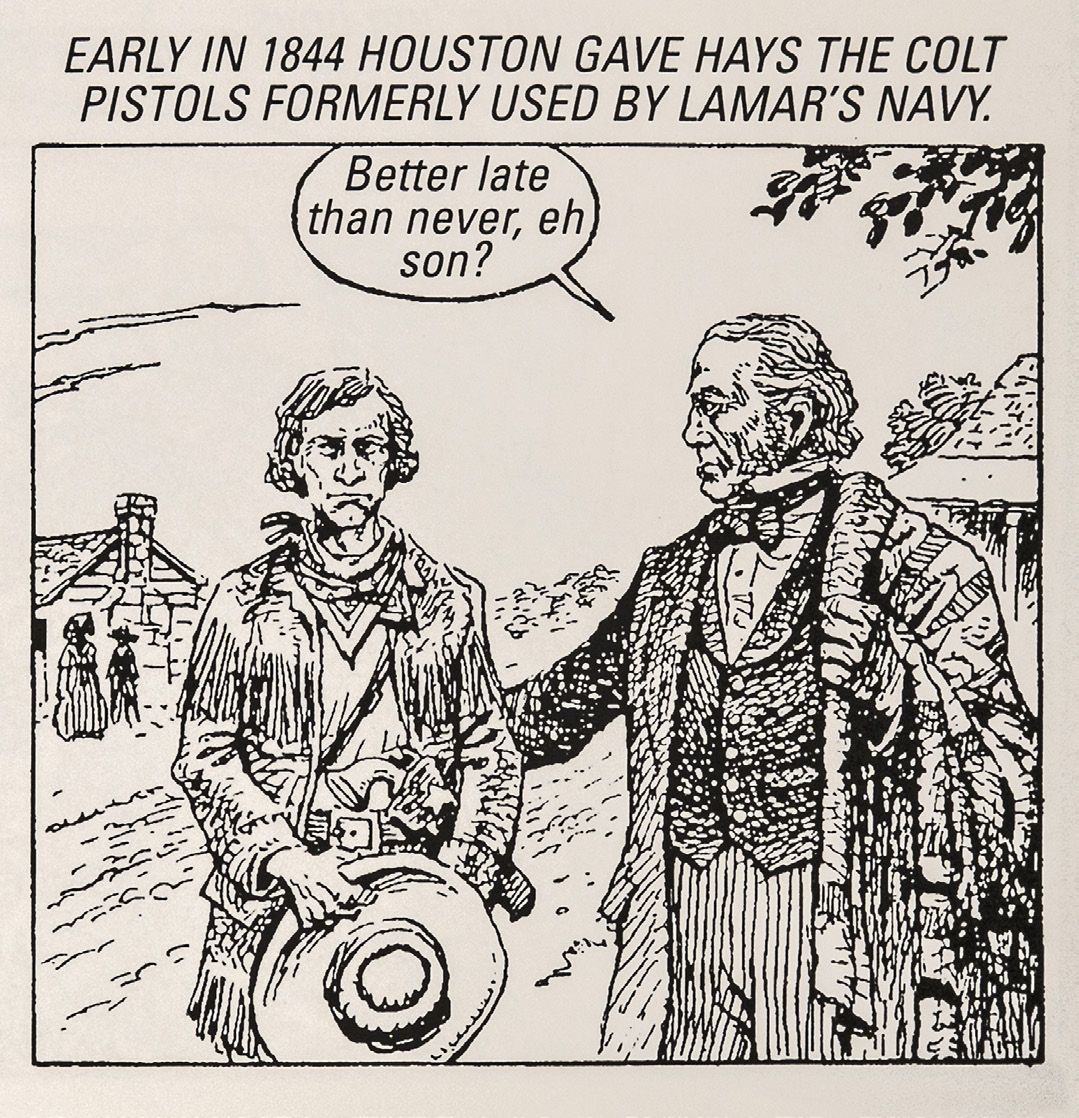
Republic of Texas president Sam Houston disbands the navy and gives its Colt revolvers to Captain John C. Hays, Texas Rangers, San Antonio. Jackson, Jack. (2007) New Texas History Movies, Texas Historical Association.
government claimed Texas was a renegade state and still hers. Powerful enemies beset Texans. The Mexican army never gave them a moment’s peace.1 Mexican bandits preyed on commercial supply trains. And the Comanches, the Lords of the Plains, slaughtered and kidnapped settlers at will. All that stood between Texans and their enemies were a small, underfunded army, militia, and the Texas Rangers.2
Texas Rangers
“Hays’s Big Fight” or the “Battle of Walker Creek” by Nick Eggenhoffer (1897–1985). Texas Rangers, in the first organized fight with Colt repeaters, made their shots count.
Rapacious, cruel, and brutal, and the only tribe that fought from horseback, the Comanches were Texans’ most fearsome enemy. Their primary weapons were the fourteen-foot lance and bow and arrow.
The shock of a lance attack could break an enemy’s line, but close-in the weapon was unwieldy. Most awesome was the Comanche’s firepower with bow and arrow. Attacking at a dead run, a skilled warrior, notching arrow after arrow, could loose a torrent of well-aimed missiles that found their marks or buzzed like maddened hornets about the ears of his enemy. Against this, the Rangers’ primary weapon was the single-shot musket. Defending from cover and having to reload after each shot was asymmetric warfare at its worst.
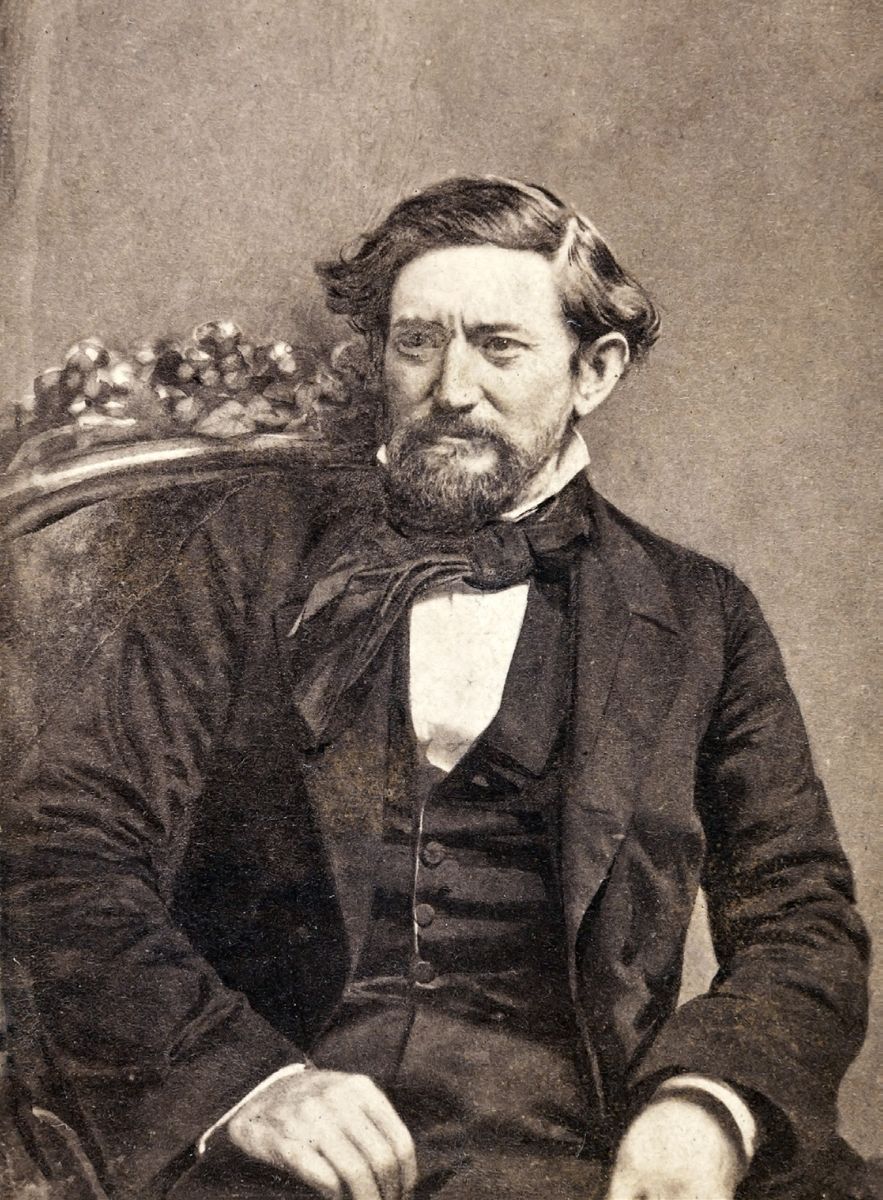
Captain Jack John Coffee (“Jack”) Hays, a surveyor from Cedar Lick, Arkansas, arrived in San Antonio toward the end of the Republic’s War of Independence. He immediately joined the Texas Army and then the Rangers. When surveying tracts granted to war veterans, Hays frequently encountered hostile Comanches. Though lacking their firepower, he put them on defense by training his men to fight as they fought: making cold camps, taking positions by stealth, and charging like screaming banshees. Rising quickly through the ranks, Hays was promoted to captain and made commander of the Ranger Company out of San Antonio. Now, way back when Sam Colt was first making guns, in 1837 or 1838, Commodore Edwin Moore, commander of the Republic of Texas Navy, wanting repeaters for covering and repelling boarders, purchased from Patent Firearms a sizeable number of revolvers and rifles.3 The largest sale to a single buyer, it did not affect the company’s fortunes, but in time it would set off an improbable series of
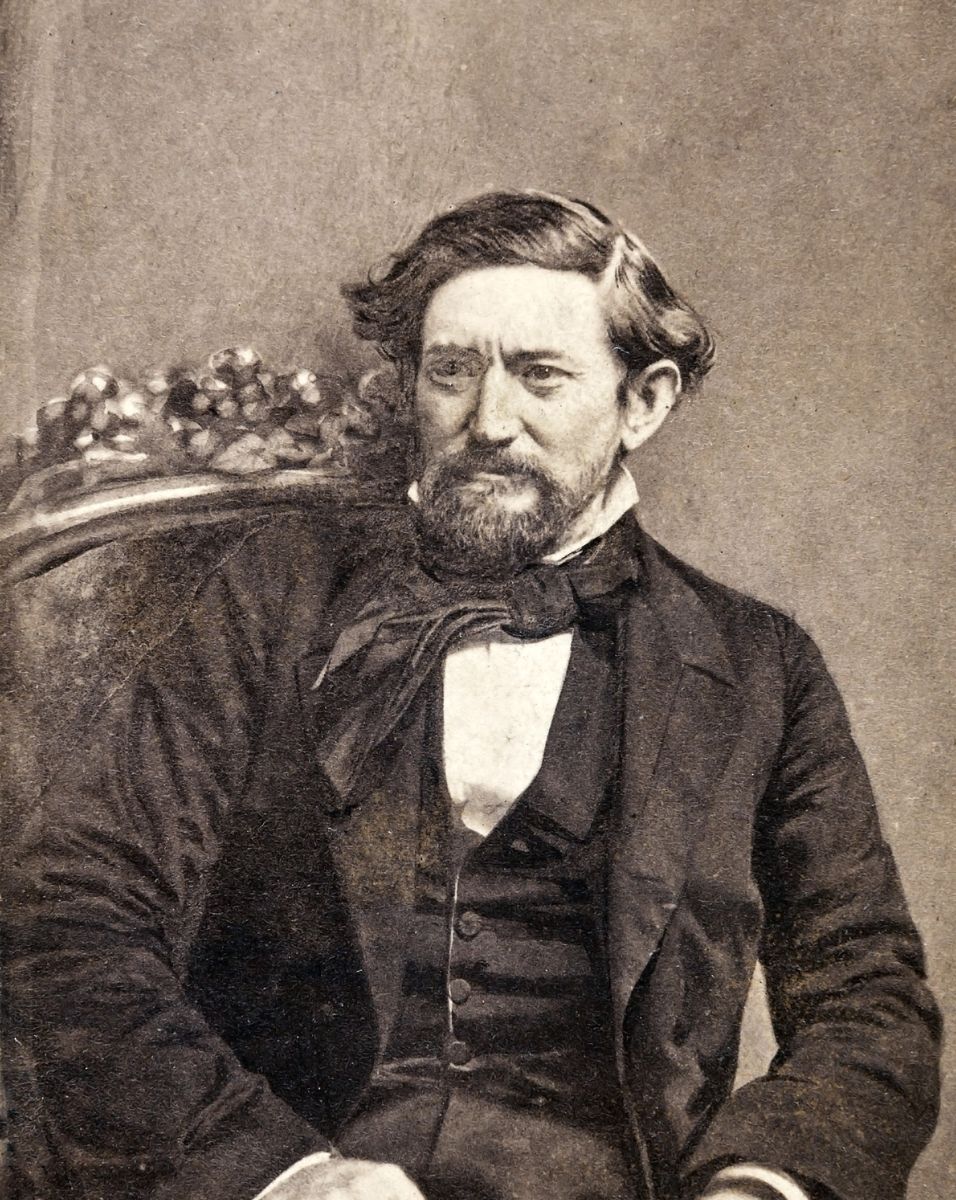
CDV of John C. Hays, by Mathew Brady, D.C. 1858.
events that would see Colt rescued from bankruptcy and raised to the heights of fame and fortune at the beginning of the Second Industrial Revolution. In early 1844, Republic of Texas President Sam Houston disbanded the Texas Navy and sent 180 of its Colt revolvers to Jack Hays in San Antonio. Experienced with the weapon, Hays trained his men to use the Colt from horseback and doubly armed them so each man could fire ten shots without reloading. In June of that year, Hays led fourteen Rangers on a
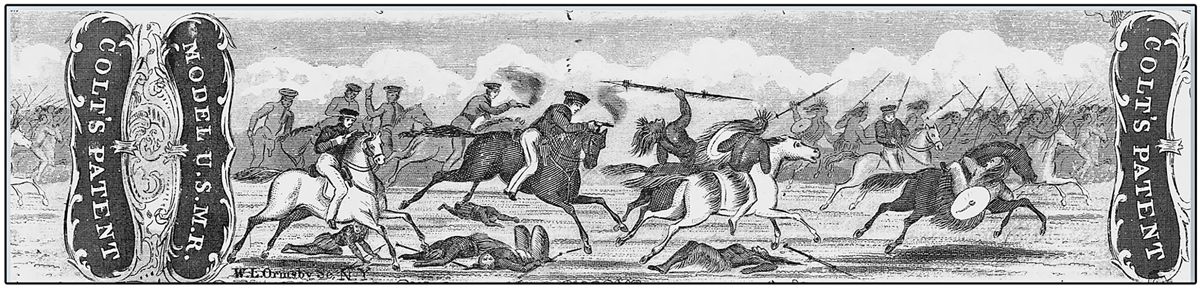
W.L. Ormsby designed the “Hays’s Big Fight” cylinder scene that was roll-died on Walkers and later Dragoons. Not knowing what Texas Rangers looked like, Ormsby showed them as U.S. Army Dragoons. On the black horse, Sam Walker leads the charge. Hays, on the white horse, follows. Hays never forgave Colt for the insult.
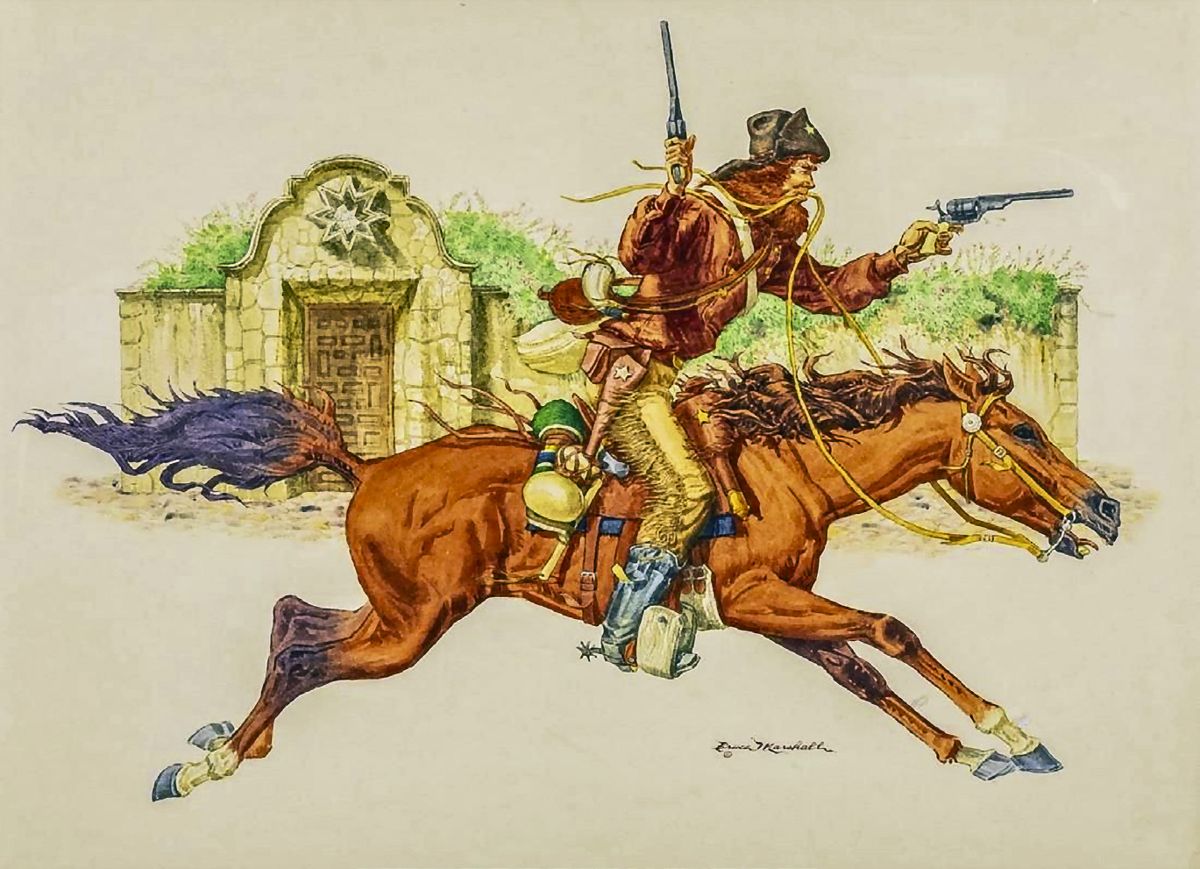
The Mexican War Texas became a state in December 1845. Like night follows day, the United States and Mexico soon went to war. President James Polk ordered General Zachary Taylor to take up positions in Texas and from there invade Mexico. Taylor’s Dragoons were adept at screening and reconnaissance, but in combat they dismounted and fought like infantry. To protect his lines of communication and supply from roving lancers and Mexican bandits, Taylor needed horse soldiers—he needed the Rangers. Texas Rangers provided the Eastern press all the color and heroics they could ask for. This Ranger is armed with a pair of five-shot .36 caliber Paterson revolvers. “Rip-Roaring Ranger, Mexican War, 1846,” Bruce Marshall (Texas, 1929–2015).
Promoted for his new command, Colonel Hays had no problem raising volunteers.6 He appointed Lt. Col. Sam Walker and Major Ben McCulloch subordinate commanders.
scout northwest of San Antonio. About forty miles out, they ran into a Comanche war party five times their number. From atop a small hill, the Comanches shouted insults and dared the Rangers to fight. The Indians were familiar with Ranger tactics. Hays had surveyed the land—he knew the terrain. The Indians waited for the Rangers to discharge their muskets and then take cover to reload. But on this day, Hays didn’t follow the old script. Instead, he slowly walked his men forward until they disappeared from the Comanches’ view at the base of the rise. Hugging the hill, they circled right and then spurred their mounts up the earthen slope. Reaching the crest, the Rangers smashed into the enemy’s left flank. They drew beads, fired their muskets, and then took up their Colts. As Hays shouted, “Close with ‘em, powder burn ‘em,” the Rangers waded in and blasted braves from their saddles at point-blank range. When half the Indians were on the ground dead or wounded, the others fled out like billie bejeezus. Three Rangers were gravely wounded, and one was killed.4 Hays’s Big Fight, also called the Battle of Walker Creek, proved the value of repeaters in frontier warfare and marked Jack Hays’s Rangers as the first mounted anti-insurgency force in North America.5 No one in the East heard of this for years.
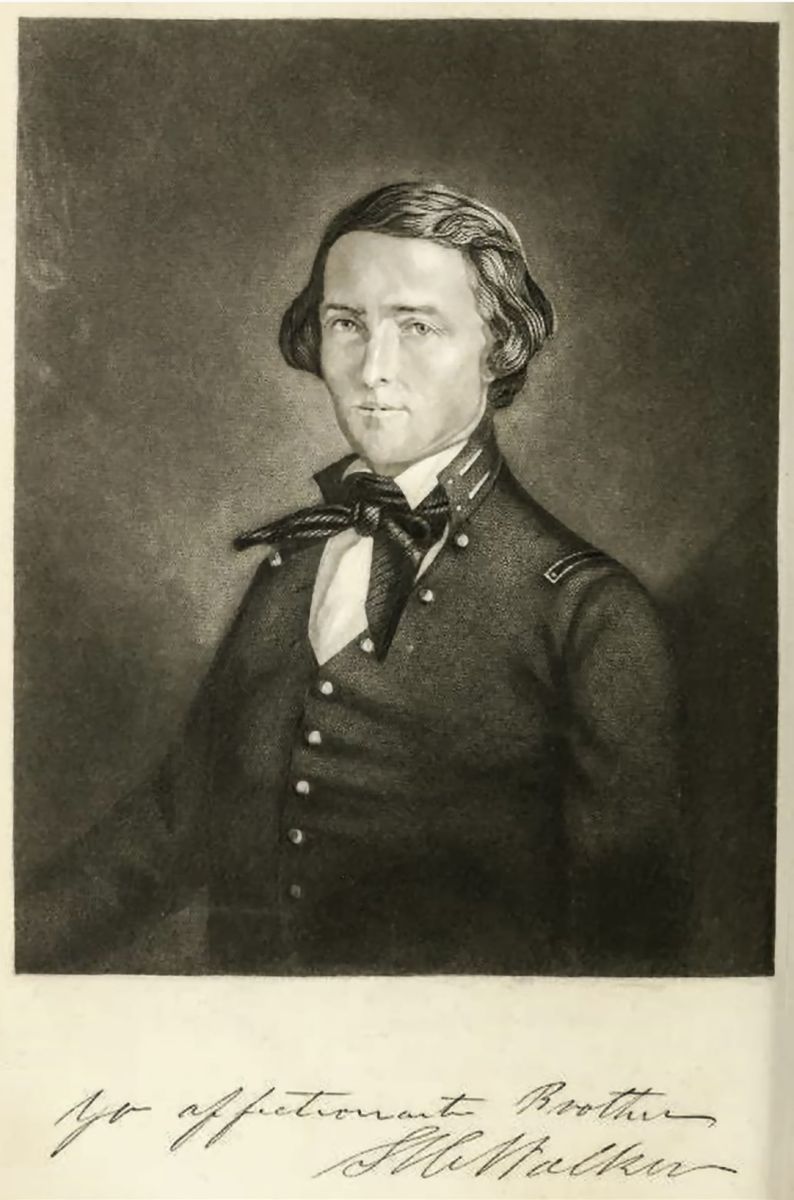
Captain Samuel Walker, United States Mounted Rifles, 1847.
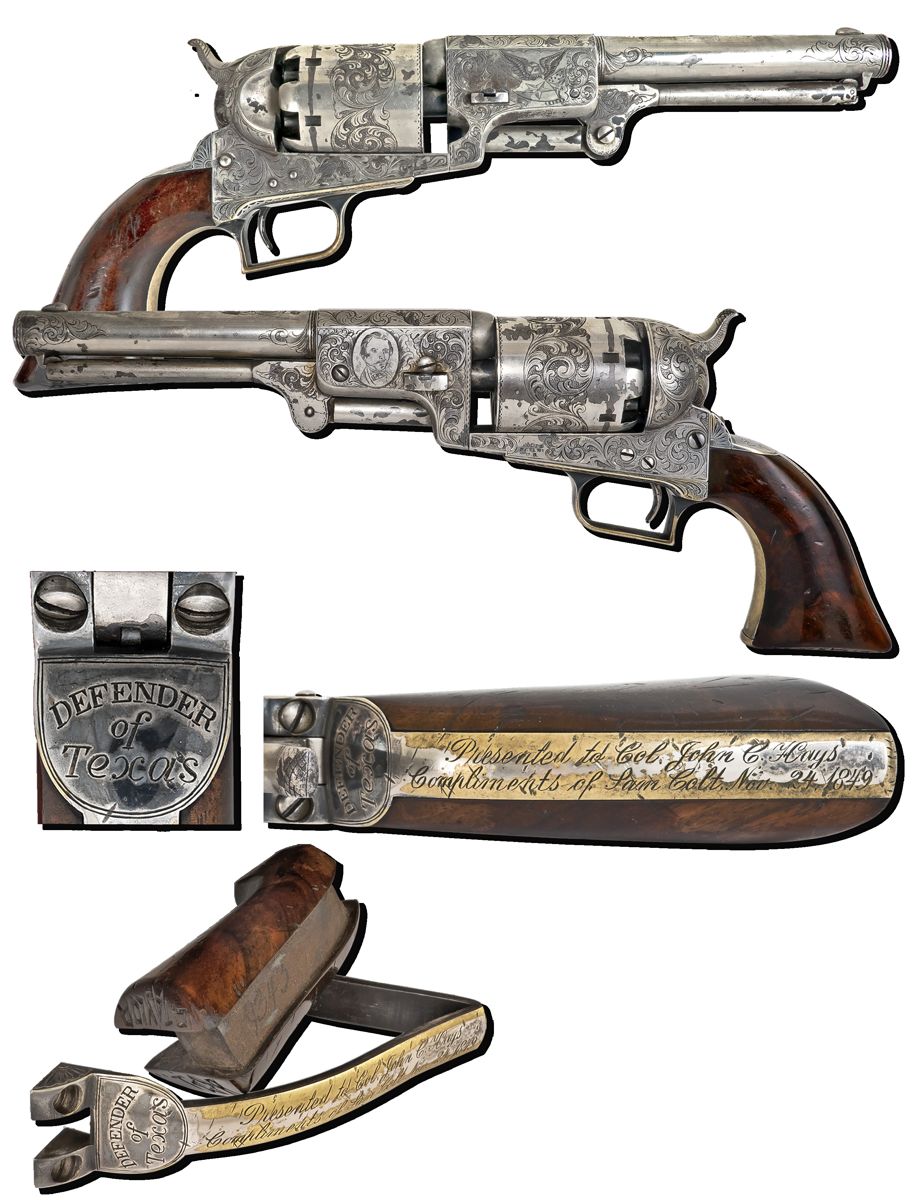
From the 1850 Exhibitions 2nd Model Dragoon, 9343.
Under microscopic examination, it is apparent the gun was Böettger plated post-engraving.
Presented to John C. Hays in 1851.
The inscription was cut with a burin. The absence of tarnished silver in the cuts evidences it was inscribed post-plating.
Backstrap shield sentiment is reserved for presentations to John Hays and Ben McCulloch. One piece walnut stocks are serial numbered to the gun by black pen. The butt is carved with the name C. Taylor, T [star] R to whom Hays gifted the gun.
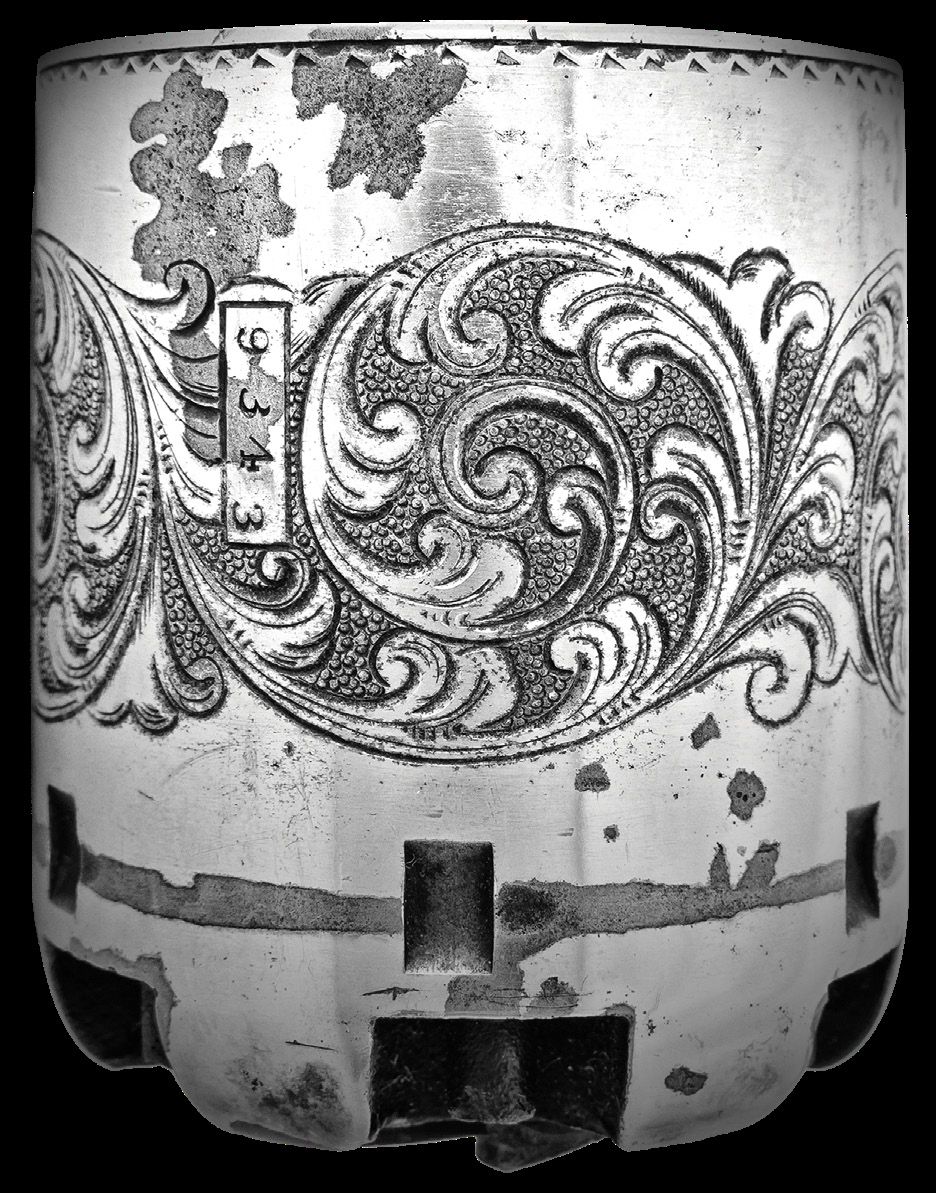
L.D. Nimschke’s hallmark, an eternal scroll with no beginning or end.
The wedge and arbor, numbered to the Dragoon, show with the cylinder’s honest aging and wear.
Seen here on the trigger guard and frame are the punch dots that mark guns for special handling, which in practice seems to have been reserved for guns that were to be engraved. A small “o” on the left frame beneath the stocks indicates the gun was condemned by an Ordnance inspector.
New York barrel address is standard for Dragoons. The scroll work on the flats and top of the barrel, not being distinctive, could be by L.D. Nimschke or another journeyman. Putting up 50 guns for the 1850 exhibitions, specific work was probably divided amongst a number of engravers.
Correspondents of the Eastern press found all the color and heroics they could ask for in the Texas Rangers. Hays, Walker, and McCulloch became national heroes, their names household words. After Taylor’s victory at Monterey, Polk ordered General Winfield Scott to end the war by marching from the port of Vera Cruz to the Mexican capital, Mexico City. As the action moved to that theatre, Taylor began discharging volunteers.7 Hays and Walker’s enlistments were about to lapse, but they were still needed. General Scott asked Hays to raise a new regiment and join him at Vera Cruz. The War Department offered Walker a captaincy in the regular army. The two men powwowed in New Orleans. The Rangers had taken such Colts to Mexico as they had, but they could have done with a lot more. Hays and Walker agreed they needed revolvers that were more deadly than the .36 caliber Patersons they had been using and enough of them to arm each man with two guns.
The Phoenix Newspaper stories occasionally mentioned that Rangers carried Colt revolvers. Naturally, this set Colt’s blood racing. So when, in November 1846, he read that Walker had accepted the captaincy and was at the Capitol recruiting and after new weapons, Colt promptly wrote to him. He stood, Colt said, ready, willing, and able to supply Walker and Hays all the repeaters they wanted. He also asked Walker to describe specific instances in which the Rangers’ use of his guns surpassed the performance of single-shot arms.8 One of the federal arsenals or an established gunmaker could have made the guns Walker and Hays were after, but Colt held the patent. Responding to Colt on November 30, Walker praised the repeaters and gave a fair account of the Big Fight. The men met in New York the next day and began discussing plans for a .44 caliber revolver that, at a distance, could kill the horse of a charging lancer. The result was a behemoth that weighed four pounds, nine ounces. At that weight, it would have to be carried in a pommel holster. What happened next remains a mystery because a newly commissioned captain does not waltz into the War Department and walk out as the government’s agent to sign a significant contract for a new weapon.9 A week later, on December 7, Walker wrote Colt saying he had the authority to do just that.
You could have knocked the man over with a feather. With no factory, not having made a gun in five years, and the Bureau of Ordnance adamant that the government should not adopt the revolver, Colt was not blind to the challenges. But come hell or high water, he would not let slip from his grasp the opportunity to bask in the reflected glory of the Texas Rangers. Hitching his wagon to Sam Walker, he called the new model the “Walker.”10 To capitalize on the Texas Ranger connection, he had the banknote engraver W.L. Ormsby create a panorama to be roll-died onto the guns’ cylinders. The subject was Hays’s Big Fight. A clever marketing device, few would notice or care that the scene showed Walker on a black horse leading the charge.11 Hays arrived in D.C. in March. He met the president, had a full social calendar, got down to the business of finalizing the details of his men’s enlistments, and, of course, revolvers. The first shipments of the new guns were to go to Walker. Hays nixed that. He got dibs. That struck Colt like a thunderbolt. Quickly writing to Hays, he implored the colonel to meet him in New York or D.C. Hays did not reply, not ever. On June 3, Colt sent Hays a pair of civilian Walkers. In his obsequious letter, Colt tried to paper over the insult. Hays didn’t want to hear it. How Colt got Eli Whitney Jr. to make the Walkers at his New Haven factory, the obstacles he had to overcome, when the guns were shipped, and to whom is covered in excellent sources to which the reader is referred.12 The Rangers and Texas had captured the nation’s attention and imagination. If Walker had survived the war, Colt would have had his spokesman. But Walker was killed not long before hostilities ended. For Colt’s purposes, that left Hays and McCulloch. McCulloch would gladly have promoted Colt’s arms—the two men later partnered in some ventures.13 But the brightest star in the Ranger firmament then read “Hays.” For more than a century, every Ranger wanted to be like Jack Hays and the obituaries of those who fought under his command never failed to say, “He rode with Hays.” Ever persistent, in 1848, Colt sent Hays Whitneyville Dragoon, 1166. The backstrap was inscribed John C. Hays presented by Samuel Colt. The backstrap shield was engraved with a sentiment: a fivepointed star above TEXAS. Covering his bases, Colt presented a similar Whitneyville Dragoon to McCulloch.
President of France, Louis coronated Napoleon III in 1852.
Napoleon,
John C. Hays, ca. 1857. William S. Jewett (1792–1874).
Portrait of 9343.
Portrait of John C. Hays engraved on Model 1851 Colt Navy 98229.
Colt M1851 Navy Revolver, .36 caliber. Serial number 98229. Presented by Col. Sam Colt to John C. Hays.
Hays gave the Dragoon to fellow Ranger Creed Taylor (1820–1906) who,in honor of his commander, named his son John Hays. Four years after Taylor’s death, Ben Stuart of the Galveston Daily wrote to Colt Firearms in an attempt to authenticate the gun. Colt replied that the relevant records had been destroyed in the fire of 1864.
Gold medal awarded to Samuel Colt by the American Institute of New York in 1850. Image courtesy of the Wadsworth Atheneum, Hartford, Conn.
Veteran Colt collector S.P. Stevens and his wife, Elizabeth, pose with the Dragoon for a publicity photo promoting the San Antonio Conservation Society Ball of 1958. San Antonio Express & News, September 21, 1958.
Colt heard back about the guns. David Torrey, who ran trading houses in Texas with his brother, wrote to Colt saying both men were fed up with the heavies. They wanted weapons they could carry in belt holsters.
On His Own Anxious to free himself from Whitney, Colt opened a small factory in Hartford in 1847. Most demand for his arms no longer came from the government but from emigrants flooding trails west. They, too, wanted smaller guns that could be carried in a belt holster. That led to the Colt .31 caliber Baby Dragoon and the .31 caliber Pocket Model of 1849. Colt moved to larger quarters in 1849 where he intended to realize his vision of what would become known as the American System of Manufacture: the progressive assembly of interchangeable parts fashioned from purpose-made machines into finished goods. Colt did not know how to fulfill his vision, but he found someone who could. By early 1849, the mechanical genius Elisha Root had Colt’s factory turning out 150 guns a day.14 Not one to let grass grow under his feet, leaving Root to run the factory, Colt’s cousin and banker Elisha Colt to handle finances, and Colt’s stepmother’s brother Luther P. Sergeant to manage the business, Colt sailed for Europe.
Colt Storms Europe His first major stop on the Continent was at St. Cloud, France, the residence of Louis Napoléon Bonaparte, president of the French Republic.15 Colt presented the president, what else, a pair of revolvers. Whatever Napoléon thought of the repeaters, Colt grew wide-eyed seeing firearms embellished by European master engravers. He also took note of electroplating. Firearms were browned or blued immediately after manufacture to prevent them from rusting.16 Electroplating, invented in 1840, also protected metal from corrosion. The elements most amenable to electroplating were gold and silver. They were primarily used for ornamentation. Not only were they expensive, but being soft (Mohs hardness 2.5-3.0), they could not hold up to even modest handling. Moreover, maintaining silver’s bright, mirror-like finish required regular polishing that would wear it away. In 1843, Dr. Rudolf Böettger of Frankfort, Germany, invented a method of electroplating nickel. Resilient (Mohs 4.0) and inexpensive, nickel protected metals from handling and the elements. Böettger plating was used primarily for commercial purposes because it could not produce the bright, mirror finish of silver.17 But Colt saw that with proper substrate preparation and vigorous after-plating polishing, Böettger-plating produced a handsome and lustrous finish with a slight gray cast that does not tarnish.18 To many, the plating looks like silver that could stand a bit of polishing. Colt and many European gunmakers Böettgerplated their arms. We know this because we regularly see such guns at auctions described as silver-plated, notwithstanding that after two hundred years, in defiance of the laws of nature, they have not tarnished. Bright, mirror-like nickel plating did not become commercially available until 1872 when, after years of tinkering with Böettger’s formula, Dr. Isaac Adams opened Adams Plating Company in South Wyndham, Connecticut. Böettger-plating is sometimes mistaken for tin. We can dismiss this notion as uninformed gun show table talk. Tin, with Mohs hardness of 1.5, ranks with lead, graphite, and softened butter. Charles Pate, who has examined more historical firearms records than anyone living or dead, stated in an e-mail exchange he has never seen any evidence of guns being tin-plated.19
Going for Gold Though his patents were not enforceable on the Continent, Colt saw others in his predicament gain a foothold by promoting their goods as winners of gold medals at industrial fairs.20 Colt had won gold medals, but after a decade, they had grown stale. He wanted new medals for a new market. Writing from Vienna on July 18, 1849, Colt alerted cousin Elisha that a shipment of thirty-five Boulle cases was heading his way.21 Made in the style pioneered by Charles Edwin Boulle, the cases, inlaid with bright metals, mother of pearl, and tortoiseshell, were themselves works of art. Colt demanded that the factory hop to and make guns worthy of the cases in which they would be displayed. He wanted them to be “in the most elegant stile [sic] possible … as good as can be made.”
He wanted to show America something beyond anything they had seen before. It was no small task. There were to be fifty guns in all: fifteen Dragoons (ten in pairs), twenty Baby Dragoons (all in pairs), and fifteen 1849 New Pockets. What was Elisha supposed to do with all these cased guns? He was to display them at the Fall exhibitions of the American Institute of New York and the Massachusetts Mechanic’s Institute in Boston and wherever else they could win gold medals. Colt said if Elisha wasn’t up to the job, he’d be back on the next ship and do it himself. No one at the factory had a clue what Colt was talking about. They didn’t know Boulle from Adam.
The only embellisher with whom they had contact was the designer of Colt’s cylinder scenes, W.L. Ormsby. Ormsby may have understood what Colt was after but knew it was a hopeless undertaking. Time was short, and there wasn’t enough engraving talent in the United States to do the work. Yes, there were banknote engravers like Ormsby, and in Hartford there were several engravers who could cut monograms on silverware and presentations on pocket watches. They could give it a whirl like bears trained to dance, but it wouldn’t be pretty. What happened? That year, there was no Colt display in New York, and the Boston exhibition was not held. For all his bluster, Colt did not return home until November. As it turned out, 1849 was a bit early for Colt’s ambition, but with the great immigration that would change. The English engraver Thomas Barlow came to the United States in 1848. The Irishman Joseph Delany and the German Otto Bodenstein immigrated in 1849. Bodenstein had completed his apprenticeship under the masters Ernst Moritz and Gustav Ernst at the Industrial School in Zella, Thuringia, Germany. Others from that school would soon follow. Louis Daniel Nimschke (1832–1904), destined to be the most celebrated American engraver of the 19th century, immigrated in 1850.22 So unlike 1849, by 1850 several European-trained engravers had immigrated to America. Though still journeymen, they were handy with a hammer and chisel. In 1850, Colt won a gold medal in New York.23 That year, the judges in Boston were reluctant to award any medals to firearms, but Colt’s guns were so attractive they gave him a bronze. A particular pair of arms caught their attention, but they gave no details.
Workbook recording the engraved firearms ornament of Louis Daniel Nimschke (1832–1904). Gift of The Robert M. Lee Foundation, in celebration of the Metropolitan’s Museum of Art 150th Anniversary, 2018.
What happened to those fifty drop-dead cased guns? Have we ever seen a gun at auction or anywhere described as having been in the 1850 exhibitions? I haven’t.
About that pair of guns that caught the Boston judges’ eyes, I suggest they were 2nd Model Dragoon, 10222, with the portrait of George Washington on the left panel and the 3d Model Dragoon, 10223, with the portrait of the Marquis de Lafayette on the right.24 With the portraits so placed, whether the guns were displayed facing each other or one above the other, viewers could take in both portraits at a glance.25
On the left panel, in the identical primitive style of the Washington and Lafayette portraits, and likely cut by the same hand, is the portrait of Louis Napoléon. (The portrait is universally said to be of John Hays, though it does not look a bit like him or, for that matter, any American of the period.) On the right panel, there is a tableau of Texas history, from the “Come and Take It” cannon of the Battle of Gonzalez to statehood.
We can imagine visitors pointing, “Can you believe these guns. Look, there’s George Washington, and there’s Lafayette.”
Ormsby likely designed the tableau. No recent immigrant would have had such familiarity with Texas history. That scene and all primary scrollwork, including his hallmark, the eternal scroll without beginning or end that circles the cylinder, is the work of L.D. Nimschke.27 It is his earliest known work.28
Another gun from the 1850 exhibitions is 2nd Model Dragoon, 9343. Stamped U.S. on the left frame, just below the cylinder, it was made for sale to the government. But an Ordnance inspector condemned it and stamped a small o on the frame beneath the left stock. As Larry Wilson wrote, Colt often repurposed condemned Dragoons as presentations.26 Why not for an industrial display?
The gun is almost universally said to be silverplated, though only the backstrap and trigger guard have tarnished. Knowing the plating could not be silver, authenticating the gun in a 2003 opinion, Wilson, said the plating was tin.
It Takes More Than A Gander
Energy dispersive X-ray spectroscopy (EDS) reveals the plating is nickel.29 Viewing the piece under even modest magnification, it is apparent the gun was Böettger-plated after engraving.30 Pairing Louis Napoléon and Texas may seem odd, but it foreshadows the Sam Colt Memorial that Colt’s widow, Elizabeth, erected in Colt Park, Hartford. Two bronze panels on the memorial’s plinth depict the alpha and omega of America’s greatest industrialist at the dawn of the Second Industrial Revolution.
Firearms expert Arnold Marcus Chernoff opined that the plating of Type 1 Colt Dragoon 2324 (top) is tin and that of the experimental Dragoon 8191 is silver. Portable X-ray fluorescence testing reveals that both are nickel plated. Images courtesy of Collectors’ Firearms, Houston, Texas.
The left panel depicts Colt presenting a cased gun to Tsar Nicolas I of Russia in 1854. On the right, he delivers to the English Society of Engineers his paper in 1851 “On the Application of Machinery to the Manufacture of Revolving-Breech Firearms.” The Society awarded Colt its coveted Telford Medal. He was the first foreigner and is still the youngest to be so honored.
The Ranger Becomes the Navy In 1850, Colt began producing the .36 caliber Colt Revolving Belt Pistol. He wanted to call it the Ranger. For that, he needed Hays on board. Hays left Texas for California in 1849. In April 1850, he was elected sheriff of San Francisco County. To feel out Hays, Colt enlisted the help of California Senator William Gwin, with whom he had a personal and profitable relationship. In April 1851, during the Congressional recess, Gwin returned to his home in San Francisco. Traveling from the east to California meant sailing to the Caribbean side of the Isthmus of Panama, crossing the yellow fever-infested swamps to the Pacific, and then taking a paddle steamer north. The journey was not without risk. One of Gwin’s fellow passengers died of the fever.31 Gwin carried with him a Ranger-size pistol Colt asked him to give to Hays. On May 11, Colt wrote to Gwin, “I should like very much to hear from you and learn how the new model ranger size pistol pleased Col. Jack Hays, which you were kind enough to take to him. I know he never writes to anyone, so do not expect an acknowledgment of its receipt from him or his opinion of its relative merits with those he used against the Indians in the early settlement of Texas.”32 Colt continued: “I have given Col. S[argeant] a letter of introduction to Col. Jack Hays although I do not know him except by reputation and hope he has a favorable knowledge of me … I feel we are intimate acquaintances.” There is no way Colt sent Sargeant on the risky trip empty-handed. He would have taken a gift for Hays and it would have been what Colt always gave to those from whom he curried favor: a presentation gun. Given the importance of Sargent’s mission, it would have been special. It was Dragoon 9343 from the 1850 exhibitions. Cut through the silver-plated backstrap, the shield was inscribed “Defender of Texas.” The backstrap proper was engraved with the usual presentation language, which in those early days read from “Sam Colt”—later inscriptions would be from “Col. Colt.” There was more. The inscription ended with “November 24, 1849.” When Texas was admitted to the Union her boundaries were undefined. She would be carved out of lands the United States won from Mexico. On that date, after tough wrangling, Congress and the Texas legislature first agreed to a boundary for Texas, the eastern boundary. Did Colt have that in mind? Who can say? We do know that when an engraver is paid to cut an inscription he does as told—nothing more, nothing less.
Hammond’s fondest memories were of weekends on the Hays ranch, near Oakland.36
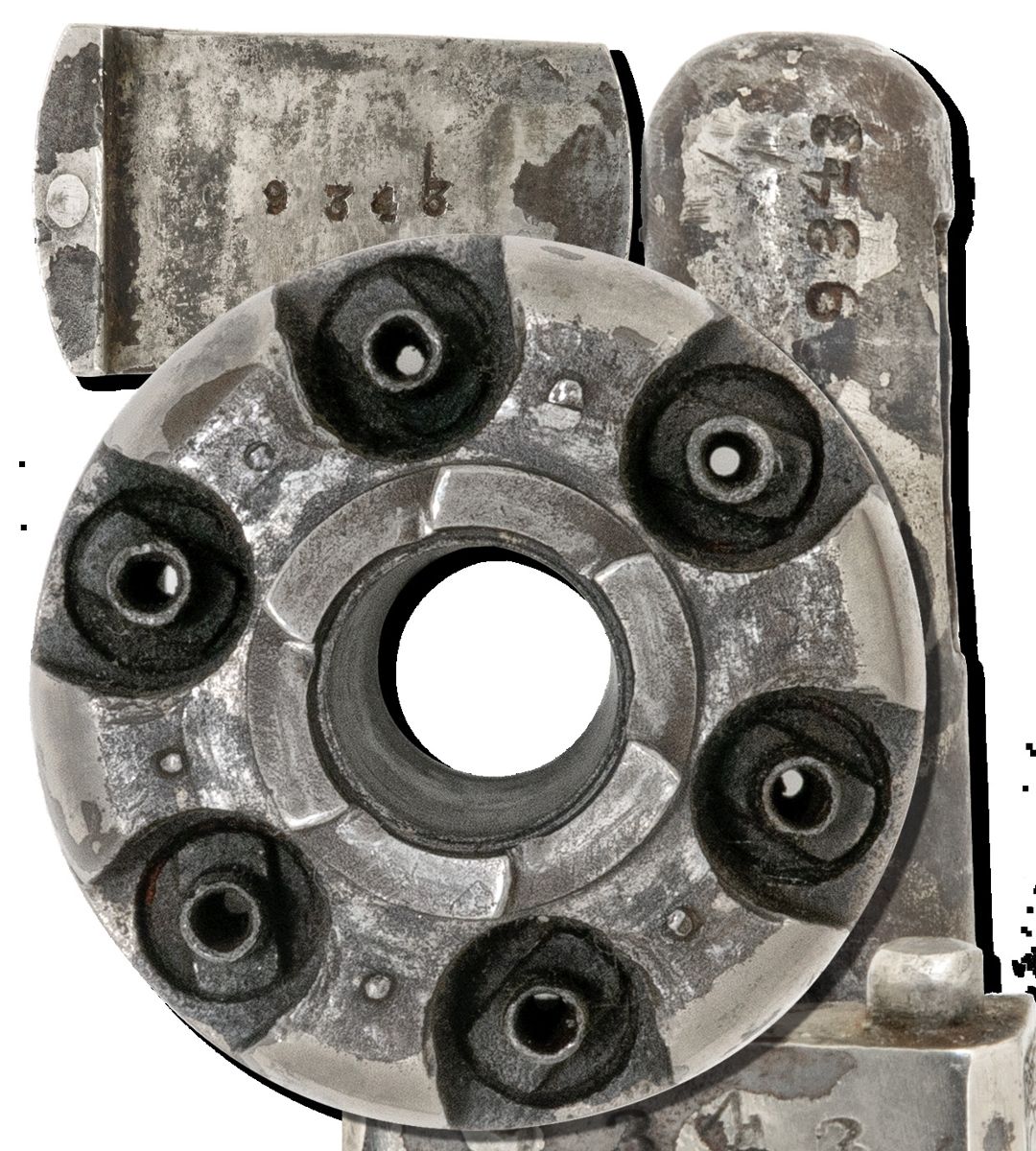
But foremost, Colt knew that sending Hays a gun with a cylinder scene showing Walker leading the charge at the Big Fight would be rubbing salt in an old wound. Instead, he sent him Dragoon 9343, the cylinder of which Nimschke, as only he could, had embellished with an elegant eternal scroll.
One story made a deep impression. In Mexico, a Mexican cavalry colonel challenged Hays to single combat. Hammond could hear the stamps and whinnies of nervous horses and see the silent men of both regiments drawn up on each side of the cleared space.
Between Gwin and Sargeant, Colt had pulled out all the stops. Hays wasn’t moved. So it was, with a cylinder scene depicting the Texas Navy’s 1843 victory at Campeche, the would-be Colt Ranger became known as the Colt Navy. A popular model, it enjoyed remarkable success.
Writing sixty-five years later, Hammond remembered the excitement of holding the Mexican colonel’s sword on his knees and running his fingers over its sharp edge. There was also some talk of Colt revolvers. Hays mentioned that once Sam Colt had designed for and presented to him a gun designed for his own use.
Hays gave the Dragoon to an old comrade, Creed Taylor (1820–1906). Taylor had fought in the major battles of the Texas War of Independence, after which he joined the Rangers. He fought side by side with Hays against Comanches, Mexican bandits, and in the Mexican War.33 There was a certain parallelism to the gift. John Coffee Hays was named for his father’s commander in the War of 1812. In 1842, Taylor, for his commander, named his first son John Hays. Taylor carved his name and T[exas] star R[anger] in the butt of the Dragoon. In 1860, Hays was called upon to command California militia against Paiutes rampaging through northern California and Nevada. Once again, he was national news. Reading of this and with Civil War looming, in February 1861 Colt sent Hays factory-engraved 1851 Navy 98229 that featured Hays’s portrait on the left panel.34 Some years before, Colt had given McCulloch an 1851 Navy with his portrait. He could do no less for the First Ranger. Whether California would join the Confederacy or remain with the Union was an open question. Whichever way it went, the state would need more arms. Whether Hays would have a say about it, it couldn’t hurt to make the gesture.
The Nephew
John Hays Hammond (1855–1936), the son of Sarah Hays Hammond, Jack’s sister, had an adventurous life worthy of his uncle for whom he was named. As he recounted in his autobiography,35
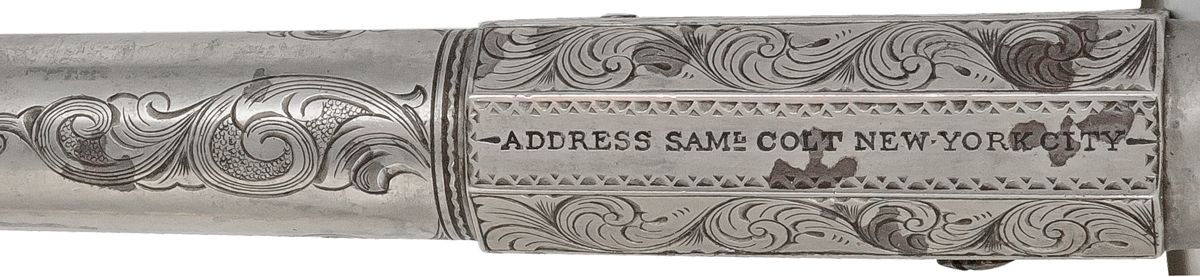
Captain Jack taught his nephew to ride, shoot, and camp. Around campfires, he told his stories of Texas and Mexico. “They were,” Hammond said, “better than a whole library of books of adventure.”
Hammond got to hold the sword, but if he ever saw, let alone held, one of the many guns Colt presented to his uncle, he didn’t mention it. 1.
Endnotes
See, e.g., Nance, J. M. (2013). Attack and Counter-Attack: The Texas-Mexican Frontier, 1842. University of Texas Press. 2. Loosely organized in 1822, the Texas Rangers were officially constituted on November 24, 1837. 3. Rasenberger, J. (2021). Revolver: Sam Colt and the Six-shooter that changed America. Scribner, an imprint of Simon & Schuster, Inc. pp. 130 et. seq. 4. Samuel Walker and another Ranger suffered severe lance wounds. 5. The first anti-insurgency force in North America was Rogers’ Rangers, famous for their achievements during the French and Indian Wars. Unlike the Hays’s Rangers, they were not mounted. 6. Taylor was authorized to muster the Rangers, but had he done so, under the Constitution, he could only have used them within the territorial limits of the United States. That restriction does not apply to volunteers. 7. Taylor held onto McCulloch past his enlistment. Fortunate it was, for McCulloch’s extraordinary recon contributed significantly to Taylor’s victory over Santa Anna at Buena Vista and paved the general’s way to the White House. 8. Parsons, John E. (1949). Sam Colt’s Own Record. Connecticut Historical Society, p. 7. 9. Wilkins, F. (1990). The Highly Irregular Irregulars: Texas Rangers in the Mexican War. Eakin Press, p. 114. 10. Op. cit., Parsons, Colt letter to Samuel Houston, February 24, 1847, p. 50. 11. Tobias, A. (2011). Colt Cylinder Scenes, 1847–1851. Arthur Tobias, Artist, pp. 44-46. 12. Readers should start with Pate, C. W. (2021). The Colt Walker Army Revolver. Andrew Mowbray Inc. and Whittington, R. D. (1984). The Colt Whitneyville-Walker Pistol: A Study of the Pistol and Associated Characteristics, 1846–1851. Brownlee Books.
-
McCulloch’s reputation would be enhanced in 1858 when, as U.S. Peace Commissioner, he brought the Mormon War to a bloodless end. 14. Colt hired Root away from the Collins Axe Company. Root was not only a gifted mechanical engineer, but at Collins, he learned how to deal with English cast steel. Gordon, Robert B. (1996) American Iron. John Hopkins University Press, pp. 172-3. Whitney and Colt made barrels, cylinders, and small parts (except for hammers) from such steel. See op. cit. Parsons, footnote to January 20, 1847, a letter from Naylor & Co. to Colt. 35. See, also, Deyrup, Felicia J. (1948). Arms Makers of the Connecticut Valley, Smith College Studies in History, pp. 139-40. 15. Louis Napoléon was crowned Napoléon III in 1852. 16. See, Taylerson, Andrews, and Frith (1968). The Revolver: 1818–1865. Crown, pp. 213 et. seq. for a discussion of blueing methods. 17. Niebolo, W. P. (2022). The History of Electroplating. NASF Surface Technology White Papers, Technology White Papers (86), p. 1–14. 18. Bright, reflective nickel plating did not become commercially available until 1872 when, after years of tinkering with Böettger’s formula, Dr. Isaac Adams opened Adams Nickel Plating in South Wyndham, CT. 19. Gogan, A. (1999). Fighting Iron: A Metals Handbook for the Arms Collector. Andrew Mobray. P 86. Cogan states that tin found limited use in the latter half of the 19th century. He cited the Sharps-Harkins Carbine, 1862–1865. I’ve seen an image of one in fine condition, but it takes more than a unaided look to tell us what the metal is. Cogan also mentioned examples of tin plating Frankford Arsenal .45-70 cartridges produced from 1886 to 1897. Attempting to scrape the surface of one given me by Bob Eder, I can attest it’s not plated. The cartridge boxes describe them as “tinned brass,” meaning the cases are made of a copper, zinc, tin alloy, sometimes called Naval Brass. Resistant to corrosion, their hardness is about three-quarters that of mild steel. 20. See Khan. Z.B. (2020). Inventing Ideas, Patents, Prizes and the Knowledge Economy, Oxford University Press. Colt had patents in the United States and England. They were enforceable in the countries where granted, but not elsewhere. He also had Belgian patents, which, for reasons beyond me, were not enforceable. 21. Wilson, R. L. (1961). Sam Colt Presents. Wadsworth Atheneum, p. 236. 22. Houze, H. G. (2012). Colt Factory Engravers of the Nineteenth Century. Mowbray Publishers. On p. 78, Houze incorrectly states that Nimschke arrived in the United States in 1853. The error came from misreading a name on a passenger list. Further, the cover of Nimschke’s workbook is in English and dated 1850. Wilson, R .L. (1992). L. D. Nimschke: Firearms Engraver. R & R Books. 23. Massachusetts Arms had a display, impressive no doubt, but was disqualified because Colt was suing them for patent infringement. 24. In the accepted sources, these serial numbers indicate the guns were manufactured in 1851. Knowing that the production dates for Colt’s Open Top .22 can be off by two years, I once asked Larry Wilson where the dates came from. He cocked his head and shrugged his shoulders. The ranges given may be best used as a loose guide. Some suggest the Washington and Lafayette Dragoons were displayed in London. Anything is possible, but
-
-
-
-
-
as American exhibitors already had to deal with a contentious English press, nothing good could have come from stirring the pot by brazenly exhibiting America’s favorite Revolutionary War heroes. Holder, P. (2014). The Hero of Two Worlds. Pete Holder. Wilson, R. L. (2001). The Colt Engraving Book, Volume I. Bannerman’s, p. 69. Wilson also notes the use of punch dots stamped by the serial numbers to mark guns for special handling, though in practice, this apparently was reserved for guns to be engraved. He also mentions that a gun condemned by an Ordnance inspector was stamped with a small o. Dragoon 9343 bears the punch dots and a small o. See Wilson, R. L. (1992). L. D. Nimschke, Firearms Engraver. R&R Books. Bleile, C. Roger, Founder and Official Historian, Firearms Engraving Guild of America, Report on Colt Second Model Dragoon #9343, May 20, 2021. See also, Opinion of R. L. Wilson, 2003. Dr. Sean Berg conducted the EDS study at BakerRisk, San Antonio, on May 17, 2022. Incidentally, the EDS examination reveals that the steel substrate is pre-1860 steel. Op. cit., Bleile. A transit railroad that avoided the most dangerous parts of the Isthmus was completed in 1855. Colt, Sam, letter to Senator William Gwin, May 11, 1851. Connecticut Historical Society. Copy provided by Charles Pate. Creed Taylor was an active Ranger until 1900. One of the few surviving Texans to have fought against Santa Anna at San Jacinto in 1836, he was a favorite at the annual San Antonio Battle of Flowers parade. He last attended that event in 1905. He died in 1906. Four years later, in 1910, Ben C. Stuart, ace reporter of the Galveston Daily, the Texas paper of record, penned an article on the life of John Hays. Stuart attempted to verify the tradition that Colt had presented Hays a special revolver, which Stuart had obviously seen. Colt’s Fire-Arms said the pertinent records were destroyed in the armory fire of 1864. Stuart, B.C. (May 8, 1910). Greatest Texas Ranger’s Career. Galveston Daily News, p. 27. In his opinion authenticating the gun, R. L. Wilson surmised that the ivory stocks were put on the gun by Colt’s ivory supplier in New York before the gun was shipped to California. Hammond, John Hays (1935). The Autobiography of John Hays Hammond. Farrar & Rinehart, pp. 18-27. Hays and fellow Ranger John Caperton were partners in real estate investments and co-founders of Oakland, CA.
About the Author Bob Swartz was born and raised in Los Angeles, earned a B.S. and M.S. in finance from UCLA. Commissioned a 2nd lieutenant in the U.S. Army, he served as a Combat Photo and Mopic officer in Vietnam with the 221s Signal Company. After a stint in Israel, Bob graduated from Stanford Law School and practiced his profession in Houston and Los Angeles. After retirement, he became interested in Colt firearms. He authored the book Colt-Smith & Wesson: A Clash of Arms (2021) and several articles on Colt history that were published in The Rampant Colt, Texas Gun Collectors, and Man at Arms. The highly-acclaimed book is available at Bob’s website DiscoverColt. com and on Amazon. His email is [email protected].
Library of Congress
Early war image of a Union cavalryman wearing regulation shell jacket with gold hand-tinted piping denoting cavalry branch of service. The soldier’s jacket has brass shoulder scales that would soon be abandoned. His Hardee hat bears a Company “K” over brass crossed sabers cavalry insignia. He is wearing gauntlets and has a saber belt with over-the-shoulder sling to go with a pair of small frame, spur trigger revolvers; the one in his hand is a Model 1855 Colt Root; the one tucked into his belt is a Remington Beals pocket model. He holds a Model 1840 heavy cavalry saber. The spur trigger revolvers are likely photographic props as these little .28 and .31 caliber pistols carried little firepower unlike the issued .44 caliber Army revolvers.