
Dickson, Nelson & Co
By Shannon Pritchard · Originally published September-October 2024 · pp. 3–11

The Shakanoosa Arms Company was established in the spring of 1861, at the west end of the Tennessee Valley, at Dickson, Ala. Now named Chisca, the town is about twenty miles west of Tuscumbia, on the Memphis & Charleston Railroad in northern Alabama. The company was originally formed by three men of financial means, political clout, and deep loyalty to the Southern Cause. The company founders were prominent planter William Dickson (1798–1880), attorney and state legislator Owen O. Nelson (1823–1892), and physician Lewis H. Sadler (1818–1881).1
they had relocated to the State Railroad Shops in Adairsville, Georgia. The company produced arms at the Adairsville manufactory until August 1863, when they were again forced to move. Confederate Rifles and Muskets by Murphy and Madaus, describes the Adairsville rifles based on the one specimen they examined. It was .58 caliber, had a 33-inch barrel, and was 48 inches in length. “The furniture is of brass, and the flat brass barrel bands are spring retained … the rear sight on the specimen examined is a two-leaf type,” and the markings are “Dickson” over “Nelson & Co.” over “C.S.” To the rear of the hammer “ALA” over “1864” is stamped in two lines, vertically.
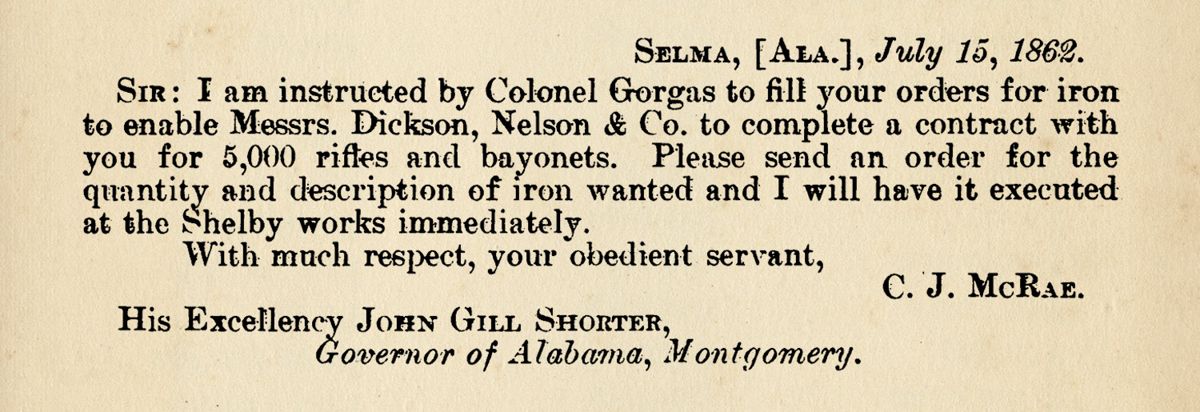
The Dickson, Nelson Company, then operating an iron foundry in Tuscumbia,2 signed a contract with the State of Alabama on January 22, 1862, to supply, ”five thousand good army guns, of the value and description of the Mississippi or Enfield rifle, with sabre bayonets attached,” to be delivered in lots of one hundred by March 1, 1863, at a cost of $33.3
This, of course, makes no sense; if they moved from Adairsville to Macon in August 1863, the 1864 dated specimen referenced could not have been produced there. More likely, this was a typo, and the authors meant to say the Type I was made at Macon before moving to Dawson in February 1864. The authors further describe this 1864-dated rifle as having an inlet blade for a front sight. The date, rear sight and bands are pertinent to this discussion because Murphy and Madaus based their Type I designation on these characteristics which are found in the one and only specimen they examined. Murphy and Madaus estimated Source: Rush, Richard. Official Records of the Union and Confederate that “3,600 arms of all descripNavies in the War of the Rebellion: Ser. I, V. 1-27, Ser. II, V. 1-3. United States, tions were made at Adairsville National Historical Society, 1921, p. 218. through August 1863.” While it The pressures of war forced them to move to is possible Nelson & Co. repaired 3,600 arms, it is not Rome, Ga.,4 in the summer of 1862, before they even possible that they “made” 3,600 arms since only one completed their factory. In Rome, they leased a large example could be found by the authors to examine, brick building, but once again, their plans were and none have turned up since. foiled before they could make the first rifle. Their completed machinery and gun parts were destroyed In Confederate Longarms and Pistols, by Hill and in a conflagration that took the building before they Anthony, the production is given as “less than completed a single arm.5 By the following month, 1,000.” This figure is much closer to the truth. Even
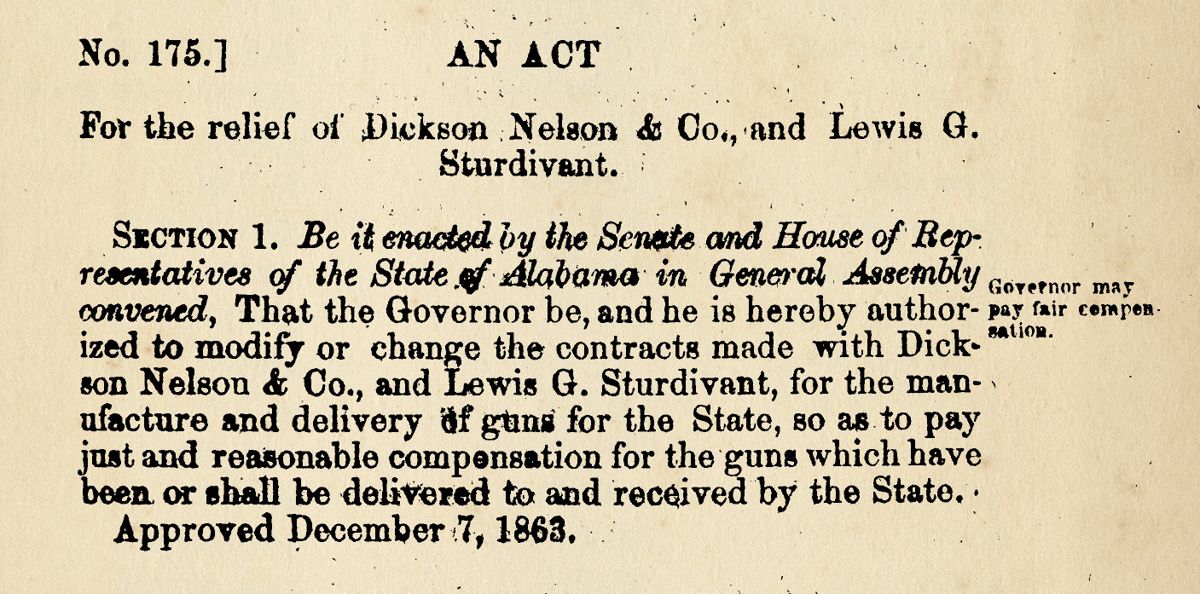
The rifle retains an original Confederate linen rifle sling.
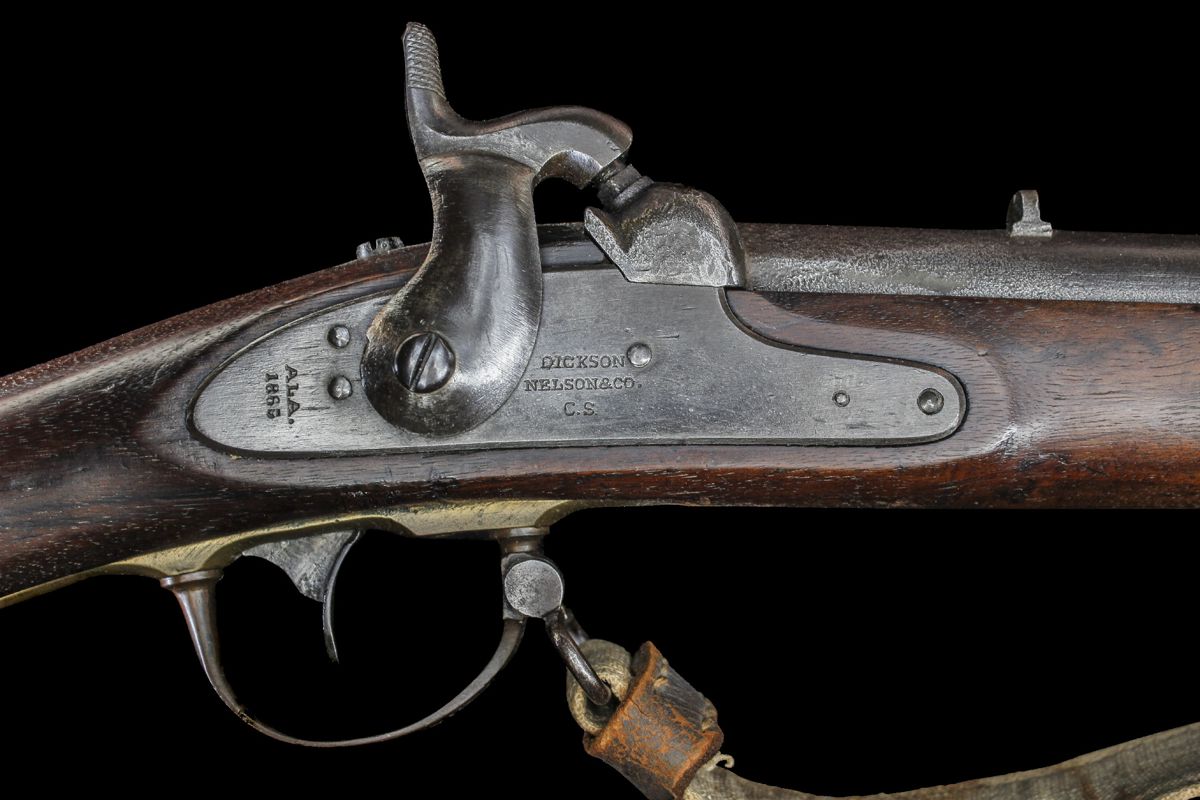
Source: Acts of the Called Session, 1863: And of the Third Regular Annual Session of the General Assembly of Alabama: Held in the City of Montgomery, Commencing on the 17th Day of August and the 2d Monday in November, 1863. United States, Saffold & Figures, 1864, p. 139.
TRI-WEEKLY COURIER ROME, GEORGIA, AUGUST 30, 1862 FIRE
On Thursday evening last [August 28th], the Armory caught on fire and was completely destroyed. The fire originated in the drying room, which was at the north end of the building, and the wind was blowing heavily at the moment from that quarter; the flames spread with inconceivable rapidity, and in less than an hour and a half the woodwork was in ashes. The fire spread so rapidly that some of the workmen were compelled to jump from the second story windows, and no efforts could be made to save any of the machinery. Most providentially the wind was from such a quarter as to blow the flames from town, which with the exertions of the citizens at some ex posed points, saved a large portion of it from destruction. The machinery had just been entirely completed, and a large lot of the parts of a gun had been made and they intended to commence putting them together the next day. The loss of Messers Dickson, Nelson & Co. is estimated at $55,000 in machinery and manufactured articles, and Eve & Bro. about $50,000 in the building and a large lot of machinery and carriage stock that had been left there. Many of the workmen lost their tools, which will be severely felt by them, as it will be difficult to procure proper supplies just now. We sympathize with the energetic proprietors of this establishment, who have had several drawbacks in their enterprise here, and especially with our friend, Dr. Sadler, who, in addition to his present misfortune, was nigh ruined in worldly effects last Spring by the yankees in North Alabama, in the destruction of his home, household effects, books & C., and also with the family of one our patriot martyrs, O. B. Eve, who will sustain a very serious loss. No insurance was on the building or any portion of the contents.
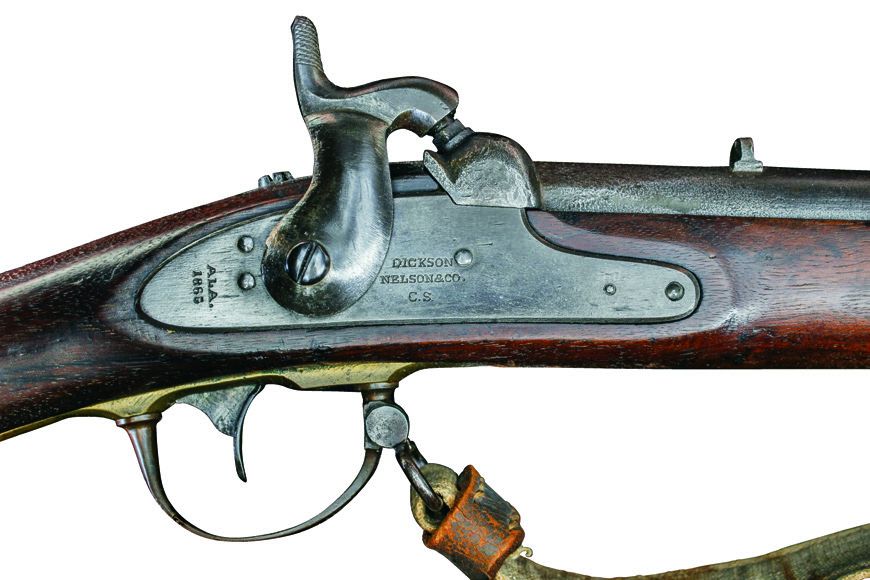
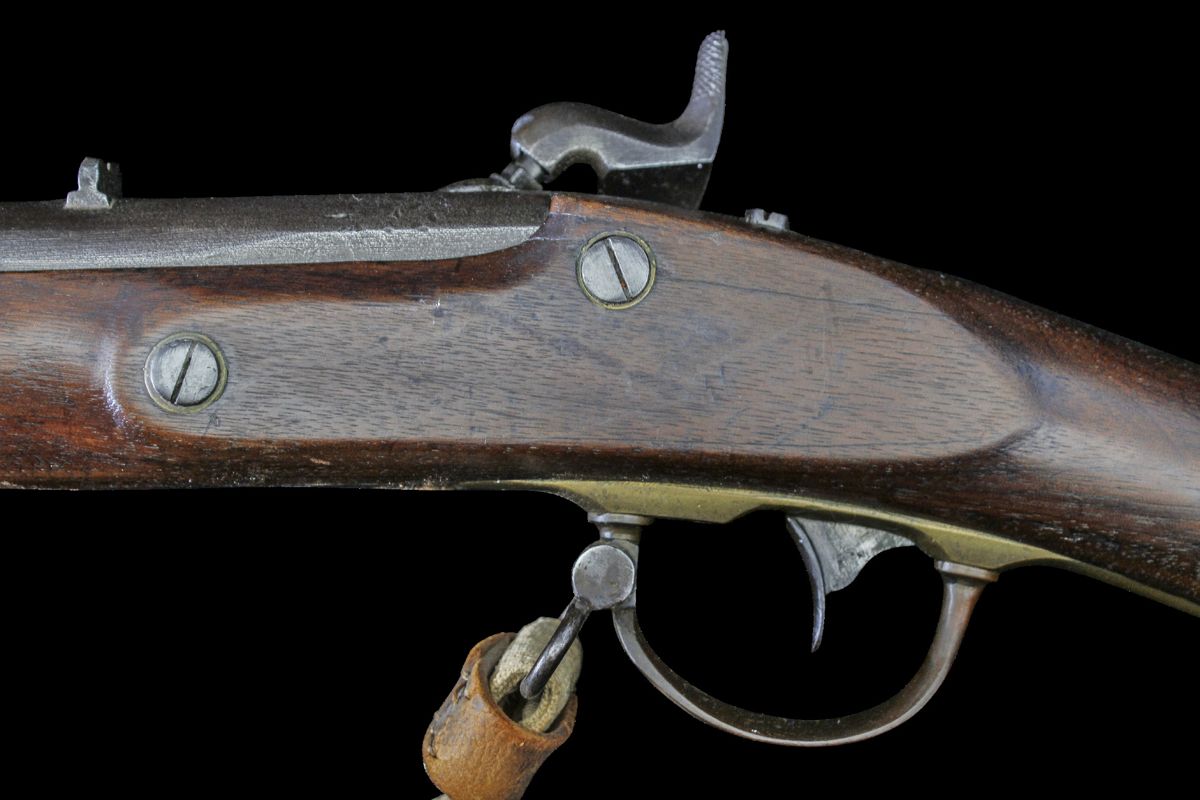
The rifle’s locks are well marked, with the exception of the broken “5.”
The Dickson & Nelson rifles have fixed “V” notch rear sights with no adjustment.
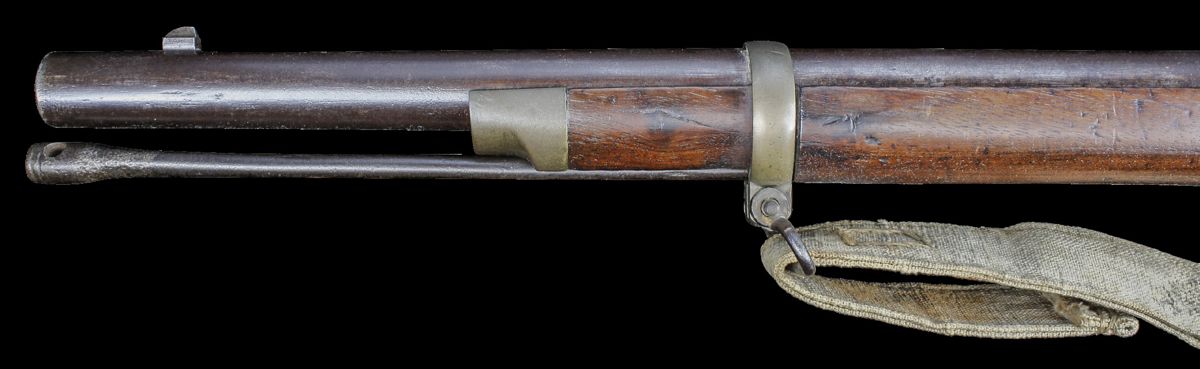
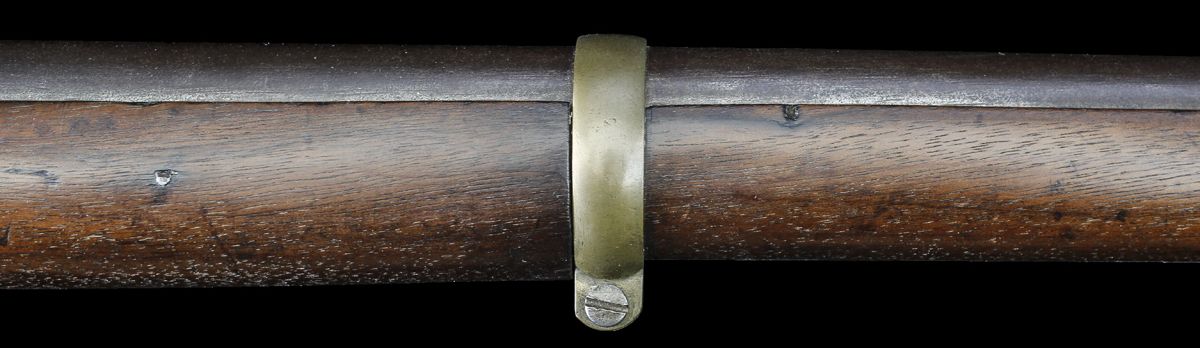
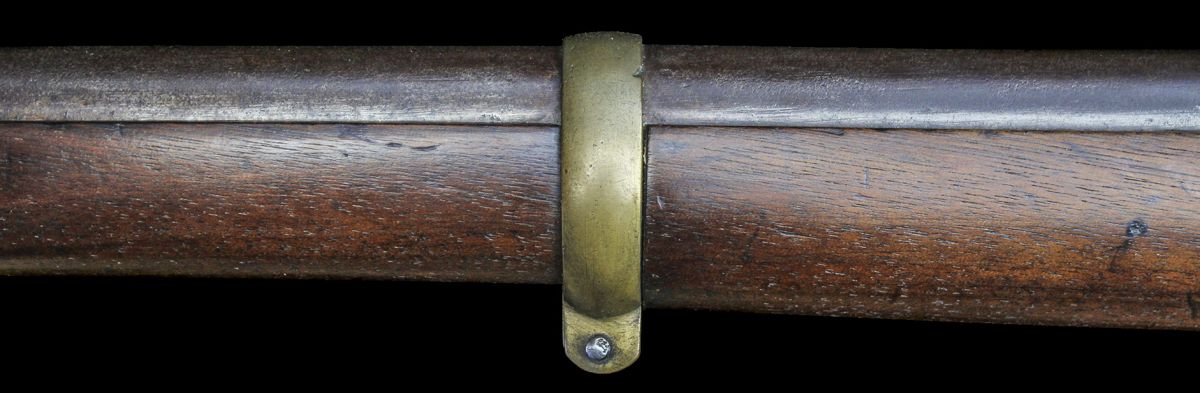
The brass bands are of the clamping type, which need no retaining spring.
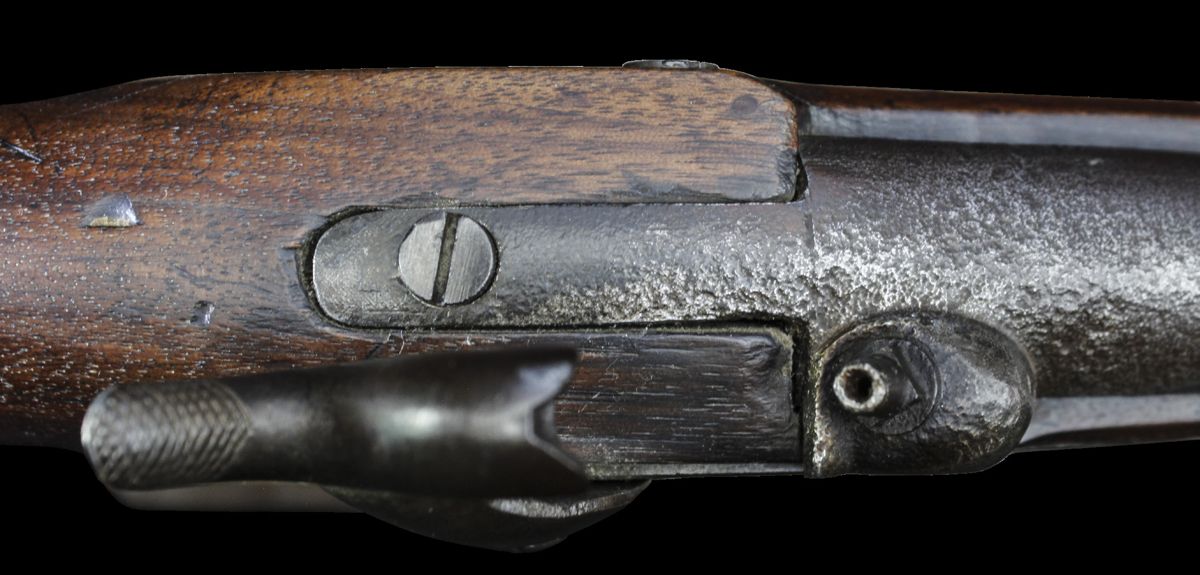
The hole in the tip of the ramrod is so that the soldier can insert a gun tool, forming a “T” handle, making it much easier to operate the rod for cleaning or pulling a bullet.
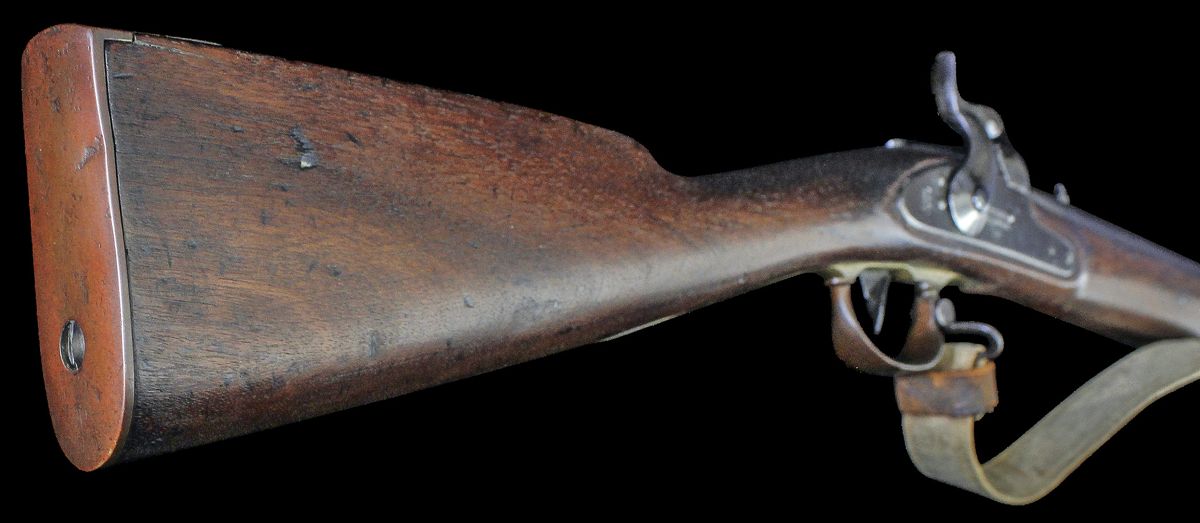
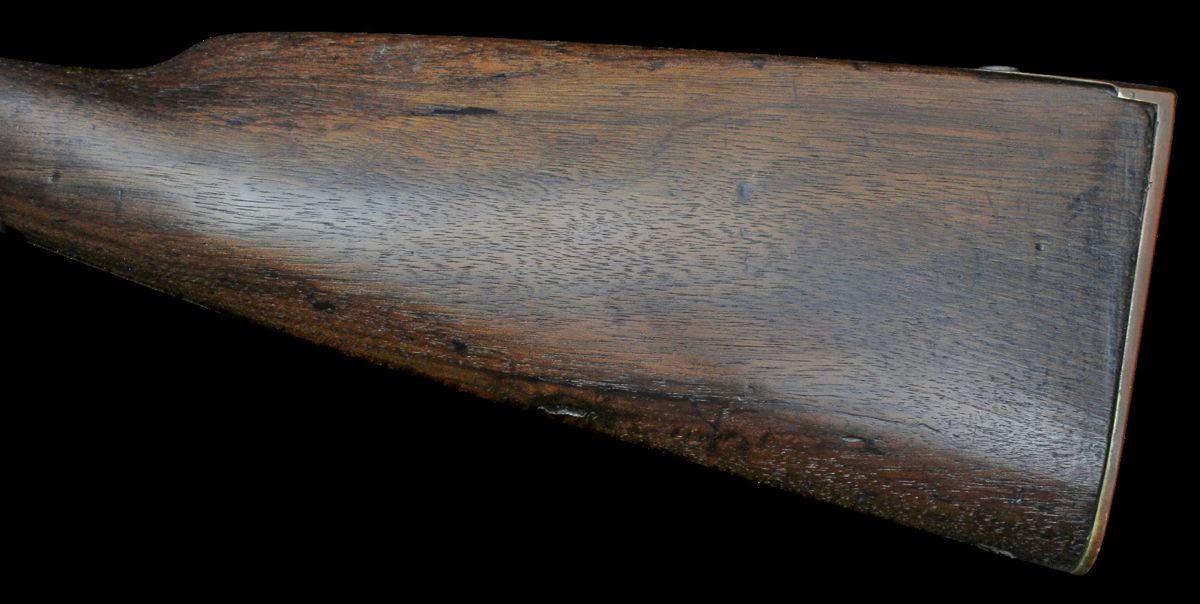
Notice the “red brass” buttplate, this is common with Dickson & Nelson rifles.
Madaus and Murphy stated only 645 Nelson & Co. rifles were documented as accepted by the State of Alabama, and another 35 rejected. Based on their rarity, it is likely that this covers all, or nearly all, their production. The authors do not explain how their example of a Type I, which is dated 1864, can possibly correspond with their posited ending production of the Type I in August of 1863. I do not mean to be critical of the authors; mistakes are bound to happen; the good Lord knows I have made enough of my own. However, this presentation is a good opportunity to correct/add to the knowledge base. Murphy and Madaus believed that “a virtually new type of rifle was made” after the move to Dawson, and the authors designated it a Type II. It is my opinion that Dickson, Nelson & Co. did not fabricate two separate models; the rifle designated as a Type I was merely made up by Dickson, Nelson & Co. by the mingling of some fabricated, and some existing parts. The 1864 date proves that it was made well after the so-called Type II was in production, which means it cannot be a Type I. In fairness to the authors, they noted that they knew of only one other 1863 dated lock plate, and no rifle. So, they assumed that the 1864 dated gun that they designated the Type I could have been made in February 1864, but if so, why, or how, at Adairsville? All others dated 1864 were made after that date.
even has the same ramrod, with a hole in the head for a T handle like that shown and documented in Confederate Rifles and Muskets. Neither this rifle, nor the two documented in the same book have Alabama acceptance marks. The gun is in excellent-plus condition, as the photos will attest. The bore is near mint. Notice that the nipple is in near-new condition, and all the screw heads are crisp. The gun retains nearly all its original finish. The stock has nicks and dings in it but is in excellent condition. The brass has a mellow, untouched patina, and the buttplate has the “high copper red” we all love. The sling is an original Confederate linen sling and was on the gun when it was acquired. Endnotes 1.
American Society of Arms Collectors Bulletin 60:29-37 “The Dickson, Nelson Company: Alabama Civil War Gunmakers,” by Douglas E. Jones
1938 W.P.A. project summary 3821, In Military Division, Acts of Alabama and Official Records, Alabama Department of Archives and History (ADAH)
American Society of Arms Collectors Bulletin 60:30 “The Dickson, Nelson Company: Alabama Civil War Gunmakers,” by Douglas E. Jones
Letter to former Alabama Governor Israel Pickens, ADAH
Tri-Weekly Courier reported on August 30, 1862
In 1866, Owen Nelson and his associates acquired the firm and, under the name of Dawson Manufacturing Company, began to manufacture passenger and freight railroad cars. In 1885 the property was sold to Dawson Works. In 1929 one warehouse still had a good many unfinished walnut gun stocks, leftovers from the arms manufacturing period. The rifle shown here has crisp, clear “Dickson” over “Nelson & Co.” over “C.S.” stampings forward of the hammer and “ALA” over “1865” behind the hammer. This rifle, like all those designated Type II, has a block front sight and a fixed rear sight. It
About the Author Shannon Pritchard has authored numerous articles relating to the authentication, care, and conservation of Confederate antiques, including several cover articles and is the author of the definitive work on Confederate collectibles, the widely acclaimed
Collecting the Confederacy, Artifacts and Antiques from the War Between the States, and is co-author of Confederate Faces in Color.