
Liljenquist Family Collection of Civil War Photographs
From the Library of Congress · Originally published November-December 2024 · pp. 51–72
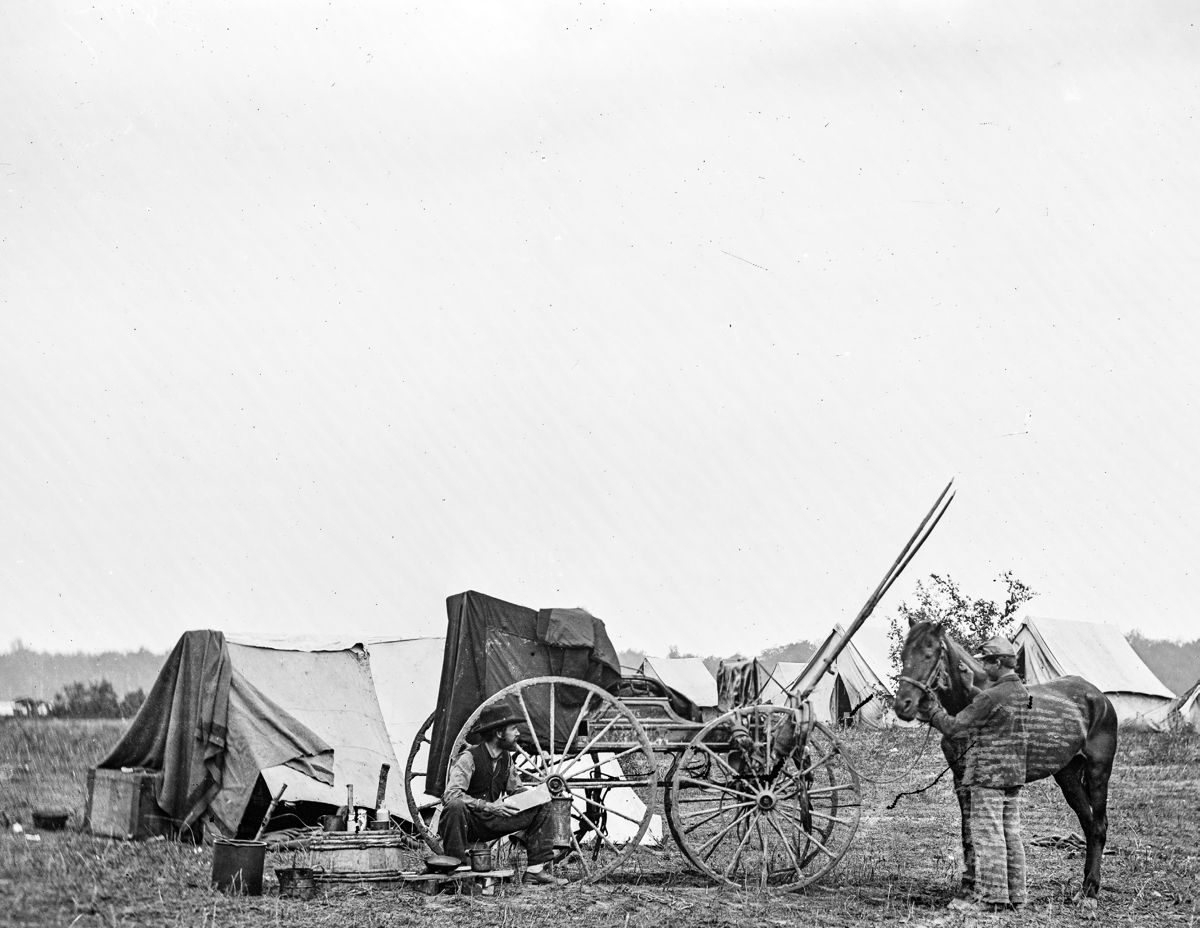
artillery at Fredericksburg, the former residence of Gen. Robert E. Lee at Arlington, the thirteen-inch mortar placed on a flatcar on the Petersburg and City Point Railroad, a slave dealer’s store front in Alexandria, and the ruins of Richmond, April 1865. Russell laid 136 of his photographs into a collection titled the “United States Military Railroad Photographic Album.” Some of its images, such as that of President Lincoln’s funeral car, have not been widely reproduced. Source: •
Russell’s Civil War Photographs 116 Historic Prints by Andrew J. Russell With a Preface by Joe Buberger and Matthew Isenberg. New York: Dover Publications, 1982.
Andrew Russell.
Photographer and his portable studio at Cold Harbor, Va.
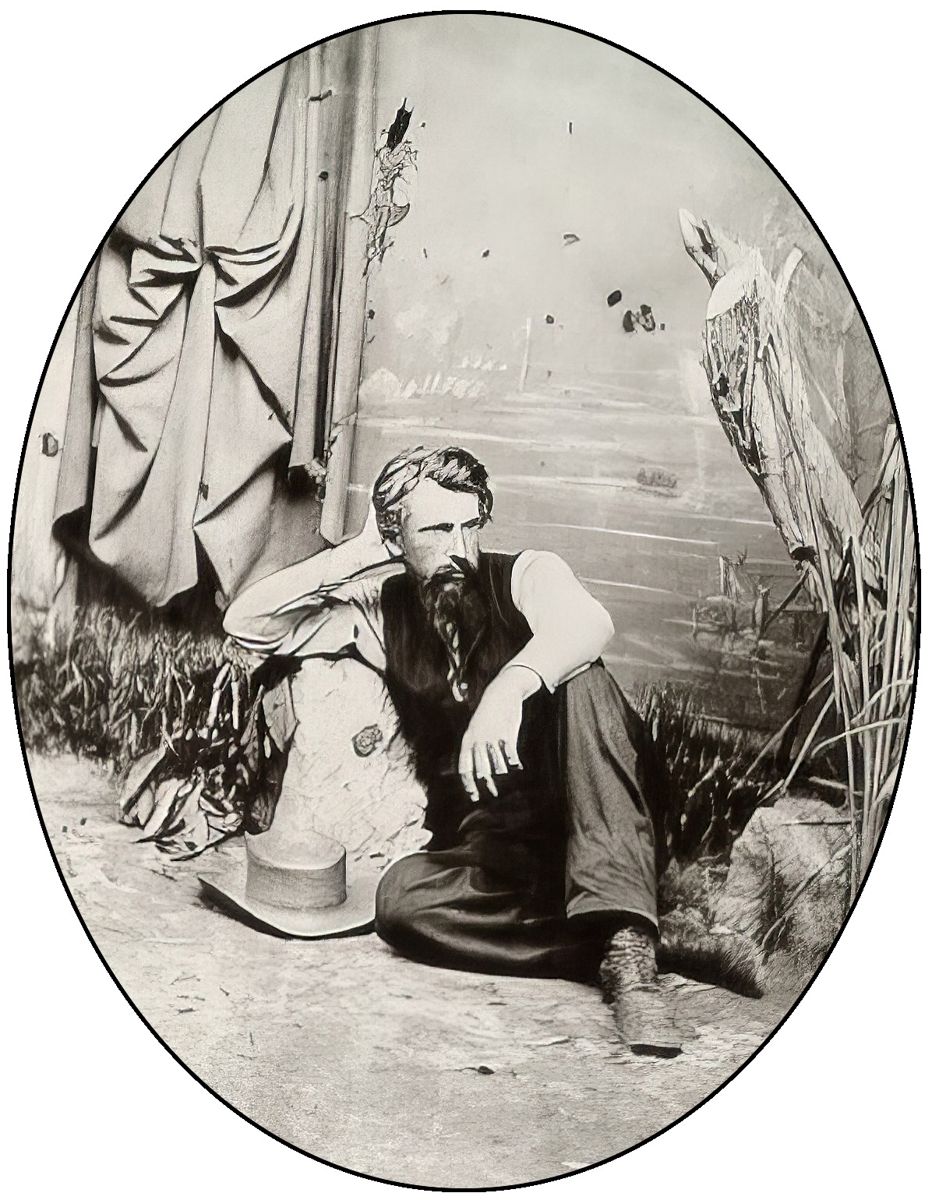
About the Author Stephen Davis has been a Civil War buff since the 4th grade. He grew up in Atlanta, attending Margaret Mitchell Elementary and Northside High. At Emory University, he studied under the renowned Civil War historian Bell Wiley. After a Master’s degree in American history from the University of North Carolina at Chapel Hill, he taught high school for a few years, then earned his Ph.D. at Emory, where he concentrated on the theme of the Civil War in Southern literature. He’s also taught at Oglethorpe University. Now retired, Steve resides in Cumming, Georgia, with his sweet wife Billie and two cats. Dr. Davis served as Book Review Editor for Blue & Gray Magazine from 1984 to 2005, and is the author of more than a hundred articles in such popular and scholarly publications as
Civil War Times Illustrated and the Georgia Historical Quarterly. Now retired, Steve is also a popular speaker at Civil War Round Tables and historical societies around the country. He has spoken on “What the Yankees Did to Us” to the Round Tables of Buffalo, New York, and Providence, Rhode Island (and gotten away with it!). He has given talks at the annual meeting of the American Civil War Round Table (UK) in London. His favorite event was a few years ago when he addressed President Carter, Mrs. Carter and family on the role of Copenhill (the Carter Center area) in the battle of Atlanta. (Mrs. Carter squealed when he used the word fixin’; “a fine Southern word,” she declared.)
Library of Congress
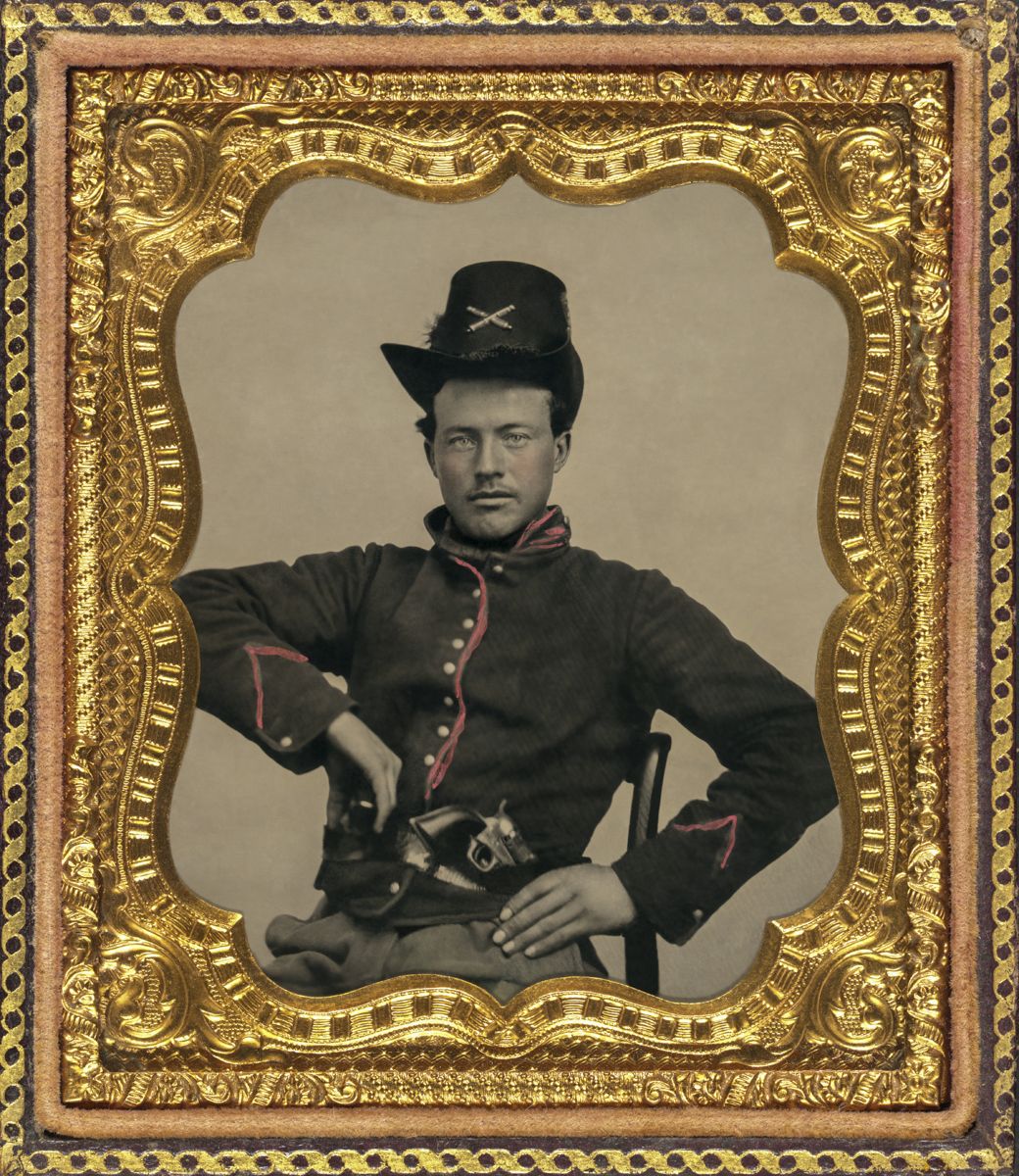
This Union enlisted artilleryman wears a shell jacket and a Pattern 1858 dress hat, known as the “Hardee hat,” decorated with the regulation stamped brass crossed cannon artillery insignia. The regulation shell jacket has had the piping tinted red for “artillery.” Two revolvers are tucked in his belt; one appears to be a Colt Model 1851 .36 caliber “Navy” revolver, while his hand obscures the other. Like most images of Union soldiers who were not officers, or in the cavalry, these pistols are likely photographer’s props.
Civil War Artillery Photographs from the Liljenquiest Family Collection
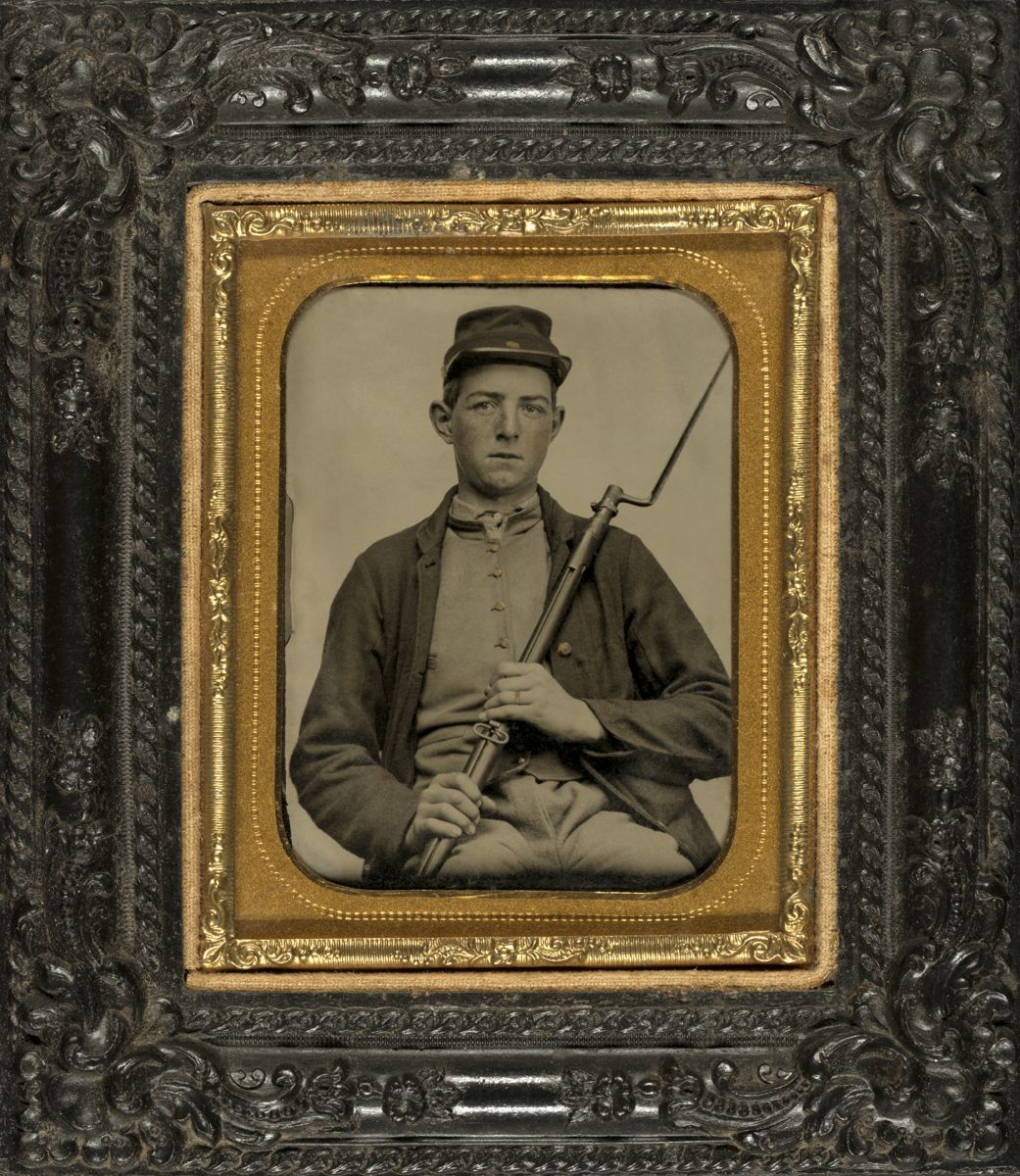
John A. Hartshorn originally enlisted into Company A, 19th Maine Infantry, August 29, 1863. Hartshorn was paid a bounty to substitute for John W. Crane. He is posed in a 4 button sack coat and forage cap, sitting with a musket with fixed bayonet but missing its ramrod. There is a gold tinted band style ring on his left ring finger. Hartshorn was transferred to the 1st Maine Heavy Artillery who fought as infantry in December 1863. He died of wounds suffered at Cold Harbor, Virginia, May 23, 1864, when he was 22 years old. The 1st Maine Heavy Artillery sustained the greatest loss in battle of any regiment during the Civil War, losing 23 officers and 400 enlisted men killed or mortally wounded with an additional 260 dying of disease. This photograph was taken at Walton’s Ambrotype & Photograph Rooms, Haverhill, Massachusetts.
Library of Congress
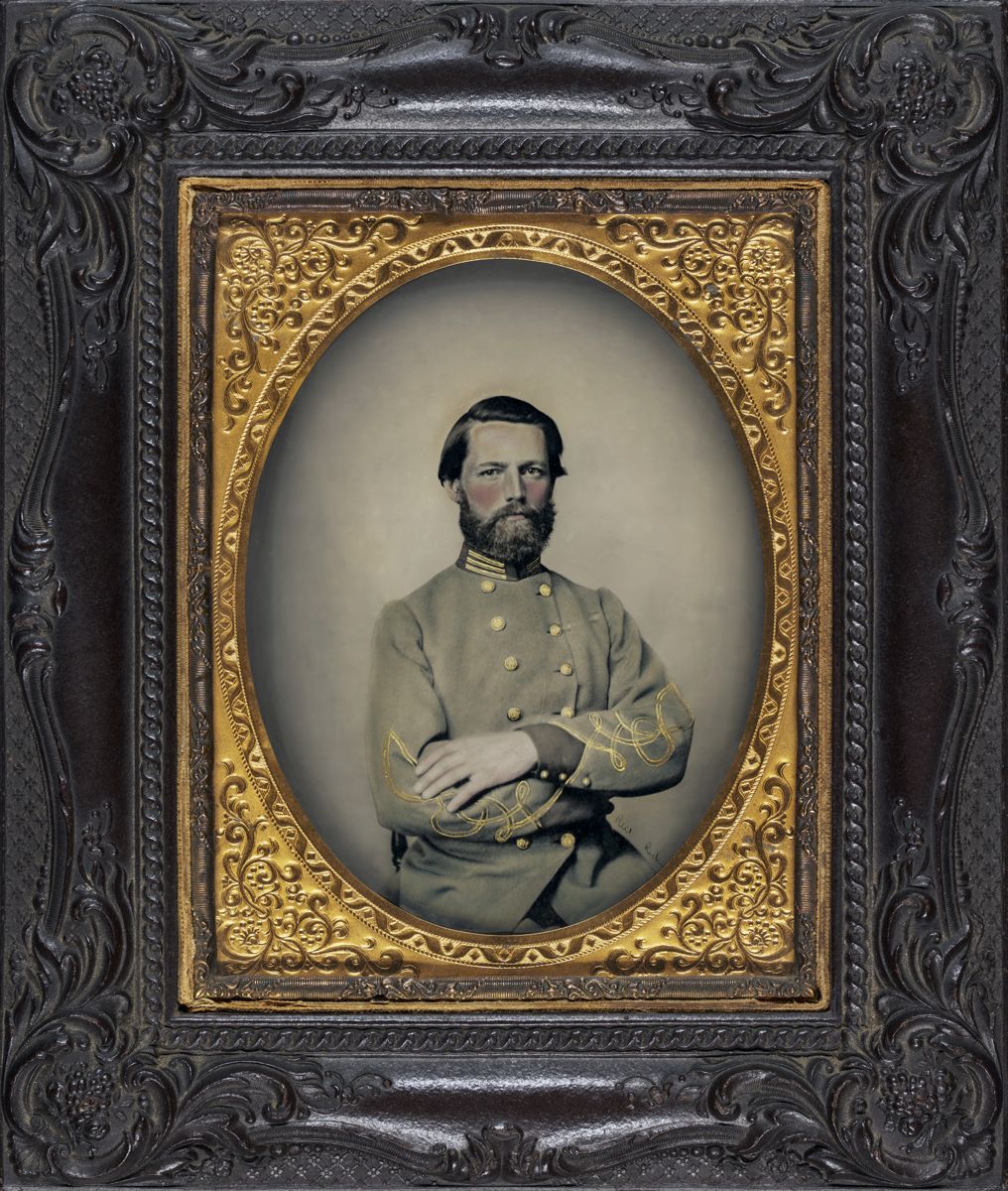
Captain William W. Cosby of Company H, 2nd Virginia Light Artillery, in regulation, double breasted Confederate officer’s frock coat with a 3-bar captain’s insignia on collar and matching captain’s quatrefoil on sleeves. The 2nd Virginia was organized on February 1, 1862, but disbanded on May 23, 1862. Most men went on to other units when Company H was reformed and became Company H, 22nd Virginia Infantry. No other military service is noted for this dignified 37 year-old captain. The cuffs and collar show faded red hand-tinting designating the artillery branch; blue would have been for infantry, and gold (yellow) for cavalry. Captain Cosby (1824–1885) studied law at the University of Virginia and is buried in Richmond’s Hollywood Cemetery. Well-known photographer Charles Rees of Richmond signed the photograph in the lower right quadrant “Rees, Richmond” scratched into the emulsion.
Civil War Artillery Photographs from the Liljenquiest Family Collection
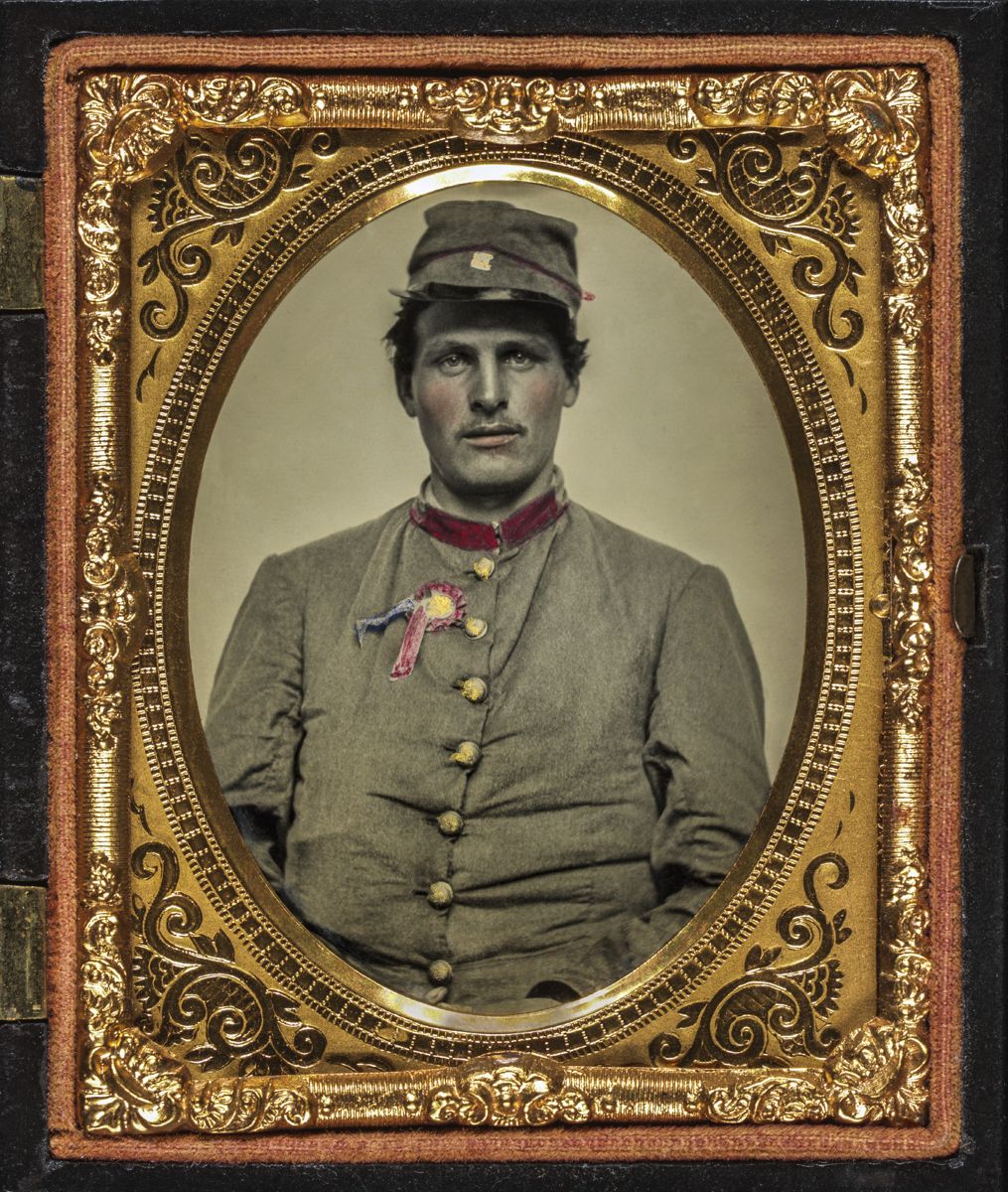
Confederate artilleryman in a frock coat with a red trimmed collar denoting artillery. The small “seccession cockade” with blue and red streamers is a Southern patriotic badge. His forage cap seems quite high, but this might be to show the unidentified badge.
Library of Congress
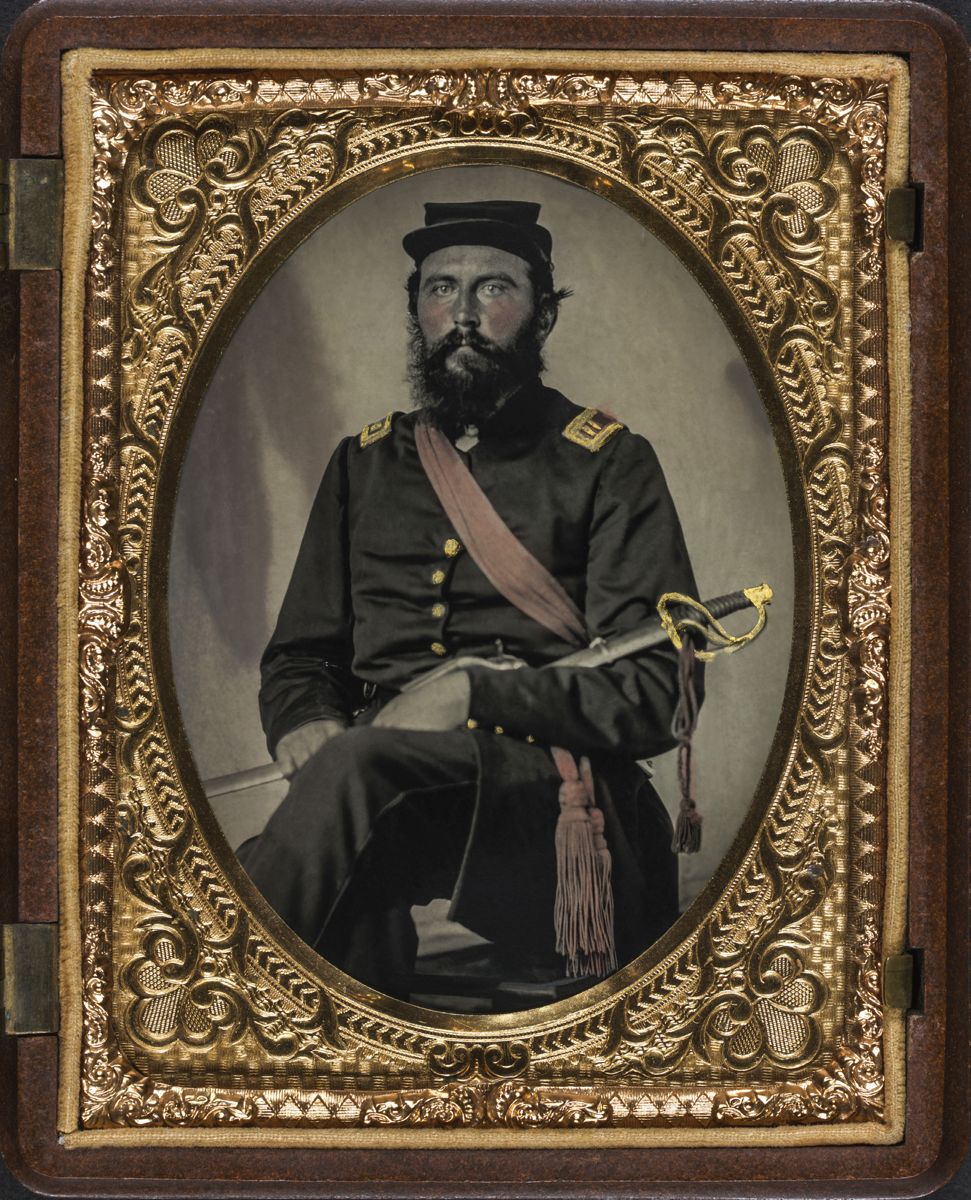
This Union captain is wearing a regulation 9 button frock coat and kepi. His crimson silk sash is slung over his right shoulder. The officer may be an artilleryman as there is a hint of red tint on his shoulder straps and a red tassel hanging from the sword hilt. It was common to see enlisted or officer artillerymen carrying cavalry sabers instead of artillery sabers.
Civil War Artillery Photographs from the Liljenquiest Family Collection
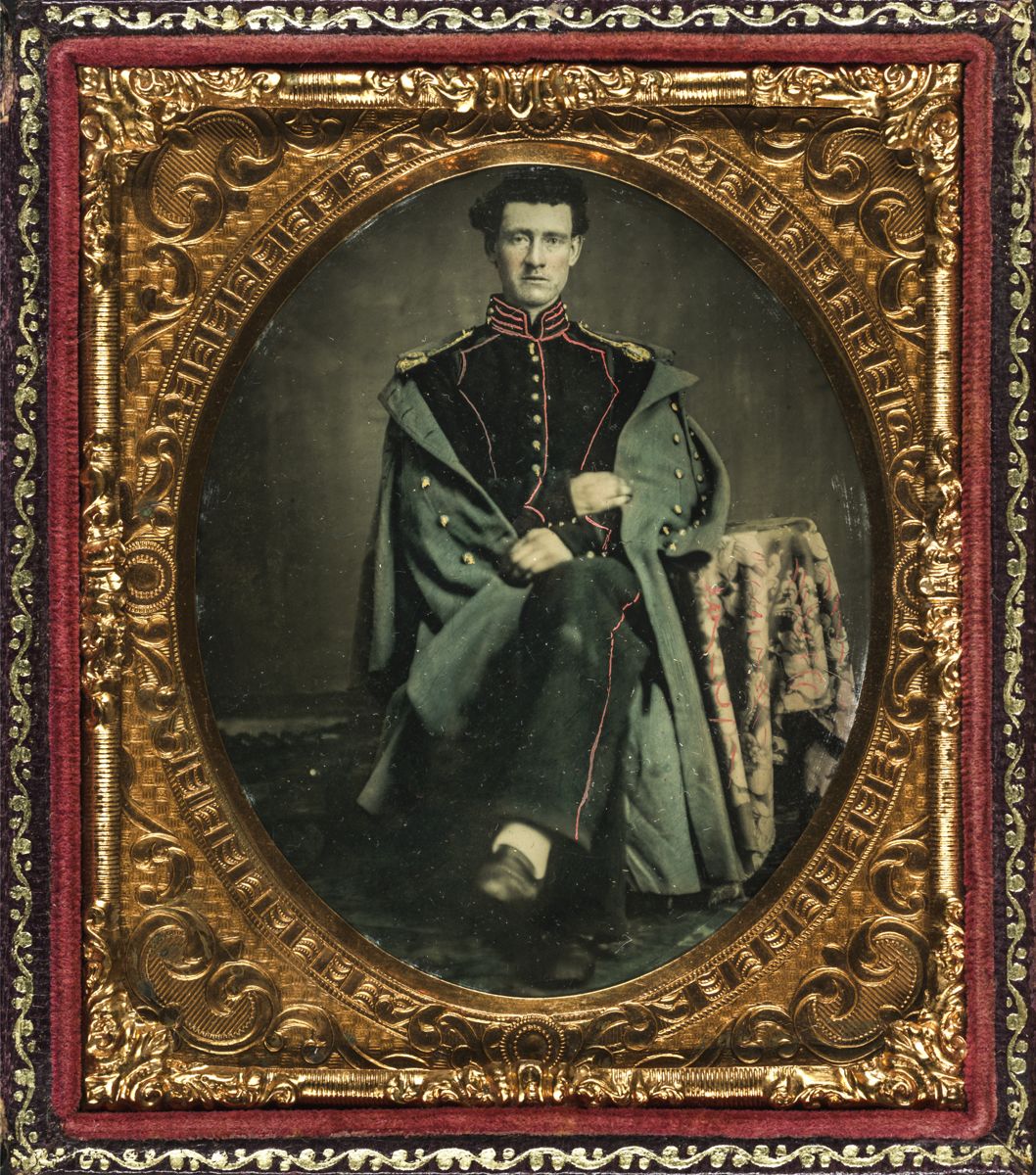
William P. Haberlin, Battery B, Pennsylvania Light Artillery, is posing in a blue double-breasted overcoat open to show the red-tinted artillery jacket. Private Haberlin was an Irish immigrant who enlisted on October 6, 1861, at Pittsburgh. He fought with his battery in the Western Theatre from Shiloh through Atlanta and the Battle of Franklin, only to be killed at Nashville on December 16, 1864. A poem found folded in the case showed his patriotism: “Now to the field again I’ll go, for the union to defend, until Jeff Davis is made to know, his kingdom is about to end. And now if I would not live, to hear f[r]eemen shout for joy, this miniature to you I give, in memory of a soldier boy. William P. Haberlin.”
Library of Congress
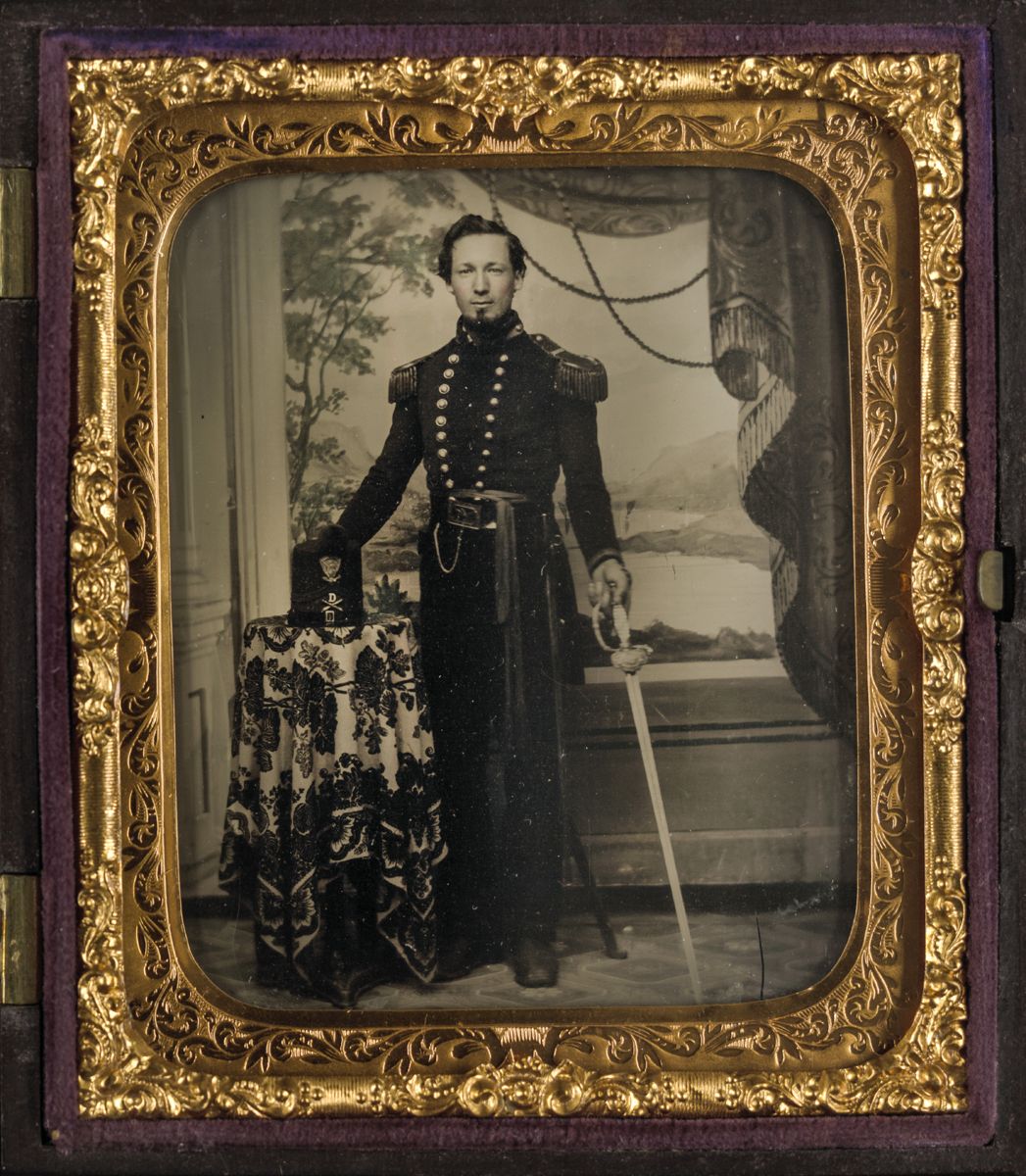
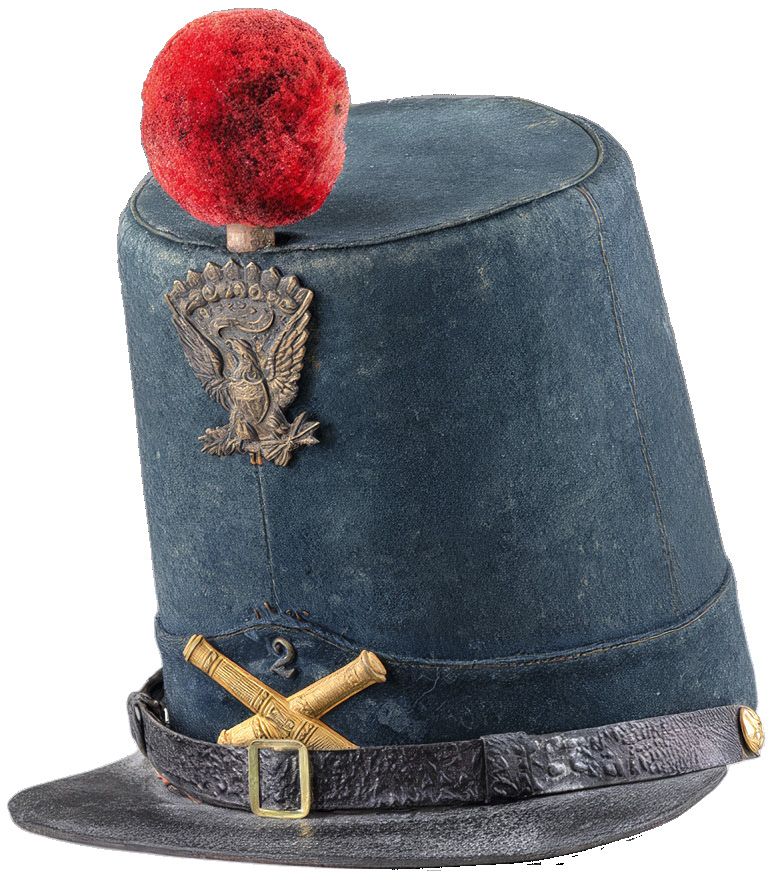
Early war artillery militia officer wearing double-breasted tail coat with epaulets. A stamped brass eagle buckle is on his sword belt which hides his sash. The officer is holding an antebellum militia officer’s sword with mother-of-pearl slab grips. His Model 1851 shako, with stamped brass “Jeff Davis” eagle hat device above-crossed cannon artillery insignia and stamped brass “D,” denoting his battery or company, rests on the table. The epaulettes on his coat do not appear to have any rank insignia. He has a watch chain attached at the waist and running into his left pocket. Modern photograph of a Model 1851 artillery shako courtesy Hindman Auctions.
Civil War Artillery Photographs from the Liljenquiest Family Collection
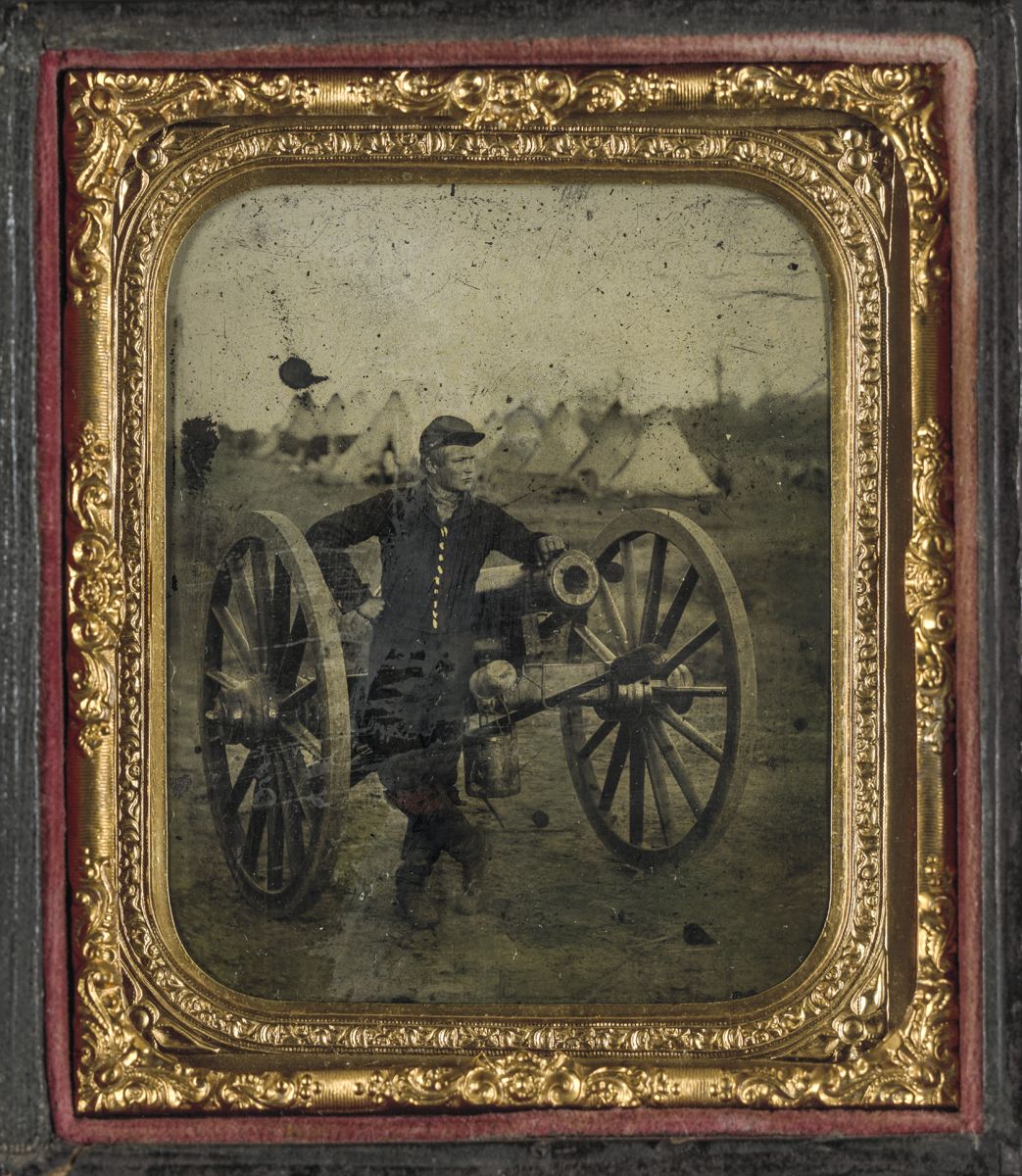
Unknown Union artilleryman in 13 button shell jacket posed in camp with a Model 1841 6-pounder cannon rifled on the James system. Sibley tents are visible in the background.
Library of Congress
Sergeant Tom Strawn, Company B, 3rd US Colored Troops Heavy Artillery, wearing regulation enlisted frock without chevrons, NCO belt with eagle buckle, forage cap, and holding a large frame revolver. He is standing in front of a painted backdrop showing the balustrade and landscape. The 3rd USCTHA served from late 1864 through 1866 as part of the Fort Pickering garrison in Memphis, Tennessee.
Civil War Artillery Photographs from the Liljenquiest Family Collection
Charles R. Rees photograph of twin brothers John C. Moore (left) and William Savage Moore who joined the Parker Light Artillery of the Confederate army on March 14, 1862, in Richmond. They wear Richmond Depot red artillery-trimmed shell jackets. At 16 years old, they required but did not have their mother’s consent to enlist. She took up a letter-writing campaign to have them released for being, in her words, “very sickly and delicately constituted,” and the two were discharged due on October 8, 1862. William would rejoin the service after he turned 18 years old and was legally able to serve.
Library of Congress
Another view of William Savage Moore from Richmond, who enlisted on March 14, 1862, into Parker’s Virginia Battery. He was only 16 years old. He is wearing a 9 button shell shell jacket, probably a Richmond Depot I. This Charles R. Rees photograph has a double casing with a lock of his hair. Young William served in two other Confederate artillery units as a lieutenant and was promoted to captain on May 1, 1865, in the decimated 15th Virginia Infantry. Two days later, 19-year-old Captain Moore was wounded and taken prisoner, held in Washington, D.C., until the end of the war.
Civil War Artillery Photographs from the Liljenquiest Family Collection
Albert B. Martin, Washington Light Artillery of New Orleans. Private Martin is wearing a red trimmed shell jacket with an unusual buttoned upturned brim on a slouch hat. Washington Artillery was among the most famous artillery batteries in Lee’s Army.
Library of Congress
Sergeant Philip Almeron Faatz, Company K and Company A, 3rd New York Light Artillery, wearing enlisted frock with sergeant’s chevrons holding forage cap with stamped brass crossed cannon artillery insignia, Company K, and designating unit markings of the 3rd NYLA. He is wearing an issue domet flannel shirt. Faatz (1837–1895) enlisted on October 23, 1861, and was discharged on July 3, 1865.
Civil War Artillery Photographs from the Liljenquiest Family Collection
This Union artillery private wears a red-tinted 13 button shell jacket and Model 1851 saber belt with an over-the-shoulder sling and eagle buckle. He is holding a cavalry saber, not the artillery version, that regulations called for. Artillery sabers were not that popular, and replacement using cavalry sabers was not uncommon, especially among officers.
Library of Congress
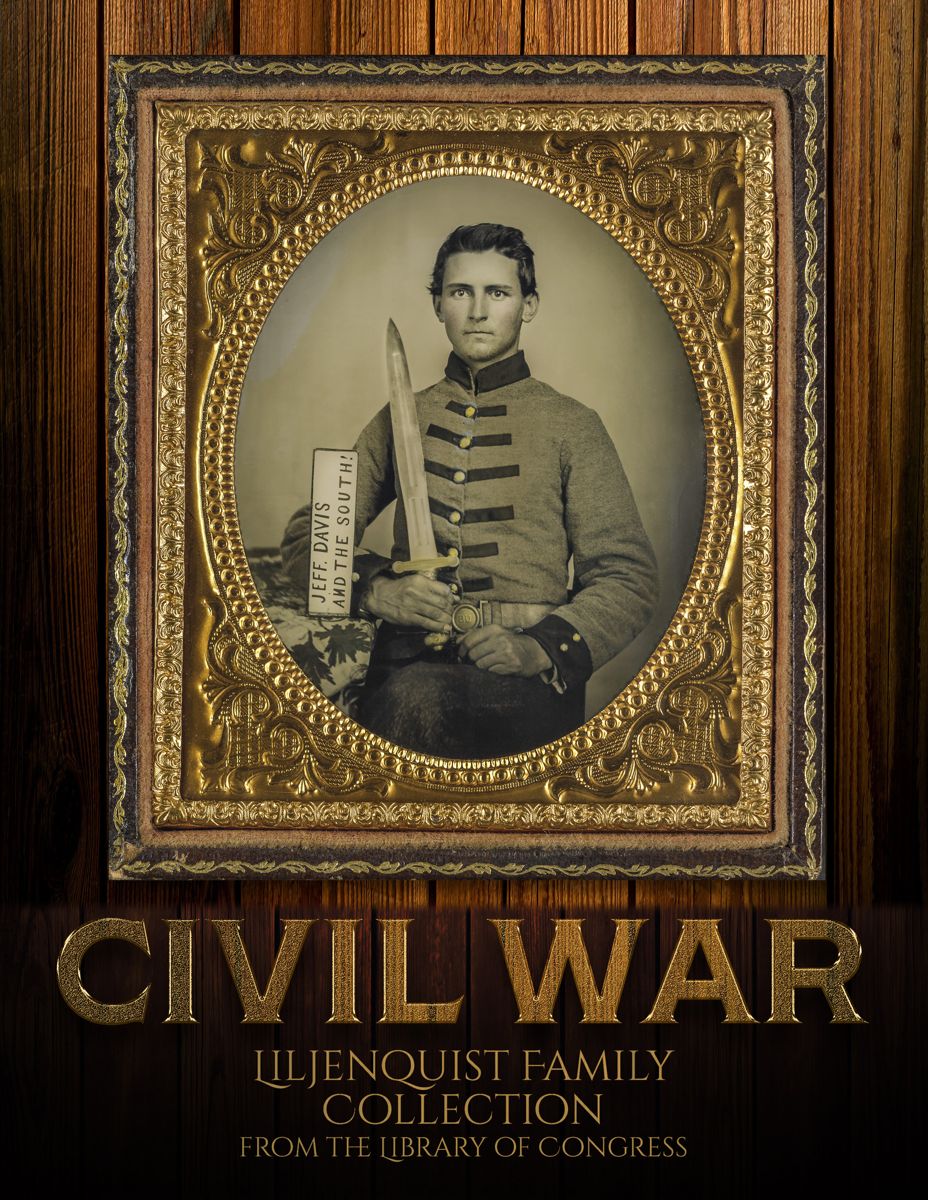
Henry Augustus Moore enlisted on May 8, 1862, into Company F, 15th Mississippi Infantry at Corinth, Mississippi. He contracted a malignant fever during the first Vicksburg Campaign and died August 14, 1862. He and six other members of his company are buried in a single grave near their home in Water Valley, Mississippi. Young Henry is photographed here wearing a Model 1832 artillery belt with interlocking US buckle and holding an Ames Model 1832 short artillery sword. His shell jacket with dark trim is quite distinctive and unique. Of the 20-plus images by this unknown Mississippi photographer, no known photographic props are repeated in any two images other than his iconic “JEFF DAVIS AND THE SOUTH” sign. Though infantrymen did not carry short swords, many early war Confederates carried big knives, so this antebellum sword and accompanying belt could’ve been used early in the war.
Civil War Artillery Photographs from the Liljenquiest Family Collection
The 5th Ohio Cavalry Regiment was originally organized as the 2nd Ohio Cavalry at Camp Dick Corwin, near Cincinnati, Ohio. Governor William Dennison changed their designation during November 1861 to the 5th Cavalry Regiment. Colonel William H.H. Taylor commanded this regiment. In February 1862, the 5th Cavalry participated in raiding Confederate supply lines in Mississippi… On April 6-7, 1862, the 5th Cavalry took part in the Battle of Shiloh, then fought at Corinth, Mississippi. During the Battle of Davis Mill, near Michigan City, Mississippi, the 1st and 3rd Battalions artillery fired 200 rounds in the same position against the
Confederates led by Sterling Price and Earl Van Dorn. The 5th Ohio guarded the Memphis & Charleston Railroad during early 1863 and raided into Mississippi serving with the XVI Corps supporting Ulysses S. Grant’s Vicksburg Campaign. In October 1863, the 5th Cavalry joined William T. Sherman’s campaigns around Chattanooga, Tennessee, and participated in the battles in that area. When General Sherman started the Atlanta Campaign in early 1864 the 5th Ohio Cavalry served
Remarkable view of complete mountain howitzer gun crew of Squadron G, 5th Ohio Cavalry taken in the field, sometime in late 1863 or 1864 after the 5th was issued their pair of howitzers. The pack horses have specialized saddles to hold the ammunition and tools necessary for firing the Model 1835 12-pounder mountain howitzer. The gun itself comes apart. The 500-pound carriage and wheels along with the 225-pound bronze barrel were then mounted in the specialized saddles.
Library of Congress with him. The years of hard service caused the 5th to lose most of its horses so they had to act as infantry during Sherman’s campaign. After Atlanta, the regiment was attached to Ma. Gen. Judson Kilpatrick’s command where they participated in Sherman’s March to the Sea. On November 28, 1864, Kilpatrick was almost captured at the Battle of Buck Head Creek. During that battle the 5th
Ohio Cavalry halted Confederate General Joseph Wheeler’s advance. The 5th marched to Savannah with Sherman and arrived in December 1864. In early 1865, during the Carolinas Campaign in South and North Carolina, the 5th Cavalry fought in skirmishes and in two significant battles where they took severe casualties. The 5th Ohio Cavalry remained on active duty for a few months after the war ended serving as picket duty in North Carolina. The Fifth was mustered out on October 30, 1865. The regiment losses were one officer and 26 enlisted men killed; three officers and 140 enlisted men died from disease or sickness for a total of 170 casualties.
Model 1835 Mountain Howitzer with caisson, note the name painted “LADY HEATH” painted on the carriage. Squadron G, of the 5th Ohio Volunteer Cavalry christened their two howitzers in honor of their commanders’ wives, Colonel Hinsley Heath for this particular gun, commander of the 5th OVC. The 5th OVC saw service with these guns from October 1863 until 1865 in the Western theater, and there are several accounts of these particular guns being used to fine effect.
Civil War Artillery Photographs from the Liljenquiest Family Collection
Charles F. Sherman, 2nd Massachusetts Light Artillery Battery with inset photo of unknown female friend and Grand Army of the Republic (GAR) medal on cushion of case. Private Sherman wears Zouave style uniform with baggy pantaloons and decorated vest. Charles entered service on July 31, 1861, when he was 20 years old. His occupation was listed as a “box maker.” He would serve over three years, most in the Department of the Gulf in Louisiana and Mississippi, where there was only sporadic fighting. As with many units fighting and garrisoning in the Southern swamps, attrition from disease was more common than casualties on the battlefield. Indeed, the 2nd Massachusetts Light Artillery lost only four men in combat, but 26 died from disease. Charles would muster out in August 1864 and return home to Watertown, Massachusetts. He lived until 1928. He was a prominent member of the Isaac B. Patten GAR Post attaining rank of major.
Library of Congress
Ten Union artillerymen surrounding a Model 1841 bronze 6-pounder smoothbore cannon. They are wearing Hardee hats, blue-tinted trousers, and 13 button artillery shell jackets. Sergeant on the far right and the private on the far left both hold cavalry sabers and wear sword belts. One battery man in the foreground holds a fixed 6-pounder canister while another uses a rammer.
“The Magazine Like No Other: Where History Isn’t Just Studied, It’s Collected.”
ANTIQUE
MAGAZINE
May-June 2022 Vol 1, No. 2 $8.00
Hey there, history aficionados and collectors! Allow me to introduce Military Antique Collector, your must-have bimonthly magazine. Printed on top-notch paper with vivid, high-res color photos, each issue is a treasure trove for both expert collectors and newcomers. Now, you might be thinking, “Is this magazine for me?” Whether you’re a seasoned collector with a room full of treasures or a newbie just dipping your toes into the fascinating world of military antiques, we’ve got you covered. Each issue is jam-packed with articles that are not just informative but downright captivating. And who’s behind these articles? Only the best in the business—renowned authors, museum curators, and auction experts who really know their stuff. We spotlight rare and unique military artifacts, from early American and European pieces to select post-1898 gems, all tied to historical figures you’ve read about. Ready to make history come alive in your hands? Leech & Rigdon made about 1,500 guns, most in Greensboro and Augusta, Ga., with machinery moved from Columbus, Miss., during March 1863. Leech revolvers are copies of Colt avies with round barrels. There are several variations; SN 1463 is the highest known Leech serial number.
By Philip Schreier, Director, NRA Museum
Leech & Rigdon, SN 15, earliest known barrel marking.
Colonel Joseph Walker, Field and Staff, Palmetto South Carolina Sharpshooters, 1862–1864. He is wearing his uniform, a two-piece South Carolina belt buckle with palmetto tree, a red sash over shoulder for officer of the day and is holding an eagle head sword. His kepi has the palmetto tree insignia with “K,” “5,” and “R.” Liljenquist Family Collection of Civil War Photographs (Library of Congress).
The most important contract requirement noted that, These arms and their component parts, to be manufactured within the State of South Carolina, of the best material and workmanship and as far as practicable, of material and by mechanics obtained in the state foresaid. From this contractual clause it is clear that the State of South Carolina was trying to establish a Virginia Manufactory type facility and wanted to be completely independent of any reliance upon the industrial north for arms manufacture. This clause would be the undoing of Glaze’s enterprise.
It appears that even though Glaze built a factory and acquired some machinery, he never intended to actually fabricate any arms in his own facility. Rather he intended, at most, to acquire finished components and assemble them into complete arms. As noted by collector, researcher, and author Lew Southard in his excellent article “The Origin of the Palmetto Pistols” (American Society of Arms Collectors Bulletin 81:29-42) the “economy of scale” clearly indicated that Glaze had no intention of manufacturing complete arms. The very cost of the tooling and machinery to manufacture muskets, rifles, pistols, and two
This Model 1900 in .30-40 was one of the last designs produced by the Gatling Company before they were found to be obsolete and replaced by water cooled and air cooled full automatic machine guns. Photos courtesy of NRA Museum. Photo of Dr. Richard Jordan Gatling (1818–1903). (Library of Congress).
Novelty Works ad that appeared in the Memphis Daily Appeal (Memphis, Tenn.) Sept. 10, 1862, page 2.