
The Marine Raider Stiletto
By Tim Prince · Originally published May-June 2024 · pp. 68–75
The Marine Raider By Tim Prince
Stiletto
If imitation is the sincerest form of flattery, then the fighting knife created and issued to the Marine Raider Battalions during World War II certainly qualifies as flattery of the iconic Fairbairn-Sykes commando knife. The Raider stiletto holds the distinction of being the first U.S. military designed fighting knife to be put into production after the United States officially entered the Second World War. Lt. Colonel Clifford H. Shuey is credited with the knife’s design in 1941. Shuey was the Officer in Charge of the Engineer Division, Quarter Master Department, Headquarters of the US Marine Corps. Lt. Colonel Shuey would go on to design several knives used by the USMC over the coming years, including the iconic USMC 1219C2 “fighting knife, utility” known simply as the KABAR. Shuey would retire from the Corps as a brigadier general in 1956. The genesis of the Raider stiletto has a strong British influence and harkens back to the interwar days in China. The establishment of the Marine Raiders was modeled upon the 1940 British Commandos. The concept was to create an elite fighting force that would be adept at various amphibious landing techniques, lightning strikes, and able to operate in hostile territory or behind enemy lines to create as much havoc for the enemy as possible. The first Marine officers to train the Raiders were themselves indoctrinated into the world of elite commando warfare training by spending time with the British commando forces the Marine battalions would be based on. In November 1941, Marine Captains Wallace Greene Jr. and Samuel Griffith II were dispatched to Great Britain to learn from the British Commandos. There, they met the primary trainers of the British Commandos in close-quarter combat, including both unarmed and with edged weapons: William Ewart Fairbairn and Eric Anthony Sykes. Fairbairn and Sykes were no strangers to the old China Marines of the 4th Marine Regiment. Both men had served with the Shanghai Municipal Police in the decades before World War II and had developed their own blend of Western and Asian close quarter combat techniques well suited to surviving as police officers in what was generally considered to be one of the most dangerous cities in the world during that period. Soon the men were teaching their techniques to the balance of the Shanghai Municipal Police, and to U.S. Marines stationed in and around Shanghai in the 1930s.
One of the fighting techniques that Fairbairn and Sykes helped develop and refine was using the knife as a closequarters weapon. The men felt that no quality, missionspecific fighting knife was available and proceeded to design what they felt was the perfect fighting knife. These experiments occurred during the mid-1930s with the prototypes produced in the Shanghai Municipal Police armory. The knife design they settled on was a tapered doubleedged dagger-shaped blade with a prominent median ridge that gave the knife a diamond-shaped cross-section. The knives had a round wood grip with a swelled, vase-like profile and an oval cross guard made from sheet aluminum. The blades were produced from the blades of old British Lee-Metford bayonets that were still in inventory with the Shanghai Police but were no longer seeing use. Blade lengths varied from about 4.75 inches to a little over 5.5 inches, with overall lengths that varied from about 9 to just under 10 inches. The reminiscence about these early Fairbairn-Sykes knives from those involved in their production remembered that two knife blades were made from each bayonet blade. The knives had the basic overall profile of plug bayonets from the 16th and 17th centuries. Interestingly, a Marine Captain who served with the 4th Marine Regiment in China, Sam Yeaton, was apparently part of the prototype knife design process in Shanghai, giving the Fairbairn-Sykes knife a direct link to the Marine Corps. While in Shanghai only a small number of the knives were made, primarily as prototypes and for the use of some of the Shanghai Municipal Police. When Fairbairn and Sykes returned to England to start training the new Commandos in close-quarter combat in 1940, they brought with them their personal knives and the knowledge they had obtained during the development process in Shanghai. Realizing that the British military had no purpose-built fighting knife that filled the needs of the Commandos, the two approached the British War Ministry to get the knife they envisioned produced and into Commando hands. This resulted in Fairbairn and Sykes being introduced to Sir John Wilkinson-Latham of Wilkinson Sword and the rest, as is often said, is history. The result was the famous FairbairnSykes fighting knife produced by Wilkinson Sword, which would become one of the most iconic and copied fighting knives in history.
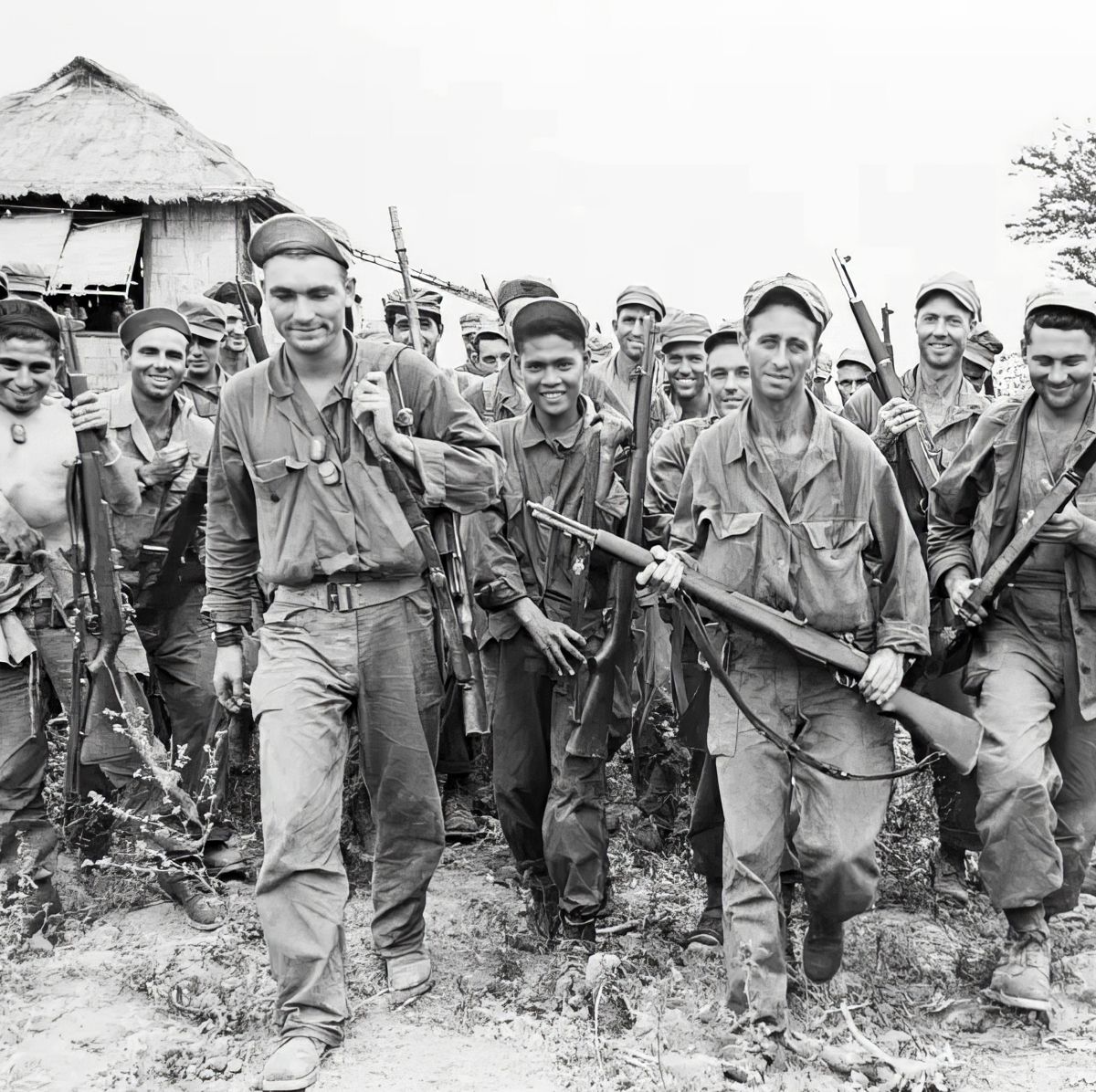
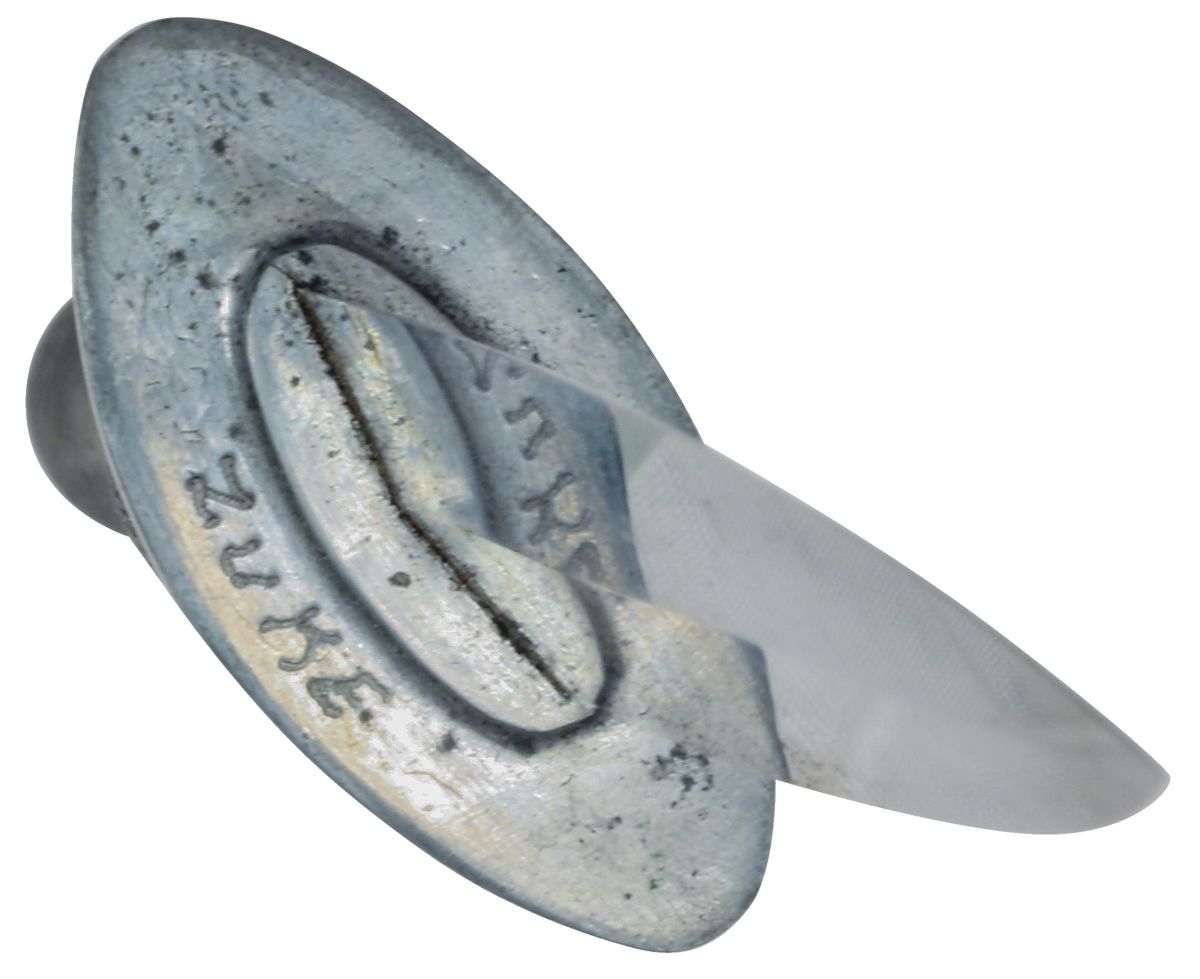
Left: The 4th Marine Division soldiers pose with two Japanese captured flags. Above: Overall obverse view of a rare example of a used Raider stiletto that retains a fine condition hilt with no obvious deterioration and also retains visible etching on the blade. This stiletto is identified on the face of the guard with the name “Zuke,” likely the nickname of the Marine Raider who carried the knife. (All photos by Tim Prince)
Face of the guard of the “Zuke” Raider stiletto, showing the name scratched on the knife.
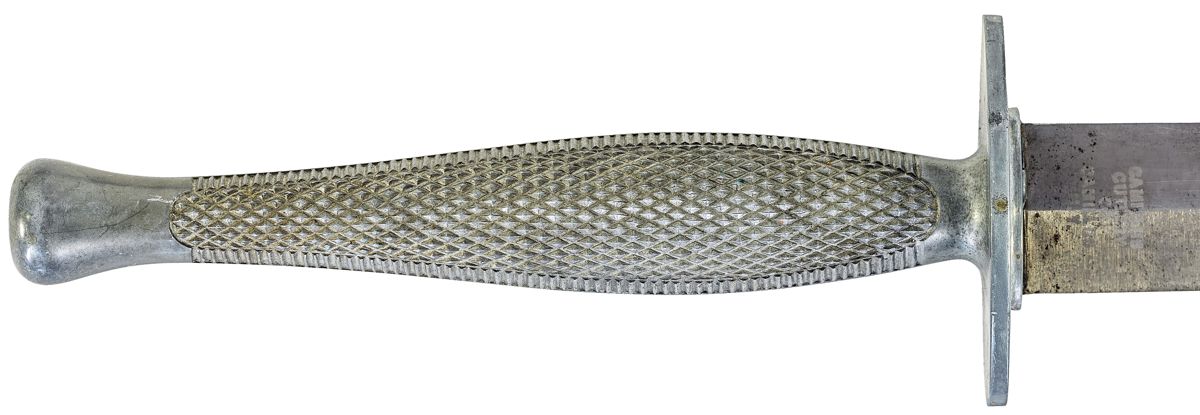
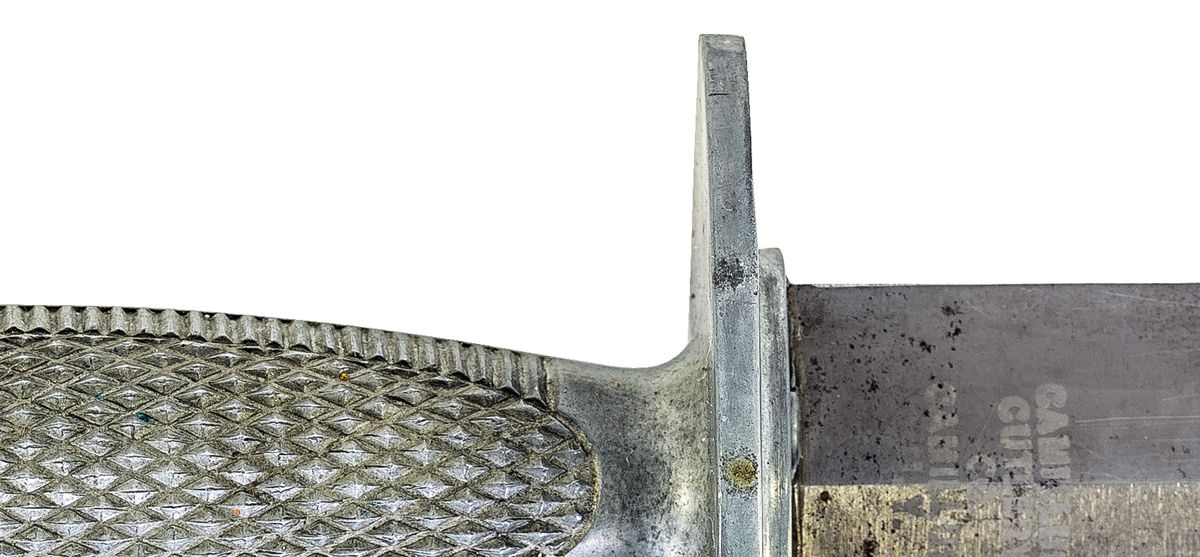
Close-up view of the hilt of a very fine condition Raider stiletto, showing the cast checkering and no apparent deterioration due to ion leaching.
For the newly formed Raider battalions, whose initial training was based upon the British Commando units, a Fairbairn-Sykes style knife was a natural fit. Not only were Captains Greene and Griffith familiar with it from their time with the Commandos, but they were familiar with techniques for its use. Additionally, the old-time 4th Regiment “China Marines” were familiar with both the knife and the training concepts provided by Fairbairn and Sykes in China. Fairbairn and Sykes also brought their training to North America, training commandos from multiple countries at the British Special Training School on Lake Ontario in Oshawa, Canada. Known as “Camp X,” it became active on December 6, 1941, the day before the Japanese attack on Pearl Harbor. This location not only trained commandos who would serve with British and Commonwealth troops but also early members of the American OSS, the World War II predecessors of the CIA. Here such famous American close combat luminaries as Rex Applegate were first exposed the Fairbairn-Sykes system and would teach those techniques to many others over the ensuing years. With all the influence that Fairbairn and Sykes had on the fighting techniques, training, and associated knife design for elite fighting forces, it is no surprise that Lt. Colonel Shuey based his Raider knife on their knife. When America was forced into World War II with the Japanese bombing of Pearl Harbor, there was only one fighting knife in the American military arsenal, the U.S. Model 1918 Mk1
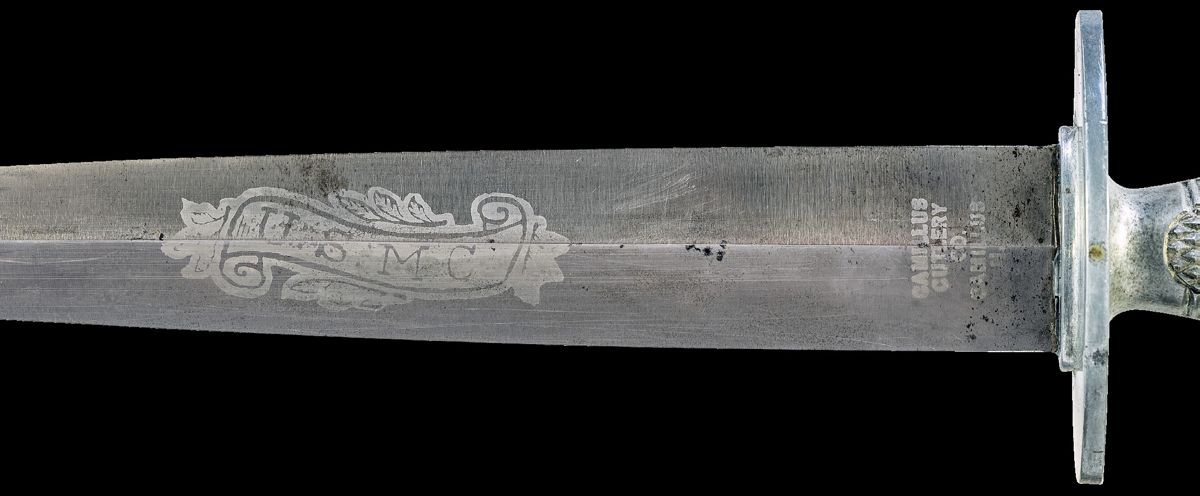
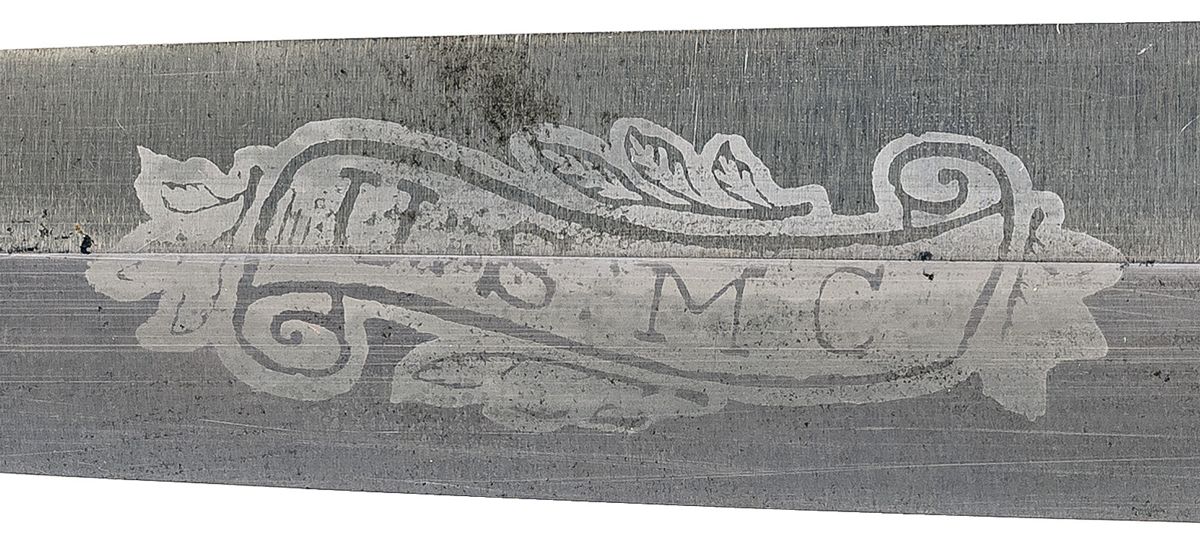
brass knuckle trench knife. While this sturdy and hardhitting fighting knife was certainly an effective combat tool, it had several drawbacks that made it the less than perfect choice for the Raiders. It was heavy and bulky, and the large oval guard made it difficult to carry comfortably or to easily strap it to an arm or leg. The metal scabbard was similarly uncomfortable, and the fixed prongs that engaged the grommets in the web belt were prone to bending and breaking. Additionally, the large brass knuckle hilt restricted the ways in which the knife could be held and used and did not lend itself to the refined knife fighting techniques taught by Fairbairn and Sykes. From a production standpoint, the nearly one pound of brass used in casting the large brass knuckle hilt was not considered an efficient use of a relatively scarce war material needed for more important things like shell casings. Since there was no current production knife that filled the need for the Raiders, Shuey adapted a known successful design for the Raiders’ purposes. The Raider stiletto, like the Fairbairn-Sykes knife, was a purpose-made killing weapon with little value as a utilitarian knife or tool. The knife was designed to be lightweight, cheap, and easy to manufacture. It utilized a stamped steel blade that was then machined to a diamondshaped cross-section to improve its strength. The blade was polished to a bright shine and acid etched with a USMC banner scroll on the obverse of the blade and with the maker’s name and location etched on the ricasso.
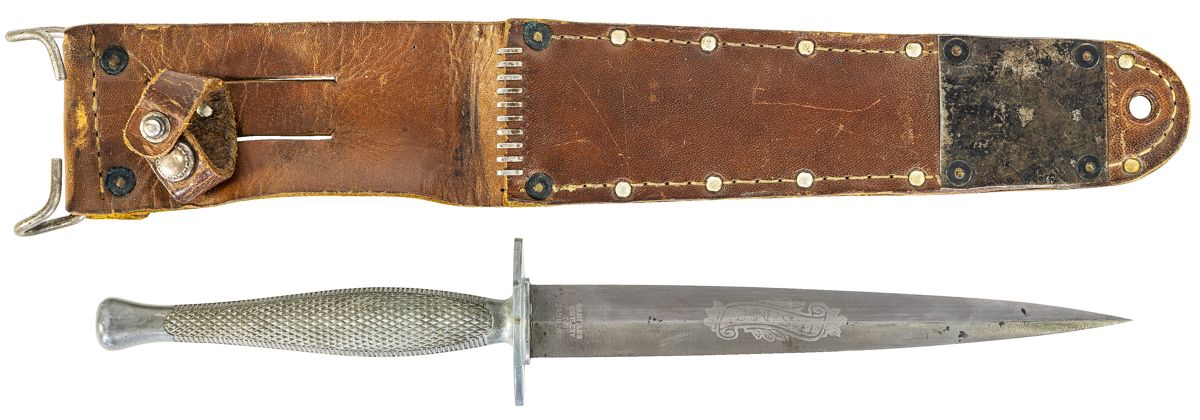
Detail view of the blade etching of a very fine condition Raider stiletto.
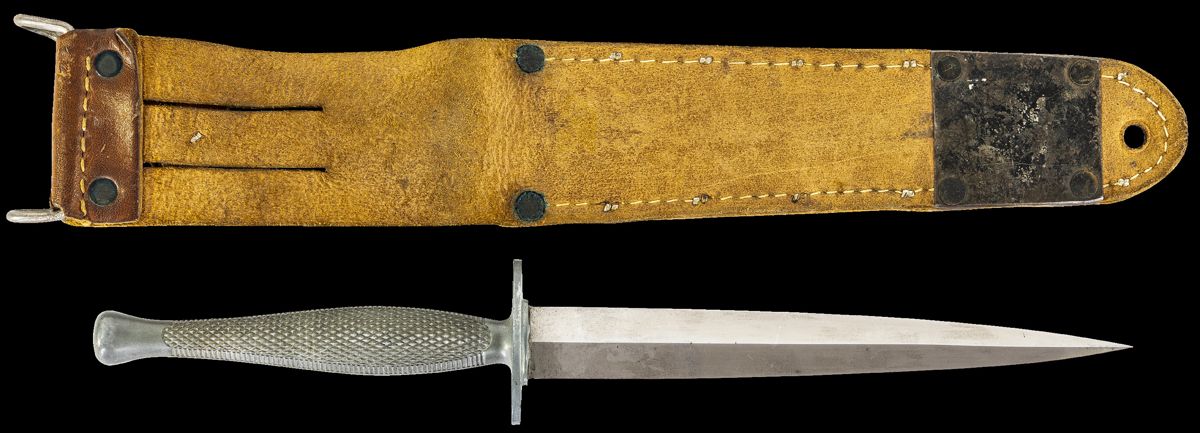
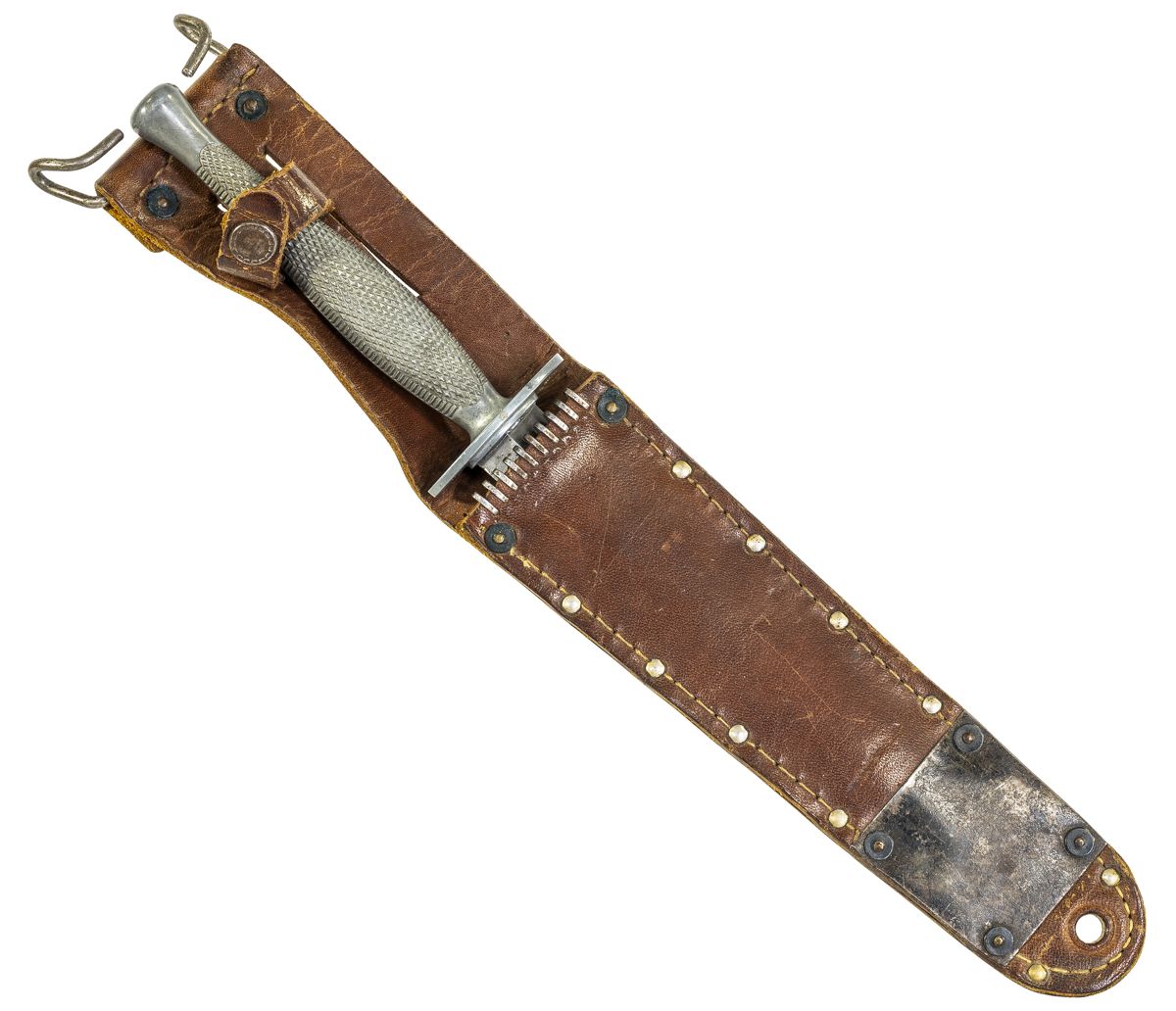
The handle was cast from an aluminum-zinc alloy and integrally cast onto the blade’s tang. The grip featured sharp diamond checkering cast into the sides of the hilt and serrations along the top and bottom. The grip was cast in a slightly oval shape, which fit the hand better than the machined round hilt of the Fairbairn-Sykes knife. The oval guard was integrally cast as part of the grip as well. The stamped steel stiletto blade was very thin at the end and quite delicate. In fact, the Marine Corps specifically prohibited throwing the stiletto, as it would likely break the tip of the blade. In actual use, the stilettos likely had many of their tips damaged by using the knives as tools to open and pry things and using them in any number of ways other than as a stabbing weapon. This inherent weakness in the blade design has made these rare knives even harder to find with original full-length blades that have not been reshaped or “re-tipped.” Marine Major General (retired) Oscar F. Peatros recalled of the Raider stiletto in the book Bless ‘em All: The Raider Marines of World War II: “It was pointed out that it should never be thrown, as it was designed as a hand-held weapon to be used only in combat. It was also pointed out that it was brittle and would break even if just dropped, particularly the point.” While not known at the time, the aluminum-zinc alloy hilts also had an inherent weakness. The alloy was very brittle and leached zinc ions over time, essentially decomposing. This made the hilt susceptible to cracking and degrading with age. The end result is that finding a Raider stiletto without any obvious cracks in the guard or grip is very difficult these days and will only become harder as the grip alloy continues to age and essentially decomposes due to the loss of the zinc ions over time. The Raider stiletto was issued with a leather scabbard made by Mosser that would become the pattern used with the Army’s Special Forces V42 Stiletto and the M3 Trench Knife. It was a two-piece scabbard, with the front and rear leather components joined by a combination of sewing and riveting. The scabbards were produced in two basic variants, with the early scabbards being leather without the metal reinforcing plates on the front and back at the tip, while the later scabbards had the metal plate reinforced tips. The Raider stiletto scabbard was based upon the scabbard used with the Western L76 and L77 stilettos which used a wire belt hanger to allow it to be attached to the web belt’s eyelets. In early 1942, a contract for 5,000 of the new Raider stilettos for Raider Battalions that had officially been designated in February 1942 was let to the Camillus Cutlery Company of New York. Camillus would receive an additional contract for 9,370 knives, bringing the Overall view of the “Zuke” Raider stiletto showing the well-worn total production of these rather scarce knives to only scabbard as well, which shows discoloration, which is likely the 14,370. The initial production knives reached Marine result of exposure to a number of adverse conditions during carry supply depots and Raider Battalions in training in the summer that same year. It was probably the fall of 1942 and use. Note that the hilt retaining strap is missing as well.
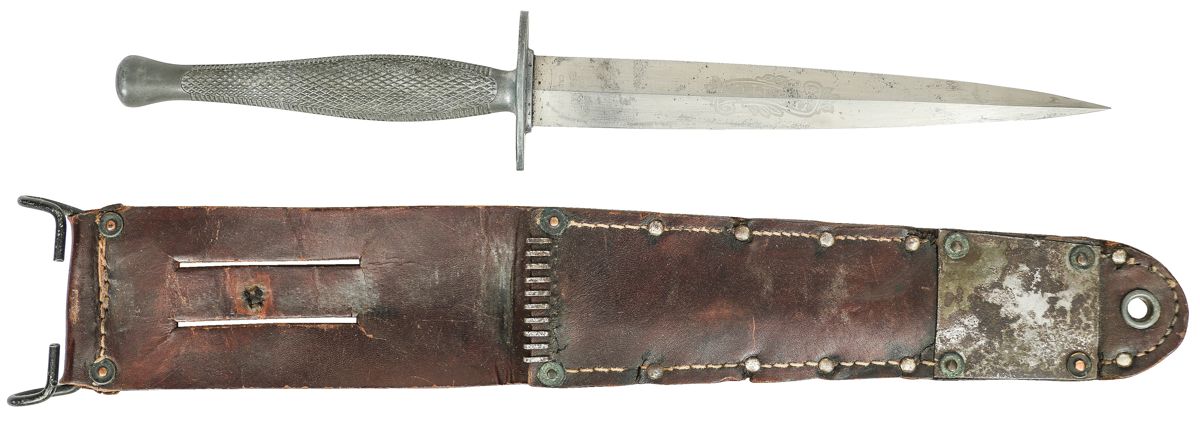
Reverse overall view of a very fine condition Raider stiletto with a very nice condition later production scabbard with the tip reinforcement plates.
Obverse overall view of a very fine condition Raider stiletto with a very nice condition later production scabbard with the tip reinforcement plates.
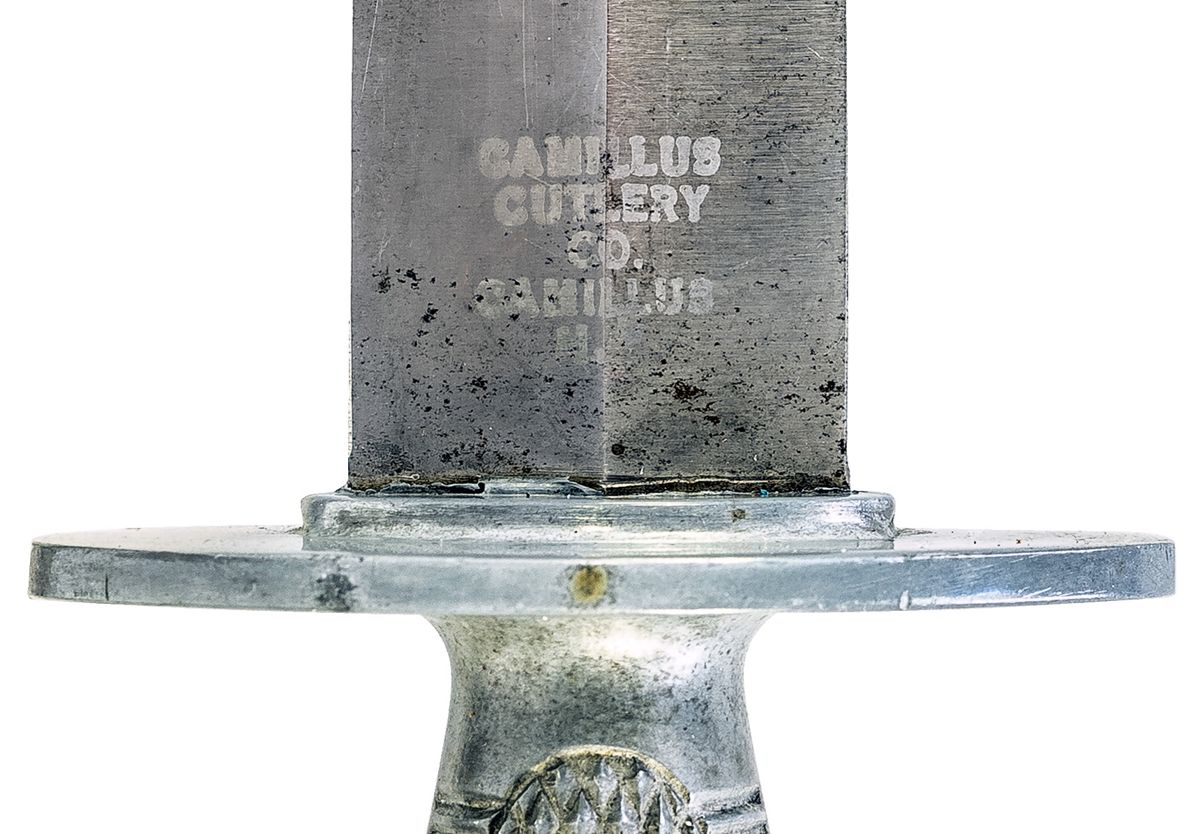
CAMILLUS CUTLERY CO. CAMILLUS N.Y.
before any stilettos were issued to the Raiders already engaged in the Pacific. The very first knives issued to Raiders while the Raider stiletto was in development and prior to delivery were the Western L76 and L77 stilettos, along with their so-called two-piece leather “commando” scabbard with a wire belt hanger. As the Raiders were based on their British Commando counterparts they were intended for lightning-fast “behind the lines,” “hit and run” amphibious actions against the Japanese. During WWII, the Raiders were instrumental in delivering stunning blows to the Japanese forces and fought gallantly in nearly every major Pacific landing operation from the Battle of Midway through Guadalcanal, the Solomon Islands Campaign, New Georgia, and Bougainville. The four official “Raider” battalions were disbanded in January 1944, and the two battalions in the process of being formed were reorganized into other standing Marine regiments. During their brief existence, a total of 7,710 Marines and 368 sailors served as “Raiders.” The USMC Raider stilettos pictured in this article are mostly in very fine to excellent condition and are far superior to most found on the collector market today. Even though the Camillus factory specifications for the knives list the blades at a nominal 7 inches, it has been my experience that truly fine-condition examples that have not had any blade damage typically have blades that measure between 7.125 inches and 7.25 inches. One of the most noted authors and experts on US fighting knives, M.H. Cole, lists the blade length for the Raider stiletto at 7.25 inches. It would be fair to assume that there was some minor variation in length during production, especially in the final shaping of the point, and a variation +/.125 inches would not be unreasonable. The bright steel blades were decorated with an acid-etched USMC scroll banner on the obverse of the blade. They were additionally etched in five lines CAMILLUS/CUTLERY/CO/CAMILLUS/ N.Y. on the obverse ricasso. When in nearnew condition, the blades often show a grained cross polish that is not seen on knives that have seen much use. The cast zinc alloy hilts typically have a dull, pewter gray color, although it is not uncommon for a flaky white residue to develop on the hilt as it oxidizes and degrades over time. The knives pictured here are in the correct, later production leather scabbards. All the Raider stilettos were delivered in unmarked scabbards produced by Mosser. The only major variation of the sewn two-piece leather scabbards with rivet reinforcements are whether or not the scabbards have protective
Overall view of the “Zuke” Raider Stiletto in its scabbard.
metal plates near the tip to prevent the knife from poking through the scabbard. The scabbards were designed with a pair of slits in the hanger portion to allow its placement on a belt without having to use the wire hanger to engage web belt eyelets. A tie-down thong that passed through a gromet-reinforced hole was included to keep the scabbard from flopping around if the Marine wanted to secure the scabbard against his leg. The staple reinforcements at the throat were to keep the blade from slicing through the scabbard when the knife was being sheathed. The hilt retaining strap on the Raider scabbard is shorter than on M6 scabbards for the M3 trench knife and will not accommodate an M3 hilt. While most M6 scabbards are marked with a contractor name as well as dates and inspection marks, the Raider scabbard is invariably unmarked.
For collectors today, it is hard to find a truly finecondition USMC Raider stiletto. While production figures are nearly double the number of men who served in Raider Battalions, suggesting that many unissued knives should be floating around on the market, the production methods mean that even unissued knives often have condition issues. Due to the ion leaching issue with the zinc alloy hilt, it is not uncommon for a knife with a very fine blade to have a deteriorating hilt that shows cracks or is even missing pieces. By the same token, the fragile blades and tendency for the acid-etched blade markings to wear away easily with even light use mean that finding a used knife with a full-length blade with fully visible etching is quite difficult as well. The Raider stiletto, with a fine hilt and equally fine blade, is a collecting rarity that is highly coveted in military knife collecting circles.
About the Author
Tim Prince is a full-time dealer in fine and collectible military arms from the Colonial Period through WWII. He operates College Hill Arsenal, a web-based antique arms retail site. A long-time collector and researcher, he has been a contributing author to two major book projects about Civil War era arms including The English Connection and a book on southern retailer-marked and Confederate-used shotguns. He is the author of over 70 articles on weapons in Civil War News and Military Antique Collector. Tim is also a featured Arms & Militaria appraiser on the PBS Series Antiques Roadshow and serves as a Senior Consulting Specialist to the Arms & Armor department of Cowan’s, a Hindman Company.
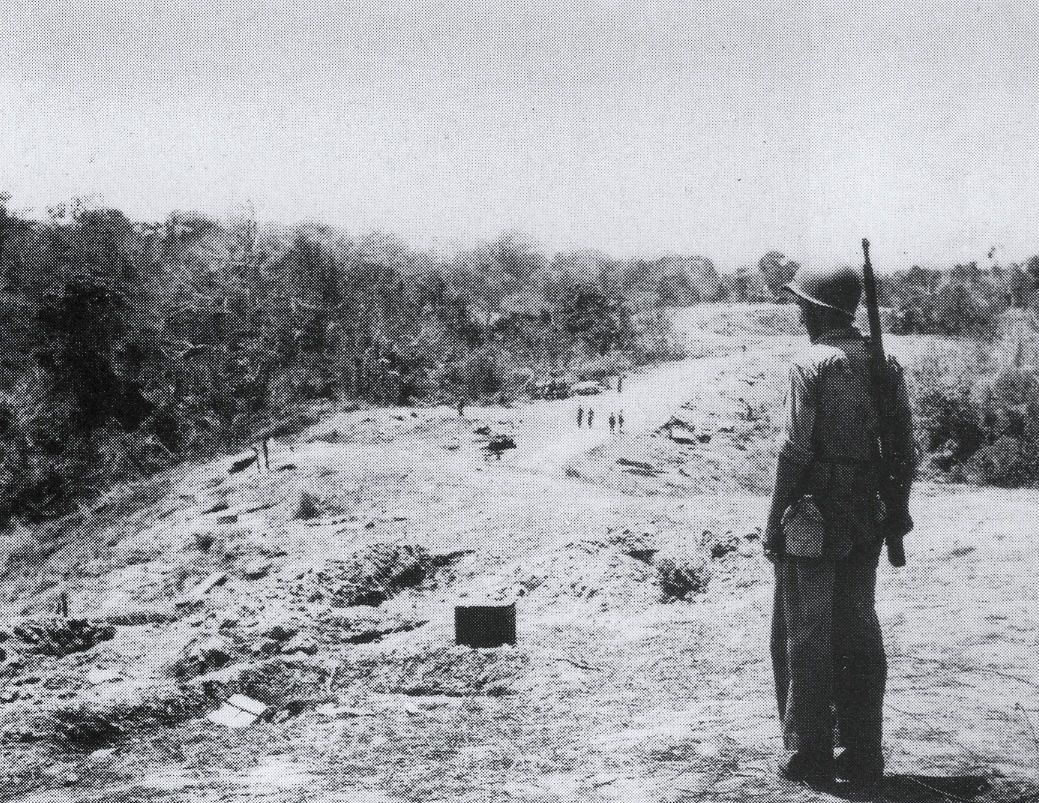
U.S. Marine Raiders during World War II.