
Captain Andrew Mulligan, C.s.a
By Shannon Pritchard · Originally published March-April 2024 · pp. 8–22
Captain Andrew Mulligan
Andrew Mulligan, circa 1870.
At the 2019 North South Trader National Show in Richmond, Va., I saw a Confederate captain’s frock coat that belonged to well-known dealer and Antiques Roadshow appraiser Rafael Eledge. When I asked Raf about it, he proceeded to tell me that he had just acquired a group of items from the descendants of a Captain Andrew Mulligan. On further inquiry, I found that he not only had Captain Mulligan’s coat, but also his revolver, sword, photograph, numerous period letters, and other documents that had been preserved by his family, including the captain’s handwritten account of the Battle of Trevilian Station and a hand-drawn map of the same battle. I soon realized that I had stumbled upon one of the most fantastic Confederate groupings to come straight “out of the woodwork” that I have encountered in my forty years of collecting and dealing in Confederate antiques. Due to my addiction to fine Confederate antiques, all other thoughts went out of my head; I was in love again, and of course, my new love went home with me. Then, the real fun began. We lovers of history, addicts all, have often lamented, “If only it could talk.” This historic grouping answers back, “I have a story to tell,” and the detail in which it tells the story is as remarkably complete as the Captain’s wartime artifacts. I can think of no better introduction to Alfred Birmingham Mulligan than the sketch that he himself wrote from Spartanburg on July 9, 1891. “I was born in Prince William’s Parish, Beaufort District, S.C. one mile from Whippy Swamp Cross Road, Oct. 3rd, 1825. Am the youngest son of John & Catherine Mulligan. My father died when I was about fifteen years old, leaving a large family, a fine plantation, & some twenty odd slaves. His debts were small, but left Mother, grandmother, & several of my sisters with no means of support. It fell to my lot to take charge of them & to provide for them. This prevented me from educating myself. My first business effort was teaching school near to where I was raised but finding I could not make a support of the family teaching, I went to Savannah, Ga. in 1848 I engaged myself as clerk there in a dry goods store, where I remained for two years in that capacity. I then went to Charleston, S.C. about 1851 & engaged as a clerk in the same line of business for about two years.
I then commenced business on my own account at Graniteville in 1854 & re engaged as clerk in a dry goods house until 1857 when I commenced the general grocery business on Meeting St. Opposite the Pauline Hotel, Charleston, S.C. In 1861 I closed business & entered the Confederate Service as Captain, having raised a company of Cavalry. In equipping my company I spent several thousand dollars of my private funds. Until July 1863 I was on the coast of S.C. In July 1863 I was ordered to Eastern N.C. where I remained on duty until April 1864 when I took my company to Virginia. From April 1864 until Oct. 27th 1864 I was in active service around Richmond, Petersburg, &c. being in 5th Reg. S.C. Cavalry, Butler’s Brigade S.C. Vol. On Oct. 27th 1864 I was severely wounded in battle near Burgess’ Mills, about 6 miles South West of Petersburg, Va. This ended my career as a soldier.”1 After the Captain’s death on March 10, 1910,2 Mrs. A.B. Mulligan began gathering and organizing his papers and letters with the intent of having them published for the family. In 1935 she passed this duty to her daughter in a letter written on March 12th, she wrote: “There is romance in a families [sic] history of generations of ancestors and I’m keen on “looking things up” and having it ready for the ones who can write it up.” In 1992, her dream was brought to life by Olin Hutchinson Jr. “Hutch” Hutchinson met Captain Mulligan’s granddaughter by accident in 1988 and found that the family had nearly two hundred wartime letters written by the Captain. My Dear Mother & Sisters, Civil War Letters of Capt. A.B. Mulligan, Co. B 5th South Carolina Cavalry — Butler’s Division—Hampton’s Corps 1861–1865, was the fruit of two generations of Mulligan descendants’ work and an enthused historian. It is not my intention to write the book over in this space, only to bring out some passages that especially caught my attention. Mulligan raised and equipped his 89-man company, the “Dixie Rangers,” at his own expense,3 costing him $34,000; a considerable sum today, but a fortune in 1861; that would be $1,185,155 in 2024 dollars!4 On February 19, 1862, he proudly wrote that he had been unanimously elected captain by his men. In the same letter he drew an analogy to the First War for Independence:
Captain Mulligan’s U.S. Model 1860 light cavalry sabre made by Ames Manufacturing Company. (Photos courtesy OldSouthAntiques.com.)
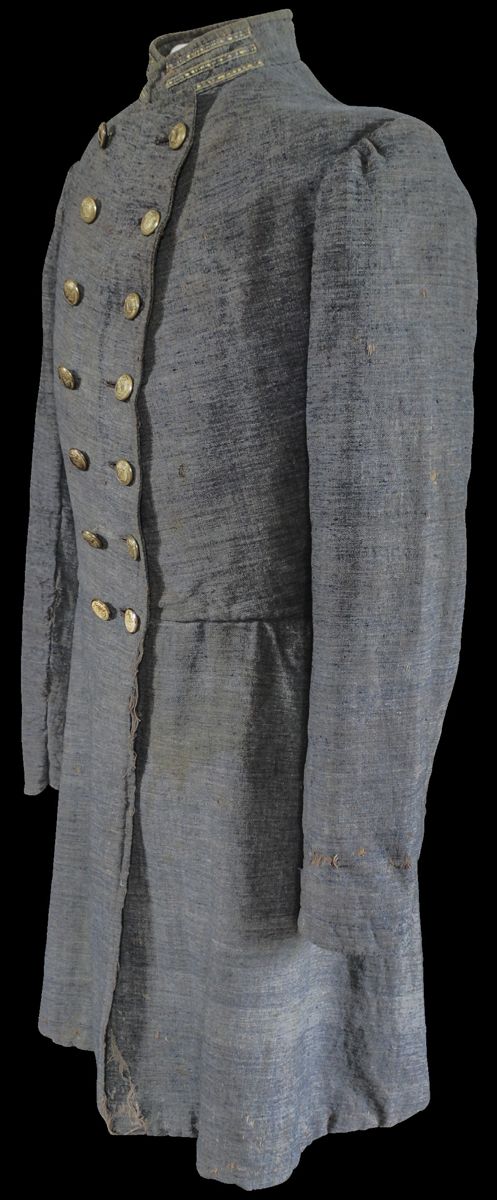
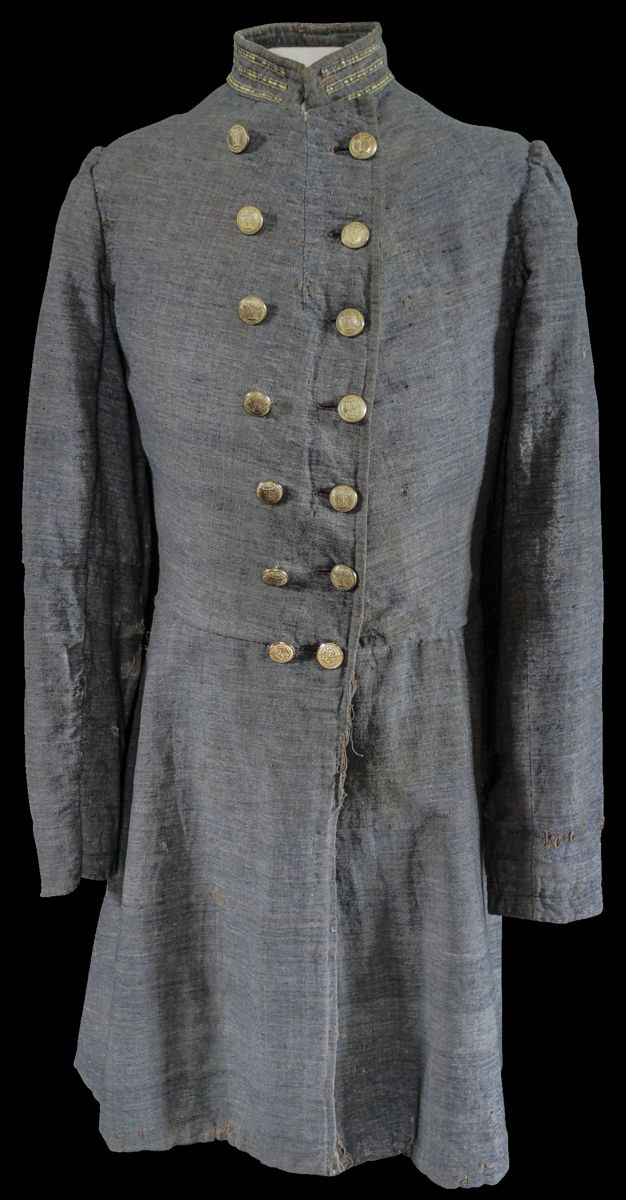
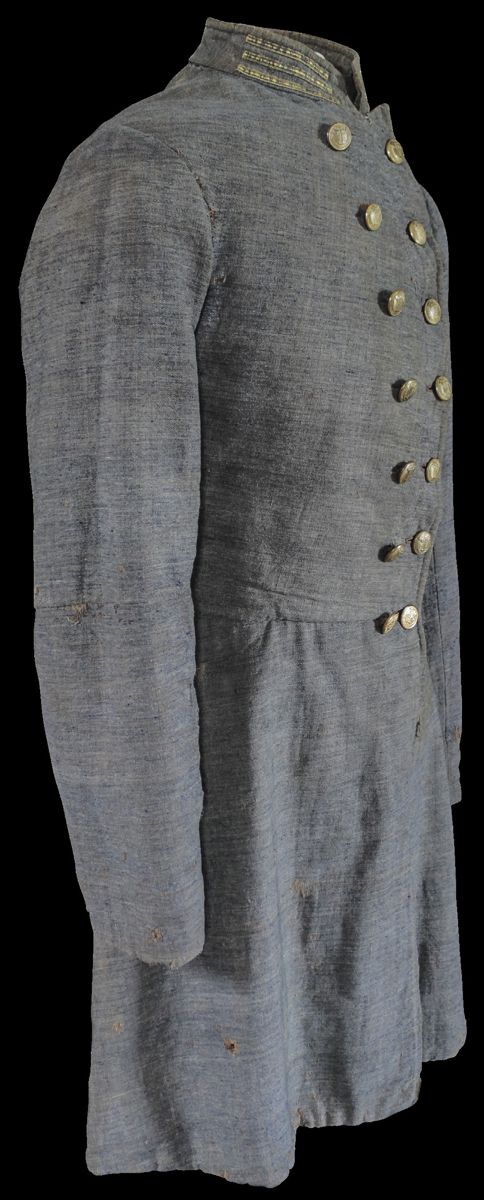
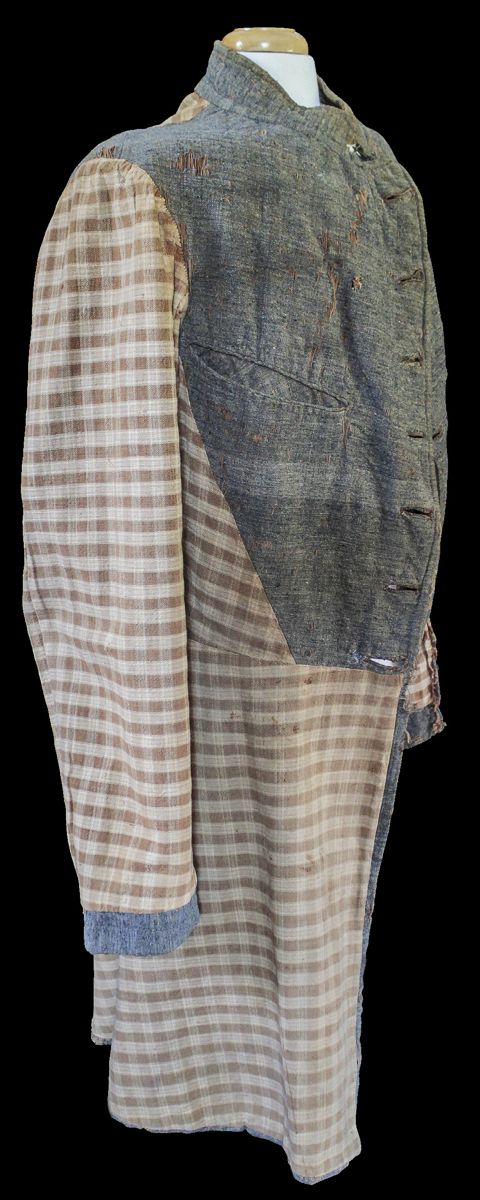
Notice that Mulligan had the lower portion of the right sleeve replaced after it was damaged by the bullet that disabled him.
Coat is courtesy of the Steve and Lynn Basheda Collection.
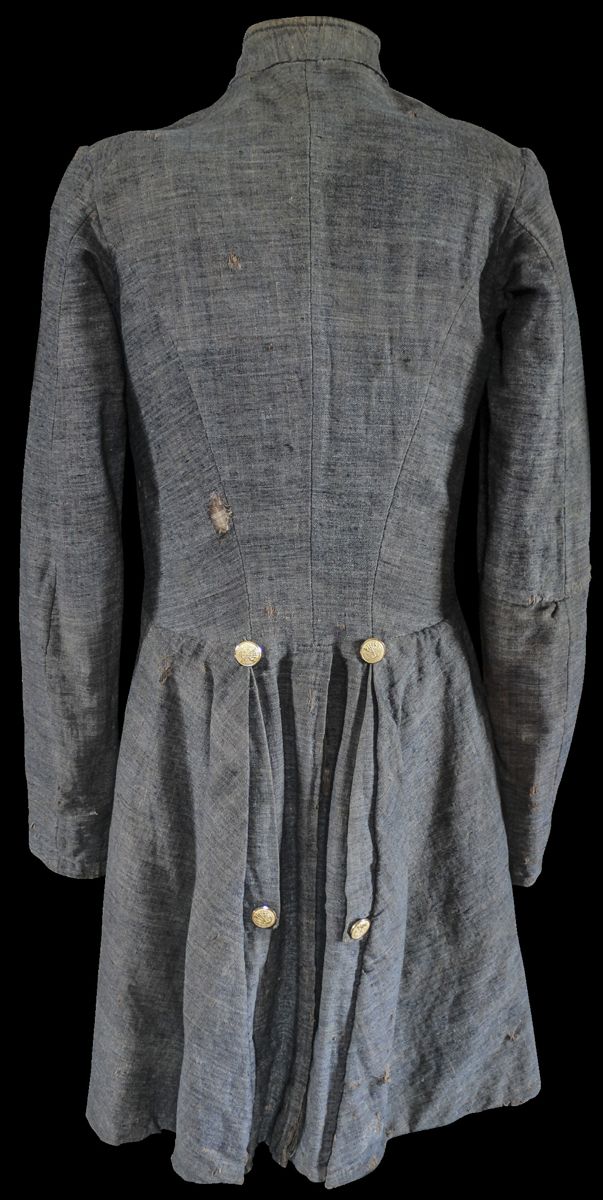
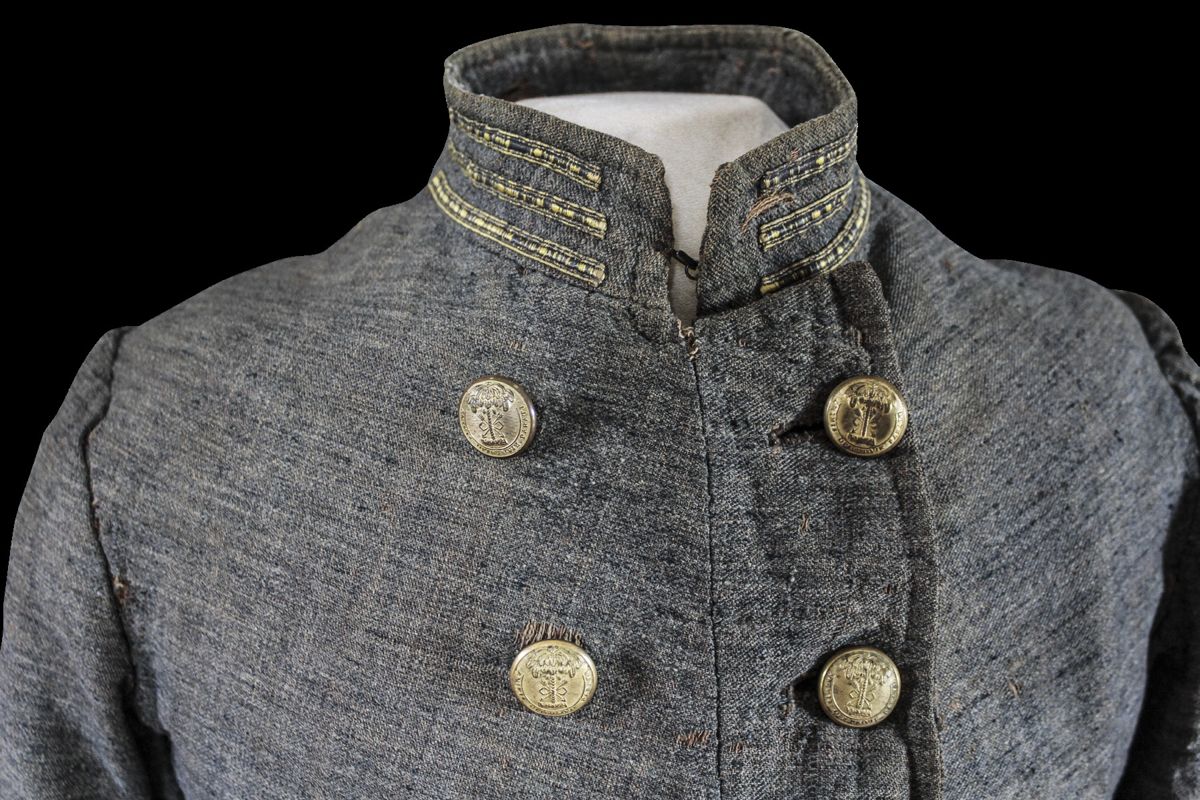
The double breasted frock coat Mulligan was wearing when disabled is all business, there is no sleeve ornamentation, only the sixteen South Carolina state seal buttons, including the four on the tail pockets.
The three bars of metallic braid rank insignia on the collar denote a Confederate Captain. “We have no cause to despond for in the first revolution our country was you know completely over run for several years & still we gained our independence. They may take all our cities & expect to approach us by their Navy but they can never penetrate our country.” On March 22, 1862, Captain Mulligan informed his family that his command had mustered into Confederate service the preceding day. In it he noted his mother’s worry about serving outside South Carolina, but explained, “…when we see that this war is to be a war of extermination, when the men of other states come to help us, we feel bound to go with the Confederate ranks … I know you would not say that I should (stay) at my country’s peril.” The Captain proceeded to describe his uniform on March 31, “Our uniform is gray cloth & sky blue pants trimmed with buff for the officers.” This is likely not the uniform frock with the surviving artifacts. The existing coat is gray, but not trimmed in “buff.” It very unlikely that his first frock survived four years of field service. The Captain was constantly concerned for the welfare of his family, and he was thoughtful of his black family, to whom he often sent advice and well wishes. On March 31, 1862, he wrote: “I saw John yesterday, Patsey’s husband (Patsey was Mulligan’s servant and John was owned by a neighbor). He looks very well & was glad to hear from his family…. I will try & get his master to let him go see his family. I will see his master & try to get him to send John to Spartanburg to stay awhile.” This is one of the many instances of kindness shown towards his servants.
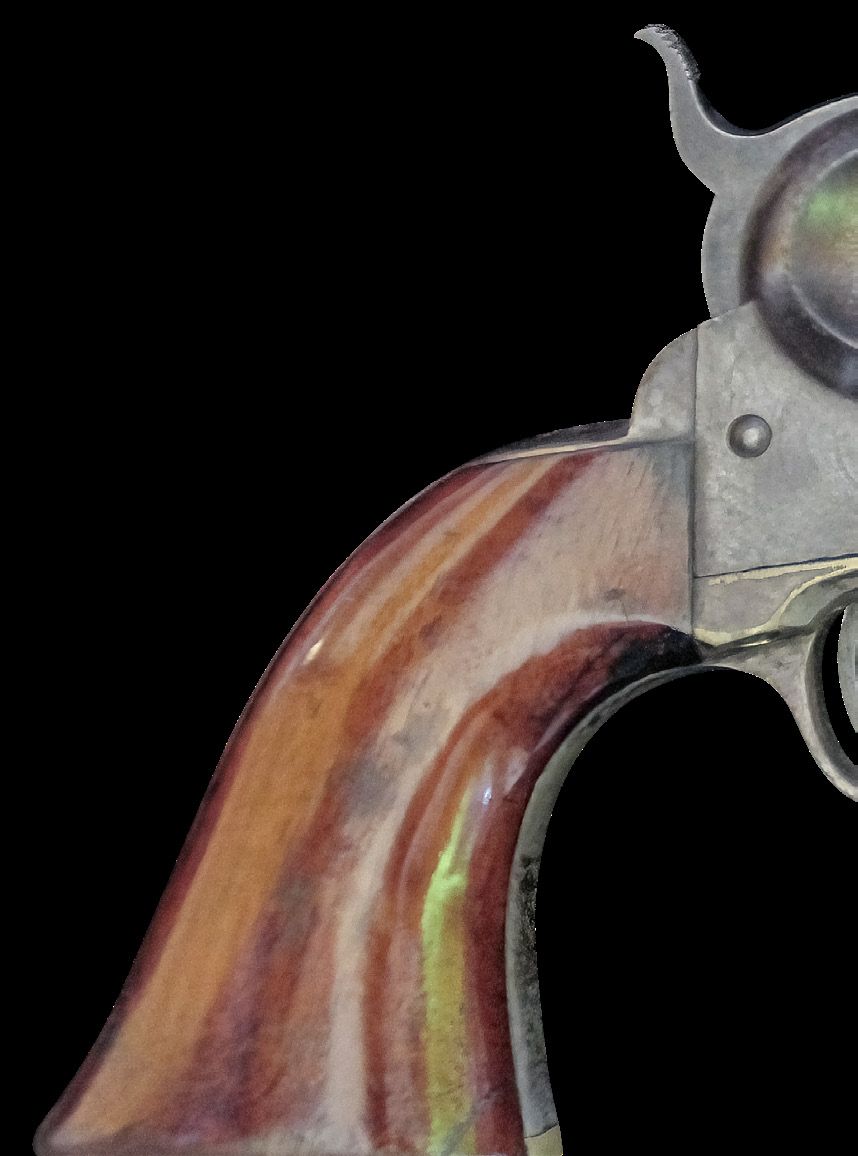
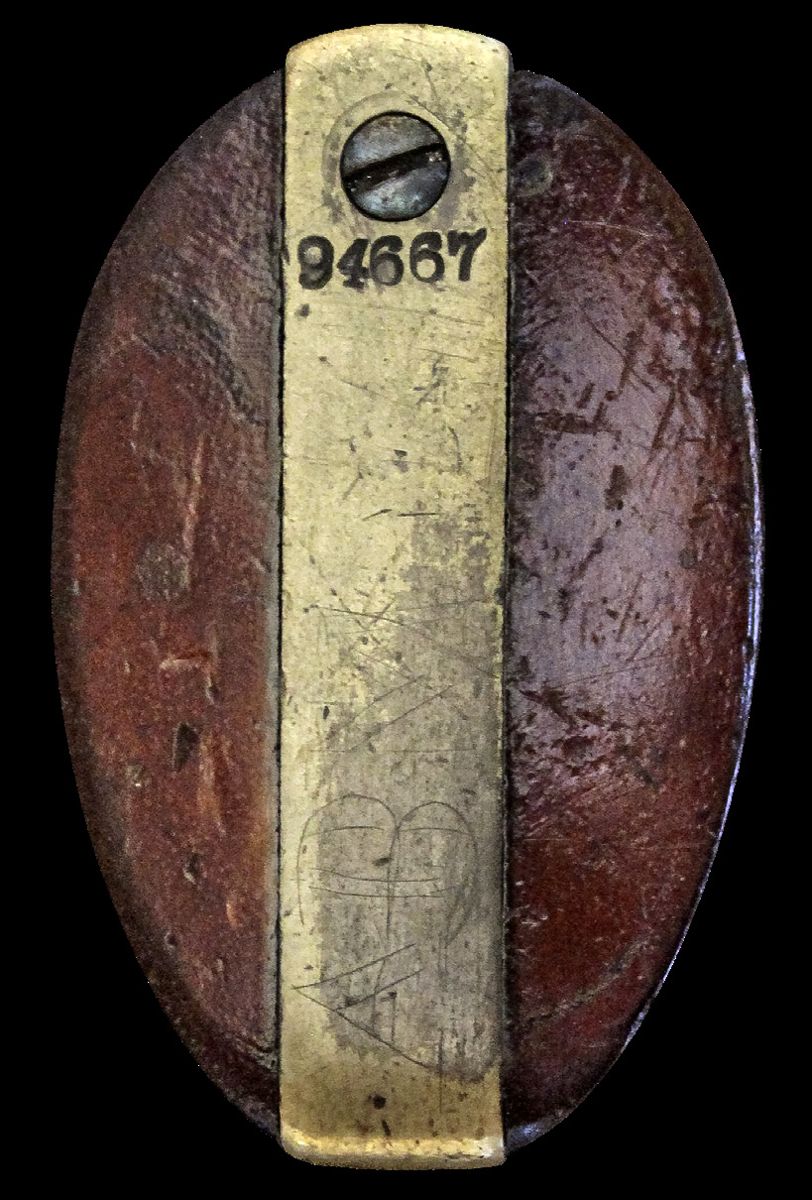
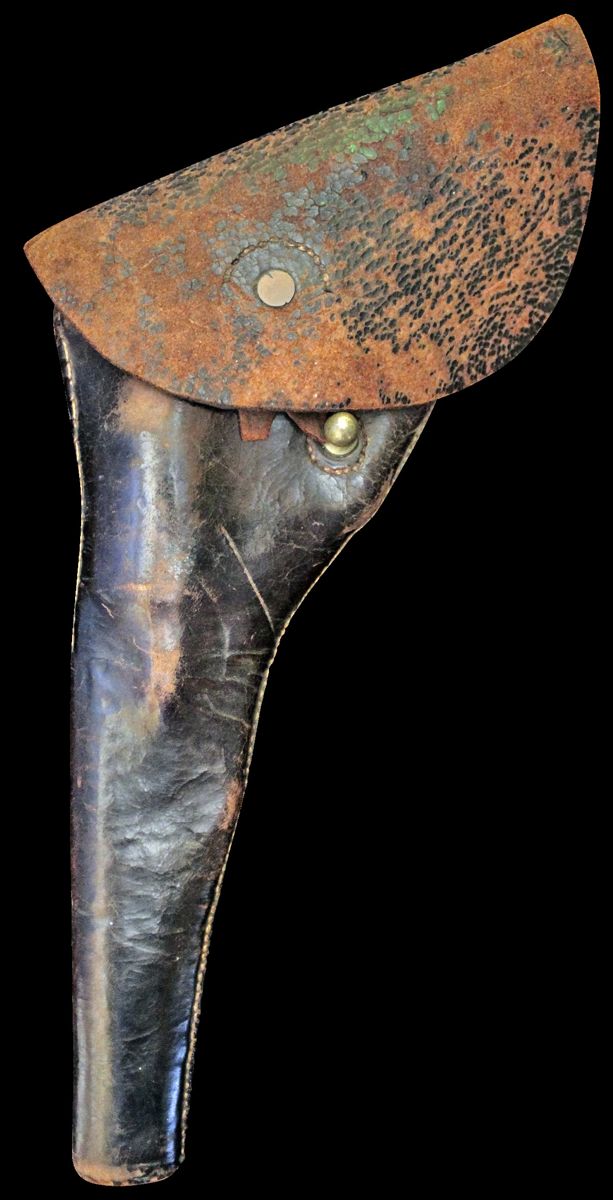
The Captain carried the revolver, a .36 caliber Colt’s Navy revolver serial number 94667, that remains with the family archive. The revolver was made in 1860 and was given to Mulligan by his future father-in-law, Mr. Archer, in early December 1861. It is accompanied by its original Emerson Gaylord Holster. In his letter to “My Dear Mother & Sisters” written on December 9, 1861, Mulligan directed his mother to have Mr. Archer, “…send me his pistol. He can put it in the trunk. You can direct it to me in Charleston.” His patriotism was at a fever pitch when, on August 24, 1862, he wrote: “I will live in the woods through all my life & eat rocks or die by starvation if need be before I will give up our great cause.” He never had to go to that extreme, but he suffered terribly for the remainder of his life for his devoted service. On December 30, 1862, he was ebullient about the South’s prospects, “We will soon have peace and will have the most prosperous & perfect government the world ever saw. Spartanburg will be the great center of learning, manufacturing & etc., etc.” By April 1863, Mulligan had seen two years of service, yet never wrote a single complaint of the hardships or mentioned any danger that he had been in. He always wrote about how he was getting along and how well he was fed and housed. His letter indicated that he had an active social life as well, writing: “I only want the two summer vests made last, one white & one buff with standing collars. If you pick out two or three of my linen borax shirts that will do to wear & am not apt to send them…” Later in April he wrote that his buggy & harness would: “…bring $600.00 here now” and by August 28, he updated the price: “…the buggy harness is worth about
13-1500, about 7 times what it cost.” Throughout the War, he used the buggy and harness as a gauge of inflation. To prepare his mother and sisters for his possible demise, on December 1, 1863, he wrote: “Mother let me beg that you will not fret & worry yourself about me. You have given me to your country. Should I fall in defense of your country you should not grieve so much that I have fallen as that you have no more sons to give” and six days later wrote to her from his camp in Richlands, S.C.: “We are very happily situated here. Plenty of first rate beef, pork, potatoes, & etc.” and “I hunt foxes & deer and expect to get a shot at a bear soon for there is a large swamp not far off where bear are to be found.” He continued in the same vein on December 20, as we “…have five good
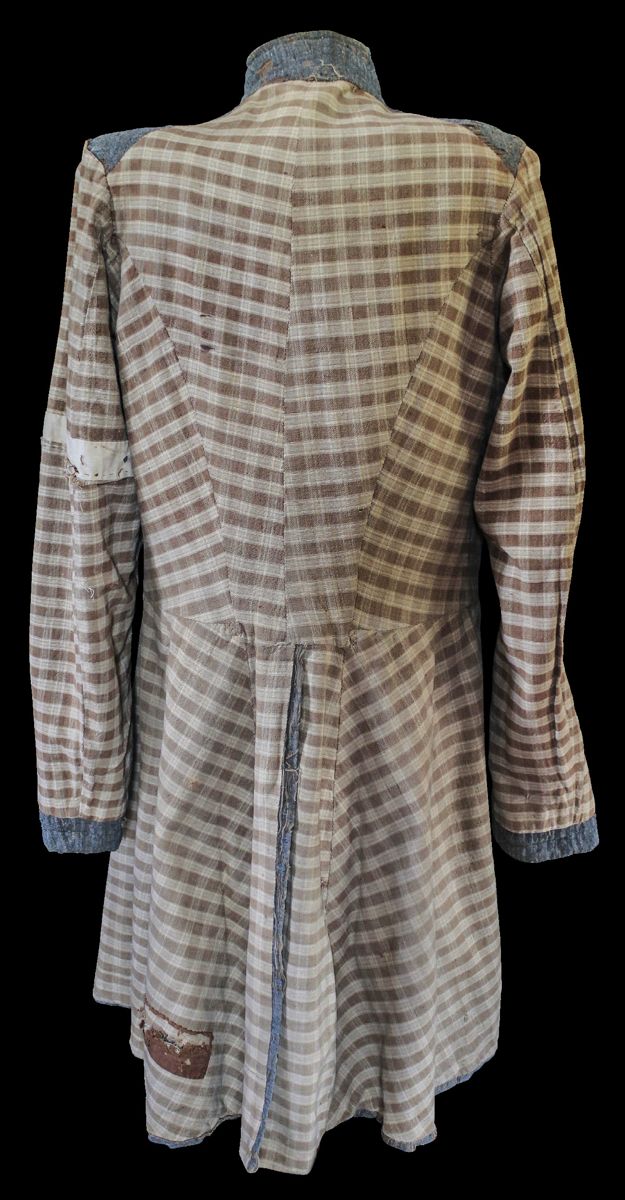
The inner liner of the Captain’s coat discloses its homemade origin.
long [sic log] cabins built, and good forage, completed and am pretty comfortably situated here. I occupy the church with a chimney, as usual. I wish all churches had a chimney to them.” And on March 29, 1863, he noted, “I have just dined on boiled bacon, greens & “pot dodgers” rice, fried ham & good biscuits with fritters & hone for dessert.” In the same letter he wrote: “Everything indicates a speedy termination of speedy peace.” The plenty found where he was stationed led him to greatly misjudge the straits to which the Confederacy had already been pushed. A hard dose of reality was coming. On April 10, 1864, he let his “Dear Mother & Sisters” know, “We are still under orders for a move to Virginia. … “I am not sorry that we are going. I will do better, I think, in many respects in Virginia than I could either here or in South Carolina.” “My dear Mother… I must beg you not to be anxious or uneasy about me. Calvary [sic] is detached service like I am and have been out of greater danger when in a large army.” Even though he knew that Virginia was a killing field, he did not yet understand the everyday hardships to which the Confederate soldiers in Virginia and Tennessee were subjected. Confident, and still living well, he wrote from Goldsboro, N.C., on May 8, 1864, while on the way to Virginia, “The time is near when I expect this war to close. We may meet with some setbacks but we are sure to gain our independence soon. … I spent a very pleasant time Friday & Friday night at my friends … They “Gave most all our men something nice to eat & loaded me down with nice vegetables, section cakes, pastry, biscuits & etc. & etc.” Mulligan’s war was about to change dramatically. Six days later he wrote, “We arrived in Petersburg late last night…I have with me three horses, a cart, my camp chest, and my trunk and Simon (his faithful manservant). I wish I had sold all except one horse, saddle and bridle.” On May 16, 1864, the Battle of Drewry’s Bluff was fought when General Benjamin “Beast” Butler attempted to take Petersburg. Captain Mulligan wrote about it on May 18, “we surprised them on their extreme right on Monday. Killed & captured 230 men & a quantity of plunder…we live on raw bacon & hard bread… the yankees fight under the influence of whiskey.” Drewry’s Bluff was the first battle in which he carried the Ames sword preserved in his collection.5 In 1895, in response to a request to loan his sword, Mulligan had written, “Dear Bro Rogers, You ask for the loan of a sword with some account of its war record.” The sword is a Model 1860 light cavalry sword by Ames Manufacturing. “It was captured from the enemy by an humble officer of Butler’s Brigade (known in the Army of Virginia during 1864 as –“that fighting Cavalry from South Carolina).” Mulligan wrote that he had used the sword in the battles of “Drewry’s Bluff, Chester Station, Atkinson’s Farm, Charles City Court House, Haws Shop, Cold Harbor, Trevilian Station, White House, White-Oak Swamp, Riddles Shop, Nance Shop, Sappony Church, Gravelly
Run, Ream’s Station, Vaughan Road, Cummings Farm, and last, but not least, at Burgess’ Mills Oct. 27, 1864.”6 There Mulligan received his final furlough, a wound that disabled him from further participation in the War. “His presence here today is an evidence of the goodness & mercy of our Heavenly Father bestowed upon an unworthy son.” By Captain Mulligan’s own record, he wielded it in seventeen battles! After nine days at the front, death seemed much more likely to him now, so on May 23, 1864, he wrote his mother informing her of everywhere that he had money deposited or loaned out, advising her how to collect and use it. He noted that his buggy was then worth $3,000. Three days later he proudly announced, “Today finds me in the great army of Northern Va, Lee’s Army.” He notes the big difference in circumstance, “The service I have seen heretofore is nothing compared to what we experience now.” He added that he has informed the banks to release money on his or his mother’s demand. In his letter of June 5, 1864, he wrote, “I have undergone the extremest exposure ever since I came to VA. I did not think it possible for men to undergo so much exposure without breaking down. We have not been under cover since our arrival. We take rain, & sunshine and are getting so that we can lye down in a mud hole & sleep about as well as we used to in our beds. We who are just from North & South Carolina have just begun to realize the war….. our horses suffer more than we do…I have not as much hopes of a speedy peace now as I had before I arrived here.” At the time his company was picketing the Chickahominy River, waiting to see which way Grant would move following his disaster at Cold Harbor. Clearly, he had not been hiding the privations and danger of his service from his mother as I first assumed; he simply had managed to go through the first two years of the war in relative comfort. On June 16, 1864, Mulligan wrote from Chilesburg, near Trevilian Station, “We are now 35 mile N.W. from Richmond, having thoroughly whipped the great yankee Genl Sheridan and driven him 50 mile into the yankee lines.” A quick note on the June 19, continued: “I have only time to say that I am up & going notwithstanding I have been subjected to the severest exposure … our regt is reduced to less than one hundred men from killed, wounded, sick, broak [sic] down horses & etc … no cavalry has now undergone as much as we have. We have done more hard fighting & endured more hardships any way since we arrived in VA. than most troops under go in a year.” As Hampton’s pursuit of Sheridan continued, on June 26, he wrote more about his company’s service:
The butt of the Captain’s Colt revolver is scratch engraved “A B Mulligan.”
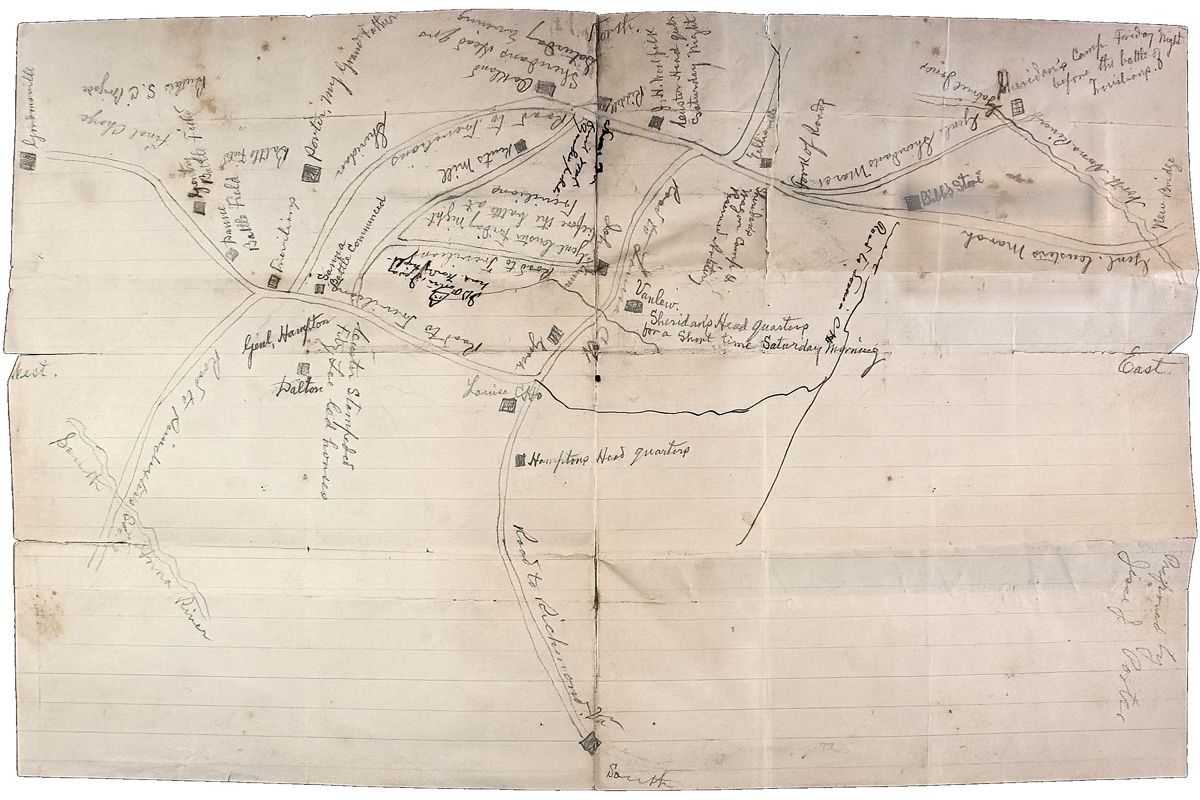
“For several weeks now I have been acting as Major both our Col. & Lt. Col. being wounded….we fought Sheridan at Whites Store….killing and capturing over 500. We routed them completely.” We “have just crossed the James River about 5 mile below Richmond. I suppose we are now going to look after the yankee raiders south of this … The weather is dry & parching & the dust so bad that we can’t see a man or horse 20 yards. The service we are doing is the most unusually severe that troops have ever performed. You may judge what we are doing when I tell you that we have only 64 men for duty today in our whole regiment out of 1000.” [I have been in] “ten severe battles… thank God for his kind care & protection … I hope that you will not be uneasy about me, I am performing the highest duty incumbent on man & while life & strength holds out, I am determined to stand up to it. If I die at my post I die in the discharge of duty… I live on rice bread & bacon.” In later years, he visited Trevilian Station and engaged a local ex-Confederate, Jesse J. Porter, who had grown up on the battlefield, to make a detailed map. In all likelihood, Porter played host and escorted Mulligan around the field. Mulligan later wrote an account of the battle.
“On Friday evening a courier came to Capt. A.B. Mulligan from Gen’l Hampton & Gen’l Butler to come to headquarters. He did so & was given the order to take some of his men & picket them. He was up all night long & towards morning opened the fight. During Friday night I selected a position about a mile from Louisa C.H. & built a double barricade with rails across the public road. I considered it a very strong position, from which to meet an advancing enemy. Unfortunately, I shall always think our Gen’ls advanced one or 2 miles beyond it; where we met the enemy in a dense forest, they two to our one & we without any advantage as to position. Having been in the saddle all night & in the fight all day Saturday & with very little rest Saturday night, you will understand we were in a very trying condition to meet the enemy Sunday morning. On account of the above, my command was held in reserve Sunday morning in a forest about a mile in the rear of the line of battle, until midday. While waiting there for orders to join in battle, one of my couriers found a large box filled with hams, sugar, tobacco & etc. which presumably was hid there by some neighboring farmer, lest the enemy might rob him if kept at home in the smoke house. I just had time to tie one of the hams to the back of my
The map of Trevilian’s Station was drawn by Jesse Porter for Mulligan. Porter fought there on his own family farm.
Here Porter points out his grandfather’s home on the battlefield (inside the added red square).
Remarkably, Mulligan’s family saved the telegram he sent advising them of his wounding. The form was printed by Evan’s & Cogswell of Charleston, S.C.
saddle & fill my haversack with N.O. (New Orleans cane) sugar & (my courier did the same) when the order came for me to advance to the front with men. As we fought all that day dismounted, my ham was sent to the rear with my horse, while I held to my haversack of sugar, which was all the food I had till midday on Monday – When as we were pursuing Sheridan & his army. I rode up to a farm house some distance from the public roads & exchanged what was left of sugar for some substantial food with some kind ladies. One incident of Sundays fight – we were advancing up to R.R. & a large house on the eminence, on the other side was filled with U.S. Men-sharp shooters & they were picking out our men & killing them. Stuart’s artillery soon swept up by the side of us & tore the house to pieces & we were no more annoyed by the sharp shooters. Now Rossers charge occurred Sunday evening firing had almost ceased, he came over the field from our extreme left – my position being on the left. I witnessed it– The dead & wounded was the result of a hard days fight. Along the left there of our line, where we met the numerous charges of the enemy & mowed him down as we did the sassafras & cedar & etc. with our Enfield Rifles. I was myself over the field Sunday night, placing pickets & videttes, where we slept on our arms expecting the enemy to resume the battle Monday morning. It was not till Monday morning that we knew of the enemies retreat – We heard some noises during the night but we thought the enemy were placing their artillery for next days fight. Had our scouts practiced proper vigilance & advised us earlier of Sheridans retreat we could have bagged the last one of them. They got 12 hours start of us & it was impossible for us to overtake them before they reached a place of safety behind their lines below Richmond.” By June 28th, Mulligan’s command was on the south side of the James River protecting the railroads between Petersburg & Weldon, N.C., but he told “Dear Mother &
This requisition is a reminder of the more mundane duties of a captain. Captain A.B. Mulligan submitted a Special Requisition for Co. B, 5th Regiment S.C. Cavalry, for 60 uniforms, received in Charleston, S.C., on July 3, 1863. (NARA, Citizens File)
Sisters” that there is no telling where they will be, “…we keep constantly in the saddle & “pitch into” the Yankee cavalry wherever we find them.” He told them how much he enjoyed being here, relieved from, was acting as colonel commanding the regiment; all his senior officers had been killed or wounded.
“… the obnoxious sight of dead horses & sometimes men & the smell is awful. Sheridan left at least one dead horse for every 150 yards of his march from Grant’s army on the Chickahominy to Louisa County & back. His plan was to shoot every horse as soon as it broak down. We are now awaiting another party of Yankee calvary about 5000. We will be apt to capture or smite them. Our boys fight like Trojans. The Yankees fear the fire eaters from South Carolina as they call us.”
“I am sorry to hear that some people at home are so easily disheartened by a few reverses. It is shameful, we are as confident as ever of success and the Army of Northern Virginia are all right.” Nevertheless, death was always on his mind, “I have been reading my Bible regularly and trying to get my mind right on religion but I find it an uphill business. If I could only say from the bottom of my heart: Jesus, I my cross have taken, All to leave and follow Thee I would give the world. Pray for me My dear Mother & Sisters that I may be able through the help of God to say the above.”
On June 30, Mulligan expanded on the services that the South Carolina cavalry had performed: “Until this summer the Cavalry in VA. have done comparatively but little good. It has been our good fortune to do much to save our country and although we have suffered much and have undergone much fatigue and hardships, fought more hard battles & gained more victories that ever has been done by all the cavalry ever engaged since the war commenced.” Obviously, he was very proud of himself! On July 3, 1864, he wrote a letter that showed to what lengths the mind will go to, and what straws it will grasp during desperate times. He wrote, “It is said that General Grant says if he does not take Richmond tomorrow, July 4th, he will give up & let the war end. God grant that he will do so for he can’t take Richmond.” Today, in hindsight we ask, how could he have believed that? Captain Mulligan frequently sent a word to the servants back home, and always arranged to look after their needs. His faithful Simon was often complemented but his letter of July 10, 1864 goes into more detail regarding the servants than previously, “Please give them my respects. I am glad to hear Leila is well. Also my other friends both little and big. Also our servants, and that the latter are doing well for it is a blessing these days to have your servants. Simon is doing very well indeed. I trust he will and he is trying to do all he can to please me. I am glad that I did not send him home. If I were sick or wounded he would be of still greater use to me. I can send him to Richmond or anywhere.” Seven days later, the Captain noted that his three-horse supply has dwindled badly; he wrote, “I own but one horse. I have a yankee horse which I captured which I use and when he dies I will try & capture another.” He was, however, still suffering badly from self-delusion, “Our prospects for a speedy peace are very good, never so good since the war began.” His one horse did not last long; writing on August 28, that he, “…was in a very hot battle [near Reames Station] most of the day yesterday but through God’s goodness & your prayers, I came out unhurt. I had my horse shot under me.” After the battle, the Captain
Still confident of victory, he lamented,
On October 3, 1864, he commented on the thousands of prisoners they had taken, “A majority of the prisoners are fighting who can’t speak a word of our language. Often one of our men capture a dozen of them. In a month or two Grants … whole army will be composed of such men.” At the time, he was a Captain commanding a 300-hundred-man battalion of dismounted men, guarding a bridge near their camp. After coming to Virginia, his views on the war had changed dramatically, “At the beginning of this war many of our officers considered it rather cowardly to do this [hide behind obstacles] but now all sensible men & good officers agree as to the great importance of using every means in their power to protect their men from unnecessary danger & exposure. In two days from this if nothing happens to prevent, we will have our lines completed along the entire front of our cavalry … Every day I meet with General Hampton, W. H. F. Lee, Butler, Dearing & several of the generals of our cavalry.” Intending to cut the two remaining lifelines coming into Petersburg, Grant ordered an attack for the purpose of cutting the Boydton Plank Road and the South Side Railroad, on October 27, 1864. Captain Mulligan refers to it as the, “2nd Battle of Burgess Mill.” Having first ordered an attack on the north side of the James River as a diversion, the Federal II, V, and IX Corps were sent westward around the south side of Petersburg. The IX and V Corps were to attack Confederate fortifications to hold the defenders in place, while the II Corps was to cut the supply lines. Confederate Major General Henry Heth stretched his line to stop the V and IX Corps from reaching the Boydton Plank Road and sent General Mahone to attack the right flank of the II Corps. Heth’s reinforced division consisted of Lt. Gen. A.P. Hill’s III Corps, Lane’s and McGowan’s brigades of Wilcox’s Division, Brig. Gen. James Dearing’s Cavalry Brigade, and 600 dismounted men of Dunovant’s Brigade, including approximately one hundred men of the 5th South Carolina Cavalry under Captain Mulligan.
Heth’s attack stopped the Yankee advance and Hampton’s Corps nearly surrounded the isolated yanks. During the night the Federals withdrew. During the engagement Captain Mulligan was wounded. I have been unable to find the exact circumstances of the Captain’s wounding, but we have a very detailed account of the aftermath from Captain Mulligan, written on the night of the battle,
“One of my men (named Smith) was my attendant and we were wet to the skin, nearly, hunting a place to shelter. I was suffering with my wounded hand, had no attention from the surgeon yet. We rode on horseback to a large house near battlefield owned by a man named Stone. The yard was full of wounded & so was the house. Surgeons were busy. My man dismounted & went in the premises to look & see if there was a prospect of shelter. He came to me & reported they didn’t have any place for us. I asked him if he saw any women? “No” was his answer. I told him to go look again. He returned & said he saw some in one room. I got off my horse & knocked at the door. Several females were in the room. Had a large fire & it looked very inviting. I apologized for coming to them & asked if they would allow a wounded & wet soldier to sit by their fire for a little while? They assented. After a while Mr. Stone came in & said he was very sorry to disturb me but that was the only room in the house that was reserved for the moment & I would have to leave it for their use. I replied, I did not intend to intrude, but I was suffering very much & needed attention. I then gave him the masonic sign of distress. He left the room & came back after a while. He immediately opened a door of an adjoining room which was not occupied, saying he had been expecting his brother’s family to come from Richmond & as they had not arrived that room was at my service. He brought a colored man to wait on me named Ruffin. I gave the man a piece of silver, I then told him to build a fire. My man Smith went out to attend our horses. As soon as room was comfortable, I went in & took possession. Made my self comfortable, by taking off boots. Having straw laid on the floor and blankets put over it. I made the man cover the whole floor with straw & sent word to the surgeons when they had operated on any of my company to send them in my room & before night passed the room was full. Some had their legs cut off & others were dying before the sun rose.” The following day he sent a telegram by the Southern Express Company to his mother in Spartanburg, that read: “I am wounded in hand will be home few days.” Most remarkably, the original telegram was saved by the family and it remains with Captain Mulligan’s wartime effects. On October 29, Captain Mulligan and Major Hart, who had also been wounded, were able to catch a freight train bound for South Carolina. Captain Mulligan was the senior captain in the regiment, with Major Hart disabled Mulligan was next in line for promotion to regimental command. While at home on a wounded furlough, he received a letter from Captain Zimmerman Davis, requesting that Mulligan waive his right to promotion, which the Captain politely declined to do. It was no matter, as he was not able to return to field duty prior to the surrender of the Army of Northern Virginia, and Davis commanded the regiment till the end. On January 2, 1865, surrender was not on the Captain’s mind; he wanted to get back in the field. He traveled to the College Hospital in Columbia to see if something could be done about his hand, but was informed that: “they can do nothing for me.”… “There are pieces of bone in my hand which must work out before the wound can heal.” The wound was through the palm of the hand, leaving that hand practically useless. A year after the War, Captain Mulligan wrote: “I am yet suffering from my wound and am without any means of support.”
and which still remains with the family archive. His wound gave him serious trouble for the rest of his life. “The fingers were crumpled and the doctors wanted to amputate the hand, but he would not give his consent” wrote his daughter Florence Carroll Mulligan, who had become his “right hand.”
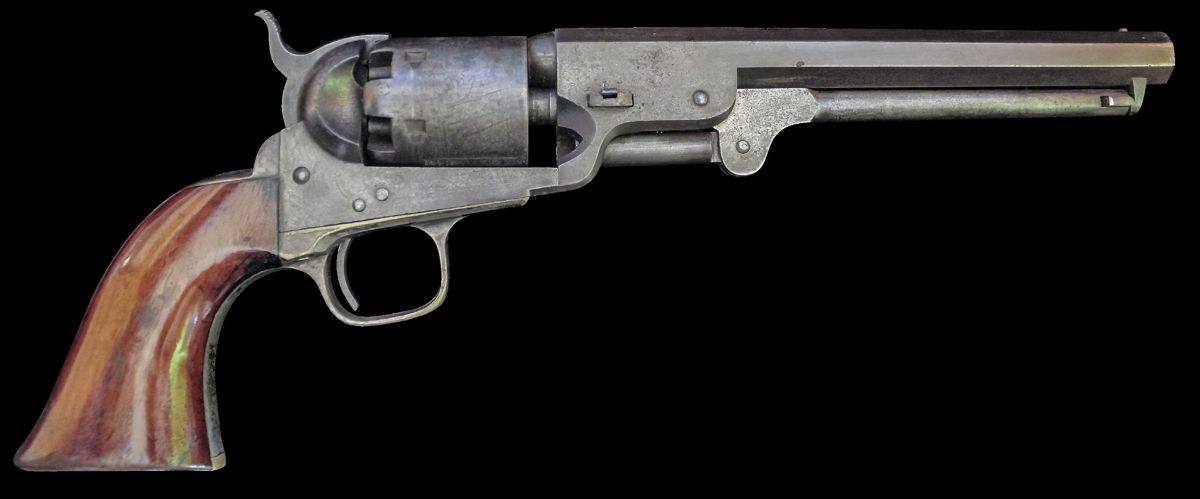
After the War Captain Mulligan married Florence Carroll Archer, the daughter of the Mr. Archer frequently mentioned in the Captain’s letters, the same man who gave him the Colt revolver he carried through the War
In this remarkable letter, written in 1895, Captain Mulligan recounts the capture of his sword from the enemy, and the battles in which he endeavored to give it back to them. The Watchman and Southron (Sumter, South Carolina) · 16 Dec 1884, Tue · Page 2 Downloaded on Jan 11, 2024
Clipped By:
JACK3535 The 1906 application to join the Daughter’s of the ConfederacyA.B. Mulligan The Watchman and Southron (Sumter, S.C.) Dec.Thu, 16, Jan 11, 2024 by the Captain’s granddaughter, Florence Carrol Boyd. 1884, Tue., page 2.
Copyright © 2024 Newspapers.com. All Rights Reserved.
Eventually Mulligan made his fortune back; first as a clerk until 1868, and then in the “cotton factorage” business, which today translates to “cotton broker.” He was very successful until 1878, when his head clerk stole $34,800; a fortune in those days. Adjusting for inflation, it was the equivalent of $1,067,467.08.7 This caused his business to fail and he sold his Charleston house and mortgaged the home in Spartanburg to pay “every cent” to his creditors. He rented a room in Charleston and continued to work to support his “Dear Mother & Sisters” in Spartanburg. In 1887, as his health failed, he went home to Spartanburg. His daughter Carroll wrote that: “Papa was worn out. He had no disease that we knew of.” The 1900 census reports that he was selling insurance to make ends meet. He lived until 1910, passing away aged eighty-five years. His wife Florence died away in 1934; both rest in Spartanburg’s Magnolia Cemetery.
Confederate groupings extant. Today the Captain’s frock coat, sword, revolver, telegram, battle accounts, and map remain together, a collection for someone who will treasure and keep them intact for another generation at least.
E N DNOT E S 1. 2. 3. 4. 5. 6. 7.
My Dear Mother & Sisters, Civil War Letters of Capt. A.B. Mulligan, Co. B 5th South Carolina Cavalry—Butler’s Division—Hampton’s Corps 1861–1865 Tombstone Magnolia Cemetery, Spartanburg, S.C. Dear Mother & Sisters Officialdata.org, accessed January 27, 2024 May 18, 1895 letter to “Bro Rogers” 1895 letter to Brother Rogers Officialdata.org, accessed January 27, 2024
Even before she passed away, his wife had been passing his letters and wartime effects to their daughter Carroll. Carroll had a great interest in the Confederacy and her father’s legacy. She was a member of the United Daughters of the Confederacy until her death in 1989. She handed the archive over to her daughter, Florence Carroll Boyd Wadlow. Both ladies’ U.D.C documents remain in the family archive. These ladies preserved one of the most complete
About the
Author
Shannon Pritchard has authored numerous articles relating to the authentication, care, and conservation of Confederate antiques, including several cover articles and is the author of the definitive work on Confederate collectibles, the widely acclaimed Collecting the Confederacy, Artifacts and Antiques from the War Between the States, and is co-author of Confederate Faces in Color.