
The Battle at Battery 5, Petersburg, Va
By Scott Kraska · Originally published July-August 2024 · pp. 40–52
The Battle at Battery 5
Petersburg, Virginia By Scott Kraska
The unheralded bravery and artifacts of Captain George Naylor Julian 13th New Hampshire Volunteers.
June 18, 1864, Petersburg, Va. “…musket balls were flying around us and the air, full of them, they were whirring past us and shells falling too. Right before us was a ravine which through ran a little brook and as [sic at] the base a log hut. I made for this point as they could bring no gun to bear upon it. Before I reached it along came a grape shot and hit my sword, which I had drawn in my right hand, resting across my body a little below my breast. It knocked the sword out of my hand, bent it up…I thought I was hit, killed…” – June 18th letter written by George Julian to his family describing the incident. Letter is in the University of New Hampshire Archives. George Naylor Julian (March 17, 1841–July 26, 1927) was born in Exeter, N.H., the son of Luke and Abigail Moses Julian. The elder Julian was a carriage maker and wool merchant. In April 1861, following the bombardment of Fort Sumter, Julian moved to Massachusetts and enlisted as a private in the Second Battery of Massachusetts Light Artillery. The Second Battery first went to Baltimore, where it helped quell unrest by Maryland secessionists before moving to Camp Hamilton, Va., where Julian witnessed the historic battle between the USS Monitor and the CSS Virginia (Merrimac). Shortly thereafter, the battery was transferred via New Orleans, and later took part in the Siege of Vicksburg. On July 28, 1862, Julian received a commission as captain of the newly formed Company E, 13th Regiment of New Hampshire Volunteers. The 13th trained in New Hampshire and first saw action
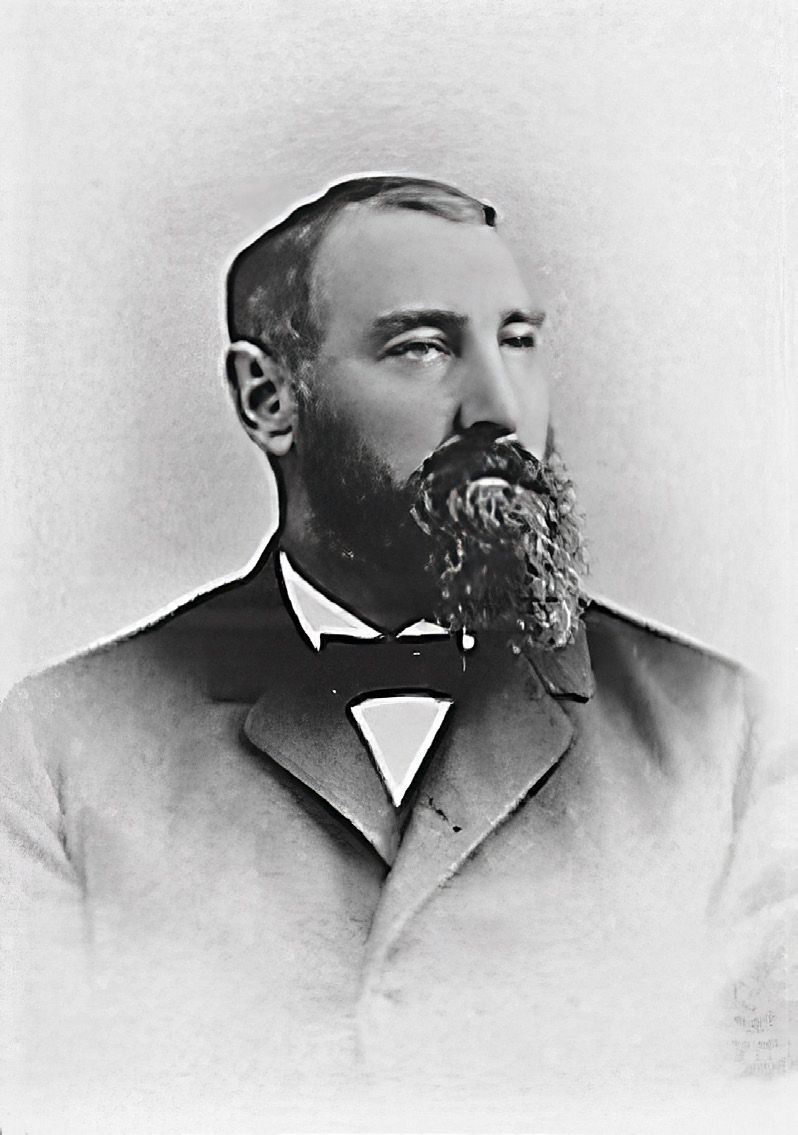
Captain Julian.
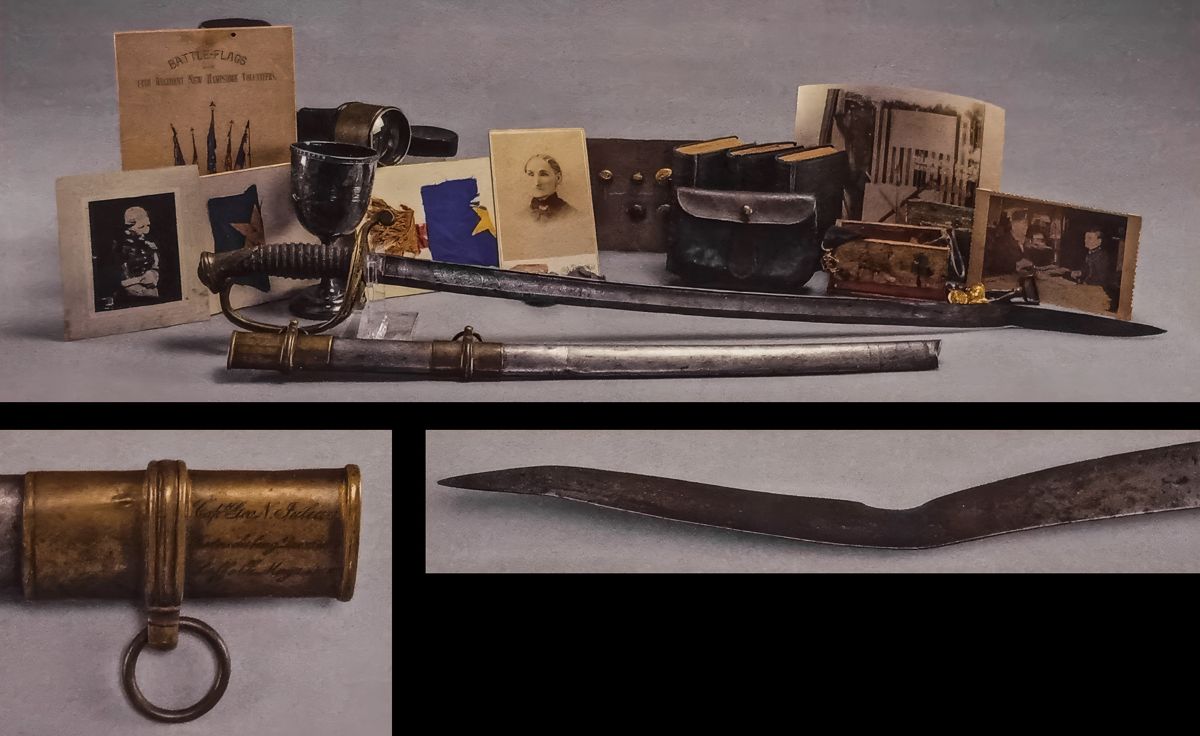
Auction catalog photo showing part of the grouping in August 1997.
As the group appeared in August of 2021.
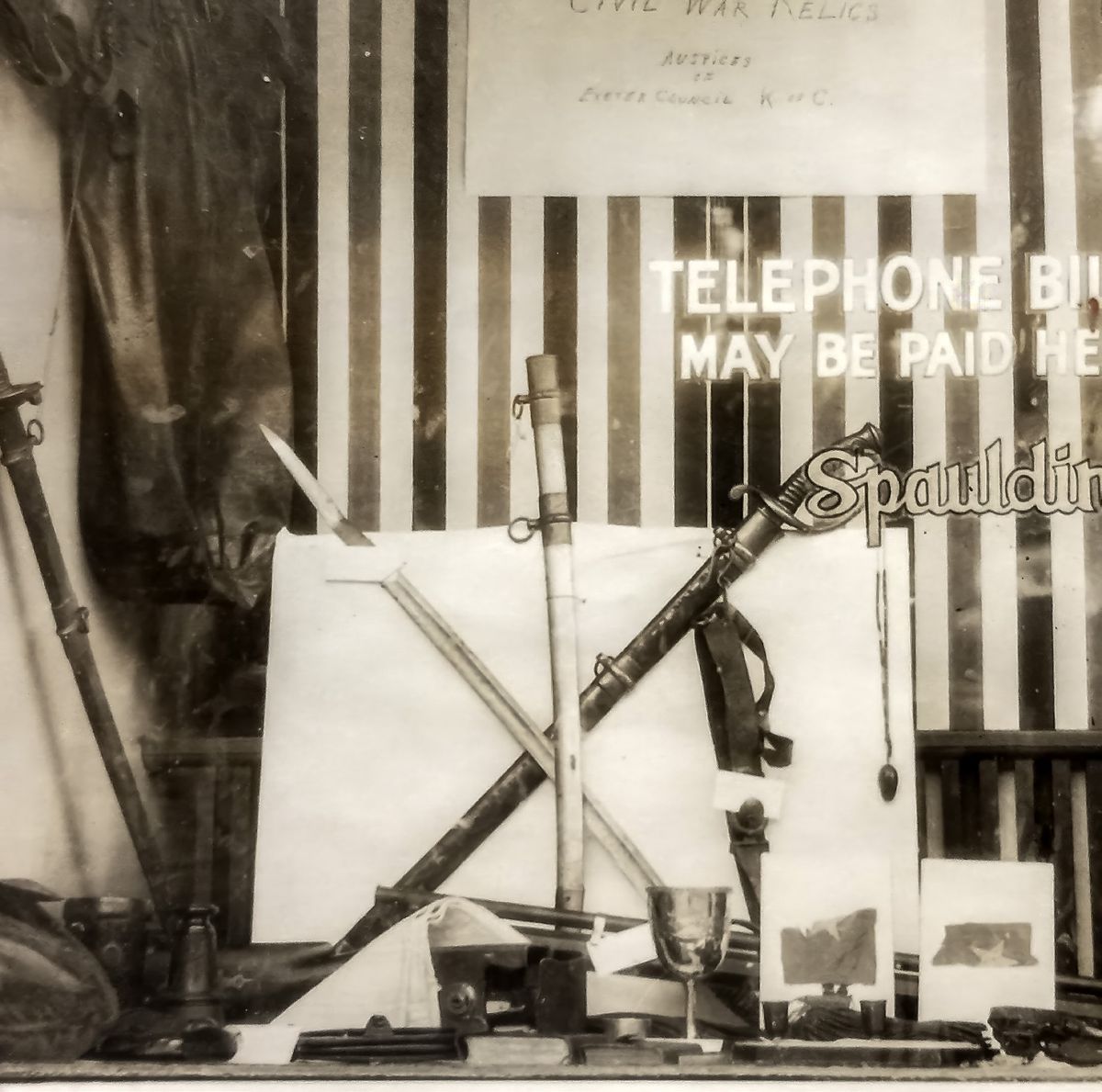
Exeter, New Hampshire, storefront window, 1913, showing Captain Julian’s equipment and souvenirs.
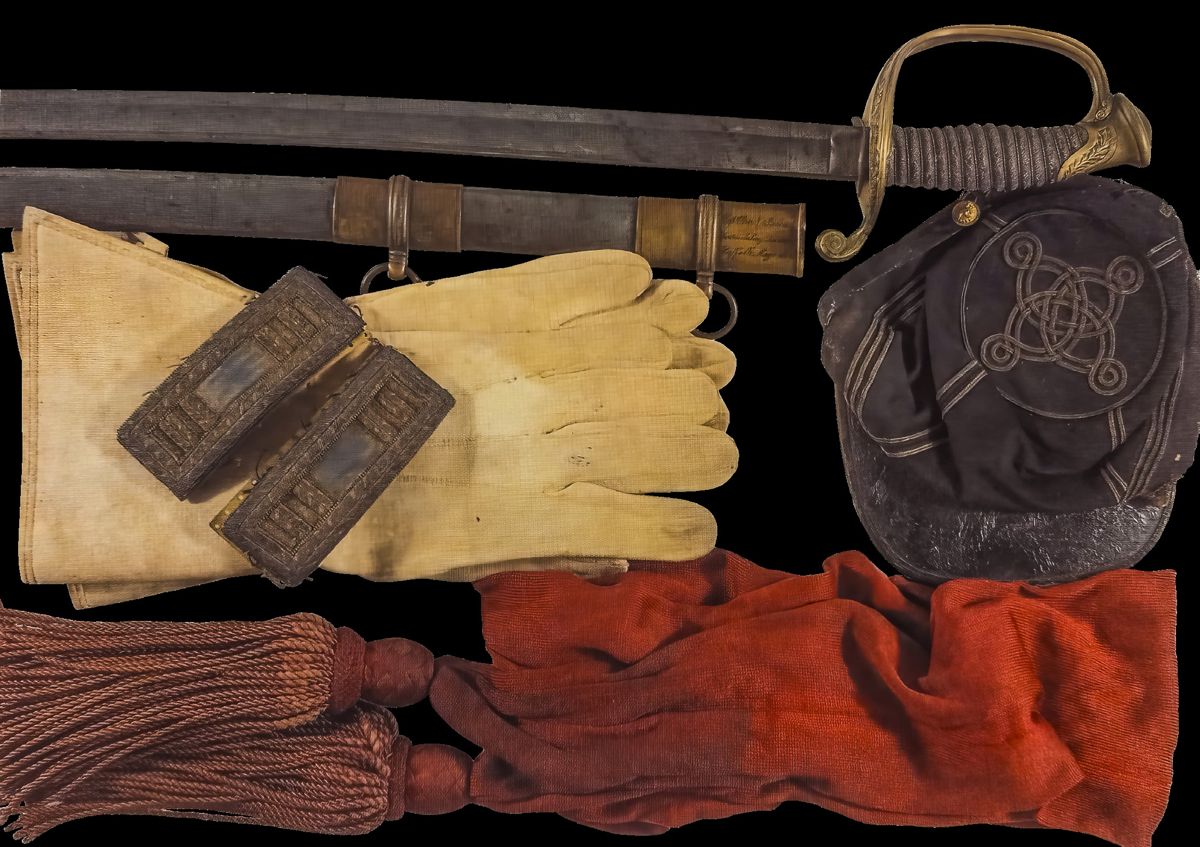
at the Battle of Fredericksburg, Va. Julian also saw action at Providence Church Road, Proctor’s and Kingsland Creeks, Drury’s Bluff, Cold Harbor, Petersburg, and Fair Oaks. I first saw his group of artifacts in 1997, at an auction in Bedford, N.H. I was not collecting Civil War material at that point, but I was absolutely fascinated by what was there and the level of documentation that was present. Sadly, the grouping was sold in several lots, and when my chance to purchase it 24 years later came up, several more items had been removed, including the kepi, sword belt and sash, gauntlets, and shoulder boards, and some photos. It still did not dim my enthusiasm, and I hope to reassemble the scattered pieces one day. Captain Julian’s letters, now owned by the University of New Hampshire, show an eagerness to preserve all parts of the story of which he had become part. In addition to battles and events he discusses the artifacts that are present and their stories. As a graduate of Exeter Academy, he writes well and conveys his stories in an effective manner, leaving few details out. In addition to the descriptions in his letters, there is an 8 x 10 photo of a storefront in Exeter, N.H., taken in 1913. This photo, presumably for the 50th Anniversary of Gettysburg, displays the objects he had preserved. By 1997 some of these items had already been scattered, but the main objects can clearly be seen. In the photo below. The battle damaged sword, tip up, with its scabbard vertical. The other two, Confederate officer swords, and the belt with a two piece interlocking Virginia officers buckle. Other items in the photo can also be matched to items that survive. Reading through his letters we come across one dated November 20, 1862. He asked for a “ships glass” such as used by officers, as they are “better,” than binoculars. This glass and case appear in the photo on the lower left and are still present today.
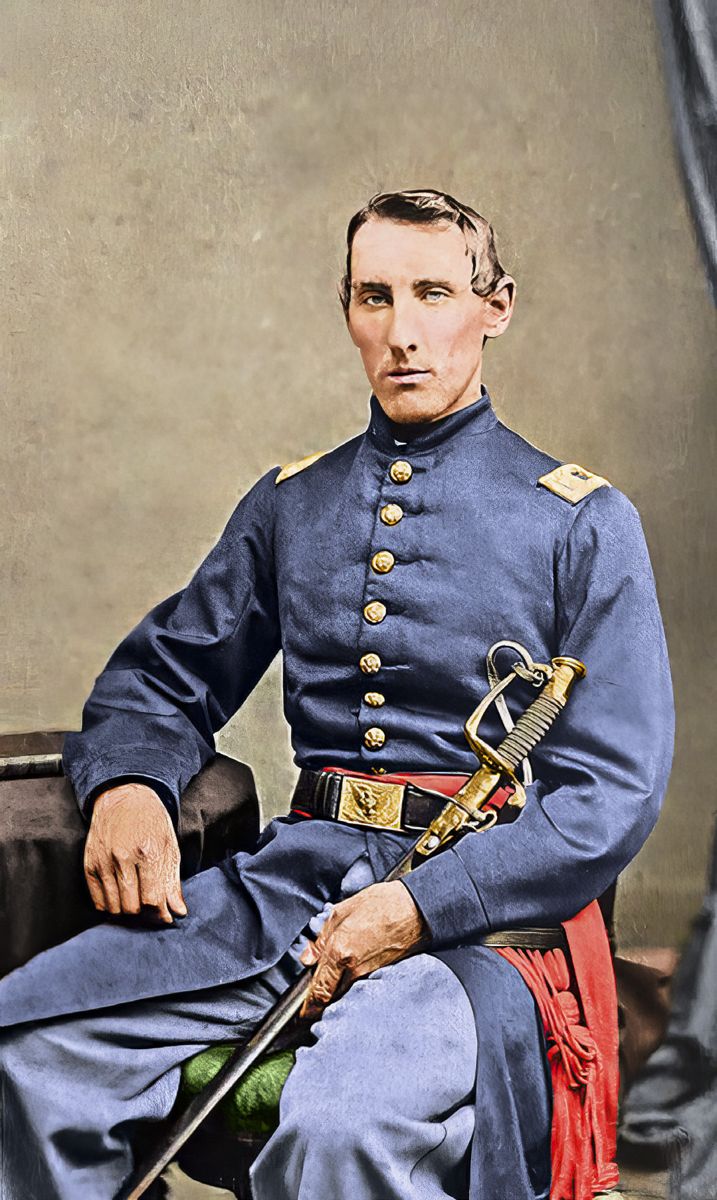
George Naylor Julian, colorized.
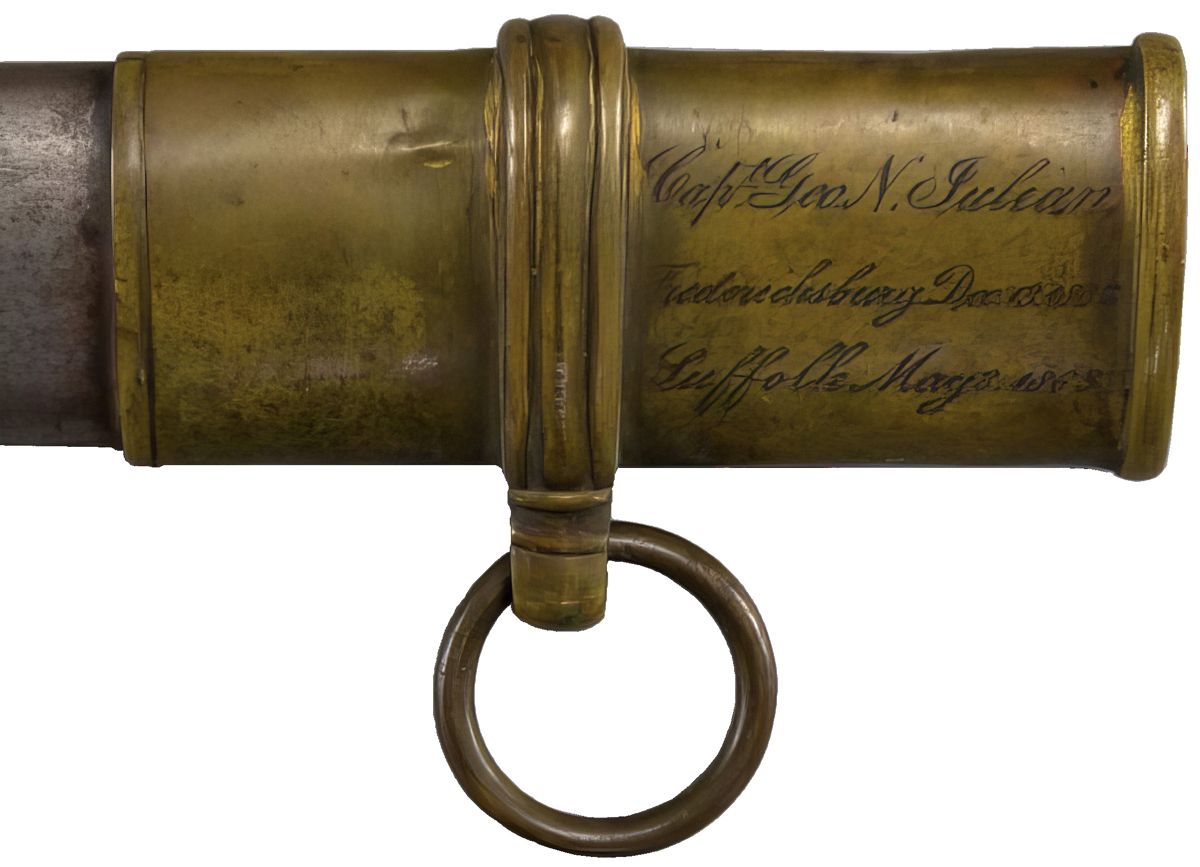
December 23, 1863. “My sword, which was being repaired, arrived here several days ago in a splendid condition…I am very fond of it and would not part with it for any other sword I ever saw. I have got it engraved, ‘Fredericksburg Dec 13th, 1862’ and ‘Suffolk May 3rd, 1863.’”
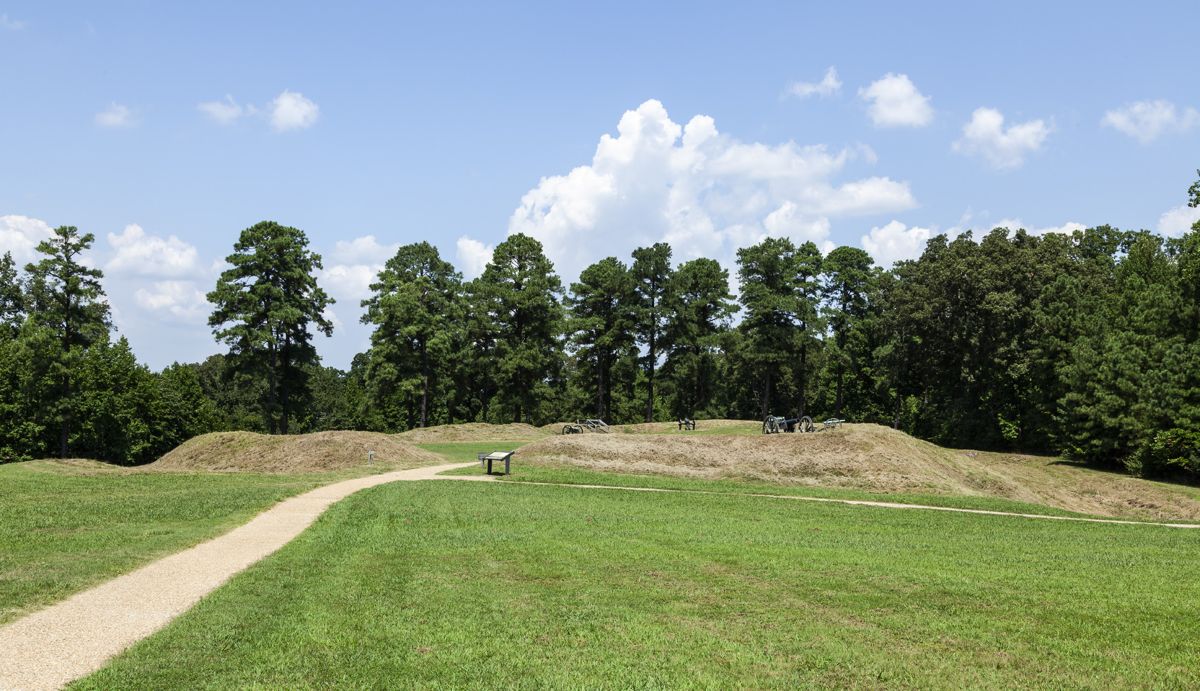
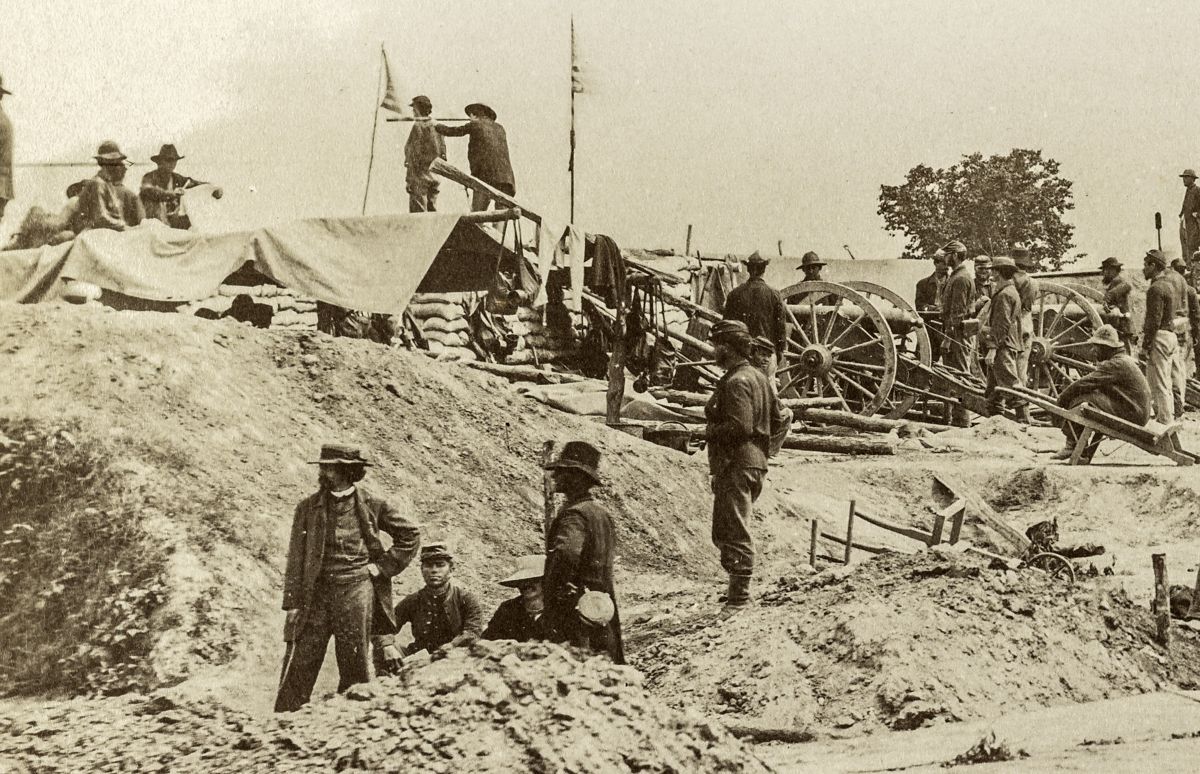
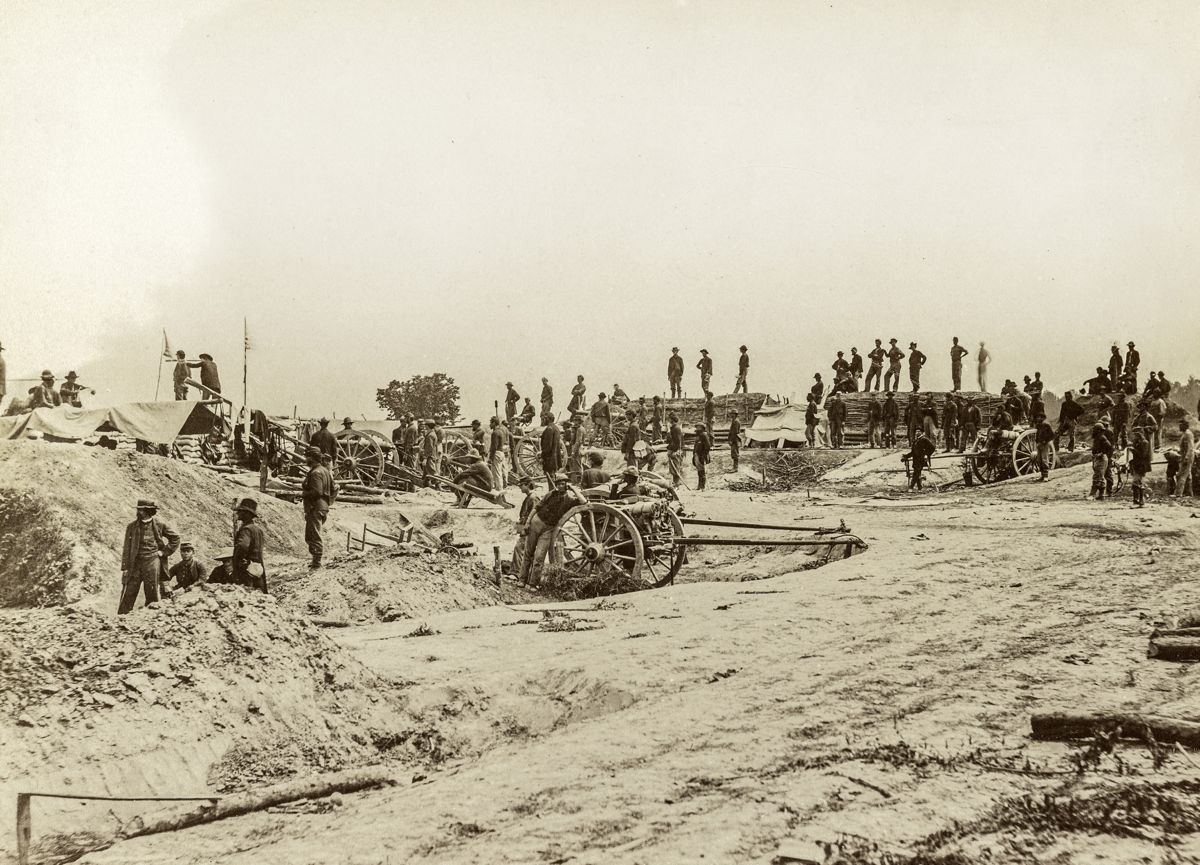
Enlargement of Battery No. 5, in front of Petersburg, Va. Standing in the foreground, on the far left, is wartime photographer Mathew Brady. Note the man on top of the parapet holding a field telescope. Could this be Captain Julian? (Library of Congress) Battery 5 as it appears today. Petersburg National Battlefield. (Photo by Jack W. Melton Jr.)
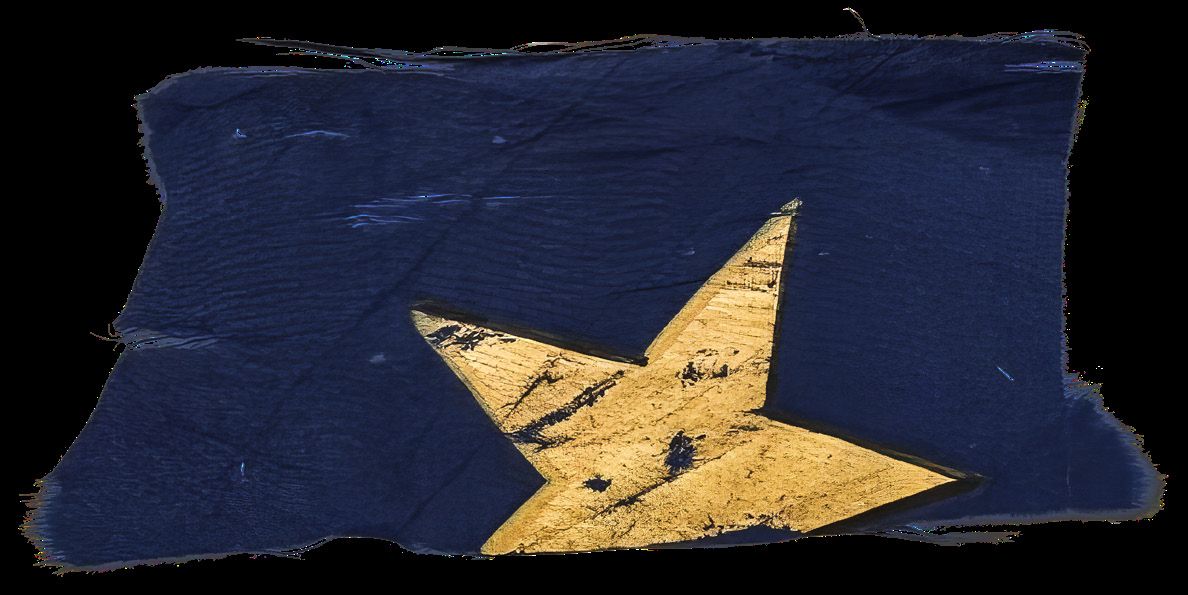
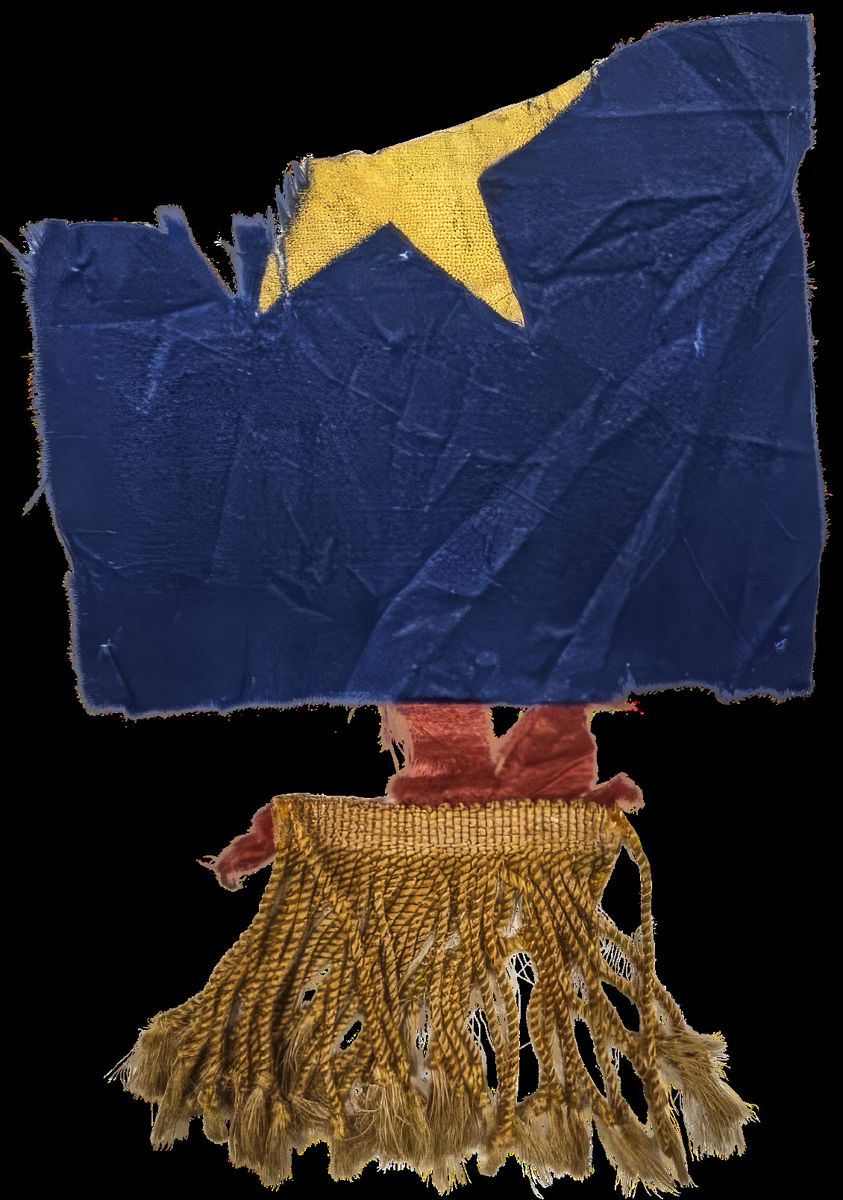
Flag fragments from the regimental and national colors of the 13th New Hampshire retrieved by Captain Julian at Petersburg, Va., after being shot away by Confederate bullets on June 4, 1864. Both flag pieces are shown in the 1913 photo, lower right.
Outer line of Confederate fortification Battery No. 5, in front of Petersburg, Va. captured by 18th Army Corps, June 15, 1864. (Library of Congress)
gilt stars is cut out of our badly tattered flag by the rebel shells and bullets. Capt. Julian, Lieut. Thompson of E and one of the men, as the piece comes fluttering down near them, make a simultaneous rush for it; possession is difficult to determine, all three seizing it at once, and in the moment of waiting before another move is made a jack-knife decides the matter as umpire, by cutting out one star for each claimant. The writer still, 1887, has one of these stars, Capt. Julian has another. June 5, 1864. “Yesterday whilst our colors were planted on top of our works, the State flag staff was shot into 3 times and the US flag staff, 4 times, besides any number of bullets through the flags themselves.” “Enclosed you will find a piece of our State colors. It is the one with nearly a whole star upon it. Also 2 pieces of our U.S. colors. Accept the same, from one of its defenders with strongest and best love.” Both pieces appear in the 1913 photo, bottom right.
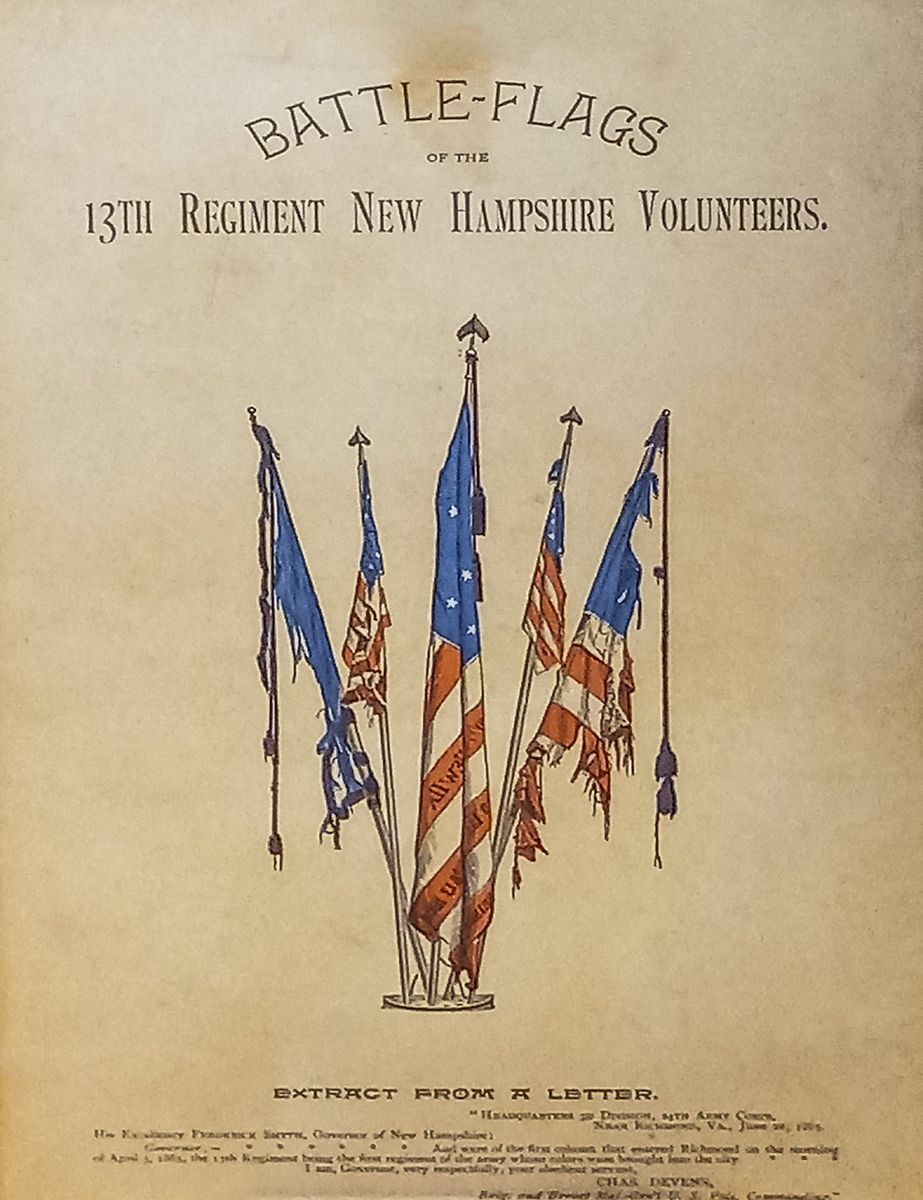
Bookplate Battle-Flags of the 13th Regiment New Hampshire Volunteers. Part of Captain Julian’s collection.
Cold Harbor was miserable, but not more so than their time at Petersburg. A ring of forts, the Dimmock Line, surrounded the key railroad hub. This fortification line was a series of high bank earthen artillery forts connected by rifle pits and trenches. Union troops closed in on this area at varying distances from the breastworks. One particular position, Battery 5, shaped like a fish hook, would be assaulted along with other forts on June 15, 1864. Battery 5 came under the operational control of the
From the History of the 13th New Hampshire Volunteers (1888, page 361), June 4, 1864, Cold Harbor, This morning between 2 and 3 a.m. the Thirteenth moves to the left to a new position on the line, as mentioned under June 3d, and as daylight comes on it reveals the enemy’s works directly on our front and very near, apparently not more than 500 feet distant….The bodies of the rebel dead lying about, and the bodies of some Union men also, are piled up for a barricade, but separately, also a few logs, and sand thrown upon the whole – anything to keep the rebel bullets back. A rebel shell burying and bursting in one of these horrid heaps makes a scene better imagined than described; the barricade is speedily re-arranged, however….During this manoeuvring and occupation of the ground before commencing to entrench, a piece containing three
Other items belonging to Captain Julian, which are visible in the 1913 window display, include this inscribed goblet, ships glass with case, and Infantry manuals.
This Confederate officer’s sword belt and two-piece CS buckle were captured during the assault on Battery 5. The belt can be seen hanging from the sword in the 1913 photo.
Plan of enemy’s Battery No. 5 in front of Petersburg before the advance of U.S. Forces, June 1864. (Library of Congress)
June 18, 1864, Petersburg, Va. “…musket balls were flying around us and the air, full of them, they were whirring past us and shells falling too. Right before us was a ravine which through ran a little brook and as [sic at] the base a log hut. I made for this point as they could bring no gun to bear upon it. Before I reached it along came a grape shot and hit my sword, which I had drawn in my right hand, resting across my body a little below my breast. It knocked the sword out of my hand, bent it up…I thought I was hit, killed…”
Sword tip showing the impact of the grape shot.
Part of the outer Confederate defenses captured by the U.S. 18th Army Corps shortly after the battle of June 15. Note the cannonball on the post in the foreground on the far left. (Library of Congress)
XVIII Corps, specifically the 13th New Hampshire, eight companies of the 8th Connecticut, and a small detachment from the 118th and 92nd New York. The 189 men of the 13th moved up into assault positions at 6:30 p.m. Approximately five paces apart, they formed a skirmish line 400 yards in length against Battery 5’s east side, which was just 100 yards wide. As they start to move forward, they were met by a hail of bullets. Soon, batteries of Union artillery opened up from behind, and the order shouted by officers and NCOs. “Forward!” As the men advanced, they were met by artillery fire not only from Battery 5, but also from Batteries 6 and 7 as well as batteries near the Appomattox River. The skirmish line advanced to the Confederate rifle pits, as the noise grew deafening. Colonel Stevens, regimental commander of the 13th, approached Captain Julian and passed the order that the unit will charge the earthworks. Julian thinks he has not heard the colonel correctly and asked, “do you intend this skirmish line to charge?” “Yes” was the reply “the success of this move depends on you, every one of you.” Captain Julian was stunned. This was foolhardy. The colonel had not made himself fully clear with his order. He was actually just preparing them to get ready to advance with the rest of the assault. He did not want Captain Julian to lead the charge single-handedly, but with the roar of battle around them, quickly the captain’s pride took over. Not willing to question an order twice, he rose and shouted at the top of his lungs, “Forward 13th!”
Major General William T.H. Brooks was watching the affair though field glasses and yelled, “What the devil are they trying to do, we are not in position yet!” Captain Julian rushed forward with 12 men in tow. They crossed the rear line of rifle pits in front of Battery 5 and rushed toward the fortification itself. The young captain, was struck in the chest as he approached the base of the emplacement. Knocked to the ground, he discovered his life had been saved by the sword he loved. June 18, 1864, Petersburg, Va. (Continued from paragraph 1). “I put my left hand on my breast, but could feel no blood, no wound, didn’t feel any pain. I passed around the corner of the building, rallied some men, told them I want to take the guns, pointing at some we could see in the fort and then told them to follow me. We would have them, and call them ours and so we went and in minutes the work was done.” Captain Julian and his small group were now at the base of the earthen fort, Battery 5, and the Rebels, being fired at by hundreds of other soldiers and artillery, had lost sight of them. Hand over hand, and with the assistance of bayonets and clumps of grass, they clawed their way to the fort’s parapet, some 30-35 feet above them, before jumping down from the rampart among the gun crews. The Confederates were totally caught by surprise and immediately threw up their hands at the appearance of the Union muskets. Captain Julian quickly accepted the surrender of over 200 men and officers. Within minutes, 13th New Hampshire men poured into the fort. Julian accepted surrendered weapons from six Confederate officers, including three swords and two belts with pistols and holsters. The two swords he kept, along with a Confederate officer’s belt, also appear in the 1913 photo. The third sword was given to one of his NCOs. From the Portsmouth, New Hampshire Times, a newspaper account, It was a dare devil piece of business, but it succeeded; had they have waited until Brook’s whole Division made the charge, we would have undoubtedly have lost half our brigade, as the guns were double shotted and trained to sweep the fields in front. From the History of the 13th New Hampshire Volunteers, pages 387-388,
Maj. Gen. William Thomas Harbaugh Brooks. Brooks commanded the 1st Division of XVIII Corps at Cold Harbor and Petersburg. (Library of Congress)
…as these few Northern soldiers look from the parapet down into the Battery, they see a full hundred of the enemy. These are thrown into a little disorder by the number of their own [infantry] men who have rushed in hurriedly from their rifle-pits taking refuge in the Battery, and they all appear to be waiting for something—they had not long to wait! Dashing without a moment’s hesitation into their midst our officers demand a surrender. Capt. Julian calls upon Lt. Col. [James C.] Council of the 26th Virginia, commanding the rebel infantry, to surrender and receives his sword, also receives the swords of several officers who surrender to him—among them Major Beatty and another Major. The Confederates are stunned as they quickly realize that they have surrendered to such a small force, but it is too late, and they are soon inundated with men of the 13th New Hampshire. From the History of the 13th New Hampshire Volunteers, page 390, When Capt. [Nathaniel A.] Sturtivant, commanding the Battery, finds how few men have caused his surrender, and how matters stand, he is beside himself with anger and chagrin; and exclaims in pure Old Virginia: ‘Here are my guns double-shotted for infantry, and all of us captured by a —— Yankee skirmish line!’
Confederate Captain Nathaniel A. Sturdivant. Liljenquist Family Collection of Civil War Photographs (Library of Congress).
When our artillery belched out all at once so heavily, he expected an assault by a strong column of infantry, and prepared for it by double charges in his guns; while waiting the onset, fuse in hand—about a dozen officers and men of the Thirteenth gobble up the whole of his garrison pickets, guard, gunners, guns and all! ‘The National colors of the Thirteenth were planted by me on the parapet of Battery Five — the first flag planted upon it after its capture.’ SERGEANT DAVID W. BODGE, Color-bearer Soon, the prisoners are being led away, and one of them, Major Beatty, asks to speak with him. History of the 13th New Hampshire Volunteers, page 389, Eight Confederate officers in Battery Five surrendered to Capt. Julian, five of these eight are here accounted for by their arms: Lt. Col. Council, who was in command of the line of works. His sword Capt. Julian still has, 1887, and it bears this inscription: ‘Presented to Lieut. Col. Council By the Officers and men of Companies B & C 26th Va. Regt. Jan. 1863.’ He received of another officer a sword, apparently a home-made affair, with the edge ground and whetted as sharp as a scythe. This he gave to Sergt. James R. Morrison of K who still, 1887, preserves it as a relic. Of another a revolver – Colt’s – which he gave to Lieut. Murray. Of another, a young naval officer, who was at Battery Five merely on a visit to friends for the day, and just down from Richmond, a revolver which he now has. When the officer handed this revolver, with the belt, holster and ammunition-pouch, over to Capt. Julian he remarked: ‘I will give you this as a special present to Old Abe.’ Capt. Julian still retains possession of it, however, by prior right. It is a Colt’s, of English make, and the ammunition taken with it was made by Ela [Eley] Brothers, London. Of another – a Major Beatty – a sword which he still preserves. An incident connected with this sword deserves mention. Sergt. Morrison of K had charge of taking the prisoners to the rear, and just as he was starting with them, Major Beatty said to Sergt. Morrison that Capt. Julian was a very brave man, and expressed a desire to see him again before the party of prisoners was taken away. Morrison sent a man for Capt. Julian, who went over where the prisoners were, carrying with him his special collection of Southern arms. Major Beatty then politely drew out of the collection the
Another view of Battery 5 that was part of the outer line of Confederate fortifications at Petersburg. Mathew Brady stands in the foreground near the breech of the cannon. (Library of Congress)
sword which he but a few minutes before had surrendered, and turning the hilt, formally presented the sword and belt to Capt. Julian, with the request ‘that in future he would wear it as his own, and when doing so would think of him the recent owner.’ Capt. Julian accepted the gift, promising to wear it; and during the rest of his term of service he wore that sword and none other, and still preserves it as a relic of the war having a special history of a particular interest. The results of the day give to the Thirteenth two rebel colors, one captured by Sergt. James R. Morrison of K, and the other by Corp. Peter Mitchell of K – both of which colors are sent as trophies to the Governor of New Hampshire, and are now, 1887, preserved in the State House, and are the only rebel battle-flags in the custody of the State – about as many prisoners as the Regiment itself numbers; several ammunition wagons, and five pieces of artillery – four handsome brass cannon, and one iron gun – belonging to Sturtivant’s Richmond Battery; and have broken the enemy’s main line on this side of the “Cockade City.” “July 6th, 1864. A week or so ago I sent home to you, by Captain Bradley, who lately resigned on account of disability, very properly so. I sent home by him as I was saying my old sword. Also, 2 Rebel sword belts, a part of my trophies in the last fight. You will see by my sword what a narrow escape I had with my life, for had it not been for the sword, the shot which hit it would have gone way through me in the region of my heart. I hope you will treasure this sword as a little reminder of your absent Soldier son.”– July
6th letter written by George Julian to his family describing the incident. Letter is in the University of New Hampshire Archives. He continued, “The sword I wear now I took from a Rebel Major. Also the revolver I wear, I took from a Rebel or Confederate Captain. I am splendidly armed and if I can get more I would like to send these to you.” The results of the day were astounding. This small band of 13 men captured Battery 5, over 100 men with their arms in the fort, five cannon, and two Confederate colors. The 13th New Hampshire soldiers who followed their assault rounded up another 100 prisoners. From the Portsmouth New Hampshire Times, General “Baldy” Smith said he felt like giving every one of the men a Brigadier’s commission; he called them his ‘pet’ regiment after that day’s work. The Boys were the first to break the lines at Petersburg, as they were the first Brigade in Fredericksburg and the first to charge and capture the rifle pits at Cold Harbor. On the conclusion of the war Captain Julian again took up the wool business, carrying it on for many years in San Francisco, Calif., to which state he went in 1875, the name of his firm being Ball & Julian. In July 1892, he returned east and settled in Exeter, N.H., continuing in the wool business for some years, with another office in Boston. He was appointed postmaster of Exeter in 1898 by President McKinley and, on July 1, 1898, assumed the duties of the office.
About the Author
Scott Kraska is the owner of Bay State Militaria and Antiques. He has been collecting, buying and selling militaria for over 40 years. He is also the President of the New Ipswich Museum of History as well as Chairman of the Board of Directors for Ukraine Focus, an NGO focused on delivery of Ambulances and other aid materials to Ukraine. He is the coauthor of River Patrol Insignia of the US Navy in Vietnam (2009) with Stephen Kirby, published by Bender Publishing, and author of numerous articles of military history and artifacts. He can be reached at www.baystatemilitaria.com or 978-855-2179.