
Colt’s “navy-Navy” Revolvers
By Tim Prince · Originally published January-February 2024 · pp. 15–25
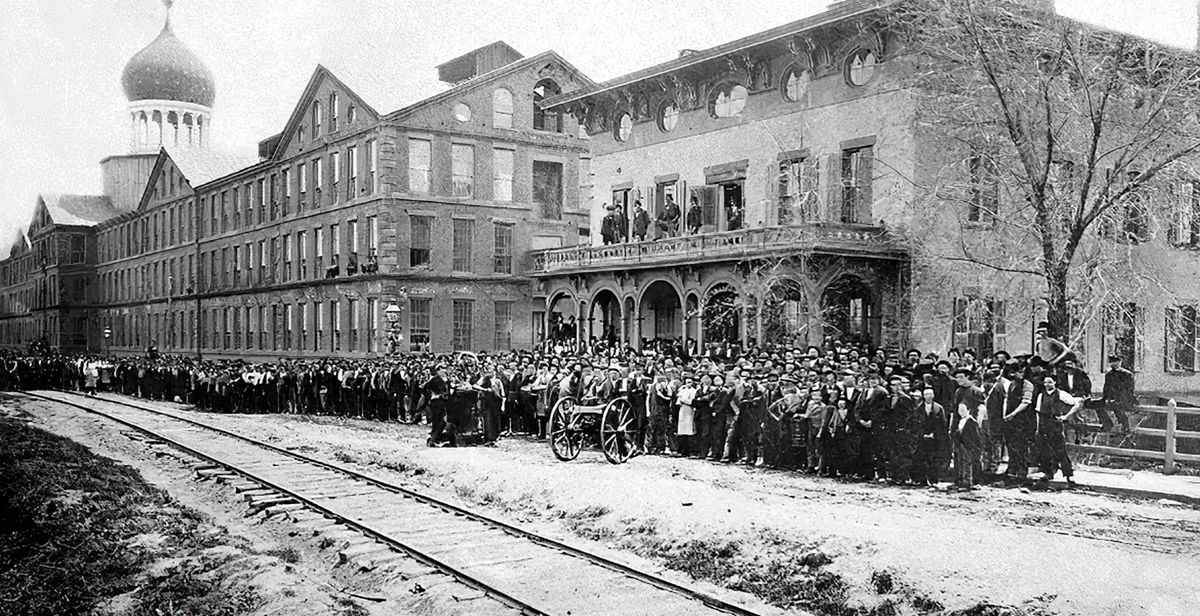
Colt’s “Navy-Navy” Revolvers By Tim Prince
The mid-1850s was a revolutionary time for small arms development worldwide; the United States was no exception. The U.S. Army had already adopted the percussion revolver in limited numbers for the U.S. Mounted Rifles and U.S. Dragoons by acquiring the Colt “Dragoon,” .44 caliber “holster” (as in pommel holster) revolvers in 1848. The U.S. Navy, however, remained steadfast in their belief single shot, muzzle-loading pistols were sufficient for the use of their seamen. In 1851, Colt introduced his Belt Revolver, a slimmed down, lighter weight, 6-shot .36 caliber handgun that would become known by its year of introduction as the Model 1851 revolver, or simply by its nickname, the Colt Navy revolver. The number of Colt .36 caliber M1851 “Navy” revolvers purchased by the U.S. Navy was limited. While Colt had vigorously lobbied the Navy to purchase his revolving pistols during the early 1850s, he met with significant resistance. He did manage to secure an order for 100 revolvers in June 1852 for the use of Commodore Matthew Perry’s command on his voyage to open Japan. This order included fifty Colt Model 1851 Navy revolvers, which correspondence noted were to be “plated,” 25 “Army Pistols – brass mounted,” and what appears to be a small selection of Colt Model 1849 pocket revolvers, likely for presentation as gifts. The correspondence requested “6 Four-inch barrel….6 Five-inch barrel….13 Six-inch barrel,” and all were noted as being “plated” as well. Despite these inroads, the general belief of the Naval Ordnance Department was that pistols were only of use while boarding an enemy ship, and in those circumstances, edged weapons such as sabers or axes were more practical to the average seaman. In fact, the chief of Naval Ordnance, Commodore Morris, wrote to Secretary of the Navy James Dobbin on June 21, 1854, noting in part: It has not been considered advisable heretofore, to purchase Colt’s revolvers for general service….Pistols can seldom be used with effect in the Navy, except when boarding vessels, with the view to their capture, which very rarely occurs. At such time, the contest soon becomes hand to hand when sword or boarding hatchets could be used by seamen, with equal, if not greater certainty and effect than pistols.
Colt was not to be discouraged, and ever the consummate salesman, he did manage to sell the Navy fifty M1851 revolvers in June 1856 and an additional fifty revolvers in May 1857. In September of that year, the Navy finally placed a larger order for M1851 revolvers. They purchased 2,000, less the one hundred previously ordered, and deliveries began in November 1857. These “1st Contract” guns appear in the 55500 to 62000 serial number range. The first 615 were delivered for inspection at the Norfolk Naval Yard on November 9, 1857. The next batch of 667 were delivered to the Boston Naval Yard on December 6, and the remaining guns were delivered to the New York Navy Yard later that same month. The Navy placed a second order for an additional 600 M1851s in August 1859. These guns were in the 89000 to 91000 serial number range, with half the guns delivered to the New York Naval Yard and the other half delivered to the Boston Naval Yard. The U.S. Navy-purchased Colt M1851 revolvers were somewhat unique in that they were specifically ordered with iron backstraps and triggerguards. This is especially interesting because the triggerguards and backstraps of standard production revolvers were made of brass, which made them less susceptible to harm from the corrosive sea air that sailors would expose them to. John D McAulay’s research reveals that by 1860, Colt M1851 revolvers were listed in the small arms inventories of nearly thirty U.S. Navy vessels, including the USS Caledonia, USS Colorado, USS Congress, USS Crusader, USS Cumberland, USS Decatur, USS Fennimore Cooper, USS Fulton, USS Independence, USS John Adams, USS Lancaster, USS Merrimack, USS Mississippi, USS Pawnee, USS Plymouth, USS Porpoise, USS Powhatan, USS Portsmouth, USS Roanoke, USS Sabine, USS Saranac, USS Saratoga, USS St. Mary’s, USS Susquehanna, USS Vincennes, USS Wabash, USS Water Witch, and USS Westernport. The percussion Colt Model 1851 “Navy-Navy” revolver pictured in this article was part of the original order for 2,000 guns and was one delivered to the New York Navy Yard in December 1857. The revolver has the matching serial number 61931 on all the major parts, with the loading lever, barrel wedge, and cylinder arbor having the matching abbreviated number 1931, omitting the first digit. The inside rear channel of the walnut grip is numbered in period ink; while the ink is worn and faded, it also reads
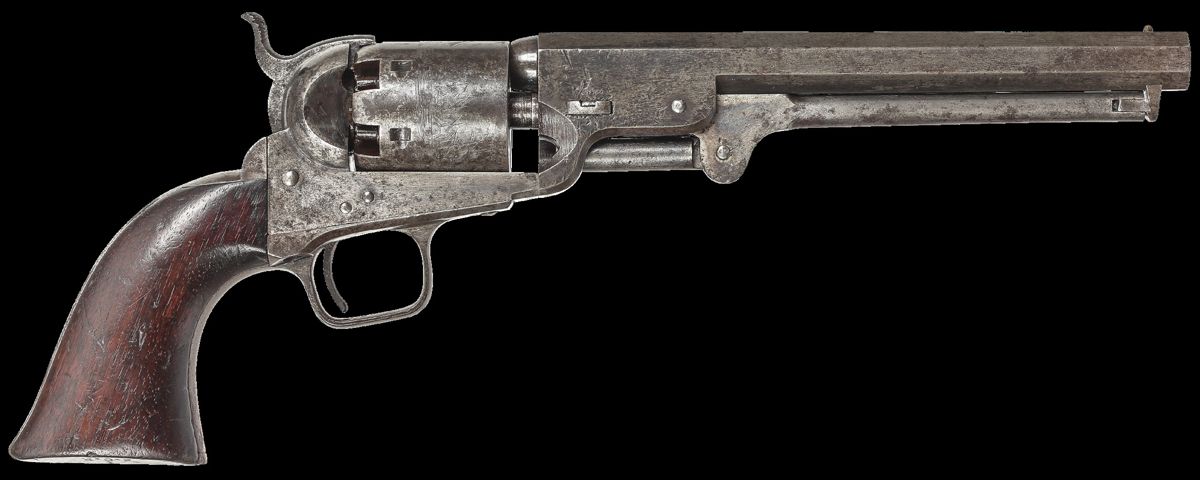
Obverse overall of Colt Navy-Navy #61931, still in its original percussion configuration. (All photographs by Tim Prince)
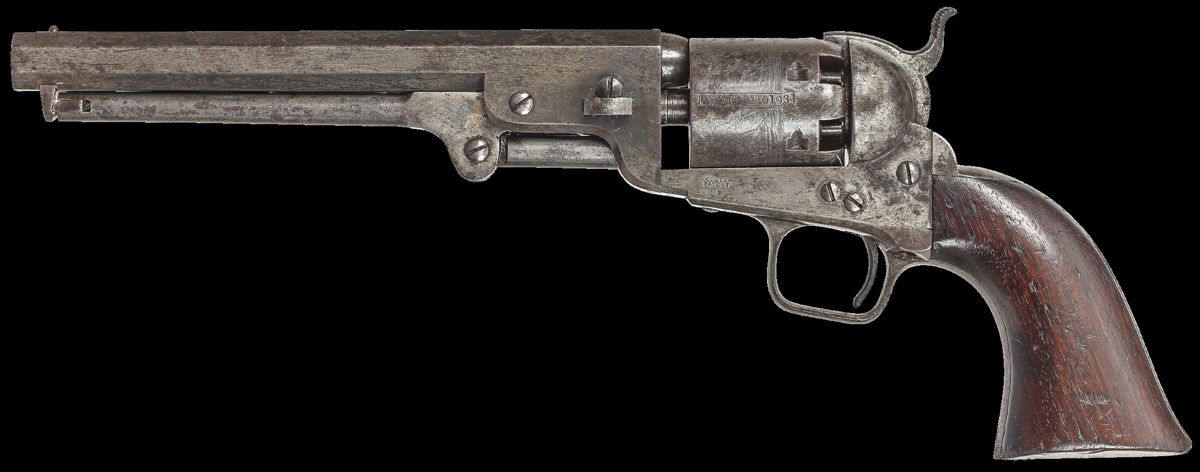
Reverse overall of Colt Navy-Navy #61931, still in its original percussion configuration.
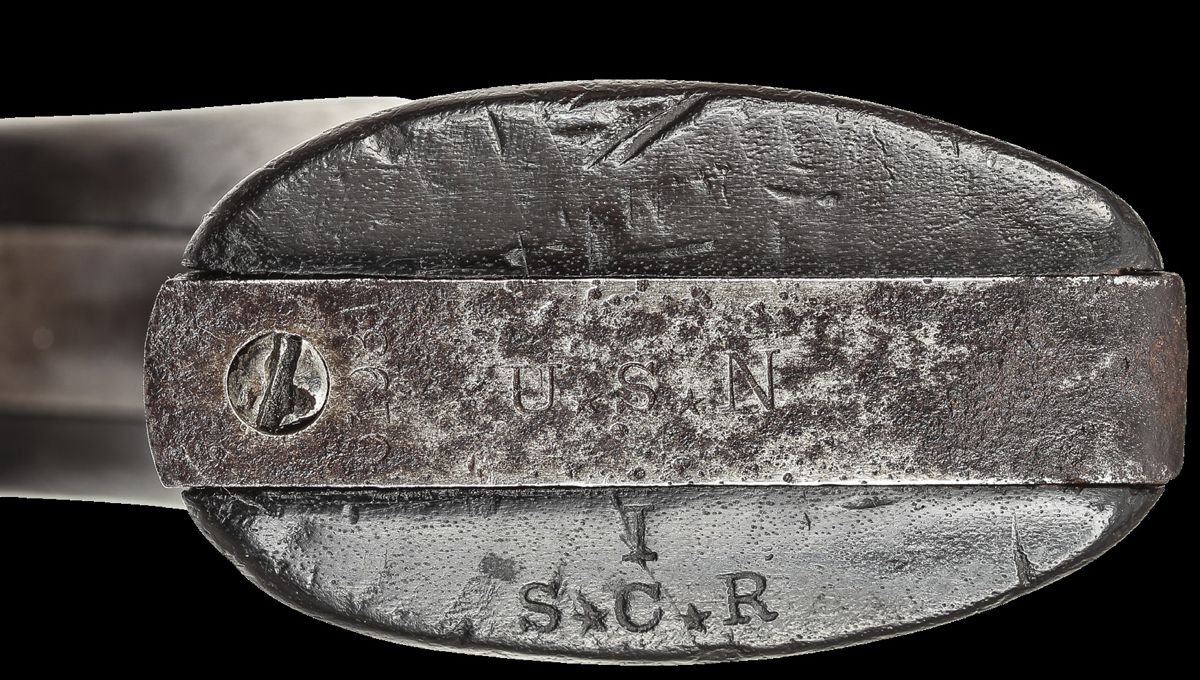
Butt of Colt Navy-Navy #61931, still in its original percussion configuration. Note the USN marking typical of those found on 1st contract guns and the I over SCR inspection of Commander Stephen C. Rowan of the New York Navy Yard. The fact that this inspection is in the wood and that so many grips were replaced on the cartridgealtered guns explains why it is extremely difficult to find a cartridge Navy-Navy with inspection marks today.
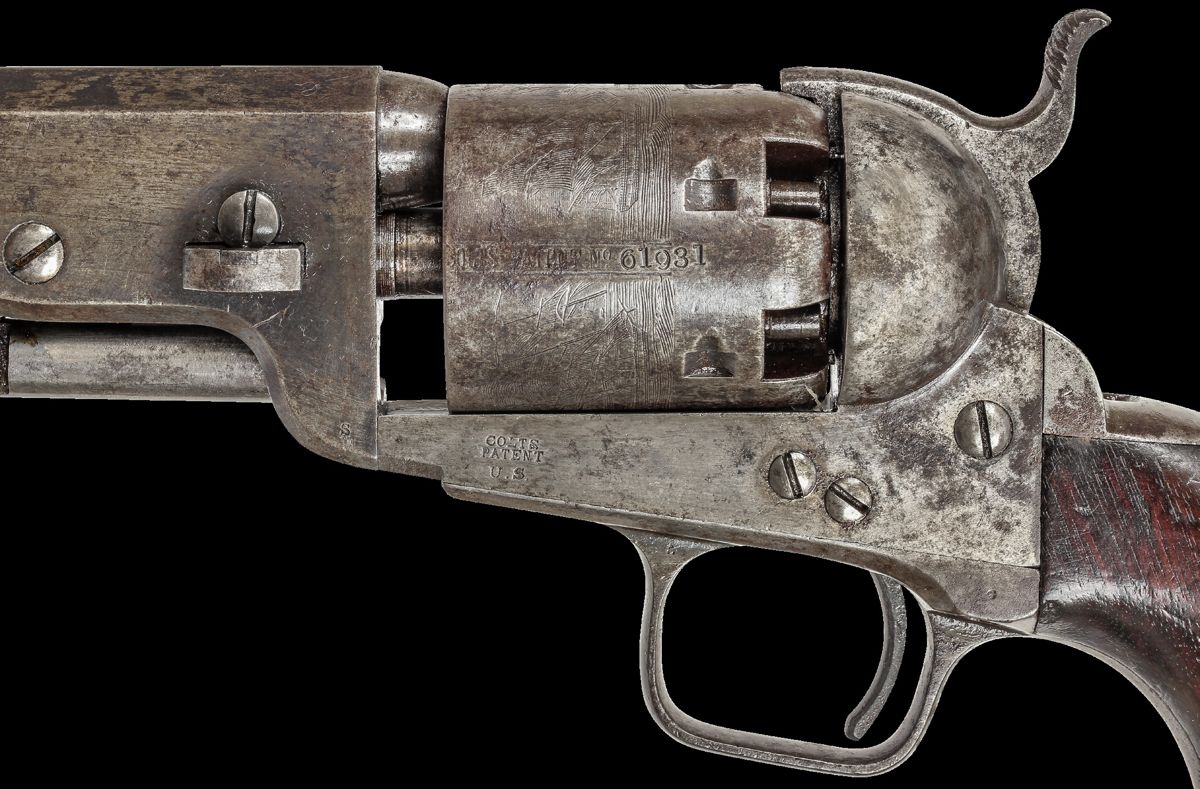
Reverse frame close-up of the first contract percussion Colt NavyNavy Revolver #61931. Note the standard three-line COLT’S/ PATENT/U.S. mark on the lower front edge of the frame and the boxier London-style iron triggerguard with rounded corners.
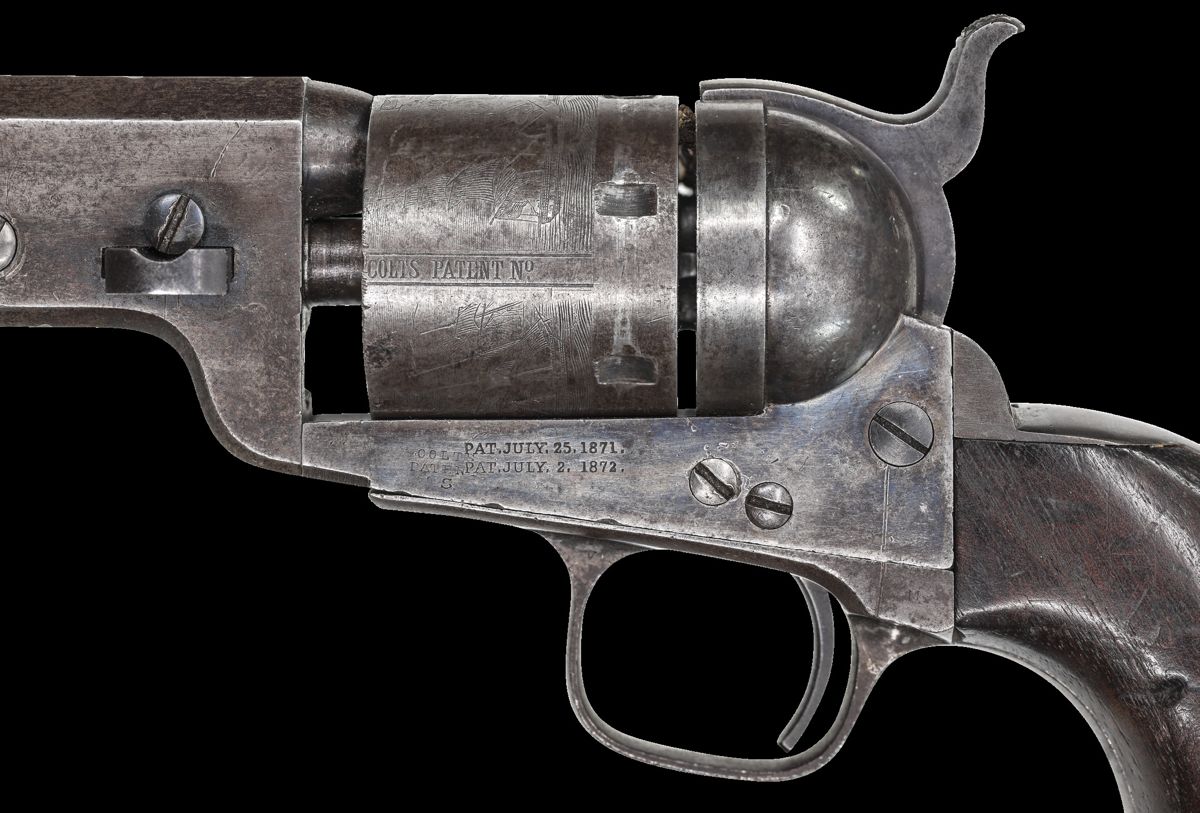
Reverse frame close-up of the second contract Colt NavyNavy #89849 altered to cartridge by the Richards-Mason system. Note the remnants of the original three-line Colt marking and the addition of the two-line patent date markings referencing the Richards and Mason patents. Note also the more rounded profile of the iron triggerguard than found on the first contract guns.
- Like all the Colt M1851s delivered under the first U.S. Navy contract, the revolver has a London-style iron backstrap and a large London-style iron triggerguard that is boxier with a more squared-off profile than the later contract triggerguards. The later contract guns utilized the Hartford-style iron backstrap and more rounded triggerguard. The lower front portion of the left side of the frame is marked in three lines: COLT’S/PATENT/U. S. The octagonal barrel is marked with the single line New York address reading — ADDRESS SAML COLT NEW YORK CITY —. The bottom of the iron gripstrap is clearly marked USN, and the bottom of the wooden grip is marked I over SCR, indicating inspection by Commander Stephen C. Rowan at the New York Naval Yard. These are very scarce guns today, as only 2,600 guns were procured via contract with the Navy before the Civil War; approximately 1,000 of them were subsequently altered to cartridge revolvers. The end of the Civil War essentially announced the end of the percussion firearms era for the U.S. military. The effectiveness and reliability of self-contained metallic cartridges had been more than proven on the battlefield. All the U.S. armed forces were looking for ways to modernize their small arms by adopting cartridge-firing weapons. Even the incredibly traditional U.S. Navy sought a selfcontained cartridge handgun to add to their small arms inventory. However, the traditional attitude about the
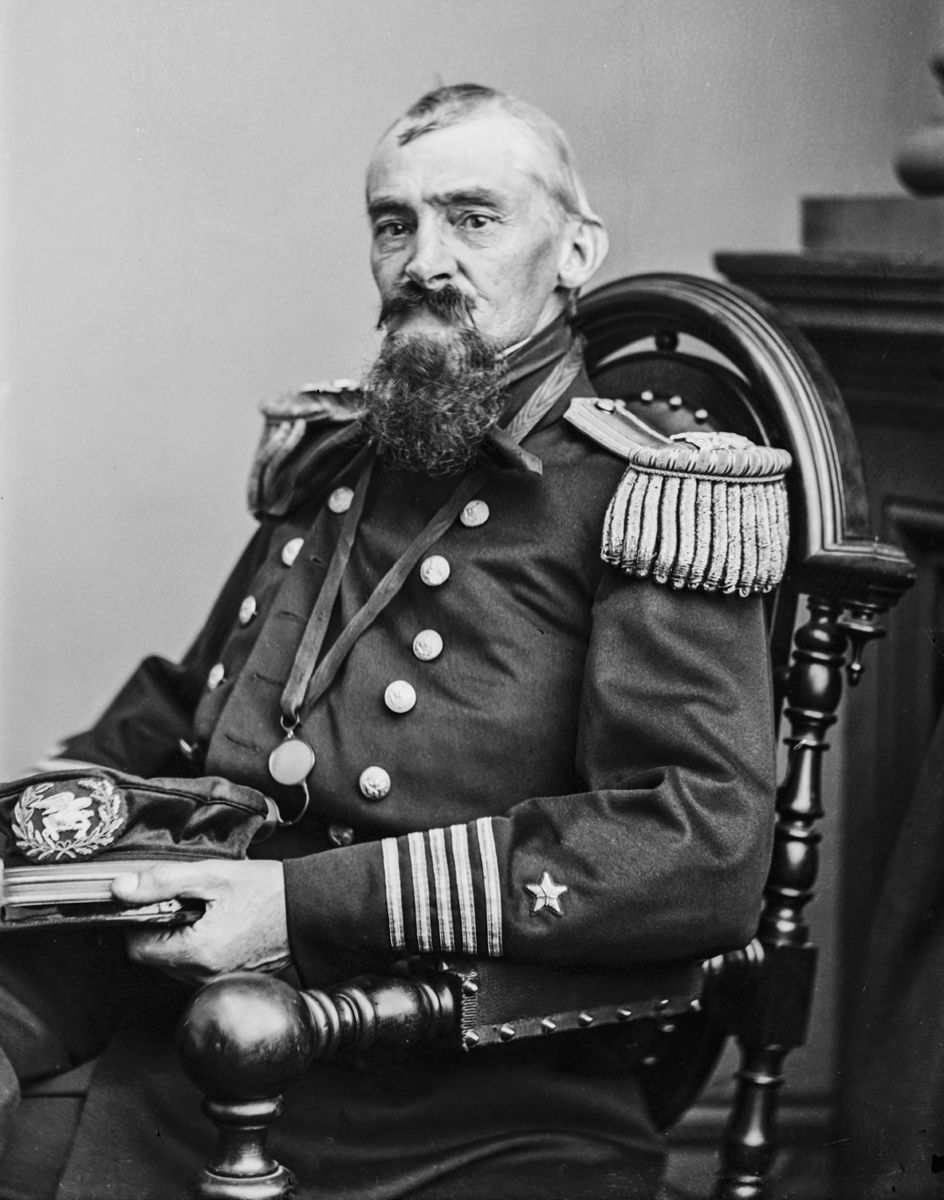
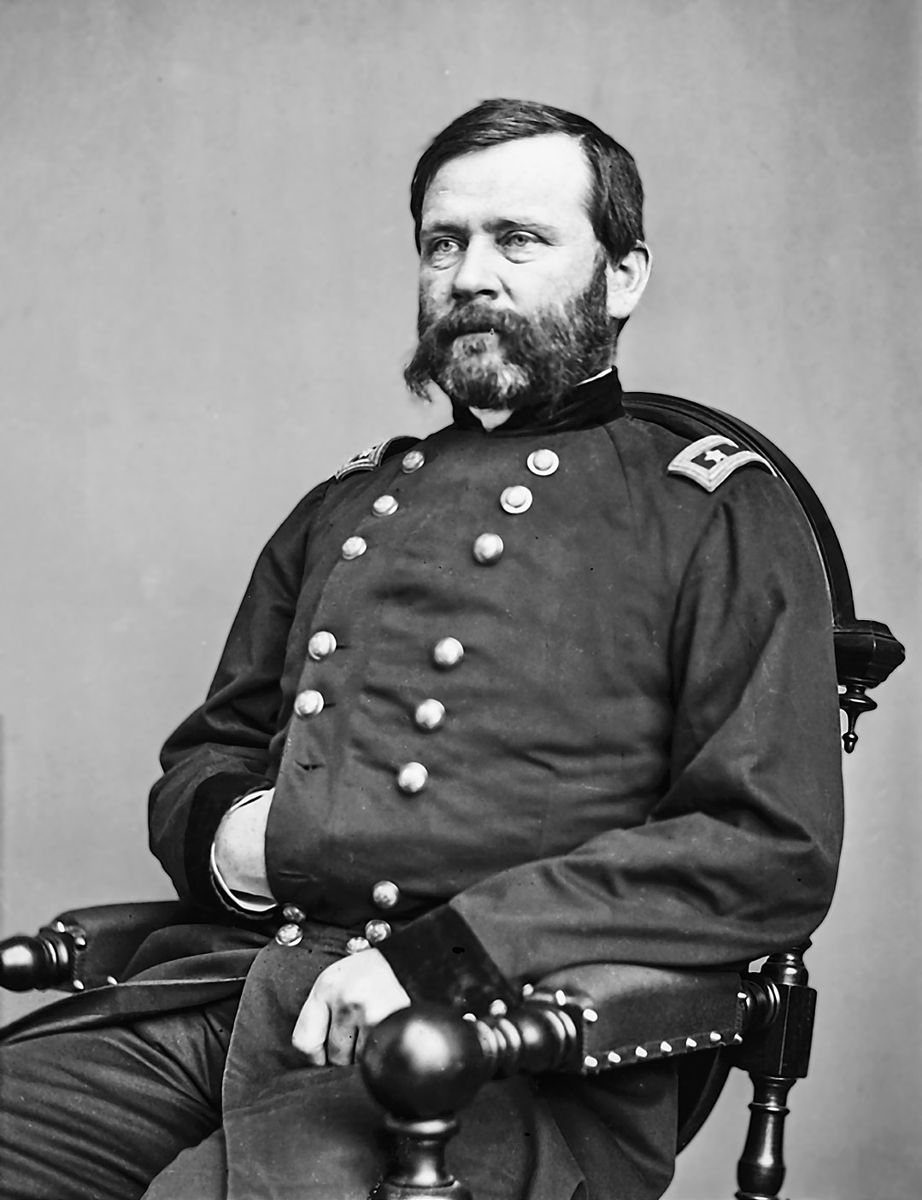
Richard Worsam Meade II. (Library of Congress) utility of pistols, and revolvers in particular, remained at the top echelon of the naval hierarchy during the post-Civil War era’s first decade. As a result, the Navy adopted the Remington rolling block single-shot pistol as their standard sidearm in 1865. This clearly indicated the Navy felt that self-contained cartridges were desirable for pistols, but the multi-shot firepower of a revolver was not. The Navy was also caught in a budget crisis that arose from government debt that had been accrued during the War and had an overabundance of small arms, albeit obsolete, on hand. There was simply no money for the widespread acquisition of cartridge revolvers, nor was there a general consensus regarding which revolver might be the appropriate choice. In 1873 the Colt Patent Firearms Company approached the Navy with a potential solution that was low cost and allowed the Navy to upgrade many obsolete percussion revolvers to cartridge handguns. General William B. Franklin, Vice President of Colt, offered to upgrade existing stocks of M1851 and M1861 Navy revolvers to centerfire cartridges via the Richards-Mason conversion system for $3.50 each. In a July 10, 1873, letter to Franklin, USN Chief of Ordnance William N. Jeffers accepted the offer from Colt and noted that he had
Maj. Gen. William B. Franklin (Library of Congress)
…advised the Commandant(s) of the Boston, New York, and Philadelphia Navy Yards to send to your manufactory 100, 400 and 300 pistols respectively for alteration.
Reverse overall of Richards-Mason altered Colt Navy-Navy #89849.
Barrel address of Richards-Mason altered Colt Navy-Navy #89849.
Obverse overall of Richards-Mason altered Colt Navy-Navy #89849.
Thus began the process by which some 2,097 U.S. Navyowned .36 caliber Colt percussion revolvers were altered to fire a metallic cartridge by the Richards-Mason system. The guns were all altered to .38 Long Colt, and while some sources suggest the barrels were reamed and re-rifled, the reality is that the bores of the guns were not altered, although Colt replaced a few barrels due to the poor condition of their bores. The alteration consisted of a series of modifications to the revolver’s frame, cylinder, and barrel. The cylinder was modified by milling down a portion of its rear, removing the percussion cones (nipples), and creating a bored-through chamber while leaving the original ratchet mechanism intact. The chambers were then reamed to accept the .38 Long Colt cartridge cases. A conversion breech plate was added to the frame, mounted in front of the original recoil shield, and a loading gate added on the frame’s right side. A new, longer, two-pronged hand was added to the internal mechanism to actuate the cylinder, and the ratchets on the cylinder’s rear face were re-cut to ensure proper timing and indexing. The barrel had the loading lever and associated catch removed. The dovetail for the catch, as well as the loading lever mounting recess, were both filled. The hole in the front of the frame through which the rammer plunger passed was not modified. A William Mason pattern ejector rod assembly was added to the right side of the barrel, consisting of an ejector rod tube with a spring-loaded ejector rod that had a kidney-shaped plunger tip with concentric rings embossed on the front to ensure a good grip while using the ejector rod. After the alteration, the pistols were refinished by Colt. At least one letter from Colt to the Navy suggested that the iron backstraps of the M1851 Navy revolvers be polished and refinished and new grips be installed on the revolvers to improve their overall appearance and bring them up to the standards of the rest of the gun that had been refinished after the alteration process. The Navy agreed and paid Colt an additional 75 cents for each gun that had the backstrap refinished and the grips replaced. The poor condition of the iron backstraps was specifically noted and again begs why the Navy insisted on iron instead of the standard brass for their revolver backstraps. As a result of replacing most of the grips on the guns sent to Colt, original USN inspection marks in the grips are usually missing from the cartridge-converted “NavyNavy” revolvers. Due to the polishing and refinishing, the original percussion era marks on the guns are often weak or missing, as are most of the original Navy markings in the metal. The pistols were stamped on the lower left side of the frame with the new two-line patent date legend that referenced both the Richards and the Mason patents. In almost all cases, the wedges of the cartridge-altered revolvers were replaced with new Colt factory wedges, using both leftover percussion wedges with springs and newly made cartridge wedges without springs, all of which were unnumbered. Based upon extant examples, most
M1851 Navy-Navy revolvers altered to cartridge ended up with mismatched cylinders that were renumbered to match the gun at the factory. The newly applied numbers were struck either below the original serial number on the side of the cylinder or the rear face of the cylinder. As the work to modify and machine the percussion cylinder into a cartridge one was the most complicated and timeconsuming part of the alteration process, the cylinders were likely removed and sent to the machine shop when the guns were initially disassembled. Cylinders that already been modified were used during reassembly. As the guns were interchangeable, there was no advantage to spending the time and effort to track the altered cylinders and put them back with their original gun. Colt would follow this same policy of ignoring the serial numbers when refurbished guns were reassembled, when at the end of the century, they rebuilt the venerable 7.5-inch barreled Single Action Army “cavalry” revolvers as 5.5-inch “artillery” revolvers. It is generally believed that only about 1,000 Colt NavyNavy cartridge conversions were performed on M1851 Navy revolvers, with the balance performed on M1861 Navy revolvers. When the revolvers were returned to the various Navy yards by Colt, only those sent to the New York Navy Yard received any new inspection marks. The revolvers sent to New York were inspected by Commander Richard W. Meade, who stamped his initials and an anchor under the barrels, forward of the frame. Those pistols with the R.W.M. {ANCHOR} mark can be concretely attributed to having been inspected at the New York Navy Yard after alteration. No known inspection markings have been attributed to the revolvers returned to the Boston, Philadelphia, Norfolk, and Portsmouth Navy Yards. Today, Richards-Mason converted Colt Navy-Navy revolvers are quite scarce, with less than 100 of the 1,000 altered M1851 Navy revolvers believed to exist. The revolver is an important one in any martial collection as it is the first metallic cartridge revolver used by the U.S. Navy and one of the first metallic cartridge revolvers used by any U.S. armed force. It also heralded the era of the .38 caliber handgun round in U.S. military service, temporarily displacing the .45 caliber cartridge. The Richards-Mason converted Colt Model 1851 NavyNavy revolver pictured in this article was part of the August 1859 second order for 600 guns. All 600 guns were delivered on September 9, 1859, with the deliveries being split between the New York and Boston Navy Yards. While the guns from the initial order for 2,000 revolvers were universally marked USN on their butts and with inspector marks usually applied to the bottom of the wood grips, most second order guns did not receive “USN” markings at the time of delivery. However, it appears that some did receive USN marks later. As the wood grip was usually replaced during the alteration to cartridge at the Colt factory, it is often difficult to determine where any guns were originally delivered when they were percussion revolvers, nor is it possible to know which of the two navy yards a gun from the second order was delivered without the inspector markings.
The example revolver is serial number 89849, which places it in mid-1859 production. The serial number is found on all major components except for the unmarked wedge Colt replaced during the alteration. The original serial number on the cylinder was obliterated during the polishing and refinishing process, and the last four digits of the gun’s serial number, 9849, were added to the rear face of the cylinder with two sets of numbers on either side of one chamber. Hence, it appears as 98 and 49. Like all the Colt M1851s delivered under the 2nd U.S. Navy contract, the revolver has a Hartford-style iron backstrap and a large Hartford-style iron triggerguard with a slightly “round bottom” profile that is not as flat as the London-style triggerguard found on earlier contract guns. The lower front portion of the left side of the frame was originally marked in three lines: COLT’S/PATENT/U.S., and amazingly this marking remains mostly legible. This mark was usually almost completely removed by the polishing and refinishing
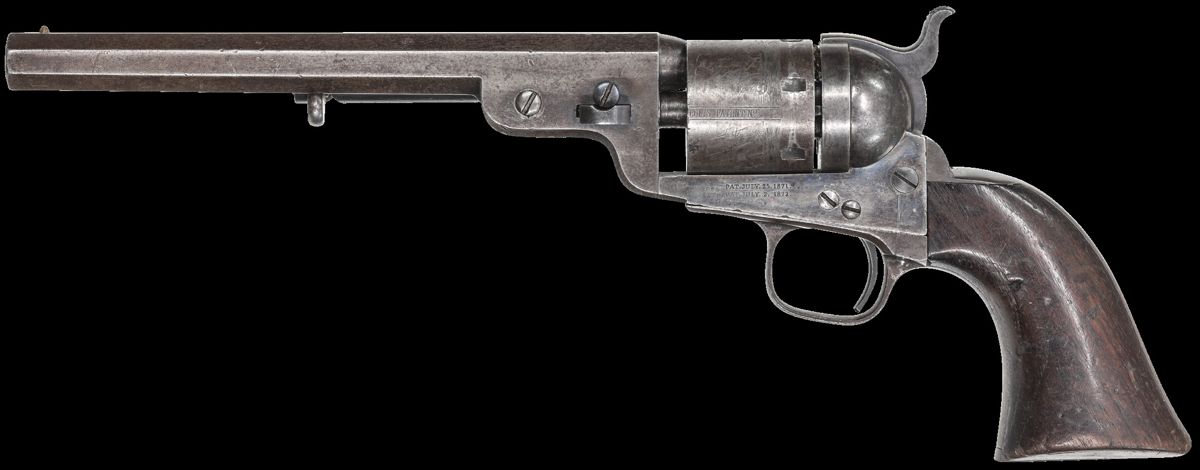
Close-up of the inspection mark of Commander R.W. Meade.
Butt of Richards-Mason altered Colt Navy-Navy #89849 showing the later added USN marking. Note that this differs from the USN marks found on the 1st contract guns. Underside of Richards-Mason altered Colt Navy-Navy #89849 showing the filled loading lever hole in the frame, the underside of the Mason patent ejector system, and the inspection mark of Commander R.W. Meade.
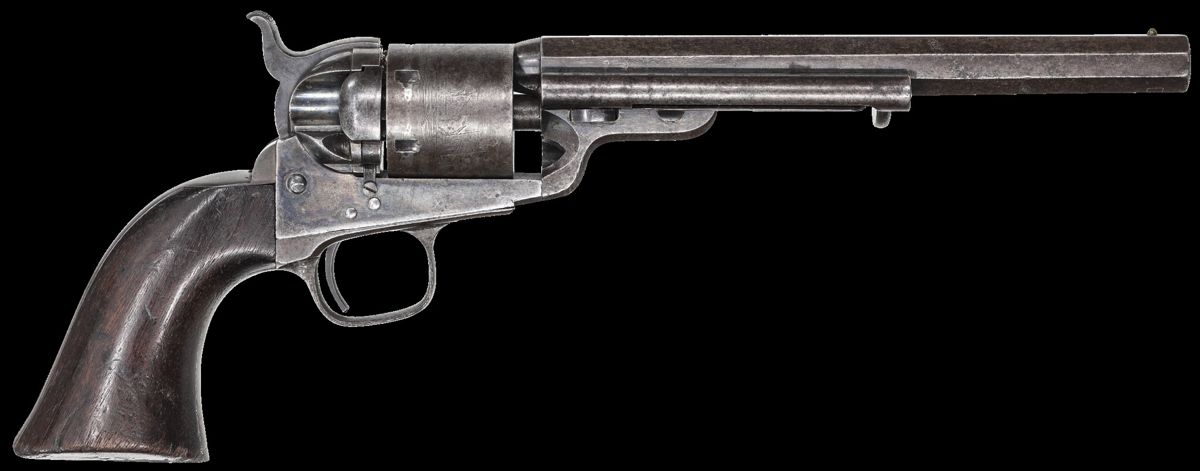
Rear face of the cylinder and open loading gate of Richards-Mason altered Colt NavyNavy #89849. This shows the assembly number 1158 on the rear face of the loading gate and the partial serial number 98 49 on the rear face of the cylinder, where it was renumbered to match the gun during the alteration process.
process, but in this case, it remains. The left side of the frame is additionally marked in two lines: PAT. JULY. 23, 1871./PAT. JULY. 2, 1872. The octagonal barrel is marked with the Hartford address as were all the guns from the second order, and it reads in a single line: — ADDRESS SAML COLT HARTFORD, C.T. —
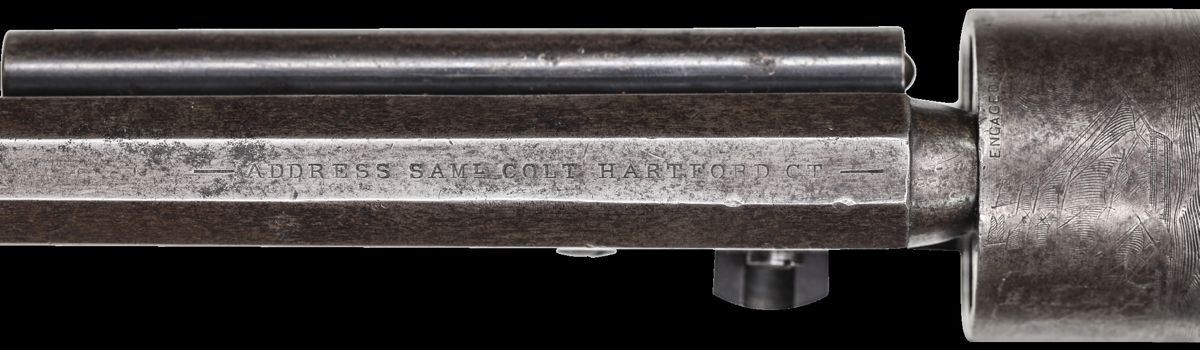
ENGAGED 16 MAY 1843 legend at the front edge of the cylinder on Richards-Mason altered Colt Navy-Navy #89849.
The cylinder is marked with the usual COLT’S PATENT No, but as noted, the original serial number that was on the cylinder has been largely obscured by the refurbishment process. The cylinder is rolled with the typical Texas and Mexican naval engagement scene, which remains about 80%+ visible. This is much better than the roll engraved scenes normally found on Navy-Navy alteration revolvers. Even the ENGAGED 16 MAY 1843 legend at the front edge of the cylinder remains almost entirely legible. The loading gate is marked with the factory assembly number 1156, and there is no doubt if the conversion ring were removed from the breech face of the revolver, it would also be marked with this number. The same assembly number, 1156, is found on the top of the cylinder arbor as well. These numbers were Colt factory internal assembly marks for the conversion process and were not meant to match the serial numbers on guns to which they were applied. The barrel bottom is clearly and deeply stamped with R.W.M.{ANCHOR}, so we know this gun was sent to the New York Navy Yard after Colt converted it. A August 12, 1873, letter from Commander Jeffers to Colt asked that when the first 100 revolvers were altered, 50 be sent to the New York Navy Yard and 50 to Portsmouth. Colt undoubtedly delivered the guns to the various navy yards as needed and at Jeffers’ direction. However, due to the diligent inspection of the guns delivered to the New York Navy Yard by Commander Meade, we know this gun was returned from Colt to New York.
April 30, 1843, and May 16, 1843 saw the Naval Battle of Campeche. Samuel Colt immortalized the battle scene on the cylinder of the renowned Colt 1860 Army Revolver and the Colt 1851 and 1861 Navy Revolvers. This served as a token of appreciation to Commodore Moore, who had bought Colt Paterson revolvers for the Republic of Texas Navy in 1837.
About the Author
Tim Prince is a full-time dealer in fine and collectible military arms from the Colonial Period through WWII. He operates College Hill Arsenal, a web-based antique arms retail site. A long-time collector and researcher, he has been a contributing author to two major book projects about Civil War era arms including The English Connection and a book on southern retailer-marked and Confederate-used shotguns. He is the author of over 70 articles on weapons in Civil War News and Military Antique Collector. Tim is also a featured Arms & Militaria appraiser on the PBS Series Antiques Roadshow and serves as a Senior Consulting Specialist to the Arms & Armor department of Cowan’s, a Hindman Company.
Confederate pistols bearing the name of Leech & Rigdon are among the most famous and well-known Civil War revolvers. Thomas Leech and Charles Rigdon were the only large manufacturers of Confederate revolvers to put their names on all their guns. Spiller & Burr marked a portion of their production. The Leech & Rigdon firm has been written about for over 100 years; early authors misread the name because of broken dies used to mark the barrels. In the 1911 Magazine of Antique Firearms Confederate arms article by Henry Steuart, the marking was thought to read “BEECH & RIGDON.” There are even fakes with this name copied from the article. Richard Steuart corrected spelling by 1925 in an updated article in a Confederate Veteran magazine. The biographical backgrounds of Thomas Leech and Charles Rigdon, the principals in this manufacturing firm, have been explored in many earlier publications.
in Burnet, Texas. That same year, Thomas Leech Sr. visited him, according to newspaper articles, and was living with his son when the 1900 U.S. census was taken. Thomas Sr., the arms maker, and his son, the cotton broker, died six months apart in Burnet in 1908. Thomas Leech Jr., like his father, did well in some of his ventures and not so well in others. Partnerships with cotton brokers were not uncommon, as was the dissolution of partnerships. Thomas Leech and J.B. Leech were in several partnerships in England just after the Civil War and in the United States prior. There is another Thomas Leech with no known direct relation who was also a cotton broker in London with his own son Thomas (1825–1885), so there was confusion.
While researching this article, I found much of the information was incorrect, especially about Thomas Leech. I will attempt to update the known facts. Thomas Leech (1826–1908) was born in England and emigrated to the U.S., where he became involved in the cotton business, originally as a clerk and later a broker. Leech worked for several firms between 1855 and 1859. He partnered with John B. Leech, forming Thomas Leech & Company in 1859. In the 1860 U.S. census, Leech is listed as owning his home with his wife Rebecca (1835–1921), and son Thomas Leech Jr. (1856–1908). Living in Leech’s home at the time was Samuel B. Carver, another English emigree, and his wife. Carver was also listed as a cotton broker. He would form his own company after the war; Thomas Leech Jr. was an employee early in his own career as a cotton broker. Thomas Leech Jr. continued in his father’s profession as a cotton broker and other “money-making ventures” but went bankrupt in 1900