
Artifact of the Third Texas Cavalry
By W. Kerry Elliott · Originally published November-December 2023 · pp. 30–45
During the American Civil War, a unit of mounted volunteers sometimes known as the South Kansas-Texas Mounted Volunteers served in the Confederate States Army as part of the 3rd Texas Cavalry Regiment. After being organized at Dallas, Texas, during 1860, the 3rd Texas Cavalry mustered into Confederate service June 13, 1861. Colonel Elkanah Greer, Lieutenant Colonel Walter P. Lane, Major George W. Chilton, and Adjutant Mathew Ector were the first officers to serve in the field. Officers and enlisted men largely came from a dozen counties in northeast Texas. Numerous Third Texans, including its first commander, Elkanah Greer, were Knights of the Golden Circle members, a shadowy organization that advocated for secession prior to the war. Greer was the grand commander of the Knights in 1859. At least three earned general’s commission. Greer was promoted to brigadier general after being wounded at Elkhorn Tavern. Irish-born Walter Lane, fought in the Texas War for Independence, including the final battle at San Jacinto. He received the three stars of a Confederate general March 17, 1865, appropriately St. Patrick’s Day, on the last meeting of the Confederate Senate. Matthew Duncan Ector in 1863 after he was elected colonel of the 14th Texas Cavalry and distinguished himself at Murfreesboro and Richmond.
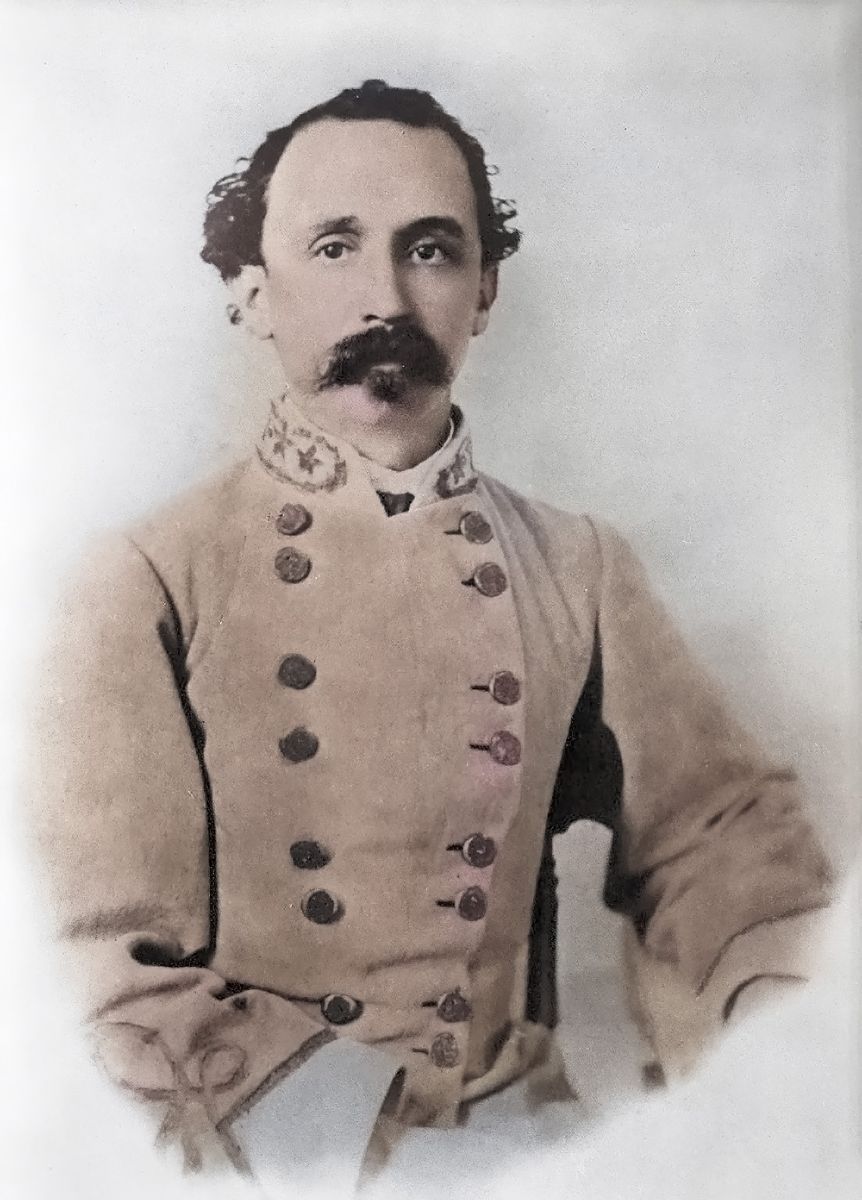
Bedford Forrest’s regiments got behind the Federal rear. Sam Barron later wrote that, “as they retired to their hill and cedar brake the third time, Forrest opened fire on their rear, and they threw down their guns and surrendered— that is, those that were still upon the field. Their artillery, cavalry, and one regiment of infantry had already left.” During the War’s last 18 months, the regiment was in Ross’s Brigade, but the only change was in renaming Whitfield’s Brigade in which they had served since October 1862. The Texans thereafter continued fighting together until the end of the war. In December 1863, Lawrence Sullivan “Sul” Ross, a former Texas Ranger and future governor of Texas, was assigned command of the Texas Cavalry Brigade, hence the designation “Ross’s Brigade.” Ross had a heroic career as a Texas Ranger when he rescued Cynthia Ann Parker from the Comanches and later killed Chief Peta Necona in single combat. Upon his promotion to brigadier general Dec. 21, 1863, he was given his brigade. By the end of the War, he had fought in over 130 engagements and had five horses shot under him. Confederate General Lawrence Sullivan Ross, seen here in his military uniform in the 1860s. The original photograph now resides in the Texas Collection at Baylor University.
The regiment was eventually assigned to the Texas Cavalry Brigade. The Third fought at Wilson’s Creek, the first Texas unit to see heavy combat, and Chustenahlah in 1861. Soon after crossing into Mississippi, the regiment participated in the Battle of Iuka in September 1862, where it suffered casualties equaling fifty percent of its total strength. Other significant 1862 battles included the siege of Corinth, Pea Ridge, Second Corinth, and the Holly Springs Raid. On October 23, 1862, a new brigade was formed under Colonel John Wilkins Whitfield that included the Third Texas, along with the Sixth, Ninth, and 27th Texas Cavalry Regiments. Despite their losses, the regiment went on to play an essential part in defending Vicksburg and Jackson. After Whitfield’s brigade was sent to Mississippi they took part in operations conducted to force Grant to abandon his envelopment of Vicksburg. In December 1862, General John C. Pemberton promoted Van Dorn to brigadier general and assigned him to destroy Grant’s supply base at Holly Springs, Miss. The Holly Springs Raid Van Dorn led some 3,500 cavalrymen from Grenada, Miss., and caught the Federals unawares; the garrison was asleep. The Confederate horsemen captured and paroled over a thousand Yankees and destroyed $1,500,000 worth of supplies by looting warehouses and burning everything they couldn’t take away. Grant’s forces had to abandon northern Mississippi. It took over four months to restart their attempt to capture Vicksburg. At Thompson’s Station, Tenn., on March 5, 1863. Whitfield’s Brigade engaged in a series of charges, rallies, and counter charges. The attacks ended when two of Nathan
Lawrence Sullivan “Sul” Ross. (Sept. 27, 1838 – Jan. 3, 1898)
In May 1864, Ross’s Brigade was transferred to Georgia and assigned to W.H. Jackson’s cavalry division to help defend Atlanta. During the Atlanta Campaign, The Texans distinguished themselves and sustained heavy losses in near continuous fighting during the campaign. When Atlanta fell to Sherman’s armies, they participated at Franklin and Nashville. After Nashville, the regiment fought for the remainder of the war in Mississippi. The Third’s surviving 207 members eventually returned home after Ross’s Brigade formally surrendered May 4, 1865. The brigade’s veterans formed the Ross Brigade Association in 1875. A few artifacts and photographs associated with the regiment’s soldiers are presented in this article. They document the service of a western regiment that served for the war in a variety of roles. Like most soldiers, Barron carried a canteen and relied on it for good water, something he found lacking at Corinth: Barron’s account of the water and rations available at Corinth he recalled:
“Our camp was moved to a point about three miles east of Corinth. … The rate at which our men fell sick was remarkable, as well as appalling, and distressing in the extreme. The water we had to drink was bad, very bad, and the rations none of the best. The former we procured by digging for it; the earth around Corinth being very light and porous, holding water like a sponge. When we first went there the ground was full of water, and by digging a hole two feet deep we could dip up plenty of a mean, milky-looking fluid; but as the season advanced the water sank, so we dug deeper, and continued to go down, until by the latter part of May our water holes were from eight to twelve feet deep, still affording the same miserable water. My horse would not drink a drop of the water the men had to use, and if I failed to ride him to a small running branch some two miles away he would go without drinking. The rations consisted mainly of flour, made into poor camp biscuit, and the most unpalatable pickled beef.”
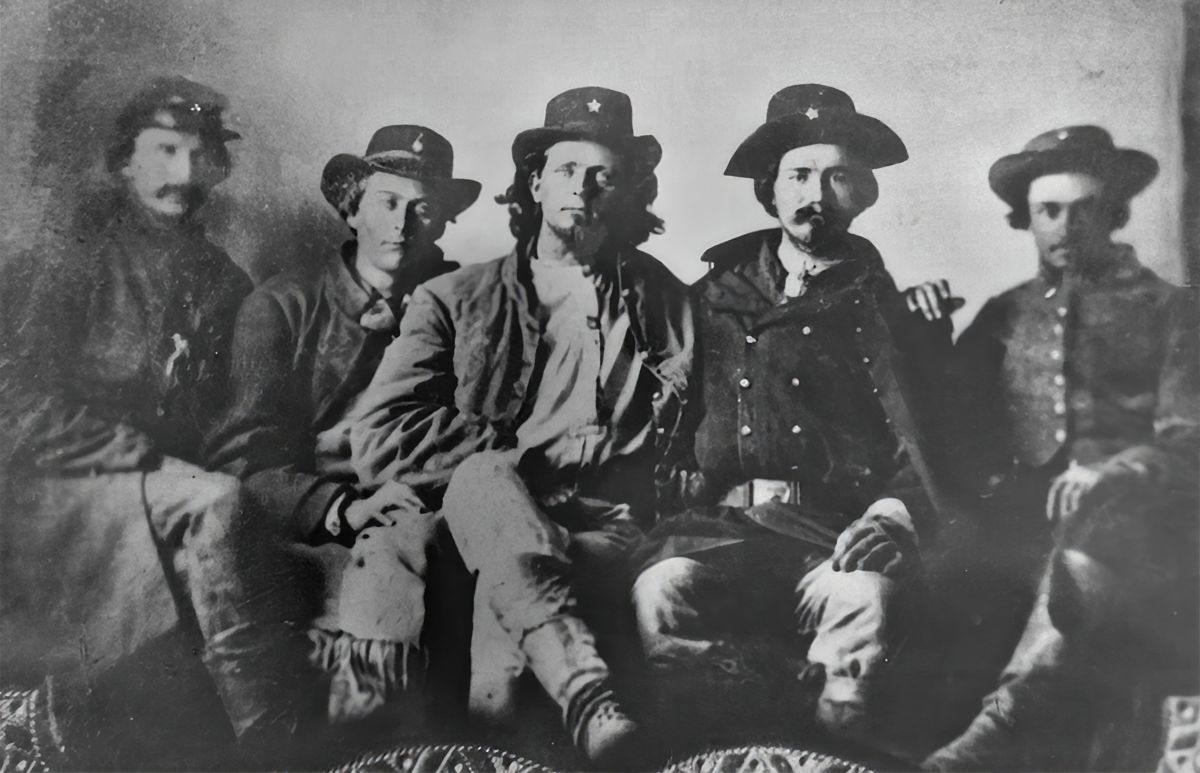
FIVE OF TERRY’S TEXAS RANGERS, CA. 1863 Walter S. Wood, Thomas S. Burney, Felix G. Kennedy, William A. Lynch, and Peter L. Kendall are shown from left to right. The five men wear a mixture of outer garments and head covers. They each sport a pin in the shape of a five-pointed star on the front on their hats. The original photograph is in the archives of Texas A&M University, College Station, Texas.
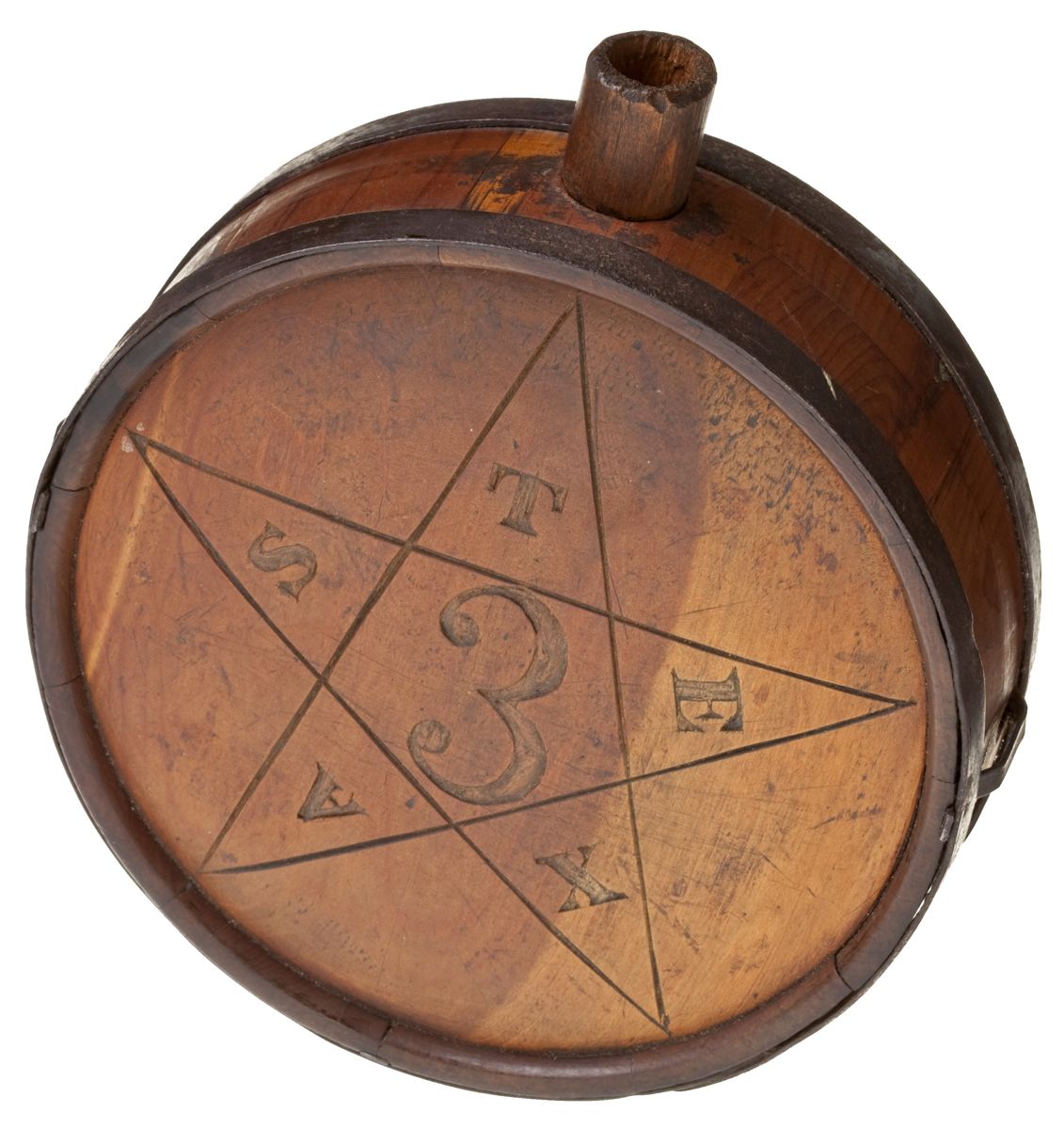
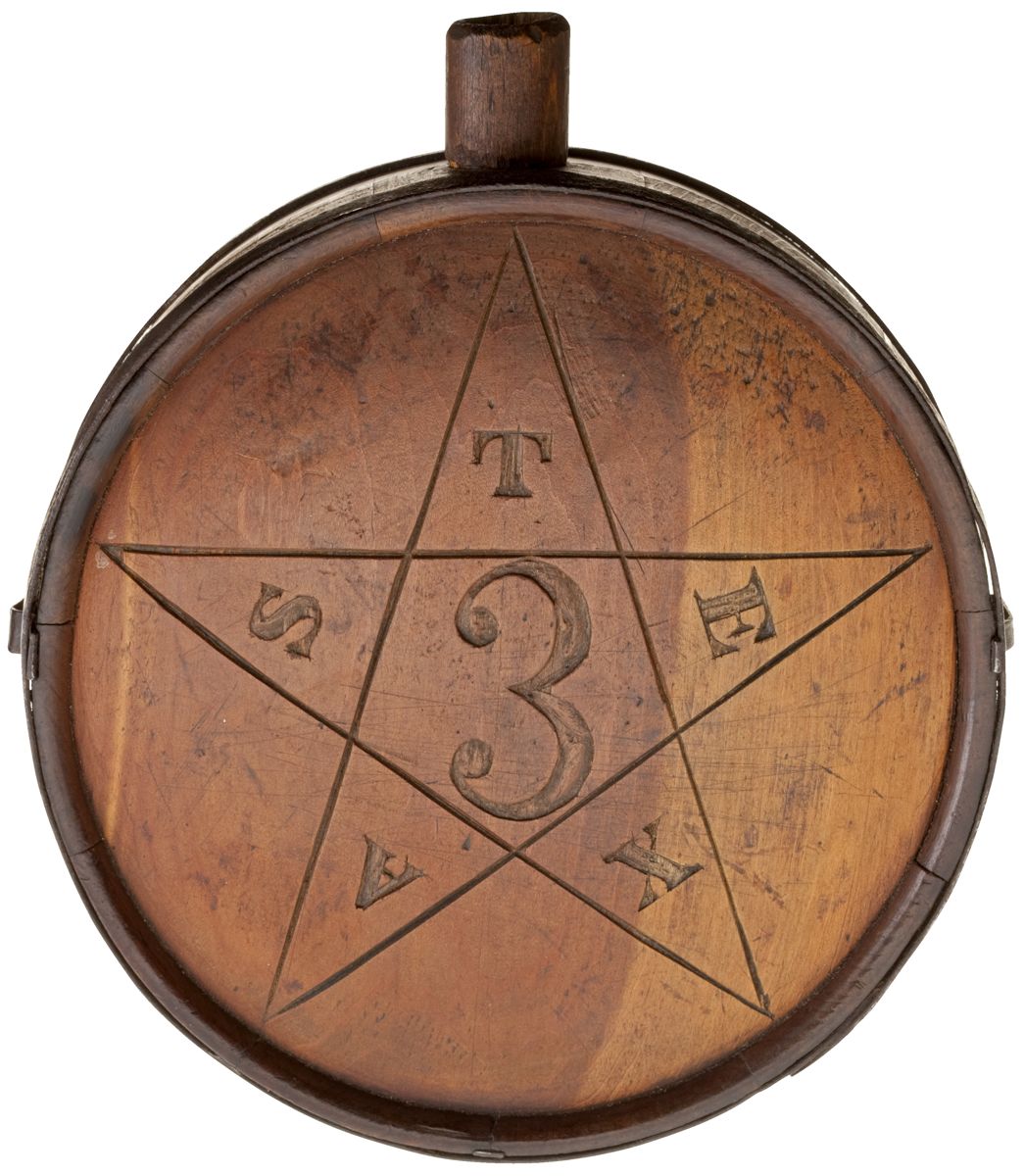
CANTEEN CARRIED BY SAMUEL BARRON This Confederate wood drum canteen was carried by Samuel Barron. It was featured as the cover on Sylvia and O’Donnell’s book Civil War Canteens, 1983. The neatly carved TEXAS graces the five star points with a 3 in the center.
This canteen has a carved wooden spout and two iron bands that hold the wood frame together.
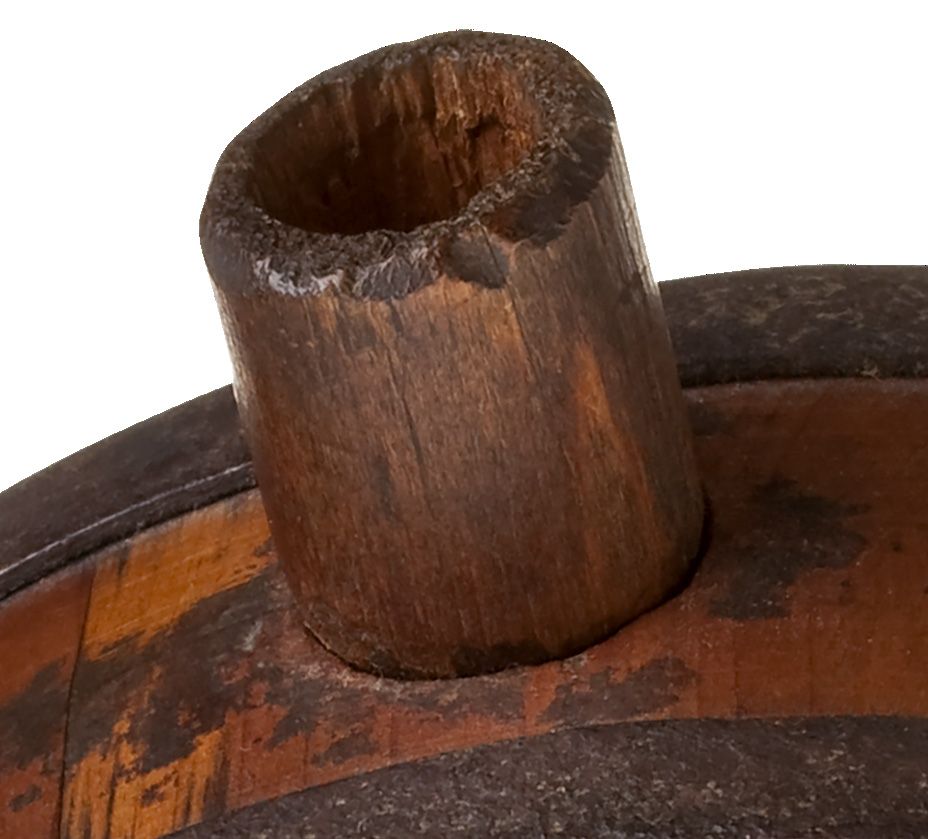
The carving on the canteen back contrasts with the fine work on the canteen’s “front.”
This engraved silver-plated pin was recovered in Vicksburg, Miss. It reads “TEXAS” around the outside points with “3rd / Cavl” in the center.
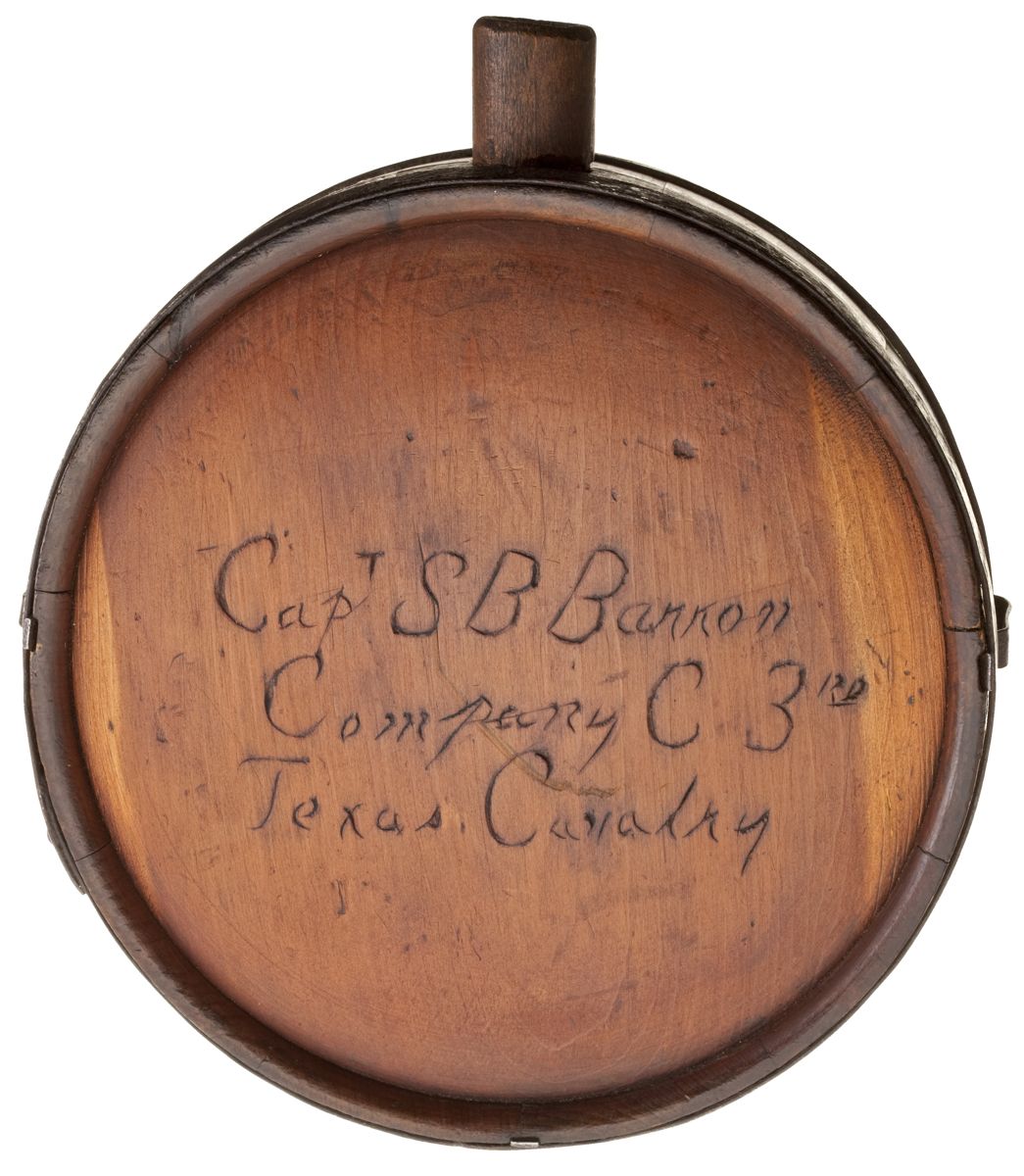
Carved on the reverse is: “CapT S B Barron / Company C 3RD / Texas Cavalry.”
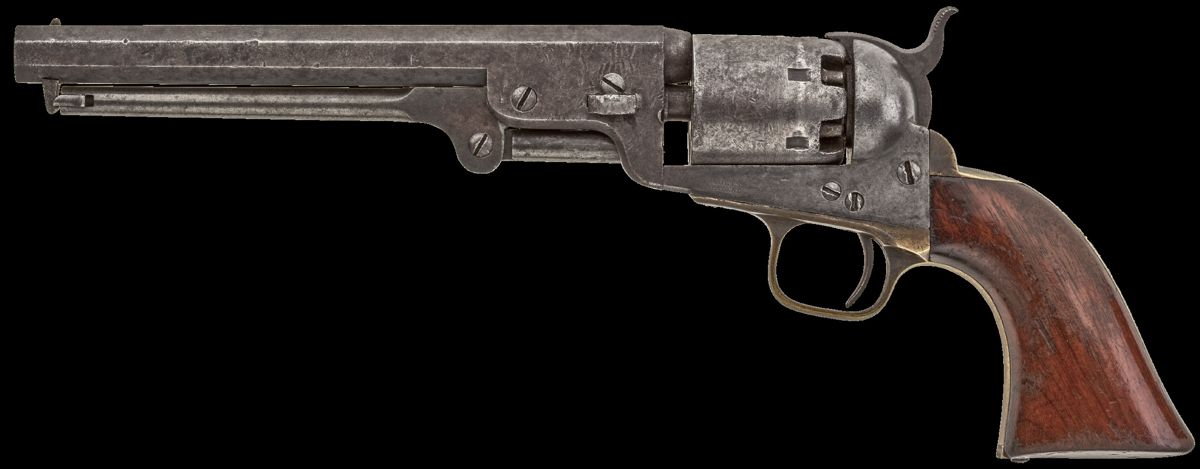
Colt Model 1851 Navy revolver carried by Samuel Barron Serial No. 102789.
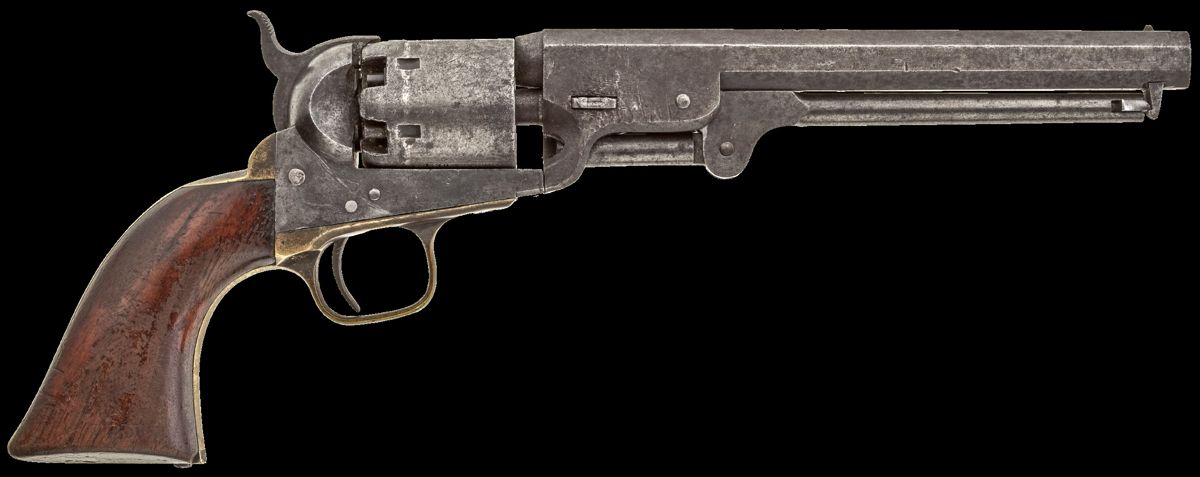
The cylinder of this revolver is engraved with a scene of the victory of the Second Texas Navy at the Battle of Campeche on May 16, 1843. Despite the “Navy” designation, the revolver was chiefly purchased by civilians and military land forces and very popular with Confederate officers.
Colt’s Patent Fire Arms Manufacturing Company.
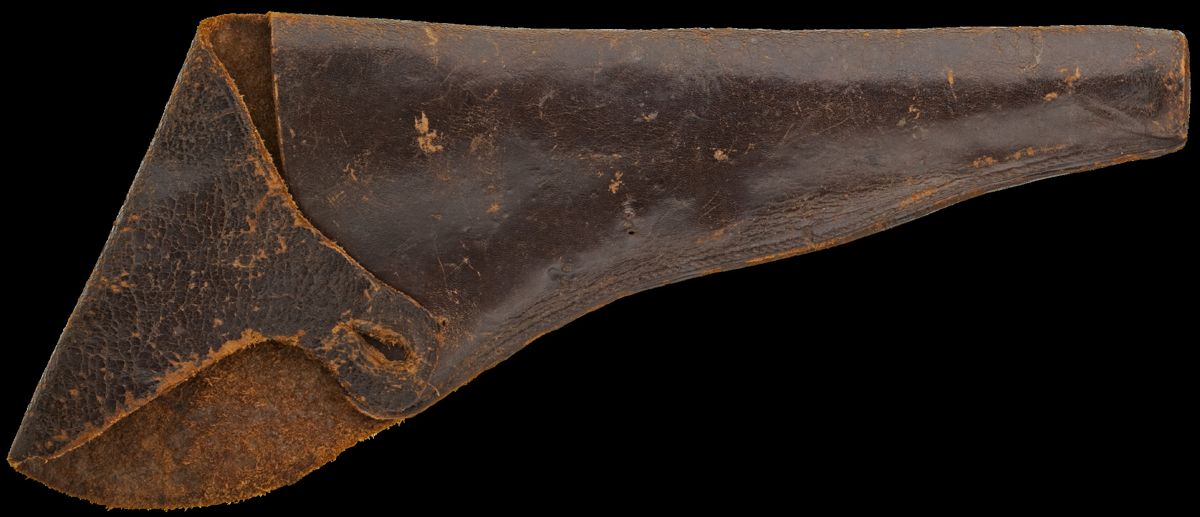
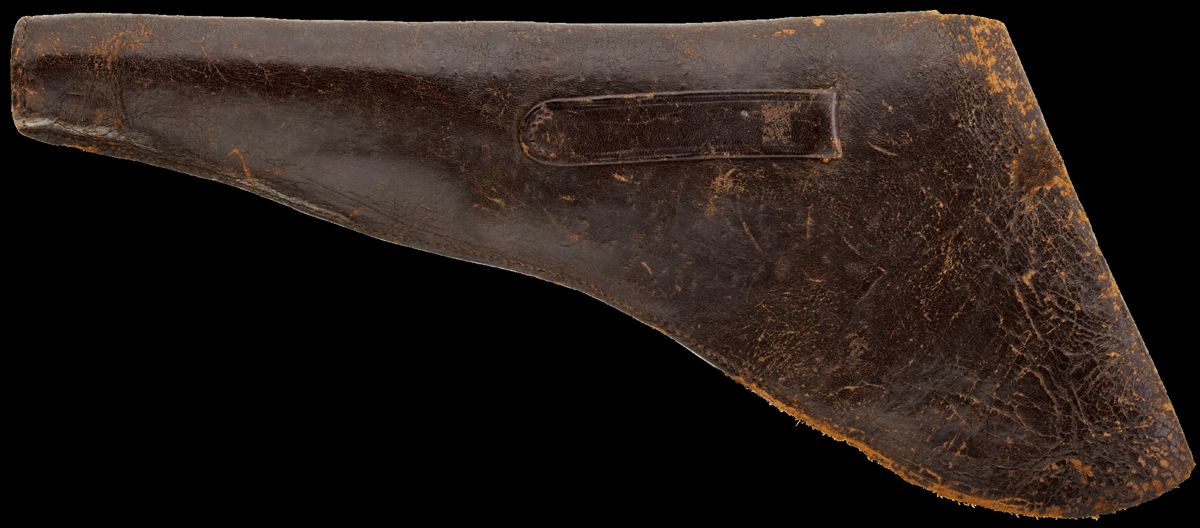
Barron’s well worn pistol holster.
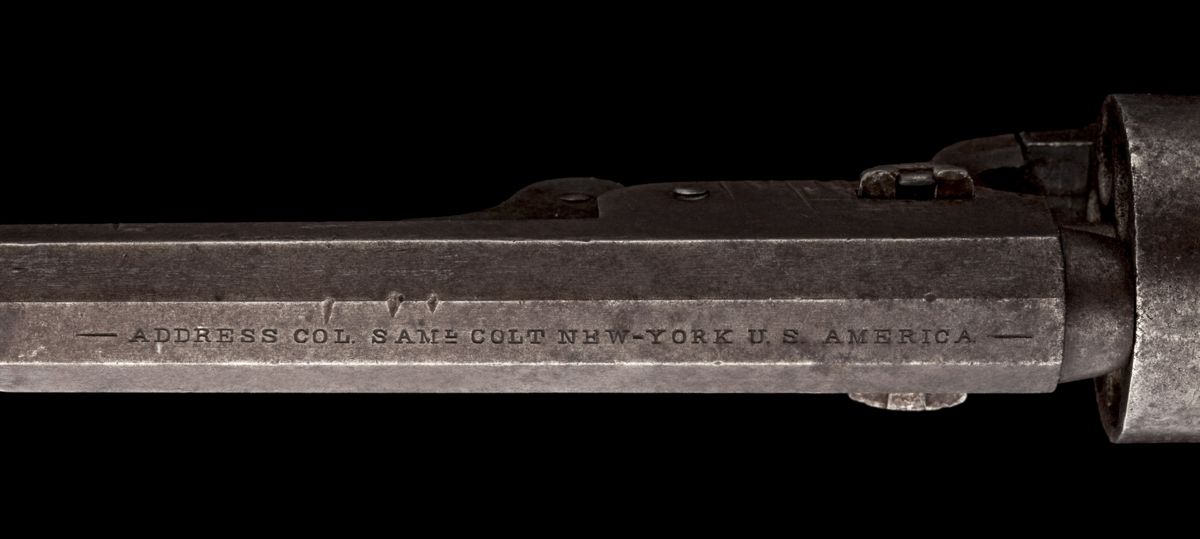
The top of Barron’s Colt’s octagon barrel is stamped: “— ADDRESS COL. SAML COLT NEW-YORK U. S. AMERICA. —”
Barron’s Colt backstrap is engraved: “Captain S. B. Barron / Company C, 3d Texas Cavalry.”
The underside showing the Colt’s serial numbers.
The matching serial number 102789 stamped on the butt stock, bottom of the guard and frame, and on the loading lever indicates this revolver was manufactured in 1861.
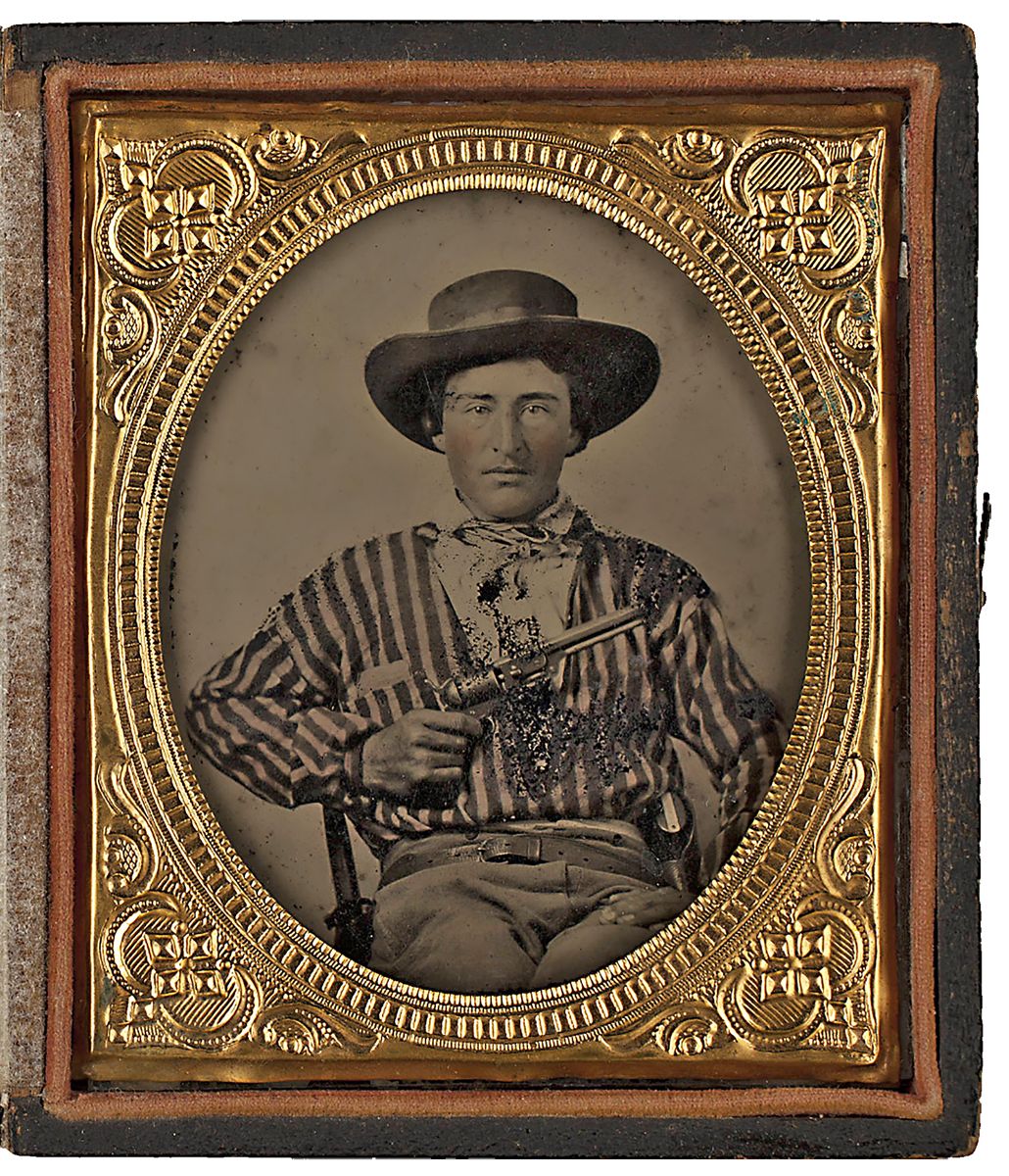
Private George T. Brown, 3rd Texas Cavalry Regiment, Arizona Brigade. Brown is holding his Colt Model 1851 Navy revolver. His battle shirt says something about the casual attire often worn by Western Theater cavalrymen. The identification, Arizona Brigade, is curious since the regiment did not serve in the far southwest. (DeGolyer Library, Southern Methodist University).
Lawrence Sullivan “Sul” Ross. (Sept. 27, 1838 – Jan. 3, 1898)
This Confederate canteen is adorned with intricate carvings that elevate it from a mere utilitarian object to a work of art. The meticulous craftsmanship displayed in the engravings imbues the piece with a sense of history and gravitas, making it a remarkable artifact of its time. Each carving appears to have been executed with great care and precision, suggesting not just skill but also a deep reverence for the object. It is not merely a container for sustenance; it is a canvas that captures the essence of a tumultuous period, rendered all the more compelling by the hands that crafted it.
FLAG CARRIED BY THE THIRD TEXAS CAVALRY This banner was made by a private contractor in Mobile, Ala. It was given to the regiment in November 1863. It is somewhat unusual in having twelve stars, not the typical thirteen or eleven. The regiment name and several engagements in which the 3rd Texas Cavalry distinguished itself were sewn to the flag. This flag was found in a Confederate ambulance abandoned Aug. 20, 1864, at Lovejoy’s Station, Ga., and taken by Minty’s Brigade. In 1905 the flag was returned to its rightful owner, the State of Texas. https://www.tsl.texas.gov/historicflags/4049ThirdTexasCal.html.
Samuel B. Barron, 3rd Texas Cavalry, ca. 1882.
Captain Jesse Wynne, Company B 3rd Texas Cavalry.
Samuel B. Barron’s PAROLE OF HONOR dated July 28, 1865. (https://www.fold3.com/image/10389380)
TERRY’S TEXAS RANGERS REUNION, TEXAS San Antonio served as the host site for the yearly reunion of Terry’s Texas Rangers. The photo shows the front of Turner Hall on Houston Street on November 13 and 14, 1889. The Special Collections Department of the UTSA Libraries.
SOURCES Barron, Samuel B.: The Lone Star Defenders: A Chronicle of the Third Texas Cavalry, Ross’ Brigade. 1908. Battles and Leaders of the Civil War. Vol. 1. Secaucus, NY: Castle. 1987. Benner, Judith Ann: Ross’s Brigade, C.S.A. from the Handbook of Texas Online (June 22, 2017). Retrieved August 22, 2023. “Historic Flags of the Texas State Library and Archives: TSLAC 306-4049 Third Texas Cavalry Regiment.” Austin, TX: Texas State Library and Archives Commission. 2017. Sylvia, Stephen W., and Michael J. O’Donnell, Civil War Canteens, 1983. The War of the Rebellion: A Compilation of the Official Records of the Union and Confederate Armies, Volume XVII Part I. Washington, DC: Government Printing Office. 1886. Retrieved July 13, 2023. The War of the Rebellion: A Compilation of Official Records of the Union and Confederate Armies, Volume XXIV Part III. Washington, DC.: Government Printing Office. 1889. Retrieved July 7, 2023.
About the Author Kerry Elliott is a retired chiropractor from Newnan, Ga. He graduated from West Georgia University with a degree in Biology and a Doctorate of Chiropractic from Life University in 1981. He is a member of the Sons of Confederate Veterans, the Atlanta Civil War Roundtable, and the American Society of Arms Collectors. His interest in Civil War history was sparked as a teenager, by his discovery of having two great, great grandfathers in “Fightin” Joe Wheeler’s cavalry. Dr. Elliott’s primary collecting focus is items associated with Western Theater Confederate cavalry.