
The Sharps Model 1855 British Carbine
By Tim Prince · Originally published March-April 2023 · pp. 69–79
T By Tim Prince he Sharps Model 1855 Carbine is a relatively scarce gun in the world of Sharps long arms collecting. Only 6,796 Sharps 1855 pattern carbines were produced between May 1856 and July 1857. Of those guns, the large majority were sold to the British on a military contract, totaling 6,000. Of the remaining production, 600 were sold to the U.S. Army, 101 were sold to the U.S. Navy and ninety-five were sold commercially. All these guns were produced with Edward Maynard’s patented automatic tape primer system. The United State military had adopted the Maynard system for general use with their 1855 series of firearms, and when they approached the Sharps company about producing more carbines for the military, Chief of Ordnance Colonel Henry Knox Craig requested the new guns be so equipped as well. The initial request to Sharps to produce carbines with the new priming system was made on April 13, 1854. However, due to the delays in receiving a sample Maynard lock to copy and the time required to redesign the Sharps Model 1853 receiver to accommodate the priming mechanism, deliveries would not commence until May 1856. The Sharps company spent a substantial amount of time, money, and effort adapting their Model 1853 design to accommodate the Maynard priming system. In the end, that investment only resulted in U.S. military purchases totaling 902 of the newly redesigned Sharps firearms, including both Sharps Model 1855 rifles and carbines. Interestingly it was the British military that provided the bulk of the orders for the newly minted Sharps Model 1855 carbine. While 6,000 British contract carbines may seem like a fairly substantial number, these guns are extremely scarce on the American collector market today. The reasons are multi-fold, but essentially revolve around the fact that the Sharps carbines were part of a foreign contract, were sold to Great Britain, and then the British issued them to five troops of cavalry stationed in India. The order for the 6,000 carbines came about due to a combination of indecision, a lack of options, and the poor field performance of the Victoria carbine. As the British went to war in the Crimea in 1856, they found their infantry well-armed with the Pattern 1851 Minié Rifle and the newly adopted, and very modern, Pattern 1853 Enfield Rifle Musket. The cavalry, however, went into battle with the 2nd Pattern Victoria Carbine of 1843. This was a percussion, smoothbore, .73 caliber, muzzle loading carbine with a 26-inch barrel. The appearance of the carbine was reminiscent of earlier English flintlock carbines, as the barrel was pinned to the stock, instead of being secured by barrel bands. The carbine had a captive swivel ramrod, and when this feature was combined with the rather long barrel length for a carbine, the end result was an arm that was difficult to handle and reload on horseback. Due to the woeful inadequacies of this carbine on the Crimean battlefields, the Board of Ordnance began to seriously look at options for adopting a breechloading rifled carbine that would be easier to handle while mounted and that would be more effective on the battlefield. The first serious contender for selection by the British was a patent capping breechloader designed by James Leetch. Leetch’s design had been submitted to the Ordnance Department for review in November 1853, one month after the beginning of the Crimean War. However, Leetch’s design did not undergo serious trials until June the following year and was not endorsed for adoption by the Board of Ordnance until July 1855. Initially some 15,000 Leetch carbines were ordered, but the order was quickly reduced to 2,000 as it was considered prudent to try a number of designs in the field prior to making a final selection regarding a breechloading carbine. In April 1854, a Sharps carbine design was first examined by the British Board of Ordnance for consideration as a potential breechloading carbine. This was a Model 1851 Box Lock military carbine. When testing was conducted in February 1855, the results were mostly positive. The Sharps 1851 carbine variant tested was equipped with the Maynard patent automated tape priming system, rather than the Sharps pellet priming system. The initial testing went well enough that a month later, in March 1855, the Board of Ordnance requested the Royal Small Arms Factory at Enfield Lock produce twelve Sharps pattern arms in .577 caliber for additional testing. This testing took place in July 1855 and resulted in the ordering of 6,000 Sharps Model 1855 carbines in .577 caliber. The order was placed on March 26, 1856, and the British deliveries commenced on May 31, 1856, continuing through March 31, 1858. The guns were produced in two primary variations, with the only major difference being the barrel lengths. According to most references, the first 3,000 carbines were delivered with a 21-inch barrel, while the next 3,000 were delivered with 19-inch barrels. The difference in barrel lengths was part of a series of improvements the British military requested as the earliest guns started to see use and reports on their service were returning from the field. As originally produced, the guns were blued with color casehardened receivers and were mounted with brass
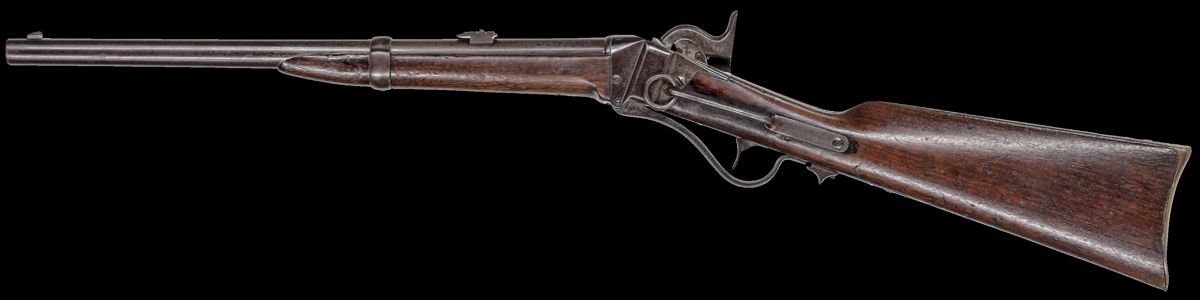
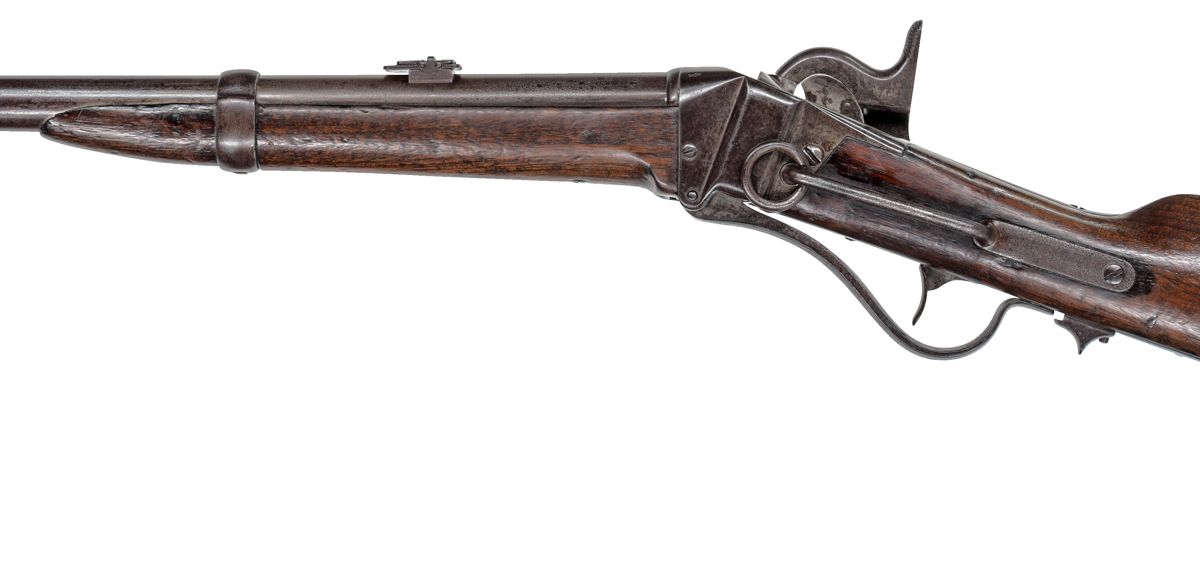
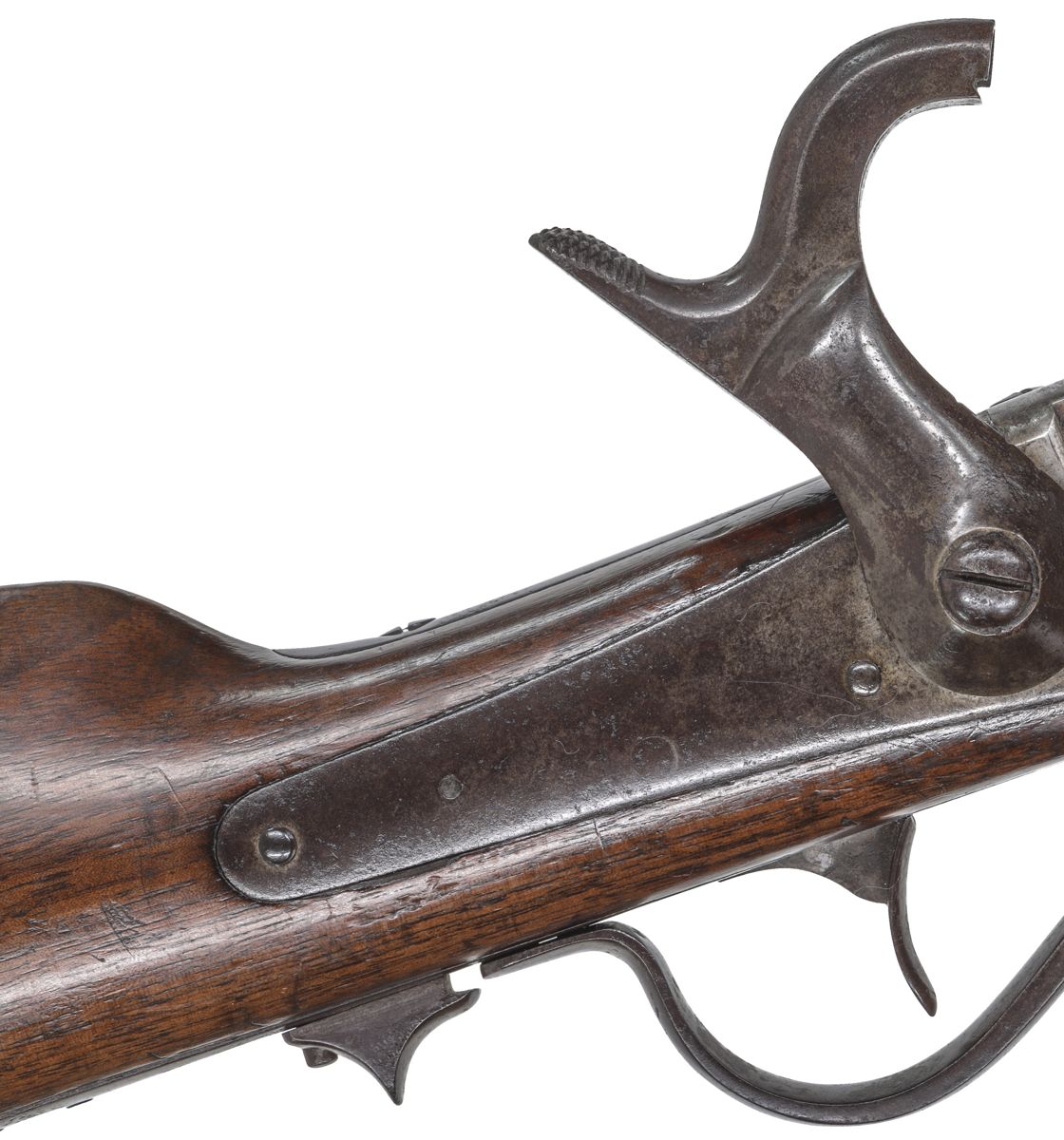
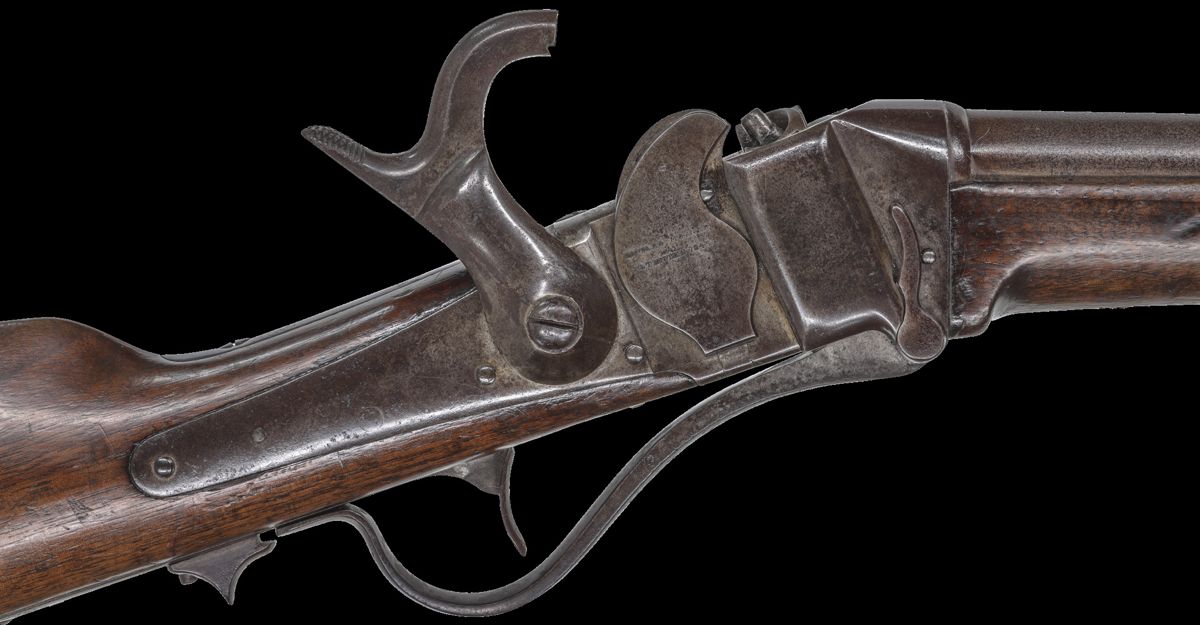
Overall reverse view of the Sharps 1855 British carbine.
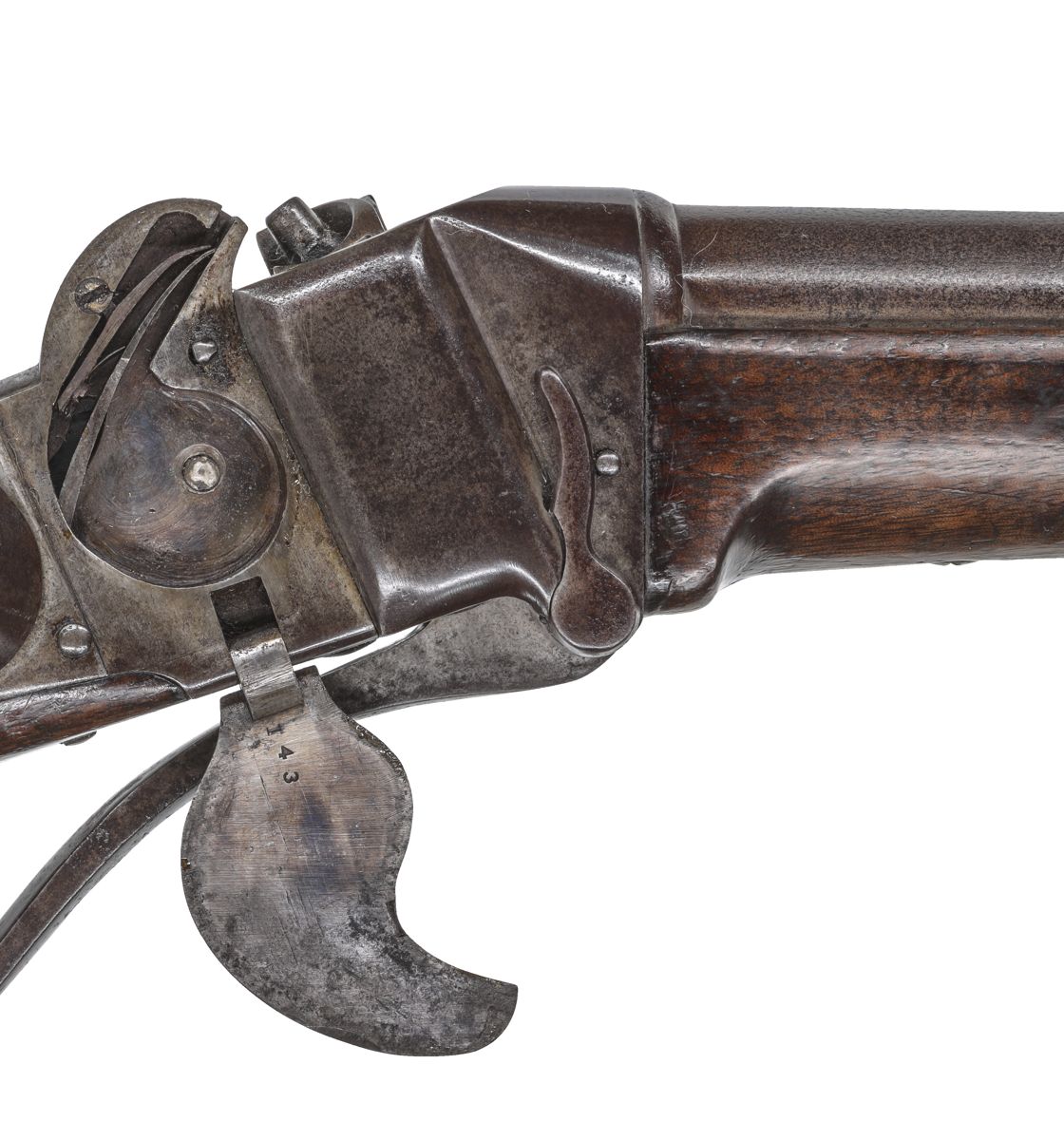
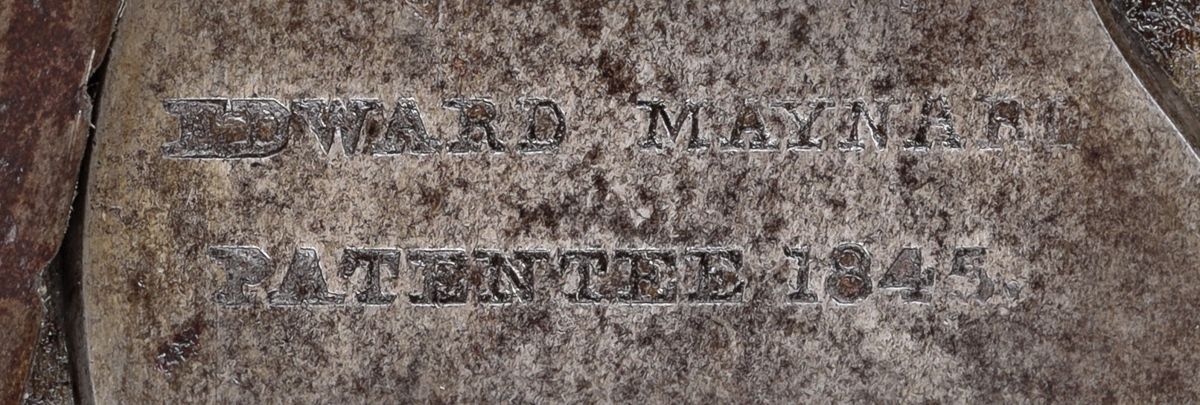
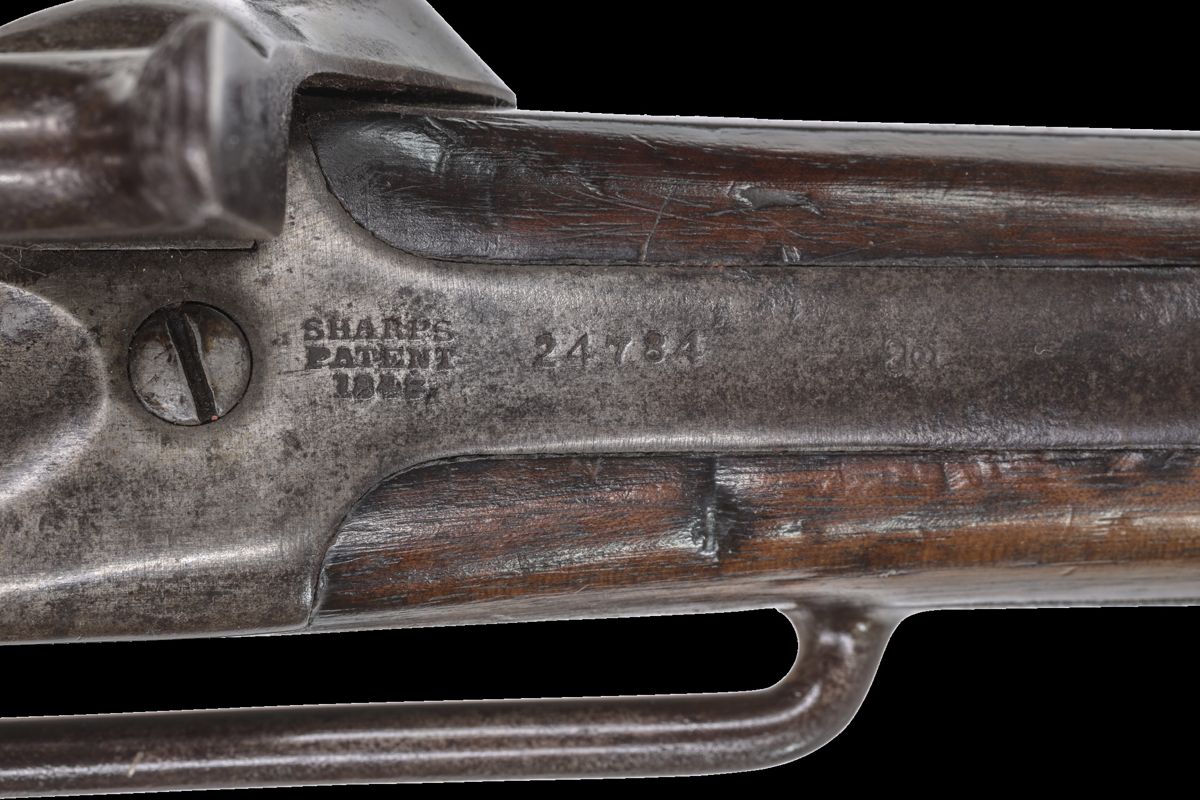
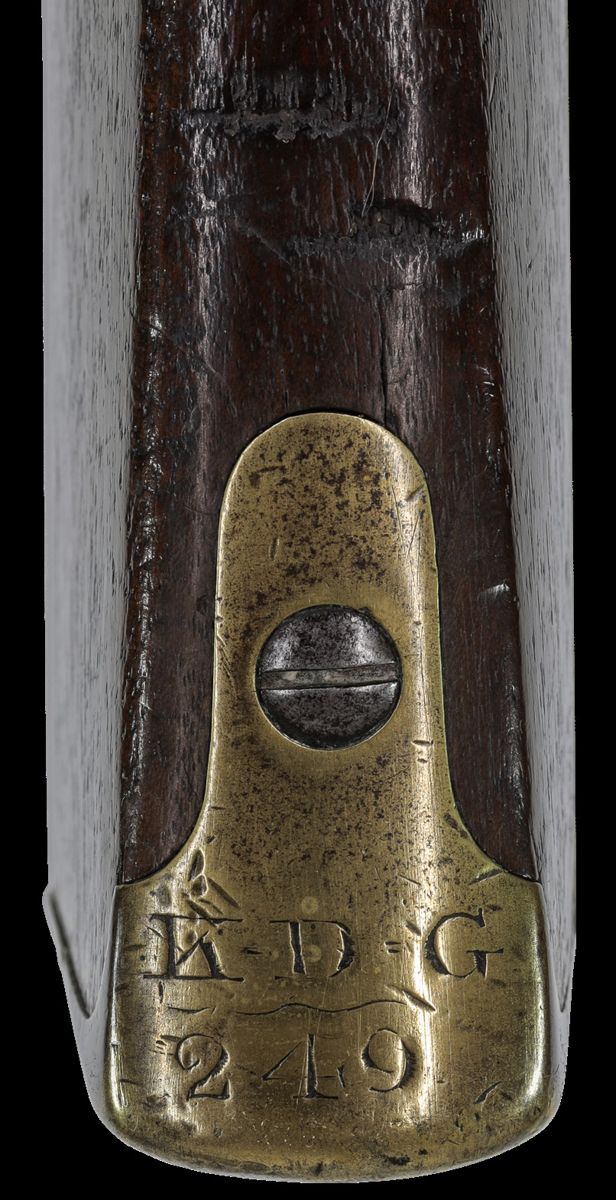
furniture, including a brass patchbox in the obverse butt. Initial deliveries utilized the usual flat brass barrel band, but a recommendation from British Captain H.J.W. Jarvis, who inspected the Sharps factory in August 1855, suggested replacing the flat brass band with a rounded iron one as used on the Pattern 1853 Enfield rifle musket. Jarvis also suggested that the barrels be browned rather than blued, that the locks should be marked with the royal crown and “VR”, as well as with the date of manufacture, and that the graduations of the sight leaves be changed. As previously noted, the guns incorporated the Maynard automatic tape priming system. The initial carbine deliveries included a fixed block sight graduated for 100 yards, with four additional folding leaves for additional distances. The pair of rear-most leaves were graduated to 200 and 300 yards, and the two forward of the fixed sight were graduated to 400 and 500 yards. This system was found to be less than effective, and during their service a newer version of the sight was adopted with the forward leaves graduated to 400 and 600 yards, respectively. As originally ordered, the carbines had .577 caliber bores, rifled with three grooves and a 1 in 78-inch rate of twist. This was found to be inadequate, and sometime in 1857 new specifications were issued, changing the rate of twist to 1 in 48-inches. Between 1857 and 1859 a number of carbines were re-barreled with 18-inch barrels with the faster rate of twist and .551 caliber bores. It appears that this occurred during the same time frame the rear sights were improved as well. It is worth noting here that the “19-inch” length and the “18-inch” barrel length may well have actually been the same, with the difference being how the barrel was measured. Measuring to the face of the breech block results in a nominal 19-inch length, while measuring to the front of the receiver results in a nominal 18-inch length. The British military’s search for the most perfect carbine for cavalry use did not end with the order for Sharps’ carbines. In 1858 another competing American design, the Greene carbine, was ordered from the Massachusetts Arms Company for field trials. In addition, British designs by Burton, Restell, Terry, and Westley Richards were also considered. In the end, the Westley Richards design was the winner, but it was not universally adopted until 1866. By February 1864 only 2,877 of the Sharps carbines were still in British service, as the other 3,123 had been removed from service in one form or another. It appears that all the carbines still in inventory at that time had been modified with the new, shorter, smaller caliber barrels with the faster rate of twist or were later production Sharps carbines that conformed to the more recent standard. Most interesting is that testing all the various breechloading carbines resulted in the British War Department reversing itself and adopting a percussion muzzleloading carbine with a captive ramrod, all features that they were trying to eliminate. Interestingly, this design also incorporated the Maynard tape priming system. The carbine was adopted as the Pattern 1856 Cavalry Carbine and was based upon the one then in service with the East India Company. It would not be until the latter part of the 1860s that the British finally moved to a breechloading carbine, but this time it was a cartridge firearm. The carbine pictured with this article is a very good condition example of one those rare British Contract Sharps Model 1855 Military Carbines. The gun is an 1857 period re-barreled and apparently refurbished as it has an 18-inch long, nominally .55 caliber barrel and the upgraded rear sight with the 600-yard leaf. More than likely this is an original Sharps sight as the gun was made after the Jarvis recommendations for improvements. It also features the later production rounded iron musket style barrel band, but this time it was a British design. The gun bears the matching serial number 24784 on both the receiver tang and on the bottom of the barrel beneath the forend. The bottom of the barrel also has the British style assembly mark \ \ | |; the same mating mark is found inside the forend. The forend was apparently salvaged from another Sharps during the arsenal’s refurbishment, as it has the partial serial number 443 on its interior. However, the presence of the matching mating marks clearly indicates that this forend has been with this carbine since it was rebarreled by the British. The serial number of the carbine fits about the middle of the serial number production range these carbines are found in, which is between 19,000 and 29,000. The receiver tang is marked in three lines with the standard Sharps patent marking of the period: SHARPS / PATENT/ 1848. A small CROWN / 3 British inspection mark is present on the tang as well. The exterior of the door of the Maynard tape priming mechanism is marked in two lines: EDWARD MAYNARD / PATENTEE 1845. This mark is found on the doors of all Sharps Model 1855 arms. The inside of the door is marked with the sub-assembly number 143. As is typical of the early Sharps carbines, the breechblock is unmarked and unnumbered, however it is also marked with the same mating hash marks \ \ | | found under the barrel and in the forend. The interior right side of the breech block also has British inspection marks, consisting of a CROWN / A / 3, indicating inspector “3” in America viewed the breech block and approved it for use. The left side of the barrel, ahead of the receiver is also marked with a series of inspection marks. These include a raised “BROAD ARROW” in a depressed oval and a “CROWN” / A / 2 British military inspection mark, with the “A” indicating inspection in America. This is the same inspection mark found on many “Windsor” Pattern 1853 American contract Enfield rifle muskets produced at the Robbins & Lawrence Factory. This is because the Sharps company contracted with Robbins & Lawrence to produce 6,500 of the Model 1855 carbines, rather than manufacture them at the company’s Hartford factory. The barrel also bears a set of London commercial proofs including a “CROWN” / V and a “CROWN” / GP which are separated by the gauge mark 28, indicating “28-Bore” or nominally .55 caliber. The interior of the patchbox door is stamped with the sub-assembly number 64. However, the most interesting mark is found on the buttplate tang, which is stamped in two lines: K-D=G / 249. This indicates that the gun was issued to the King’s Dragoon Guards and was gun number 249. The King’s Dragoon Guards are one of the most storied British cavalry units. They are the senior British cavalry line regiment, having been formed initially in 1685 as the 2nd Queen’s Regiment of Horse to fight in support of the Queen against the Duke of Monmouth’s rebellion. From that point on, the regiment remained in active service until it was amalgamated in 1959. The regiment has a history that spans some 300 years. In 1714 the regiment was renamed the King’s Own Regiment of Horse in honor of the new king, George I. During the War of the Austrian Succession (1740–1748) the regiment was again redesignated, this time as the King’s Dragoon Guards in 1746 and later given the additional designation of the 1st King’s Dragoon Guards. The regiment served primarily in the German states during the Seven Years War (1756–1763) and saw service in Flanders during the French Revolutionary Wars (1793–1802). They fought with distinction throughout the Napoleonic Wars and played a pivotal role at the Battle of Waterloo. The regiment traveled to North America in 1838 to suppress the French-Canadian Rebellion in Lower Canada and fought in the Crimean War (1854–1856) with particularly heroic service at Sevastopol. The regiment was deployed to India in 1857 during the Indian Mutiny and it is likely they received their Sharps Model 1855 carbines there. From India the regiment proceeded to China where they fought during the Second China War (1857–1860) and likely kept their carbines with them for that service. Like many British cavalry regiments during the mid-19th century, the King’s Dragoon Guards saw service around the world to support the British Empire and to suppress insurgents. They fought in the Zulu War of 1879 and the Transvaal War in 1881. The turn of the century saw the regiment back in South Africa, fighting in the 1st Boer War (1899–1902). The regiment served gallantly in World War I, in particular at Ypres (1915) and the Somme (1916). After the Great War they saw service in
Afghanistan in the Third Afghan War (1919). There, at the Battle of Dhakka, they made one of the last cavalry charges by a British regiment. After additional garrison service around the Empire, they returned to England to become part of the Royal Armored Corps in 1939. During World War II, the regiment served in the North African and the Italian theaters for the entire war. Their post-World War II service saw them enforcing the Palestine Mandate in 1948, as well as five years of occupation duty in West Germany from 1951–1956. In 1959 the regiment was merged with the Queen’s Bays (2nd Dragoon Guards) to create the 1st Queen’s Dragoon Guards.
Sharps Model 1855 BRITISH CARBINE
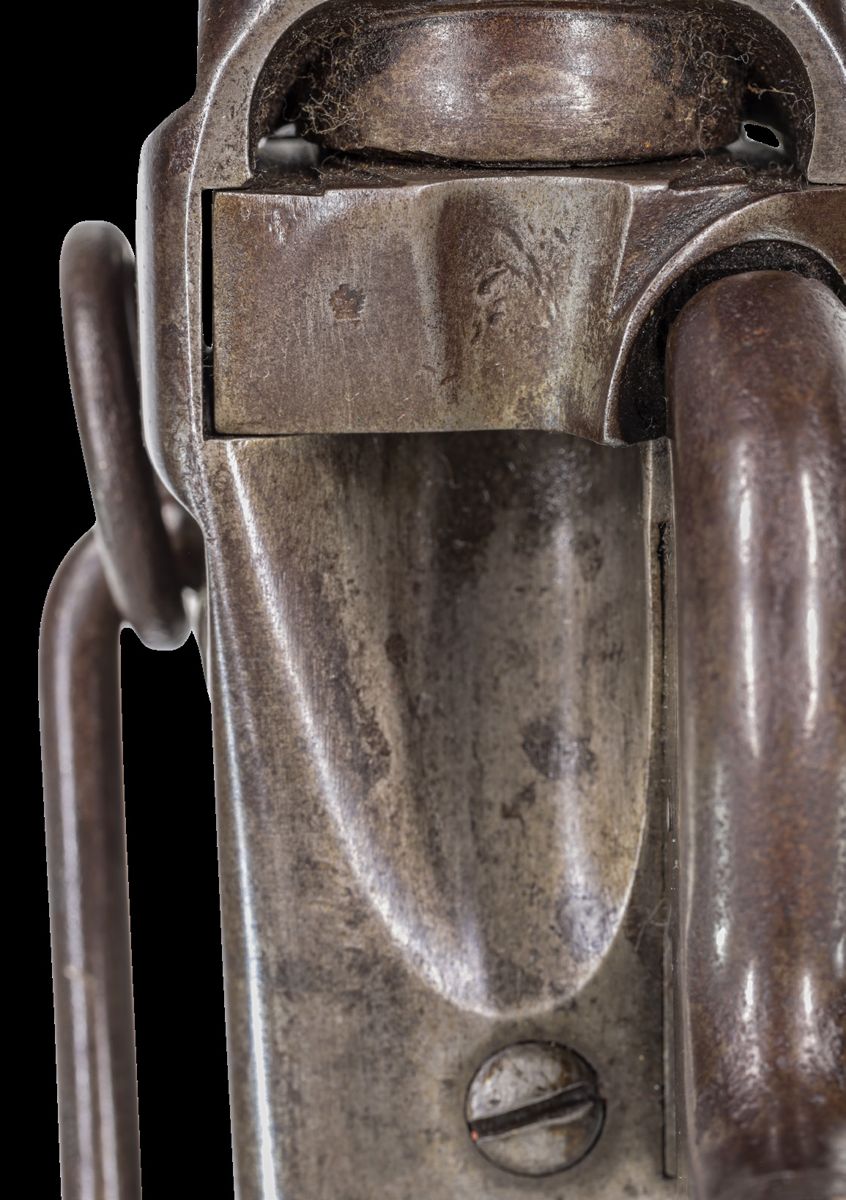
Breech and lock area of a British contract Model 1855 Sharps carbine with the tape primer door open. The interior reveals traces of the original color casehardened finish and the assembly number 143 on the primer magazine door. All photographs courtesy of Tim Prince, CollegeHillArsenal.com.
Breech and lock area of a British contract Model 1855 Sharps carbine with the tape primer door closed.
Enlargement of the EDWARD MAYNARD / PATENTEE 1845 marking that is visible on the exterior of the tape primer door.
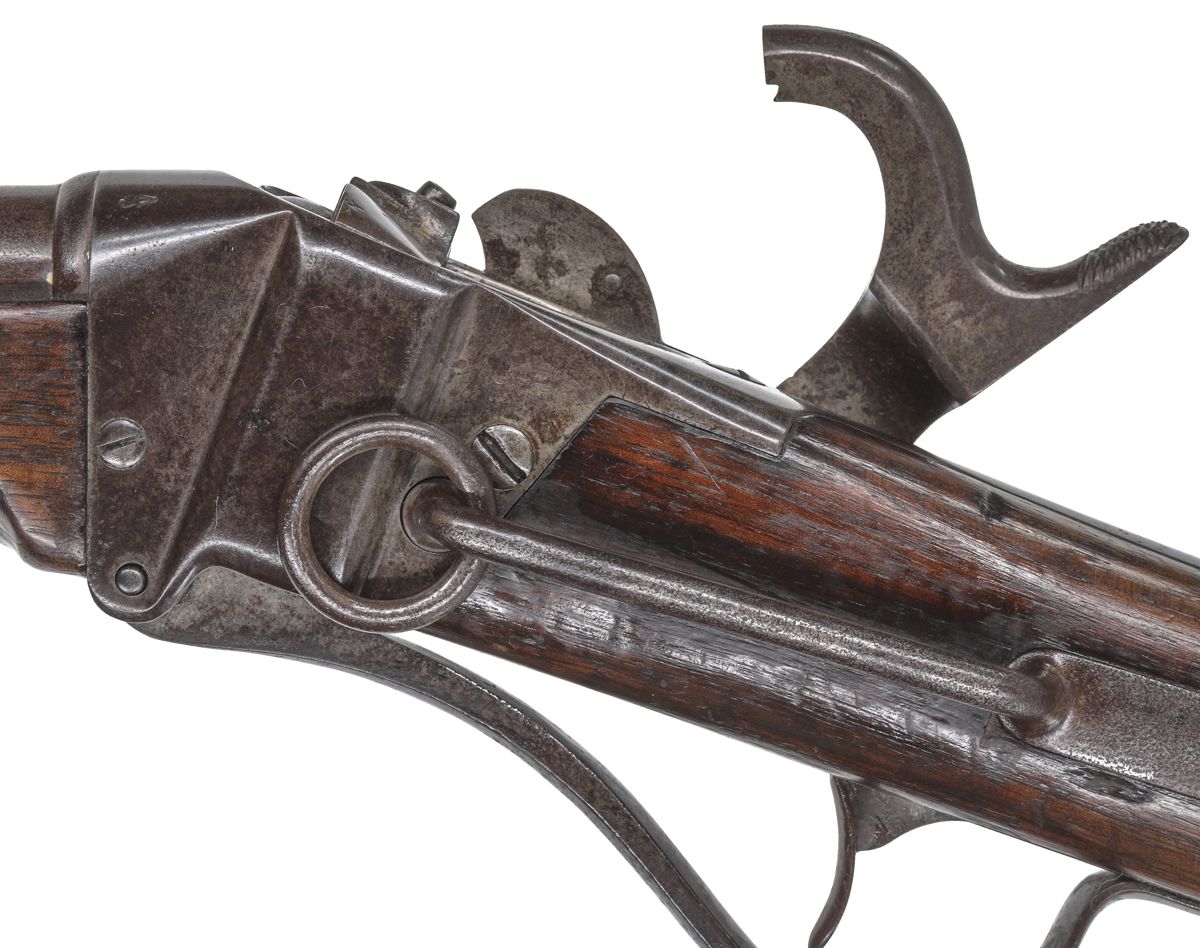
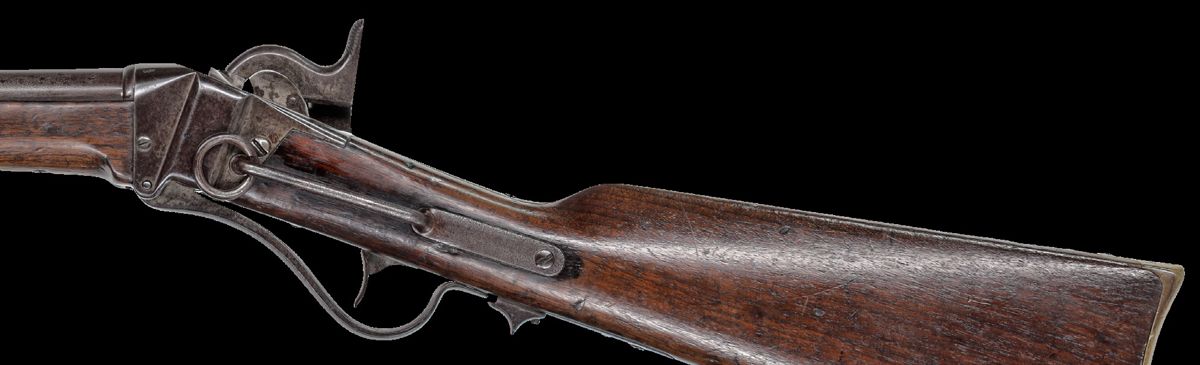
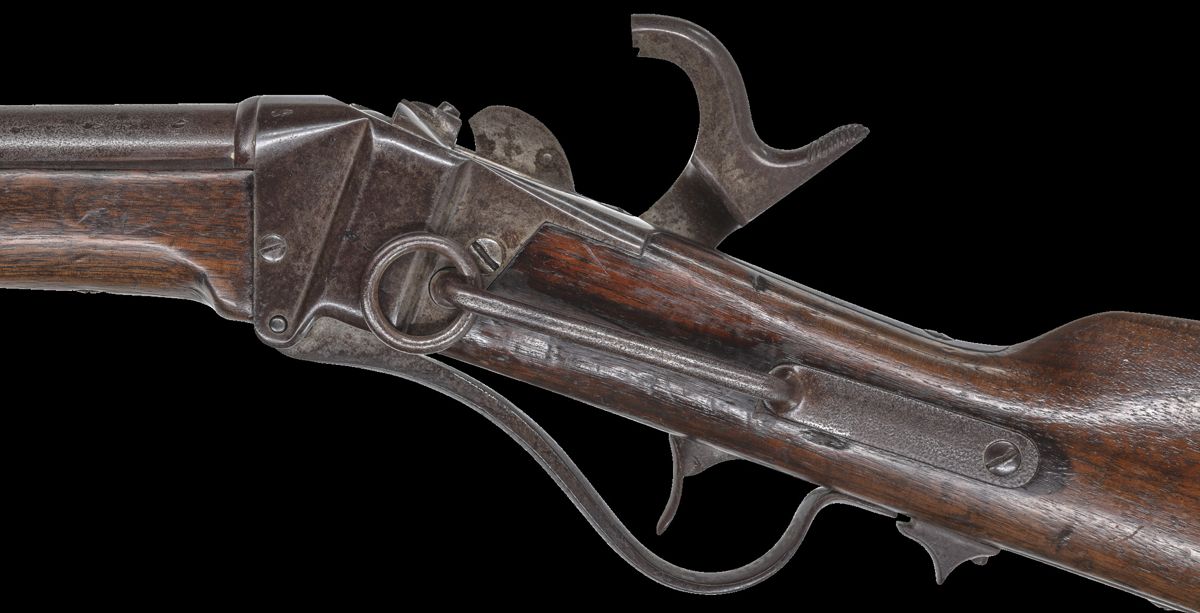
Counterpane of the British contract Model 1855 Sharps carbine, showing the sling bar and ring.
Top of the breech block of the British 1855 Sharps Carbine with the London commercial CROWN / V view mark.
Standard Sharps markings on the tang of a British M1855 Sharps carbine, showing the serial number 24784 as well.
Close up of the British Ordnance Department’s inspection mark on the breech block of the carbine.
Buttplate marking of the Sharps M1855 British carbine with the K-D=G / 249 mark, indicating “King’s Dragoon Guards” and gun no. 249.
Bore of the Sharps 1855 British carbine.
Close up of the rear sight leaves, note the longest forward sight leaf is marked “6” for 600 yards, indicating that it is one of the refurbished and rebuilt carbines.
Close up of the proofs on the breech block and barrel of the Sharps 1855 British Carbine. From front to back the marks are 1) London commercial proof mark, 2) 28 gauge bore mark, 3) London commercial view mark, 4) British military inspection mark, 5) British military “Broad Arrow” ownership mark and finally 6) another London commercial view mark on the receiver. Top of the breech block of the British 1855 Sharps carbine with the London commercial CROWN / V view mark.
Sharps MODEL 1855 Navy Rifle
Note the longer 27-inch barrel with saber bayonet lug underneath. Interestingly the U.S. Navy contract variant utilizes the British Pattern 1853 Enfield style rear sight, a pattern that was not used on the British contract guns. Note the flat brass barrel band used on the early 1855 British carbines that was later abandoned in favor of an iron musket pattern band.
Saber bayonet lug.
About the Author
Tim Prince
Tim Prince is a full-time dealer in fine and collectible military arms from the Colonial Period through WWII. He operates College Hill Arsenal, a web-based antique arms retail site. A longtime collector and researcher, he has been a contributing author to two major book projects about Civil War era arms including The English Connection and a book on southern retailer-marked and Confederate-use shotguns. He is the author of over 60 articles on weapons in Civil War News. Tim is also a featured Arms & Militaria appraiser on the PBS Series Antiques Roadshow and serves as a Senior Consulting Specialist to the Arms & Armor department of Cowan’s A Hindman Company.
Arms, Armor & Militaria FEATURING THE COLLECTION OF JAMES B. STEWART May 3–4, 2023 Cincinnati | Live + Online
Highlights include: Borchardt Model 1893 Pistol by Ludwig Loewe ($15,000-25,000) Thai Marked Japanese Model 1902 “Grandpa” Nambu Pistol ($8,000-12,000) Bergmann Schmeisser Prototype 1897 Model 5 Experimental Pistol with Holster Stock ($15,000-25,000)
Tim Carey | 513.666.4984 [email protected] COWANS.COM