
Images Captured in Time
Originally published March-April 2023 · pp. 46–53
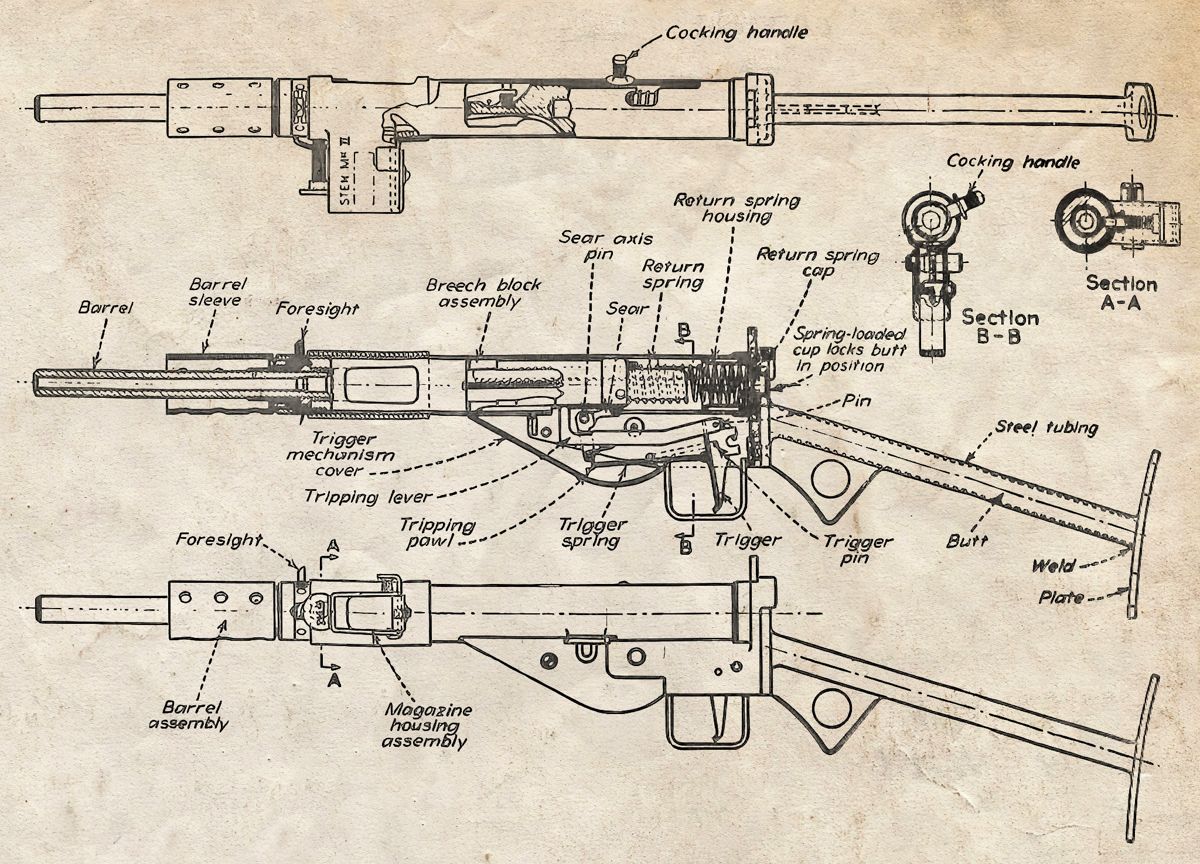
IMAGES CAPTURED IN TIME STEN SUBMACHINE GUN
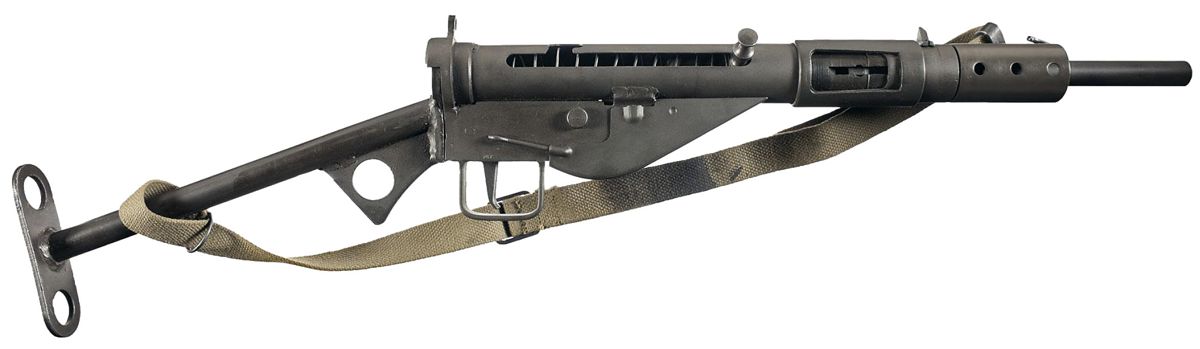
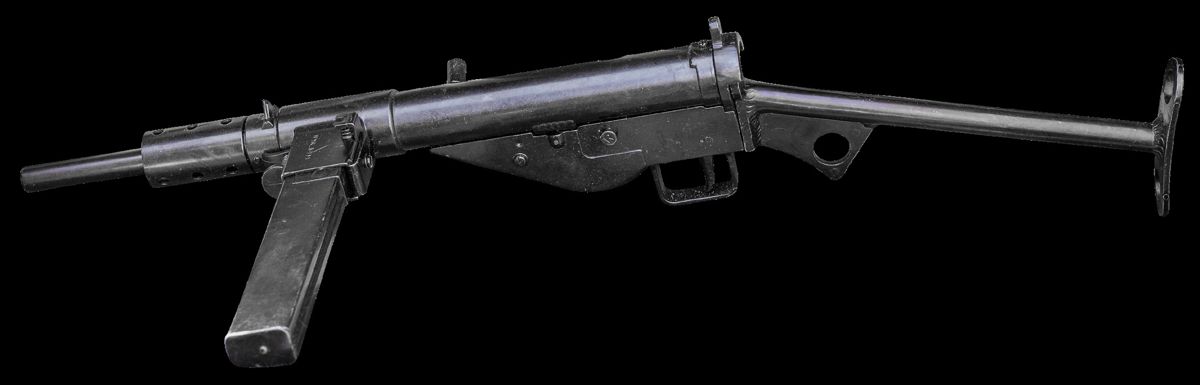
Sten machine gun Mark II. Courtesy Rock Island Auction Company.
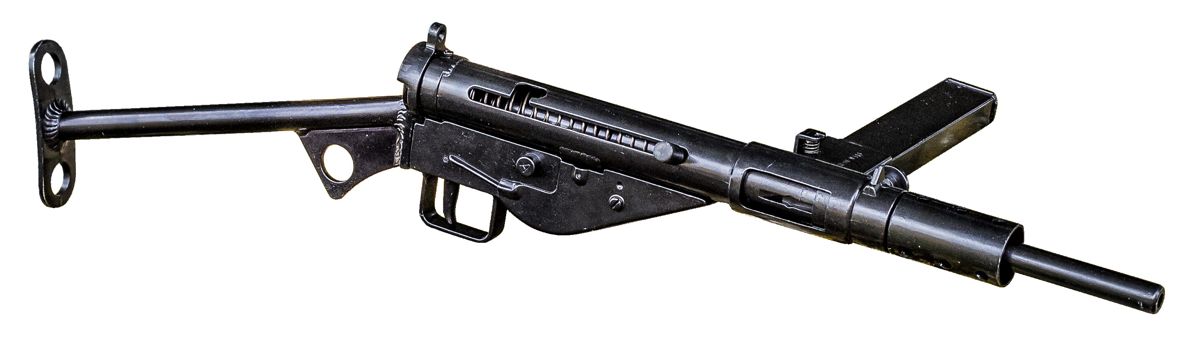
IMAGES CAPTURED IN TIME British and Commonwealth forces made widespread use of the STEN (or Sten gun) series of British submachine guns during World War II and the Korean War. The acronym is based on the names of Major Reginald V. Shepherd (S) and Harold J. Turpin (T), the weapon’s principal designers, and “En” for Enfield. Major R.V. Shepherd, OBE, was Inspector of Armaments in the Ministry of Supply Design Department at The Royal Arsenal, Woolwich, and later Assistant Chief Superintendent in the Armaments Design Department. After retiring from Woolwich, he worked for a while at the Birmingham Small Arms Company (BSA). With the war underway, Shepherd was recalled back into duty. Harold John Turpin was a Senior Draughtsman in the Design Department of the Royal Small Arms Factory (RSAF), Enfield. The pair are credited with responding to the crisis by designing a new, easily produced and operated weapon. The Sten was an easy to use, efficient weapon for resistance groups due to their straightforward construction, fairly rapid production, and low cost; irregular military forces are still using them today. The Sterling submachine gun replaced the Sten in British service until the SA80 supplanted it, in turn, during the 1990s. The Sten is a 9 mm select fire, blowback-operated firearm with a left-mounted magazine. The Sten, with over four million guns produced in the 1940s, was World War II’s second-most produced submachine gun, behind only the Soviet PPSh-41.
Canadian soldiers inspect a Sten Mark II machine gun.
IMAGES CAPTURED IN TIME When Germany drove the Allies from the European mainland and the Battle of Britain was underway, the Sten appeared. While simultaneously expanding, the army was required to replace weaponry lost during the Dunkirk evacuation. The British purchased as many U.S. Thompson submachine guns after the war started and up until 1941 and later, but these ad hoc fill-the-gap weapon purchases did not come close to meeting demand. The Thompsons were expensive, with the M1928 costing $200 in 1939, and $70 in 1942, whereas a Sten would eventually cost only $11. When the demand for Thompson manufacturing facilities increased exponentially after the United States entered the war, the Royal Small Arms Factory, Enfield, was asked to create an alternative firearm so a large enough combat force could be quickly armed to defend the home islands against the Axis. Simple stamped metal components and light welding were employed in producing the Sten, which thus needed little machining for production. Small workshops could handle most production demands, while the Enfield location could assemble and fine tune the guns. Over the course of production, the Sten design was further simplified; the Mark III, the most basic form, could be built with five man-hours of labor. Some of the least expensive models contained only forty-seven individual pieces. The Mark I was a better-crafted weapon with a hardwood foregrip and handle; succeeding early war iterations
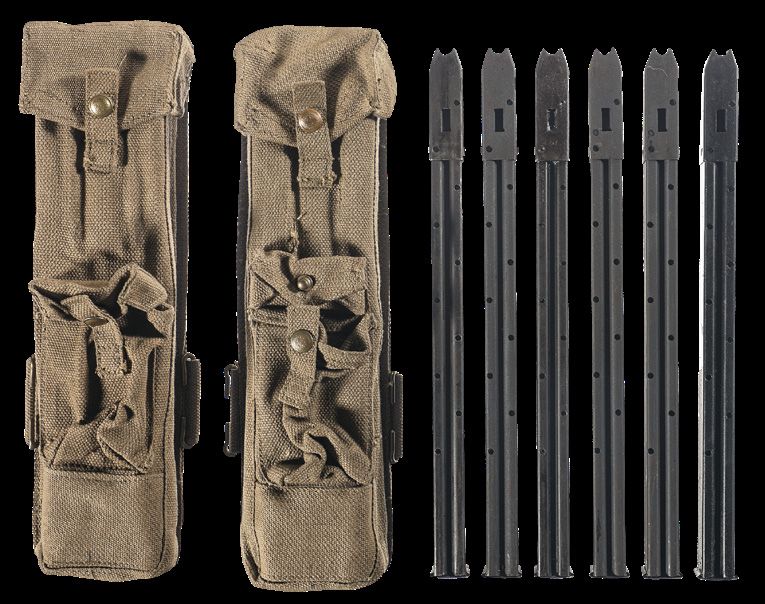
Canvas pouches and magazines for Sten gun. Courtesy Rock Island Auction Company.
were more utilitarian. The Mark V, which was created after the invasion danger subsided, was made to a higher standard. Throughout the conflict, the Sten underwent numerous design changes. For instance, the Mark IV’s cocking lever and corresponding hole in the receiver were developed to lock the bolt in the closed position and lessen the possibility of unintended discharges caused by the design’s intrinsic features. Most modifications were minor and intended to make products easier to manufacture and more dependable, but the potentially significant variations in manufacturing quality led to the Sten’s reputation as a flimsy weapon. Nevertheless, a 1940 investigation noted that “Exaggerated claims concerning [the Sten’s] unreliability were typically based on the product’s manufacturing quality. The Thundersley Patrol of the Auxiliary Units, led by Don Handscombe, considered them to be more dependable than the Thompson SMG.” Although concerns related to accidental firing persisted throughout the war, Sten guns produced from late 1942 and later were very effective weapons.
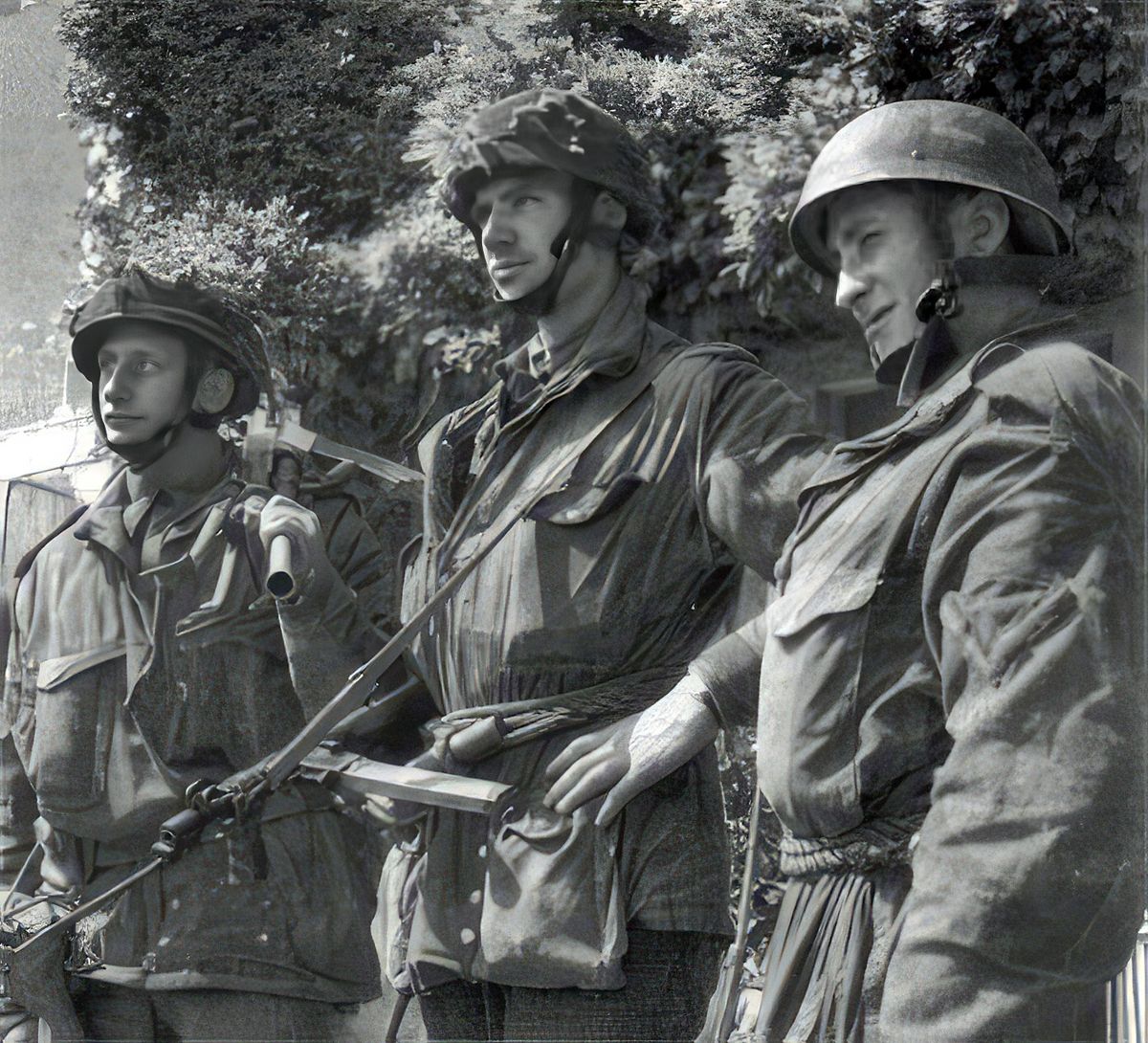
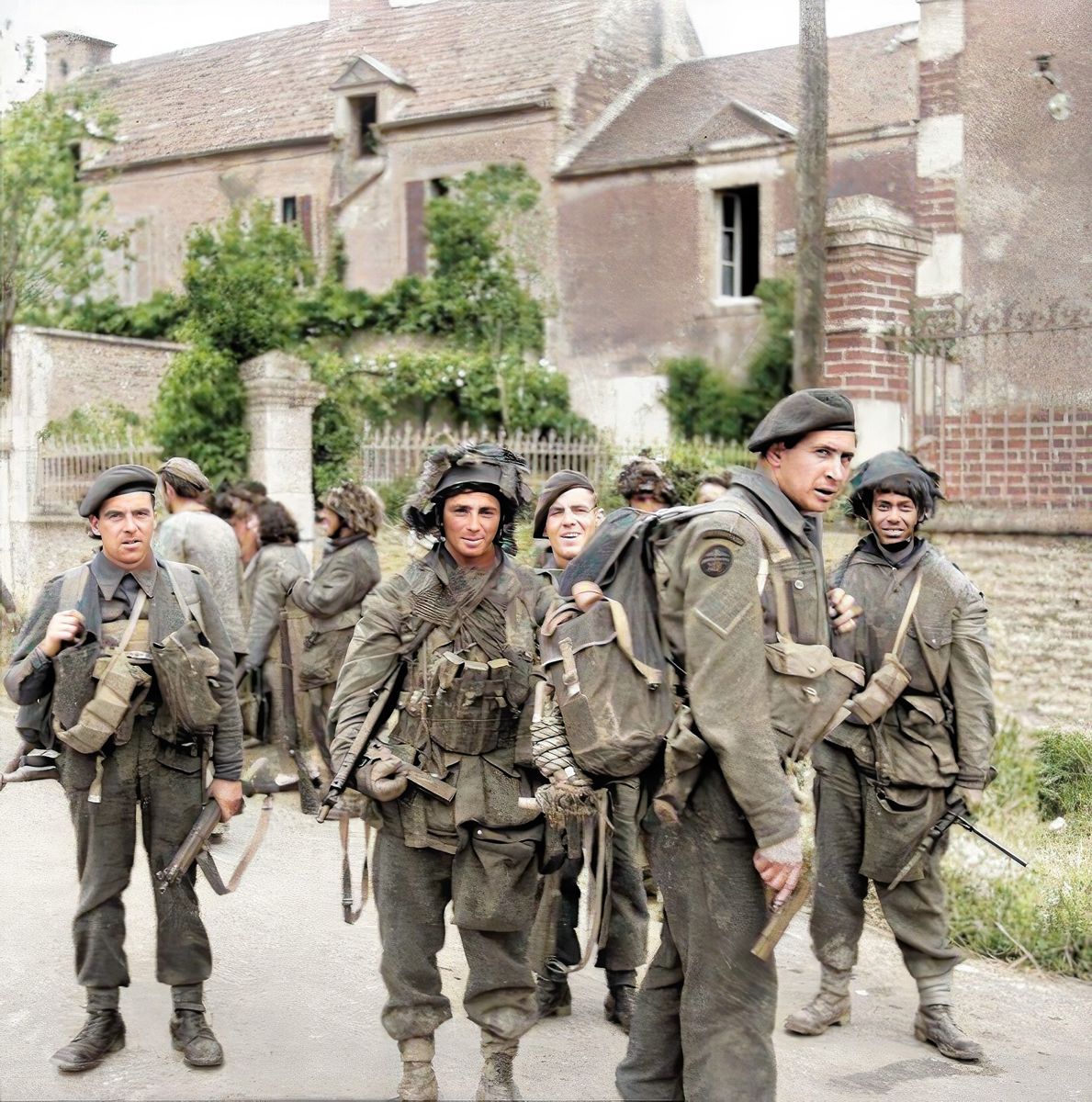
Men of D Company Oxfordshire and Buckinghamshire Light Infantry after capturing Pegasus Bridge, known as the Caen Canal Bridge, at Bénouville, France. The soldier in the center is carrying a Sten gun with a fixed bayonet..
IMAGES CAPTURED IN TIME STEN GUNS ON D-DAY – BRITISH FORCES DURING THE INVASION OF NORMANDY JUNE 6, 1944