
Experimental Enfields
By Tim Prince · Originally published July-August 2023 · pp. 35–45
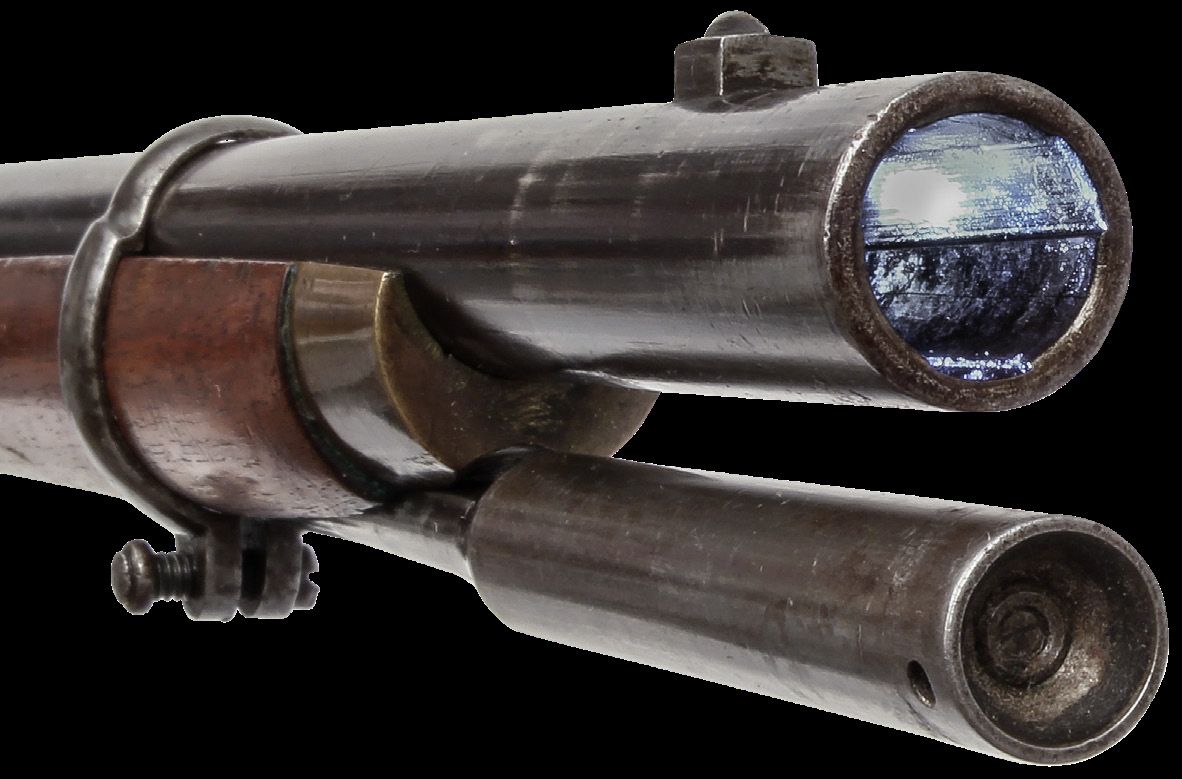
Colt’s Patent oiler ramrod, with details showing the oiler removed from the oil reservoir in the head.
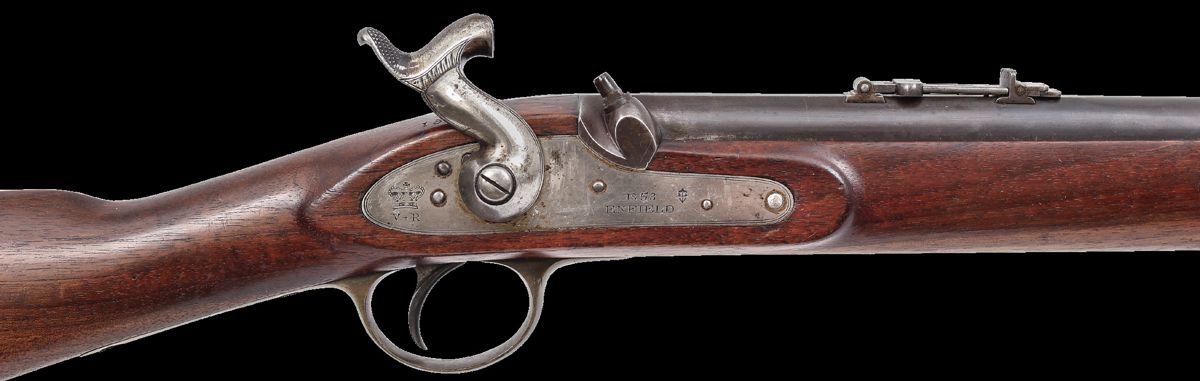
Overall obverse view of the experimental Pattern 1853 Enfield rifle musket with the Westley Richards rear sight system and Colt’s Patent Ramrod. Note the lack of sling swivels, a feature that the committee considered eliminating on the Pattern 1853 Enfield. Courtesy of the Mike Lauer Collection.
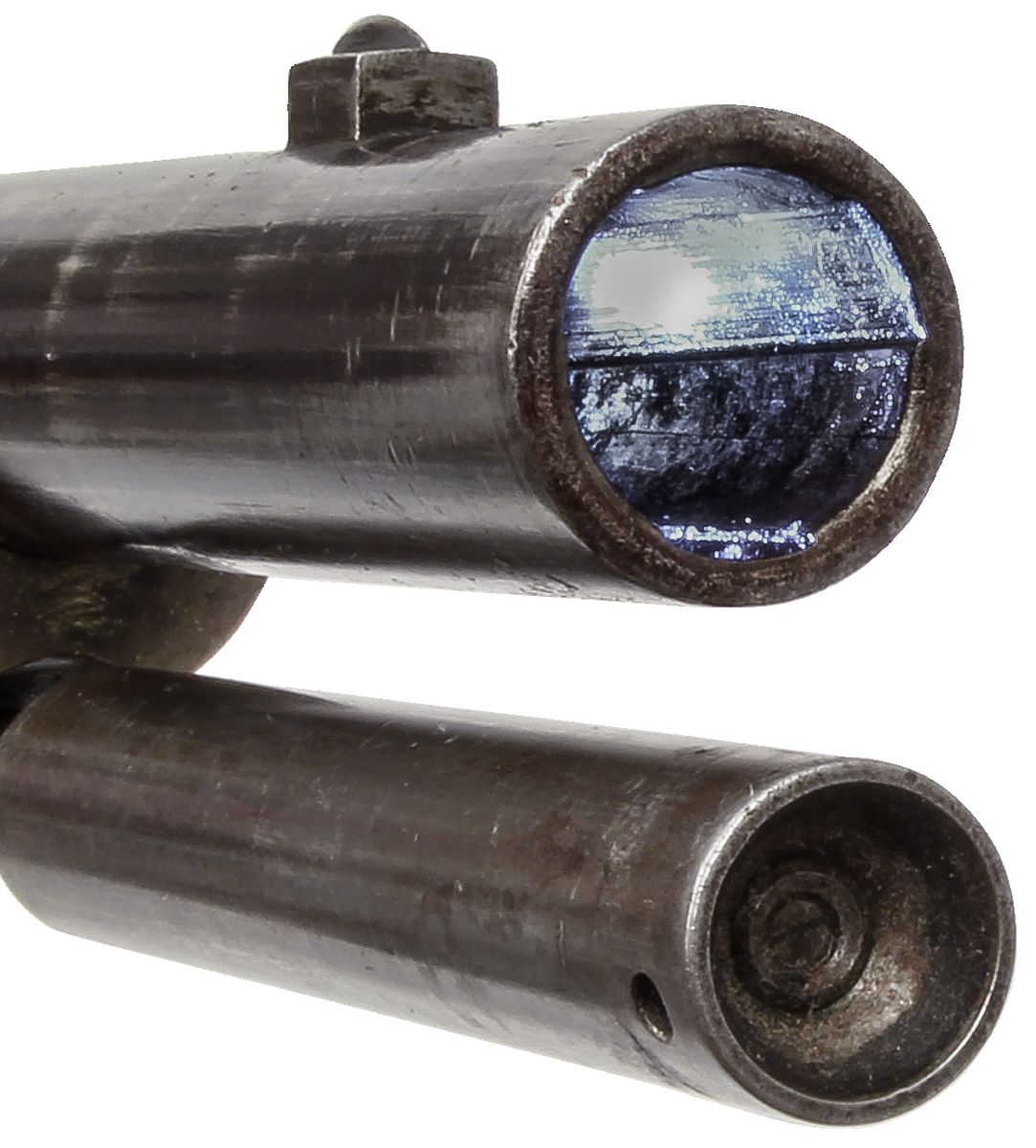
Bore of the Experimental Pattern 1853 with the Westley Richards rear sight system.
The conventional Pattern 1853 rear sight as adopted by the Small Arms Committee and designed by Charles Lancaster.
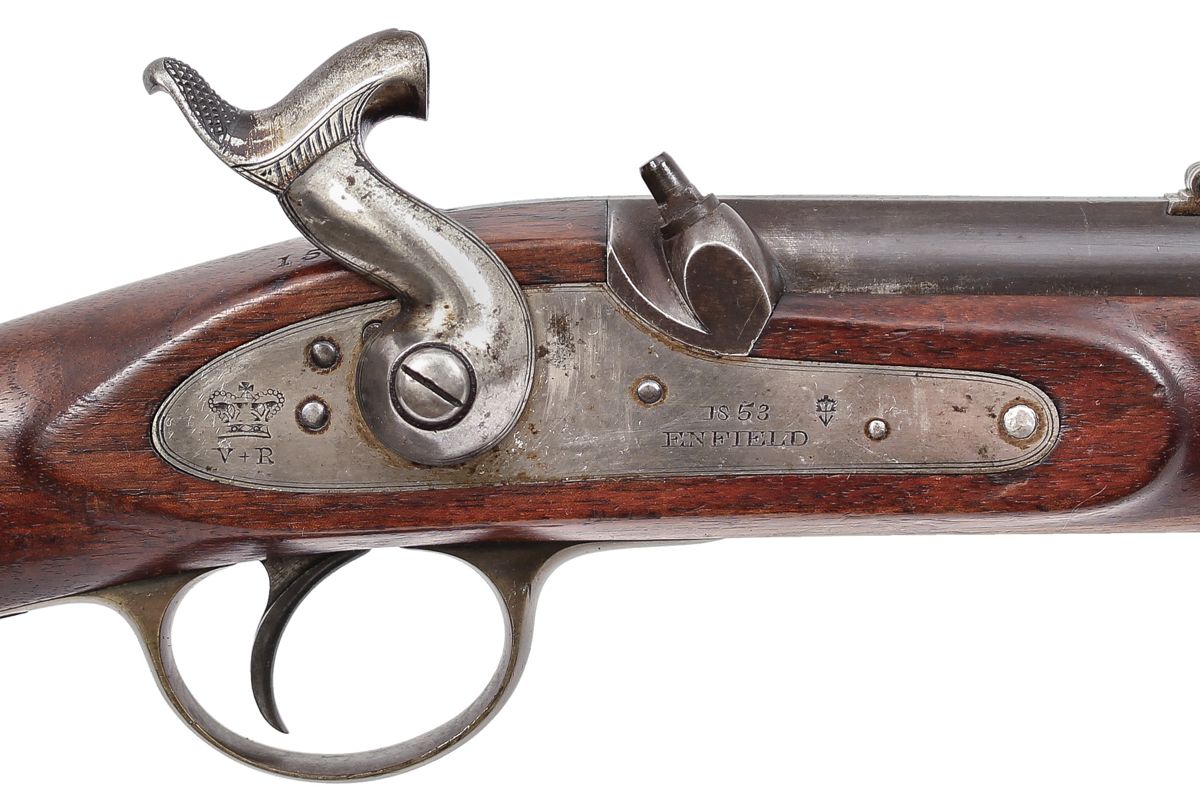
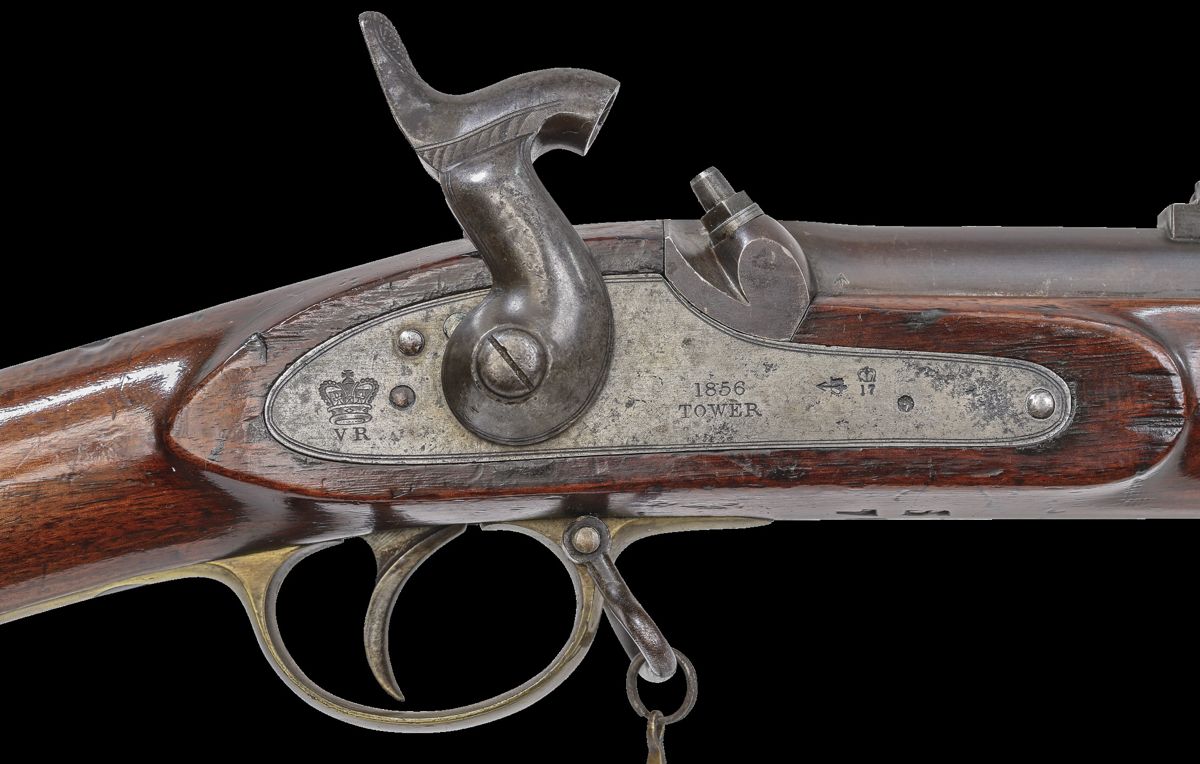
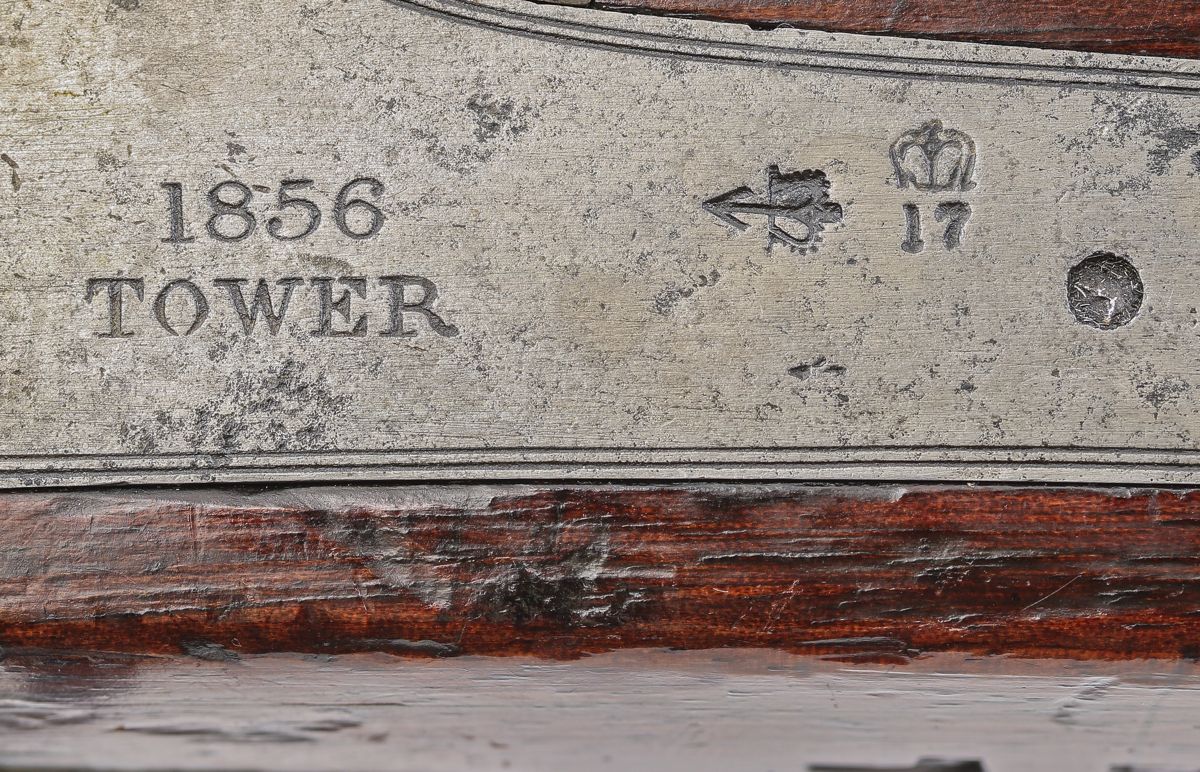
Lock of the Experimental Pattern 1853 showing the engraved markings, and the “Type I” curled hammer.
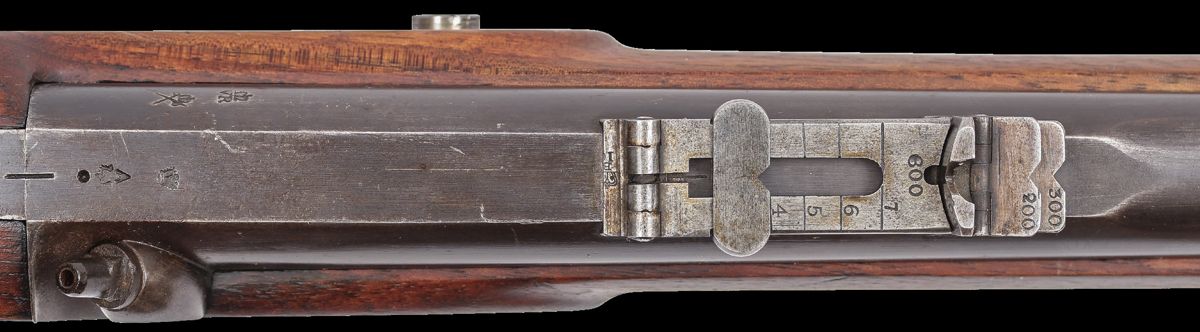
Experimental Pattern 1853 with the rear sight leaves and ladder raised.
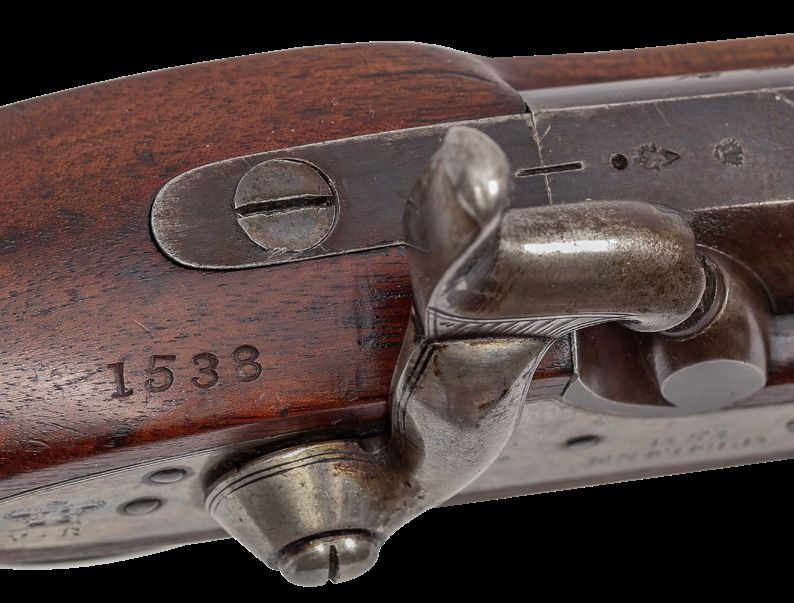
Stamp marking in wood “1538” is consistent with collection numbers found on firearms that were formerly in the collection of the Smithsonian Institution.
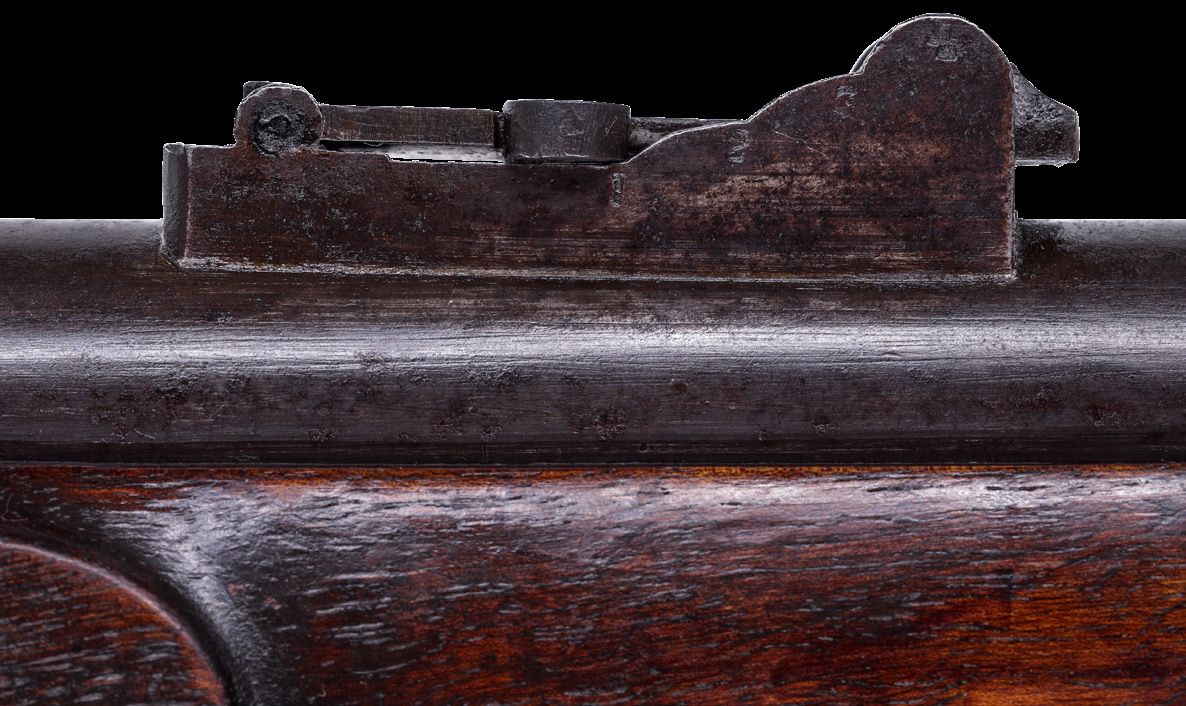
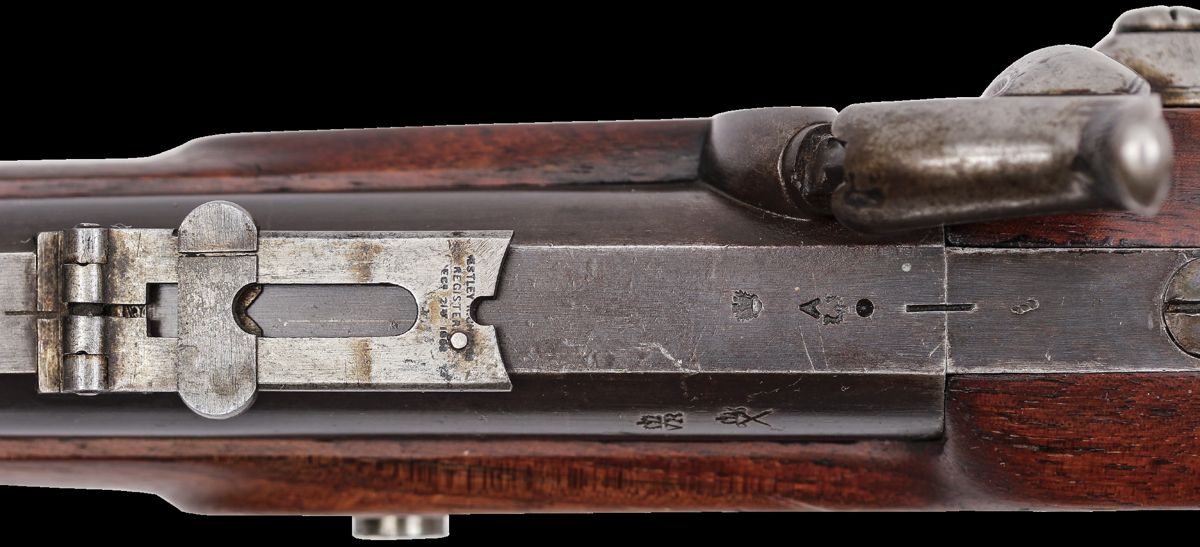
The rear sight system without the leaves or ladder elevated.
British line infantry regiment transitioned from a .75 caliber smoothbore musket that differed little cosmetically from the Brown Bess of one hundred years earlier, other than being a percussion rather than flintlock arm, to the Pattern 1851 Minié rifle in .708 caliber, and finally to the “small bore” Pattern 1853 Enfield in .577 caliber.
The genesis of what would become the Pattern 1853 really began in 1850, when the Board of Ordnance endeavored to find a new and improved musket for the line infantry regiments. The resulting design was the Pattern 1851 Minié rifle which at best, must be considered a stop-gap compromise in design. It was essentially obsolete as soon as it was put into production. The Pattern 1851 resembled the
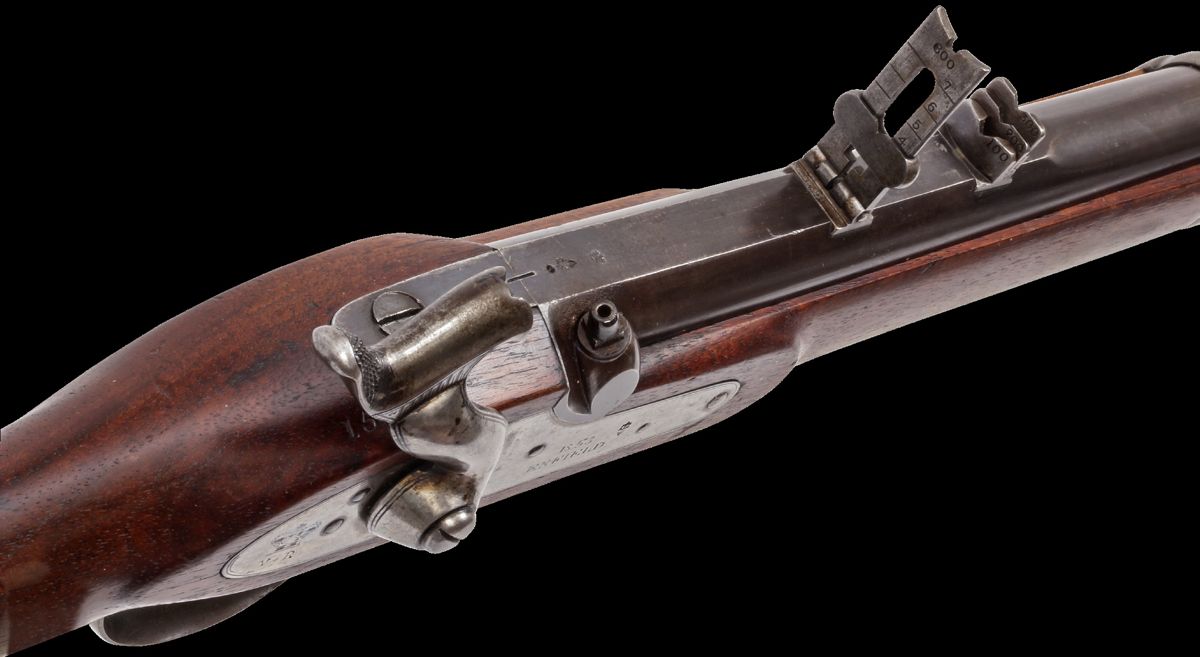
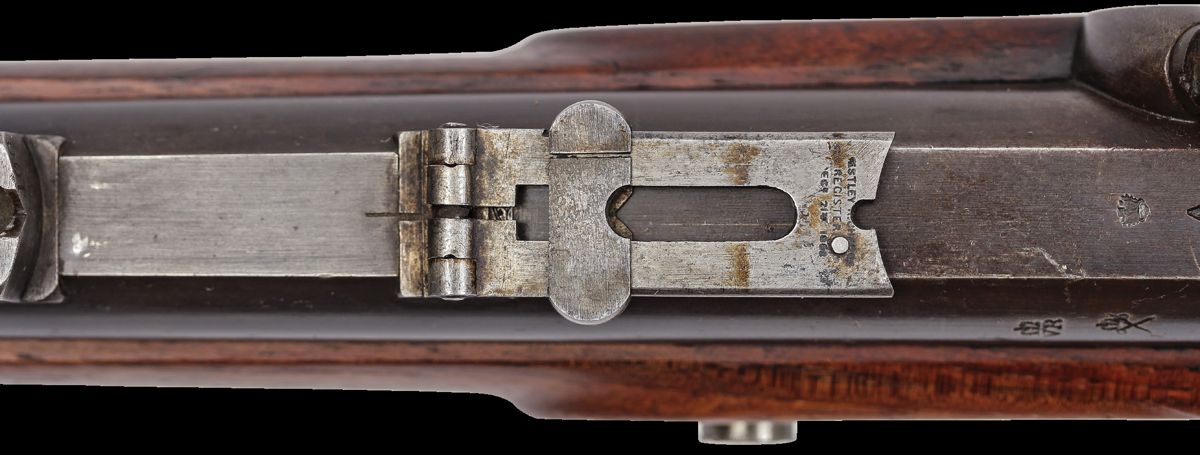
Experimental Pattern 1853 showing the top of the breech with the extended nocksform and the multiple sight leaves for the sighting system. Details show the reverse of the leaf with the Westley Richards markings.
earlier British pattern percussion military long arms with a wedge secured barrel like the preceding Pattern 1842 and a relatively large bore at .708 caliber. Innovations the Pattern 1851 brought to the British infantryman were a rifled bore and an adjustable, long-range rear sight, or “backsight,” as it was referred to by the English. Previously rear sights were rarely found on infantry muskets, and when they were, they were usually on simple fixed sights and not adjustable. The era’s sights of British military service rifles were relatively simple affairs with little room for adjustment. The transition to an adjustable sight was a big step for the infantry, and introduced what would be a more contentious portion of the Pattern 1853 development, what type of “backsight” was appropriate. In January 1852 the British Board of Ordnance began taking the next significant steps towards designing what would become the Pattern 1853 Enfield rifle musket. These movements were not without some hesitancy; the Pattern 1851 Minié rifle had only been officially adopted the previous year, and those new arms were now starting to be delivered by the contractors. Even though the Pattern 1851 was the first rifled arm for general issue to the British military, officially ending the English military’s smoothbore musket era service, it was a design that was obsolete prior to being adopted. The large, .708 caliber was an anachronism of a by gone age. Various Continental armies had been experimenting with, and even issuing, smaller bore rifled arms since the latter part of the previous decade. This knowledge that a smaller bore rifle musket was necessary to stay competitive with other European armies spurred the Board of Ordnance to start experimenting with new “small bore” rifle designs. The first two trials rifles testing the basic theory of a reduced caliber, elongated bullet design were ordered “set up” at the Royal Small Arms Factory at Enfield Lock (R.S.A.F.) in January 1851 and were for all practical purposes simply smaller bore versions of the Pattern 1851 Minié rifle. These guns were only intended to be proof-ofconcept weapons showing the “big bore” military musket was dead, and the “small bore” rifled musket was the new heir apparent to the throne of infantry small arms. At that time, the Royal Small Arms Factory at Enfield was not the thriving manufactory that America’s Springfield or Harper’s Ferry arsenals were. The arms produced there were made essentially by hand from a mixture of government made and contractor delivered parts in much the same manner as the Brown Bess muskets had been “set up” at the Tower of London nearly two centuries earlier. It would not be until 1856, in the wake of the Crimean War that the R.S.A.F. would be modernized and outfitted with American machinery, allowing it to operate on the “American System” of manufacture, using interchangeable parts on an assembly line. As a result, the design of what would become the Pattern 1853 Enfield was in some respects left up to the powerhouses of the British firearms manufacturing community, namely Westley Richards, Charles Lancaster, James Purdey, Henry Wilkinson and
William Greener; all of whom are household names to any student of English arms from the period. As Dr. C.H. Roads so artfully puts it in his seminal book on the subject, The British Soldier’s Firearm – From Smoothbore to Smallbore 1850– 1864, “…all agreed to construct and submit the best military rifles their ingenuity could fashion.” Selecting the appropriate caliber for the Pattern 1853 was somewhat contentious, as two very different schools of thought prevailed at the time. The “old-school” infantry leaders were heavily influenced by the opinions of the Duke of Wellington of Waterloo fame. They believed that a large bore arm was the only satisfactory weapon for the infantry; however, more visionary designers and arms builders saw the advantages of the smaller bore weapon, firing a longer conical bullet that retained reasonable weight by lengthening the bullet’s bearing surface. After much consideration by the highest levels of the British military hierarchy, and some friendly intervention by none other than Prince Albert, the British military hierarchy decided to forgo the status quo, and began to test smaller bore, rifled arms. The arms submitted by the various gunmakers took a range of forms. The variety provided the Board of Ordnance an opportunity to further investigate such technical nuances as types of rifling, as well as rates of rifling twists, rear sight patterns, bullet designs, etc. As a sort of “control,” these trial arms were often compared with known quantities like the Pattern 1851 Minié rifle and the Brunswick rifle. At times special versions of these current issue rifles, usually only one or two, were produced at Enfield to test a specific design principle, while leaving all other factors constant. One example is the reduced bore Pattern 1851 Minié rifles that were produced in January of that year in .635 caliber versus the standard .708 simply to test the basic principle of a smaller bore diameter. Submissions by the various makers were all in different calibers, and different patterns of rifling. Each used a bullet of their own design, with the only constant that bullet weight was about one ounce, a weight considered minimal for an effective infantry musket. The end result of the initial trials that took place during the summer of 1852 was to create a set of specifications that would define what would become the Pattern 1853 Enfield rifle musket. Rhodes lists the specifications set forth in the fall of 1852 as follows: Weight, including the bayonet, about 9 lb. 3 oz. Bore, .577 in. Barrel, 39 in. long, weight 4 lb. 6 oz. and rifled with three grooves of a constant pitch of one turn in 6 ft. 6 in. Lock, of swivel pattern. Bayonet, to be fixed by means of a locking ring. Barrel, to be retained by three bands in place of loops and pins. Ramrod, to be made with a swell near the head. The specification that the lock would include a “swivel” (stirrup) was desired so that the mainspring did not bear directly upon the tumbler as it did in earlier designs. This resulted in less friction in the lock and a superior trigger pull than those found in earlier designs. Specifications regarding a rear sight still remained open to discussion; a number of designs had been submitted and several were considered quite good. Interestingly the rifling pattern was not completely established either, for although the initial specifications called for the three-groove bore of Enfield design with a 1:78-inch twist, the performance of the Lancaster and Wilkinson pattern rifling left significant doubt in the minds of the Small Arms Committee as to whether the correct decision had been taken as to the style of rifling to be use. Charles Lancaster’s submission was his “oval bore” design. This was a mechanical rifling system that from a visual inspection would appear to be a smoothbore. However, the bore was very slightly oval in cross-section with a minor axis of .543 inch and a major axis of .557 inch at the breech, which was slightly reduced to .540 inch and .55 inch at the muzzle. The bore itself twisted along the length of the barrel, creating mechanical rifling similar to the systems that would be subsequently patented by Sir Joseph Whitworth and Westley Richards. The pitch of the rifling also increased along the bore’s length; in other words, the rifling spun slower at the breech and more quickly at the muzzle. The oval bore rifling performed very well in the trials, as did Wilkinson’s five-groove design, and the three-groove design submitted by Enfield. The “oval bore” elliptical rifling design of Charles Lancaster was so accurate, and showed so much promise, that repeated trials and testing would be conducted before a final decision was made regarding what system to officially adopt. It would take no less than ten separate rifling trials before the Enfield pattern three-groove rifling was officially decided upon. However, the Board of Ordnance was afraid to allow this lack of ability to take a final decision regarding the type of rifling to be adopted to prevent the manufacture of the new Pattern 1853 Enfield rifle musket. As a result, the October 6, 1853, contract let for building the major components for 20,000 Pattern 1853 rifle muskets had a special caveat involving the barrels. The use of contractors was due to the fact the Royal Small Arms Factory at Enfield Lock was not yet ready to go into full production of the new pattern. As such, the arms were ordered as parts from the traditional Board of Ordnance arms contractors, to be assembled at Enfield, much as the Tower of London had long assembled contractor parts into guns. This system had served the Board of Ordnance well from the mid-1700s through the beginning of the percussion era. Due to the lack of a final decision regarding the rifling of the barrels at that time, the 21,000 barrels first ordered were specified to be un-rifled, with that procedure to be handled at RSAF Enfield, once a final determination as to the type of rifling was made. It is likely the 1,000 extra barrels was in case barrels were damaged during rifling and allowed for 5% spoilage during that process. In the end, the official decision regarding the type of rifling to be used were not made until January 4, 1854.
Overall obverse view of the School of Musketry experimental oval bore Pattern 1853 Enfield rifle musket.
The final major feature left undetermined by the summer trials of 1852 was what would be the most advantageous design for a “backsight.” Two schools of thought prevailed here. One suggested that the complexity of the rear sight should be kept to a minimum and it should be simple to operate, while the other felt that a fully adjustable sight that took advantage of the ballistic capabilities of the new rifle and ammunition was necessary to exploit the advantages of range and accuracy the guns were capable of. As a result, some additional trial guns were assembled with two types of rear sights. The first was a simple block sight with flip-up leaves for 100 and 200-yards. The second had a Westley Richards patent folding ladder rear sight, which was adjustable out to 800 yards. An adjustable long-base ladder rear sight designed by Charles Lancaster was also tested. The theory among some members of the Board of Ordnance was similar
Close up of the lock of the 1856 produced School of Musketry experimental oval bore Pattern 1853 Enfield rifle musket.
Muzzle view of the School of Musketry experimental oval bore Pattern 1853 Enfield rifle musket. The bore appears smooth but is really slightly oval and uses the concept of mechanical rifling with the bore physically twisting along the length of the barrel.
Marking in the wood forward of the triggerguard of the oval bore test gun with the legend SM / 78, likely indicating School of Musketry #78, as this gun came from that collection at Hythe.
Muzzle area of the oval bore test gun showing the “Type I” Enfield swelled ramrod with small tulip head.
Close up of the non-standard backsight on the oval bore test gun without graduations for distance.
Close up of the School of Musketry Lancaster oval bore Pattern 1853 breech showing Lancaster’s patent mark, the Enfield inspection stamp, and the numbering 1 of 2.
to the one that would be taken by the Austrian military with the Model 1854 Lorenz rifle musket. The Lorenz was produced with two types of rear sights. A simple block rear sight with no facility for adjustment was issued to the majority of the Austrian infantry, while a Lorenz with an adjustable rear sight was issued to the flank companies and specialty troops. The Board of Ordnance tended towards a compromise solution that would provide basic sighting for the majority of troops, but also offered a more complicated adjustable sight specialty troops needed to take advantage of the Enfield’s longer-range capability. This eventually resulted in field testing two primary competing designs. One was a combination of both the simple leaf sight and the Westley Richards sight and the other was the Lancaster variant. The combination sight would be used on some arms produced for further accuracy testing and trials during 1853. A somewhat related issue was how best to attach the rear sight. The rear sight of the Pattern 1851 Minié rifle had been attached by soldering, but this was found to be less than optimal in field use on the earliest Pattern 1851s produced. Eventually, the problem was rectified, by a combination of using silver solder and improvements in the techniques used to apply it. As a result, this problem had been effectively resolved by May 1852. However, the Board of Ordnance felt the ability to provide lateral adjustment for the rear sight by allowing it to be drifted in a dovetail cut might be a superior method of attachment. As such, the earliest of the Pattern 1853 Enfield rifle muskets (those produced for trials prior to September 1853) have a long flat elevation on the upper portion of the breech. The British refer to this as an elongated nocksform; it is immediately identifiable as different from any other Pattern 1853 breech most collectors have encountered. The elongated, tapered flat is about 6 ½ inches in length and provides a flat surface for the attaching a rear sight, or sights, in a dovetail cut. After September 1853 this additional complicated and precision milling process was eliminated to save time and money, and sights were attached via solder from that point onward. In January 1853 an order for 1,000 of the newly specified rifle muskets was placed. The first 500 were to be equipped with the combination flip leaf and Westley Richards ladder pattern for the rear sight and second 500 with Lancaster’s ladder rear sight. After the field trials were completed, the ladder rear sight designed by Charles Lancaster was adopted and became the rear sight that we are familiar with on the Pattern 1853 Enfield today. However, the committee still had a significant lack of confidence they had “chosen wisely” regarding the rifling system. As a result, in early 1853 both Wilkinson and Lancaster were asked to submit Pattern 1853 Enfield rifle muskets that conformed exactly to the newly adopted specifications, the only exception being the rifling of the bores. Both makers would subsequently submit sample guns with their own patented rifling designs. As a control factor, it was intended that all the guns would be tested with the British military’s newly adopted 530-grain MetfordPritchard designed bullet loaded in a standard service cartridge.
In June 1853 the trials of the three rifling systems began and the Lancaster oval bore shot better than either of its competitors. Initially Lancaster had requested that his guns be tested with his own cartridges that used specially sifted powder, which theoretically reduced fouling. However, it was soon discovered that the newly designed and adopted British military service cartridge shot better in the Lancaster gun than his own cartridge. Wilkinson also insisted on using his proprietary cartridge and did not acquiesce to the use of the standard service load during testing. The result of testing the three systems at 500-yards, aimed at a 6-foot target resulted in the Lancaster rifling system placing all shots in a 4-foot group, while the Enfield rifling could only put 75% of the shots on target at that distance. The Wilkinson system fared far worse, failing to reliably keep shots on the 6-foot target at 200 yards. The test results were so promising for the Lancaster design that an additional twenty oval bore Pattern 1853s were ordered from him for further evaluation by the Committee on Small Arms. In addition, it was decided to issue the available three-groove Pattern 1853s very sparingly, in the event that Lancaster’s system was eventually adopted over the Enfield threegroove bore. Additional testing in August 1853, shooting at distances of up to 800 yards, again showed the Lancaster design’s superior accuracy. However, two issues had raised concerns among the nay-sayers who supported the Enfield pattern rifling. The first was that the increasing spiral of the bore was complicated and difficult to produce, making it harder for the various arms contractors, as well as R.S.A.F., to manufacture the Lancaster patent barrels. The second concern was that the relief at the breech, being slightly larger than the muzzle, could allow a loaded bullet to move forward when the arm was in service, leaving an air gap between the bullet and the powder charge. It was feared this gap might create an unsafe situation resulting in increased pressures and a burst breech when the gun was fired. Lancaster subsequently performed tests with bullets that were not fully seated, demonstrating this fear was unwarranted. However unfounded, the concern would affect further testing of the Lancaster system and in some ways conspired to help it fail. In late August five trial Pattern 1853 Enfields were set up, at Enfield, using Enfield-made, Lancaster patent barrels. The barrels had a minor axis of .577-inch and a major axis of .587-inch and had the standard one turn in 78-inches rifling pitch. The barrels did not have the breech relief of the Lancaster-made barrels, nor did they use his progressive twist rifling, so the rate of twist remained constant through the length of the bore. These five rifles were tested against Lancaster’s submissions and were found to be sorely lacking, with the Lancaster produced rifles placing 99 of 100 rounds in a reasonable group on a 300-yard target, and the Enfield-produced oval bores missing the target entirely 68 times at the same distance! Amazingly, this additional confirmation only resulted in further testing, with the Board of Ordnance’s decision-making process moving with all the speed of a receding polar ice cap. This fourth series of tests of the Lancaster system again proved that the oval bore rifling was superior not only to the conventional three-groove rifling employed at Enfield, but also to the Enfield-made version of the oval bore. In these tests, the Enfield “oval bore” showed a tendency to “strip” after a significant amount of firing, what a modern shooter would refer to as the bore being “shot out,” with the rifling being worn beyond the point of serving its purpose. While the Lancaster-made rifles did not show this tendency, it was implied that since this defect existed in the Enfield-made arms, that “production quality” oval bore rifles, not produced with the same precision as Lancaster’s trial rifles, would suffer the same fate. Thus, a fifth set of tests were performed in November 1853, this time eliminating the Enfield-made oval bores and once again putting the Lancaster produced oval bore in a head-to-head competition with the three-groove Enfield bore. This last 1853 testing showed that even Lancaster’s well-made guns began to “strip” as the Enfield-made versions had, after a significant amount of firing. The report commented that no visible, or even measurable, deterioration was noted but that after repeated firing the accuracy of the guns gradually eroded. It appears the Small Arms Committee had been performing these tests with the same five rifles supplied earlier and that summer, and it was likely at this point that thousands of rounds had been fired through the guns. Amazingly, this report resulted in a new series of tests in early 1854. This sixth test required more than 1,000 rounds of ammunition to be fired from a single Lancaster oval bore rifle musket versus a standard Pattern 1853 Enfield. As had been discovered in the final testing at the end of the previous year, the Lancaster system eventually began to “strip” and the accuracy degraded over time. The reason for the failure could not be discovered, and as the oval bore system was so much more accurate than the three-groove system when the bore was new, the supporters of Lancaster’s design lobbied for another test, the seventh, in February 1854; again the results were the same. At this point the serious pursuit of the Lancaster rifling system by the Small Arms Committee was finally abandoned. However, only a year later, Lancaster’s design was adopted for limited production and issue to the Royal Engineer Corps, as the Pattern 1855 Royal Engineer’s Carbine, or more commonly as the Royal Sappers & Miners carbine, with Lancaster’s oval bore. The oval bore concept was far from dead and still had several supporters with the small arms and ordnance communities. In a continuing attempt to try to improve upon the basic design of the Pattern 1853 Enfield rifle musket, various trials continued at the School of Musketry at Hythe, under the direction of Colonel Hay. Very often these trials involved only one to two experimental examples of an arm, set up at Enfield for the express purpose of testing a specific theory about the performance of one particular feature. The testing performed by Colonel Hay resulted in several recommendations regarding the current service pattern Enfield rifle musket. These recommendations included reducing the length of the butt by one inch, changing the length of pull from 14 to 13 inches, moving the rear sight forward to improve the ability of a solider to easily focus upon it, changing the number of grooves in the rifling from
The new School of Musketry was established at Hythe on the Kent coast, where the wide-open beach and proximity to the sea made it ideal for shooting. The school consisted of a dedicated body of instructors tasked with ensuring a standardized level of proficiency across the infantry. (https://hythehistoryblog.wordpress.com/tag/school-of-musketry)
three to five, and changing the rate of twist from 1:78-inches to a much faster 1:48-inches. Many of these suggestions were never adopted for the Pattern 1853 Enfield in service, although the length of pull was eventually shortened. However, several recommendations were adopted for use in subsequent versions of the Enfield “short rifle” and were incorporated into Colonel Hay’s “Hay Pattern,” or “Medium Enfield,” rifle musket design. The Lancaster oval bore Pattern 1853 Enfield rifle musket shown in the accompanying photos appears to be one of two that Colonel Hay required at Enfield to test the effects of fouling upon the design, versus conventional rifling. He requested these guns during 1856, after adoption of the Lancaster Patent rifle for use by the Royal Engineers. Interest in the overall Lancaster concept had not subsided, and even though the Small Arms Committee had abandoned serious consideration of the oval bore for general issue in 1854, the elliptical bore design was once again involved in official trials. In late 1861 the Ordnance Select Committee had five 39-inch barreled oval bore rifles to be set up at Enfield, this time using Lancaster’s progressive twist system and allowing .002-inches of relief at the breech. These newly set up arms were produced with a major bore axis of .580-inches and a minor bore axis of .572-inches (.582-inches and .574-inches respectively at the breech). The 1862 trials once again revealed the superiority of the oval bore design in accuracy and in its tendency to not foul as badly as the three-groove rifling did. In fact, the testing showed that the slow twist, three-groove rifling was probably the most inefficient design that could have been chosen, with Colonel Hay’s preferred five-groove, 1:48-inch pitch rifling proving superior, as he had already discovered during his own testing. However, the die was cast as it were, and it was simply too late to change the specifications for the Pattern 1853 yet again. Additionally, even in 1862, it was apparent that soon a smaller bore rifle that would most likely include a breechloading design would be the future of the British military, the days of the muzzleloading cap lock were coming rapidly to an end. The trials Pattern 1853 Enfield with the Westley Richards combination sighting system shown here is a typical “Type
I” Enfield in many ways. The hammer spur has the instantly identifiable Type I “curl” that is reminiscent of the hammers on earlier Pattern 1851 and Pattern 1842 muskets. The lock markings are engraved like the earlier pattern guns, not stamped as would become common on later production Pattern 1853s. The stock is cut with a small widening in the ramrod channel, just behind the brass nose cap. This swell was to accommodate the bulging shank of the “Type I” ramrods. Closer examination quickly reveals the gun has no sling swivels, or any accommodations to mount them, and has the oddly shaped, elongated nocksform of the preSeptember 1853 production Enfields. Dovetailed into the nocksform are two types of backsights. The one closest to the breech is an adjustable ladder sight, regulated for use between 400 and 800 yards. The sight further forward is a simple block affair set for 100 yards, accompanied by two small, “express” style flip-up leaves for use at 200 and 300 yards. This is the same pattern of simple leaf sight would be used on the Pattern 1853 Artillery carbine and the Pattern 1856 Cavalry carbine. The long-range sight is a Westley Richards design marked on the reverse of the ladder in three lines: WESTELY RICHARDS / REGISTERED / DECr 21st 1852. The two sights together represent both schools of thought regarding the type of rear sight for the Pattern 1853. This pattern would be used for a good portion of the trials, until the Lancaster long base ladder rear sight that we are used to encountering on the Pattern 1853 Enfield was finally adopted. Another unique trials feature of the gun is the inclusion of a Colt’s Patent oiler ramrod. The rod has a 3 ½ inch long head, which doubles as an oil reservoir, and has a removable end that serves as an oil dipper. This rod is so rare that most collectors have only seen a picture of one in Rhodes’ book. He only mentions these scarce Colt produced rods in passing in the text. It is unclear whether the British military seriously considered the adoption of this unique, heavy headed ramrod or if Colt supplied them of his own volition hoping for a contract. As Colt had just opened his Pimlico factory on the Thames River in January 1853, it seems quite likely that he would have done just about anything to help acquire a lucrative military musket contract, and if supplying a few ramrods gratis ingratiated him to the Board of Ordnance, so much the better.
About the Author
Tim Prince is a full-time dealer in fine and collectible military arms from the Colonial Period through WWII. He operates College Hill Arsenal, a web-based antique arms retail site. A long-time collector and researcher, he has been a contributing author to two major book projects about Civil War era arms including The English Connection and a book on southern retailer-marked and Confederate-use shotguns. He is the author of over 60 articles on weapons in Civil War News. Tim is also a featured Arms & Militaria appraiser on the PBS Series Antiques Roadshow and serves as a Senior Consulting Specialist to the Arms & Armor department of Cowan’s, a Hindman Company.