
Commodore Edwin Moore — A Forgotten Texas Hero
By Allen Cebula · Originally published July-August 2023 · pp. 3–22
Edwin Ward Moore (1810–1865) was a Virginia born, American naval officer who achieved a measure of local fame commanding the outgunned Republic of Texas Navy at the Battle of Campeche in 1843. Moore’s grandfather and great uncle both served in the Revolution and perhaps their retelling of adventurous stories instilled in the youth a desire to serve his country. At age fourteen Moore entered the navy as a midshipman in 1825, a time when the practical art of seamanship was acquired after years ‘before the mast.’ In between lengthy cruises to distant stations, Moore dedicated his time ashore to attend college in Charleston, S.C., where he was described as “confident, enthusiastic, energetic, and a great leader, with very good communication skills.”
that fall he traveled to Galveston where he took command of the Republic of Texas Navy as senior Captain and flag Commodore, an incredible opportunity for advancement that would have been patently impossible in the senioritybound U.S. Navy.
Moore achieved his Passed Midshipman rating in June 1831. Seasoned by a decade of experience Moore advanced to Lieutenant in March 1835 and was assigned to the 18gun sloop-of-war Boston as executive officer. During the summer of 1836 while cruising the West Indies Moore was credited with saving his ship during a hurricane. In 1838 the Boston was patrolling Gulf waters as part of the American squadron watching for gun-running and contraband during the standoff between the Republic of Texas and Mexico.
In the aftermath of the Alamo, Santa Ana had kept a covetous eye on the Rio Grande, determined to exploit any opportunity to quash Texas independence and restore lost Mexican prestige and territory. The dictator was much distracted by fractious Mexican politics, including a rebellion in the state of Yucatan and a quasi-war with France, allowing Texas a narrow window to prepare defenses. Concurrently, Commodore Moore ran afoul of the anti-navy policy of Sam Houston, “father” of the Texas Republic. Houston’s overriding political goal was to see Texas annexed by the United States. He and his faction believed a strong and successful Texas Navy was an obstacle to this vision. While Moore was bedeviled by Houston and the machinations of Texican-Mexican politics for the duration, the crowning point of his career was still before him.
In May 1838 the Boston put in to Galveston, probably the first time Moore ever encountered native Texians. Riding at anchor in the harbor was the ship Potomac, a civilian vessel acquired for the Texas Navy but never converted to a warship due to an ongoing lack of funds, equipment, and sailors. Perhaps the encounter sparked an idea in the mind of the ambitious Lieutenant Moore, one that would prove to be transformative. It is almost certain that during the visit Moore was approached by Texas authorities with an offer of service in the Texas Navy. Over the next year Moore began to weigh his professional prospects while staying informed about events in Texas. By March 1839, matters had clarified to the point where Moore made a hurried trip to Galveston. At this time, it is likely that Lieutenant Moore was offered command of the navy by President Lamar of Texas. Back in New York, Lieutenant Moore unexpectedly became embroiled in what the navy deemed a violation of the 1819 Neutrality Act. Moore was accused of attempting to recruit officers and up to 80 sailors from the Boston to join the Republic of Texas Navy and brought up on charges. It can be surmised that ambition coupled with the excruciating slow pace of promotion in the navy prompted Moore to the decision that would soon alter both his life and Texas history. With a “first rate service record” Lieutenant Moore resigned from the U.S. Navy in July 1839 rather than face a court-martial. Later Title page: Sixth plate daguerreotype dated circa 1840, housed in a paper case and showing Commodore Edwin Ward Moore in uniform and housed in a paper case circa 1840. This is a very important piece of history of the Republic of Texas Navy. The case and gold mat are the earliest style used for a daguerreotype and believed to be the works of Jules Lion of New Orleans.
Sailing aboard the Texas brig Wharton, Captain Moore returned to New York in December 1839 intent upon surreptitiously obtaining supplies and personnel for his new command. While conducting business as a civilian, Moore was arrested on charges of violating the Neutrality Act after his activities were reported to authorities. He returned to Texas in February 1840 having forfeited a large sum of bond money.
Having been stymied by the Houston faction in the legislature, in June 1840 President Lamar utilized his executive powers and overruled the body that had conspired to limit the Texas Navy to a pair of small survey vessels. Commodore Moore then received orders to make ready a small squadron and sail for Vera Cruz adding weight to the diplomatic effort of envoy James Treat to secure Mexican recognition of Texas. Failing that, Moore carried official documents from President Lamar to Mr. Treat proposing an alliance, Yucatan then being in open revolt against Santa Ana. The proposal offered Yucatan the use of the Texas Navy, protection in exchange for $8,000 month, plus allowing Texas the use of Yucatan ports. The subject percolated throughout the summer when finally, the governor-elect of Yucatan agreed to a treaty and use of ports. The spark ignited on October 20, 1840, when a Mexican water battery at Tampico fired on the Texas squadron with Commodore Moore aboard his flagship Austin. Now unshackled from political constraints, Commodore Moore was free “to take the battle to the enemy – and so he did.” The Texas Navy quickly gained control of the western Gulf keeping the Mexican Navy at bay, all while disrupting commercial trade, capturing a number of vessels, and taking the fight to the enemy. Eighty miles up the Tabasco River stood the city of San Juan Bautista then under siege
by Mexican Centralists. A combined flotilla of Texas and Yucatan warships made the foray up the river towed by the steamship Zavala and quickly liberated the city. The victory netted the Texas Navy $25,000 “in much needed ransom money.” Later that fall Moore put into Galveston, his ships in need of rest and refit. Upon arrival Moore found himself confronted with the bane of shifting Texican politics. Citing a formal lack of funding by the legislature, at the behest of Houston, Moore received orders to disband the flotilla, discharge the men, and lay up all but the two survey vessels. At the same time rumors reached Galveston the Mexicans were engaged in rebuilding their navy with British support. As matters transpired Moore did not remain idle. During the summer of 1841 he sailed in the schooner San Antonio engaging in survey work while patrolling the Texas coastline. It is worth noting that he charted an exhaustive survey of the entire Texas coastline. Always the favored avocation of 19th century mariners, the charts would later be published in New York and replicated by British Admiralty in 1844. In the closing months of President Lamar’s term (1841), Texas launched the ill-fated Santa Fe Expedition, a combined commercial and military foray intended to eliminate Mexican control of northern New Mexico. The incursion ended in dismal failure with Texican prisoners paraded in Mexico City and not released until April 1842. In December 1841, Moore was able to partially refit several Texas Navy vessels and preemptively weighed anchor at Galveston to join rebellious Yucatan forces. Once more the pendulum swung as Sam Houston was reelected President of Texas. His first act was to recall Moore and his small flotilla to Galveston. Safely at sea aboard the Austin, Moore did not receive the order. Thus, for several months the Texas Navy kept the Mexicans bottled up in port, cruising and capturing a handful of Mexican merchant vessels. Unbeknownst to Moore, Yucatan was double dealing, having separately negotiated a treaty with Mexico suspending hostilities. Upon Moore’s return to Galveston, Houston gratuitously ordered the command to New Orleans for refit and repair but provided no funding. As 1842 progressed Commodore Moore found himself commanding a navy without ships; he spent the rest of the year battling Houston for funds. Finally, word reached Galveston that Mexico was rapidly building up its fleet, adding two large British built paddlewheel steamers, the Guadalupe and Montezuma, partially armored and fitted with 68-pounder shell guns. Moore was forced to solicit private funds to put two warships back into service; during the same time Houston, once and for all, tried to sell the pesky Texas Navy. In April 1843, dire news from the Yucatan changed everything. The port city of Campeche was under bombardment by Mexican warships with “a force of 8,000 infantry preparing to assault the city after the walls were demolished.” It was further reported that once Campeche fell the Mexicans would sail to invest Galveston. The irrepressible Moore determined to make for the Yucatan with his two warships, Austin and Wharton, and combine with a small flotilla, coincidentally commanded by a former American officer. Better to fight in Yucatan than in Galveston, he reasoned. Over the next six weeks Commodore Moore would miraculously achieve the pinnacle of his career, fighting and winning the epic naval battle of Campeche against a much superior Mexican force. On April 29, 1843, a lookout aboard the Austin spotted smoke from the Mexican fleet anchored near the port of Lerma. Early next morning the Yucatan flotilla sortied under Moore’s overall command and the first Battle of Campeche commenced as the sailing vessels maneuvered aggressively to engage. Against the odds, Moore’s ships surprisingly held their own for several hours until becalmed when the wind died. The timid Mexican steamers then moved to attack with their 68-pounder shell guns. Somehow Moore’s warships demonstrated superior seamanship and gunnery, keeping the Mexicans at bay while inflicting heavy damage. As the day wore on the Mexican steamers became reluctant to press home the attack; by evening Moore’s battle-damaged ships had successfully maneuvered between the broken Mexican line and the port of Campeche. The besieging Mexican troops ashore were cutoff from direct support while the morale of Yucatan defenders was reenergized by the successful fight. For the next two weeks the aggressive Moore attempted to engage the Mexicans who avoided giving battle. On May 16, 1843, Commodore Moore’s moment arrived. Austin and Wharton sailed directly toward the advancing Mexican steamers, but as the range decreased, the wind died allowing the Mexicans to attack with their longer range guns. For nearly two hours Moore’s ships tacked while absorbing “round after round from the steamers without fatal results.” When the wind suddenly picked up, Moore deliberately sailed Austin between the two Mexican ships, allowing raking fire from either side of his plucky sloopof-war. For the next three hours the Austin hammered the Mexican warships, gradually forcing them to retreat down the coast away from Campeche. An improbable naval victory had been achieved at great cost. The resolute Austin fired 530 rounds resulting in 147 casualties aboard Guadalupe and 60 on Montezuma including her captain. Austin suffered 14 hits with three killed and 20 wounded. Moore then put into Campeche for badly needed repairs. The twin battles at Campeche were the first time exploding shells were used in combat. Commodore Moore became the first officer commanding sailing vessels to defeat steam power warships. With the Mexican threat having dissipated, in late June 1843 Moore left Campeche bound for Galveston with “the cheers of the people echoing from quayside.” Unfortunately for Commodore Moore, President Houston’s earlier dispatch finally reached Campeche. Both angered and stunned, Moore read that he stood accused of disobedience, was stripped of his command, declared a pirate, and subject to arrest. Later, as the two warships docked at Galveston, a hero’s welcome greeted the battered Texas Navy. Amidst the cheering crowds, Commodore Moore witnessed the rare spectacle of a full twenty-onegun salute. He sent a message to the local sheriff saying that he was ready to surrender and stand trial, but the sympathetic sheriff refused to make an arrest. Boxed into a corner, Houston yielded to public pressure and backed off his threat to try Moore and his men as pirates. Houston saw to it that the Commodore and his two senior captains were dishonorably discharged. He then fired the Navy commissioner who had carried the dispatch. Over the next few days all but two of the Texas Navy’s officers resigned in protest. During the summer the incident played out in local newspapers as Moore demanded a court-martial which Houston refused to grant. Finally, in February 1844, the Texas Congress voted in favor of Moore’s request for a court martial, much to Houston’s disdain. Beginning on May 20, 1844, the proceedings lasted 72 days. The prosecution left no stone unturned. Moore was charged on 22 counts ranging from “willful neglect of duty, misuse of funds, disobedience of orders, contempt and defiance of country, and treason and murder.” It is known that Commodore Moore respectfully stepped forward at the beginning of the trial and presented the President of the tribunal with his sword, certainly the same sword presented here. Commodore Moore then intoned: I place in your keeping, Mr. President, and gentlemen of the court, my sword which I have worn in this and my native country upwards of nineteen years, which I can safely say I have always used to the utmost of my ability, with prudence, discretion and humanity… The long trial concluded in August, but Moore had to wait until the next session of Congress to learn the verdict. The court found Moore innocent of all charges except four specifications related to “disobedience of orders” for which there was no penalty assessed. President Houston had been wounded politically, was livid and made his ire known to the court and the newspapers. In fact, Moore was dismissed from his post illegally and with the trial results heavily in his favor he pressed the government for the honorific title of Post Captain and financial claims for which he was due. Later in the year the Texas House of Representatives concluded that Moore was entitled to nearly $27,000, he would be paid in installments over 12 years ending in 1856. In 1850, now that Texas was a state, Moore and former Texas Navy officers petitioned the U.S. Government for back pay and reinstatement of rank. This final battle of Moore’s life took nearly 13 years to resolve, going all the way to the Supreme Court. In a pyrrhic victory Moore and his fellow officers were required to drop their claims for reinstatement of rank in the U.S. Navy in exchange for five years of back pay. The vendetta with Sam Houston never ceased, remaining both bitter and public even after Moore relocated to distant Philadelphia. Edwin Moore married in Philadelphia in 1849 and, thereafter, spent the majority of his time between Washington, D.C. pursuing claims, in New York with business interests, and his home in Charlottesville, Va. In 1857 he briefly returned to Galveston where he and a business partner completed the city’s first Custom House in 1860, just as Texas seceded from the Union. The legacy brick building survived the Galveston fire of 1885 and still stands. During the last year of his life Moore worked on finishing the prototype of an extraordinarily efficient coal-burning steam engine. On the day before he died, he had exclaimed to his wife, “Next week we expect to astonish the world.” He dropped dead of apoplexy on October 5, 1865, age 55, and was interred in Ivy Hill Cemetery, Germantown, Penn. The legacy of Edwin Moore is carried on with the familiar cylinder scene of his friend Samuel Colt’s Model 1851 Navy revolver commemorating the naval battle of Campeche and the incredible victory in honor of Commodore Moore. The following pages contain photographs of Edwin Moore’s surviving uniform, chapeau dirk, sword, and personal items.
About the Author
Allen Cebula has had a lifelong interest in American military history and historical research. His forte is to breathe life into the past, a person or subject, so they are reanimated and relevant to the present. His personal collecting interest is Civil War photography. A former advertising executive, Cebula now lives in Mooresville, Ind., with his wife.
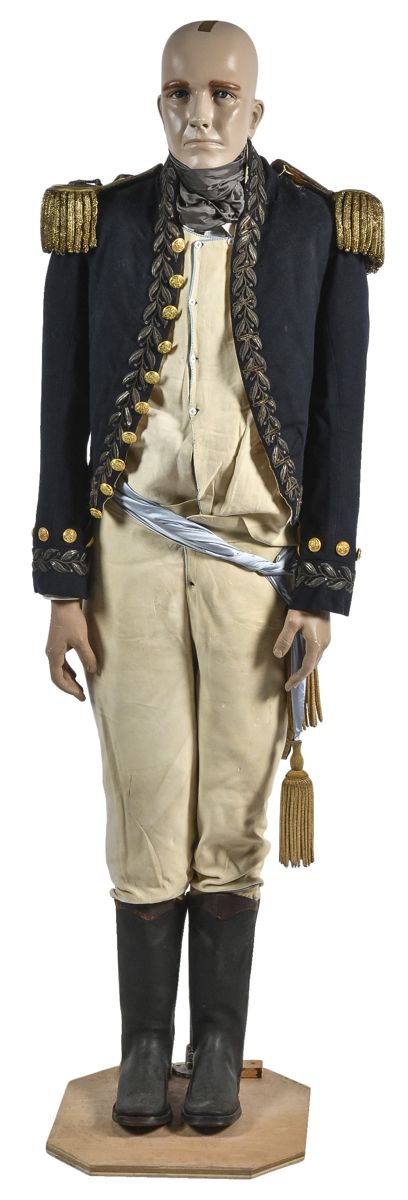
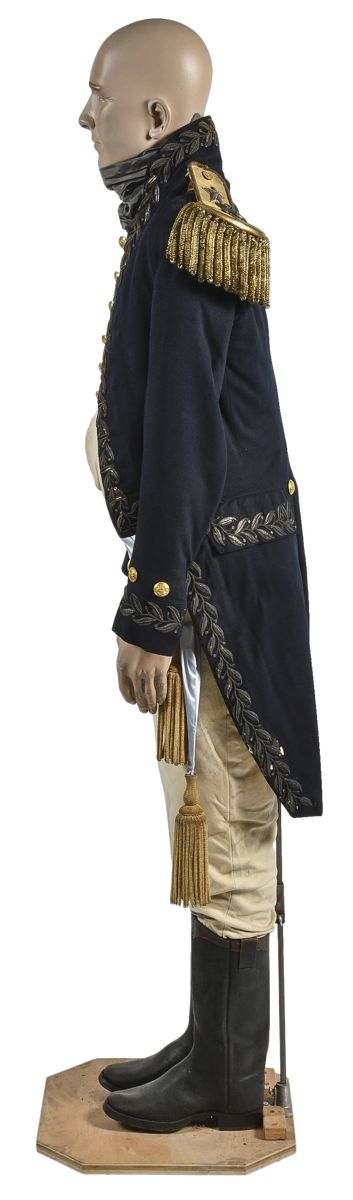
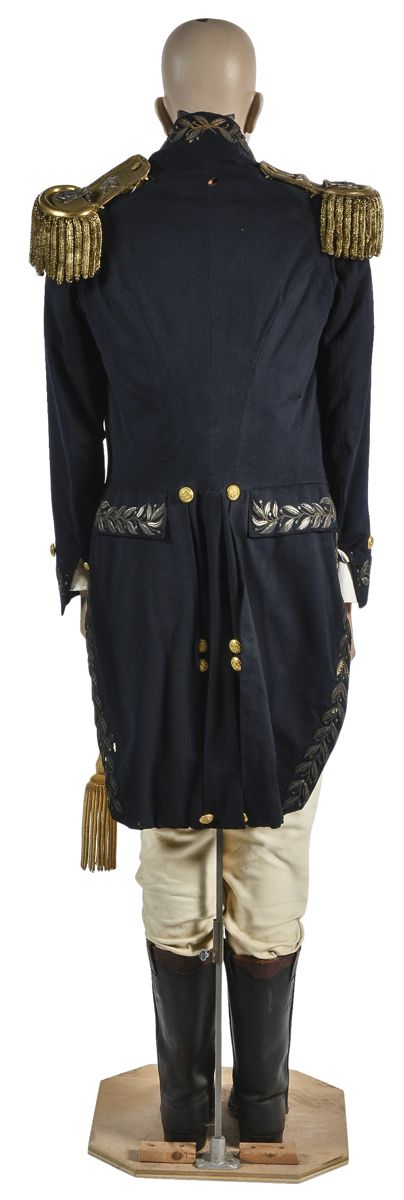
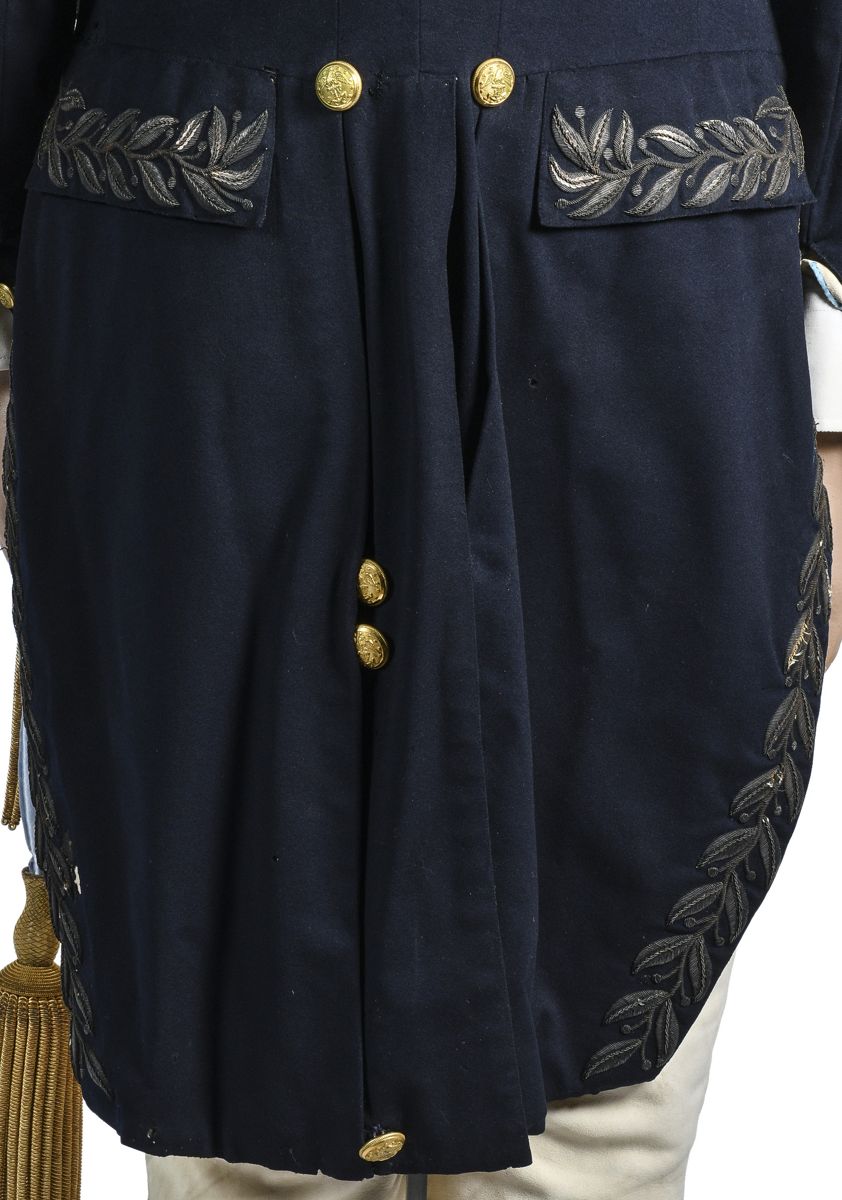
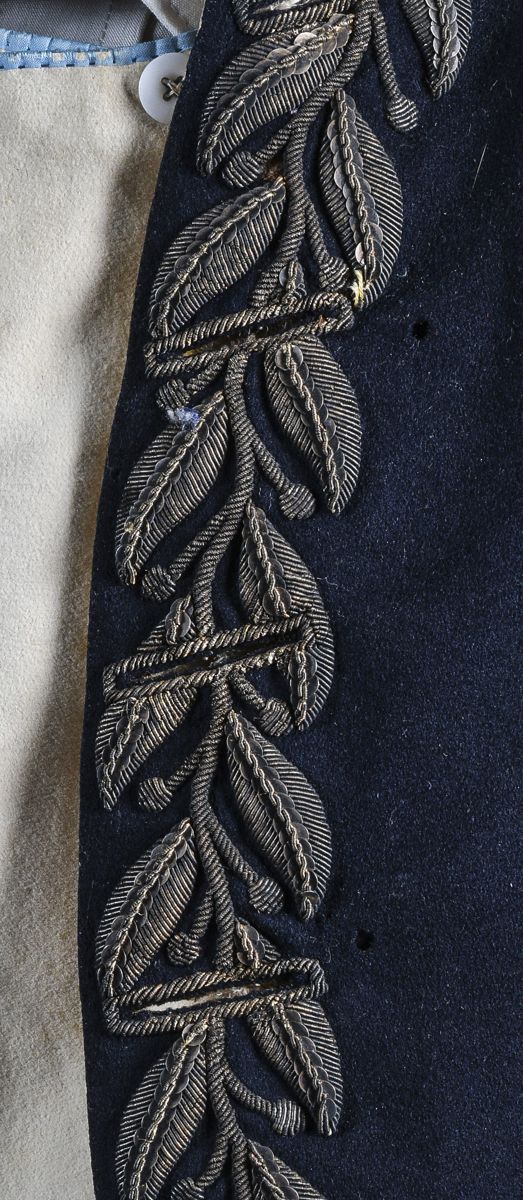
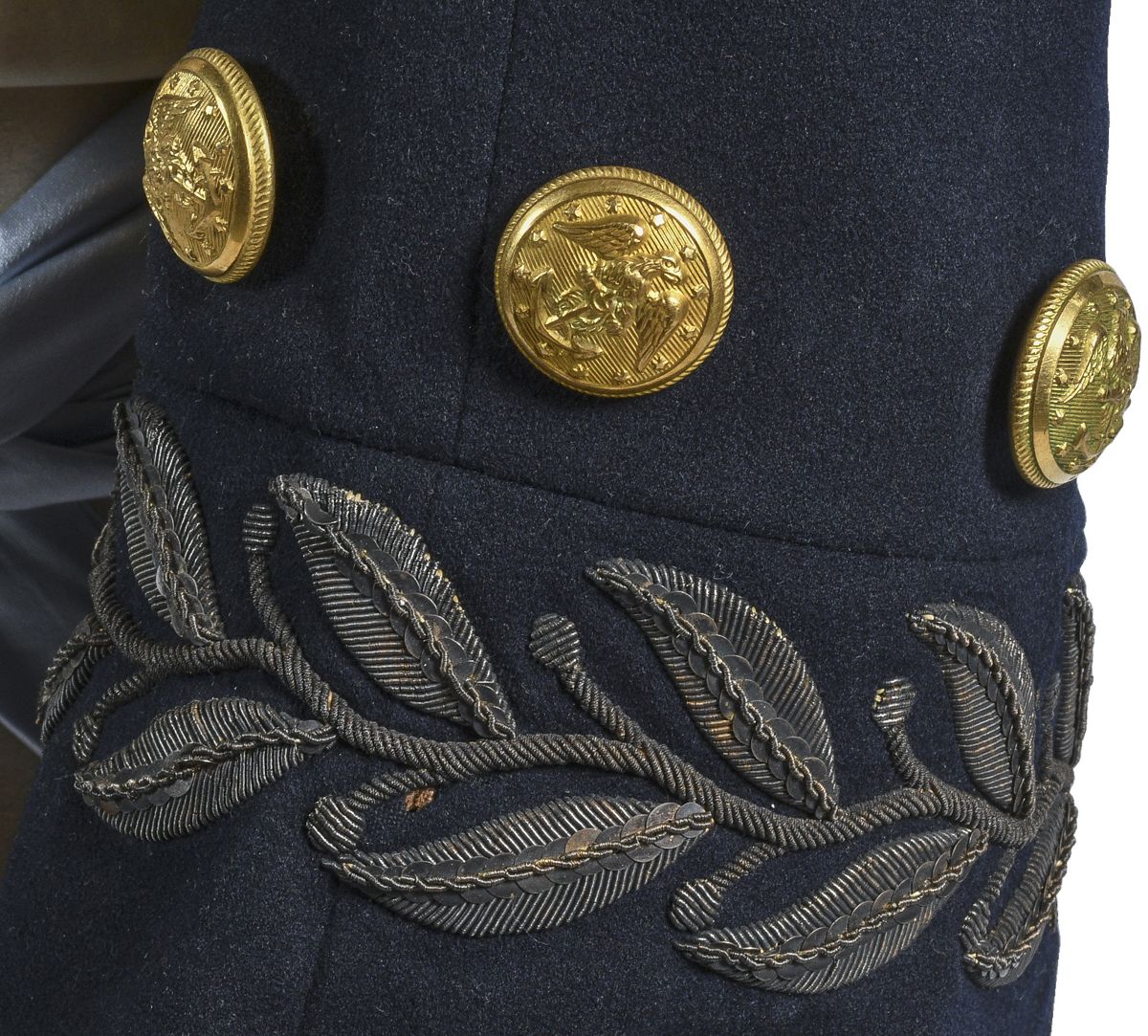
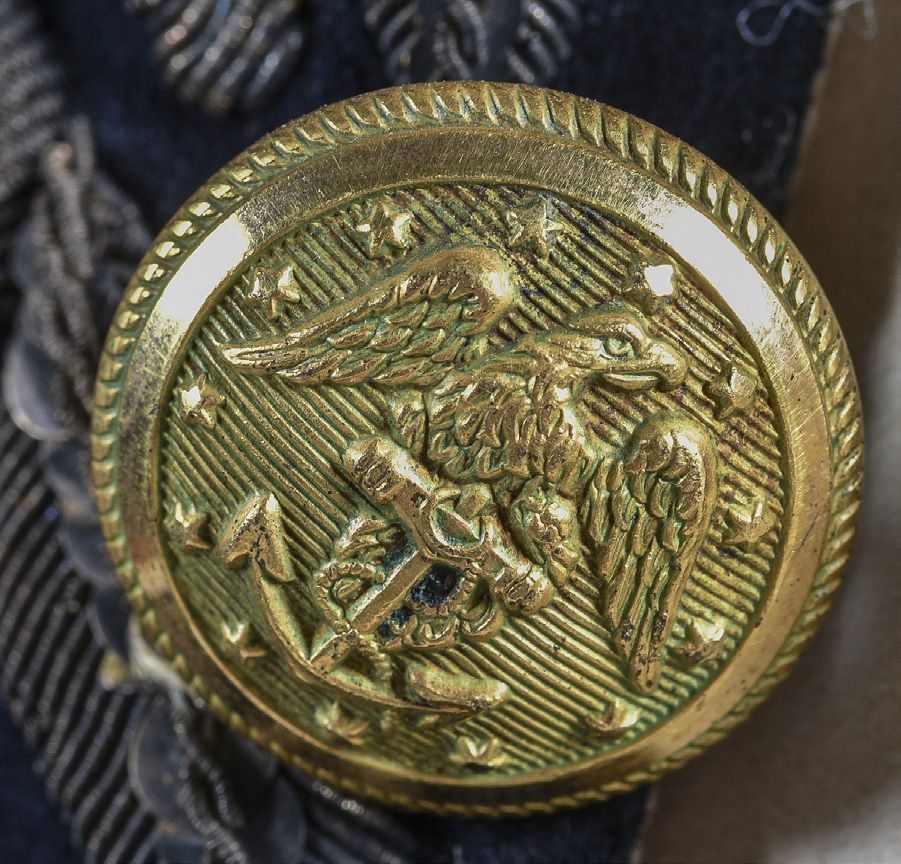
TEXAS NAVAL UNIFORM OF COMMODORE EDWIN MOORE The blue wool coat body is lined with a white colored material. The sleeves and front are trimmed in gold bullion. The navy style buttons are brass. The pants and skirt are made of a chamois material trimmed in light blue on the outer edges. The light blue sash has gold tassels. The boots are reproductions.
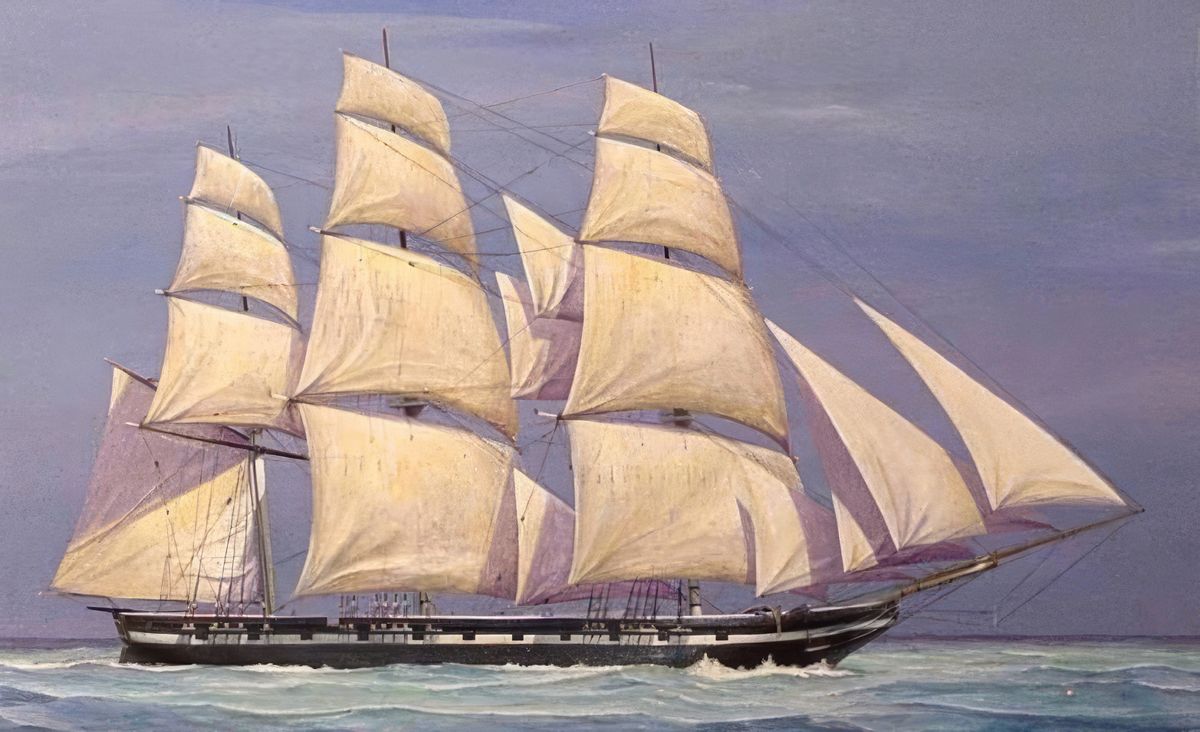
Texas Navy flagship sloop-ofwar Austin, commanded by Commodore Edwin Ward Moore, during the Naval Battle of Campeche, April 30, 1843.
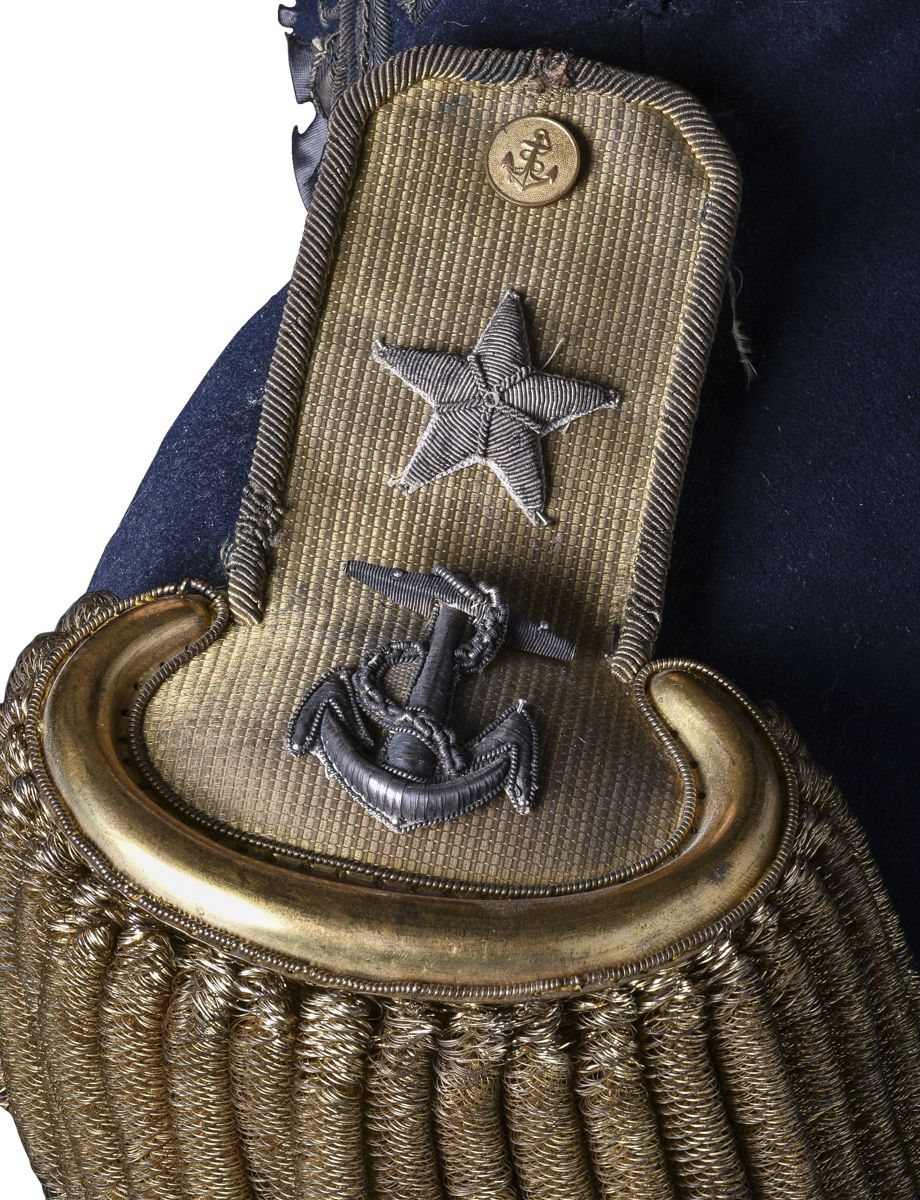
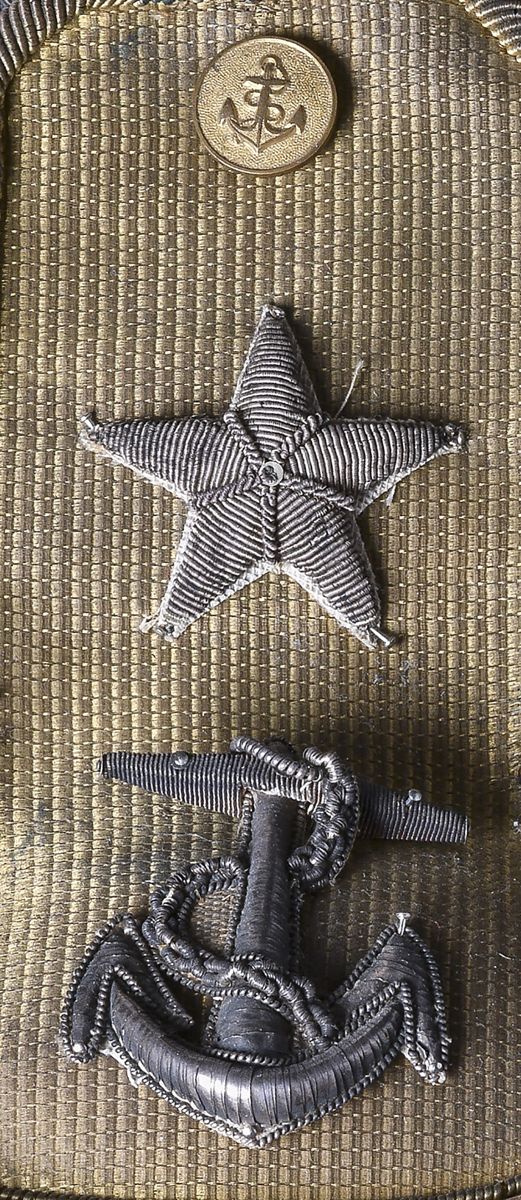
Navy style brass buttons. Brass epaulettes with gold bullion tassels. A silver star indicating commodore’s rank and silver anchor are on the epaulette.
TEXAS NAVY CHAPEAU ATTRIBUTED TO COMMODORE EDWIN MOORE
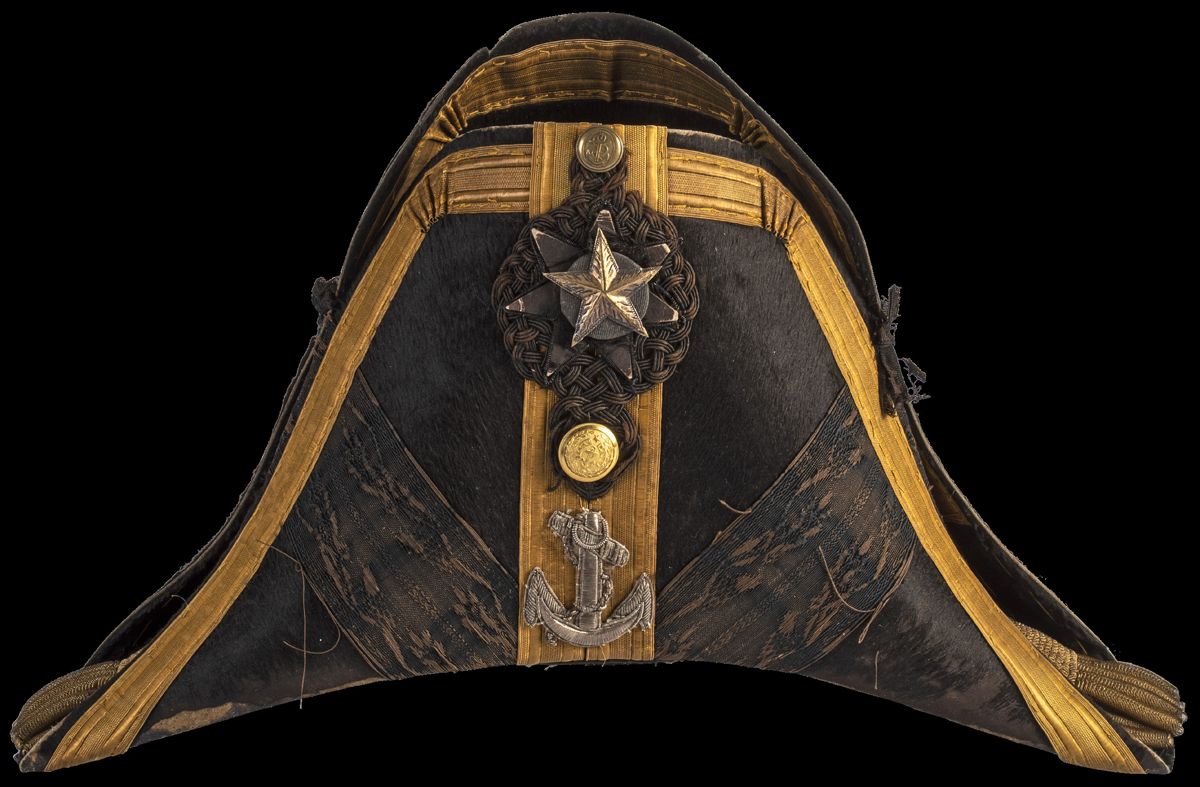
Texas Navy chapeau attributed to Commodore Edwin Moore. The chapeau is made of black beaver fur or felt and features a low, circular crown with a wide brim turned up on three sides, similar to the U.S. Model 1832 General Officer’s Chapeau. The chapeau is adorned with a black silk cockade, a gold bullion tassel, and a black ostrich feather plume that is attached to the left side of the hat.
TEXAS NAVY CHAPEAU DETAILS The white silk interior has a printed paper trade label indicating that the headgear was sold by George B. Foster, a Boston military outfitter.
The hat is decorated, from the top, by a small anchor button, then a large cockade with an embroidered silver star backed by a sevenpointed stat that may not be original. Under the cockade is a Texas Navy button above a large embroidered silver fouled anchor.
TEXAS NAVAL FULL DRESS COCKED HAT ATTRIBUTED TO MOORE
Cockade detail showing a metallic seven-pointed star mounted above the fouled anchor.
A wide band of vertical gold lace bisects the side body of the headgear. There is heavy wear to the black silk brocade work.
COMMODORE MOORE’S TEXAS NAVY SWORD BELT RIG
Maker’s gold stamp.
Commodore Moore’s Texas Navy sword belt with round star over anchor belt plate complete with both adjustable sword straps. The length of black or dark blue Moroccan leather is detailed with a center row of gold embroidered oak leaves.
The upper and lower edges are worked in bands of gold embroidery, identical to the sword straps fitted with fancy rococo buckles.
The cast brass two-piece buckle features a raised center fouled anchor within an oval of 19 small stars beneath the Texas Navy lone star. The buckle is unmarked.
POCKET WATCH PRESENTED TO ADMIRAL MOORE
Silver, key wound pocket watch presented to Admiral Moore. The case, pocket chain with key and fob are coin silver. The watch has an extra outer case for water protection when worn at sea.
Watch is 2 inches in diameter, with an open face featuring gold hands. A center arm allows for 24 hours.
Back of watch is engraved “COMMODORE / EDWIN W. MOORE / REPUBLIC OF TEXAS / NAVY / 1840.”
EAGLE POMMEL NAVAL DIRK Midshipman Edwin Moore’s eagle pommel naval dirk and scabbard measure 16 inches on the ellipse. Though impractical, the highly curved blade was the epitome of fashion during the Regency period when it became popularized by the Royal Navy.
The chased and once gilded scabbard is highly ornate with raised panels having generic martial panoplies neither of which has a nautical theme or even an anchor. There are two scabbard ring mounts braised to the scabbard, but the original rings are gone. The dirk might have been worn from a belt on watch or parade, or around the neck slung from a leather belt.
This spectacular dirk is said to have been given to Moore by his parents when he began his U.S. Navy service during 1825. The scabbard throat bears a fine engraving reading, “E.W. Moore / U.S. Navy / 1825.”
The rather timid eagle’s head is linked by a double row of original chain to a primitive sea serpent doubling as the quillon. The grip is a machine carved, ribbed pattern hardwood; the blade is plain and unmarked.
FEDERALIST PERIOD OFFICER’S SWORD Edwin Moore’s inscribed eagle head dress sword with gilt and fire blue 32.5 inch curved blade with fuller. The upper half of the blued blade is decorated with two generic gold panels, the center panel incorporates an American shield and stars. The unpolished scabbard has two ring mounts showing traces of original gilt. No maker is noted.