
The Confederate Whitworth Rifle
By Tim Prince · Originally published January-February 2023 · pp. 3–39
Sir Joseph Whitworth, oil on canvas. (1803–1887). ‘Portrait of Sir Joseph Whitworth’ by T. B. Kennington. (The Whitworth Art Gallery, The University of Manchester)
There is probably no muzzle loading rifle more renowned for accuracy than the Whitworth Patent Rifle. Sir Joseph Whitworth was an incredibly talented engineer who was responsible, among his many innovations and inventions, for the establishment of the first standardized thread system for screws. This is something we tend to take for granted today, but the standardization of thread count, thread pitch, and screw diameter was a revolutionary idea during the mid-19th century when screws were normally handmade and hand cut. To this day, Whitworth threads are still used on many products, particularly English ones. Whitworth’s reputation for being able to produce machines with tight tolerances led the British Board of Ordnance to approach him in 1854 to help with designing and manufacturing the machinery that would be necessary for the Royal Small Arms Factory at Enfield Lock to produce the new Pattern 1853 Enfield rifle musket to very tight tolerances. This facility was the first English operated manufactory to produce small arms on the principle of interchangeable parts, a production method pioneered in America by such companies as Colt’s Patent Firearms and Robbins & Lawrence. Colt brought the concept to England with the establishment of his short-lived factory there in early 1853.
who had developed the “oval bore” mechanical rifling system, and Westley Richards, who was working with an octagonal bore mechanical rifling system. Whitworth’s interest in precision machining and in the potential for improved firearms accuracy led to his adopting a polygonal, 6-sided, mechanical rifling system that proved extremely accurate. While he cannot be directly credited with the invention of the hexagonal mechanical rifling system, he can be accurately considered to have substantially improved it in such a way as to make it extremely successful. Much of his design’s accuracy was due to his work with the projectile. He adopted a design that was longer in length and smaller in diameter than the typical military bullet, but still retained the weight of the standard service bullet of the time. In fact, Whitworth felt the bullet’s length needed to be at least three times its diameter to properly stabilize in flight. His 530-grain, .451-caliber hexagonal bullet did not depend
The Board of Ordnance asked Whitworth to provide input for potential improvements that might be obtained in rifling small arms barrels. To this end, Whitworth consulted prominent gunmaking engineers like Charles Lancaster,
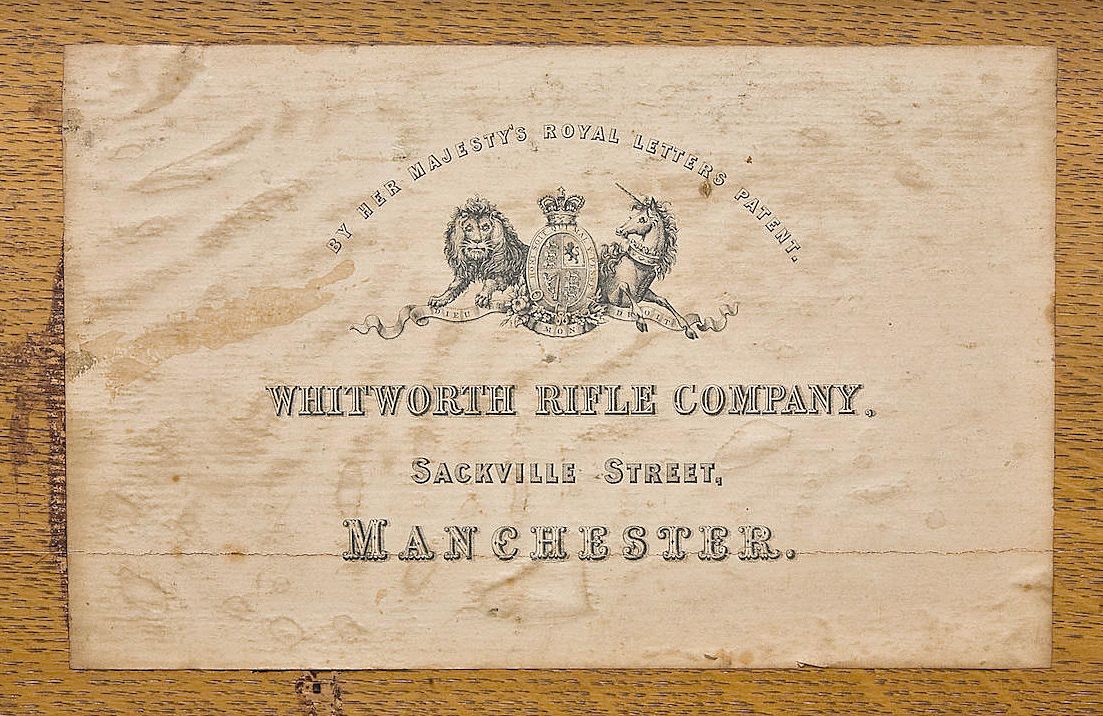
Paper label glued to a cased Whitworth rifle. It reads “By Her Majesty’s Royal Letters Patent. / Whitworth Rifle Company. / Sackville Street. / Manchester.”
upon the unreliable expansion of a hollow base to engage the rifling of the bore, but instead relied upon the tight mechanical fit of his bullet to the .451 polygonal bore. The end results were simply stunning accuracy for a muzzle-loading firearm; one period test reportedly resulted in a 12-foot group at 1,800 yards. That is an 8-minute of angle group which is incredibly impressive.
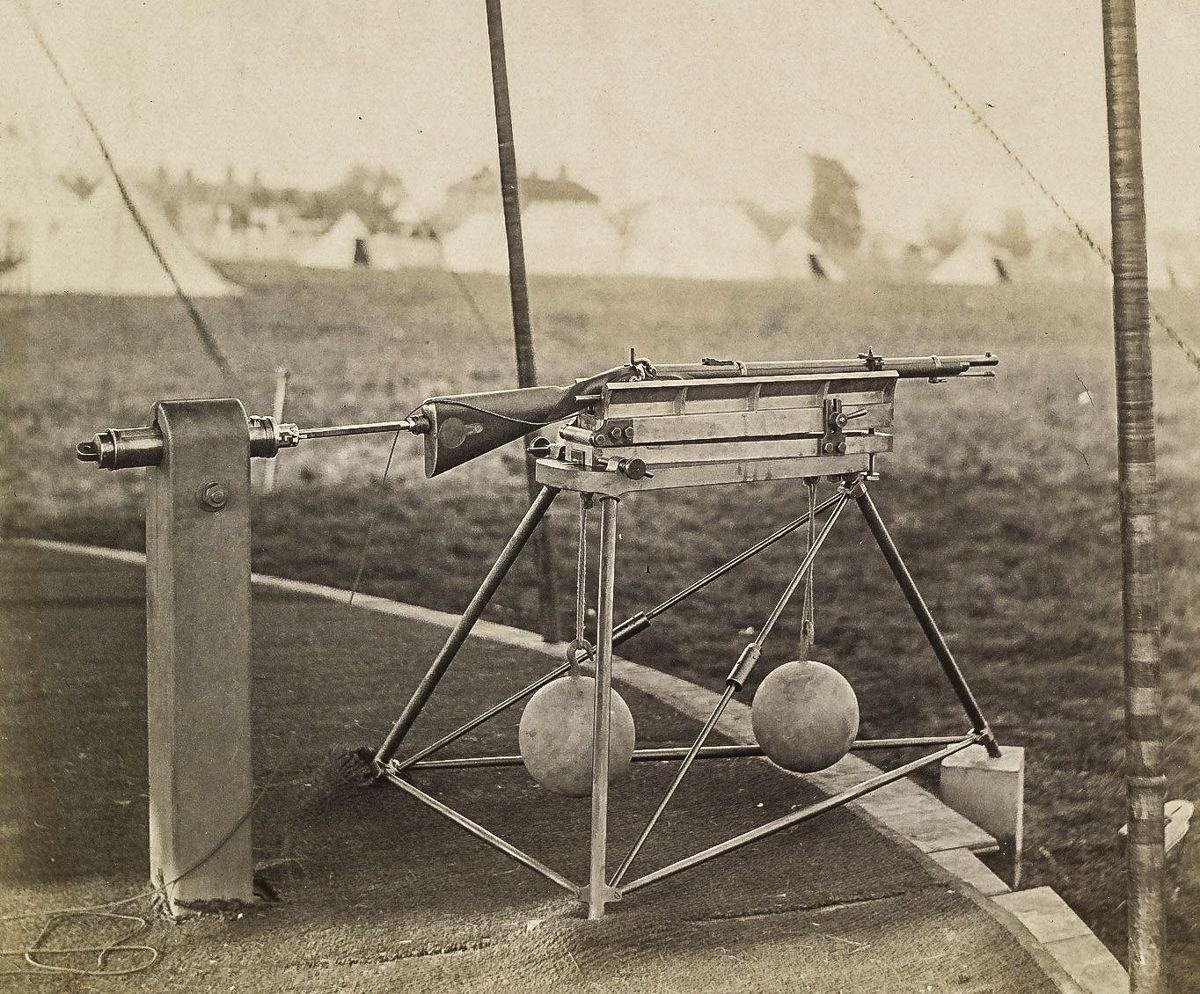
Queen Victoria opened the inaugural meeting of the National Rifle Association at Wimbledon Common, by firing this fixed Whitworth rifle at a target set up 400 yards away, and struck the bull’s-eye 1 to 1 ¼ inches from its center. The cord, pulled by The Queen to fire the rifle, can be clearly seen. Today this gun and mount are located in the Museum of the National Rifle Association in Surrey, United Kingdom.
Whitworth began manufacturing his revolutionary rifles in 1857; in 1860 he formed the Whitworth Rifle Company in Manchester, England. Initially, the majority of his customers were serious target shooters, who were interested in obtaining the most accurate rifle of the period. He produced the rifles in a variety of styles from cased multi-barrel sets to military style match rifles, and everything in between. The Whitworth Rifle Company operated in Manchester from 1860–1862, when it became the Manchester Ordnance & Rifle Company, and finally became the Whitworth Company LTD in
1865, before closing in 1870. The first two incarnations of the gun company were located separately from Whitworth’s machine tool company at 51 Sacksville Street in Manchester. In 1865, the final iteration of the arms company relocated to 44 Chorlton Street, where Whitworth also maintained his machine tool company. There is probably no more famous, romantic, or more desirable variant of the Whitworth rifle for the modern arms collector than the handful purchased by the Confederacy during the American Civil War. Confederate sharpshooters put these rifles to devastating use against the Union Army from 1863 to 1865, in both major theaters of the war. The Confederate purchased guns were all “2nd Quality” Military Match Rifles; at least some deliveries were equipped with 4-power Davidson telescopic sights, while other guns used Whitworth’s conventional ladder rear and “globe” front sights. Some estimates place the total number of guns imported at around 200. However, based on period primary source evidence it seems unlikely that more than fifty or sixty Whitworth rifles were actually imported into the South during the War. Despite their small numbers, the legendary stories of their use and great accuracy have made them an iconic piece of American Civil War arms collecting history. The first period reference about Southern attempts to acquire these rifles comes from the diary of Major Edward C. Anderson of Georgia. The Savannah native had served as mayor of the city from 1853 to 1856 and was closely tied to the newly elected Confederate President Jefferson Davis. In June 1861 Anderson was dispatched to England to help purchase and acquire small arms and equipment for both the Confederacy and for the state of Georgia. It was during this visit that Anderson contracted for the Georgia marked Pattern 1853 Enfield rifle muskets that appear on the market from time to time today. Anderson arrived in England on June 22; on July 2 he visited Whitworth’s “Foundry.” He noted in his diary that “Before leaving Whitworth’s establishment this morning we bought two of his rifles. He asks enormously for them.” Anderson would later note in his post-war memoirs of his service to the Confederacy that the Whitworth rifles cost as much as “…about $1,000, in the equivalent of gold, for each rifle and one thousand rounds of ammunition.” That would translate to roughly $32,000 in today’s money! While it is not clear what Anderson did with the two Whitworths that he purchased, or if they were in any way different from other Confederate acquisitions, it seems reasonable that he brought them back to Savannah when he returned on the Fingal in November 1861. In addition to Anderson, Fingal transported other items that he had purchased for both the Confederacy and Georgia, including the first 1,000 Georgia marked and inventory numbered Pattern 1853 Enfield rifle muskets. As noted, the Whitworth rifles acquired by the Confederacy were “second quality” guns. This in no way related to their actual functional quality as firearms, but refers to the fact that they were not highly embellished arms, did not have special quality finishes, and were not engraved. This mark was engraved on the tang of triggerguard. Higher-grade guns were engraved in the same location with the word “Best.”
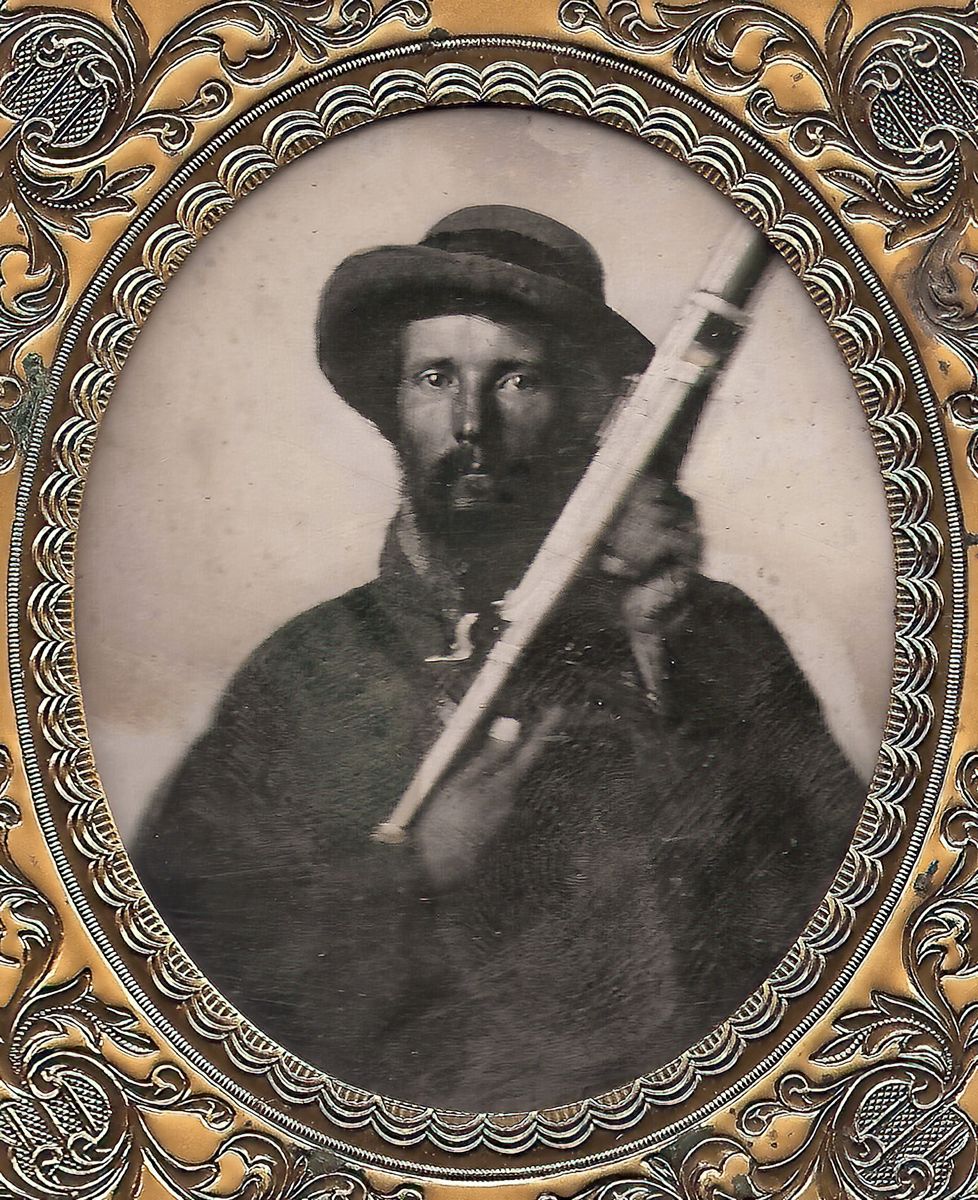
Unknown Confederate soldier wearing slouch hat and overcoat holding a Whitworth rifle with telescopic sight. This is the only known wartime photograph of a soldier holding a Whitworth rifle. (Courtesy Shannon Pritchard)
Based upon surviving examples, Confederate purchased guns appear in a very specific serial number range. Whitworth used a letter prefix system to avoid long serial numbers, so the guns were numbered in series, with the first series theoretically numbered 1-1,000 without a prefix, the second series numbered A 1-1,000, the third series B 1-1,000, etc. It is not entirely clear whether Whitworth made each group of 1,000 guns prior to changing the prefix, or if he changed the prefixes based upon a period of time or in an attempt to make it appear as if more rifles had been made. Surviving Confederate guns exist in the B 5XX range to the C 6XX range. It is also interesting that two variations of the “2nd Quality” mark are known. The first, found on the B-prefix guns has the “Q” in “Quality” written much like the numeral “2.” The second variant, found on the C-prefix guns, uses a more conventional “Q” shape for the letter. Since Whitworth’s rifles were assembled into their final configuration on an “as needed” basis, there is no uniformity to the serialization system and three consecutively numbered guns could be a military match rifle, a custom sporting rifle, and a Confederate 2nd Quality gun, all completely different and unrelated to each other.
Confederate documents relating to the issue and use of these rifles are fairly scarce, but a few have been discovered that help tell part of their story. One of the first significant references to the rifles comes from the Confederacy’s Chief of Ordnance, Josiah Gorgas. In a May 29, 1863, letter to General Braxton Bragg, commanding the Army of Tennessee, Gorgas wrote that he had ordered: “for the use of sharpshooters 20 Whitworth (telescopic) Rifles recently imported from England. These arms are reported to be very effective at 1,200 yards…they be placed in the hands of careful and reliable men only, as they are very costly & so costly indeed that is not deemed expedient to increase the number already brought in.”
Second Quality mark found on Whitworth rifle No. B 547. Note the two lines under the script nd in 2nd and the Q in Quality appears to be the numeral 2.
These guns were transported from the Charleston Arsenal to Bragg’s command and were accompanied by 1,000 rounds of ammunition for each rifle. At least one researcher has concluded from this correspondence that only 20 Whitworth rifles were purchased, as Gorgas notes that “it is not expedient to increase the number already brought in.” However, that assumes that only twenty had been purchased, not that these twenty were just part of a larger delivery of rifles that had “recently” arrived. As we will see, we can certainly document more than twice as many Whitworth rifles in the field at the same time as the war continued. Bragg dispersed these twenty rifles throughout his command, ordering Lt. Colonel Hypolite Oladowski, the Chief of Ordnance for the Army of Tennessee, to “issue one of these guns to each brigade, to be placed in the hands of one the most skillful sharpshooters.”
Second Quality mark found on Whitworth rifle No. C 529. Note the lack of any lines under the ND in 2ND and Q in Quality appears to be of conventional design.
In September 1863, General Longstreet’s Corps was detached from the Army of Northern Virginia and sent to assist with Bragg’s campaign in Northern Georgia. Lt. Robert Cole of the 4th Alabama Infantry (Law’s Brigade, Hood’s Division, Longstreet’s Corps) recalled in his postwar writings that:
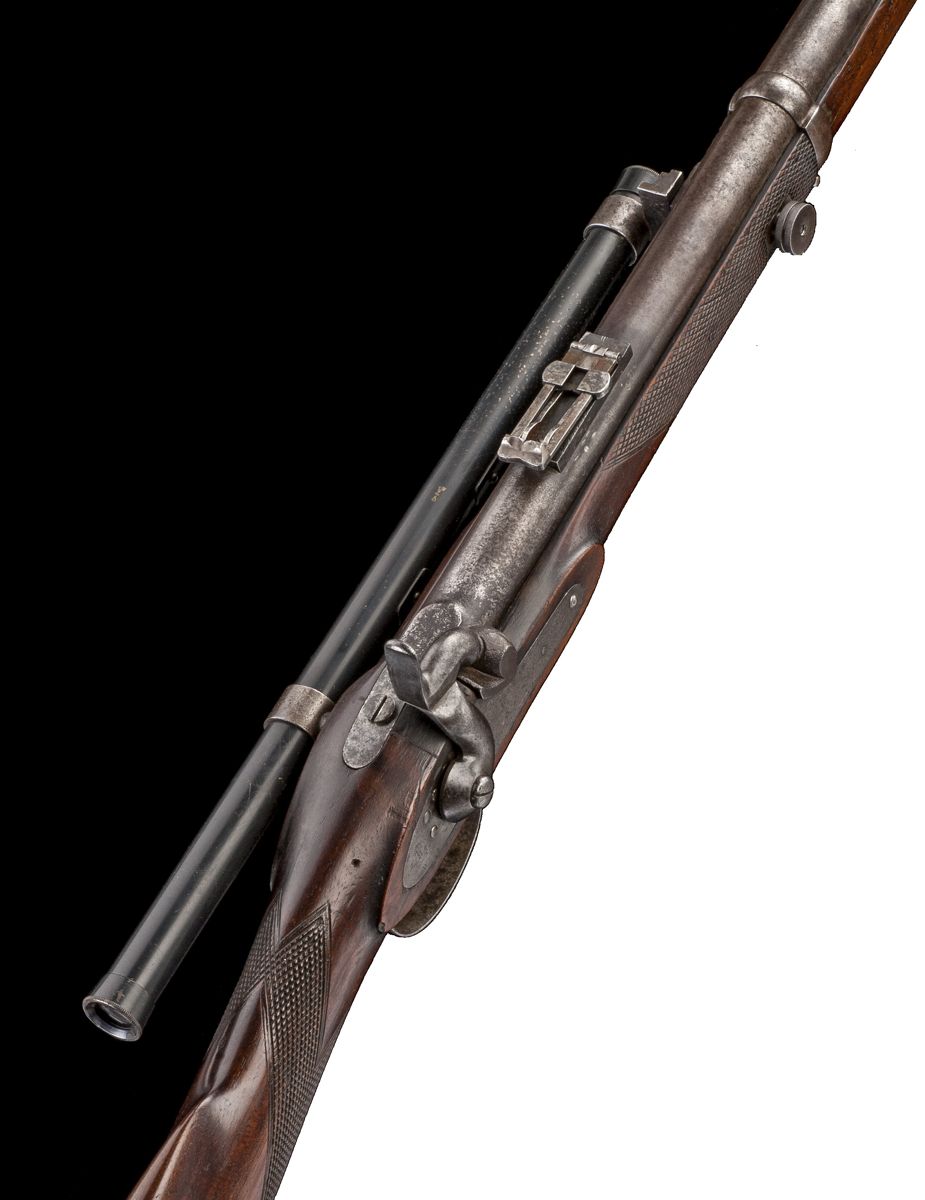
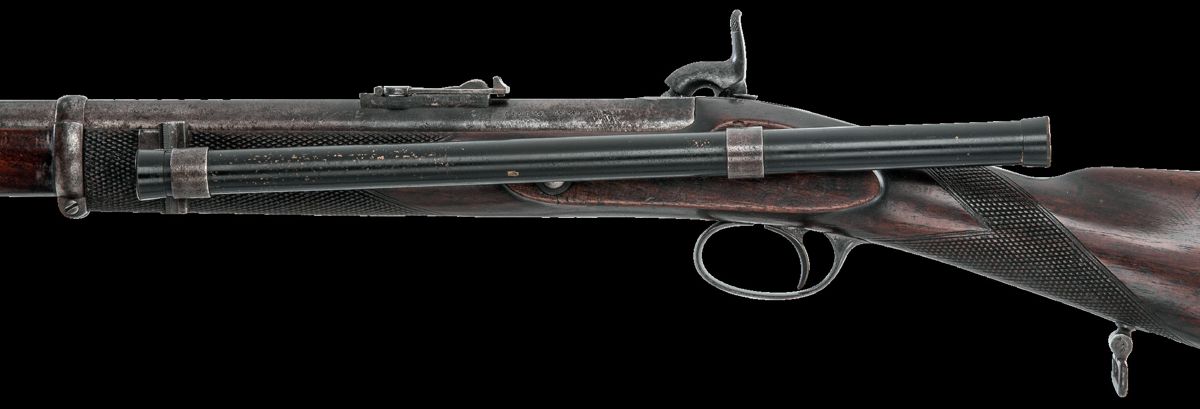
Aside from being “2nd Quality,” the Confederate purchased rifles were standard Whitworth Military Match Rifles with 33-inch-long barrels with 52-bore (.451) hexagonal bores. The rifles were 49-inches overall length and equipped with an adjustable folding ladder rear sight and either a drift adjustable blade front sight or a more complicated adjustable globe front sight. A reasonable quantity of the rifles was also equipped with mounts for a Davidson style 4-power telescopic sight that was nominally 14.5-inches in overall length with a diameter of .9375-inch. Simple wire crosshairs provided the sight picture. The mounts were located on the left side of the gun, placing the scope more than 1-inch away from the plane of the rifle’s barrel. An adjustable sliding forward mount, that tracked along a regulated vertical piece, allowed elevation adjustments to the telescopic sight. However, there was no reasonable way to regulate and adjust the sight’s drift, which meant that accuracy on the horizontal plane was based more upon the ability of the shooter to apply correct “windage” than upon any ability to adjust the sight picture itself.
“We had brought our Whitworth rifles from Virginia with us. I saw one of the Whitworth rifles, an English gun with Globe sights carrying a large ball, a few of which ran the blockade, in the hands of one of our sharpshooters, kill two mules with one shot, the heavy missile passing through their necks.” It is not clear how many rifles were in this Corps, but if we use the same rate of issue as Bragg was attempting to use, one rifle for each brigade, then we should assume that Longstreet’s command had at least six rifles with them, as he had a total of six brigades in his two divisions at Chickamauga. In the Western Theater we can document at least thirtytwo Whitworth rifles in the field simultaneously. This comes from a June 25, 1864, report from Lt. Colonel Oladowski, where he notes there were twenty-nine Whitworth rifles in the possession of the Army of the Mississippi and an
A letter dated May 29, 1863, written by Colonel Josiah Gorgas, Chief of Ordnance, to General Braxton Bragg, advising him that “20 Whitworth (Telescopic) Rifles” had been sent to the Army of Tennessee from Charleston Arsenal and that, due to cost, no more would be imported.
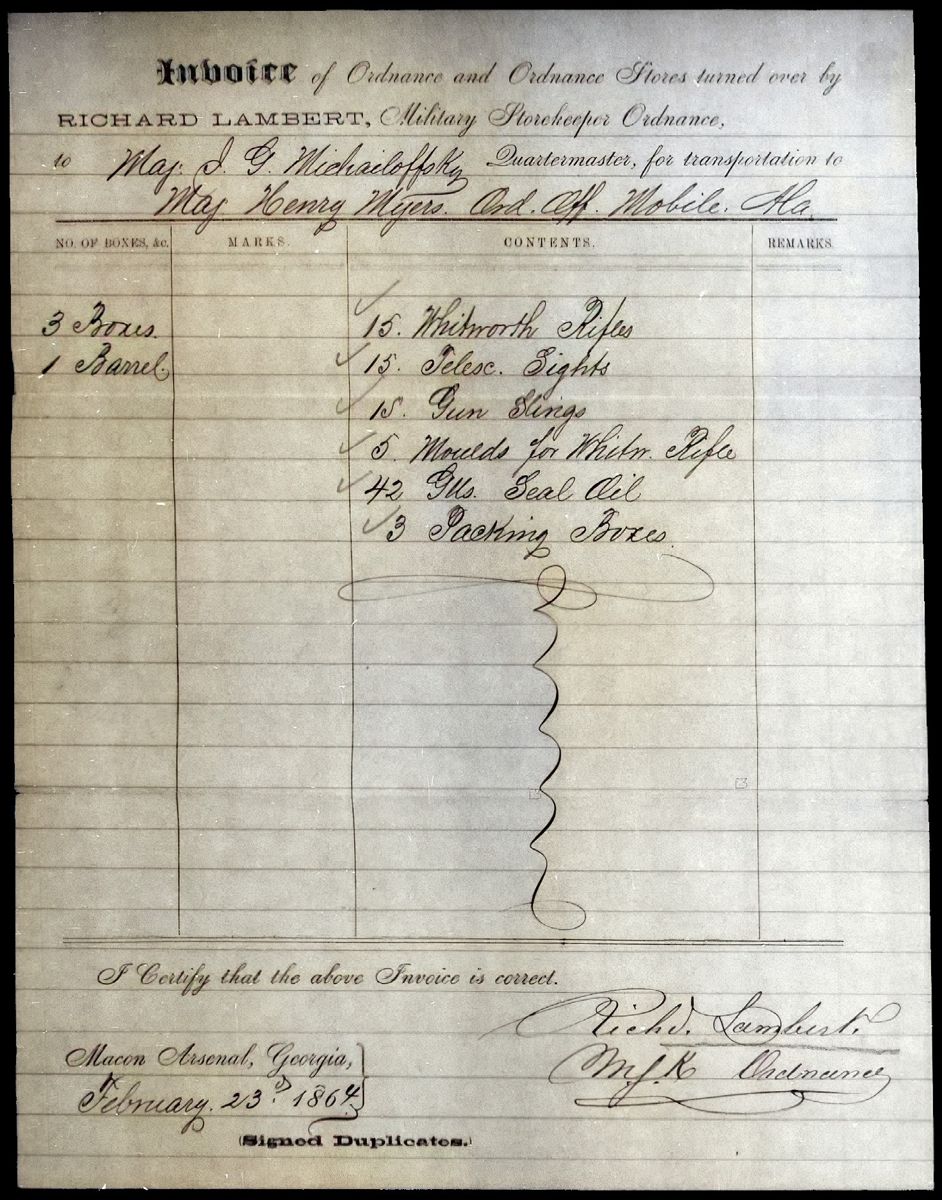
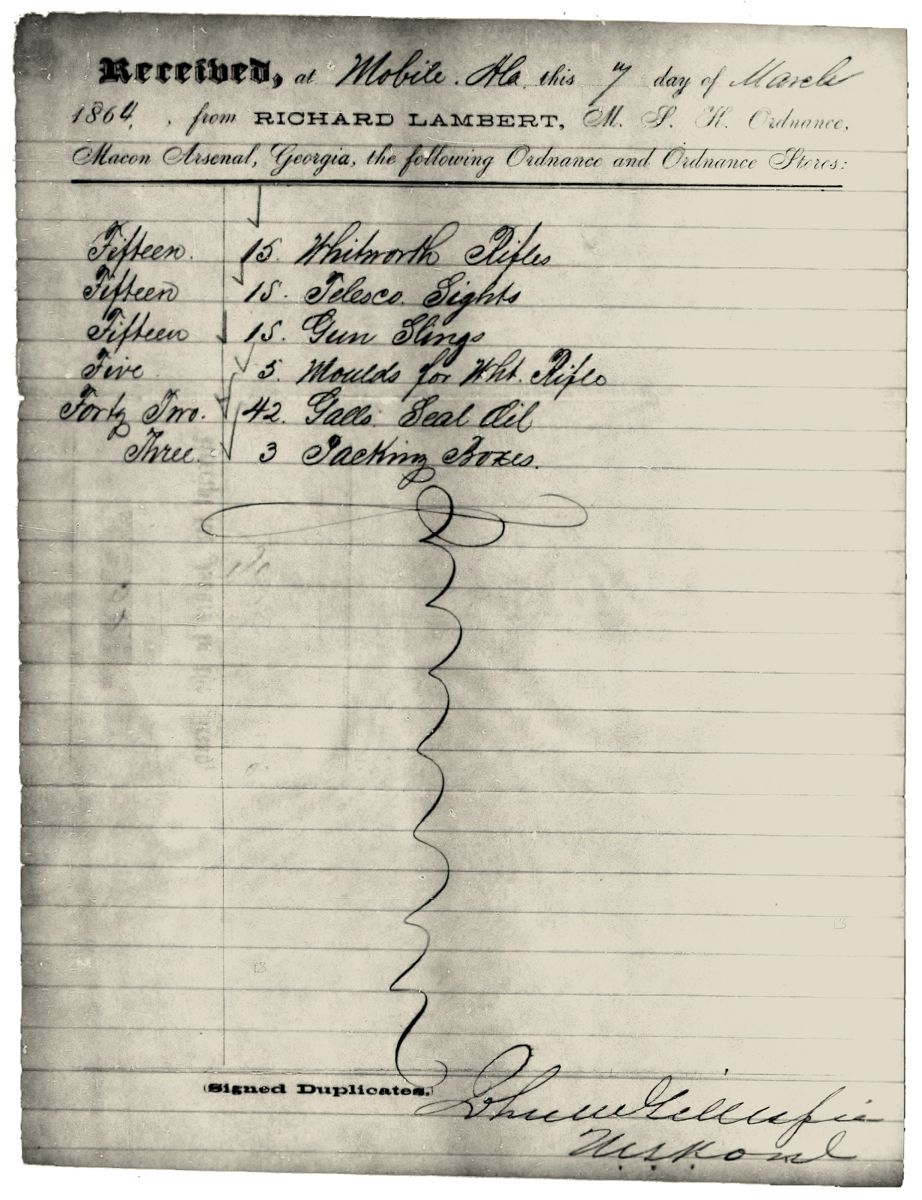
additional three in Hood’s Corps. Almost simultaneously there are two shipping records regarding the reallocation of Whitworth rifles and demonstrating even more Whitworths were in the field than the thirty-two Oladowski was accounting for. An invoice, shown below, dated Feb. 23, 1864, for Whitworth rifles and accessories, turned over by Richard Lambert, Military Storekeeper Ordnance, Macon Arsenal, Ga., to be delivered to Maj. Henry Myers, Ordnance Officer Mobile, Ala. (see document on following page). This order was received on March 7, 1864, and signed for by Capt. John W. Gillespie, the Military Storekeeper in Mobile. On June 12, 1864, Gillespie was ordered to ship: “6 Whitworth Rifles Complete, (including) 6 Telesc. Sights, 6 Gun Slings, 3 Moulds for Whit. Rifle, 2000 Whitworth Rifle Cartridges (in) 3 packing cases to Brigadier General James Cantey.”
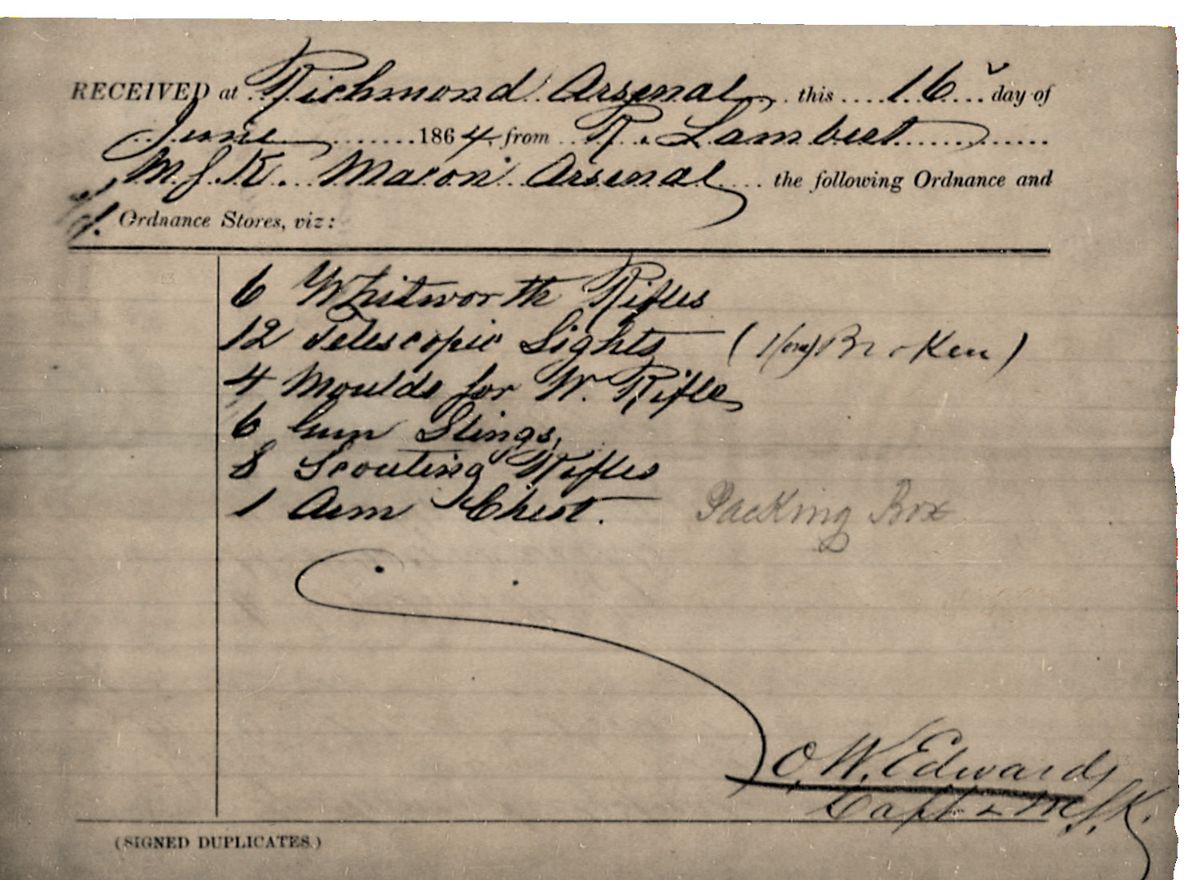
Cantey was a brigade commander in Polk’s Corps, Army of Tennessee, so these six guns would be in addition to the twenty-nine in the hands of the Army of Mississippi and the six in the hands of Hood’s Corps. That brings the total number of Western Theater Whitworth rifles in the field during the summer of 1864 to forty-one. Another document, dated June 16, 1864, reported the arrival of six Whitworth rifles at the Richmond Arsenal, having been shipped from the Military Store Keeper at the Macon Arsenal. The receipt lists the following: “6 Whitworth Rifles 12 Telescopic Sights (1 (one) Broken), 4 Moulds for W. Rifles, 6 Gun Slings, 8 Scouting Rifles, 1 Arms Chest Packing Box.” This receipt brings the total number of Whitworth rifles that can be accounted for simultaneously to at least fortysix. That number assumes the guns in the hands of Longstreet’s Corps in September of the prior year had been reallocated. Assuming Longstreet still had at least one Whitworth per brigade we are at least forty-eight rifles. If as few as another dozen guns were in storage at various Confederate arsenals or in the hands of the Army of Northern Virginia, we can safely establish about sixty Whitworth rifles were in use by the Confederacy during the summer of 1864.
Ordnance and Ordnance Stores to be delivered to Maj. Henry Myers, Mobile, Ala. “3 Boxes 15 Whitworth Rifles, 1 Barrel, 15 Telesc. Sights, 15 Gun Slings, 5 Moulds for Whitw. Rifle, 42 Galls. [gallons] Seal Oil, 3 Packing Boxes.”
During the war Whitworth rifles were used quite effectively by the Confederacy against very specific, high-value targets. Like the American marksmen of the Revolutionary War, Confederate sharpshooters often concentrated their fire on enemy officers. The most famous confirmed Whitworth shot was the one that brought down Union General John Sedgwick on May 9, 1864, during the Battle of Spotsylvania. Sedgwick had famously quipped shortly before being shot below the left eye that they “couldn’t hit an elephant at this distance.” Witnesses to his death specifically mentioned the unique whistling sound of the Whitworth bullet that struck him. Another equally famous, but ineffective use of the Whitworth was during Jubal Early’s attack on Washington, D.C., in July 1864, when a number of shots were taken by Whitworth-equipped marksmen at President Abraham Lincoln; none of those shots scored a hit. However, at least one Union officer in the vicinity fell to the hexagonal bullets that day and excavated Whitworth bullets at that location confirm the story.
Other than shooting at officers, and the occasional president, Confederate marksmen tended to concentrate their fire on artillery batteries, sometimes forcing them from the field or at least forcing the men to abandon their guns. Considering the great superiority the Union army had in artillery, particularly during the second half of the War, the Whitworth marksmen became the South’s most effective form of counterbattery fire. Today, there are at least eighteen legitimate Confederate purchased, 2nd Quality Whitworth rifles known to survive, and many are in institutional collections. Some of the best known and fully vetted examples to survive are No. B 509 which was donated to the Tennessee State Historical Society
(now at the Tennessee State Museum) by Confederate General A.P. Stewart, No. B 547 from the George W. Wray Jr. Collection, now in the collection of the Atlanta History Center, No. C 321 in a private collection, which is pictured on page 183 of The English Connection – Arms, Material and Support Furnished to the Confederate States of America by Great Britain by Pritchard, Huey, Prince, Nichols, and Thomas, and No. C 619 formerly in the collection of Richard D. Steuart and currently in the collection of the former Virginia Historical Society, known today as the Virginia Museum of History & Culture. It is worth noting that there are no known U.S. government or official U.S. military references to any Whitworth rifles being surrendered at the end of the war or of any post-war U.S. government sale of these rifles. This suggests that the value and importance of these guns was well known, not only by the men who carried them but by the men who might potentially capture a Confederate sharpshooter armed with one. In fact, when you realize that roughly one-third of the potential acquisitions of these guns do survive, it becomes clear that their value was well known during the period. When compared to the survival rate of known Confederate numbered Enfield rifle muskets, against the known number of the guns acquired, it is stunning. Only about 1% of numbered Enfields are known to have survived but roughly 35% of Confederate Whitworth rifles have.
Ordnance received on March 7, 1864, and signed for by Capt. John W. Gillespie, the Military Storekeeper in Mobile, Ala. (Fold3.com, Gillespie, John W., page 87.)
One of the rifles pictured in this article is a recently discovered example that directly relates to the period knowledge of their value and the June 16, 1864, Richmond Arsenal receipt. That gun is No. B 902. It was discovered a few years ago in a house in Colorado. The gun was wrapped in a blanket with a Peterson 75 non-regulation U.S. Staff & Field Officers Sword and a disintegrating folded leather U.S. officer’s sword belt. It seems quite likely that the rifle was captured from a Confederate sharpshooter and subsequently retained by a Federal officer who likely moved west after the war. Interestingly the gun mismatched screws proves that these two guns were disassembled at the same time and in the same location, when the screws were inadvertently swapped. It seems almost certain that both rifles were part of the six guns sent from Macon to Richmond in June 1864. It truly gives you chills when you realize that you can sometimes take a period document and directly relate it to an item that you can hold in your hands. In this case, Whitworth rifles B 902 and B 547 are a perfect example of surviving artifacts that tell a story because of a surviving document. I am happy to note that the screws were subsequently exchanged, and now both rifles are complete and matching once again for the first time since the summer of 1864. Above is a Richmond Arsenal receipt for the 6 Whitworth rifles, 12 telescopic scopes, 4 moulds, 6 slings, and other items transferred there from the Macon Arsenal on June 16, 1864. Receipt was signed by Military Store Keeper, Capt. Overton W. Edwards. Also note the reference to eight “Scouting Rifles,” a specific type of rifle whose identity has been debated for decades. (Fold3.com) shows moderate use and traces where a tang sight was added in the post-war era to allow the owner to maximize the longrage capabilities of the gun. The parts on Whitworth rifles are numbered, even the necks of screws. Upon disassembly to inspect the gun for originality and authentication, it was found that one lock mounting screw was not numbered 902, but rather 547. As noted above, B 547 is in the collection of the Atlanta History Center and was formerly owned by George W. Wray Jr. After contacting the military curator at the museum, it was discovered that one lock screw in B 547 was numbered 902, matching the recently discovered gun. Given that six guns were sent from the Western Theater to Richmond in the summer of 1864, and that one of them had a broken scope, it seems reasonable to surmise that those guns went through at least quick dismantling and cleaning before they were re-issued to elements of the Army of Northern Virginia. The
Lieutenant Colonel H. Oladowski’s Armament and ammunition report of the Army of Tennessee, commanded by Joseph E. Johnston, for the week ending June 19, 1864. Lists 26 Whitworth rifles. (Official Records of the Union and Confederate Armies, The Atlanta, Ga., Campaign Volume XXXVIII, Part IV, (Vol. 38, Chap. 50), 1891, page 782.)
SERIAL NUMBERS OF KNOWN WHITWORTH TELESCOPED RIFLES PURCHASED BY THE CONFEDERACY B 5091 B 547 B 902 B 911 C 317 C 321 C 3342 C 345 C 361
C 520 C 529 C 544 C 554 C 581 C 601 C 6193 C 631
- This Whitworth rifle has a period side-mounted telescoping sight. The rifle belonged to Lt. Gen. Alexander Peter Stewart of the Army of Tennessee. Tennessee Historical Society Collection. 2. C 334 was issued to Charles T. Ingram of the 3rd Missouri Regiment, in Cockrell’s Brigade, Army of Tennessee. 3. Used by E.J. Gilbert of Maj. Gen. Bushrod Rust Johnson’s Division, who was a resident of Marshall Co., Tenn., used this rifle up to the Battle of Kennesaw Mountain in Marietta, Ga., when he was captured. He dismounted the rifle and hid it in his blanket. It has an original Davidson telescopic sight. MarylandSteuart Collection, Virginia Museum of History & Culture.
Lieutenant Colonel H. Oladowski’s Armament and ammunition report of the Army of Tennessee, commanded by Joseph E. Johnston, for the week ending June 25, 1864. Lists 32 Whitworth rifles in the Army of Tennessee. Official Records of the Union and Confederate Armies, The Atlanta, Ga., Campaign Volume XXXVIII, Part IV, (Vol. 38, Chap. 50), 1891, page 791.
WHITWORTH CARTRIDGES
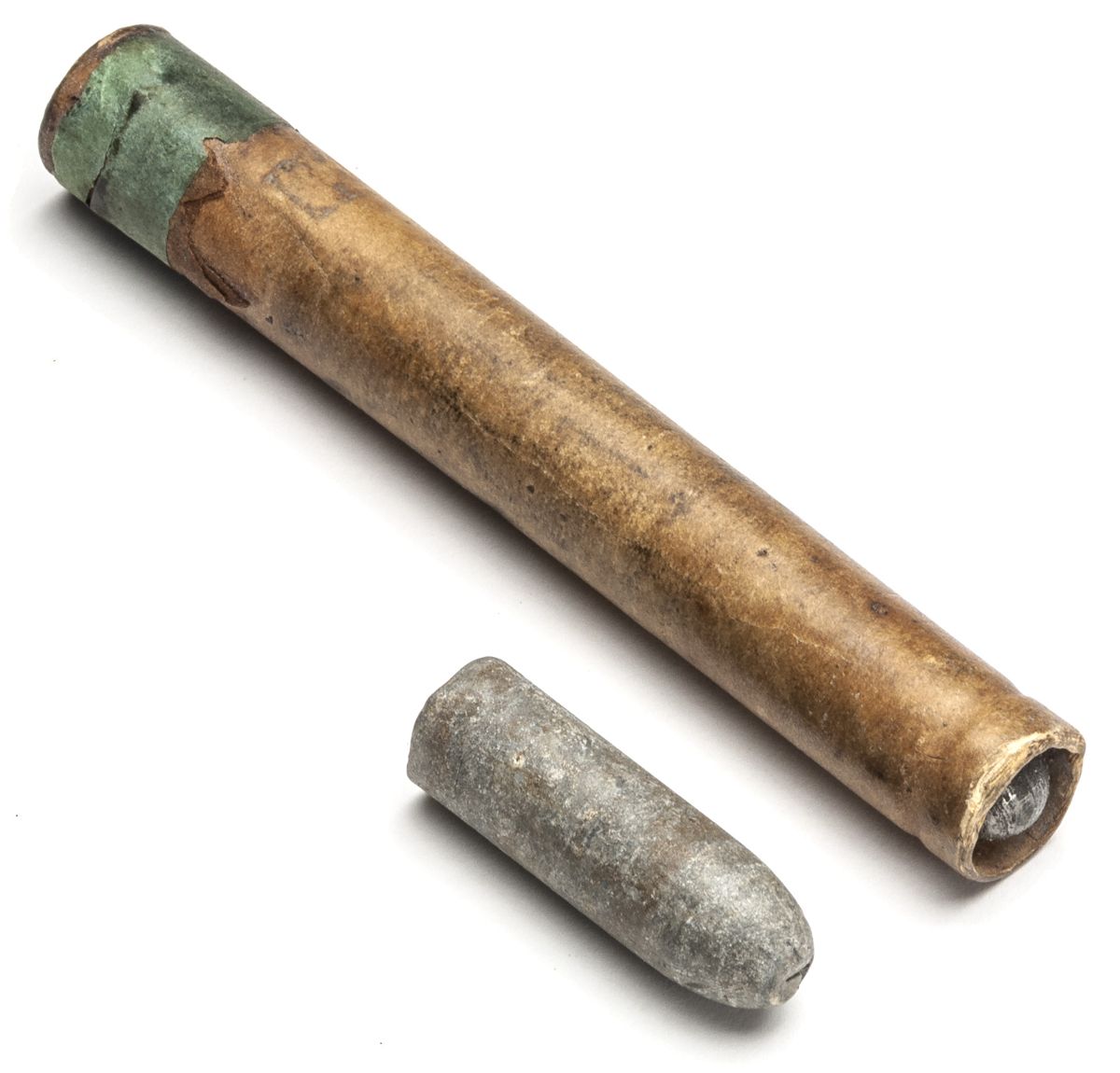
In 1859, Joseph Whitworth patented a special cartridge cardboard tube around the bullet and powder charge. The tube was intended as a sort of false muzzle to hold the cylindrical bullet in place just before it was rammed down the barrel, thus seating it evenly. After loading, the tube was discarded. Left: A Whitworth cartridge in a cardboard tube and one of the deadly round nosed cylindrical Whitworth bullets. The long bearing surface relative to the bullet’s diameter was one of the keys to the bullet’s stabilization and long-range accuracy.
Right: Hexagonal Whitworth bullet inside a cardboard cartridge.
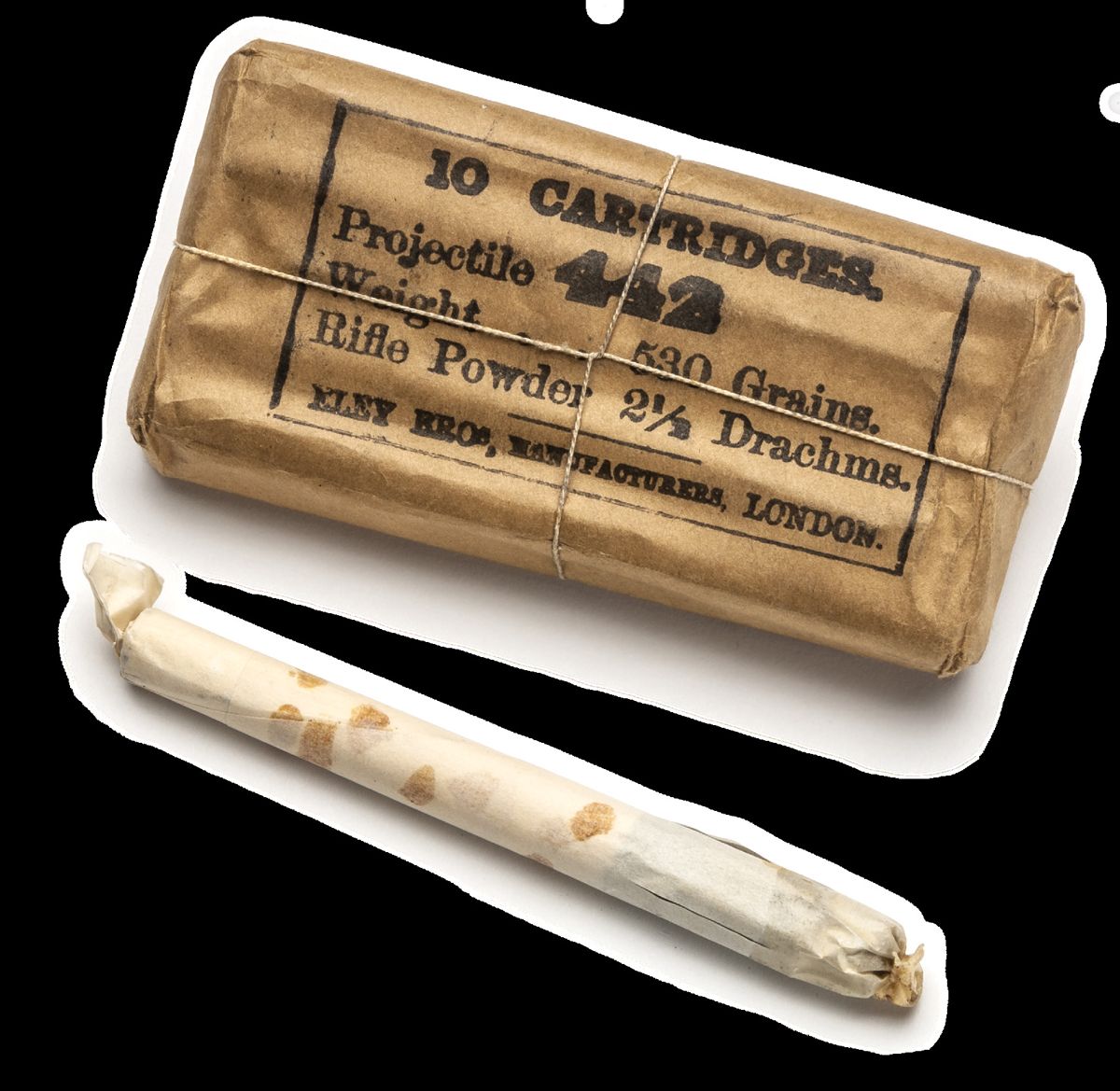
A packet of ten Whitworth cartridges made by Eley Brothers. Eley supplied hundreds of thousands of rounds of ammunition to the Confederacy during the Civil War. In addition to the expected English ammunition for Enfield pattern rifles and muskets, they also supplied .69 caliber buck and ball cartridges and ammunition for the Austrian Lorenz. Some cartridges provided with Whitworth rifles were made in the “American” style, that is, with the cylindrical bullet wrapped in plain white paper. This bundle of ten cartridges was made by Eley Brothers of London, one of England’s largest ammunition manufacturers. Artifacts courtesy the Atlanta History Center.
B 547 WHITWORTH 2ND-QUALITY MILITARY MATCH RIFLE, WITH DAVIDSON STYLE TELESCOPIC SIGHT
The Whitworth rifles purchased by the Confederate government were of a particular configuration known as second-quality military match (or target) rifles. These arms were built with a thirty-three-inch barrel secured to a checkered stock with two bands and as expected for a sharpshooter rifle, no provision for a bayonet. The term “second quality” had nothing to do with the internal quality of the rifling, sights, or lock but referred only to the external finish and features. These “economy models” lacked the usual deep polish or engraving and dispensed with nonessential features such as the safety mechanism forward of the hammer and an implement compartment. Hence, the hand-engraved “2nd Quality” (sometimes the cursive Q resembling a ‘2’; on the trigger-guard tang is an indicator of Confederate purchase in much the same way as the “JS”-and-anchor view mark on English rifle-muskets.
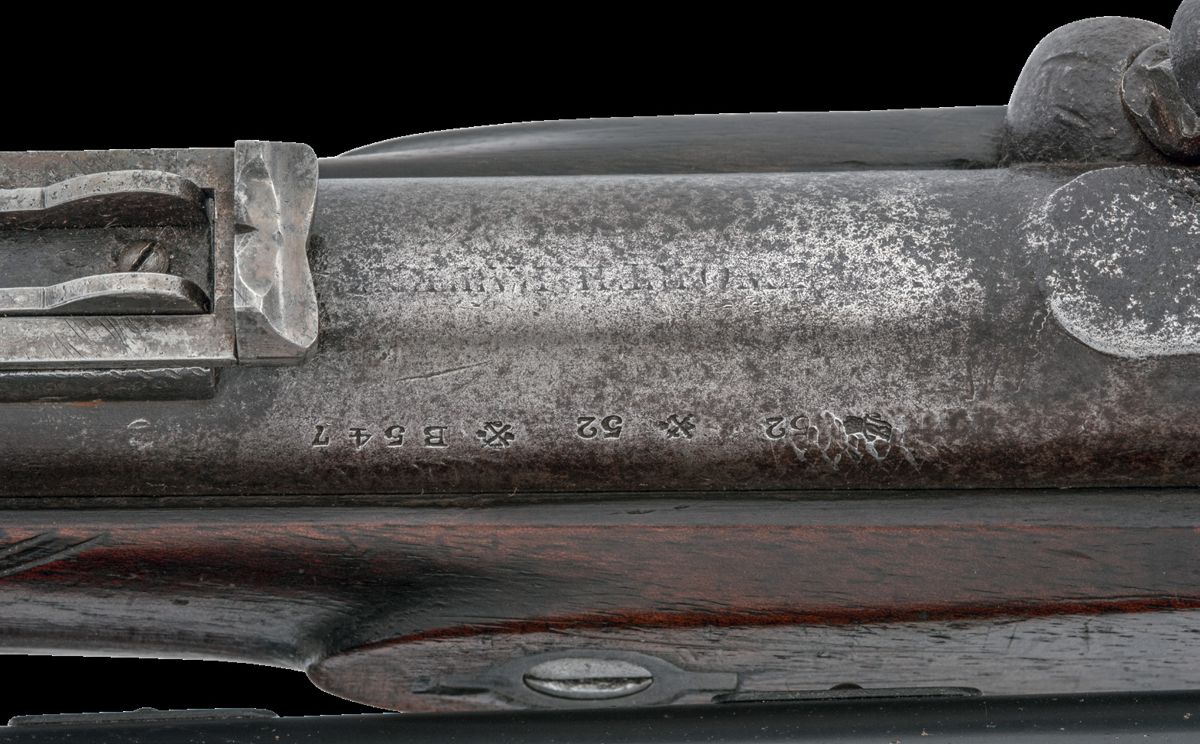
The most distinctive feature of these rifles was the Davidson telescopic sight mounted to the left side of the stock. Unlike American telescopic sights of the day, which were mounted on top of the barrel and extended its full length, Davidson s sights were only about fifteen inches long and could be attached to the side of the arm, thus allowing the option of using the open sights on the top of the barrel (adjustable up to twelve hundred yards) for closer-range work. The rear mounting ring of the telescopic sight served as a pivot point, while the front mount could be raised or lowered for elevation adjustments by using a large knob on the right side of the stock. Though closely resembling the original, this particular Davidson sight is a restoration with twentieth-century optics. The breech of this rifle is stamped with the obligatory Birmingham commercial proof marks, a bore gauge of 52 (.451 caliber), and serial number B 547. Whitworth rifles were consecutively numbered regardless of configuration; after the first one thousand were produced, a letter prefix was added for each additional batch of one thousand arms. In theory, B 547 should be the 1,547th rifle manufactured, but without a date stamp, the precise date of origin is unknown. Serial numbers for the few surviving Confederate-purchased Whitworth rifles range from B 509 to C 619. Although it is impossible to determine when or where this particular rifle was used, as one of the Confederacy’s most valuable weapons, it certainly did see use. Just as certainly, it killed and wounded many Union soldiers.
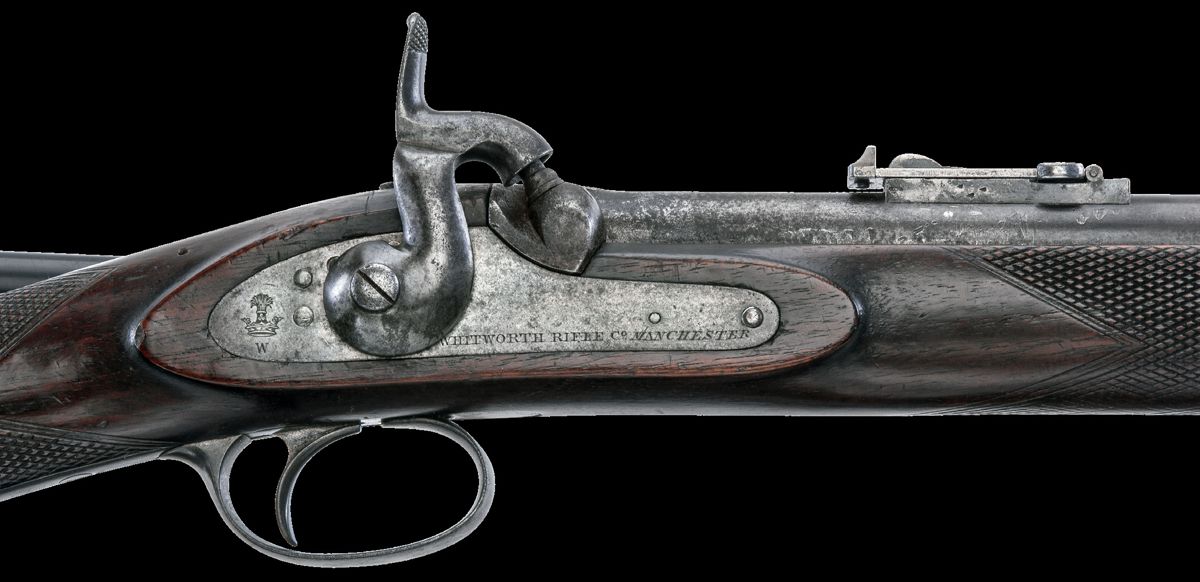
Overall view of a 2nd Quality Military Match Rifle No. B 547 with telescopic sight mounted on the left side. During their Civil War service one of the lock screws from B 902 was accidentally installed in this rifle and the screw from this rifle was installed in B 902. Photographs of B 547 courtesy the Atlanta History Center, George Wray Jr. Collection.
Overall reverse view of Confederate purchased Whitworth rifle B 547. (ca. 1861-62, imported 1863)
B 547
Lock area of this rifle marked forward of the hammer Whitworth Rifle Co. Manchester. To the rear of the hammer is the Whitworth trademark, a sheaf of wheat over a crown over W. Note the simple back sight is mounted reversed.
Barrel markings at the breech. Birmingham provisional proof, the “52” bore markings which indicate .451 caliber, view mark, 52, proof mark, and the Whitworth serial number B547.
Close up of the breech markings of Confederate Whitworth B 547, the gun that had one of the lock screws for B 902 in it.
Reverse view of this rifle showing the manner in which the telescopic sight is mounted. The few original Davidson scopes examined are surprisingly unmarked and most of those found on surviving rifles are actually later incorrect replacements on reproduction mounts, as shown in this example. (Photographs by Jack W. Melton Jr. B 547 information and photographs courtesy Atlanta History Center)
B 547
B 547
B 678 Best quality mark on Whitworth Military Match Rifle B 678, in the same serial number range as known Confederate Whitworths. This mark is a clear indicator that the gun is not a Confederate purchase.
Marks on the barrel breech are: Birmingham provisional proof, 52 [bore], view mark, 52, proof mark, and B678, along with the Whitworth barrel marking. These markings were the same style on both commercial target guns and Confederate acquired rifles.
C 317
Lock area of C 317 marked forward of the hammer Whitworth Rifle Co. Manchester. To the rear of the hammer is the Whitworth trademark, a sheaf of wheat over a crown over W.
2ND Quality engraved on triggerguard tang.
Muzzle view and front sight. Note the unrifled portion of the barrel closest to the muzzle. This wider area allows the cardboard cartridge to be inserted as a false muzzle to properly seat the bullet and do so more rapidly.
Birmingham provisional proof, the “52” bore markings which indicate .451 caliber, view mark, 52, definitive proof, and the Whitworth serial number C317.
C 317
Eye-piece is made of steel.
Steel tubed sight differs from the usual brass telescopic sights. The scope tube is 1 inch in diameter.
(Joseph Fitzgerald Collection)
C 321
Nashville Banner description of the wagon train account.
Overall view of Confederate Whitworth rifle C 321.
This wood engraving from the December 5, 1863 issue of the Illustrated London News by British correspondent Frank Vizetelly depicts Whitworth armed sharpshooters of Longstreet’s Corps on detached duty from the Army of Northern Virginia firing on Federal wagon train across the Tennessee River from Raccoon Mountain.
C 321
Reverse view of Confederate Whitworth C 321, showing the Davidson pattern telescopic sight mounted on the left side.
Close up of the telescopic sight mounted on Confederate Whitworth C 321. The tube is made of steel with brass ends.
Close up view of the elevation adjustment system for the telescopic sight.
C 321 A Whitworth cartridge in a cardboard tube and one hexagonal Whitworth bullet.
Close up of the bore of Whitworth rifle C 321. This clearly shows the hexagonal pattern which was certainly a departure from conventional rifling during the period.
C 321
Breech barrel markings. Birmingham provisional proof, the “52” bore markings which indicate .451 caliber, view mark, 52, definitive proof, and the Whitworth serial number C321.
Close up of the Whitworth barrel mark on Confederate Whitworth C 321.
(David Winfield Collection)
C 345
Angled views for a different perspective.
2ND Quality engraved on triggerguard tang.
Scope mounts for the telescopic sight.
Front barrel band with swivel, nose cap, front sight, and ramrod.
Birmingham provisional proof, the “52” bore markings which indicate .451 caliber, view mark, 52, definitive proof, and the Whitworth serial number C345. WHITWORTH PATENT marked, below right, on top of the barrel.
Knurled knob for front sight adjustment. Lock area of C 345 marked forward of the hammer Whitworth Rifle Co. Manchester. To the rear of the hammer is the Whitworth trademark, a sheaf of wheat over a crown over W.
(Joseph Fitzgerald Collection)
C 520
Lock mortise is crisp internally.
“M. C.” initials scratched into the stock.
SN 520 stamped on left rear web of trigger guard bow, rear scope mount fitting well fit.
C 520 inside lock, original components still have some muted case coloring.
Distinguishing features: Iron mounted, hexagonal patent bore with recessed starter at muzzle, fitted for scope mounts, standard Confederate configuration with “2ND Quality” engraved on trigger guard tang, checkered stock with burled flaws. Lock Markings: “Whitworth Rifle Co. Manchester” engraved in block letters forward of hammer with “crown and sheath / W” at tail. Barrel markings: Crossed scepter black powder proofs are found at left breech on either side of “52” and “C520.” SN 520 stamped on each barrel band, rear band also has number “709” in larger font of unknown purpose opposite the “520.” Serial Number: “C520” and stamped with proofs on left breech, “520” is stamped on barrel, lock, both barrel bands, trigger guard, rear sling swivel, rear sight leaf externally. Inspection and proof marks: “52” gauge markings on left side of barrel near breech with crossed scepter black powder proofs on either side. (Photographs and information courtesy John Sexton)
C 520
SN 520 stamped on both sides of rear sling swivel.
SN 520 stamped on base of 1,200 yard ladder of rear sight.
Rear telescopic sight base.
Forestock has hand worn wear to checkering from use with undisturbed patina, well fit front scope mount.
Breech markings, weak due to pitting from firing, on barrel breech of C 520. Note the 52 bore markings which indicate .451 caliber, the Birmingham proof, and Whitworth serial number C520.
C 529 CONFEDERATE DAVIDSON STYLE TELESCOPIC SCOPED 2ND QUALITY WHITWORTH SHARP SHOOTER’S RIFLE. The barrel is missing ³⁄₁₆ inch and the bore has been reamed to about a .48 caliber smoothbore.
Matching SNs are also found on lock, trigger guard, breech, and barrel band.
Stamped on the breech are Birmingham proof, 52 bore marking, view proof, 52, Birmingham proof, and SN C529.
In a 1992 letter from noted Whitworth authority John Morrow’s The Confederate Whitworth Sharpshooters, 1989. “The telescope mounted Whitworth ‘2nd Quality’ No. C529 Rifle described here conforms to the specification of all the other known surviving examples of the Confederate Purchase Special Arms.”
C 529 The brass tube Davidson scope was adjusted for elevation by turning the knurled knob on the right side of the forearm. This loosened the clamp on the left side so the 1 ½-inch bar graduated in ¹⁄₁₆ inch increments could be raised and lowered, pivoting on the rear mount secured by the rear lock plate screw. The normal long range ladder sight could be used for normal short-range shooting.
The lock has the “wheat sheaf” crown over “W” rear of hammer and “WHITWORTH RIFLE CO MANCHESTER” forward of the hammer.
Photos courtesy of Morphy Auctions, www.morphyauctions.com.
C 529
Checkering on the stock is worn from use.
A Charleston Mercury article published June 13, 1864, reported that a Whitworth-armed sharpshooter was “so skilled that in the presence of that general [Confederate General Richard S. Ewell] he put seventeen balls in succession in a space no larger than the hand, at the distance of 500 yards.”
Original tin container of Joseph Whitworth & Co. 200 Felt Wads. (David Winfield Collection)
C 529
The stock has a hand worn patina with beautiful set of initials of solider who carried this gun, “JSW” are carved on bottom of stock.
Excavated Whitworth cylindrical and hexagonal bullets from Civil War battlefields.
The scope was mounted on the left side of the rifle because it would have interfered with the hammer if placed on the right side.
Whitworth and Enfield experiment. Sheffield and Rotherham Independent (Sheffield, South Yorkshire, England), Saturday, April 25, 1857, page 9.
C 619 CONFEDERATE DAVIDSON TELESCOPIC SCOPED 2ND QUALITY WHITWORTH SHARP SHOOTER’S RIFLE.
Lock plate is marked with tufted Crown and “Whitworth Rifle Co., Manchester.”
Front and rear eye pieces are made of brass.
14 ½-inch telescopic sight on left side of stock with brass forend and thimbles. (Virginia Museum of History & Culture. www.virginiahistory.org)
C 619 Whitworth rifle, serial no. C 619 with rare Davidson telescopic sight. Rifle used by E.J. Gilbert of Maj. Gen. Bushrod Rust Johnson’s Division. Gilbert, who was a resident of Marshall Co., Tenn., used this rifle up to the 1864 Battle of Kennesaw Mountain in Marietta, Ga., when he was captured. He dismounted the rifle and hid it in his blanket. Entire forestock was cut off sometime after the war.
The barrel’s breech is marked with the Birmingham provisional proof, “52” bore mark indicating .451 caliber, view mark, 52, proof, and the Whitworth serial number C619, and “WHITWORTH PATENT.” on top of the barrel. Engraved on the trigger guard tang is “2nd Quality.” Images of C 619 have been edited, cropped, and rotated.
Overall length 49 inches, 33-inch barrel, .451 caliber, hexagonal bore, half stock, iron rib under barrel, iron buttplate, and trigger guard. No sling swivels.
To the rear of the hammer is the Whitworth trademark, a sheaf of wheat over a crown over W.
C 544
The barrel is proper 33 inches long including internal beveled crown to fit projectile to bore.
CONFEDERATE DAVIDSON STYLE TELESCOPIC SCOPED 2ND QUALITY WHITWORTH SHARP SHOOTER’S RIFLE.
C 544, 52 Bore, .451 caliber, with Whitworth’s distinctive hexagonal bore.
“WHITWORTH RIFLE CO MANCHESTER” forward of hammer on lock and Crown over “W” rear of hammer and engraved on trigger guard plate “2ND QUALITY.”
C 544
Barrel is marked on left of breech with Birmingham proofs, “52” gauge markings and SN “C 544.” Matching SNs are also found on lock, trigger guard, breech, major screws, and barrel bands.
The Japanned brass tube Davidson style scope was adjusted for elevation by turning the knurled knob on the right side of the forearm.
Photos courtesy of Morphy Auctions, www.morphyauctions.com.
C 544 Below is a list of Union generals (excluding brevet ranks) who are believed to be killed (kia) or mortally wounded (mw) from a long-range targeted shot by a Confederate Whitworth sharpshooter during the Civil War. C Major-General Amiel Weeks Whipple – (mw May 7, 1863) C Brigadier-General William Haines Lytle – (mw September 20, 1863) C Brigadier-General William Price Sanders – (mw November 19, 1863) C Major-General John Sedgwick – (kia May 9, 1864) C Brigadier-General Thomas Greely Stevenson – (kia May 10, 1864) C Brigadier-General James Clay Rice – (kia May 10, 1864) Three of the above generals (Lytle, Sanders, Sedgwick) are commonly understood to be casualties by Whitworth sharpshooters. The other three are highly possible. In all these cases, Whitworth riflemen were actively operating in the vicinity and within range at the time of the deaths.
This gun is just 10 numbers removed from the Whitworth rifle which is part of the Chickamauga National Park Museum (SN C 554) which is pictured in Firearms of the Confederacy (1944), plate XXIII and discussed on pages 27 and 28. C 544 is in the database of The English Connection by Russ Pritchard, Tim Prince, and C.A. Huey.
C 902 Lock of Confederate Whitworth B 902 marked “Whitworth Rifle Co MANCHESTER.”
Overall obverse view of Confederate Whitworth B 902, found wrapped in a blanket in a house in Colorado. Photos of B 902 courtesy of Cowan’s Auctions-A Hindman Company.
“2nd Quality” mark engraved on the triggerguard tang of Confederate Whitworth B 902. Note the use of a “Q” in “quality” that looks like a “2.” This is typical of the mark on B-series 2nd Quality guns.
REC O MME N D E D R EA DIN G FIRST-HAND ACCOUNTS BY CONFEDERATE SHARPSHOOTERS Adams, Charles R., ed. A Post of Honor: The Pryor Letters, 1861–1863; Letters From Capt. S. G. Pryor, Twelfth Georgia Regiment and His Wife, Penelope Tyson Pryor. Fort Valley, GA: Garret Publications, 1989. Benson, Barry, Berry Benson’s Civil War Book: Memoirs of a Confederate Scout and Sharpshooter. Athens, GA: University of Georgia Press, 1992. Bryan, Mary Givens, ed. Letters of a Private in the Confederate Army: Jack Felder. Bound volume in Georgia Dept. of Archives and History, July 1951. Dunlop, William S. Lee’s Sharpshooters or The Forefront of Battle: A Story of Southern Valor That Never Has Been Told. 1899, page 49, reprinted Dayton, OH: Morningside Publishing Company 1982, 2000. Leon, Louis. Diary of a Tarheel Confederate Soldier. Charlotte, NC: Stone Publishing, 1913. Lowe, Jeffrey C. and Sam Hodges, eds. Letters to Amanda: The Civil War Letters of Marion Hill Fitzpatrick, Army of Northern Virginia. Macon, GA: Mercer University Press, 1998. Montgomery, George F. Jr., ed. Georgia Sharpshooter: The Civil War Diary and Letters of William Rhadamanthus Montgomery, 1839–1906. Macon, GA: Mercer University Press, 1997. Prideau, Thomas, “The Killing of Gen’l Sedgwick,” Confederate Veteran, May 1918. Wood, Anthony. Reminiscences of the 35th GA. Regt. As Seen By A Sharpshooter At The Front. Conyers, GA: Privately published, n.d.
SECONDARY SOURCES Edwards, William B. Civil War Guns. Harrisburg, PA: Stackpole, 1962. Huey, Cleveland Adger., Thomas, Dean., Pritchard, Russ A., Prince, Tim. The English Connection. Gettysburg, PA, Thomas Publications, 2014.
Jones, Gordon L. Confederate Odyssey: The George W. Wray Jr. Civil War Collection at the Atlanta History Center, Athens, GA: University of Georgia Press, 2014. Katcher, Philip. Sharpshooters of the American Civil War. Osprey Publishing, 2002. Morrow, John Anderson. The Confederate Whitworth Sharpshooters. 1989. 2nd edition, privately published, 2002. Ray, Fred L. Shock Troops of the Confederacy: The Sharpshooter Battalions of the Army of Northern Virginia, Asheville, NC: CFS Press, 2006. Sword, Wiley. Firepower from Abroad: The Confederate Enfield and the Lemat Revolver. Lincoln, RI: Andrew Mowbray, 1986. Yee, Gary Sharpshooting in the Civil War
ARTICLES Benson, Berry, How General Sedgwick Was Killed, Confederate Veteran XXVI, 1918. Carlson, Robert Sharpshooter Weapons in the American Civil War, American Society of Arms Collectors Bulletin 107, pp. 2-28. Gross, John, The Myth of Confederate Sharpshooters and the Whitworth Rifle, The Gun Report, April 2009, pp. 29-45. Manson, H. W. , Story From the Ranks, Confederate Veteran I, 1893. Pegler, Martin, Sharpshooters of the Confederacy, American Rifleman, November 2007, pp. 59-80. Shannon, Isaac N., Sharpshooters with Hood’s Army, Confederate Veteran XV, 1907, pp. 123-127. Fleming, V. M., How General Sedgwick Was Killed, Confederate Veteran XVI, July 1908, No. 7, p. 347. The Whitworth Research Project originated with De Witt Bailey and Bill Curtis, www.researchpress.co.uk/index.php/research/hexbore
The author would like to recognize Gordon L. Jones, Ph.D., Senior Military Curator for the Atlanta History Center, and the University of Georgia Press, for research and additional text.
About the Author
Tim Prince is a full-time dealer in fine and collectible military arms from the Colonial Period through WWII. He operates College Hill Arsenal, a web-based antique arms retail site. A longtime collector and researcher, he has been a contributing author to two major book projects about Civil War era arms including The English Connection and a book on southern retailer-marked and Confederate-use shotguns. He is the author of over 60 articles on weapons in Civil War News. Tim is also a featured Arms & Militaria appraiser on the PBS Series Antiques Roadshow and serves as a Senior Consulting Specialist to the Arms & Armor department of Cowan’s, a Hindman Company.
Tim Prince
Extremely Rare Confederate Imported Whitworth Sharpshooters Rifle #B902 SOLD FOR: $108,000
WELCOMING CONSIGNMENTS We invite you to sell at our 2023 Arms, Armor & Militaria auctions. Contact us to receive a complimentary auction estimate on a single item or entire collection. INQUIRIES Tim Carey 513.666.4984 [email protected] COWANS.COM