
Spiller & Burr Revolvers – the Chronology of Manufacturing
By John Sexton · Originally published January-February 2023 · pp. 73–80
There are excellent texts providing the history of the principals and manufacturing history of Spiller & Burr brass framed revolvers made in Atlanta, and later in Macon, Georgia. William Albaugh’s The Confederate Brass-framed Colt & Whitney (1955) was the first; Matthew Norman’s Colonel Burton’s Spiller & Burr Revolver: An Untimely Venture in Confederate Small-Arms Manufacturing (1996) is both the most recent and a truly comprehensive study. This article is intended to examine individual revolvers and determine when they were made and where. I have studied Confederate handguns for forty years and have personally examined almost all surviving Spiller & Burr revolvers. My research has included details of characteristics not previously thought important, such as serial number (SN) die fonts as well as determining sequences of manufacture to narrow down the probable site where a specific Spiller and Burr revolver was manufactured. By identifying the factory, the time frame for the pistol’s manufacture and date of issue can often be determined. The First Model Spiller & Burr revolvers were produced with open frames and thus almost duplicated the Whitney 2nd model-1st type navy revolver. This occurred because the government supplied the Whitney as the model type to be followed. Whitney produced two versions of his first model pistol. The first guns submitted for inspection during late 1862 are the 1st type. Whitney submitted twelve revolvers, ten passed inspection; only one, SN 13, survives today. After several modifications, a second version of the 1st model Whitney was completed. Forty 2nd Type, 1st Model Whitneys were submitted for inspection in April 1863; only seven passed, and today only SN 23 survives. Spiller & Burr began producing their standard 2nd model during the summer of 1863. The revolvers were turned out at the rate of 200 a month. During the previous two years, Spiller and Burr produced only fifty-two revolvers, all with the open frame, indicative of the 1st model. The Spiller & Burr 2nd Model production run ended December 31, 1863. By then the Atlanta operation had produced 854 revolvers. The Confederate government purchased the factory’s machinery and unfinished parts, then moved everything to the Macon armory in January. Macon records show an additional 677 revolvers were produced between April and December 1864. Spiller & Burr revolver serial numbers found on their standard 2nd model guns will surprise most collectors because many lower serial numbered revolvers are later Macon 1864 issue. Many Spillers cataloged in past years as 1863 Atlanta production because they had a low SN are now known to be Macon manufacture; in fact, more low SN survivors were issued from Macon. Here, the term “issue” is used when referring to Macon guns because most are reworked Atlanta production revolvers that either failed their initial inspection or were damaged/failed during use and were sent to Macon for repair where new parts were given serial numbers matching the revolver’s original SN. The highest known Spiller & Burr SN is 1248, a Macon issued pistol made up from mostly Atlanta made parts. The highest SN for an Atlanta issued gun is actually 1219. This pistol was issued from Atlanta, then, apparently failed in the field, was repaired, reissued from Macon during June 1864. The earliest surviving Atlanta SN in the current database of 188 revolvers is SN 27; the lowest Macon production pistol SN is, however, SN 5. The first 100 government accepted Spillers were issued during August 1863 and most likely fall within the 1-123 SN range. Of the 112 revolvers submitted for inspection, 100 passed. These revolvers all have specific factory inspection marks and “CS” government acceptance stamps. This lot of the first 100 revolvers all have factory inspection markings internally on left inside of the grip frame and the “C.S.” inspection mark on the right side James Burton wrote out a specific system of manufacture and inspection procedures at beginning of the Atlanta production run that notes, “This first inspection requires appropriate stamp on left side of frame.” Revolvers in the first lot of 100 passed on August 4, 1863, all have their inspection mark under the left side grip, and the “C.S.” government acceptance stamp on the frame’s right side. The inspection of the first lot of Spillers was performed at the Macon Armory. After that first run, all the Atlanta production guns were inspected in Atlanta with the “C.S.” placed on the left side with the factory inspection mark. All Atlanta production guns after SN 123 have both the factory inspection mark and the “C.S.” government inspection mark on the left side. Initially, cylinders were not numbered as Colonel Burton’s May 15, 1862, “Proposed Order of operations on the various parts of revolving pistol, Whitney’s pattern…” makes no provision for cylinder serial numbers even though all other components were numbered in the specific sequence of manufacture. Spiller & Burr did not number their cylinders when they were originally produced in Atlanta or Macon. The cylinders were serial marked only after they were replaced because they initially failed the factory inspection. This is the explanation why so many 2nd models have serial numbered cylinders; they were renumbered when inspected at the armory after being repaired or replaced. Atlanta-made guns had inspector initials and/or “CS” stamped on their left side as directed in Burton’s inspection protocol only after they passed inspection. Macon inspected guns were stamped “CS” on right side of gun using the same distinctive die used earlier in Atlanta. The Macon “CS” mark is seen on all documented revolvers A variant “C.S” die with identical letters but missing a period after the “S” has been observed on the twelve known survivors in SN range 64-345. These are stamped on the left as typically March to June 1864 Macon inspected and issued guns.
In the database of 188 surviving Spiller & Burr revolvers, 208 Spiller & Burr serial numbers are documented, but many of these “guns” are incomplete or excavated. The discrepancy between the number of serial numbers and the total guns is due to mixed numbers found on survivors, something that only occurs on Macon issued pistols.
Spiller & Burr was paid by the Confederate government for 854 revolvers. This figure clearly shows that some 400 revolvers, most with early serial numbers, initially failed inspection and were rejected. When the factory moved to Macon, under Confederate Ordnance Department auspices, these Atlanta failures were repaired, refitted with new parts, and reinspected.
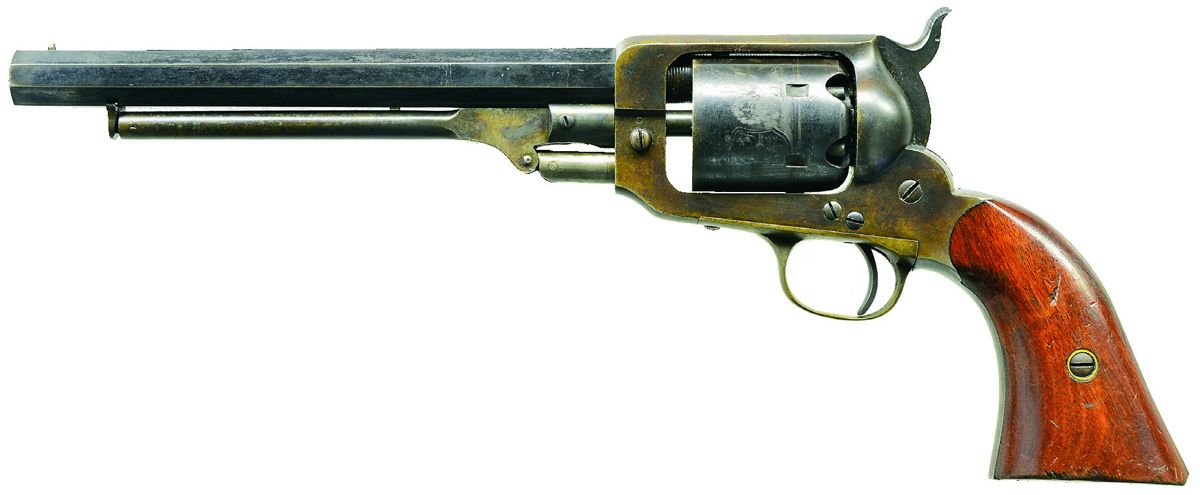
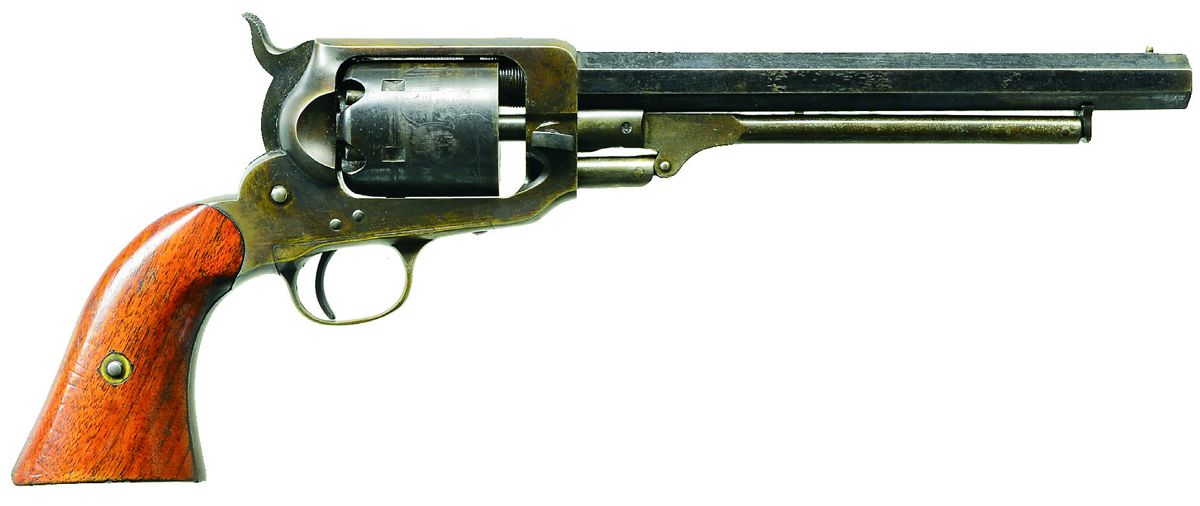
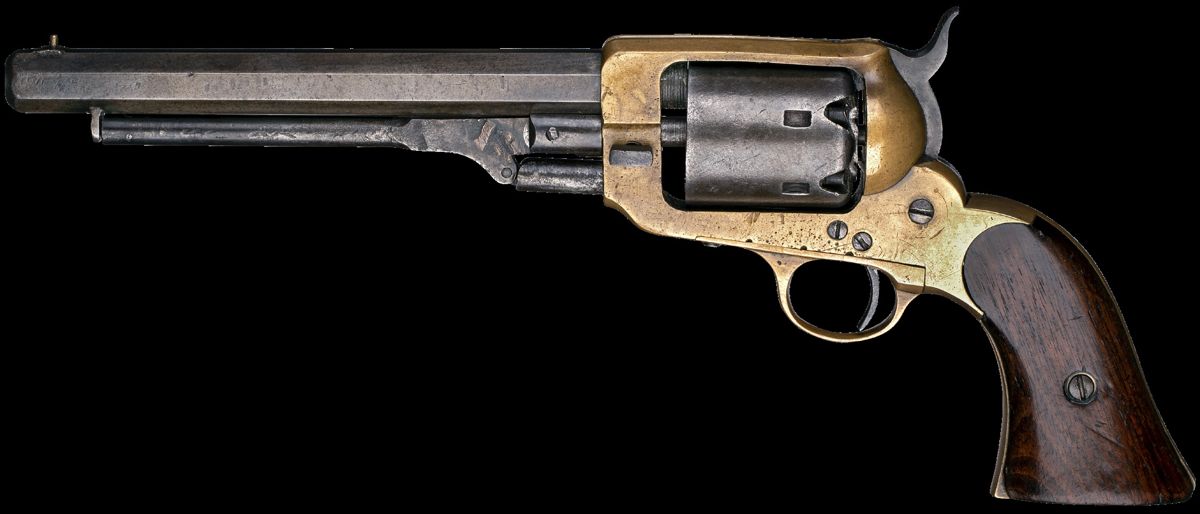
Whitney 2nd model, 1st type, the pattern gun for the Spiller & Burr 1st model (SN 444). (Courtesy Poulin Auctions, lot 3026, May 9, 2022)
SN 13
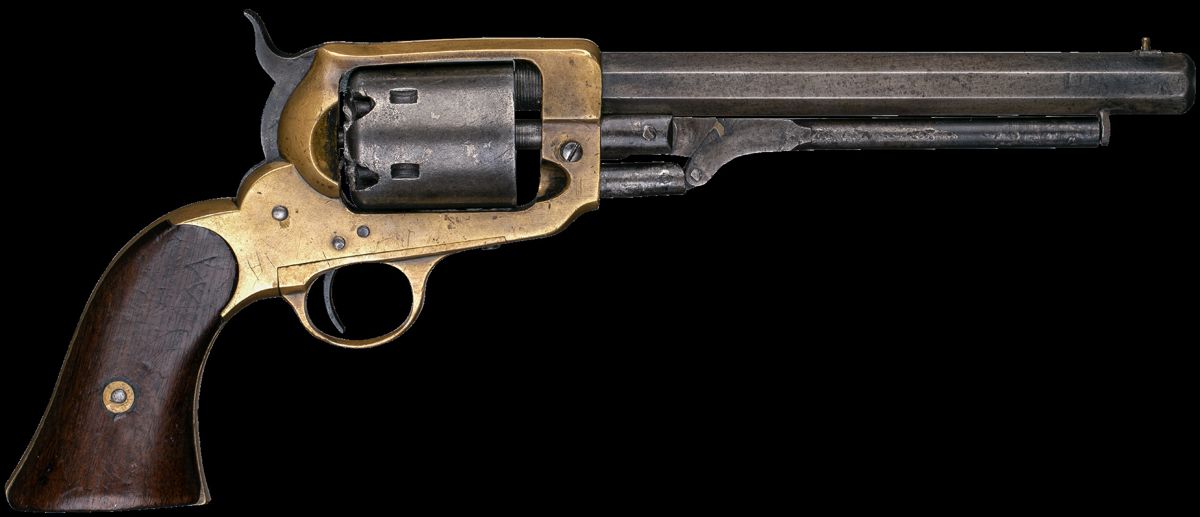
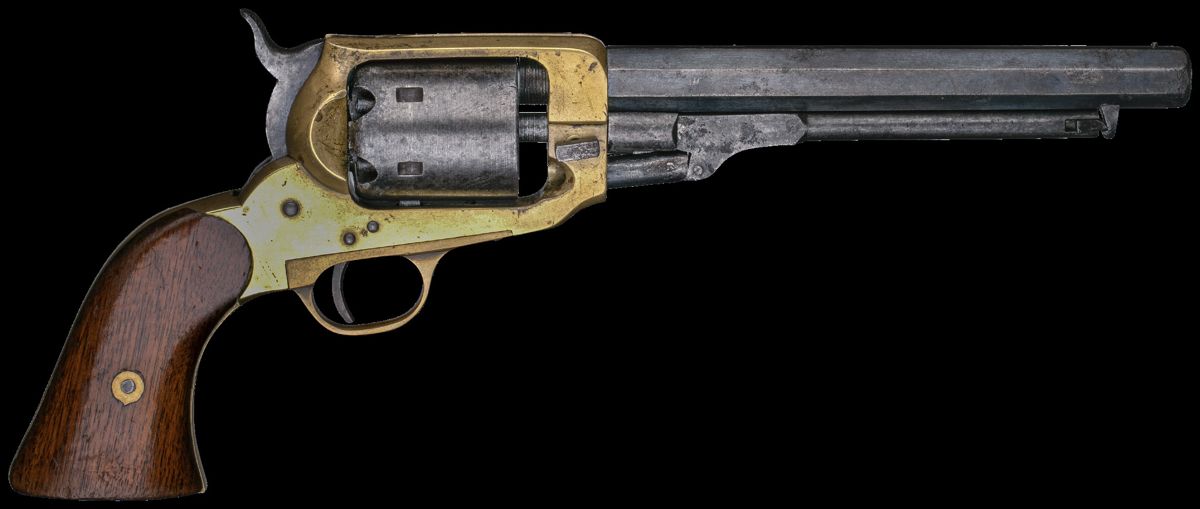
SN 13
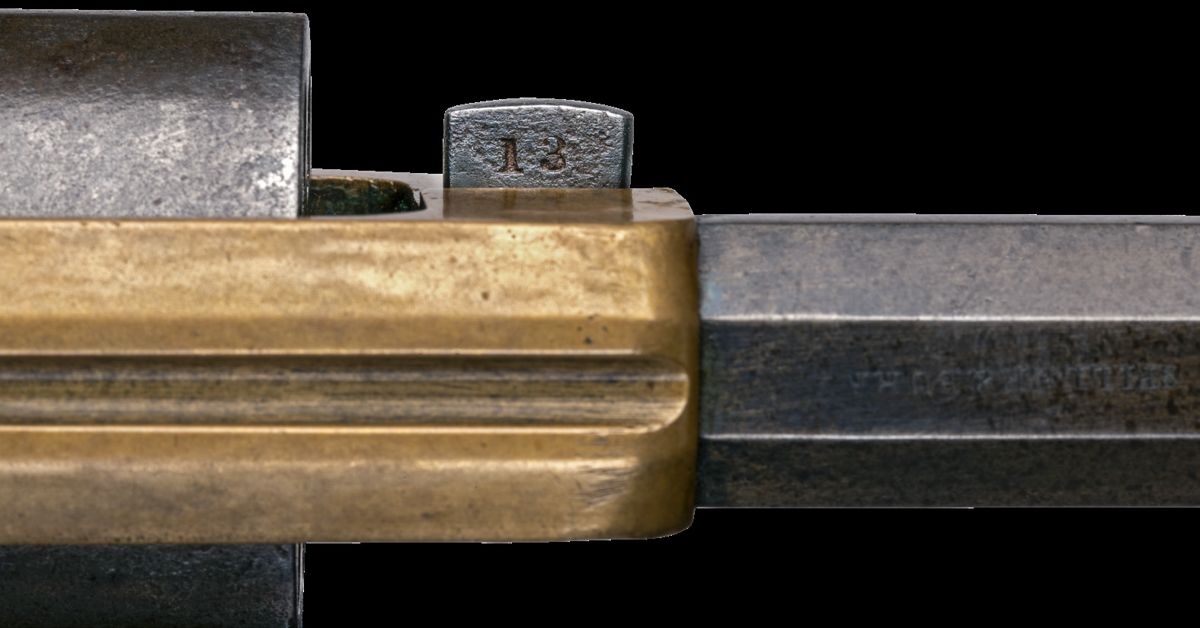
SN 13 is the only Spiller & Burr pistol with a SN on the “thumb bolt,” or “wing nut,” that locks cylinder pin in place.
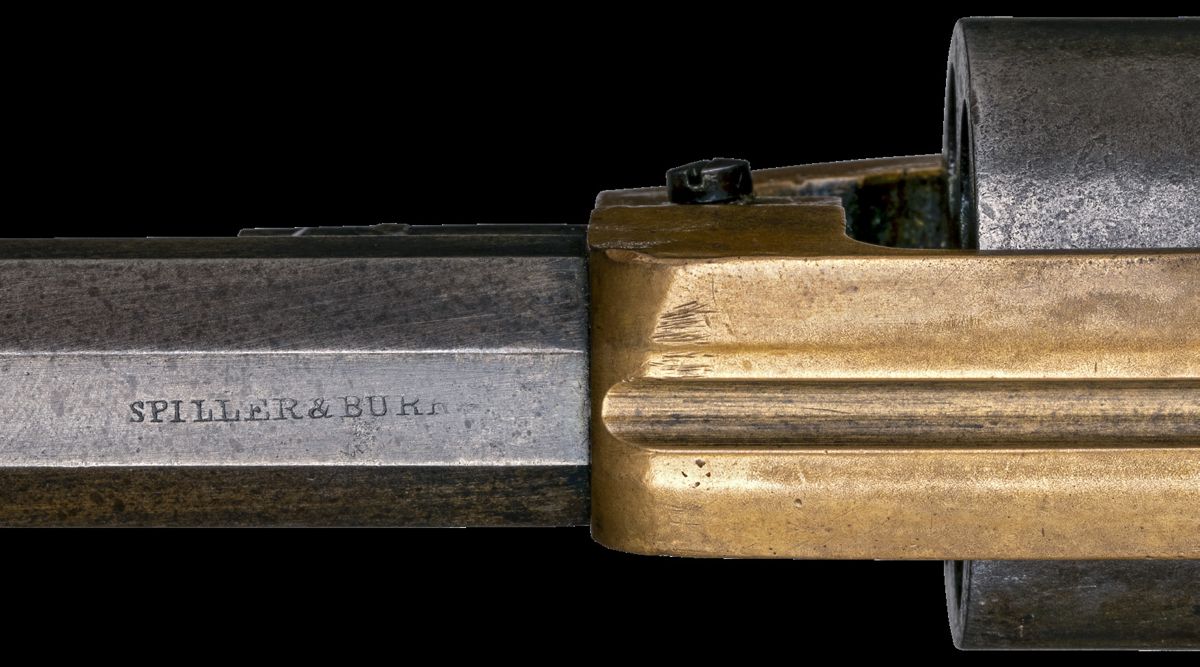
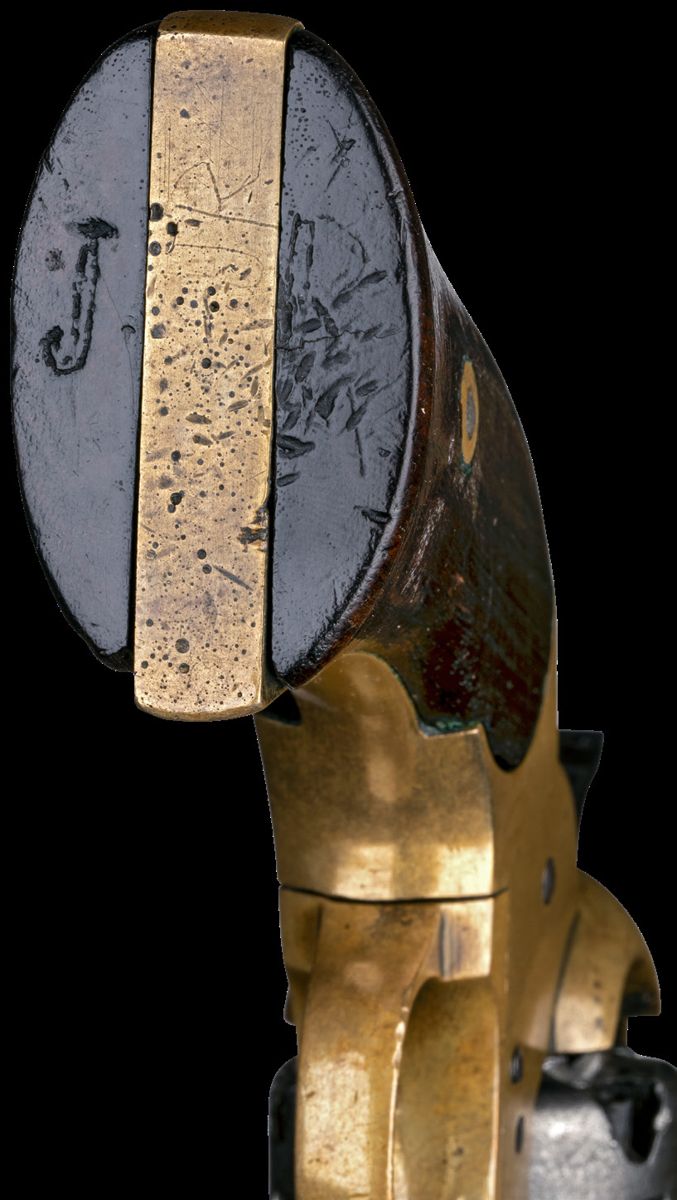
SN 13 is the only surviving 1st model-1st type, Spiller & Burr revolver. It was inspected during December 1862. It is a copy of the 2nd model-1st type Whitney Navy revolver with a silver-plated brass, instead of steel, frame; only vestiges of the plating are visible on protected areas under grips. This pistol has a twisted iron cylinder instead of one made using steel. This particular revolver has a slightly smaller bore measuring .35 caliber (.346inch at the muzzle), with a ball type catch for the loading arm, no safety slots on the cylinder’s rear, a crowned muzzle, and flatter milled wood grips. These same features are also found on the original Whitney pattern piece it was copied from, although the Whitney shows less muzzle crowning. After the Confederate government inspected the 1st model-1st type Spiller & Burr revolvers on December 26, 1862, suggestions for improving the pistols were made by the inspector. The suggested changes are found on the next lot of pistols submitted for inspection five months later. SN 23 is the only surviving 1st model-2nd type Spiller & Burr of the seven that passed inspection May 1, 1863. The seven accepted pistols were in a lot of forty pistols submitted. This lone survivor exhibits the changes suggested by Confederate inspector Maj. William S. Downer. These changes include a stronger Colt style loading lever latch, a lack of electroplated silver on the frame, six safety slots milled into the cylinder rear, and lastly a change in bore to .36 caliber. The shift to .36 caliber allowed these pistols to use the standard ammunition being produced for use in Colts, Griswolds, and Leech & Rigdon revolvers. The 1st model, SN 23, is the only pistol that has the “SPILLER & BURR” marking in more than one place. It is stamped three times; twice on the frame, and one on top of the barrel flat, where other examples are marked. The mark is from the same die used on all original examples with slight variations of partially filled letters as die wore. This is as crisp a mark that can be seen.
SN 23
There is one surviving complete revolver made with a 1st model unnumbered open frame that has parts with mixed serial numbers. SN 6 appears on the loading lever, 17 on the cylinder pin, and 79 is on the barrel.
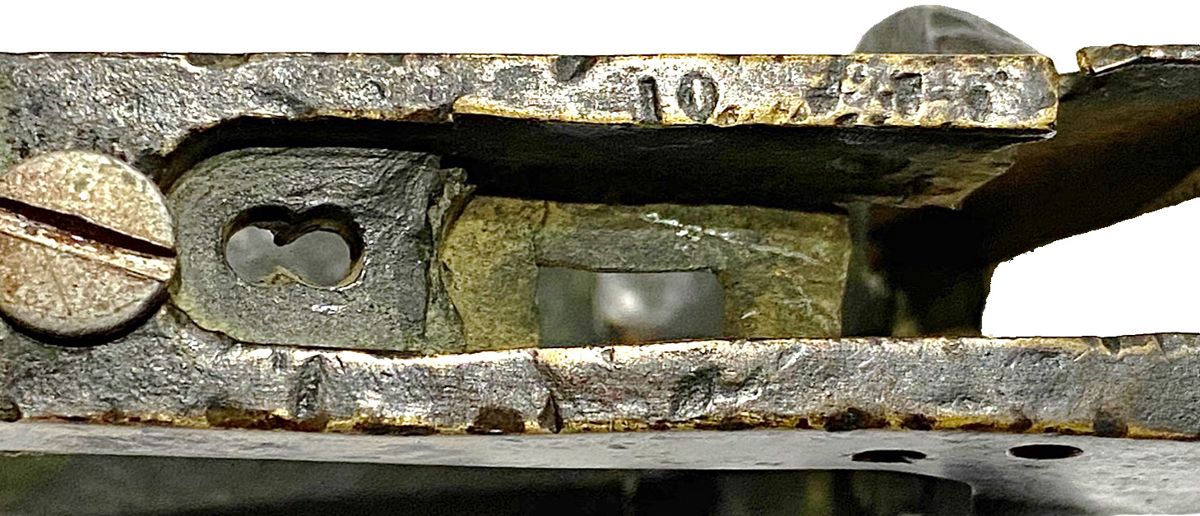
due to the broken and warped top strap that was a major complaint of inspectors. SN 10 is most likely from a 1st model 2nd type revolver as it lacks the cast hammer notch in top strap found in SN 23.
There are three original open frame revolvers that show ⁵⁄₁₆ inch barrel threading found on the Whitney pattern piece. The only other surviving 1st model open frame is SN 10. This was excavated on, or near, the site of the Macon Armory and is thought to have been repeatedly test fired,
Major Moses Wright’s May 20, 1863, inspection report concluded by suggesting changes to frames were necessary to make Spillers field worthy including thicker stronger frames with no gap exposing the barrel threads. This change marked the beginning of the 2nd model production.
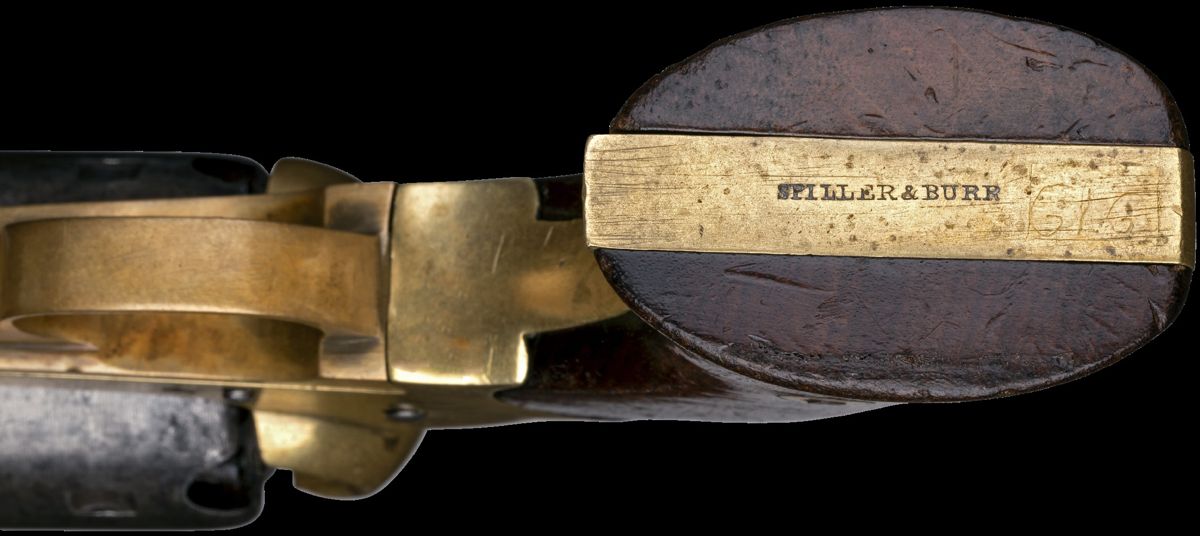
The “SPILLER & BURR” marking die never changed. Only one die was used, and this stamp is found on all authentic revolvers; all were originally Atlanta production guns. The highest known SN with this manufacturer’s marking is SN 1058. Only the Atlanta finished barrels have this barrel stamp.
NSN (Courtesy of Hayes Otoupalik)
SN 6 appears on the loading lever, 17 on the cylinder pin, and 79 is on the barrel. Excavated 1st model frame, SN 10.
SN 10 SN 10 stamped on bottom of frame. Frame excavated near the site of the Macon Armory according to The Gun Report article, March 2004, pp. 36-39. There is no CS stamp on the side of the frame. No notch was cut in frame for the hammer, so like SN 23, 2nd type, again non-sequential numbering of Spiller & Burr.
Here is a portion of Maj. Moses Wright’s May 20, 1863, inspection report pointing out the fragility of the 1st model frames. The suggested change marked the beginning of the 2nd models produced with his recommended strengthening of frames with added metal.
TRANSITIONAL/PATTERN
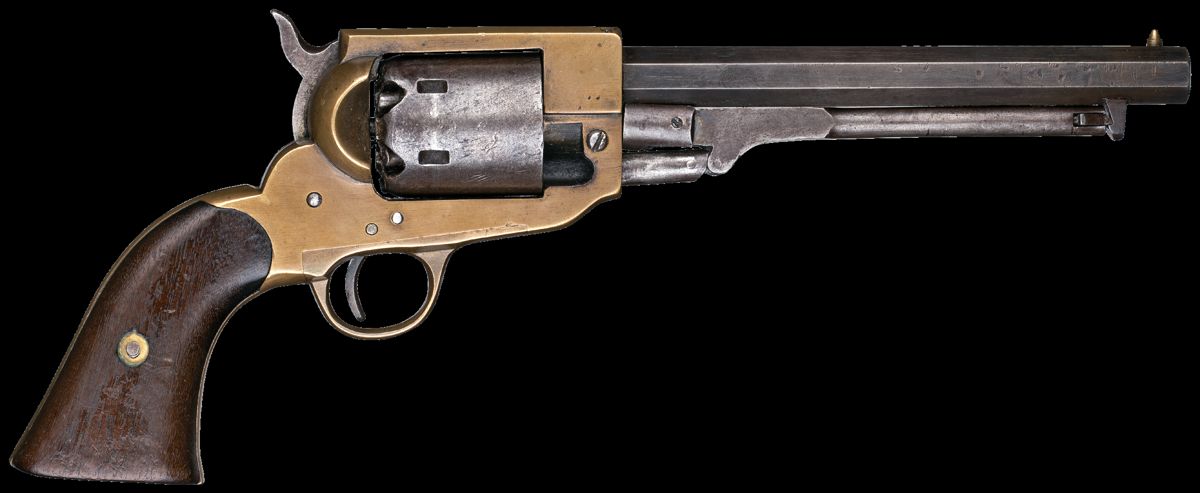
Sighting channel and loading port are unfinished on this pattern piece. Major Wright recommended a smaller sighting channel to leave more metal for structural integrity. The large brass cone front sight found on all 2nd models appears for the first time on this pattern. The grips are unfinished and thicker at the butt even though they have the milled flat abutting the frame found on all Spiller revolvers. This thickness left room for final finishing.
“The rejected pistols were returned to Spiller in Atlanta. Frames were melted, and some components were reused. Early 1st model parts are found on later fabricated guns. Amazing that the Atlanta Pistol factory could only deliver 52 revolvers to be inspected by Spring 1863 and only 17 passed inspection. No doubt Spiller manufactured many more revolvers that failed internal testing as inventory correspondence states over 100 guns almost finished late in 1862. Most Confederate revolvers are rare, the two surviving examples of the 1st Model Spiller & Burr revolver are justifiably ranked among the rarest and most desirable of American made small arms of the Civil War.” (Kusrow, Bruce and Norman, Matthew, “The Southern Cousin of The Whitney Revolver: From the Federal to the Confederate Model,” 1999 (unpublished))
This unfinished frame shows 2nd or 3rd stage milling with an unfinished loading port and thin, partially finished sighting channel. (Dennis Headlee Collection)
There is a known unnumbered, uninspected, non-maker marked, transitional, 2nd model pattern that probably dates to the May-June 1863 period. Dimensionally, this unnumbered pistol is the same as standard production 2nd model but the frame has slightly more metal, especially in the top strap, although this thickness is not much more than an unfinished frame taken from Macon Armory in 1865 by a Union soldier as a souvenir.
All known SNs started out as Atlanta production. Since the highest SN is 1248 and Spiller was paid for 854, there were over 400 unfinished Atlanta revolvers, and we can conclude that lower SNs were based on Macon issues. Macon production totaled 665 issued revolvers with twelve still in inventory in January 1865. Macon “production” appears to consist of only finishing or fabricating specific parts needed to bring failed Atlanta revolvers up to standard and repair damaged revolvers turned in for repair.
The Spiller & Burr Atlanta Pistol Factory now had a design that worked. After two years of failure with a defective pattern, Spiller would go on to fabricate nearly 200 pistols per month. The first lot of 112 2nd models were submitted for inspection August 4, 1863; 100 were accepted. In only five months, Spiller submitted almost 1,000 guns for inspection before Dec. 31, 1863. Of that total, 835 passed inspection and went into service. At the end of 1863, the factory moved to the Macon Armory taking machinery, pistol parts, and failed and unfinished revolvers, for production under Confederate government ownership.
This interpretation can be shown with SNs known to have passed inspection in Atlanta during 1863 that were subsequently inspected and passed again in 1864 because they still had the Atlanta “CS” surcharge on the frame’s left side. Cecil Anderson stated in his 1974 monograph that he felt Macon produced no new revolvers, and only repaired earlier Atlanta examples, an assessment that seems even more correct today.
Getting machinery set up in Macon and finding employees took time. It was not until February 18 that production restarted. The first 100 pistols were delivered to Atlanta in March, another 100 were sent in April, and 150 in May. There were many parts that came from Atlanta; and the first guns no doubt were repaired by cannibalizing failed Atlanta production pistols. The lists of inventoried parts included over 5,000 good steel barrels in various stages of completion; no barrels needed to be manufactured in Macon. Applying the “SPILLER & BURR” marking on the barrel was never done in Macon. The “SPILLER & BURR” marked revolvers issued in Macon were all repaired or reworked guns usually found with distinct Macon inspection or numbered repair marks.
There are a few survivors which appear to be 100% Macon manufacture including barrels with Macon SNs. There are many survivors in the SN 200 range listed in the Macon records as being made in May and sent on to the Military Store Keeper (MSK) in Atlanta on June 4, 1864. We will follow up in next issue with 2nd model standard production revolvers which were made from Summer of 1863 through end of war.
About the Author
John Sexton holds the highest designations as certified appraiser with International Society of Appraisers (ISA-CAPP) & accredited senior appraiser with American Society of Appraisers (ASA) specializing in Civil War memorabilia. He authenticates and evaluates other rare and valuable historic items as well. He is coauthor of the book Confederate Bowie Knives (2012) with Jack Melton and Josh Phillips, published by Mowbray Publishing Inc., and author of many periodical articles on Confederate arms. John’s contact information: website: www.civilwarappraiser.com, email [email protected], cell 770-329-4984.