
Historical Accounts of Whitworth Rifles
Compiled by Jack W. Melton Jr. · Originally published January-February 2023 · pp. 47–52
- It places persons with short or defective vision on a par with those possessing the best sight. Having thus described the nature of my said Invention, and the manner in which it is to be performed and carried into effect, I would observe, in conclusion, that I do not restrict or confine myself to the precise details and arrangements which I have described or referred to, as variations may be made therefrom without deviating from the principles or main features of my Invention; and, moreover, that what I consider novel and original, and therefore claim as my Invention, are,— First, the construction of the field bar of the telescope with the slides and fittings, and arrangements connected therewith, herein-before described and set forth, or any mere modifications thereof. And, secondly, the methods of arranging and fixing telescopes in combination with fire-arms, and the mechanism for effecting the same, for the purposes aforesaid, hereinbefore substantially set forth and described, or any mere modifications thereof. In witness whereof, I, the said David Davidson, have hereunto set my hand and seal, this Seventeenth day of June, in the year of our Lord One thousand eight hundred and sixty-three. D. DAVIDSON. (L.S.)”
The following text is from the book written by Davidson, David. Memoirs of a Long Life. United Kingdom: D. Douglas, 1893, Chapter XIV, pp. 340-342. “CHAPTER XIV.
IN reply to a letter of mine, I received instructions from the War Office, dated 23rd January 1858, to apply my patent military telescopic sight to two Enfield and two Whitworth rifles. This I did in Edinburgh, and took them to Whitworth’s gallery to be tried. The result was most satisfactory, Mr. Whitworth saying, “I can now for the first time shoot with my own rifles, the telescope supplying the place of my defective sight.” He at once bought my royalty for a considerable number, but for what purpose I could not ascertain. I left the rifles with him to be forwarded to the War Office, and was surprised afterwards to find they were kept back nearly three years, the reason assigned being that Mr. Whitworth was not yet prepared for his rifles being made public. Whether, when sent, they were ever tried, I could not find out. When the civil war in America was going on, I happened to read in the papers an article of which I kept a copy, in which the writer exposed the absurdity of tabooing the use of telescopic sights at Wimbledon, as not military, when, he added, “at this moment we believe there are many men, in the ranks of the Confederate army, doing fearful execution, at almost fabulous distances, with Whitworth rifles, fitted with strong and compact telescopes.” When I read this, I saw where my telescopes had gone, and why the rifles I had fitted with them for Government had been kept back. Recently Mr. C. Frederick Lowe, the well-known rifle shot, took up my application of telescopic sights both for rifles and cannon ; and, with a courage and persistency equalled only by the generosity that led him to fight for an invention not his own, he searched into the matter, and discovered not only that a hundred Whitworth rifles fitted with my telescopes had run the blockade for the use of the Confederates, but he also found a Confederate soldier, named Shannon, who had carried one of them through the whole war ; and who gave in a letter, dated July 1886, a most interesting account of the service they had done. He said that five rifles had been assigned to each division ; and that he was one of the five selected from General B. F. Cheatham’s division, and that he was present at all the battles fought in that department, from Shiloh to Beatonside. He said : “At the battle of Franklin, Tennessee, which was a desperate affair, our detachment of five of these guns opened the battle, and fought for an hour or more, until the divisions formed and came up. I fired the first shot in that engagement.” On one occasion, he said, they raised their telescopes to 2200 yards elevation, and then aimed at the tops of pine timbers, at least 100 feet high, which stood on the edge of a large cotton plantation, dropping their balls amongst a large park of waggons and ambulances, and in a short time cleared the field of every waggon. He supposed the range was two and a half or three miles. This last is evidently in excess. Telescopes were also used on the Federal side. A distinguished Federal general told Mr. Lowe that a small body of telescope men kept a Confederate battery silent for some twenty days ; and when it was subsequently taken, they found about fifty of the gunners killed, chiefly by shots in the head and shoulders, and this at a distance of 1100 yards. In 1887 an English Martini rifle was sent to me, with instructions from the War Office to fit it with my military telescopic sight. The Select Committee, by an extraordinary blunder, in adopting the ratchet grooving, made 100,000 barrels with the ratchet reversed ; and it was one of these that was sent to me. Having fitted a telescope to this rifle, in spite of the theoretic blunder,—showing that the spin may be given with any kind of grooving,—it shot with extreme accuracy ; so much so that six out of seven shots at 100 yards would have hit a threepenny-bit, and per forming with corresponding accuracy at long ranges up to 1300 yards. It was forwarded by the Surveyor-General of Ordnance to Hythe ; where, after a very inadequate trial, it was condemned. I particularly explained that I pitted it against open sights, where the object to be hit could not be discerned by the naked eye; and that, in the trial, such objects, instead of targets with well-defined bull’s eyes, were to be used, but this was not done. It is evident that, as long as the existing system prevails, inventors outside the dominant clique can have a poor chance of fairplay. When Continental nations lead, then England follows suit.” Lieutenant Isaac Shannon, a Confederate sniper, wrote Lowe a letter containing information about Whitworth rifles: Regarding their distribution: Five of the telescopic-sighted rifles were given to each division’s top marksmen in the southern army. Shannon was one of the five in a “company of special sharpshooters” under Lieutenant John M. Ozanne in General Benjamin Franklin Cheatham’s Tennessee division. Thirty Whitworth rifles and sixteen Kerr rifles were claimed to have amassed by the sniper company in General Patrick Cleburne’s division of the same army in Tennessee. *
Sources
The British Soldier’s Firearm 1850–1864; C H Roads, Herbert Jenkins, London 1964. Civil War Guns; William B. Edwards, Stackpole, Harrisburg, Pennsylvania, 1962. Davidson’s Telescopic Rifle Sight; Steven Roberts, 2010.
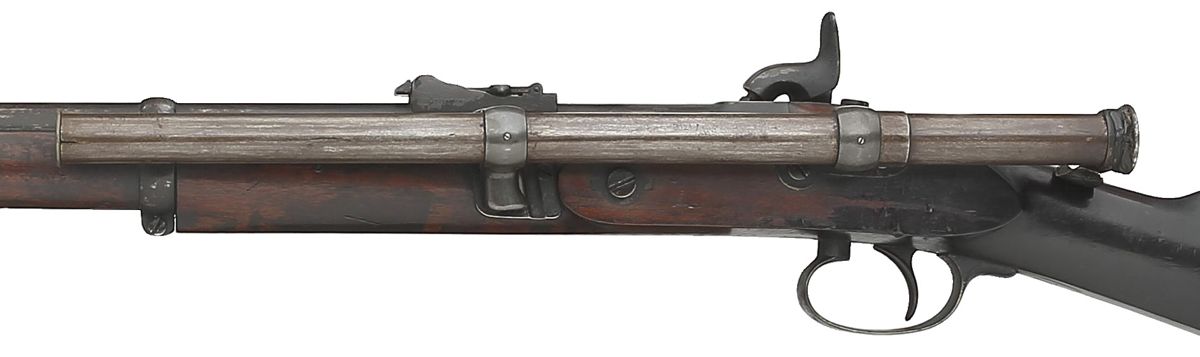
WHITWORTH PATTERN PERCUSSION MUZZLE-LOADING RIFLE FITTED WITH DAVIDSON’S TELESCOPIC SIGHT The lock is of Pattern 1853 form but slightly smaller throughout. The cock and plate have the typical double border lines engraved. On the tail of the plate is engraved a wheat sheaf over a crown over a W, and ahead of the cock, WHITWORTH 1858. Stocked to 2/13/16 inches of the muzzle the barrel retained by three Enfield pattern clamping bands. Iron furniture. The trigger guard of the typical twopiece quick-removable pattern used on experimental arms, with the lower sling loop through the rear of the trigger plate. The buttplate has a short blunt tang. The ramrod is of P-53 type but smaller in diameter. The stock is of P-53 design. The barrel bands are stamped F. PRESTON as is the ramrod. The top of the barrel is engraved ahead of the back sight, JOSEPH WHITWORTH PATENT and to the rear of the
English Patents of Inventions, Specifications: 1862, 3354– 3419. United Kingdom: H.M. Stationery Office, 1863. Journal of the Royal United Service Institution; Volume VIII, W. Mitchell & Son, London 1865. Mechanics’ Magazine; No 1,680, London, October 20, 1855. Memoirs of a Long Life; David Davidson, David Douglas, Edinburgh, Scotland 1890. The Rifle; and how to use it; Hans Busk, Routledge, Warne & Routledge, London, 1861. Rifles and Volunteer Rifle Corps; Llewellyn Jewett, Ward & Lock, London, 1861. Report of the Twentieth Meeting of the British Association for the Advancement of Science held at Edinburgh in July and August 1850; John Murray, London 1851.
backsight is numbered 110, and stamped on the left breech with a crown over W. The barrel screws into a separate breech piece which incorporates the nipple seat and the tang, just ahead of the front of the nocksform. The sights are of P-53 design, but the elevating ramps on the backsight are lower, and the leaf is not graduated. The base of the leaf is stamped 110. The bed is stamped PRESTON. The Davidson Telescope (which was not patented until December 19, 1862, No. 3390 of that year) is of standard form. The barrel is of P-53 form and is made of homogenous iron of Whitworth’s fabrication-a major factor in greatly increased cost of these rifles which deterred the government from seriously considering their purchase from a private firm. The rifles were offered at £10 each, or rather £3.5.1 from the London and Birmingham trades, or £1.19.8 of Enfield manufacture. This is one of twenty-five rifles made by Whitworth for the trials of 1858, but this particular number, 110, was not amongst those tested, and must have been one of the fifteen rifles which were withdrawn before the trial. This steel tubed scope was developed by Lt. Col. Davidson in 1834 and this rifle has an original version of it.
Barrel Length: 39 inches Caliber: .451 inches, 52 bore Overall Length: 55 inches Overall Weight: 10.3 pounds
(Photographs and text courtesy Royal Armouries)
Historical accounts from Newspapers, Magazines, and Books Research compiled by Jack W. Melton Jr.
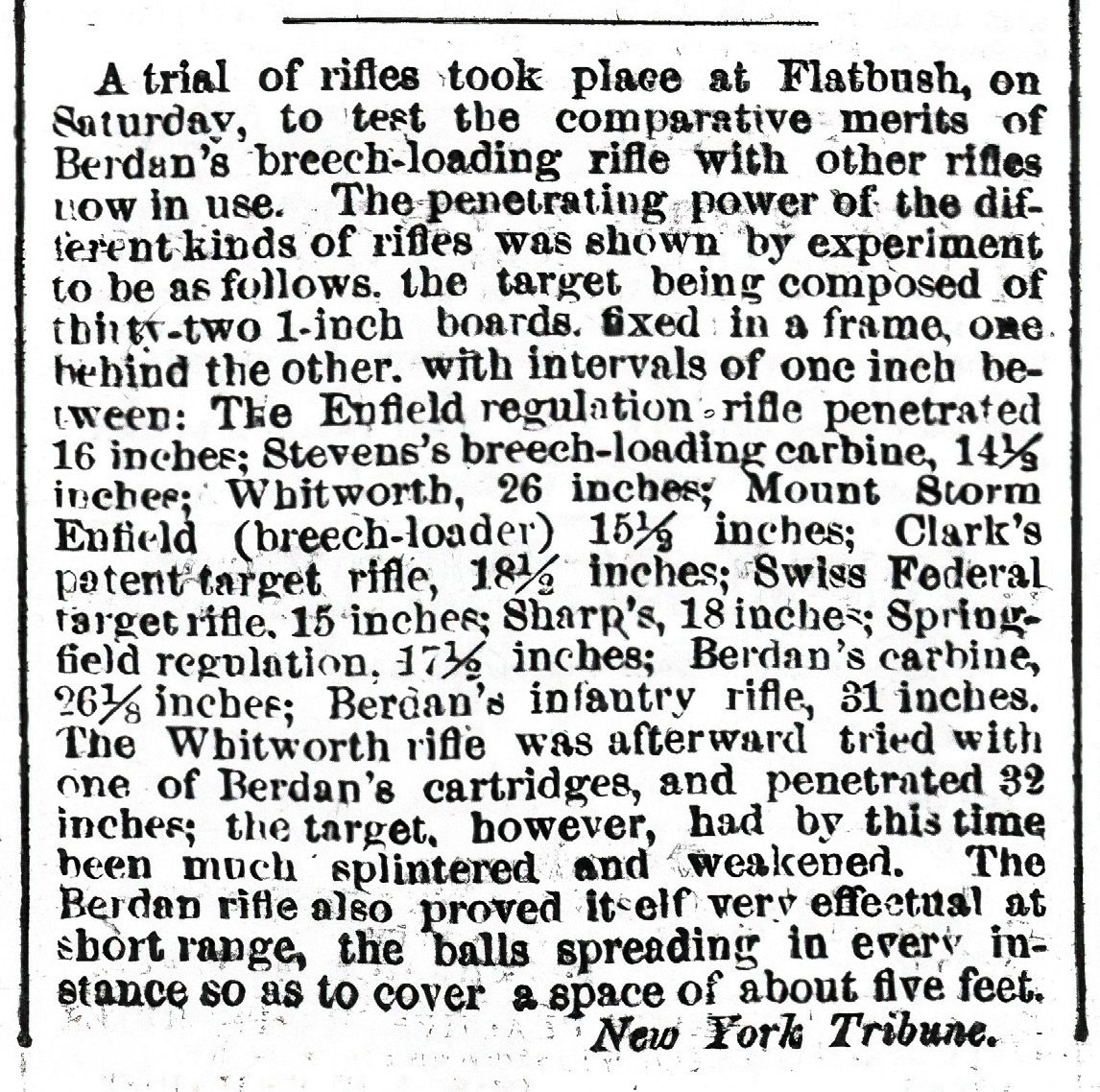
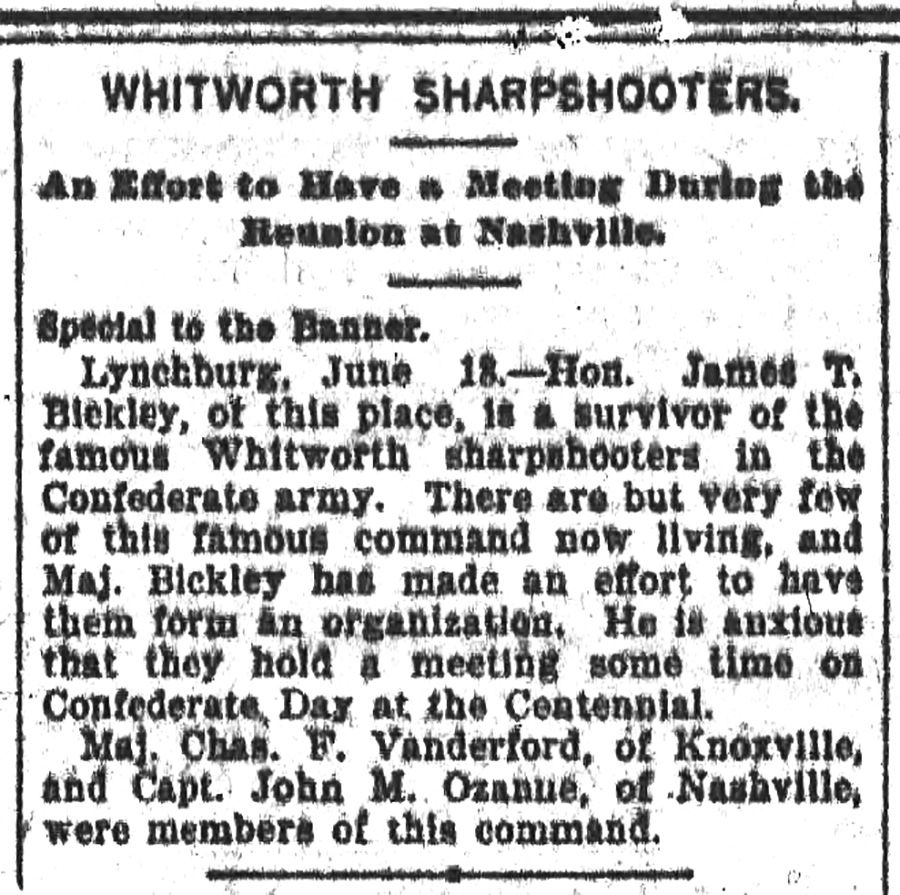
Nashville Banner (Nashville, Tennessee), Friday, June 18, 1897, page 3. The Courier-Journal (Louisville, Kentucky), Wednesday, November 23, 1864, page 1.
Sun-Journal (Lewiston, Maine), Thursday, September 8, 1864, page 1.
The Soldiers’ Journal (Alexandria, Virginia), Wednesday, July 13, 1864, page 7.
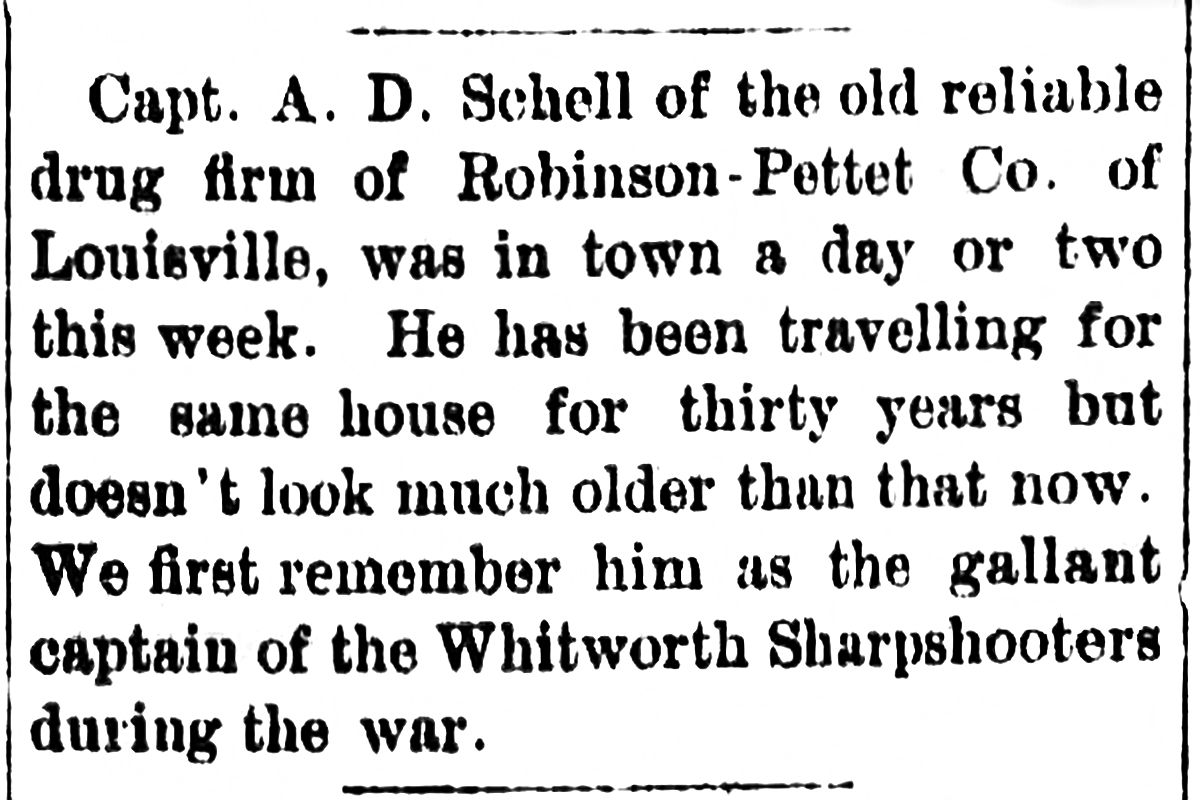
Confederate Veteran Vol. XVI, April 1908, No. 4, page xxii.
Confederate Veteran Vol. 11, August 1894, No. 8, page 247..
Confederate Veteran Vol. XVI, April 1908, No. 4, page 172. A. G. Hill was in Company D, 20th Tennessee Infantry.
Right: Johnson, John. The defense of Charleston Harbor, 1863– 1865. United States: n.p., 1890, p. ix.
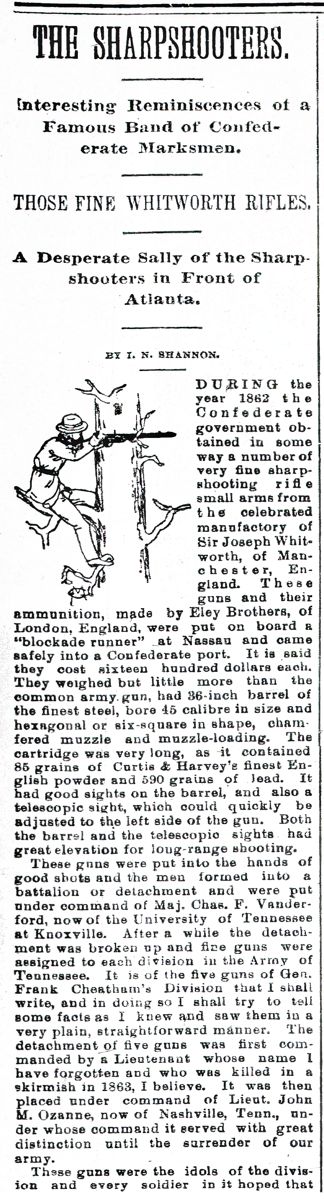
Left: Macon Beacon (Macon, Mississippi), Saturday, March 20,1897, page 3.
The 19th ranked long distance sniper kill of all time was by an unknown Confederate Army sniper who fired his Whitworth rifle from Fort Sumter and killed a Union soldier inside Battery Gregg, on Morris Island, December 1864, at a distance of Boston Evening Transcript (Boston, Massachusetts), Friday, 1,390 yards. The Charleston Daily Courier (Charleston, South Carolina), Tuesday, December 6, 1864, page 1. July 15, 1864, page 3.
Sir Joseph engraving.
Whitworth from an
Nashville Banner, Monday, January 25, 1892, page 2.