
Sherman and His Sword at Shiloh
By Stephen Davis · Originally published November-December 2022 · pp. 14–24
Time will rust the sharpest sword. – Sir Walter Scott
That may be true, but old swords remain objects of affection to their owners, and treasures to arms collectors.
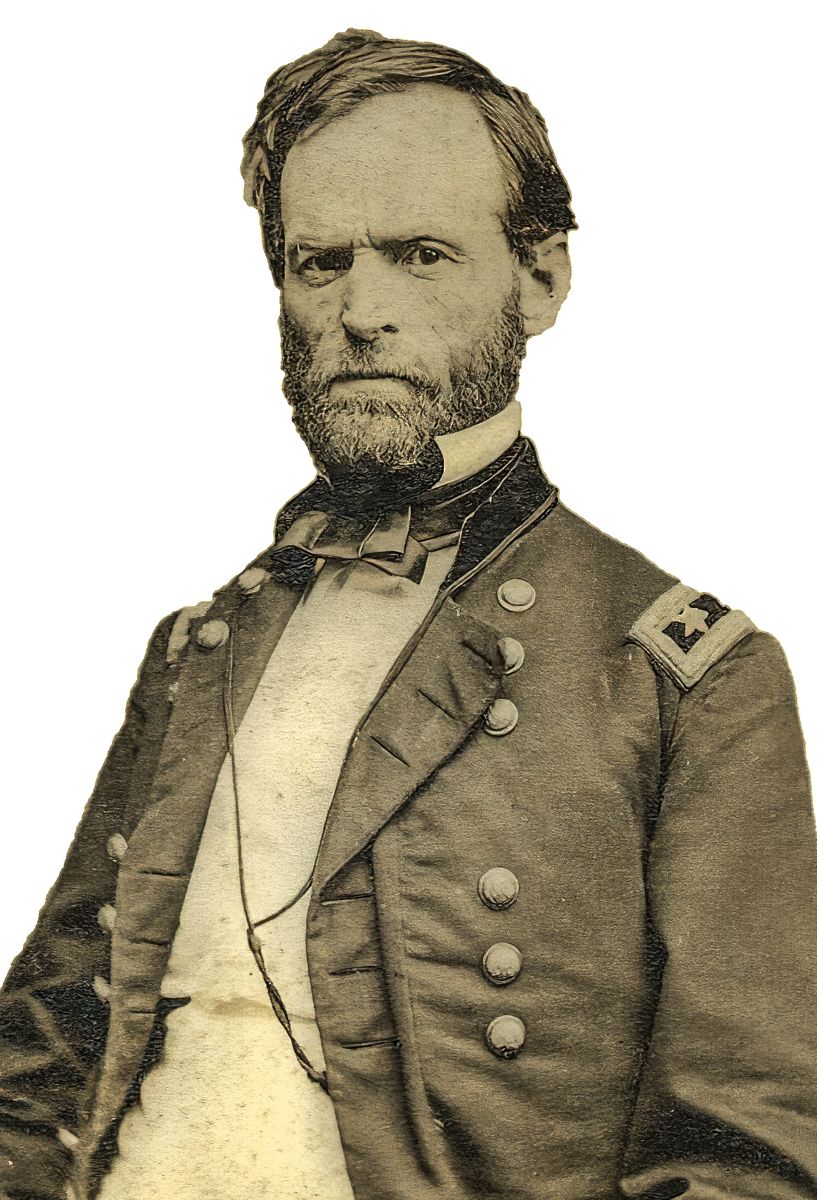
Take the sword of William Tecumseh Sherman. But first, how he got it. Throughout adult life Cump, as Sherman’s friends called him, was careless in his dress and sometimes even forgot to comb his hair.1 Lloyd Lewis, the early biographer, states that this indifference was a deliberate and persistent response to the time when, as a lad, young Sherman was so self-conscious of his red hair—a relative even called him a “red-haired woodpecker”—that he gathered various chemicals to dye it—which turned green. (After it grew out in its natural hue; Sherman never messed with it again.)2 Red-haired and quirky, Sherman seemed to cultivate an air of eccentricity. His heedlessness of uniform and breezy attitude toward military discipline had earned him dozens of demerits at West Point. During the Atlanta Campaign one Union officer observed him wearing a gray flannel suit under his old faded blue blouse. At night, through most of which Sherman was seen working and cigar-smoking, he lounged about in red flannel drawers and slippers. Not without reason did a fellow officer characterize Sherman as “a splendid piece of machinery with all of the screws a little loose.”3 Such a slothful soldier would shun wearing an officer’s sword, though Sherman possessed one. (In the grand review of May 1865 he unsheathed it for a salute to President Johnson.4) He may have been wearing it when, in early September 1864, George Barnard photographed the general astride his horse “Duke” outside Atlanta; the general was in fine dress, even wearing a sash.5 The Smithsonian has Sherman’s sword, which it states the brigadier general was wearing during the battle of Shiloh. Because Sherman’s outsized historical reputation rests so much on his successful campaigns in Georgia and the Carolinas later in the war, Sherman’s role at Shiloh bears looking at. First, about Sherman himself. Born at Lancaster in central Ohio in 1820, he was raised mostly by Thomas Ewing, a family friend, after his father died in 1829. He was schooled in Lancaster and entered West Point, thanks to his foster father’s connections. He graduated sixth in the class of 1840 and was assigned as a second lieutenant in the 3rd Artillery. His duties sent him south, including Georgia during the mid-‘40s. Mexican War service followed, after which in 1853 Sherman resigned from the army. He worked as a
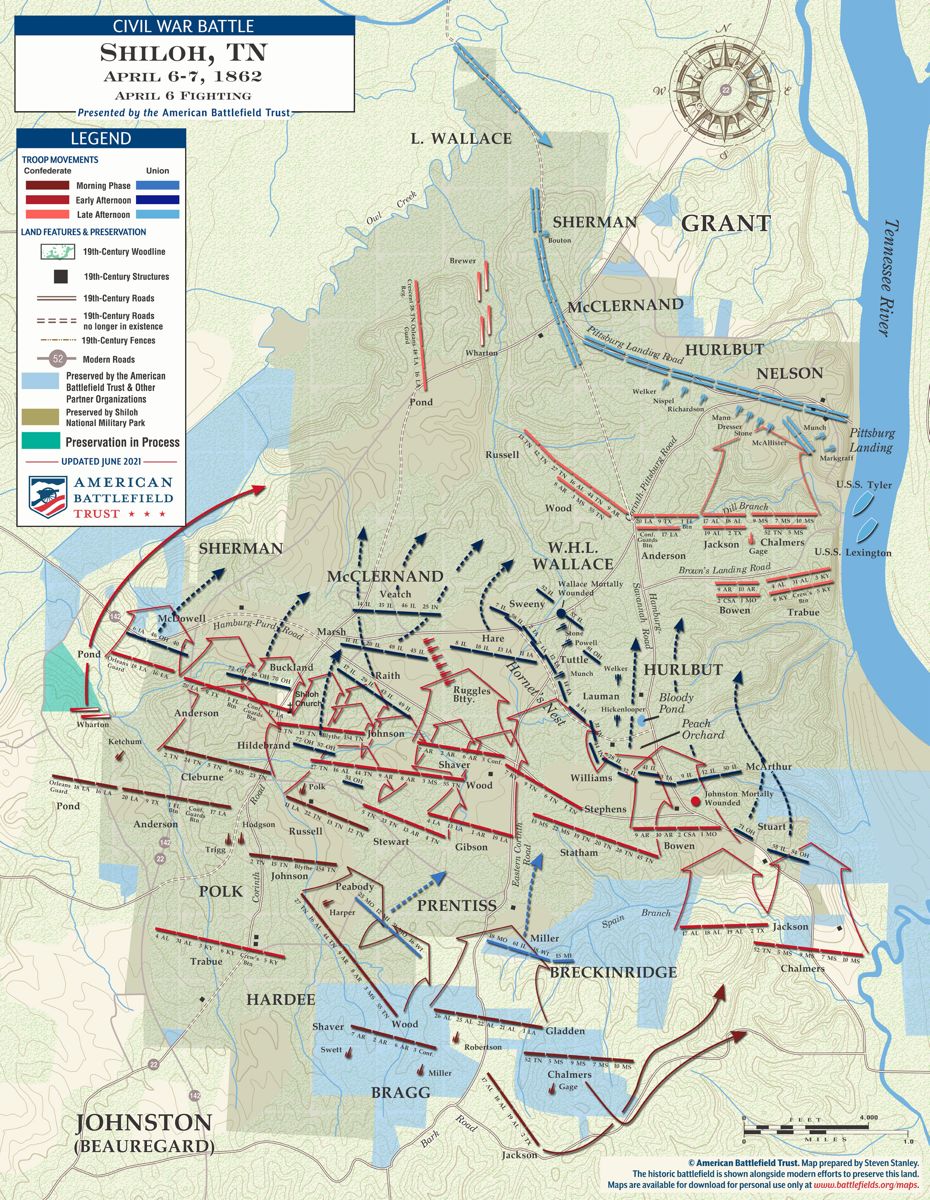
Shiloh – Day One – April 6, 1862. Courtesy American Battlefield Trust.
banker in San Francisco, as a lawyer in Kansas, and then as superintendent of the Louisiana State Seminary (now LSU). After Louisiana seceded from the Union, he declined a commission in the Confederate army, then worked for a short while in St. Louis. He returned to the army as colonel of the 13th U.S. Infantry, and was with McDowell at Bull Run, commanding a brigade. Promotion to brigadier came in mid-May, whereupon he was sent to Kentucky. After he called for 60,000 men to drive out the Rebels, the press got hold of the story and started rumors of insanity. “GENERAL WILLIAM T. SHERMAN INSANE” blared the Cincinnati Commercial. Brig. Gen. Carlos Buell relieved Sherman in mid-November and sent him on a medical furlough to St. Louis, following which he was brought back and assigned to Grant’s Army of the Tennessee. In the words of Winston Groom, a biographer, Sherman “wasn’t ‘insane’ any more, or a ‘nervous Nellie,’ or ‘flighty.’”
Sherman stormed, “Take your damn regiment back to Ohio! There are no Confederates closer than Corinth!” Boy, was he wrong. Later, that night, Sherman sent Col. Jesse Hildebrand, one of his brigade commanders, a message: “General Sherman says you must be badly scared over there.”7 Grant’s Army of the Tennessee was sprawled on the west bank of the Tennessee River, a couple miles west and south of Pittsburg Landing.8 It was organized in six divisions of infantry, a couple of cavalry battalions, and the usual artillery. Sherman commanded Grant’s Fifth Division of four brigades, 8,550 officers and men.9 Johnston’s attack began around dawn on April 6, striking
After his capture of Forts Henry and Donelson in February 1862, Grant and his army (41,000) marched into southwest Tennessee to Pittsburg Landing, preparing to move on Corinth. He was awaiting the arrival of (now) Major General Buell’s force, which would bring the Federals’ combined strength to more than 61,000. The Confederate theater commander, Gen. Albert Sidney Johnston, determined to attack Grant before Buell arrived. Thus on April 3 he marched north with just over 40,000 troops toward Pittsburg Landing. Surprise was essential, for the Federals’ outer lines were just twenty miles away. “Bad roads, thickly wooded country, and inexperienced staff work fettered the advance,” writes Liddell Hart, Sherman’s British biographer.6 Working to the Southerners’ advantage, though, was Grant’s belief that the Rebels would not be attacking him. He knew they were at Corinth, but thought they were entrenching on the defensive. Sherman shared this notion, and told his subordinates not to worry. His division at the time was camped on the right of Grant’s line, almost two miles southwest of Pittsburg Landing and the Tennessee River. To his left was Brig. Gen. Benjamin Prentiss’ division. If the Rebels attacked, Sherman and Prentiss would be their point of first contact. Sherman’s brigade commanders, though, weren’t so confident. When Col. Jesse Appler of the 53rd Ohio warned on the afternoon of April 5 that his videttes suspected Rebels in the area, an angry
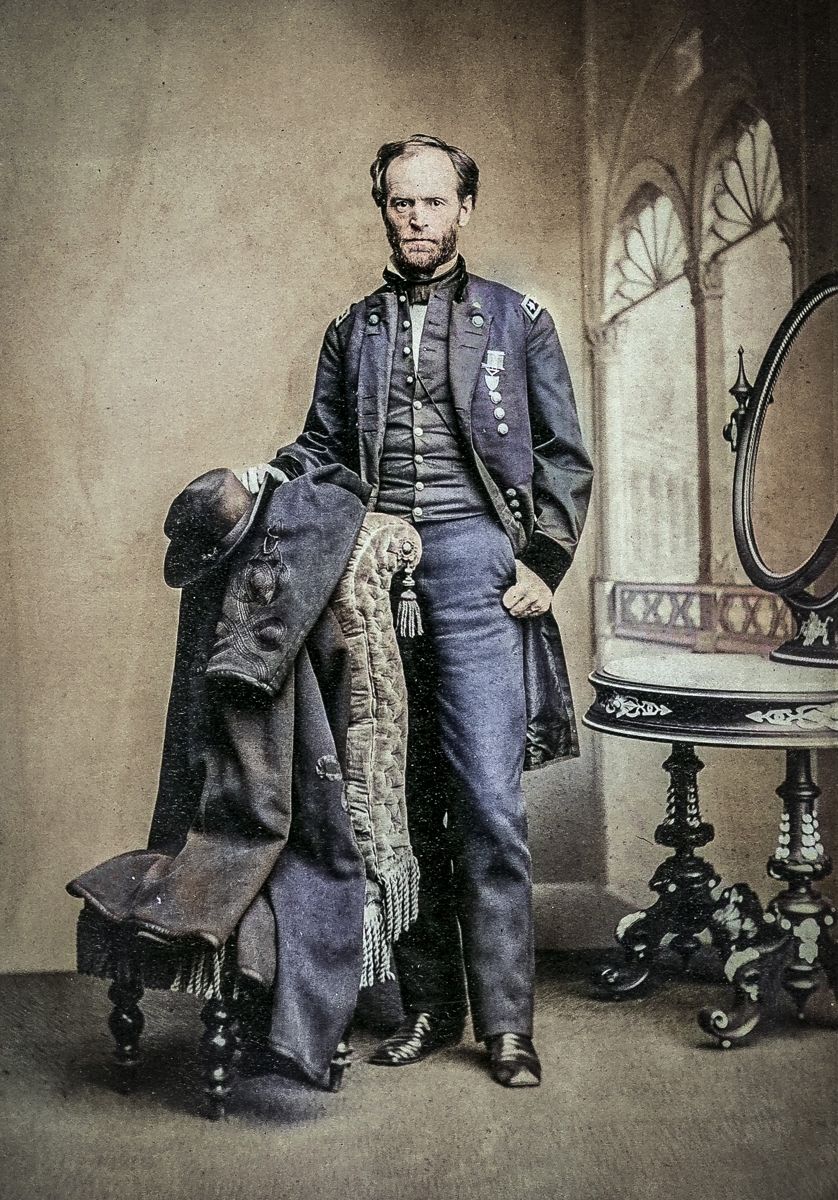
Maj. Gen. William Tecumseh Sherman.
“I think I understand what military fame is; to be killed on the field of battle and have your name misspelled in the newspapers.”
“Time will rust the sharpest sword,” Sir Walter wrote, but the years since the war have not seen a tarnishing of Cump Sherman’s stature as one of the Civil War’s leading figures. “Like the soldier’s Old Testament hero, this mythic marcher is known by all,” write two historians of Sherman’s place in history.15 Yet how he is known and regarded—well, it depends to whom you’re a-talkin’.
– William Tecumseh Sherman Prentiss’ division at 5 a.m., then Sherman’s an hour or so later. Alarmed, Sherman rode to the sound of firing. At one point he uncased his telescope to take a look. “My God, we are attacked!” he cried.
“The shot that killed him was meant for me.” – Sherman
Assailing his position were the troops of Pat Cleburne’s division. As the Rebels approached, a Federal officer called out, “Sherman will be shot!” That he was. A single buckshot—many Confederates were firing buck and ball from their .69 caliber smoothbore muskets—struck him in the right hand. At his side, another Federal was shot and killed. Sherman wheeled his horse and galloped toward the rear. “The shot that killed him was meant for me,” the general later declared.10 Sherman was in fact twice wounded and had three horses shot beneath him. 11 But the wounds were slight, and he stayed in action. “They shot real bullets and I am safe, except a buckshot wound in the hand and a bruised shoulder from a spent ball,” he wrote his wife Ellen a few days after the battle.12 Sherman’s Division held its ground for three hours before he ordered a withdrawal in the face of fierce assault by the Rebels.13 When it was all over, the Fifth Division had suffered 325 killed, 1,277 wounded and 299 missing—1,901 casualties.14
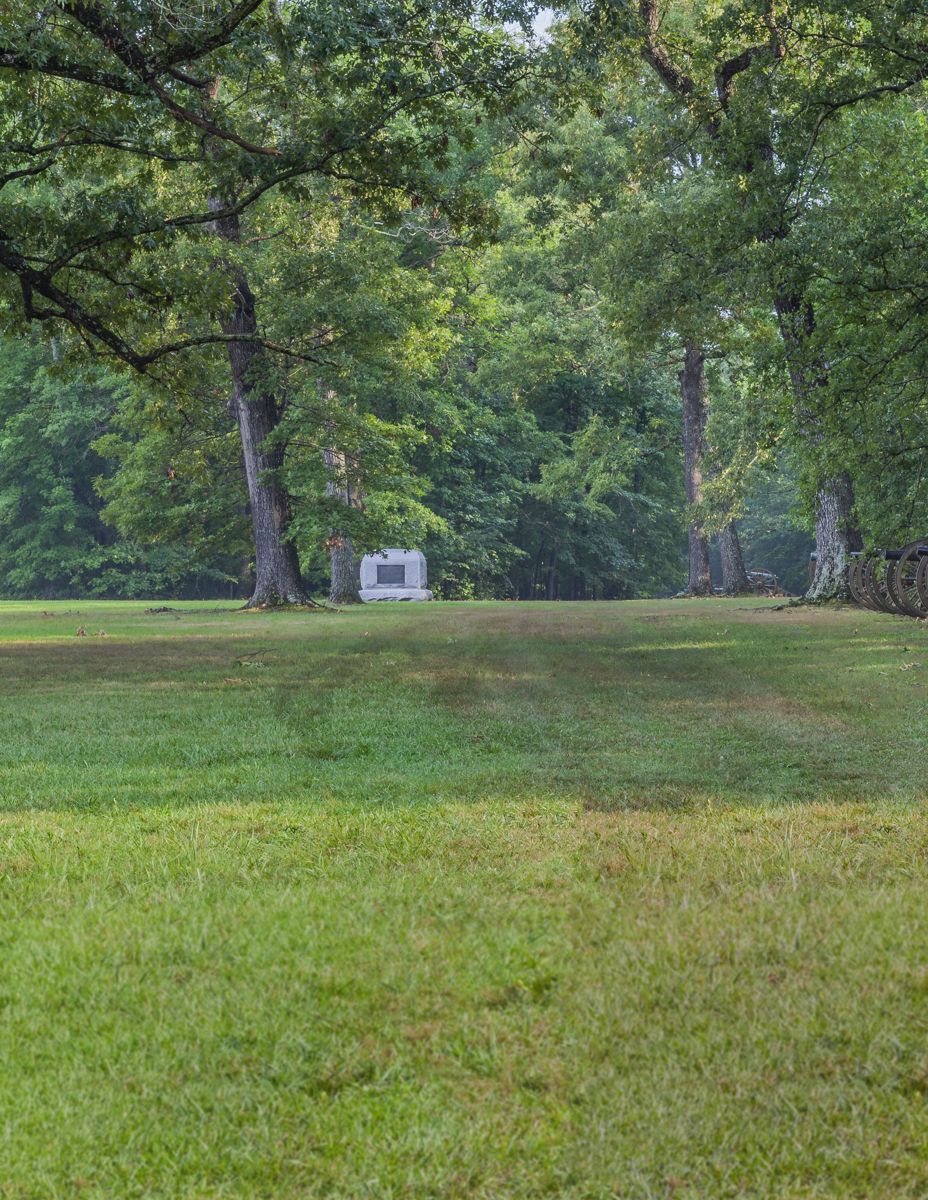
Hornet’s Nest location at Battle of Shiloh, Tenn. Photographs in the Carol M. Highsmith Archive, Library of Congress, Prints and Photographs Division.
U.S. MODEL 1850 STAFF AND FIELD OFFICER’S SWORD MADE BY AMES MANUFACTURING COMPANY IN CHICOPEE, MASS.
One of the greatest battles of the War Between the States erupted near the banks of the Tennessee River at Shiloh, Tennessee. On April 6, 1862, General Sidney Johnston launched his attack. The Union forces were quickly driven back; they found themselves rapidly approaching the Tennessee River to the east and Owl Creek to the north. However, the Union troops finally established a line at an area known as “the sunken road.” Confederate forces launched eleven attacks against the position, but the line would not break. The area became known as the “Hornets’ Nest” because of the intensity of gunfire and volume of bullets. Finally the Confederates brought sixty-two artillery pieces to bear on the Hornets’ Nest, many at point-blank range. After holding the position for six hours, the Union forces surrendered. The next morning, having been reinforced, General Grant attacked the tired and surprised Confederates, who believed they had won a great victory. By sheer weight of numbers the Federals pushed them back. Resistance stiffened; as the day wore on, the Confederates pulled back and the next day withdrew to Corinth. Courtesy National Museum of American History.
“War is the remedy that our enemies have chosen, and I say let us give them all they want.” – William Tecumseh Sherman
General William T. Sherman carried this U.S. Model 1850 Staff and Field Officer’s Sword during the Battle of Shiloh, Tennessee, April 6-7, 1862.
“It is the unanimous opinion here that Brig. Genl. W.T. Sherman saved the fortunes of the day on the 6th and contributed largely to the glorious victory on the 7th.” – Abraham Lincoln
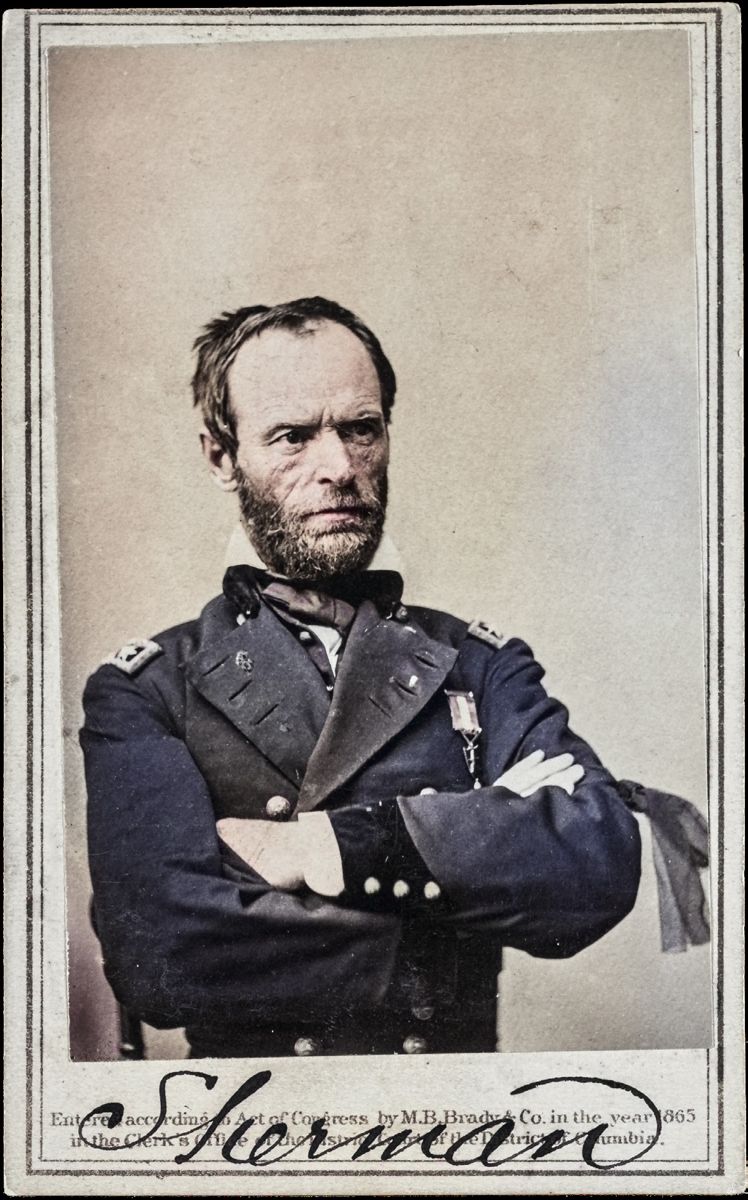
Sherman, under Maj. Gen. Ulysses S. Grant, fought at Shiloh and was promoted to major general, effective May 1, 1862. He then rose from division leader to commander of the XV Corps, fighting with Grant all the way to Vicksburg.
General Sherman in uniform with mourning ribbon for President Lincoln, and a Society of the Cumberland badge, 1865. Mathew Brady photograph, Liljenquist Family Collection of Civil War Photographs
Ruggles’ Batteries
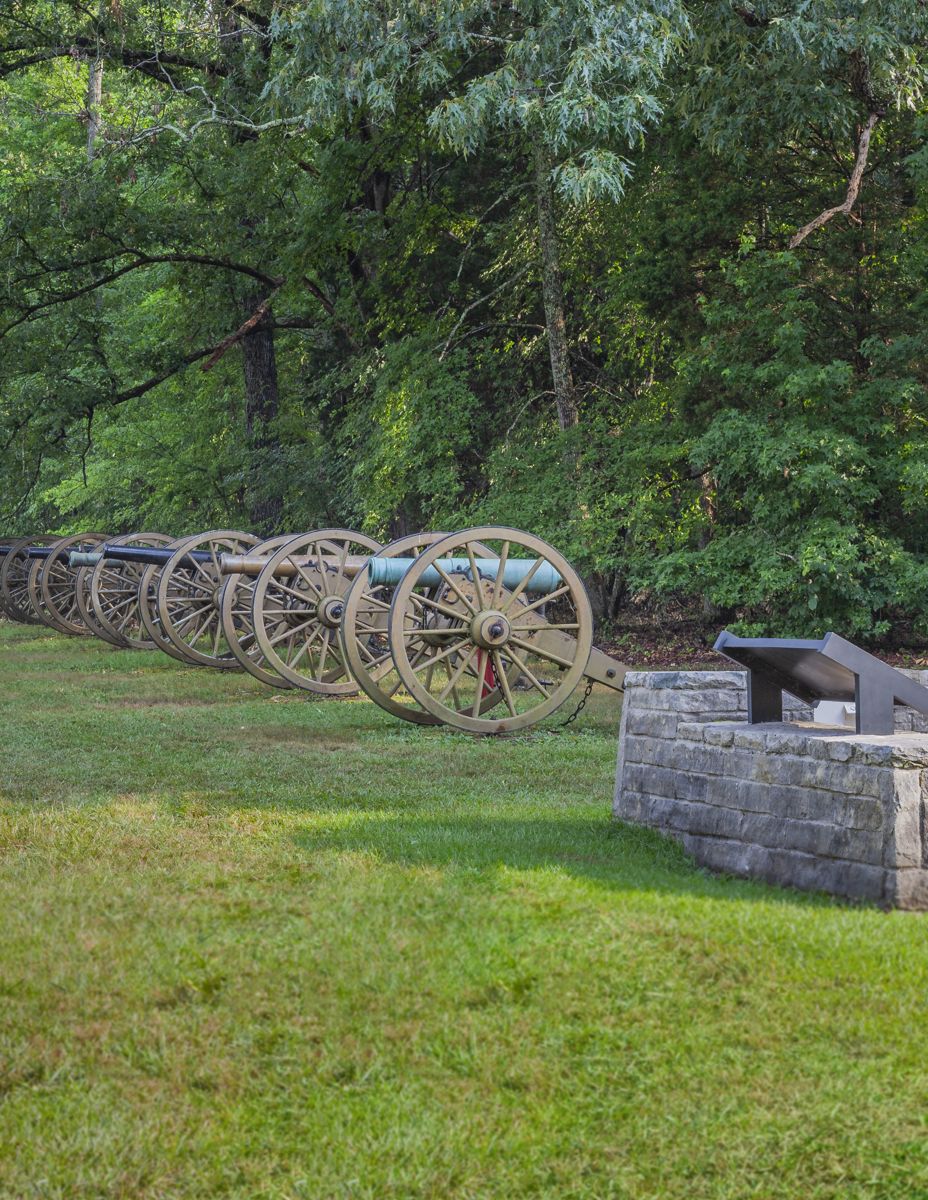
On April 6, 1862, after six hours of bloody fighting here, it became evident that Confederate infantry alone would not break the strong Union defenses along the Sunken Road and the thickets beyond. Toward late afternoon, Brig. Gen. Daniel Ruggles brought forward eleven batteries of artillery and placed them in a line that began here and extended to your right along the wooded edge of Duncan Field and beyond. According to Ruggles’ official report, there were 62 cannon here, the greatest concentration of field guns seen on a North American battlefield up to that time. For more than an hour the Confederate artillery roared, unleashing a great storm of shot, shell, and canister that kept the Union soldiers in the “Hornets’ Nest” pinned down. Confederate infantry then encircled the Hornets’ Nest and forced its defenders to surrender. The cannon you see today mark the locations of Ruggles’ batteries. Although not the same cannon used in the battle, they compose one of the best collections of Civil War field artillery in existence.
A nice window into Sherman’s post-Shiloh views is found in a letter the Ohioan wrote his wife about a week after the battle.
Camp Shiloh, Apl. 14, 1862 Dearest Ellen, The day before yesterday I heard Halleck had arrived at the River and upon making a short turn through the Camps I found him on board the Continental and Grant on the Tigress. I was there ordered again to try to destroy the Memphis and Charleston Road, a thing I had twice tried and failed. I at once ordered 100 4 Illinois Cavalry under Bowman to be embarked on board [illegible phrase] and a Brigade of Infantry Fry’s on board the [illegible boat name] and White Cloud, and with two Gunboats went up the Tennessee 32 miles to Chickasaw, just at the Corner of Alabama, then I disembarked there and sent them on their errand—Bowman reached the Railroad and destroyed the Bridge and some 500 feet of trestles succeeding perfectly in the undertaking which is very important as it prevents all communication of the enemy with the East. I tried to go up to Florence but the water would not let us pass two shoals above so I returned & Halleck was delighted. This has been with him a chief object. When I got down this morning he handed me the enclosed copy of one sent last night to Washington—so at last I Stand redeemed from the vile slanders of that Cincinnati paper—I am sometimes amused at these newspaper Reporters. They keep shy of me as I have said the first one I catch will hang as a Spy. I now have the lawful right to have a Court martial, and if I catch one of those Cincinnati Newspapers in my camp I will have a Court and they will do just as I tell them. It would afford me a real pleasure to hang one or two—I have seen a paragraph in the Cincinnati Commercial about Dr. Hewit. He never drinks, is as moral a man and as intelligent as ever, and all his time is working for the Sick, but because he will not drop his work & listen & babble with a parcel of false humorists who came here from the various [illegible phrase] of our Country he must be stigmatized as a corrupt drunkard. Rebellion is a sin, & of course should be punished but I feel that in these Southerners there are such qualities of Courage, bold daring and manly that though I know they are striving to subvert our Government and bring them into contempt, Still I feel personal respect for them as individuals, but for these mean contemptible slanderous and false villains who seek reputation by abuse of others—Here called off by a visit of my Kentucky friends who express to me unbounded confidence. I have just got yours of the 9th my hand is not off—it was a buckshot by a Cavalry man who got a shot at me but was almost instantly killed in return.—My shoulder is well and I am as good as ever. For mercy’s sake never speak of McClellan as you write. He ought to have Sent me men & officers in Kentucky but did not, but that he had any malice or intention of wrong I don’t believe. I committed a fearful mistake in Kentucky and if I recover it will be a wonderful instance. I have made good progress here, and in time can illustrate the motives that influenced me—I know McClellan to be a man of talents & having now a well organized & disciplined army, he may by some rapid strokes achieve a name that would enable him to Crush me—Keep your own counsel, and let me work for myself on this Line. Halleck has told me that he had ordered the 4 Cos. Of the 13 Inf. to me as soon as a certain Battalion could be spared at New Madrid. Charley need not be impatient[.] The southern army was repulsed but not defeated. Their Cavalry hangs about our front now—we must have one more terrible battle—we must attack—My Division is raw—some regts. behaved bad but I did the best I could with what remained, and all admit I was of good service—I noticed that when we were enveloped and death stared us all in the face my seniors in rank leaned on me—Well I am not in search of honor or fame and only count it for yours & childrens sake. I think you will have some satisfaction and I know your father will be please that I am once more restored to favor. Give him Hallecks letter & tell him I broke the Charleston Road[.] Yrs. W.T. Sherman
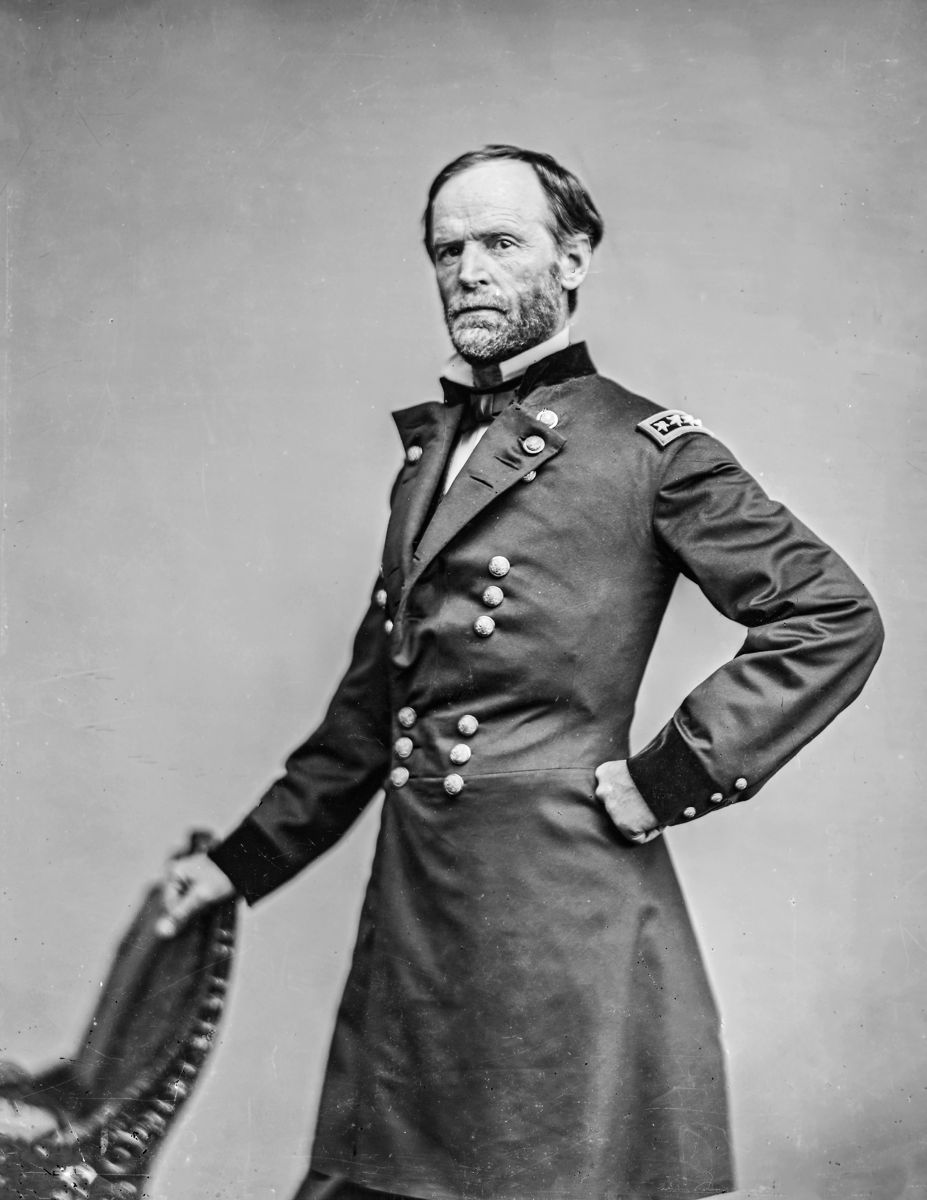
“It is only those who have neither fired a shot nor heard the shrieks and groans of the wounded who cry aloud for blood, more vengeance, more desolation. War is hell.” – Gen. William T. Sherman
Endnotes 1. Brian Holden Reid, The Scourge of War: The Life of William Tecumseh Sherman (New York: Oxford University Press, 2020), 29, 211. 2. Lloyd Lewis, Sherman: Fighting Prophet (New York: Harcourt, Brace & World, 1960 [1932]), 36; John F. Marszalek, Sherman: A Soldier’s Passion for Order (New York: Free Press, 1993), 13. 3. Lewis, Sherman, 61, 401, 461; Albert Castel, Decision in the West: The Atlanta Campaign of 1864 (Lawrence: University Press of Kansas, 1992), 42. 4. Lewis, Sherman, 575. 5. Stephen Davis, 100 Significant Civil War Photographs: Atlanta Campaign (Charleston: Historical Publications, 2019), 92. 6. John D. Kallmann, “William Tecumseh Sherman” in Patricia L. Faust, ed., Historical Times Illustrated Encyclopedia of the Civil War (New York: Harper & Row, 1986), 681-82; B. H. Liddell Hart, Sherman: Soldier, Realist, American (New York: Dodd, Mead & Company, 1929), 37, 107-109, 116, 122-23; Lewis, Sherman, 201; Thomas L. Livermore, Numbers and Losses in the Civil War in America 1861-65 (Dayton OH: Morningside, 1986 [1900], 79-80; Winston Groom, Shiloh 1862 (Washington: National Geographic, 2012), 59. 7. Stacy D. Allen, “Shiloh! A Visitor’s Guide,” Blue & Gray, 2001, 13 (map), 15, 18-19; Larry J. Daniel, Shiloh: The Battle That Changed the Civil War (New York: Simon & Schuster, 1997), 146, 165 (maps). 8. David E. Roth map, “The Battle of Shiloh,” Blue & Gray, 14. 9. Allen, “Shiloh,” 16, 18-19; Wiley Sword, Shiloh: Bloody April (Dayton OH: Press of Morningside Bookshop, 1983), 460. 10. Sword, Shiloh, 176. 11. James Lee McDonough, William Tecumseh Sherman: In the Service of My Country—A Life (New York: W.W. Norton, 2016), 10; James M. Merrill, William Tecumseh Sherman (Chicago: Rand McNally, 1971), 197. 12. Brooks D. Simpson and Jean V. Berlin, eds., Sherman’s Civil War: Selected Correspondence of William T. Sherman, 1860-1865 (Chapel Hill: University of North Carolina Press, 1999), 201. 13. McDonough, Sherman, 10; Allen, “Shiloh,” 19. 14. Sword, Shiloh, 460. 15. Edward Caudill and Paul Ashdown, Sherman’s March in Myth and Memory (Lanham MD: Rowman & Littlefield, 2008), 183.
About the Author
Stephen Davis
Stephen Davis of Cumming, Ga., has been a Civil War buff since the 4th grade. He grew up in Atlanta, attending Margaret Mitchell Elementary and Northside High. At Emory University he studied under the renowned Civil War historian Bell Wiley. After a Master’s degree in American history from the University of North Carolina at Chapel Hill, he taught high school for a few years, then earned his Ph.D. at Emory, where he concentrated on the theme of the Civil War in Southern literature. He’s also taught at Oglethorpe University. Now retired, Steve resides in Cumming with his sweet wife Billie and two cats. Steve is the author of seven books on the Atlanta Campaign: Ë Atlanta Will Fall: Sherman, Joe Johnston and the Yankee Heavy Battalions (Scholarly Resources, 2001); Ë What the Yankees Did to Us: Sherman’s Bombardment and Wrecking of Atlanta (Mercer University Press, 2012); Ë A Long and Bloody Task: The Atlanta Campaign from Dalton through Kennesaw to the Chattahoochee, May 5-July 18, 1864 (Savas Beatie, 2016); Ë All the Fighting They Want: The Atlanta Campaign from Peachtree Creek to the City’s Surrender, July 18-September 2, 1864 (Savas Beatie, 2017); Ë George N. Barnard: Photographer of the Atlanta Campaign (Historical Publications, 2019); Ë From Texas Brigadier to the Fall of Atlanta: John Bell Hood (Mercer University Press, 2019); and Ë Into Tennessee and Failure: John Bell Hood (Mercer University Press, 2020). His most recent work is The Atlanta Daily Intelligencer Covers the Civil War (University of Tennessee Press, 2022) Dr. Davis served as Book Review Editor for Blue & Gray Magazine from 1984 to 2005, and is the author of more than a hundred articles in such popular and scholarly publications as America’s Civil War, Civil War Times Illustrated, Civil War News, and the Georgia Historical Quarterly.