
Colt’s Side Hammer Revolving Military Rifles
By Tim Prince · Originally published March-April 2022 · pp. 3–9
by Tim Prince In 1855, Samuel Colt introduced his “Side Hammer” series of percussion handguns and longarms. The handguns are known to collectors today as the “Root” revolvers, honoring their designer, Elisha K. Root, while the revolving long arms are more generically referred to as Colt revolving rifles, carbines, or shotguns. Between 1855 and 1864, Colt produced a total of 18,300 revolving longarms, of which 1,100 were shotguns, with the balance being rifled arms. During their production run, the rifled arms were available in a wide variety of calibers from .36 through .64 and produced as sporting rifles, carbines, and military rifles. Depending upon the caliber and model, barrel lengths varied from as short as 18 inches for carbines and as long as 37 ½ inches for larger caliber military rifles. The smaller caliber arms (.36, .40, & .44) were manufactured on a medium sized frame with 6-shot cylinders while larger caliber arms (.50, .56, and .64) were produced on a much larger frame with 5-shot cylinders, as were the shotguns. All these revolving arms featured the closed top, solid frame Root design with a side mounted hammer and a cylinder pin that entered through the rear of the frame. Most Colt “Root” guns had a “creeping style” loading lever mounted under the barrel, forward of the cylinder. While the early production sporting arms had round cylinders with a roll engraved hunter and deer scene, the majority of the revolving long arms were produced with fluted cylinders. The standard finish for the long guns was blue overall, color casehardened hammers and loading levers, and smooth oil finished walnut butt stocks and forends. As with all his firearms, Colt looked to the U.S. military as a potential customer and as a means of promoting his designs to the larger civilian populace. Colt felt there was no better advertising fodder than saying his guns were used by the United States Army. The U.S. military placed their first order for Colt percussion revolving long arms in 1838 when they acquired 50 Colt Patterson Number 1 ring lever rifles for fighting the Seminoles in Florida. These revolving firearms must have rendered at least satisfactory field service, as additional orders were soon placed for Model 1839 Patterson repeating carbines. On March 2, 1841, a small number of M1839 repeating carbines were ordered by the U.S. Ordnance Department for the U.S. Navy. Subsequent orders included sixty M1839 for the U.S. Dragoons on July 23, 1841, 100 for the U.S. Navy’s Pacific Squadron in December 1841, and another 100 for the U.S. Navy on August 28, 1845. Colt had clearly gotten his foot in the door by selling revolving rifles to the Ordnance Department and, despite any shortcomings of the revolving long arm designs; an order was soon forthcoming for his newest revolving rifle design. In 1856, an order was placed for 100 new Colt Model 1855 “Side Hammer” revolving rifles, with a total of 101 being delivered; the “one” being a sample rifle. The guns were the “military” model, with a full length forend secured with two screw tightened clamping barrel bands, sling swivels, and a three-leaf military rear sight graduated to 100, 300, and 500 or 600 yards. The rifles had 31 5/16 inch-long barrels and accepted an angular socket bayonet. While future military purchases of the Colt revolving rifles and carbines would be in the larger .56 caliber, this first order was for the .44 caliber variant with a 6-shot cylinder. Interestingly, whether due to previous experiences with revolving long arms, due to a recommendation from Colt, or with an eye to carrying a spare loaded cylinder, the order specified that the guns were to be supplied with an extra cylinder for each rifle.
All Colt Model 1855 long guns were serial numbered in their own ranges, based upon caliber. While it has been generally reported that the U.S. military orders for the .44 caliber guns are found with serial numbers under 300, that statement was based upon a survey of the few examples then known to noted Colt author R.L. Wilson when he wrote The Book of Colt Firearms, where he noted the highest military .44 rifle serial number that he was aware of was 299. Wilson may have also obtained the “under 300” number from an old Bannerman catalog advertisement; one of the places that “gun show lore” often originates, usually with minimal basis in truth. It is, however, reasonable to believe that the one hundred .44 caliber military rifles delivered on January 22, 1857, were probably all under serial number 400. During the production run of sidehammer rifles, a total of 3,200 .44 rifles were manufactured, 800 in the sporting configuration, 1,200 as carbines, and 1,200 in the military rifle configuration. Only 101 were initially acquired by the U.S. military and so marked. These early .44 rifles are typically found without barrel or topstrap markings and are simply marked on the frame tang in three lines: COLT’S / PATENT / US. They were cartouched on both sides of the stock wrist, and serial numbered on major components as is typical of Colt revolving firearms. There is not much written about the service these early military Colt revolving rifles saw, but it is known that the initial issue went to the 1857–58 U.S. military’s Utah Expedition to put down the Mormon Rebellion. The commander for the expedition was Colonel Albert Sidney Johnston, who led the recently formed 2nd US Cavalry. Johnston’s field and company officers included a “who’s who” of future Civil War generals, including Robert E. Lee, William J. Hardee, Earl Van Dorn, Edmund Kirby Smith, Fitzhugh Lee, and John Bell Hood, all of whom would serve as Confederate generals during the coming war. Future Union generals George H. Thomas, George Stoneman, and Kenner Garrard also served in the 2nd Cavalry’s officer corps. The orders to confront the Mormon’s were subsequently retracted and the 2nd Cavalry spent the next two years fighting Comanche Indians in Texas and Kansas, with famous victories at Devil’s River, Wichita Village, Rush Springs, and Crooked Creek. While most Second Cavalrymen were armed with Sharps’ or Hall’s patent carbines and Colt Model 1851 “Navy” revolvers, it appears that at least some troopers were still carrying the .44 Colt revolving rifles issued prior to the Mormon Expedition. Despite any misgivings that might have existed regarding the guns, an additional three hundred were ordered by the U.S. government on June 1, 1858, for additional field testing.
Arms Issued To The Following States Alabama:
50 Rifles on May 7, 1857
Connecticut:
60 Rifles on May 15, 1858
Connecticut:
20 Rifles on October 4, 1858
Illinois:
5 Rifles on May 7, 1859
Illinois:
1 Cavalry & 1 Artillery Carbine on March 5, 1860
Louisiana:
10 Rifles on May 7, 1859
New Jersey:
2 Rifles on August 31, 1859
New Mexico: (Territory)
10 Rifles on March 30, 1860
New York:
1 Rifle, 1 Artillery Carbine & 1 Cavalry Carbine on January 12, 1860
New York:
120 Rifles & 60 Artillery Carbines on May 7, 1859
Ohio:
1 Rifle, 1 Artillery Carbine & 1 Cavalry Carbine on May 7, 1859
Pennsylvania:
1 Artillery & 1 Cavalry Carbine on July 13, 1859
Virginia:
100 Rifles on May 7, 1859
Washington: (Territory)
2 Rifles on April 14, 1860
Reverse overall view. All photos by Tim Prince.
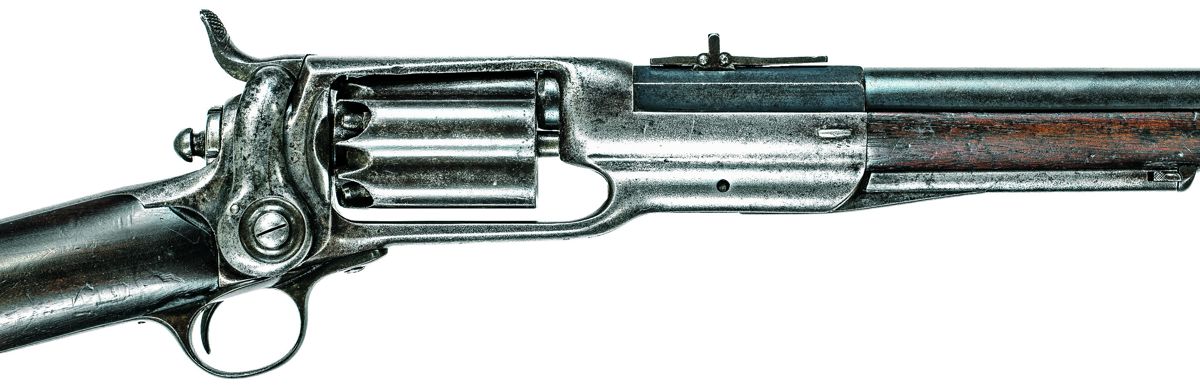
Obverse overall view of .56 caliber Colt revolving military pattern rifle.
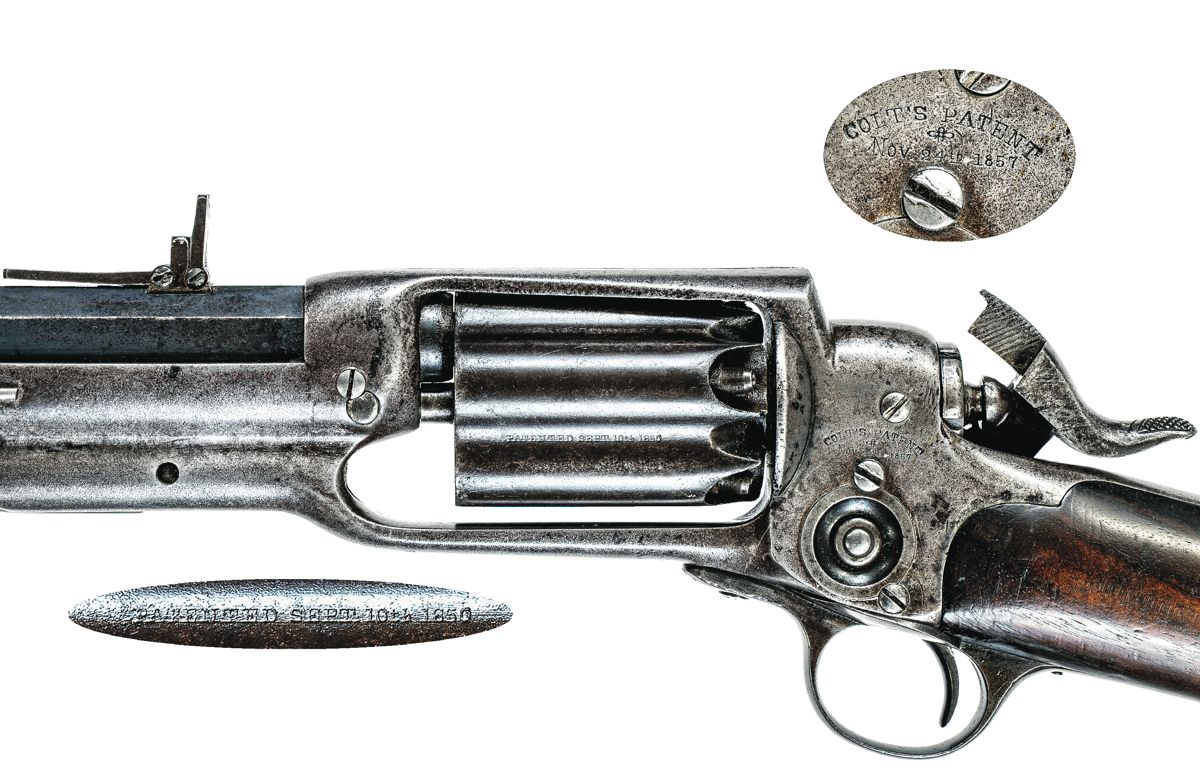
Detail of patent markings on the frame.
Reverse view of the rifle’s frame, showing patent markings on the cylinder flute.
In 1857, Colt introduced an improved variant of the 1855 Root rifle design as he pursued additional U.S. military contracts. These guns eliminated the opposed finger spurs at the front and rear of the trigger guard, the side mounted cleaning rod, and essentially eliminated the round cylinder in favor of the fluted one. An under-barrel ramrod style cleaning rod was added with a sliding trap in the butt to store the rod extension. Colt also introduced the larger frame size to accommodate the military .56 caliber cylinder. Like the earlier production Colt revolving rifles, these were produced in two primary frame sizes and numerous barrel lengths. The military variants were produced as .56 caliber carbines with 21-, 24-, and 27-inch barrels. Carbine production was very limited with only twenty-five 21-inch guns produced, and approximately one-hundred each of the two other carbine variants. Military rifles were produced with 31, 31 3/16, 31 5/16, 37 ½ and 37 5/16-inch lengths. The guns were produced with either a lug to accept a saber bayonet or a musket style front sight that doubled as the lug for an angular socket bayonet. The largest production group of the “new model” revolving military rifles was the 37 1/2-inch barreled variant. These guns accepted a socket bayonet and 4,825 were produced. The 31-inch barreled guns were produced in much smaller numbers with 1,700 31-inch, 800 31 3/16-inch guns, and 500 31 5/16-inch guns. Only 25 37 5/16-inch guns were produced. The 31-inch barreled guns were produced with a saber bayonet lug, as were the 31 5/16-inch guns. The 31 3/16-inch barreled rifles accepted a socket bayonet.
Detailed view of the rifle’s obverse frame, showing the fluted cylinder and leaf rear sight.
While the U.S. military was still considering acquiring larger numbers of the Colt revolving rifle for field service, several states started to request the guns under the Militia Act of 1808. Due to these requests, 318 Colt revolving rifles, 64 artillery carbines, and four cavalry carbines were purchased for distribution to the states between July 1, 1858, and June 12, 1860. These arms were issued to the following states in the numbers on the dates given (see table): Research by the late Herb Houze indicates that some states acquired Colt revolving long arms directly and not through the U.S. government. In early 1861 Virginia traded a number of Colt revolving rifles and carbines back to the U.S. government to acquire “holster pistols,” likely Colt Model 1851 Navy and/or Colt Model 1860 Army revolvers. The trade in included the 100 rifles the state had acquired on May 7, 1859, as well as an additional 60 .56 caliber rifles and 80 .44 caliber carbines. These other guns had been purchased by the state in November 1859, and their willingness to dispose of them indicates not only the state’s pressing need for revolving handguns but probably suggests that the state was less than happy with the guns. In addition to the first 401 .44 caliber military rifles and the guns acquired for the various states, other state military rifle acquisitions were made prior to the Civil War. The Ordnance Department showed more than 700 Colt revolving rifles in inventory by December 1860, with 170 guns on hand in Santa Fe, N.M. In general, it is believed that most guns acquired by various states in 1858–1859 and additional purchases by the Ordnance Department, were the .56 caliber rifles with nominal 31-inch barrels, both with either saber and socket bayonets.
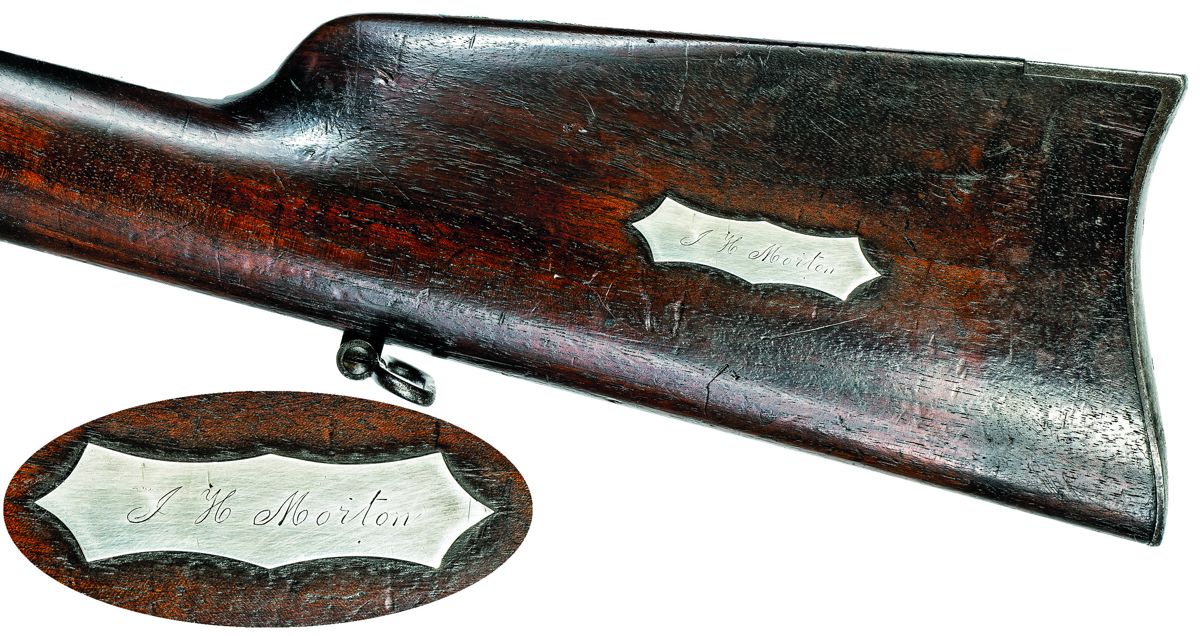
Colt revolving rifle reverse butt stock with German silver engraved plaque marked J H Morton.
The outbreak of the American Civil War caused a huge increase in demand for the .56 caliber, military pattern Colt Revolving Rifles. The first orders were placed by large private retailers like B. Kittridge & Co. of Cincinnati, Ohio, and Schuyler, Hartley & Graham of New York. These firms sold guns to various state and local buyers to outfit newly formed companies and regiments. In both cases, it is quite possible that some were sold to “straw purchasers” who acquired them on behalf of southern states. The first big wartime order from the Federal Government was placed in January 1862. This was for 1,000 .56 caliber rifles with 37 ½-inch barrels. These guns were to be issued to Colonel Hiram Berdan’s newly formed 1st and 2nd U.S. Sharpshooters. In addition to these 1,000 rifles, an additional 2,725 were purchased by the U.S. government in four orders placed between Sept. 30, 1862, and Feb. 16, 1863. Of those guns, 824, purchased on October 28, 1862, were shipped to Corinth, Miss., for issue to western theater Federal troops and 300, purchased on February 16, 1863, were sent to Ohio for issue by their governor. Based on these purchases a total of 3,725 (about 77%) of the 4,825 37 ½-inch .56 caliber military rifles were acquired by the U.S. government. However, these guns were not all the military pattern revolving rifles that saw service during the war. A significant number of U.S. cavalry and infantry regiments were at least partially armed with the revolving rifles. According to research by Earl J. Coates and Dean Thomas, no less than 21 U.S. cavalry regiments and 29 infantry regiments carried at least a few Colt repeating long guns. Many of these guns were also the 31-inch variants, as not enough 37 ½-inch guns were produced or were available to fill the need. On the Confederate side, the 12th Virginia Cavalry is known to have carried Colt’s revolving rifles as well, suggesting that the state bought even more of the long arms than the ones traded in during very early 1861. Infantry regiments of Illinois, Kentucky, Ohio, and Missouri were the ones most commonly armed with the guns. Of those, the 21st Ohio Infantry is probably the most famous for their stand at the Battle of Chickamauga where the massive firepower of their repeating arms helped stabilize the Federal line and allowed Rosecrans’ army to escape destruction. In addition to the 1st and 2nd U.S. Sharpshooters, Colt revolving rifles were issued to the 7th, 8th, 9th, and 10th U.S. Infantry Regiments. Many rifles that saw use during the War, particularly the ones used by various state troops, were not acquired through an official Ordnance Department contract. As such, they were not marked or inspected in any way, making their positive identification somewhat problematic today.
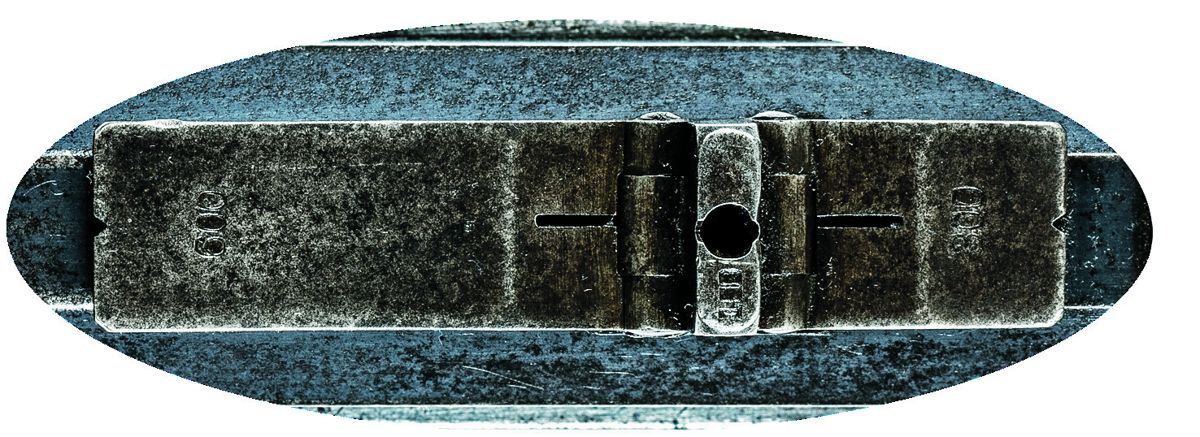
Insets showing the topstrap markings and rear sight detail.
The rifle pictured here is a 31 3/16-inch barreled Colt Model 1855 .56 military revolving rifle with a musket style front sight intended to accept a socket bayonet. Records suggest that only 800 31 3/16-inch barrel guns were produced, although the minimal difference in length between the 31-, 31 3/16-, and 31 5/16-inch barrels may have resulted in these numbers being somewhat inaccurate. The gun shows typical markings for the later production “new model” Colt revolving rifles. The top strap is marked in a single line in the sighting groove, COL. COLT HARTFORD CT. U.S.A. The cylinder is marked in one of the flutes in a single line, PATENTED SEPT. 10th 1850, referring to some earlier Colt design patents. The left side of the frame is marked behind the cylinder COLT’S PATENT in an arc over Nov. 24, 1857, a reference to some of the mechanical improvements implemented in the Root design after its original introduction in 1855. This rifle is serial number 3418. The gun’s number matches throughout with the number stamped on the bottom of the frame, on the bottom of the barrel (under the forend), on the trigger guard tang, on the rear of the cylinder, on the cylinder pin, and on the toe of the buttplate. The number is also written in period ink inside the forend. The serial number puts the gun among a number of documented Civil War-used Colt revolving rifles. These include #3115 issued to Company K, 7th Michigan Cavalry, #3148 and #3508 issued to Company I, 1st Missouri Cavalry, #2892 and #3538 issued to Company M, 9th Illinois Cavalry, #4421 issued to Company C, 21st Ohio Infantry, and #4461 issued to Company G, 4th Michigan Cavalry. Surviving serial number records are quite scarce and only a small number of guns can be traced by their number. This particular gun also has an added German silver plaque on the reverse of the buttstock. The scalloped escutcheon is similar to some used with post-Civil War ladder badges and measures nominally 2 ¼-inches by 1-inch and is engraved in script: J H Morton. It is impossible to know exactly to whom this refers, however a review of the records available through Historical Data Systems offers three possible U.S. soldiers who it could refer to: John Morton of Company G, 7th Kansas Cavalry, John Morton of Company A, 21st Michigan Infantry, and Lt. John H Morton who served on the staff of the 26th Kentucky Infantry. All three soldiers served in regiments known to carry Colt revolving rifles.[For image of another M1855 Colt revolving rifle see page 54]
About the Author Tim Prince is a full-time dealer in fine and collectible military arms from the Colonial Period through WWII. He operates College Hill Arsenal, a web-based antique arms retail site. A long-time collector and researcher, he has been a contributing author to two major book projects about Civil War era arms including The English Connection and a book on southern retailer-marked and Confederate-use shotguns. He is the author of over 60 articles on weapons in Civil War News. Tim is also a featured Arms & Militaria appraiser on the PBS Series Antiques Roadshow and serves as a Senior Consulting Specialist to the Arms & Armor department of Cowan’s Auction.