
Tiffany Presentation Sword
Cowan’s, A Hindman Company · Originally published July-August 2022 · pp. 24–35
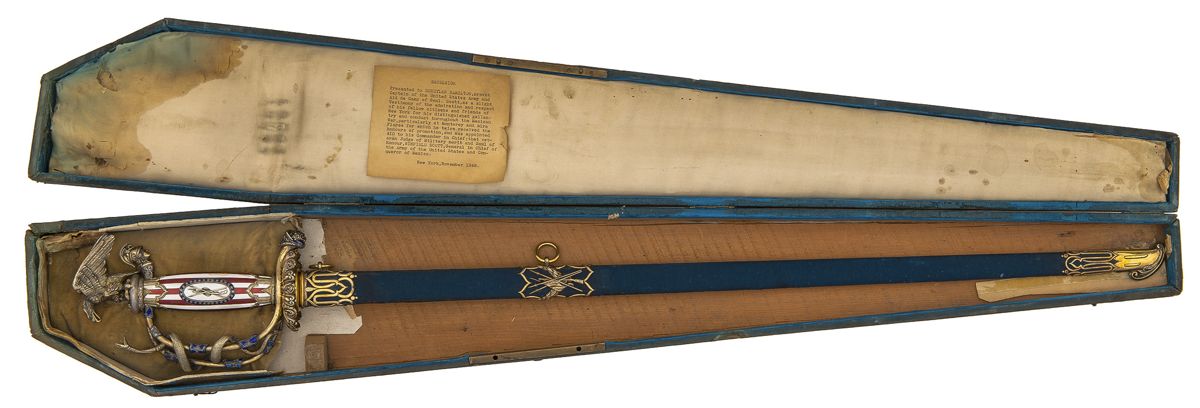
The blade is blued with gilt decorative panoplies of arms, as well as foliate and geometric scrolls with the battle names MONTEREY in the obverse fuller and MIRAFLORES in the reverse fuller. This presentation sword has a 30.25-inch spear point, double-edged blade with 20.5-inch stopped median fuller, and an 8.25-inch hilt, including the massive spread-winged eagle pommel cap.
In November 1848, Captain Hamilton received this singular, if not ostentatious presentation sword, “as a slight Testimony of the admiration and respect of his fellow citizens and friends of New York.” Similarly, the finely etched inscription also contained lavish praise for General Scott, lionizing him as “that veteran Judge of Military merit and Soul of Honour…and Conqueror of Mexico.” After the war Captain Hamilton served as secretary to the Board of Commissioners of the Soldiers’ Home in Washington, D.C. during 1852–1854, while retaining his assignment as aidede-camp to the “Conqueror of Mexico” until September 1, 1854. Hamilton found time to author a book titled History of the American Flag (1854). Captain Hamilton resigned from the army on March 31, 1855, while posted to San Francisco, and, rather surprisingly in light of his health, took up the position as administrator of the new Almaden Quicksilver Mine. Like many who preceded him, the lure of a quick fortune in faraway California eluded Hamilton. At some point during 1858, he purchased land in Branford, Conn., and took up the pastoral life of a gentleman-farmer, a decision perhaps influenced by a lifetime of poor heath compounded by the lingering effect of two wounds. When the Civil War broke out, Hamilton volunteered for service as a private in the 7th Regiment New York National Guard, a socially prominent militia unit that double-timed to Washington, D.C., in defense of the Capitol. He served only long enough to rejoin General Scott in Washington with the rank of lieutenant colonel of staff and the lofty appointment as Military Secretary to the General-in-Chief, from May 9, 1861. Hamilton undoubtedly acted as the general’s confidant in this highly sensitive role leading up to Bull Run, conveying the General-in-Chief’s thoughts to the Secretary of War, while being party to Scott’s personal discussions and correspondence with President Lincoln. Lieutenant Colonel Hamilton became an insider among the President’s ‘war council’ and gate-keeper of Scott’s daily schedule; in so doing he undoubtedly was party to
The blade is blued with gilt decorations including panoplies of arms.
The sword is accompanied by its original blue-baize covered wood scabbard with open work brass mounts and drag and the middle mount formed as panoplies of arms.
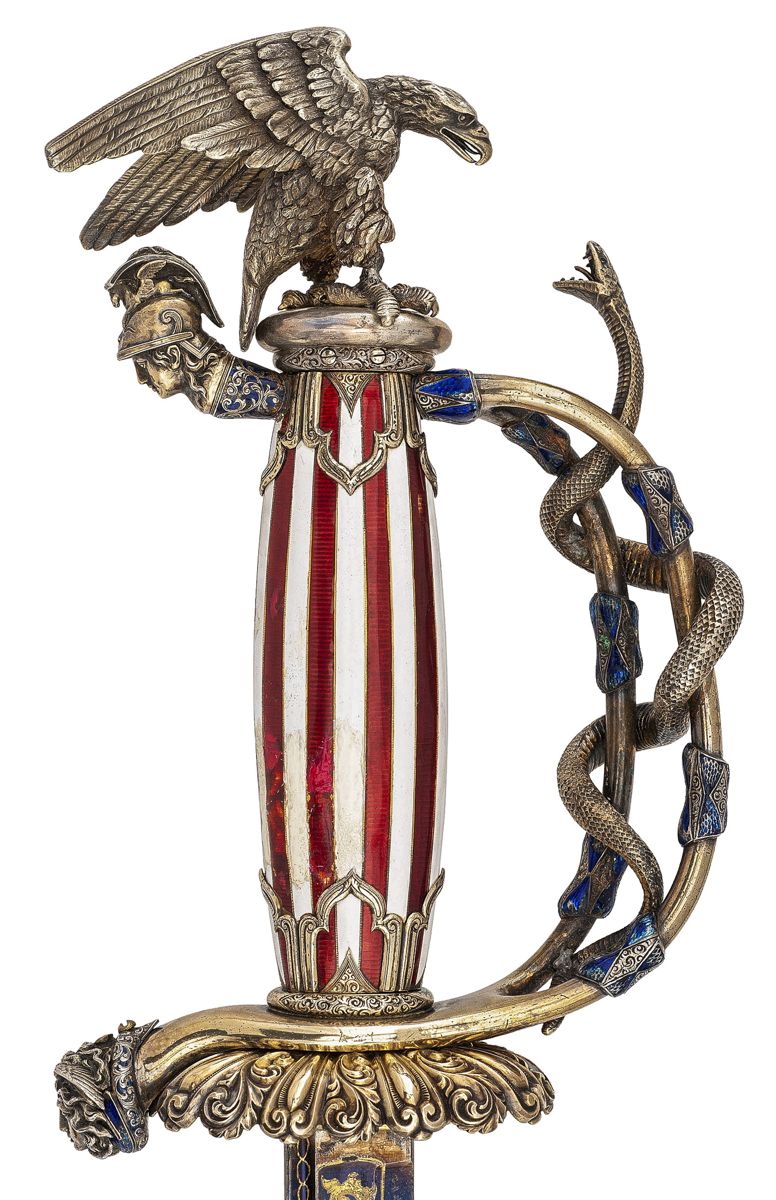
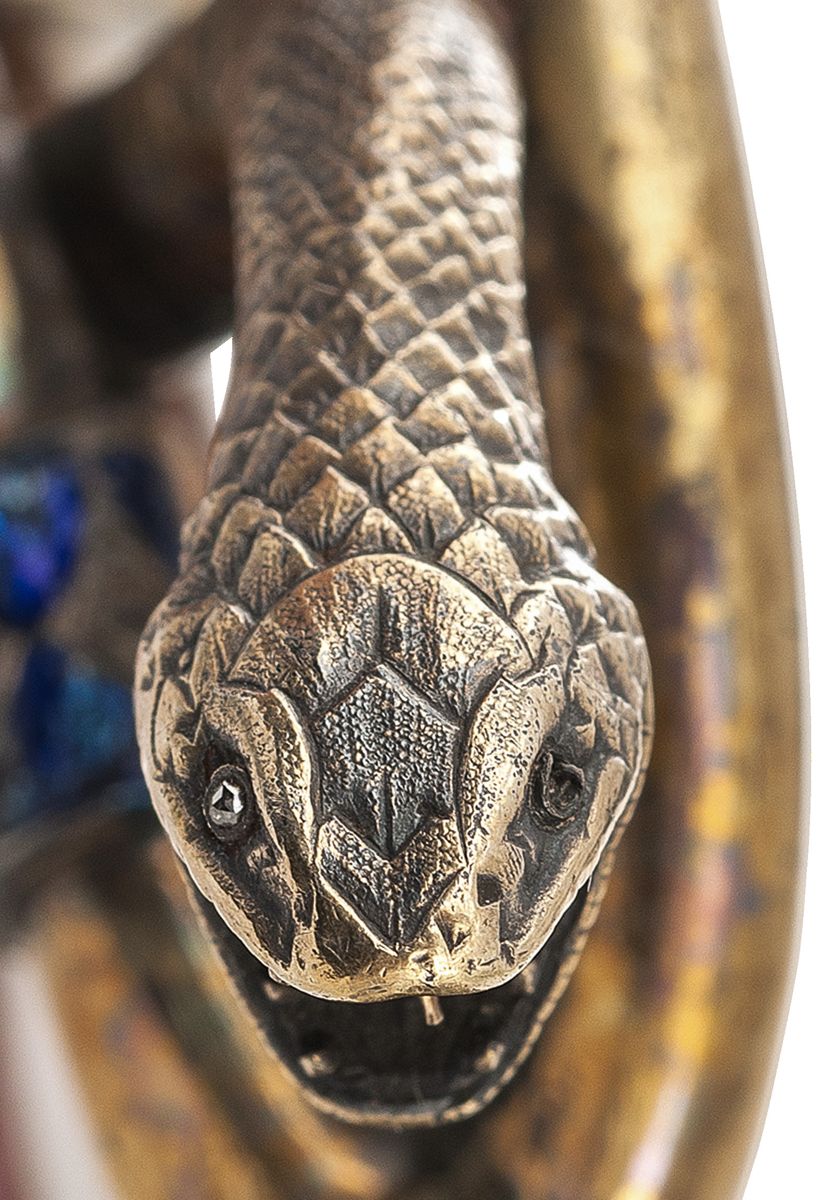
The two-branch knuckle bow is further decorated with a serpent entwined in the guard. Additional blue enamel decorations are present on the guard and knuckle bow. The oval grip is embellished with alternating bands of white and red enamel. The obverse grip features an oval plaque showing stacked arms, surrounded by a blue enamel band with gold gilt stars.
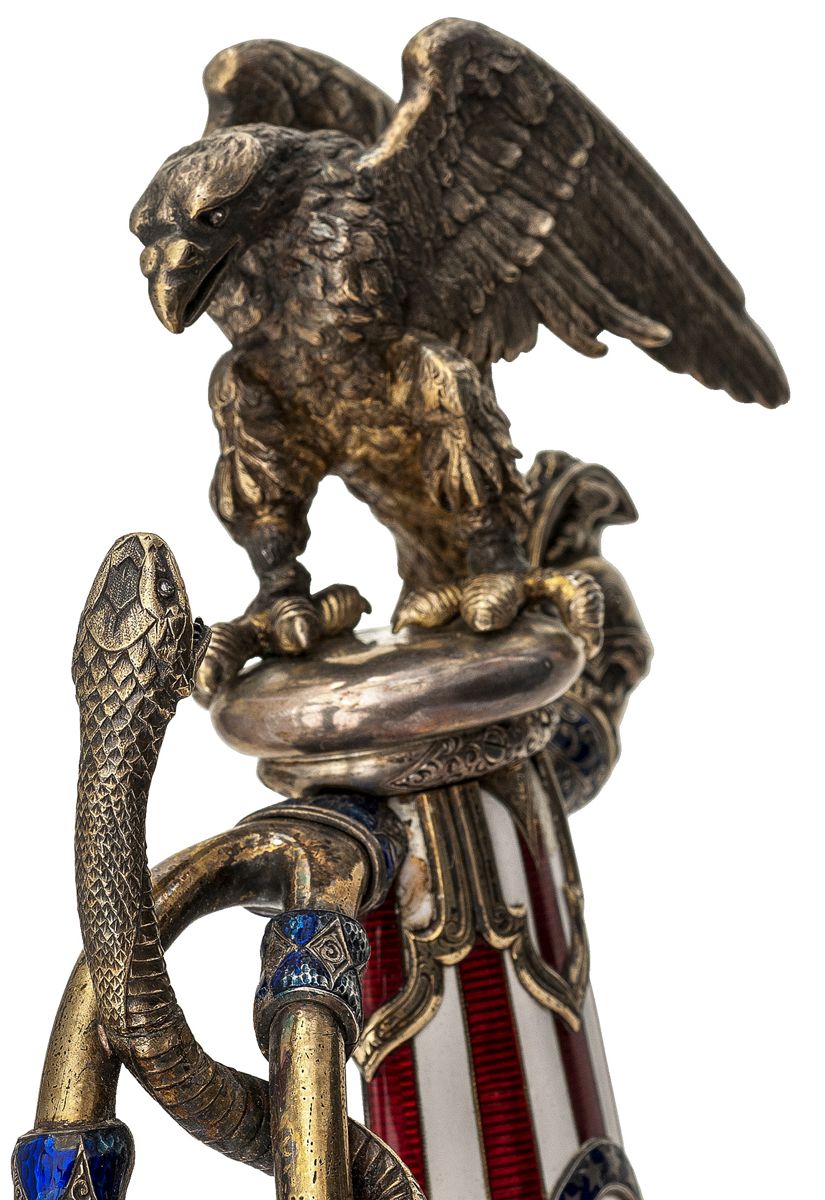
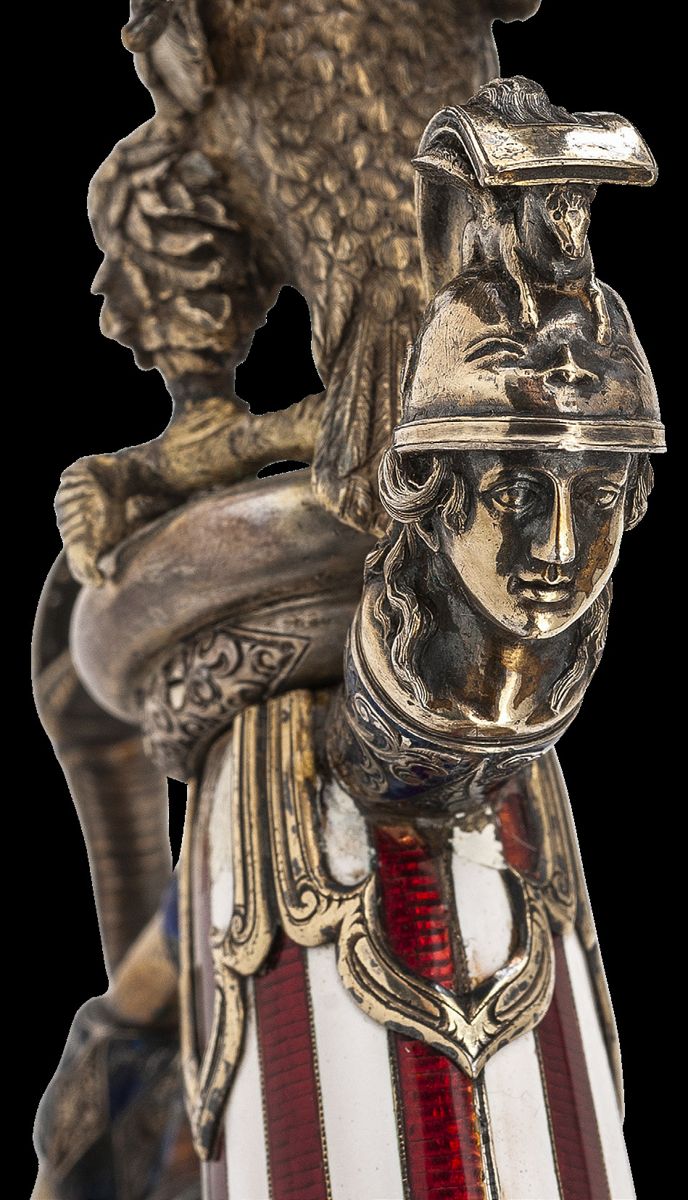
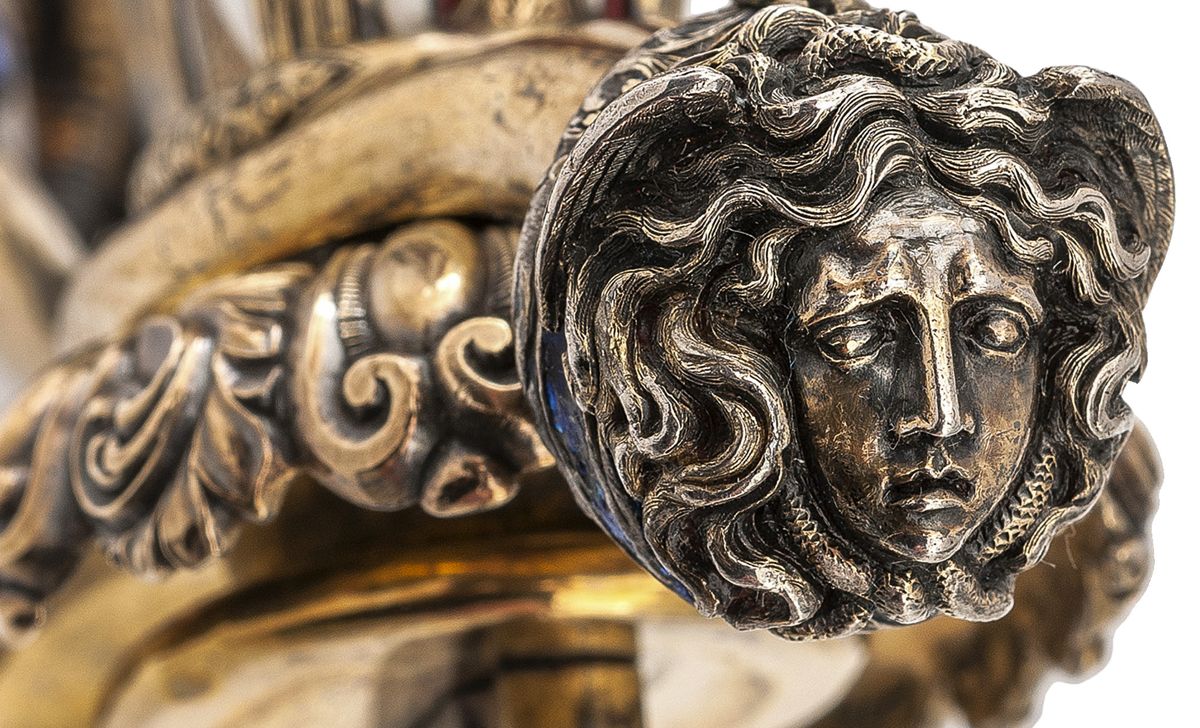
The exquisitely cast silver washed hilt is decorated with martial, classical, and foliate themes, including the face of Medusa on the top of the upper quillon, Mercury wearing his winged helm as the upper quillon at the rear of the hilt, and a large spread-winged American eagle as the pommel cap.
the details of the general’s Anaconda Plan to strangle and cut the South in half through a naval blockade and control of the Mississippi River. Hamilton was promoted to staff colonel with his old title of aide-de-camp to General Scott on August 7, 1861. The cataclysmic events of the Civil War ruined many a military career, and the senior general of the United States Army he had drilled into fighting shape during the War of 1812 with fifty-three years in uniform, was not exempt. “Old Fuss and Feathers,” at 75 years of age, proud and irascible, shouldered the ultimate blame for the disaster at Bull Run and graciously requested retirement on October 31, 1861, following the president’s decision to put McClellan in command of the army. Colonel Hamilton fared well, accepting a commission as brigadier general November 12, 1861. If army nepotism was rampant, then Hamilton capitalized, and soon joined the staff of his brother-in-law Henry Halleck, then commanding the Department of Missouri in St. Louis.
In January 1862, Brigadier General Hamilton took the field in command a division under Maj. Gen. John Pope and successfully engaged in the operations on the upper Mississippi against New Madrid and Island No. 10 that resulted in their capture on April 7, 1862. Hamilton then led the left wing of the Army of the Mississippi during Halleck’s much criticized “sluggish” advance and siege of Corinth during the spring of 1862. Hamilton apparently contracted malaria and was seriously ill during the early May 1862 operations and relied on his staff officers while quietly staying on duty. Hamilton finally requested sick leave on June 12. In July 1862 his surgeon “reported that General Hamilton had been suffering from typhoid fever that resulted in chronic diarrhea,” among other disorders. While on sick leave in New York City throughout the summer and fall, Hamilton received word that he had been appointed major general of volunteers to rank from September 17, 1862, in recognition of his service at Island No. 10. Compelled by the promotion, Hamilton returned to duty and reported to General Rosecrans for assignment at Nashville in November 1862. His health clearly incapacitating him from field service, Rosecrans ordered Hamilton home for medical care on December 14. Treated in New York City during JanuaryFebruary 1863, the attending surgeon later stated that “Hamilton had chronic dysentery, chronic enteritis, and impeded circulation of the liver…” In light of the unfavorable diagnosis, Hamilton, with no chance of being cleared for command, resigned from the army on February 27, 1863. President Lincoln had graciously published in orders a message expressing “much regret.” Hamilton’s nomination as major general was never officially confirmed by the senate. In later years, he “felt that he had been dealt an injustice” and pressed for the rank in regard to his status on the retired list. Hamilton returned to farming in Branford, Connecticut, until 1866, when, in spite of ongoing health issues, he found employment as a Hydrographic Engineer in New York City throughout the 1870’s. Schuyler Hamilton’s longevity, he lived for another 30 years, belies the many documented reports of his chronic poor health. He died on March 18, 1903, after years as an invalid, at his residence in New York City. Hamilton was buried with little public acclamation in Greenwood Cemetery, Brooklyn.
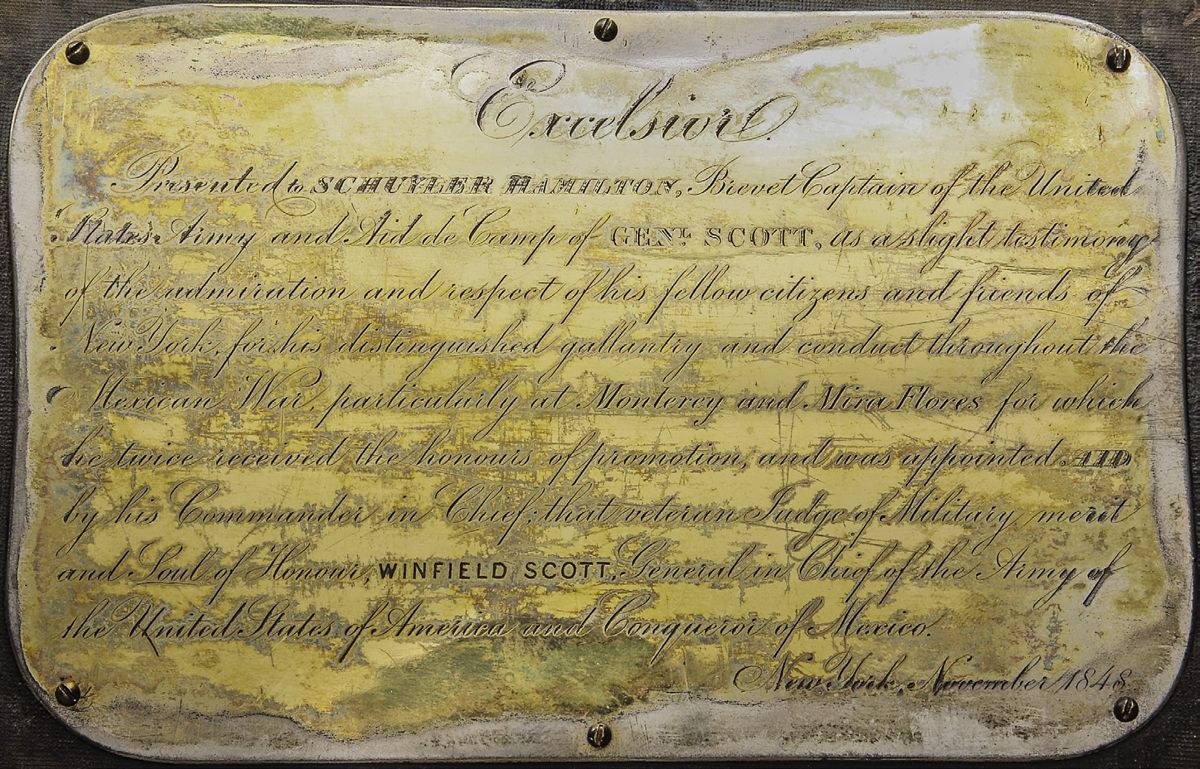
Hamilton’s sword is contained in its original semi-coffin-shaped wood case with a silver washed presentation plaque on the lid that reads: “Excelsior Presented to Schuyler Hamilton, Brevet Captain of the United States Army and Aid de Camp of GENL. SCOTT, as a slight Testimony of the admiration and respect of his fellow citizens and friends of New York for his distinguished gallantry and conduct throughout the Mexican War, particularly at Monterey and Mira Flores for which he twice received the honours of promotion, and was appointed AID to his Commander in Chief; that veteran Judge of Military merit and Soul of Honour, WINFIELD SCOTT, General in Chief of the Army of the United States and Conqueror of Mexico. New York, November 1848.” The wood case has a blue fabric covering and a satin and velvet lining.
IMAGES CAPTURED IN TIME
WILLIAM THOMAS BIEDLER (1845–1897)
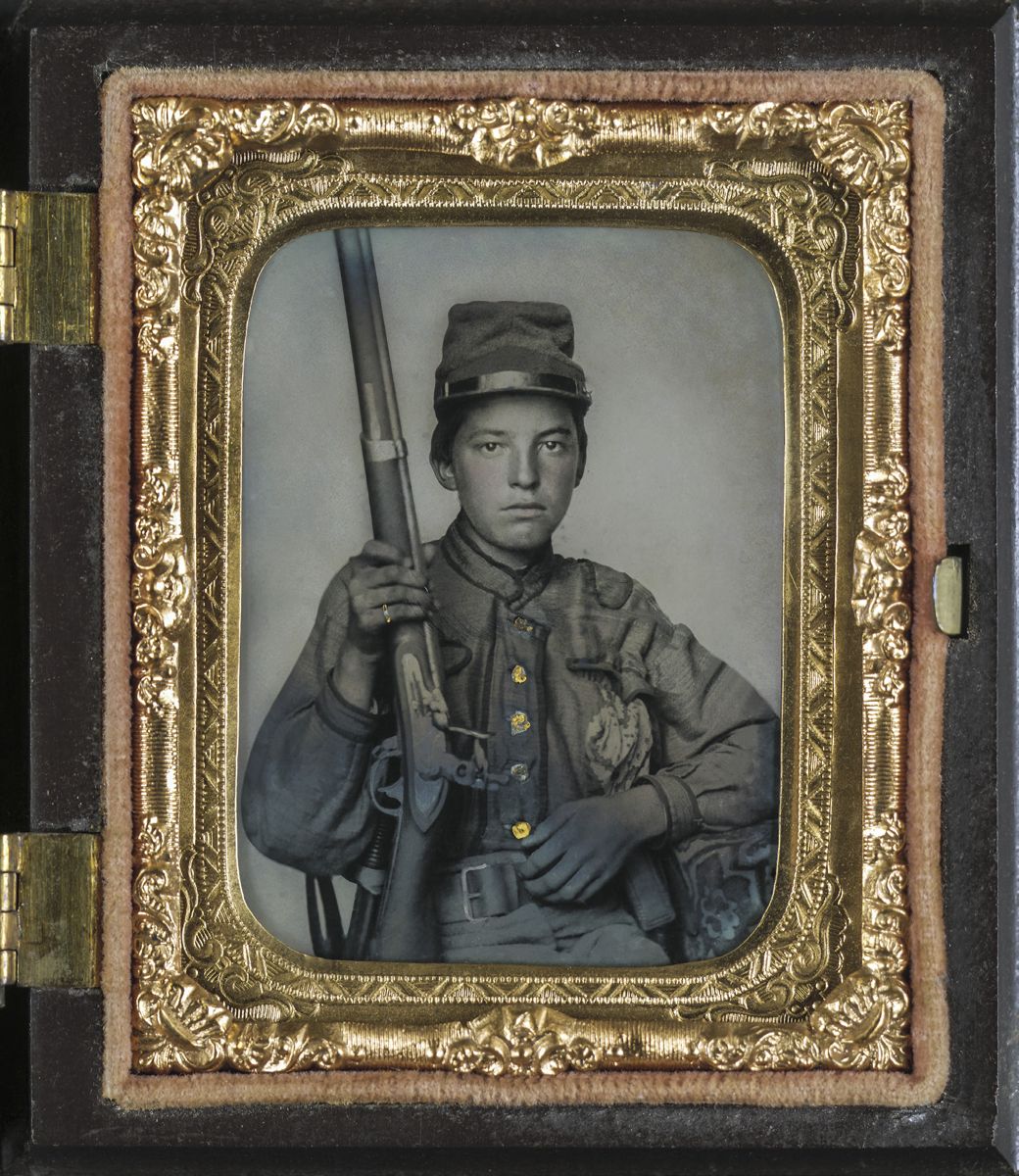
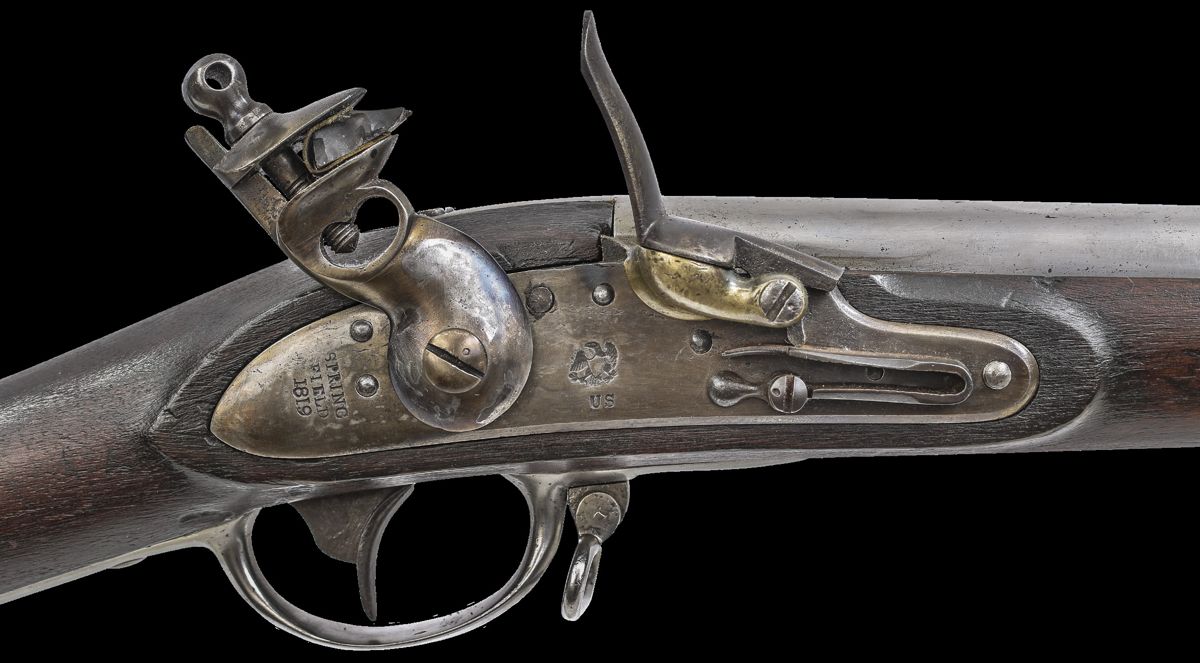
A wonderful photograph of teenager wearing a non-regulation uniform or ‘battle shirt” posed with flintlock musket most likely an early production U.S. Model 1816, as indicated by the rounded reinforced cock and the lower sling swivel attached to a lug forward of the triggerguard. According to the note found with image, William is 16 years old and that would make this image to have been taken between November 1861 and October 1862 prior to association with Mosby. “Mosby’s Rangers” or partisan Rangers were not formed until early 1863. “Mosby’s Men” were irregular troops fighting unlike the regular Army. The method of operation involved executing small raids with usually between 20 and 100 men behind Union lines undetected, quickly executing their mission, and then rapidly withdrawing, dispersing the troops among local Southern sympathizers, and melting into the countryside, rarely with casualties. Mosby’s men went on missions wearing “the gray” but few partisans had regulation uniforms. The partisans were only partially controlled by the Army and when not on raids were civilians. Indeed, some partisans were hung as guerrillas for not wearing uniforms and wearing civilian garb. The Union viewed them as unsoldierly: “a loose band of roving thieves.” Mosby liked youth in his men. He agreed with Napoleon that boys make the best soldiers “… mere boys, unmarried and hence without fear or anxiety for wives or children.” Young William no doubt was proud of his connection to Mosby’s men, over 1,300 men are listed on Mosby’s roles, mostly very late war in 1865, with virtually no service records on any. William is listed as a sergeant in 1865 at the age of 19.
IMAGES CAPTURED IN TIME
U.S. MODEL 1816
In 1812 the U.S. military began the process of improving and upgrading the design of the “Charleville Pattern” muskets then in use by the army, which were being produced at Springfield, Harpers Ferry, and by various contractors. The project would take some three years, involve the production of several model and sample guns, and would involve ideas gleaned from Eli Whitney’s state contract arms from the first decade of the 1800s as well as innovations from all levels of the U.S. government, from the director of procurements (predecessor to the chief of the ordnance department) to input from arms inspectors and workmen at the national armories. The resulting standard Model of 1815 would be the first truly “American” designed military musket to be put into widespread production. As the name of the pattern implied, one of the primary motivations in the adoption of the new design was to standardize production. Up until this point, the arms of “Charleville Pattern” (U.S. M1795 muskets) manufactured at Springfield and Harpers Ferry were different enough that for a very long-time collectors thought they were two different patterns. No level of standardization existed in the arms delivered by contractors either, as in the era of non-interchangeable parts, the contract arms were produced by copying a pattern arm supplied by one of the armories, and thus the contractors working from a Harpers Ferry pattern musket produced a gun different from those working from a Springfield pattern! The goal of the Standard Model of 1815 was to rectify this, improve upon known deficiencies in the “Charleville Pattern” arms, and to take the first baby steps towards interchangeability of parts. The pattern went into production in 1815 and like most U.S. arms of the era, immediately went through a few small changes (noted as Type I-Type IV) by collectors, over the next three years, with the “Standard Model” being produced from 1815 through 1818. These are the muskets that have long been misidentified as the Model of 1812, based primarily upon the fact that the design process that resulted in these muskets had started in that year. The evolution of the Standard Model of 1815 soon resulted in the identification of areas of design that should be addressed and improved. Most notably the stock design, which had been radically altered from the “Charleville Pattern” by making it more robust and adopting a lower comb and thicker wrist, was further altered by lowering the comb even more and extending the rail of the butt. A multi-year debate about band spring placement and type was finally resolved, and a new, rounded lock plate was adopted. Even though the new stock profile would begin to appear on muskets produced in 1816, the newly adopted Model 1816 would not really go into full production (with all newly made parts, not using older pattern parts on hand) until January of 1818, when it was noted that the guns being produced at Springfield were “All of the new model.” The U.S. Model 1816 Musket would remain in production through about 1840 at the Springfield Arsenal and 1844 at Harpers Ferry and more than 800,000 of the muskets would be produced during that period between the two national armories and the various contractors who provided the arms as well.
By Joel R. Kolander s an unfortunate side effect of time, the War of 1812 is a conflict known to many in name alone. Its dates, battles, ships, and the brave men who fought on both sides have long begun their slow fade into the pages of history books. This is surprising considering the magnitude of the events that transpired in those two and a half years. The White House and Capitol building were burned to the ground, our National Anthem was penned, USS Chesapeake’s Captain Oliver Hazard Perry defended our country from enemy vessels in the Great Lakes, and the phrase “Don’t give up the ship,” was first uttered. It was a war filled with acts of incredible valor, fierce battles, future presidents and generals on the battlefield, and epic naval slugfests as the young United States yet again confronted one of the most powerful nations on earth.
A One such battle in that conflict was the Battle of Fort Stephenson, Ohio. Far from the largest battle of the war; there were only approximately 1,500 total combatants, but it did mark a substantial change in momentum and perfectly symbolized a proud and plucky American force against Britain’s overwhelming odds. Fort Stephenson was barely more than a trading post fortified by log palisades and a large ditch, and unfortunately surrounded by high ground. It was located where modern-day Fremont, Ohio, sits about 20 miles up the Sandusky River from the southwest corner of Lake Erie. This small fort was all that stood between an inland American supply depot and a British flotilla accompanied by a band of American Indian warriors (~2,000) led by Shawnee warrior chief Tecumseh.
The sides were far from evenly matched. Some 500 British Regulars and 700-800 American Indians1 led by General Henry Proctor came backed by several gunboats as well as a 5 ½-inch howitzer. The Americans were commanded by 21-year-old Major George Croghan. Croghan was born near Louisville, Kentucky, November 15, 1791. His father had served as an officer in the American Revolution, and his mother was a sister of George Rogers Clark. After attending the College of William and Mary in Williamsburg, Virginia, Croghan joined the army in 1811. He quickly saw military service, participating in the Battle of Tippecanoe, and the siege of Fort Meigs. Not long after the War of 1812 began, George Croghan became commander of Fort Stephenson. Located on the Sandusky River, the fort was important to Ohio’s defense against the British. The fort consisted of three blockhouses inside a rectangular stockade. Croghan worked hard to increase the fort’s defensive capabilities. General William Henry Harrison believed that the fort was located at a vulnerable position and ordered that Croghan abandon it, but Croghan argued that, if his forces withdrew, American Indians would cut his men off from the rest of the army. Before the two men could resolve their differences, British troops attacked the fort. Croghan’s force was a 160-man garrison and a weathered 6-pounder cannon named “Old Betsy.” Croghan wrote a letter in the days preceding the battle: “The enemy are not far distant—I expect an attack—I will defend this post till the last extremity—I
Courtesy RIAC.
have just sent away the women the children, with the sick of garrison, that I may be able to act without encumbrance—Be satisfied—I shall, I hope do my duty.—The example set me by my revolutionary kindred is before me—let me die rather than prove unworthy of their name.”2 Days later, on August 1, 1813, Fort Stephenson found itself surrounded by British infantry, American Indian warriors, and by British gunboats. The British forces sent a messenger under a flag of truce. British officers Colonel Elliott and Captain Chambers, along with a group of American Indians approached the fort under the flag of truce. “They came with a flag of truce, and Croghan sent out Second-Lieutenant Shipp, as his representative, to meet the flag. “The usual salutations were exchanged, then Colonel Elliott said, ‘ I am instructed to demand the instant surrender of the fort, to spare the effusion of blood, which we cannot do should we be under the necessity of reducing it by our powerful force of regulars, Indians, and artillery.’ “’My commandant and the garrison,’ replied Shipp, ‘are determined to defend the post to the last extremity, and bury themselves in its ruins rather than surrender it to any forcewhatever.’ “‘Look at our immense body of Indians,’ interposed Dixon. ‘They cannot be restrained from massacring the whole garrison, in the event of our undoubted success.’ “‘Our success is certain,’ eagerly added Chambers. “‘It is a great pity,’ said Dixon, in a beseeching tone, ‘that so fine a young man as you and as your commander is represented to be, should fall into the hands of the savages. Sir, for God’s sake surrender, and prevent the dreadful massacre that will be caused by yourresistance! ‘ “‘When the fort shall be taken there will be none to massacre,’ Shipp coolly replied, for it was not long since, at Fort Meigs, he had had dealings with the same foe. ‘It will not be given up while a man shall be able to resist.’”3
increased their rate of fire, but the Americans remained quiet. This standoff continued throughout the day with no change. As firing increased in tempo, it became clear to Major Croghan, that the British were concentrating their fire against the fort’s northwest corner. Croghan ordered bags of sand and sacks of flour be piled up against those walls to help deaden the impact of the cannonballs striking the wood. As the British columns marched against the fort the next day, American soldiers had orders to husband their gunpowder and only fire when the Englishmen were so close that every shot would invariably find its mark. When that moment came, the experienced American infantrymen rained down terror with their .69-caliber muskets on the tightly formed British columns. The assailants sprinted for the ditch, expecting weakened walls from the night’s artillery bombardment, but the palisades had remained largely intact against the British cannon. Without axes to chop through the palisades or ladders to scale them, the British were musket fodder, or would have been were it not for Old Betsy. On the second day of fighting, on August 2, 1813, the British were defeated. “The British artillery played incessantly upon the northwestern angle of the fort, causing a dense smoke, and under cover of that a storming party under Lieutenant-Colonel Short advanced to within fifteen or twenty paces of the outworks before they were discovered by the garrison. But they were Kentucky sharpshooters, and every man of them was at his post. Instantly they poured upon the assailants a shower of rifle balls sent with such deadly aim that the British were thrown into confusion. But they quickly rallied. The axemen pushed bravely forward over the glacis, and leaped into the ditch to assail the pickets. Short was at their head, and when a sufficient number were in the ditch behind him, he shouted, ‘Cut away the
Shipp calmly replied that, “When the fort shall be taken, there will be none to massacre. It will not be given up while a man is able to resist.”4 “He [Shipp] was just turning to go back to the fort, when an Indian sprang from a bushy ravine near at hand and tried to snatch his sword from him. The indignant Shipp was about to despatch the Indian, when Dixon interfered.”5 Major Croghan, who had been watching from the fort, shouted, “Shipp, come in, and we’ll blow them all to hell!”6 The Americans ran back to the fort just as the British opened fire from their gun-boats. During the night the British moved three of their 6-pounder cannon to positions in the woods situated about 250 yards northwest of the fort and on slightly higher ground than the fort. Towards sunrise, the British
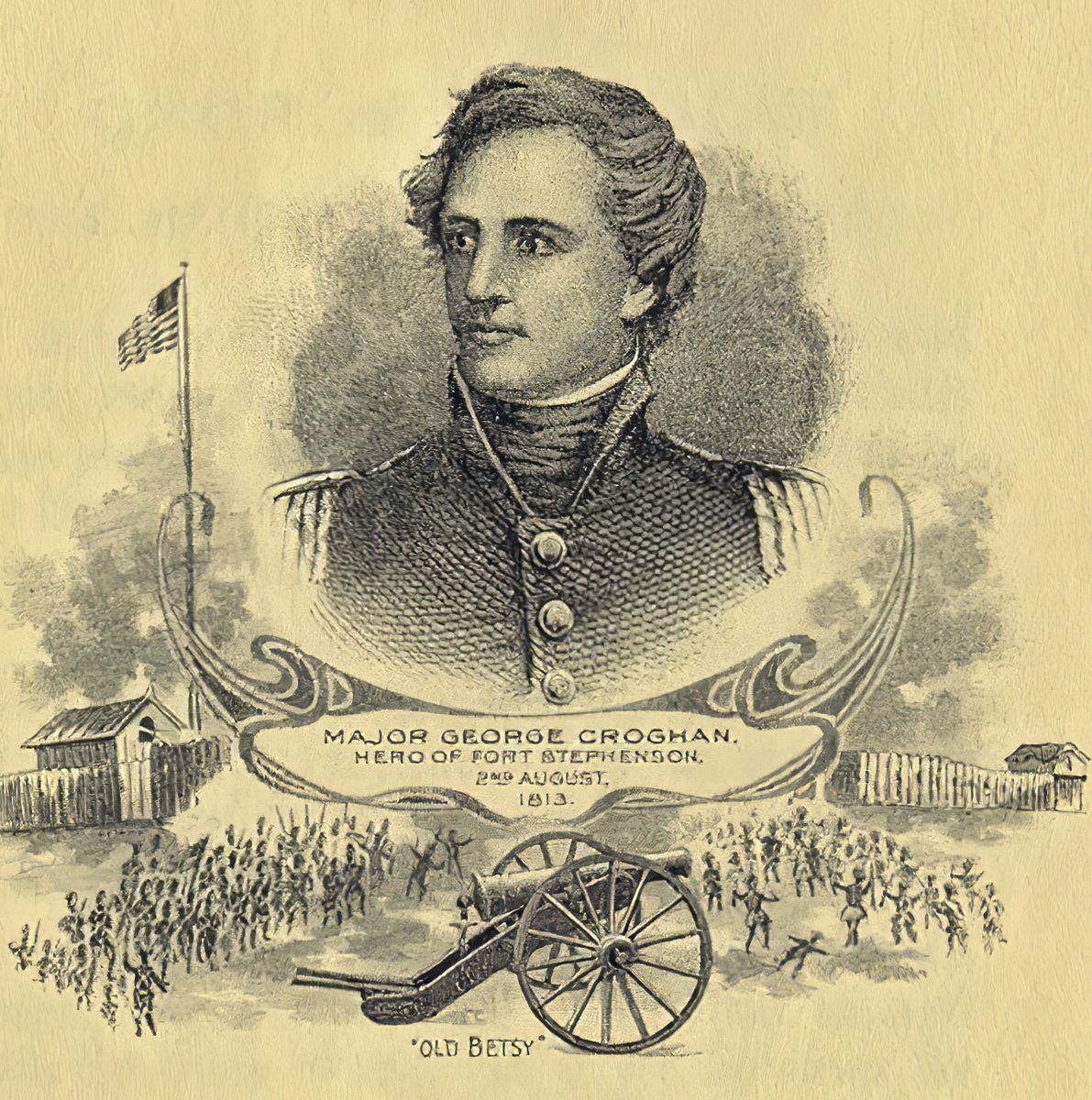
Major George Croghan / Hero of Fort Stephenson. / 2nd August, 1813. The iron 6-pounder “Old Betsy” stands in the foreground.
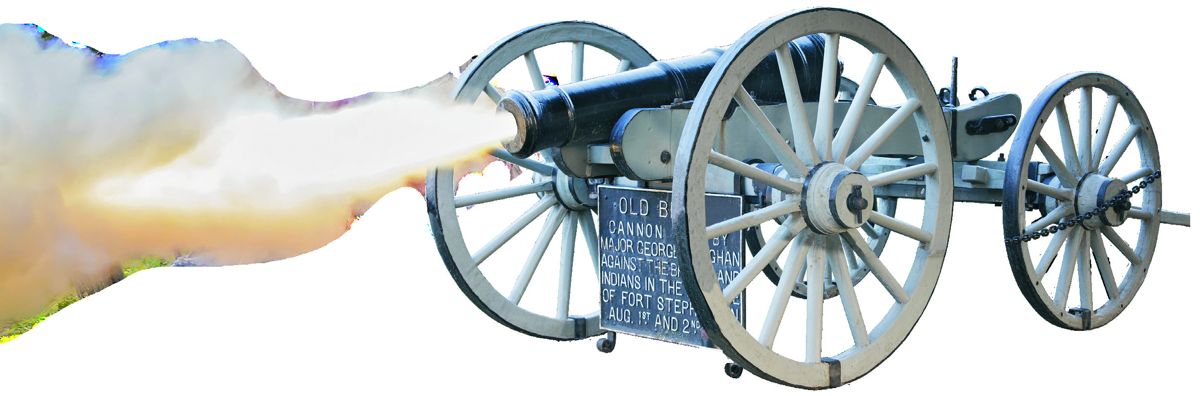
pickets, my brave boys, and show the d—d Yankees no quarter! ‘“ “Now the time had come for the six-pounder to make itself heard. The masked port flew open instantly, and the gun spoke with terrible effect. Slug and grapeshot streamed along that ditch overflowing with human life, and spread awful havoc there. Few of those British soldiers escaped. The second column of the storming party made a similar attempt, but was met by another discharge from the six-pounder and another destructive volley of rifle-balls.”7 When the ditch was filled with Englishmen, a small port hole in a palisade flanking the ditch opened and Old Betsy spoke. Given a half load of powder and a double load of lead slugs, the blast ripped through the massed men at a distance of 30 yards. Subsequent shots tore men to bits until the remaining survivors fled to the cover of distant woods. In the course of half an hour, the battle was won. Croghan wrote to Harrison: “Lower Sandusky, August 3, 1813. Dear sir, the enemy made an attempt to storm us last evening, but was repulsed with the loss of at least 100 killed, wounded, and prisoners. One lieutenant-colonel (lieutenant-colonel Short), a major, and a lieutenant, with about 40 privates, are dead in our ditch. I have lost but one in killed, and but few wounded. Further statements will be made you by the bearer. GEO. CROGHAN, Major, Commanding Fort Sandusky.”8 It was truly a change in momentum for the United States who at that point had little to crow about in the War of 1812. They wasted no time in seizing the opportunity to do so now. Croghan in his own report to Harrison had the following to say of his officers, “Too much praise can not be bestowed upon the officers, the non-commissioned officers, and privates under my command for their gallant and good conduct during the siege.”9 One of those officers was Lieutenant Benjamin Johnson. After the battle this native Kentuckian was promoted to Captain in the 2nd Regiment of Riflemen, and the praise being heaped upon him would not stop with Croghan’s. His popularity would raise him to a Representative in the Kentucky legislature for many years where he was popular with his constituents. Even though Captain Johnson would die in 1830 at just 40 years of age, his valor was not soon forgotten. “General Harrison had advised Croghan that if the enemy appeared in force he should retreat, but Croghan wrote back: “We have determined to maintain this place and, by heavens, we can.’
Fort Stephenson: Gallant Defense Of Fort Stephenson. The History of Our Country: From the Discovery of America to the Present Time, by Edward S. Ellis, Cincinnati: The Jones Brothers Publishing Company, 1910.
“A resolution presenting a gold medal to George Croghan, and a sword to each of the officers under his command, for their gallantry and good conduct, in the defense of Fort Stephenson, in eighteen hundred thirteen. Resolved, &c. That the President of the United States be requested to cause a gold medal to be struck, with suitable emblems and devices, and presented to Colonel Croghan, in testimony of the high sense entertained by Congress of his gallantry and good conduct in the defense of Fort Stephenson, and that he present a sword to each of the following officers engaged in that affair: to Captain James Hunter, to the eldest male representative of Lieutenant Benjamin Johnson, and to Lieutenants Cyrus A. Baylor, John Meek, Ensign Joseph Duncan, and the nearest male representative of Ensign Edmund Shipp, deceased. [Approved, February 13, 1835.]”10
Old Betsy is a iron 6-pounder cannon alleged to have served earlier in the French-Indian War. She currently resides at the Soldier’s Monument in Fort Stephenson Park in Fremont, Ohio. Courtesy Birchard Public Library.