
The Hay Pattern “medium” Enfield
By Tim Prince · Originally published July-August 2022 · pp. 15–23
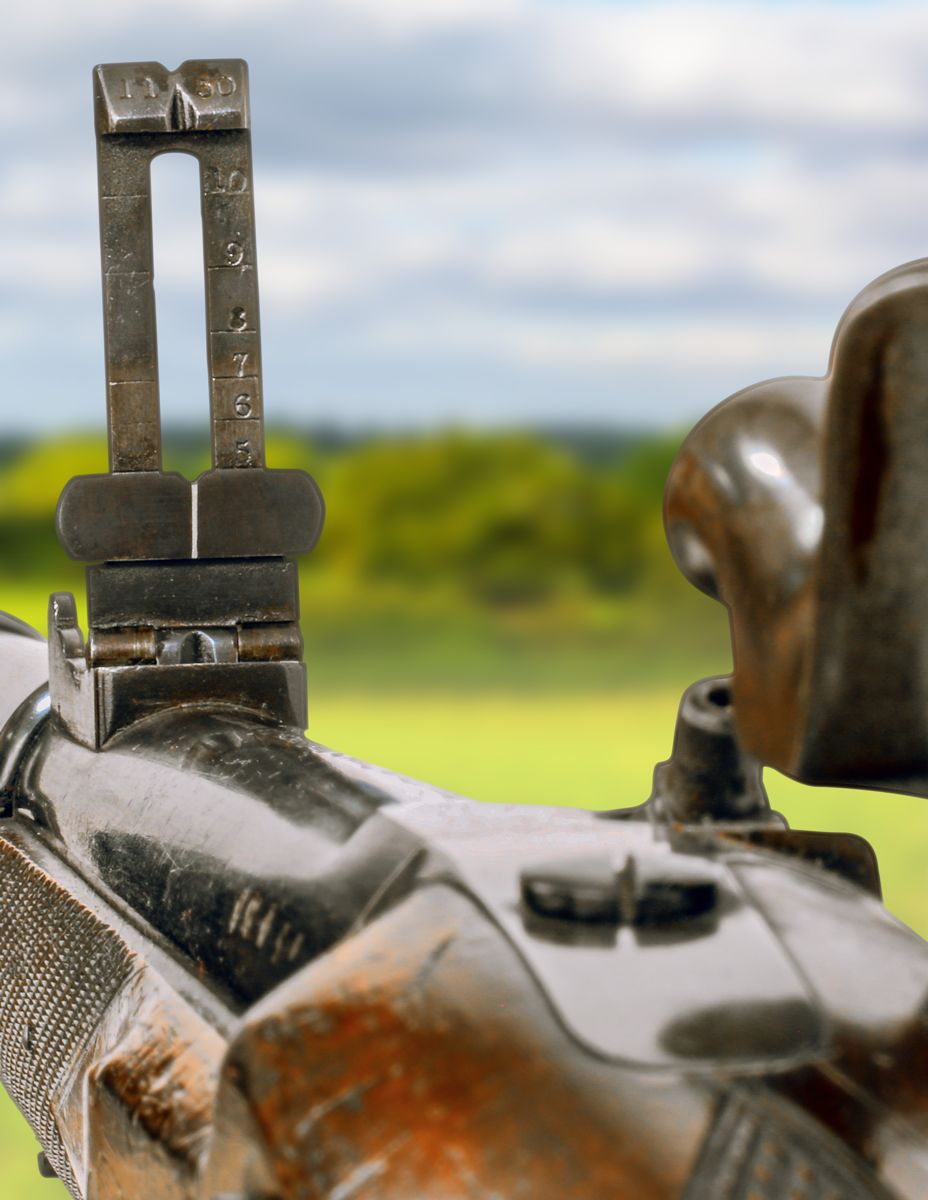
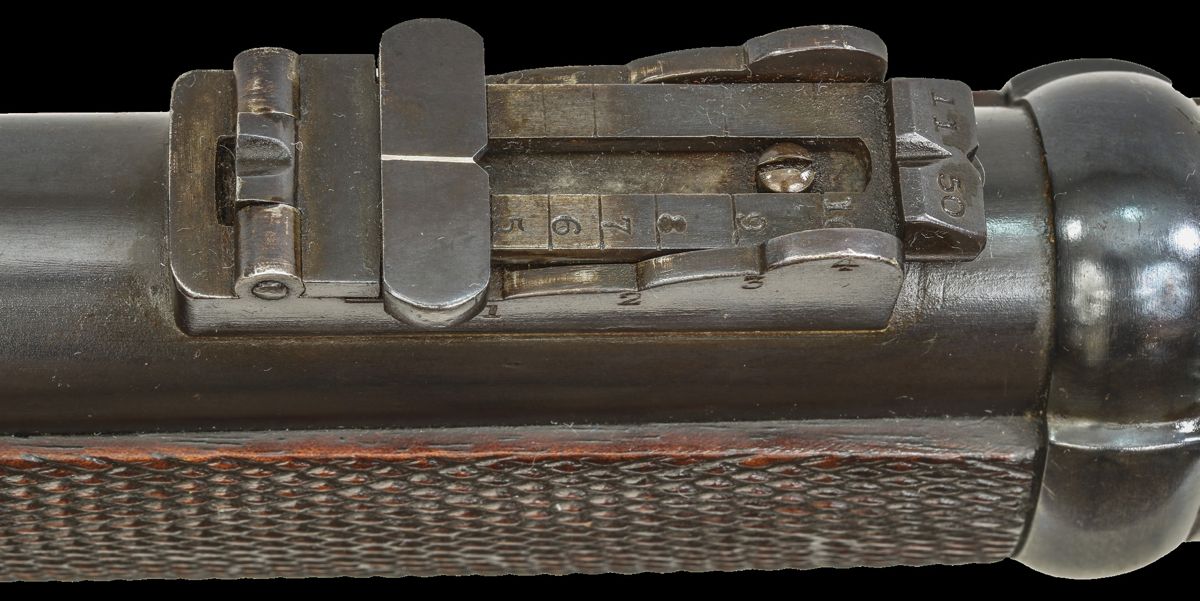
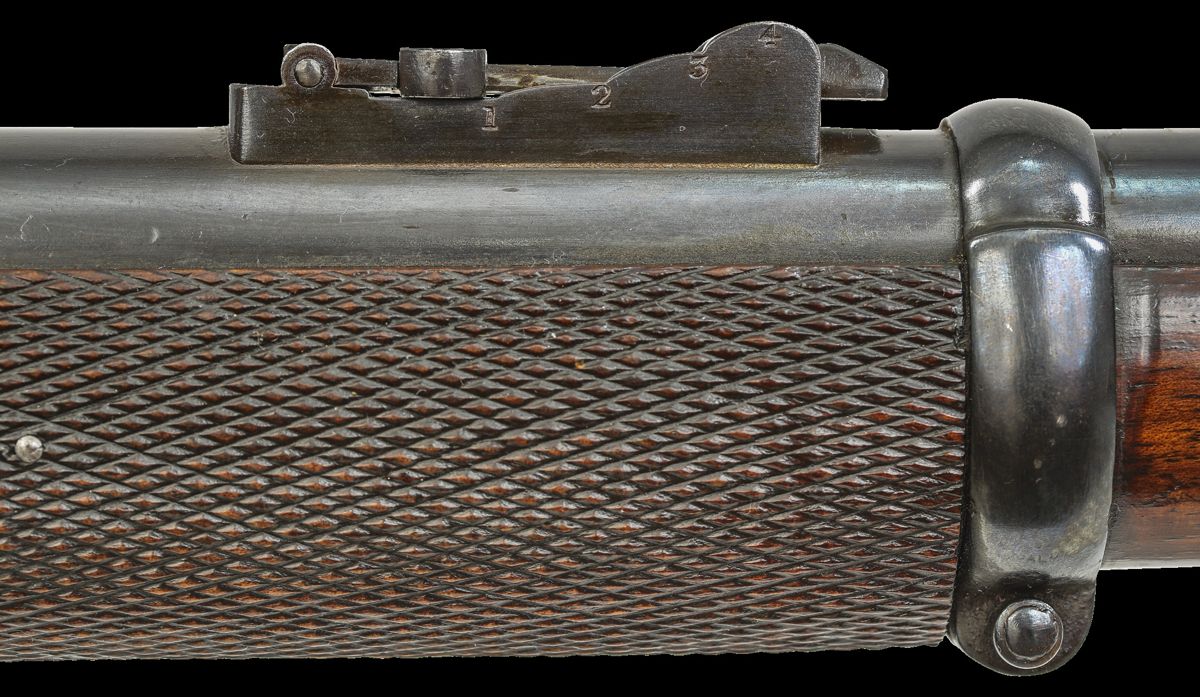
Rear sight and its graduations shown mounted on Hay pattern “Medium Enfield.”
Overall obverse view of the Hay pattern “Medium Enfield.” All photographs by Tim Prince.
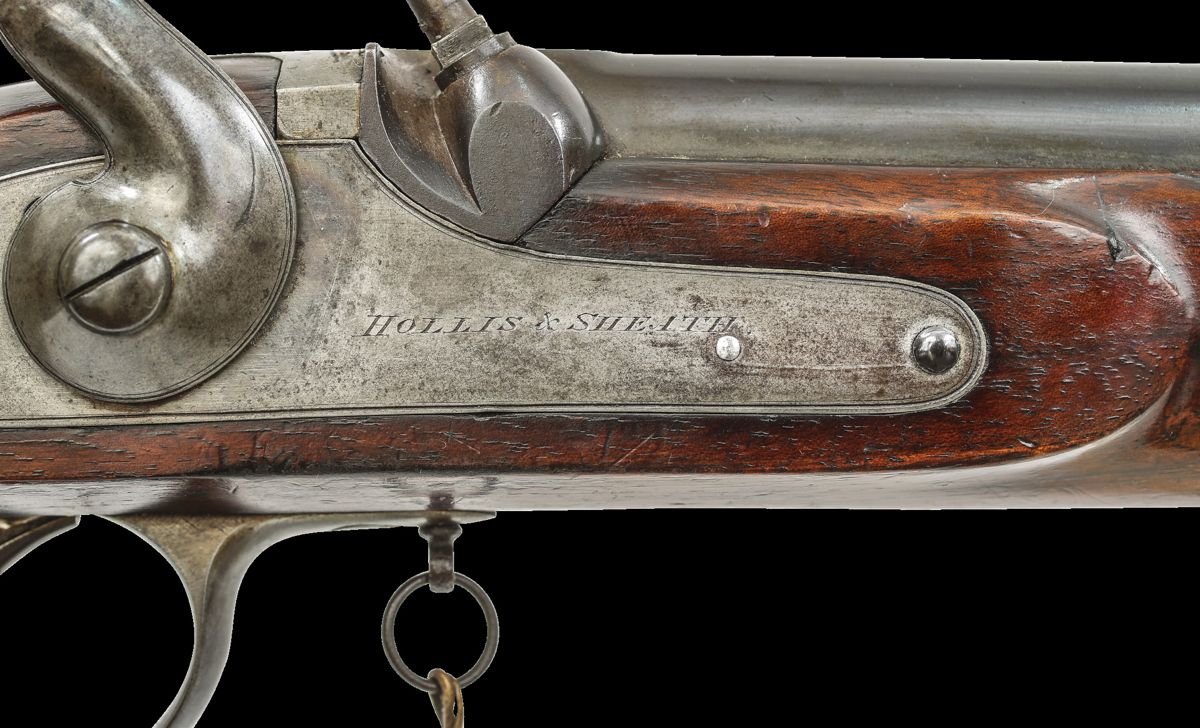
Close up of the lock and Hollis & Sheath markings on this Hay pattern “Medium Enfield.”
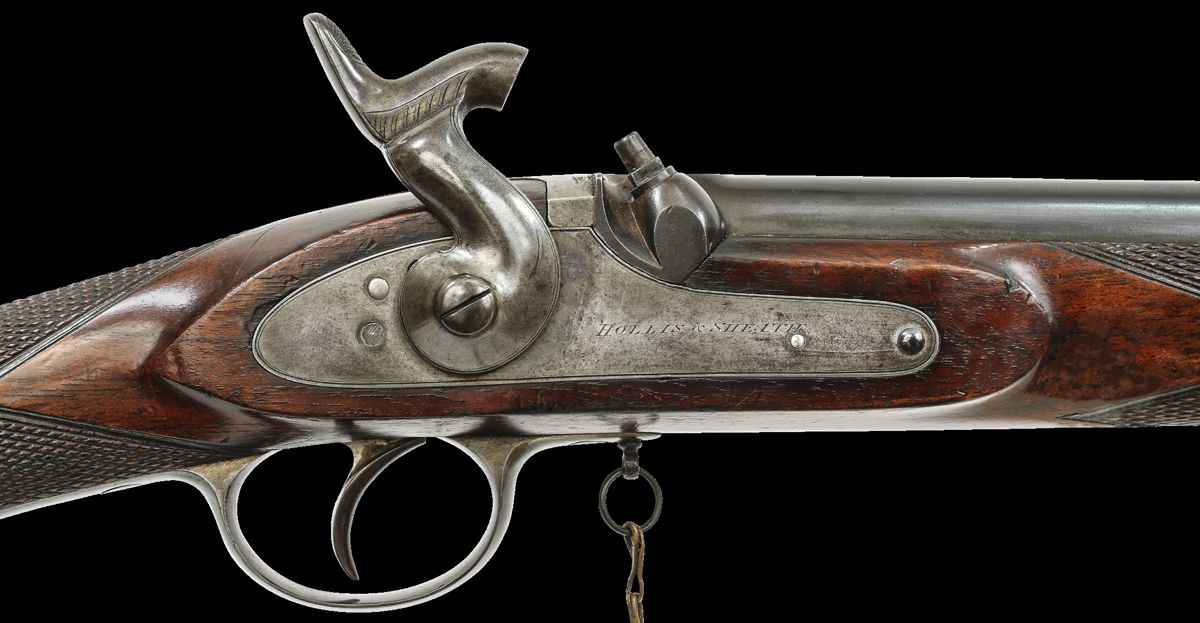
Overall reverse view of the Hay pattern “Medium Enfield.”
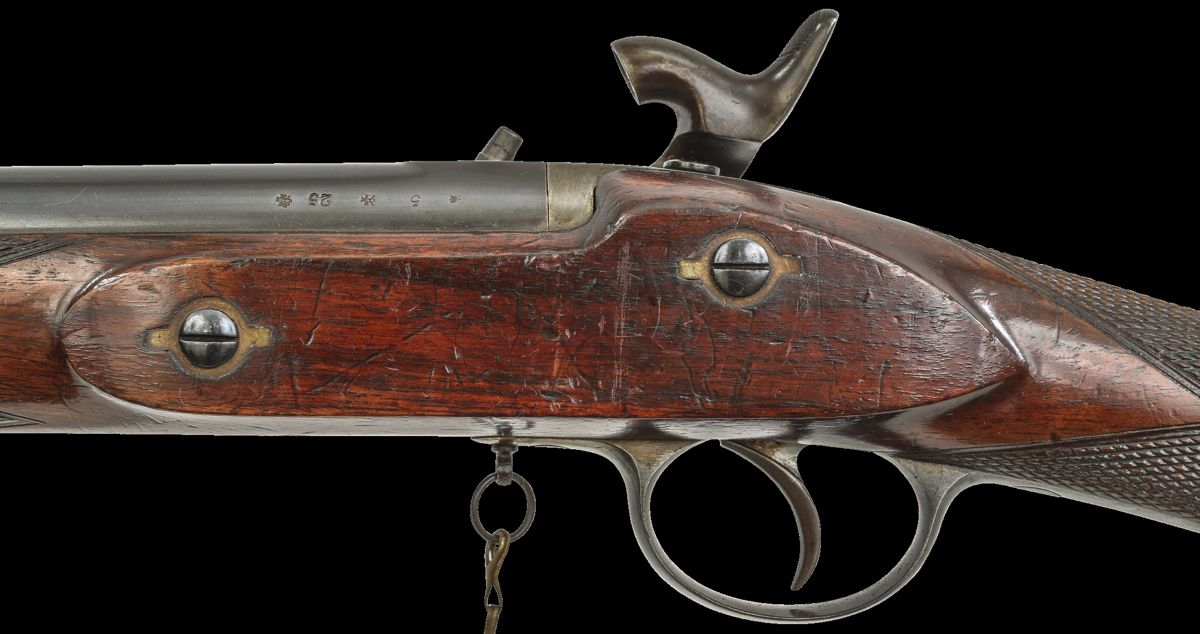
Counterpane of the Hay pattern “Medium Enfield.” Note the hooked breech at the rear of the barrel.
The first commandant of the School of Musketry was then Colonel (later General) Charles Crawford Hay of the Green Howards (19th Regiment of Foot, or 1st Yorkshire North Riding). Colonel Hay was a talented shot himself and certainly interested in the process of improving the shooting capabilities of both the soldier and the firearm that he carried. Period accounts note that one of Hay’s favorite demonstrations was to “snap shoot” a rifle from the hip, firing at a target 100 yards away, and always hitting “within 3 feet of the bull.” With the adoption of the Pattern 1853 Enfield rifle musket in 1853, Hay became intimately involved in the various trials and testing of various features that would eventually be incorporated into the final version of the Pattern 1853 Enfield’s design. Tests performed at the musketry school involved various rifling systems, sight designs, etc. and Hay had a hand in much of it. Hay was also responsible for recommending shortening the stock by an inch, reducing the length of pull from 14 inches to 13 inches. Hay made his recommendations as early as 1855, but it would be 1859 before the changes were accepted, and 1860 before the shorter stock pattern was officially sent to the various contractors producing Pattern 1853 Enfields. The final decision was to adopt the Pattern 1853 Enfield rifle musket with a 39-inch barrel in .577 caliber, and bored with 3-groove progressive depth rifling at a rate of twist of 1 in 72-inch.
While this provided a very serviceable weapon, Hay felt it could be improved. His experimentations revealed that while the slow 1:72-inch twist rate was adequate to stabilize the standard British service projectile in a 39-inch barrel with acceptable accuracy, it provided less stabilization and much lower accuracy in the 33-inch barrel of the Pattern 1856 “Short Rifle.” Accuracy of the 24-inch-long Pattern 1853 artillery carbine and the 20-inch Pattern 1856 cavalry carbine was even worse. Hay’s experimentation revealed that a 1:48-inch twist rate was much more conducive to accurate shooting and provided very good stabilization to the projectile even in the very short 20-inch barrel of the cavalry carbine. He also discovered that there was no difference in the velocities achieved by the standard British service musket load used in a 39-inch barrel or a 36-inch barrel. For centuries the length of a musket barrel had been predicated upon two primary goals: 1) being long enough with the bayonet attached for a foot solider to unhorse a cavalryman, and 2) being long enough to achieve acceptable muzzle velocity with the powder charge in use. Black powder is an inefficient propellant; it had long been a compromise to find the best marriage between charge weight and barrel length. Too short a barrel, and unburned powder was wasted, too long a barrel, and the charge fully combusted long before the projectile left the barrel. Both situations were inefficient. By the mid-19th century, the chemistry of powder manufacture and combustion
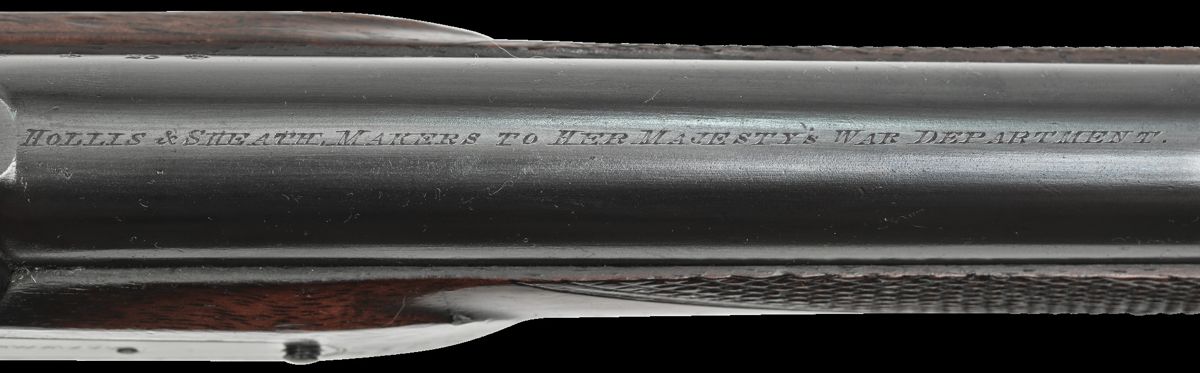
The Hollis & Sheath barrel marking: HOLLIS & SHEATH . MAKER’S TO HER MAJESTY’S WAR DEPARTMENT. on this Hay pattern “Medium Enfield.”
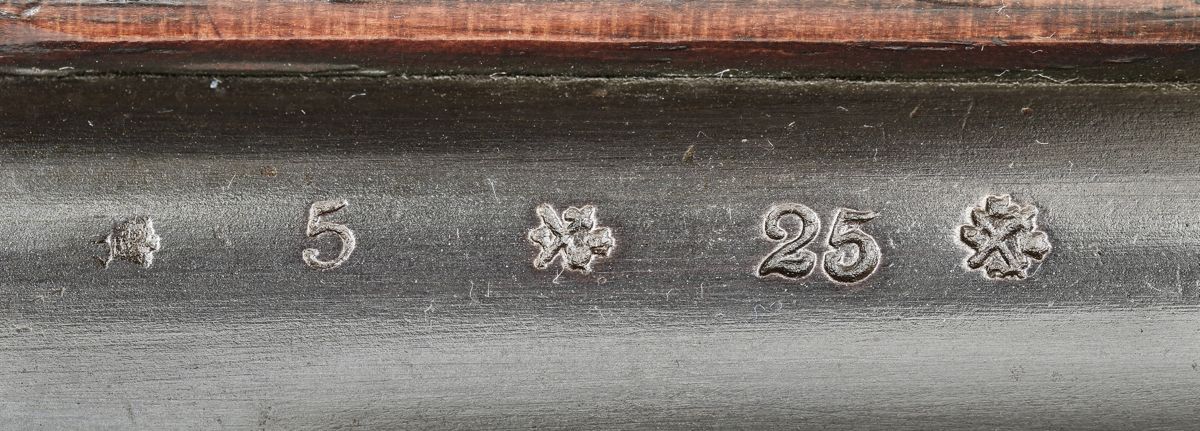
Provisional Proof, View, and Definitive Proof (left to right) marks on this Hay pattern “Medium Enfield.” The 25-gauge stamp indicates .577 caliber; the first gauge mark should read “25.” Rear sight and its graduations on this Hay pattern “Medium Enfield.”
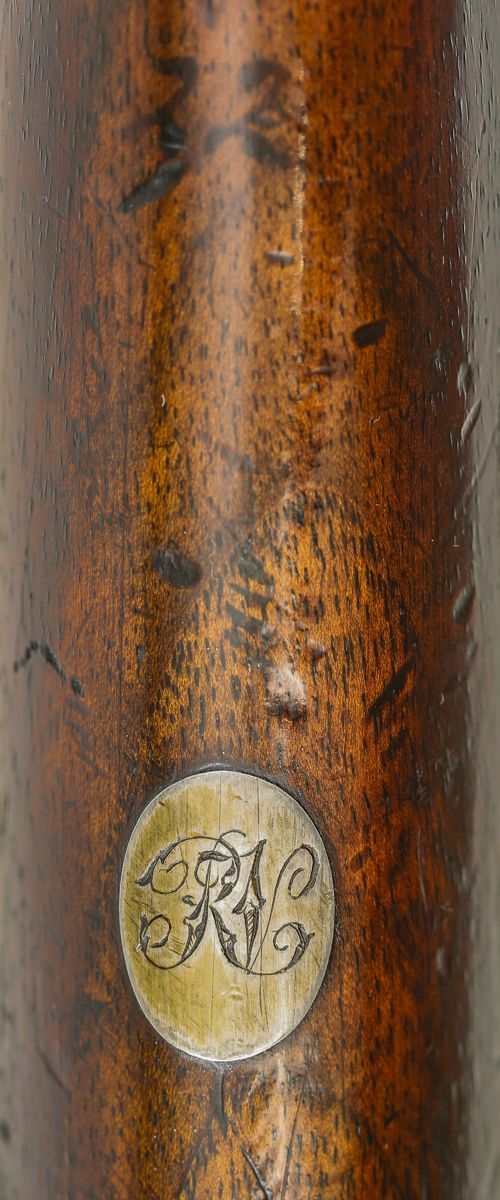
rate had improved enough so a shorter barrel could still effectively burn the powder charge. Hay determined that shortening the barrel by three inches on the rifle musket did not in any way affect velocity or accuracy, but it did reduce the weight of the firearm slightly and made it easier to handle. It is probable that Hay thought that this “medium” length between the 39-inch barreled “Long Enfield” and the 33-inch barreled “Short Enfield” might allow for a single long arm model to serve the needs of troops who then carried two different weapon patterns. Hay’s additional testing revealed that the rear sight of the Pattern 1853 Enfield rifle musket was too close to the eye for good focusing. In fact, this problem had been noted when developing the Pattern 1856 rifle; as a result, the rear sights on the rifles were placed further forward, immediately behind the rear barrel band. Hay further suggested replacing the brass furniture on the Pattern 1853 with sturdier “gun metal” (bronze). The final result of Colonel Hay’s testing and experimentation was the Hay pattern Enfield, known colloquially as the “Medium Enfield.” The gun had a 36inch barrel, secured by three clamping barrel bands, a .577 bore with 1:48-inch progressive depth rifling, and a rear sight graduated to 1,150 yards placed further forward on the barrel. Additionally, the formerly brass furniture consisting of the buttplate, triggerguard, nose cap, and side nail cups were made of “gun metal.” Since the gun was three inches shorter, the lower sling swivel was moved from the front bow of the triggerguard as it was on the “Long Enfield” rifle musket to behind the triggerguard on an extended triggerguard plate, as it was on the “Short Enfield” rifle. Other than the specified change in furniture material, Hay pattern Enfields were finished with the traditional color casehardened locks and hammers with blued barrels, bands, and small work. The jag head Enfield pattern ramrod was left in the bright. Despite the fact that Hay’s design was demonstrably more accurate than the standard Pattern 1853 Enfield Rifle Musket, it was not accepted by the Board of Ordnance as an official pattern and was never taken into service for field trials. Even though Hay was certainly in a position to push the issue, he was, after all, the Inspector General of Musketry from 1854–1867, he appears to have let the issue lie. However, those in the know appreciated the substantial improvements made to the Pattern 1853 design and some commercial makers manufactured Hay pattern Enfields for private sale. The variant was certainly popular with dedicated target shooters in England’s Volunteer movement. During 1865 the colonial government in New Zealand attempted to purchase some 5,000 Long Enfield rifle muskets and bayonets to arm their newly formed Colonial Defense Force, which was combating the local Maori tribesmen. However, they found that the guns were not readily available in England, probably due to American Civil War production contracts. The purchasing agent suggested acquiring the Hay Pattern Enfield from Isaac Hollis & Sons (previously Hollis & Sheath), and the deal was concluded. The New Zealand government was so happy with the purchase that they soon ordered another 5,000 guns, but when Hollis was unable to deliver due to backlogs, Calisher & Terry completed the second contract for Hay pattern Enfields for New Zealand. These two orders for 10,000 Hay pattern Enfields constitute the only known large purchases of the Hay Enfield for any sort of military use. All other production was on a very small scale and limited to individual or possibly small group purchases by members of the British Volunteer movement and target shooters. Even though the Hay pattern Enfield was the most accurate and probably the best conceived variant of the Enfield family of percussion long arms, it was never officially adopted for British military service and saw only very limited production, making it one of the rarest of the Enfield variants for a collector to find today. It should be worth noting that while rumors have swirled for years about possible Civil War use of Hay pattern Enfields, there is absolutely no documentation that I am aware of that in any way suggests purchase of Hay pattern “Medium Enfields” by either the North or South. While it is certainly possible that a few were acquired from local gun shops or makers by speculators during the War’s early days, for example William Grazebrook certainly sold Volunteer pattern short rifles to the Confederacy during 1861, it remains highly unlikely that the most refined variant of the Enfield ever saw Civil War service. The Hay pattern “Medium” Enfield pictured in this article is a particularly fine condition example of a rather rare gun. The rifle is not one of the 10,000 New Zealand contract guns, but rather appears to be a British Volunteer gun, commissioned by an English target shooter circa 1857–1861. The rifle was produced by the manufacturer most associated with the Hay Pattern, Hollis & Sheath of Birmingham. The firm became Isaac Hollis & Son in 1861, and it was from this later incarnation of the company that New Zealand acquired their first 5,000 Hay pattern Enfields. The rifle conforms to the Hay pattern specifications in all ways with the exception of the furniture, which is iron rather than gun metal (bronze). The rifle is engraved on the lock, forward of the hammer HOLLIS & SHEATH and in a single line on top of the breech from the nocksform to the rear sight: HOLLIS & SHEATH . MAKER’S TO HER MAJESTY’S WAR DEPARTMENT. The left of the breech is marked with the usual Birmingham commercial Provisional Proof, View, and Definitive Proof marks as well a pair of gauge (caliber) marks. The first gauge mark reads only “5” instead of the expected “25,” but the second is correctly stamped “25,” indicating .577 caliber. A small German silver oval escutcheon engraved with a set of intertwined script initials that appear to read GHVR is set into the toe of the stock, behind the triggerguard tang.
Close up of the engraved escutcheon in the toe line of the gun.

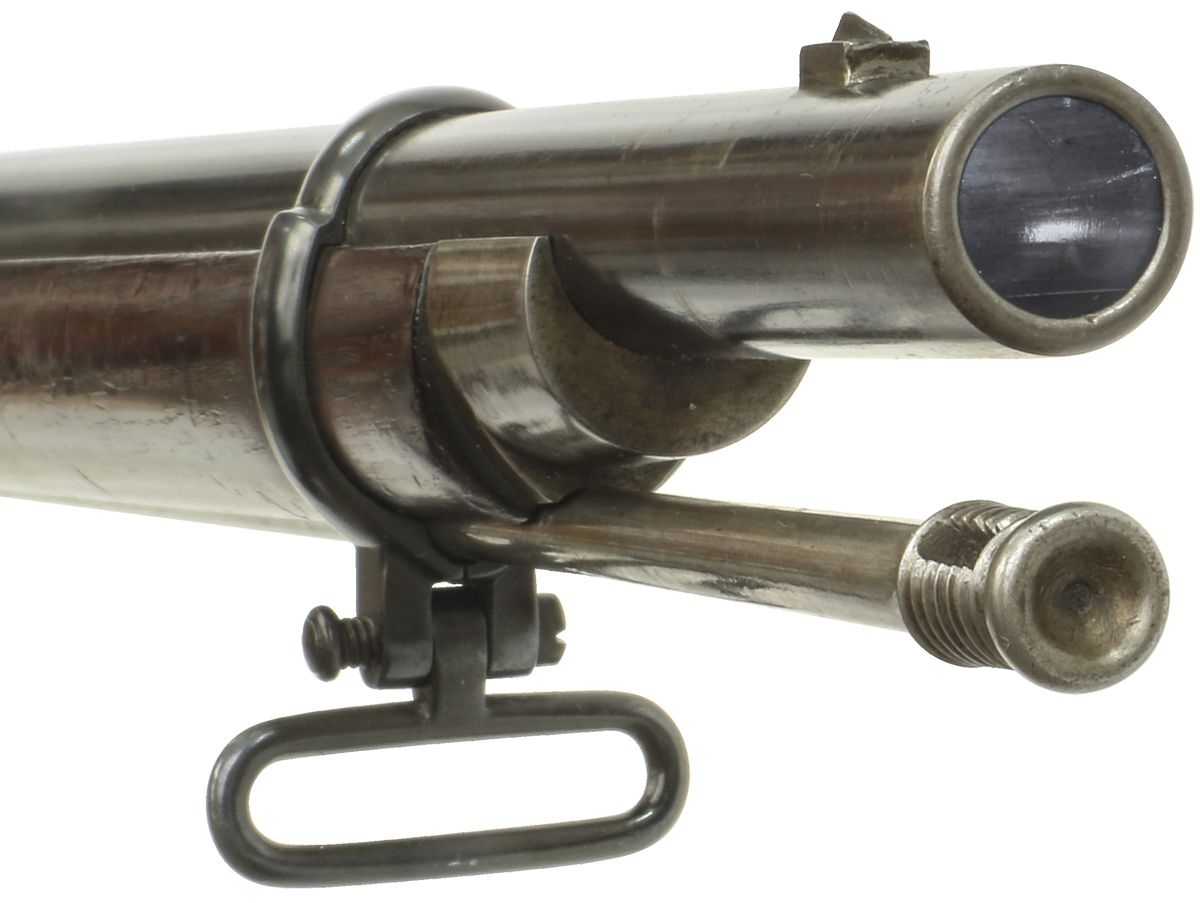
Bore, front sight, iron nose cap, and front band of the Hay pattern “Medium Enfield.”
There are no other external markings, other than the graduations on the base and ladder of the rear sight, which is correctly marked from 100-400 yards on the sidewall of the base and from 500 to 1,150 yards on the ladder. The 36-inch long, round barrel terminates in a hooked breech and is rifled with three grooves with the Hay Pattern 1:48inch rate of twist. As with most Birmingham produced guns of the 19th century, disassembly reveals a number of markings that relate to both the contractors involved in the gun’s manufacture, as well as the various steps involved in its assembly. The bottom of the barrel is marked with the name of the Birmingham barrel maker JOHN CLIVE and also stamped with the initials GHVR followed by the number “1.” The interior of the lock is stamped “H&S” for Hollis & Sheath. The initials are also followed by the number “1” on the mainspring boss stud. This same “1” is also found on the inside of the hammer neck. The interior of the lock mortise is also stamped “H&S” for Hollis & Sheath, followed by the number “1” which is stamped sideways. The barrel channel bears the same initial stamping, along with a “1,” and with the additional number “34” further down the channel. It appears that the rifle was manufactured for a customer with the initials “GHVR,” as they appear both under the barrel and on the escutcheon, and the assembly number for the rifle is “1,” as it appears on most major components. It is most likely that the initials do not refer to a person, but rather a “Volunteer Rifle” regiment whose name has the initials “GH” preceding it. Interestingly, despite the official “military” requirement that the Hay pattern guns be produced with the 1-inch reduction in length of pull, this example retains the original 14-inch length.
About the Author
Tim Prince is a full-time dealer in fine and collectible military arms from the Colonial Period through WWII. He operates College Hill Arsenal, a web-based antique arms retail site. A long-time collector and researcher, he has been a contributing author to two major book projects about Civil War era arms including The English Connection and a book on southern retailer-marked and Confederate-use shotguns. He is the author of over 60 articles on weapons in Civil War News. Tim is also a featured Arms & Militaria appraiser on the PBS Series Antiques Roadshow and serves as a Senior Consulting Specialist to the Arms & Armor department of Cowan’s, a Hindman Company. Tim Prince
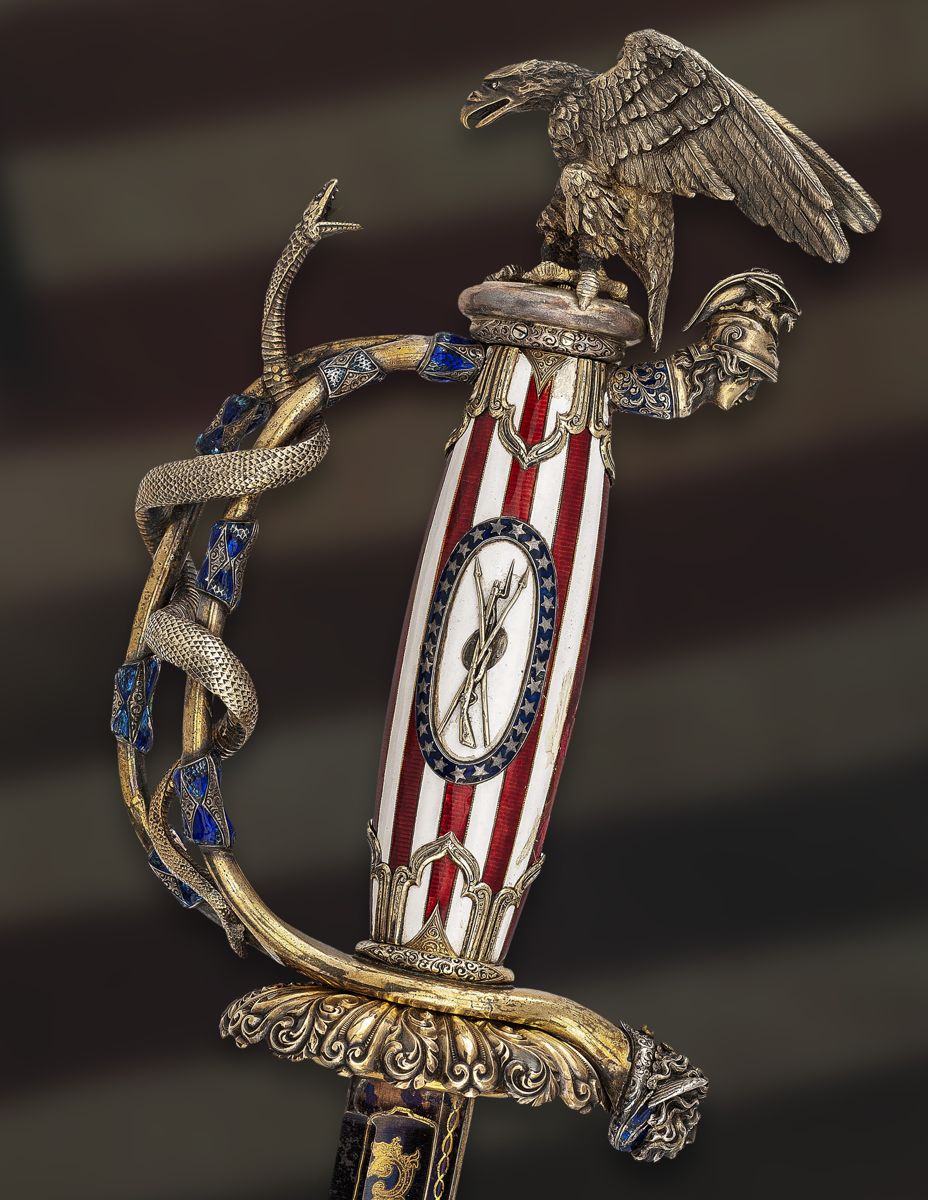
Awarded to Schuyler Hamilton by the Citizens of New York Article and Photographs Courtesy Cowan’s, a Hindman Company chuyler Hamilton (1822–1903), a grandson of Alexander Hamilton, remains a relatively obscure regular officer; wounded twice and twice brevetted for gallantry during the Mexican War, he later served competently for a short time during the Civil War as brigadier general of volunteers.
S Born in New York City on July 25, 1822, Hamilton was just 15 when he entered West Point in 1837, graduated 24th in the Class of 1841, and was duly commissioned as a second lieutenant, 1st Infantry on July 1, 1841. His early service included routine frontier duty at Fort Atkinson, Fort Crawford, and Jefferson Barracks before returning to the Military Academy as assistant instructor of infantry tactics for six months over 1844–1845. An unreported illness then compelled Hamilton to take a leave of absence in 1845–1846 prior to rejoining his regiment on the eve of the Mexican War. The 1st U.S. Infantry, formerly commanded by Zachary Taylor, was assigned to the general’s Army of Occupation in Texas that advanced across the Rio Grande, and then played a prominent role in the Battle of Monterey (Sept. 21-24, 1846), where General Pedro de Ampudia and the Mexican Army of the North were defeated. Lieutenant Hamilton was severely wounded with a skull fracture and a gunshot wound to the abdomen on September 21 during brutal house to house fighting. Two days later Hamilton was brevetted first lieutenant for “gallant and meritorious conduct” at Monterey. Hamilton’s wounds necessitated a lengthy recovery; he did not return to duty as regimental quartermaster for nearly a year during which time he was sidelined by intermittent sick leave. He was fortuitously assigned as an aide-de-camp to General Winfield Scott on April 30, 1847, and served in this capacity for the rest of the war. Within the year Lieutenant Scott would receive another dangerous wound, this time pierced by a Mexican lance in a little-known skirmish on the road to Mexico City known as Mil Flores. On August 13, 1847, Lieutenant Hamilton was accompanying a detachment of dragoons assigned as General Scott’s escort when “they attacked a superior force of Mexican cavalry and routed it.” During the brief fight Hamilton was attacked and the lance “entered between the shoulder blades and came out under the left breast” leaving the lance point fixed in Hamilton’s upper body, after the broken shaft fell away. It is documented that the lance head was “pried out breaking two ribs.” Hamilton was brevetted captain for “gallantry” at Mil Flores on August 13, 1847, and hospitalized. He did not see any further duty before the fall of Mexico City ended hostilities in September 1847.